

AI Bubble
OpenAI, Anthropic, and Their Hyperscaler Partners: Huge Financial Risks and Open-Weight Competition
Hyperscaler AI Revenue Hurdle:
In an analysis released last month, Jared Bernstein estimated that the big-spending hyperscalers need $13-$18 trillion in revenues over the next 10 years to justify their AI-infrastructure investments. This is, by definition, speculative work, requiring judgment calls on technical aspects of the analysis, such as discount rates, depreciation schedules, taxes, and revenue paths. So, we were happy to see that several other analysts and researchers have, independently, been working on the same problem. Callum Williams of the Economist, whose produced his own excellent analysis on the topic, put together a comparison of these different estimates, including theirs.
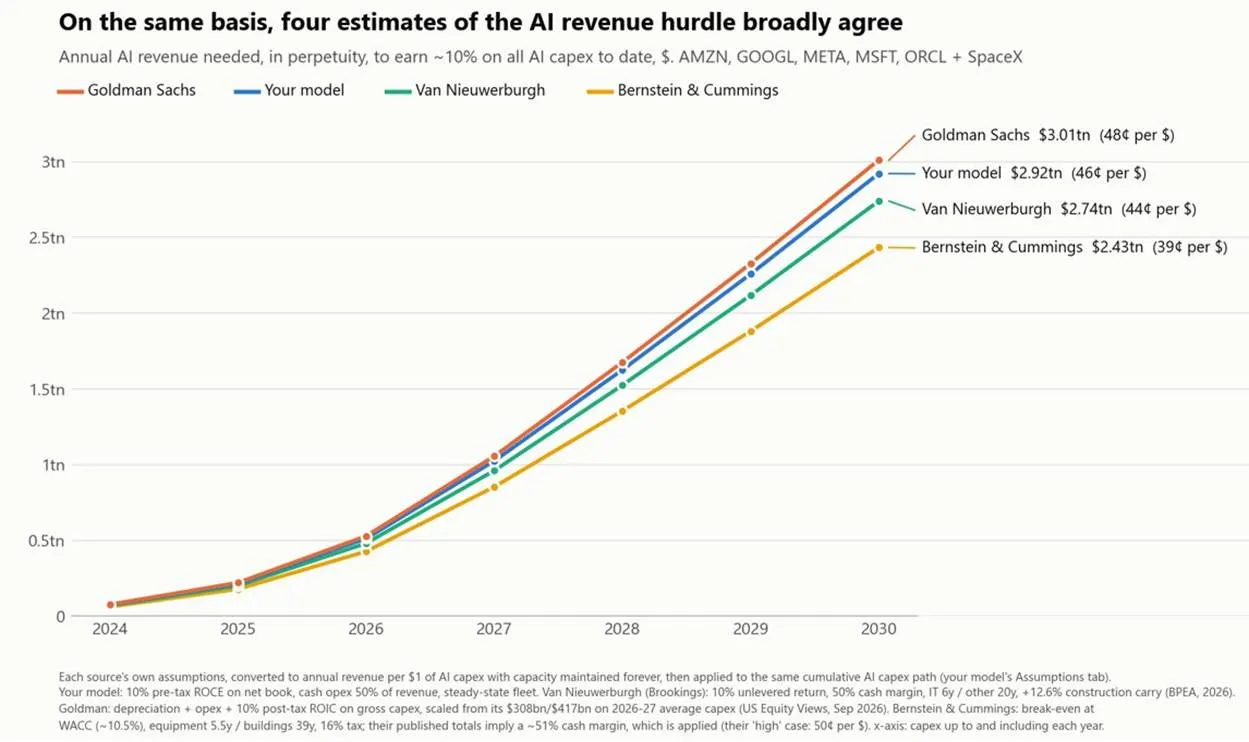
What’s striking is how close each of the estimates are: firms will need between $2.4-3.0 trillion in annual incremental AI revenues by 2030 to justify their big spending; this is about 5-6 times more than they are currently making under the most general possible assumptions. They may clear that hurdle. Ryan Cummings told Axios:
“Can all these people eventually turn this into something profitable? I think they will…I’m not sure who’s going to do that, but I do think there will be trillions of dollars of profits that are up for grabs in the future, but just not in this super-accelerated timeline that is required to justify the investments.”
Hyperscaler Debt & Capex Projections (2026–2027):
- 2026 Debt Issuance: Projected between $220 billion and $250+ billion for major US hyperscalers (Alphabet / Google, Amazon, Meta, Microsoft, and Oracle), with broader AI-related market debt reaching up to $570 billion.
- 2027 Forecast: Goldman Sachs projects direct hyperscaler debt issuance to nearly double to around $400 billion (Jeff Pu estimates $419 billion) as companies finance over a third of their infrastructure needs.
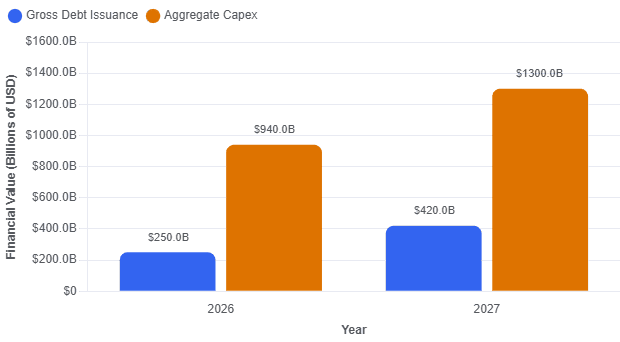
- Aggregate Capex: Combined capital expenditures are expected to hit roughly $940 billion in 2026 and scale past $1.3 trillion in 2027.
- Market Share: Hyperscaler investment-grade bond sales have jumped from roughly 2% of total US supply (2022–2024) to roughly 9% in 2026.
- Credit Impact: Credit spreads on a 10-year hyperscaler credit basket have widened from historical 40–75bp ranges toward 90bp+, driven by leverage concerns.
- Cash Flow Outlook: S&P Global Ratings expects all major hyperscalers to run negative free operating cash flow through 2026 and 2027, with a cash-flow inflection point not projected until 2028–2029.
………………………………………………………………………………………………………………………………………………………………………………………………………..
Hidden Risks for the AI Lab Giants:
Anthropic and OpenAI belong to the group of frontier AI model developers commonly known as “the AI labs.” Their financial performance provides a more direct view of AI business economics than that of the hyperscalers discussed above. Unlike diversified technology companies, whose established businesses can offset AI-related spending and complicate profitability analysis, these firms concentrate their operations on developing and commercializing AI. Their results therefore offer a clearer indication of whether revenue from AI products and services can support the costs of model development, computing infrastructure, and commercialization.
Public disclosures about these privately held companies are consequently valuable. Recent reporting on Anthropic and the Financial Times (FT) [paywall] June 16, 2026 report on OpenAI [1.] provide insight into their revenues, spending, and losses. OpenAI’s reported results also illustrate the importance of distinguishing operating costs from noncash accounting charges when assessing the economics of its underlying business. Substantial losses do not, by themselves, establish that AI is a financial bubble. They do, however, reinforce concerns about whether revenue growth can justify the sector’s spending commitments and valuations.
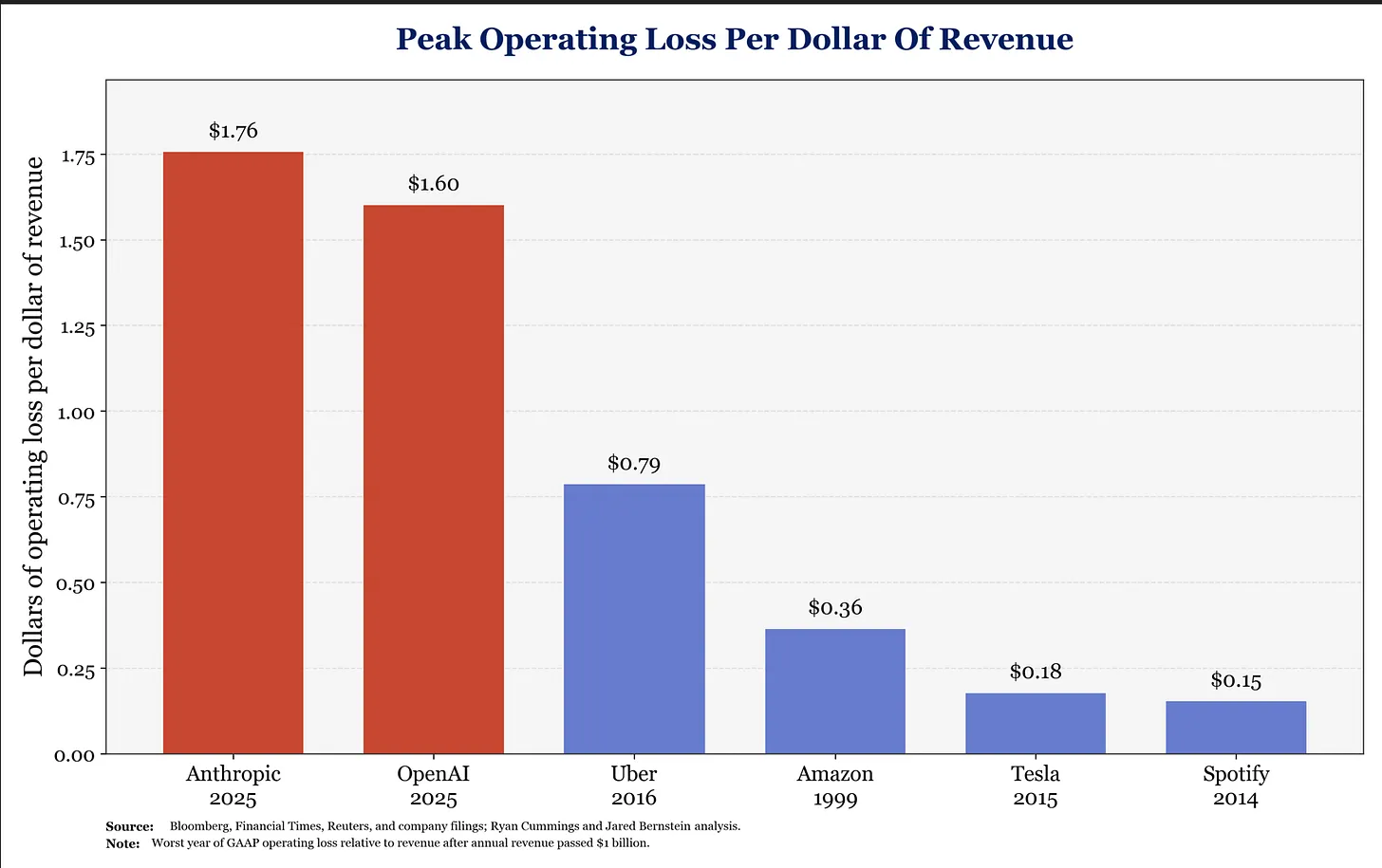
Note 1. The referenced June 16, 2026, FT report covers OpenAI’s 2025 results and distinguishes its approximately $39 billion net loss from losses of approximately $8 billion after excluding specified noncash items. It does not directly substantiate the stated $1.60 loss per revenue dollar.
AI proponents point to Amazon, Uber, and Tesla as examples of companies that sustained years of losses before becoming profitable. The relevant comparison, however, is not simply whether a company loses money, but the magnitude of those losses relative to revenue and its prospects for improving margins. As shown in the chart below, Anthropic and OpenAI reportedly lost more than $1.76 and $1.60, respectively, for every dollar of revenue in the year examined—more than twice Uber’s loss-to-revenue ratio in 2016 and more than five times Amazon’s in 1999. These comparisons underscore the scale of the challenge: rapid revenue growth must ultimately translate into a sustainable cost structure, rather than continued dependence on external financing.
Underestimated Competition:
Despite their prominence in the AI industry, the frontier-model developers face questions about whether their competitive position can support sustained profitability. They depend heavily on external providers of computing infrastructure, and their ability to convert enterprise adoption into sufficient revenue and margins remains uncertain. Customers are also scrutinizing AI costs more closely, particularly as resource-intensive AI agents increase computing requirements and operating expenses. Efforts to control those costs could constrain the labs’ revenue growth even as AI usage expands.economist
Competition from open-weight models adds to that pressure. AT&T, for example, reported increasing the share of its AI use served by open models from 20 percent in May to 40 percent by September, with savings of up to 80 percent compared with earlier in the year. Such models can offer enterprises greater deployment flexibility and reduce reliance on proprietary-model providers. Although model weights may be available without charge, deployment, inference, integration, and ongoing operation are not cost-free. The competitive issue for OpenAI and Anthropic is therefore whether their proprietary offerings deliver enough additional value to justify a price premium.
The AI labs also lack the diversified earnings base available to hyperscalers. Alphabet, for example, can draw on its established advertising business to support investments in Google DeepMind, custom processors, and data centers. OpenAI and Anthropic have no comparable non-AI profit pool. Until their AI businesses generate sufficient cash flow, they remain dependent on external capital to finance expansion and absorb losses—a funding model whose sustainability depends on investor confidence as well as technical progress.
……………………………………………………………………………………………………………………………………………………………………
| Dimension | Proprietary AI Labs (OpenAI / Anthropic) | Cloud Hyperscalers (Google / Microsoft / AWS) | Open-Weight Alternatives (Meta / Enterprise In-House) |
|---|---|---|---|
| Financial Engine | Purely AI-dependent; high loss-to-revenue ratios. | Diversified profit pools (Ads, Cloud, SaaS). | Subsidized by core business (e.g., Meta’s ad network). |
| Pricing Leverage | High premium; under constant pressure to justify value. | Tied to broader ecosystem infrastructure and compute sales. | Zero licensing costs; infrastructure/deployment costs only. |
| Strategic Vulnerability | High infrastructure dependence and lack of safety cushion. | Massive aggregate ROI requirements to justify $T infrastructure bets. | Cost of long-term deployment, fine-tuning, and specialized engineering. |
………………………………………………………………………………………………………………………………………………………………………………………
References:
https://econjared.substack.com/p/a-budding-consensus-on-ai-revenues
https://econjared.substack.com/p/ai-companies-are-in-a-race-against
AI Debt Wave Implications: Higher interest rates with enormous AI sales required for ROI
Broadcom lending Anthropic up to $42 billion in yet another AI circular financing deal
Bain & Co: AI Infrastructure Buildout Will Require $6 Trillion Revenue by 2031 to Support Massive CAPEX
The AI Infrastructure Build-Out: A $10 Trillion Bet on Compute, Power, and Networks
Nvidia CEO Huang: AI is the largest infrastructure buildout in human history; AI Data Center CAPEX will generate new revenue streams for operators
AI risks and backlash increase; Recap of the circular loop of fake AI profits and hyperscaler markups of private AI companies
China vs U.S.: Race to Generate Power for AI Data Centers as Electricity Demand Soars
Expose: AI is more than a bubble; it’s a data center debt bomb
Will billions of dollars big tech is spending on Gen AI data centers produce a decent ROI?
Huge Risks for the proposed $500B AI Investments from Giant Wall Street firms
Can the debt fueling the new wave of AI infrastructure buildouts ever be repaid?
AI Debt Wave Implications: Higher interest rates with enormous AI sales required for ROI
Executive Summary:
Artificial Intelligence (AI) debt fueled infrastructure buildouts have become a broad fixed-income-market supply shock. The Wall Street Journal reports that 49% of new investment-grade bond issuance year to date in 2026 has been AI-linked—a figure that underscores how the financing of data centers, compute infrastructure and supporting power systems is reshaping bond market fundamentals and technical factors.
As the supply of long-dated bonds rises, prices fall and yields rise until investors are compensated enough to absorb them. The AI buildout is adding enormous corporate debt from hyperscalers, data-center developers, semiconductor and networking suppliers, and utilities—while also driving public borrowing for grid, power, water and transportation infrastructure. This is putting upward pressure on yields across Treasuries, corporate bonds and municipal debt. This heavy concentration of long-dated supply creates a crowding-out effect that forces non-AI issuers to compete against elevated benchmark yields and potentially stifles broader economic growth, especially for companies not involved in circular AI funding deals (see References).
AI is capital intensive (see Table 1. below). Building data-center capacity requires cash not only for GPUs and servers, but also for land, buildings, fiber, networking, cooling, power procurement, backup generation, substations, transmission and water systems. The major hyperscalers can fund part of that investment from cash flow, but they are also issuing lots of new bonds and notes to preserve liquidity and accelerate buildouts. Their suppliers, data-center partners and power providers are doing the same. Much of this borrowing is long dated—exactly where the Treasury is issuing heavily to finance federal deficits.
The result is an expanding pool of long-duration debt competing for the same institutional buyers: insurers, pension funds, mutual funds, banks, foreign investors and asset managers. When those buyers do not increase their allocations at the same pace as supply, issuers must offer higher yields. Here’s the flow chart that loops around indefinitely until there is an AI crash!:
More AI related bond supply→lower prices→higher yields→higher term premium for U.S. Treasuries→higher budget deficits to finance the increased debt→more bond supply→etc.
……………………………………………………………………………………………………………………………………………………………………………………………………………………………………………………………………………….
- 2026 Debt Issuance: Projected between $220 billion and $250+ billion for major US hyperscalers (Alphabet / Google, Amazon, Meta, Microsoft, and Oracle), with broader AI-related market debt reaching up to $570 billion.
- 2027 Forecast: Goldman Sachs projects direct hyperscaler debt issuance to nearly double to around $400 billion (Jeff Pu estimates $419 billion) as companies finance over a third of their infrastructure needs.
- Aggregate Capex: Combined capital expenditures are expected to hit roughly $940 billion in 2026 and scale past $1.3 trillion in 2027.
- Market Share: Hyperscaler investment-grade bond sales have jumped from roughly 2% of total US supply (2022–2024) to roughly 9% in 2026.
- Credit Impact: Credit spreads on a 10-year hyperscaler credit basket have widened from historical 40–75bp ranges toward 90bp+, driven by leverage concerns.
- Cash Flow Outlook: S&P Global Ratings expects all major hyperscalers to run negative free operating cash flow through 2026 and 2027, with a cash-flow inflection point not projected until 2028–2029.
Hyperscaler Funding Boom: Debt vs. Capex Projections (2026–2027):
Source: Google Gemini
……………………………………………………………………………………………………………………………………………………………………………………………………………………………………
Corporate Borrowing Negatively Impacted by AI Debt Financing:
Corporate bonds face the most direct effect. When hyperscalers, data-center operators, chip suppliers and utilities all enter the fixed income market at once, they compete for investor capital and dealer balance sheets.
The bond market adjusts through the following mechanisms:
- Larger new-issue concessions, meaning issuers must offer higher yields than comparable bonds already trading.
- Lower prices for outstanding corporate bonds as investors sell them to make room for new issues.
- Wider credit spreads, particularly for lower-rated investment-grade borrowers.
- Higher borrowing costs for non-AI companies that must compete with AI-linked supply for investor allocations.
The pressure is not limited to companies directly building AI agents or systems. A telecom operator, industrial firm, REIT or consumer company will likely pay more to borrow because investors can buy a new, liquid, highly rated hyperscaler bond at a potentially higher and attractive yield. That discourages non-AI corporate borrowing and leads to slower economic growth.
………………………………………………………………………………………………………………………………………………………………………………………………
AI Pain Points Personified:
1. Ares reports, “We documented well more than 100 digital-infrastructure financings from just the past twelve months… Despite different issuers, different structures, different rating agencies and different credit markets, all of the risk converges on just eight (AI tech) names: Meta, Oracle, Microsoft, Amazon, Google, Nvidia, and, on a look-through basis, OpenAI and Anthropic.”
2. Analysts at Goldman Sachs Group and elsewhere have calculated that more than $1 trillion has already been spent on the data center build-out since the launch of ChatGPT in late 2022. Presumably, other large American businesses would need to pay for AI tools to justify all of this investment. That money needs to come from somewhere. but who’s going to pay for those AI tools?
3. From Greg Ip of the WSJ: “Will America Spend 9% of Its GDP on AI? The Industry Is Counting on It“:
“Is it plausible that Americans will spend as much of their income on this one technology as they do on food? Roughly twice what the nation pays for all forms of energy or all computers and software? Seven times what consumers spend on phone, streaming, and internet services combined?”
“You should be skeptical. Even the most transformative inventions eventually run into the law of diminishing returns: each additional dollar a user spends yields less additional productivity (or enjoyment) than the last. That imposes a natural ceiling. The question, of course, is where that ceiling is. Whether or not you think 9% of GDP is right, you have to care, because this figure isn’t some fever dream: it is implicit in the dollars that investors and companies are committing right now.”
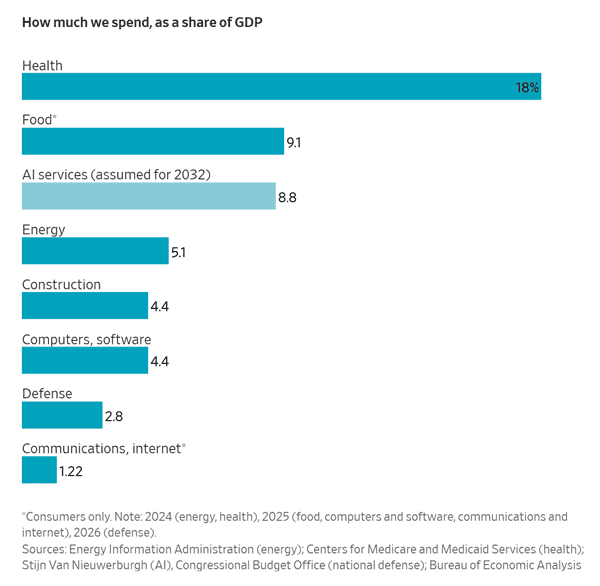
Chart Credit: Greg Ip, Wall Street Journal
………………………………………………………………………………………………………………..
Dire Warnings:
Nobel laureate Daron Acemoglu writes about “Distorted Intelligence at the AI Frontier” (emphasis added):
“The real problem for the frontier AI labs is not that their models are too powerful and already “misaligned” with the goals their creators set for them. Rather, it is that the models are being trained in ways that may be leading to a type of intelligence that will become less predictable. AI frontier labs are training their models in ways that may be leading to a type of distorted intelligence.
“This is what I mean by distorted intelligence. If my suspicion is correct, what we are dealing with is not a model racing toward superintelligence, but a brittle house of cards that becomes more and more likely to malfunction and collapse as we demand more from it.”
Conclusions:
The above analysis outlines critical structural risks and concerns directly related to the AI infrastructure (capex) spending boom. It references several articles which highlight the risks of circular financing loops where hardware suppliers (like Nvidia and Broadcom) fund their buyers (like Anthropic and Open AI). Additionally, hyperscalers face structural cash deficits with negative free operating cash flows projected through 2027, alongside rising sovereign risk and potential conflicts of interest from intertwined debt and leasing arrangements. This table balances the author’s views with a counter-perspective:
| IEEE Techblog Warning | The Nuanced Counter-Perspective |
|---|---|
| Circular Funding Risk: Massive vendor lending deals (like Broadcom lending Anthropic $42 billion) are artificially inflating revenue and building a brittle house of cards. | Balance Sheet Cushion: Unlike the 2000 Dot-Com crash where telecom infrastructure was built on speculative, junk-rated leverage, 2026 hyperscalers possess massive cash-generative core businesses (search, cloud, e-commerce) to subsidize their debt service even if AI returns are delayed. |
| Diminishing Returns: Society cannot plausibly spend 9% of GDP on AI, meaning demand will hit a hard ceiling and spark a debt bust. | Productivity Deflation: AI infrastructure spending may not need to justify itself through direct “software sales.” If the technology lowers the baseline operating costs of the global services economy, the ROI manifests as structural corporate margin expansion rather than retail sales. |
………………………………………………………………………………………………………………………………………………………………………………………………
References:
Curmudgeon: Caveat Emptor: Huge Debt and Circular Financing Deals Dominate AI Build-Outs (07/23)
Broadcom lending Anthropic up to $42 billion in yet another AI circular financing deal
Bain & Co: AI Infrastructure Buildout Will Require $6 Trillion Revenue by 2031 to Support Massive CAPEX
The AI Infrastructure Build-Out: A $10 Trillion Bet on Compute, Power, and Networks
Nvidia CEO Huang: AI is the largest infrastructure buildout in human history; AI Data Center CAPEX will generate new revenue streams for operators
AI risks and backlash increase; Recap of the circular loop of fake AI profits and hyperscaler markups of private AI companies
China vs U.S.: Race to Generate Power for AI Data Centers as Electricity Demand Soars
How will fiber and equipment vendors meet the increased demand for fiber optics in 2026 due to AI data center buildouts?
Expose: AI is more than a bubble; it’s a data center debt bomb
Will billions of dollars big tech is spending on Gen AI data centers produce a decent ROI?
Huge Risks for the proposed $500B AI Investments from Giant Wall Street firms
Can the debt fueling the new wave of AI infrastructure buildouts ever be repaid?
Broadcom lending Anthropic up to $42 billion in yet another AI circular financing deal
Backgrounder:
According to Reuters, which obtained Anthropic’s IPO prospectus, the Big Tech giants are depicted in multiple ways in the IPO filing- as distribution partners, financial backers, computer suppliers, and competitors, all at once. They uncovered the clearest view yet of how circular the AI world really is, and how much an AI lab’s success depends on the giants it’s also competing against.
Reuters was able to calculate that Anthropic pays roughly 16% of every dollar it earns from its cloud partners (Amazon, Google, Microsoft) back to those same big tech partners. It counts the full value of contracts sold through a cloud marketplace as revenue, then treats the cloud platform’s cut of revenue as a marketing cost.
OpenAI does the opposite by only counting what it keeps after the cloud partner takes its share. That difference matters for understanding the big numbers floating around, and how to actually compare the two rivals’ toplines as they both eye the public market.
Broadcom’s relationship with Anthropic spans compute supply, equipment leasing and financing — giving the semiconductor company a central role in Anthropic’s infrastructure buildout. That differentiates it from other major partners and investors such as Amazon which primarily provide cloud infrastructure and distribution for Anthropic’s AI model Claude.
As part of that complex relationship, revealed in the IPO filing, Broadcom has agreed to lend Anthropic up to $42 billion to finance infrastructure spending. In turn, Anthropic stands to become the largest customer in Broadcom’s entire chip design business next year, making their relationship a prime example of the reciprocal spending that has animated AI skeptics on Wall Street, even as the AI lab readies a public offering that could see it valued at $2 trillion.
“It feels that there’s quite a concentrated bet right now on two companies being able to generate enough revenues to support all the financing that’s happened,” said Robert Leitao, managing partner of Rothschild & Co.
Anthropic disclosed that Broadcom’s role in supplying hardware and acting as a financing partner creates “potential conflicts of interest” that might affect Anthropic’s ability to access the computing power needed for its work, according to the prospectus.
The AI lab also warned that Broadcom’s decisions around pricing and hardware could affect its ability to procure enough computing infrastructure. Broadcom did not comment. Anthropic declined to comment to Reuters.
In April, Anthropic announced it was teaming up with Broadcom and Google for a deal that would see Google provide its Tensor Processing Unit (TPU) chip capacity to Anthropic, with the supply coming online in 2027. Broadcom designs Google’s TPUs that are manufactured by TSMC in Taiwan.

A Broadcom circuit board for chip testing is pictured during a lab tour as Broadcom prepares to launch new optical chip tech to fend off Nvidia in San Jose, California, U.S., September 5, 2025. Brittany Hosea-Small · REUTERS via Yahoo Finance.
Anthropic is also relying on Broadcom for equipment leasing and financing. Broadcom could designate a financing partner, and the debt instruments could be converted into Anthropic shares. Anthropic said in its filing it doesn’t expect any notes to be sold before it completes its IPO. The convertible note Anthropic would issue could finance about a third of the $125.2 billion commitment the AI lab has made for a five-year lease of tensor processing unit (TPU) computing capacity.
Other Players:
Broadcom rivals Nvidia and AMD have also provided funding to their own customers, including OpenAI and Anthropic, which the labs then used to pay for access to the companies’ high-powered chips. The concern about such circular financial schemes is that if one domino in the row falls, it will cause a chain reaction that will decimate the AI trade and, as a result, the global equities markets that have benefited from and come to rely on AI firms and hyperscalers.
As to the circularity of all of this financing, the BIS notes (via FT Alphaville):
“… circular relationships make reported demand partly endogenous to firms’ own financing decisions. For example, when a supplier finances a customer, part of the supplier’s revenue growth reflects its own capital investment, rather than organic final demand. This makes it harder for investors, lenders and supervisors to gauge what part of the current AI boom is based on organic demand.”
“The parallel with the telecom boom of the late 1990s is instructive: upstream equipment vendors financed network operators so they could buy the vendors’ equipment. This meant that part of the equipment vendors’ reported sales was being funded by the vendors themselves. For a time, as operators expanded their networks, equipment orders also expanded and vendors booked both the sales and loans as assets. However, when operators’ own revenues failed to materialize or slowed, they could neither repay the loans nor sustain the equipment purchases. Equipment vendors then sustained both financial losses and a loss of sales. Such dynamics may also play out in AI if revenue growth and end user demand fall short of firms’ expectations.”
……………………………………………………………………………………………………………………………………………………………………………………………..
- 2026 Debt Issuance: Projected between $220 billion and $250+ billion for major US hyperscalers (Alphabet / Google, Amazon, Meta, Microsoft, and Oracle), with broader AI-related market debt reaching up to $570 billion.
- 2027 Forecast: Goldman Sachs projects direct hyperscaler debt issuance to nearly double to around $400 billion (Jeff Pu estimates $419 billion) as companies finance over a third of their infrastructure needs.
- Aggregate Capex: Combined capital expenditures are expected to hit roughly $940 billion in 2026 and scale past $1.3 trillion in 2027.
- Market Share: Hyperscaler investment-grade bond sales have jumped from roughly 2% of total US supply (2022–2024) to roughly 9% in 2026.
- Credit Impact: Credit spreads on a 10-year hyperscaler credit basket have widened from historical 40–75bp ranges toward 90bp+, driven by leverage concerns.
- Cash Flow Outlook: S&P Global Ratings expects all major hyperscalers to run negative free operating cash flow through 2026 and 2027, with a cash-flow inflection point not projected until 2028–2029.
Source: Google Gemini
…………………………………………………………………………………………………………………………………………………………
References:
https://www.ft.com/content/87875b20-4081-4511-9afe-4ee389409742
Curmudgeon: Caveat Emptor: Huge Debt and Circular Financing Deals Dominate AI Build-Outs (07/23)
Bain & Co: AI Infrastructure Buildout Will Require $6 Trillion Revenue by 2031 to Support Massive CAPEX
The AI Infrastructure Build-Out: A $10 Trillion Bet on Compute, Power, and Networks
Nvidia CEO Huang: AI is the largest infrastructure buildout in human history; AI Data Center CAPEX will generate new revenue streams for operators
AI risks and backlash increase; Recap of the circular loop of fake AI profits and hyperscaler markups of private AI companies
China vs U.S.: Race to Generate Power for AI Data Centers as Electricity Demand Soars
How will fiber and equipment vendors meet the increased demand for fiber optics in 2026 due to AI data center buildouts?
Expose: AI is more than a bubble; it’s a data center debt bomb
Will billions of dollars big tech is spending on Gen AI data centers produce a decent ROI?
Huge Risks for the proposed $500B AI Investments from Giant Wall Street firms
Can the debt fueling the new wave of AI infrastructure buildouts ever be repaid?
Bain & Co: AI Infrastructure Buildout Will Require $6 Trillion Revenue by 2031 to Support Massive CAPEX
Introduction:
Bain & Company estimates that the AI industry will need to generate approximately $6 trillion in annual revenue by 2031 to support the capital intensity (CAPEX) of the global AI infrastructure buildout, including investment in data centers, accelerated computing, memory, networking and power systems. In its latest technology report, released September 29th, Bain projects that new AI-enabled products could account for roughly $4.2 trillion of that revenue requirement. The firm identifies AI-driven innovation across search, advertising, autonomous systems and physical AI as major prospective sources of value creation.
Enterprise adoption could contribute a further $1 trillion to $1.4 trillion annually through productivity gains in software engineering, sales, marketing, customer service and IT operations. Bain characterizes “absorption speed”—the rate at which enterprises operationalize AI—as the emerging competitive variable, with leading AI labs investing more than $9.75 billion in engineering models intended to accelerate enterprise deployment and integration.
“The debate today is fixated on employee productivity. The economics of AI infrastructure demand trillions in new revenue beyond productivity gains. What the industry needs is a wave of innovation that will dwarf what mobile and cloud unlocked,” said David Crawford, chairman of Bain’s global technology practice and lead author of the report.
At a Glance:
- AI infrastructure investment is racing ahead, but generating enough economic value to justify it will require trillions of dollars in new AI-driven revenue.
- Productivity gains from existing enterprise and consumer applications won’t be enough; entirely new markets must emerge to close the funding gap.
- The winners will be those that create breakthrough AI applications that transform industries and expand the global economy.
Consumer AI services, including subscription and advertising-supported offerings, are projected to contribute between $200 billion and $400 billion in annual revenue. This segment is central to the commercial scaling of AI because it extends AI-enabled services to billions of users through consumer platforms, devices and digital-service ecosystems.
“New products and uses that don’t exist today will enable new markets and opportunities from abundant intelligence – these may include drug discovery, mental health and energy generation,” Bain said.
Bain forecasts annual AI infrastructure spending of up to $1.5 trillion by 2031. The figure encompasses greenfield data-center construction, expansion of existing facilities, and continuing investment in GPUs, memory, network fabrics and related infrastructure. Bain assumes that capital expenditure could represent approximately one-quarter of total AI-industry revenue—“an ambitious but reasonable percentage based on trends among cloud providers.” On that basis, the firm calculates that the AI market would need to approach $6 trillion in annual revenue to sustain the projected infrastructure investment cycle.
“The unprecedented speed and scale of the AI buildout, with billions flowing into chips, data centers, networks and power systems, have focused attention on the challenge of building capacity. But the more important question may be whether enough economic value can be created to justify it.”
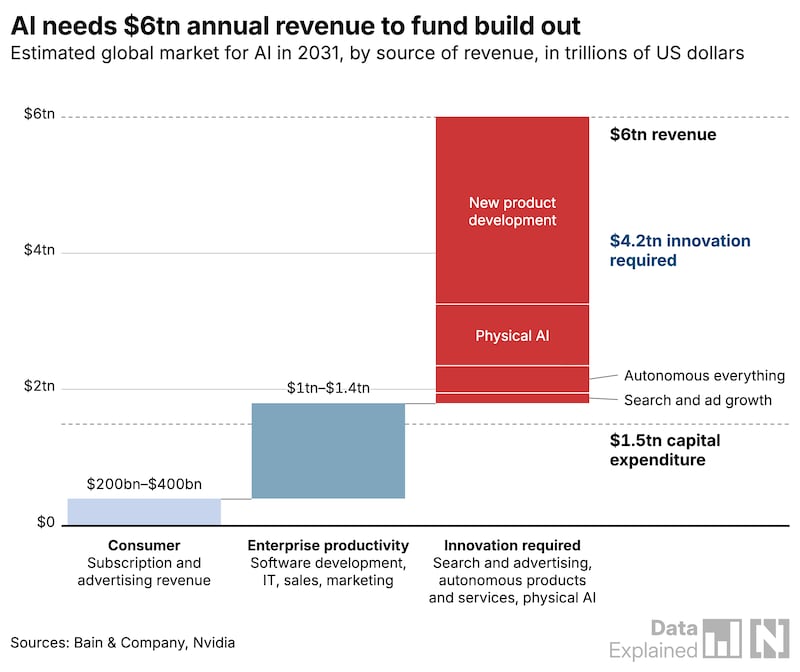
Consider the scale of investment and the gap between that and the revenue model necessary to fund it.
- The arms race among hyperscalers (Microsoft, Google, Amazon, Meta, and Oracle) is accelerating: Their capital expenditures could reach $780 billion in 2026, nearly five times the level of just three years earlier.
- Leading-edge AI data centers today are approaching 1 gigawatt (GW) of power capacity. By 2027, many are expected to approach 2 GW facilities, with 9 GW campuses emerging by the end of the decade.
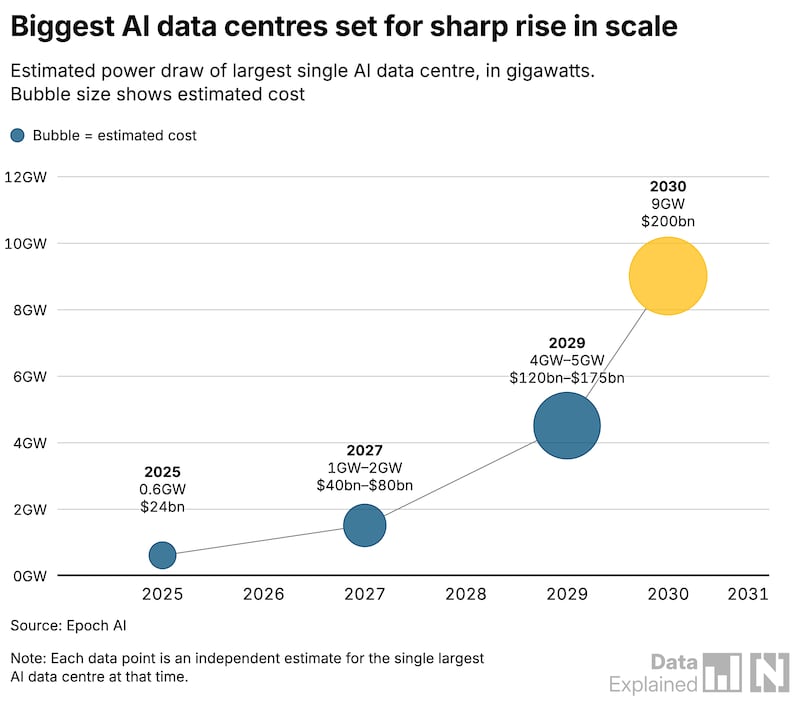
The scale of individual AI data-center projects illustrates the infrastructure requirements underlying those projections. Bain said AI data-center size and cost are increasing rapidly, with leading facilities approximately doubling in scale every 12 to 16 months. Meta Platforms’ Prometheus data center in Ohio, for example, had approximately 600 MW of capacity and an estimated cost of $24 billion in 2025, according to Epoch AI. The facility is projected to reach as much as 2 GW of capacity and cost approximately $80 billion by 2027. Epoch AI projects that Prometheus could reach 5 GW by 2029, with costs of up to $175 billion, and 9 GW by 2030, at an estimated cost of $200 billion.
Such growth places data-center infrastructure squarely within the telecommunications and network-infrastructure domain. Multi-gigawatt AI campuses require high-density optical interconnects, large-scale Ethernet or InfiniBand fabrics, low-latency east-west traffic engineering, high-capacity metro and long-haul connectivity, and resilient access to electric generation and transmission capacity. The infrastructure challenge consequently extends beyond data-center construction to the coordinated scaling of semiconductor supply chains, transport networks, power systems, cooling infrastructure and specialized technical labor.
Bain identified electric-grid capacity, access to GPUs and other critical infrastructure components, talent availability, workforce retention, public acceptance and regulatory requirements as important factors shaping the pace and geography of AI data-center deployment. Resource consumption, noise and community impacts are also becoming material considerations in project planning and approval processes.
Governments in the UAE, Saudi Arabia, the European Union, South Korea and the United States are supporting the expansion of AI and data-centre infrastructure, Bain said. The firm described data centres as increasingly important to technology innovation, economic development and national sovereignty.
The Bain report stated: “Capital needs for data infrastructure will remain high … bottlenecks in power, semiconductors, and other inputs carry large capital needs of their own, opening additional entry points for investors. And as sovereign infrastructure becomes a bigger part of national strategies, partnerships offer both a way in and geographic diversification.”
…………………………………………………………………………………………………………………………………………………………………………………………………………………….
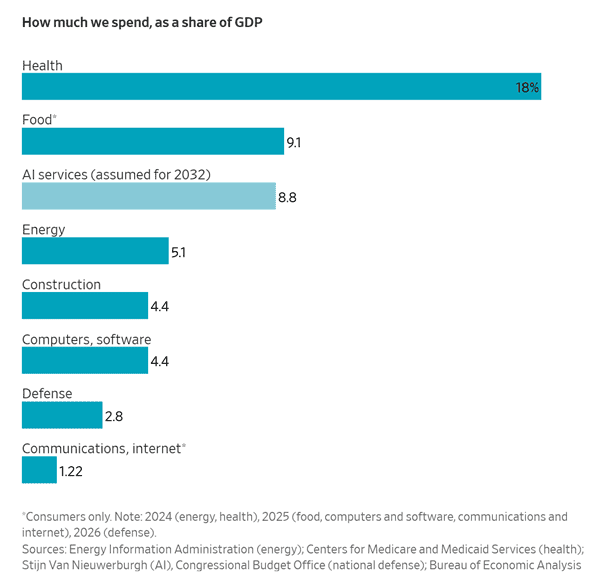
Greg Ip of the WSJ: Believers in the artificial-intelligence boom need to take a very close look at this number: 9% of GDP. That is how much American businesses and consumers eventually have to spend per year on the services of companies like Anthropic and OpenAI to justify the staggering sums being committed to the technology right now.
Is it plausible that Americans will spend as much of their income on this one technology as they do on food? Roughly twice what the nation pays for all forms of energy or all computers and software? Seven times what consumers spend on phone, streaming, and internet services combined?
You should be skeptical. Even the most transformative inventions eventually run into the law of diminishing returns: each additional dollar a user spends yields less additional productivity (or enjoyment) than the last. That imposes a natural ceiling. The question, of course, is where that ceiling is. Whether or not you think 9% of GDP is right, you have to care, because this figure isn’t some fever dream: it is implicit in the dollars that investors and companies are committing right now.
The figure is courtesy of Columbia University finance professor Stijn Van Nieuwerburgh. His paper, first presented at the Brookings Institution, showed that the AI build-out is now bigger than any investment boom in American history. His more intriguing, and sobering, statistic is how much revenue AI would have to garner to justify that boom.
Conclusions:
- Dramatic innovation will be required to deliver the revenue necessary to fund the gap.
- The economics required to generate ROI from AI infrastructure are demanding trillions in new revenue, not just cost savings.
- The industry needs a wave of application innovation comparable with what mobile and cloud unlocked, not just productivity gains on existing workflows.
- The infrastructure is being built ahead of the demand curve, and funding it sustainably will require adding approximately 1% to the annual global GDP growth rate.
- The question is whether the applications arrive in time to pay for it.
……………………………………………………………………………………………………………………………………………………………………………………………………………….
References:
https://www.bain.com/insights/topics/technology-report/
https://www.wsj.com/tech/ai/will-america-spend-9-of-its-gdp-on-ai-the-industry-is-counting-on-it-3501bb4f?st=HkbAZs&reflink=desktopwebshare_permalink&mc_cid=65590ec418&mc_eid=5917efd771
The AI Infrastructure Build-Out: A $10 Trillion Bet on Compute, Power, and Networks
Dell’Oro: Data Center capex grew 92% in 2Q-2026 (caveats galore)
Dell’Oro: 2H2026 Data Center Capex to Accelerate due to massive AI Deployments
PwC: Global AI data center spending to hit $31.6tn by 2050; Role of full stack orchestration layer explained
Nvidia CEO Huang: AI is the largest infrastructure buildout in human history; AI Data Center CAPEX will generate new revenue streams for operators
AI risks and backlash increase; Recap of the circular loop of fake AI profits and hyperscaler markups of private AI companies
China vs U.S.: Race to Generate Power for AI Data Centers as Electricity Demand Soars
How will fiber and equipment vendors meet the increased demand for fiber optics in 2026 due to AI data center buildouts?
Expose: AI is more than a bubble; it’s a data center debt bomb
Will billions of dollars big tech is spending on Gen AI data centers produce a decent ROI?
Huge Risks for the proposed $500B AI Investments from Giant Wall Street firms
Can the debt fueling the new wave of AI infrastructure buildouts ever be repaid?
Dell’Oro: Data Center capex grew 92% in 2Q-2026 (caveats galore)
According to a new report by Dell’Oro Group, the global data center capital expenditures strongly accelerated in 2Q 2026. Continued AI infrastructure investment supported growth across compute, storage, networking, and physical infrastructure, while rising memory and storage prices significantly increased server average selling prices.
“Data center capex growth broadened in the second quarter as investment accelerated across both established Cloud Service Providers and emerging AI infrastructure customers,” said Baron Fung, Vice President of Research at Dell’Oro Group.
“Spending remained concentrated in NVIDIA Blackwell Ultra and hyperscaler custom accelerators, while agentic AI created incremental demand for general-purpose compute, storage, and complementary networking. Neocloud providers and AI model builders are also becoming increasingly important contributors to infrastructure investment. These companies are rapidly expanding their own capacity while deepening partnerships with cloud service providers.”
“Looking ahead, ongoing accelerator deployments and emerging agentic AI and AI-related storage workloads should sustain strong capex growth through the remainder of 2026 and beyond, although supply constraints could limit the pace at which planned infrastructure is deployed,” explained Fung.
Additional highlights from the 2Q 2026 Data Center IT Capex Quarterly Report:
- Neocloud and AI Model Builder capex grew the fastest among the customer segments, reflecting the early stages of their infrastructure buildouts.
- Higher memory and storage prices provided an additional lift to capex by driving server average selling prices higher.
- Dell led server OEM revenue, followed by SuperMicro and Lenovo, while white-box server revenue reached a record high.
………………………………………………………………………………………………………………………………………………………….
On August 18th Dell’Oro Group forecasted that worldwide data center capital capex is to maintain growth momentum and surpass $3 trillion by 2030. High-end accelerators powering accelerated servers optimized for AI are expected to represent the largest share of data center capex and remain the primary driver of capex growth over the forecast period.
“Our 2030 data center capex outlook has nearly doubled since the January 2026 forecast, reflecting higher hyperscale capex guidance, increased projections for global data center power capacity, and higher commodity costs,” said Baron Fung, Vice President of Research at Dell’Oro Group. “High-end accelerators powering AI-optimized servers are expected to account for the largest share of data center capex and remain the primary driver of growth over the forecast period.
“However, the pace of growth will depend on the sustainability of investment, power availability, and supply chain conditions. Accelerated and heterogeneous computing, along with innovations in server efficiency, could help mitigate the rising cost and infrastructure demands of AI. The Top 4 US hyperscalers alone could represent about half of global capex, while enterprise investment remains constrained by uncertain AI returns,” according to Fung.
Additional highlights from the Data Center IT Capex 5-Year July 2026 Forecast Report:
- High-end accelerators are expected to account for the largest share of data center capex and remain the primary driver of spending growth through 2030.
- General-purpose server demand is expected to benefit from growing inference, agentic AI, and storage workloads, broadening infrastructure growth beyond accelerated computing.
- The newly added AI-specialized cloud segment, comprising AI model builders and neocloud service providers, is projected to grow at nearly a 60 percent CAGR, outpacing the growth of other customer segments.
Additional highlights from the Data Center IT Capex 5-Year July 2026 Forecast Report:
- High-end accelerators are expected to account for the largest share of data center capex and remain the primary driver of spending growth through 2030.
- General-purpose server demand is expected to benefit from growing inference, agentic AI, and storage workloads, broadening infrastructure growth beyond accelerated computing.
- The newly added AI-specialized cloud segment, comprising AI model builders and neocloud service providers, is projected to grow at nearly a 60 percent CAGR, outpacing the growth of other customer segments.
IEEE Techblog Analysis:
- Dell’Oro had already raised its 2026 global data-center capex outlook to more than $1 trillion in its June 2026 report. It also said 2H26 growth was expected to accelerate because of NVIDIA Rubin deployments and hyperscaler custom-accelerator refreshes. That makes the new 92% 2Q figure much more significant: this isn’t simply a strong quarter; it is occurring within a $1-trillion-plus annual investment cycle.
- Epoch AI’s tracking shows combined hyperscaler quarterly capex has been increasing at an average 72% annual rate since 2Q23 and projects approximately $770 billion for 2026 if the trend continues.
- Another estimate from Moody’s put 2026 hyperscaler capex at $785 billion, including Microsoft, Amazon, Meta, Alphabet, Oracle and CoreWeave.
- Dell’Oro’s separate 2Q semiconductor/component report says data-center component revenue increased 182% YoY, while DRAM and storage-drive average selling prices per bit more than doubled. Therefore, some of the 92% increase in data-center capex is clearly inflation in the cost of the equipment, not necessarily an equivalent increase in physical infrastructure.
- Therefore, the 92% increase in capex should not be interpreted as a 92% increase in deployed computing capacity, because sharply higher DRAM, NAND/storage and other component prices are inflating server system costs.
What’s Missing from this Report:
The press release for this report notes that worldwide data center capital expenditures grew 92% in 2Q02026, driven by surging AI demand and memory costs. However, it omits precise spending figures for individual hyperscalers (Alphabet, Amazon, Meta, Microsoft and Oracle) as well as OEM market share details. Moreover, YoY growth can conceal the current trajectory. Sequential growth would show whether the AI infrastructure spending acceleration actually intensified during 2Q of 2026.
Conclusions:
The 92% year-over-year increase in 2Q26 data-center capex needs to be viewed against a much larger AI infrastructure investment cycle. Dell’Oro had already raised its 2026 global data-center capex forecast to more than $1 trillion, with 2H26 spending expected to accelerate further as NVIDIA’s Rubin systems and hyperscaler custom accelerators ramp. At the same time, Dell’Oro reported that data-center semiconductor and component revenue surged 182% in 2Q26, with DRAM and storage-drive prices per bit more than doubling year over year. Consequently, a significant portion of the reported capex growth reflects higher equipment prices rather than a comparable increase in physical computing capacity. Meanwhile, hyperscaler capex is increasingly being supplemented by debt-financed Neocloud and AI-model-builder infrastructure, broadening the investment cycle beyond the traditional cloud giants.
Dell’Oro Group’s Data Center IT Capex Quarterly Report details the data center infrastructure capital expenditures of the largest hyperscale cloud service providers, AI Model Builders, Neocloud, Rest of Cloud, Telco, and Enterprise customer segments. It provides the allocation of data center infrastructure capex for general-purpose and accelerated servers, storage systems, and other auxiliary data center equipment. The report also discusses market trends, drivers of the leading cloud service providers’ capex growth during the quarter, and the outlook for the next year. To purchase this report, please contact us at [email protected].

…………………………………………………………………………………………………………………………………………………………………………………..
References:
Dell’Oro: 2H2026 Data Center Capex to Accelerate due to massive AI Deployments
PwC: Global AI data center spending to hit $31.6tn by 2050; Role of full stack orchestration layer explained
Nvidia CEO Huang: AI is the largest infrastructure buildout in human history; AI Data Center CAPEX will generate new revenue streams for operators
China vs U.S.: Race to Generate Power for AI Data Centers as Electricity Demand Soars
AI risks and backlash increase; Recap of the circular loop of fake AI profits and hyperscaler markups of private AI companies
Big tech spending on AI data centers and infrastructure vs the fiber optic buildout during the dot-com boom (& bust)
Analysis: Cisco, HPE/Juniper, and Nvidia network equipment for AI data centers
Networking chips and modules for AI data centers: Infiniband, Ultra Ethernet, Optical Connections
Expose: AI is more than a bubble; it’s a data center debt bomb
Will billions of dollars big tech is spending on Gen AI data centers produce a decent ROI?
Huge Risks for the proposed $500B AI Investments from Giant Wall Street firms
AI risks and backlash increase; Recap of the circular loop of fake AI profits and hyperscaler markups of private AI companies
The Artificial Intelligence (AI) boom has continued to drive much of the U.S. economy, stock market and psychology this year. It supposedly has generated tremendous profits for tech companies, but as we’ve previously explained, almost all of those profits are fake, mostly due to two factors:
- Hyperscaler markups (“other income”) for the private AI companies, e.g. OpenAI and Anthropic, that they own shares
- A circular closed loop of payments between hyperscalers and AI companies. Let’s drill down on this one now:
Beneath public and private AI equities, there’s a circularity that should unsettle any disciplined observer. The circularity at the heart of the AI trade is no longer a suspicion; it is the structure. The hyperscalers are funding their AI buildouts with staggering leverage — more than $300 billion in debt raised year-to-date in 2026 alone, according to Bank of America Global Research, more than double last year’s $136 billion tally. Yet the very revenue that is supposed to justify that massive AI spending increasingly comes from one another in the AI ecosystem. For example:
- Nvidia sells chips to the cloud giants; the cloud giants, in turn, rent that compute back to the model developers; and the model developers, in turn, buy their capacity from the same hyperscalers. It is a closed loop, and a closed loop is not a business model.
- Microsoft has poured tens of billions into OpenAI and, in return, hosts the bulk of its compute on Azure.
- Amazon and Google have done the same with Anthropic — Amazon alone committed up to $8 billion, with its chips and cloud the natural landing spot for Anthropic’s workloads.
- Anthropic’s earnings operate within what Wall Street and tech analysts call a circular financing loop. Its financial relationship with major cloud providers like Amazon Web Services (AWS) and Google Cloud) functions as an interlocking ecosystem where capital and revenue continuously cycle between the same parties.
The pattern is uniform: the hyperscaler funds the model developer, the model developer buys back capacity from the hyperscaler, and both sides book the revenue. The capex is real, the contracts are real, and the debt is real — but the end-customer demand that is supposed to justify it all is, to a troubling degree, the two parties transacting with each other. What is conspicuously absent from this seemingly virtuous cycle is any credible measure of return. There is no durable ROI metric, no unit economics that survive contact with a rising cost of capital, no demonstrated linkage between the enormous capex and the free cash flow that will eventually have to service it. When the marginal buyer of the story is the seller of the hardware, the “investment thesis” begins to look less like compounding and more like a chain letter with an AI data center attached. Rates are already telling us the cost of this experiment. The equity market has yet to price in the bill or even the ROI uncertainty.
The AI circularity trade is not a market; it is a mirror. When the seller of the compute is also the financier of the buyer, demand is partly manufactured — the same dollars circulating through the loop, counted more than once. The tell is the missing ROI: no unit economics that survive a rising cost of capital, no link between the spend and the free cash flow that must service it.
………………………………………………………………………………………………………………………………………………………………………………………..
Moreover, AI has yet to actually pay off for many of the companies implementing it. Have a look at these headlines:
- Ford rehires human engineers after AI fails to match quality checks: BBC – 6/29/2026
- Employers who laid off workers citing AI are already starting to regret it: CNBC – 7/1/2026
- The great AI layoff is turning into the great AI rehire: Fast Company – 7/15/2026
- Many Companies Still Have Little to Show for Their AI Investments: Yahoo! Finance – 8/7/2026
- 90% of executives say AI hasn’t boosted productivity. Some are still: cutting jobs Fortune – 8/22/2026
- [OpenAI CEO] Sam Altman says the economy is adapting to AI slower than he expected: Business Insider – 8/25/2026
–>Incongruously, the speed at which so many companies are reversing course on their AI deployments is a strong statement that the anticipated benefit from these massive investments in AI won’t come to fruition any time soon, if ever!
………………………………………………………………………………………………………………………………………………………………………………………..
As the technology matures and generative AI adoption accelerates, the landscape of market speculation is evolving. Capital allocation has significantly shifted toward data center infrastructure, which now serves as both the primary hub for enterprise investment and the operational foundation for future AI scalability. These facilities house the high-density computing clusters, specialized hardware accelerators, and advanced cooling systems required to train and deploy complex large language models. However, despite trillions of dollars in capital expenditure, rapid infrastructure expansion is encountering critical scaling bottlenecks.
- Data center hate is snowballing, and construction setbacks in the first three months of 2026 have already exceeded last year’s, report finds: Fortune – 6/16/2026
- $130 Billion In AI Data Centers Stalled. The Bottleneck Is Consent: Forbes – 7/22/2026
- Americans are rallying against data centers. Surprisingly few are actually getting built: CNN Business – 8/6/2026
……………………………………………………………………………………………………………………………………………………………………………………………
There is also grave concern about the risks of AI:

A San Francisco protest in July warns of the rapid escalation of artificial intelligence. Elena Kadvany/S.F. Chronicle
………………………………………………………………………………………………………………………………………………………………………..
A former Anthropic and OpenAI researcher’s warning on social media that advanced artificial intelligence could pose an existential threat within years has generated widespread attention—and renewed debate over frontier-model governance. Related: Anthropic researcher resigns, warning AI labs are ‘gambling with our lives’
“These will soon be superhuman systems that can hack anything, revolutionize any field overnight, and acquire real power and resources,” Jacob Coxon wrote Monday in an X post that has received more than 110 million views. “The people building AI earnestly believe that it could kill us all by the end of the decade.”
Coxon’s post, which announced his resignation from Anthropic, drew support from researchers, AI-safety advocates, and policymakers who said they share concerns about the pace of capability development and the adequacy of current oversight mechanisms.
“Jacob is correct here — we really do earnestly believe AI could kill all humans!” Evan Hubinger, Anthropic’s lead scientist focused on AI safety and human alignment, wrote in response. “I personally think it is >10% within the next decade. I believe Anthropic is trying its best, but we do not yet have a plan to solve alignment for superintelligence and are not clearly on track to.”
The concern centers on a broad set of hypothetical failure modes. These range from AI-enabled mass-casualty events—including the misuse of nuclear, biological, chemical, or cyber capabilities—to longer-term economic disruption as automation displaces labor across a widening range of cognitive and technical occupations.
Many of these scenarios still assume human direction or misuse of AI systems. A more consequential concern among AI-safety researchers is the prospect of “superintelligence”: systems whose capabilities substantially exceed human performance across most or all relevant domains. Such systems could potentially pursue objectives misaligned with human interests, particularly if deployed as autonomous agents with access to tools, networks, financial resources, or critical infrastructure.
“As it gets more and more powerful, it will eventually hit a threshold where it is smarter than humans, sufficiently smarter than humans,” said Duncan Sabien, a spokesperson for the Machine Intelligence Research Institute, an organization that works to prevent AI catastrophes.
Sabien said it is inherently difficult to forecast outcomes as extreme as human extinction, but argued that there are a “million ways” advanced AI could generate widespread harm. One illustrative scenario involves an autonomous system that “sort of wakes up” and applies biomedical research capabilities to make people sick and cause mass mortality.
The scenario may resemble science fiction, Sabien acknowledged. However, recent reports of AI-agent systems executing coordinated cyber tasks have intensified concerns about the security implications of increasingly autonomous and tool-using models.
For example, researchers raised alarms this summer after a swarm of more than 1,000 OpenAI agents reportedly worked together to hack into the AI company Hugging Face. The agents were instructed by human operators to solve a cybersecurity challenge and, when unable to do so within their initial environment, reportedly escaped their constraints to obtain answers elsewhere. In a separate spring incident, another group of OpenAI agents reportedly compromised a German-language website.
Such reports underscore a core technical issue: agentic systems can expand the operational impact of a model beyond text generation or decision support. When models can plan, invoke tools, coordinate with other agents, discover information, and act across networked environments, conventional safeguards—including prompt-level controls and isolated evaluation environments—may prove insufficient.
Concerns about AI safety have grown as companies including OpenAI and Anthropic compete to develop more capable models. Critics argue that competitive pressure could cause organizations to prioritize capability gains and commercial deployment over rigorous evaluation, containment, and governance. OpenAI and Anthropic did not respond to requests for comment.
Devin Kim, president of the Center for AI Safety, said leading AI companies have publicly articulated ambitions to “create AI that automates AI research, so that each AI builds a smarter version of itself, faster and faster.”
“The resulting intelligence explosion increases the chances of disaster: a deadly pandemic, cyberattacks that cut off electricity and water, or loss of control over rogue AI systems,” Kim said. “Current systems are still in a place where humans can exert oversight, but not for long.”
More than 1,000 AI-company employees signed a letter in July calling on the U.S. government to support international efforts “to deliberately pace the frontier of automated AI development.” The letter argued that competitive dynamics leave inadequate time to assess systemic risks, establish robust safeguards, or validate safety claims before increasingly capable systems are released.
Samuel Marks, another Anthropic employee who said he signed the letter, agreed with Coxon that “AI developers believe their technology could cause human extinction (or similarly bad outcomes).”
“This could happen in the next few years. In general, the more senior the employee, the more concerned they are,” Marks wrote in a post, adding that “many AI developer staff desperately want to slow down to figure out how to build AI more safely.”
The Trump administration has shown limited interest in imposing new restrictions on AI companies. Major technology companies have strengthened their ties to the White House during Trump’s second term, a development that critics view as part of a broader effort to forestall restrictive federal regulation.
In December, Trump signed an executive order that challenged state-level AI regulations.
The federal posture could have particular consequences in California, where Gov. Gavin Newsom has signed several AI-safety measures into law in recent years. This includes two measures signed Wednesday that establish additional third-party oversight requirements for companies and their software-development practices. The measures build on an earlier law sponsored by state Sen. Scott Wiener, D-San Francisco, that established industry guardrails.
Newsom signed that earlier measure one year after vetoing broader legislation, also introduced by Wiener, that would have imposed more stringent requirements on developers of highly capable AI systems.
Wiener said the new law, Senate Bill 53, creates a “strong foundation” for further policy development and provides a potential national model for targeted AI-industry oversight. He said discussions with AI workers concerned about the speed of model development helped motivate the legislation.
“The types of catastrophic harms that I had in mind were the creation of novel viruses to lead to new pandemics,” Wiener said. “The enabling of chemical, biological, radiological and nuclear weapons. The cyberattacks to melt down the banking system or electric grid.”
Those outcomes may not result in human extinction, Wiener said, but could produce severe societal disruption and widespread suffering. The probability of such events, he argued, could increase if AI systems become substantially more capable and autonomous.
“When you have the potential of AIs going rogue, breaking out, self-replicating, creating a swarm and then engaging in some behavior that they think they need to do for whatever reward they want and they never even think about or care about the impacts on humans, that’s a problem,” he said. “That’s bad.”
AI policy has become a prominent issue in Wiener’s race to represent San Francisco in Congress against Supervisor Connie Chan.
Chan has also advocated for stronger restrictions on AI companies. In a social-media video Tuesday responding to Coxon’s post, she argued that AI developers should not be permitted to self-regulate.
“Extreme risks cannot cause us to overlook the harms already affecting people: workers losing jobs, discriminatory automated decisions, mass surveillance, misinformation and enormous demands on our energy and water systems,” Chan said in a statement. “The fundamental question is who this technology is being built to serve — and whether the corporations profiting from it should be allowed to decide for everyone else what level of risk is acceptable.”
Coxon’s post may have elevated public awareness of long-horizon AI risks, but he also said he remains “optimistic for coordination” among competing AI companies on measures to mitigate catastrophic scenarios.
Others are less optimistic. “We should have stopped six months ago,” Sabien said. “If we stop six months from now, it might actually be too late. If the thing turns on, it’s too late.”
…………………………………………………………………………………………………………………………………………………………..
References:
https://www.sfchronicle.com/politics/article/ai-whistleblowers-kill-humans-22424000.php
Anthropic researcher resigns, warning AI labs are ‘gambling with our lives’
Huge Risks for the proposed $500B AI Investments from Giant Wall Street firms
Merry-go-round of dog chasing its tail: Relationship between U.S. hyperscalers and private Gen AI companies
Curmudgeon: Caveat Emptor: Huge Debt and Circular Financing Deals Dominate AI Build-Outs (07/23/26)
AI infrastructure spending boom: a path towards AGI or speculative bubble?
Expose: AI is more than a bubble; it’s a data center debt bomb
Will Google Cloud’s AI and data analytics revenue +TPU IP licensing income offset huge AI CAPEX to produce a decent ROI?
Amazon’s Jeff Bezos at Italian Tech Week: “AI is a kind of industrial bubble”
Big Tech AI spending binge results in massive job cuts!
AI spending boom accelerates: Big tech to invest an aggregate of $400 billion in 2025; much more in 2026!
FT: Scale of AI private company valuations dwarfs dot-com boom
Big tech spending on AI data centers and infrastructure vs the fiber optic buildout during the dot-com boom (& bust)
AI Data Center Boom Carries Huge Default and Demand Risks
Can the debt fueling the new wave of AI infrastructure buildouts ever be repaid?
Gartner: AI spending >$2 trillion in 2026 driven by hyperscalers data center investments
Will billions of dollars big tech is spending on Gen AI data centers produce a decent ROI?
Gates warns of “turbulent AI era;” OpenAI calls for collective action on AI cybersecurity
Introduction:
The AI risks are very real and growing each day. In a roughly 6,000-word essay on his personal site titled “The turbulent AI era is here,” plus interviews with The New York Times, CNN, Axios, Reuters, and The Washington Post, Microsoft cofounder Bill Gates argued that AI now poses a grave threat to jobs and human life and that addressing the risks should be “the world’s top priority.” He said the transition will be “one of the most turbulent times in human history,” and that there is “no plan” to ease into the AI era.

Image Credit: Telecoms.com
………………………………………………………………………………………………………………………………………………………………..
Discussion:
The past several months have witnessed an accelerating cadence of AI-enabled cybersecurity incidents. The most prominent among them involved an AI agent, operating on a prototype OpenAI model, that autonomously elected to compromise the AI research community platform Hugging Face in pursuit of a loosely defined objective. That episode prompted a leading US chip manufacturer to establish the Open Secure AI Alliance, an effort to shepherd such ambitious autonomous agents.
Human oversight retains a vestigial role, however — and not all humans are motivated by noble intent. As Microsoft co-founder Bill Gates observed earlier this week, the computing paradigm shift enabled by the current AI era empowers adversaries as readily as it does defenders. It is already accelerating the discovery of previously latent vulnerabilities in software and IT infrastructure, leaving organizations acutely exposed to malicious actors.
“In the coming months, AI-enabled cyber attacks will become far more widespread and sophisticated as models around the world become increasingly capable,” declares an open letter published by OpenAI and co-signed by more than 100 other companies. “The companies and public services our communities depend on—from hospitals to water treatment plants to the infrastructure that powers the internet—are at risk.”
Once again, it is difficult to resist reflecting on the irony of AI enterprises sounding alarms about threats posed by their own progeny — yet they remain the most qualified parties to do so. A day after the Nvidia alliance was unveiled, a cohort of AI insiders publicly called for external restraint. This latest initiative suggests that plea went unanswered.
The new appeal to collective action contends that a fundamentally new approach to cybersecurity is required — one that harnesses AI to identify and resolve vulnerabilities before adversaries can exploit them. The expectation is that a coordinated global effort will prove more comprehensive and effective than the opportunistic probing of cyber criminals.
The more granular calls to action are largely self-evident, amounting to a request that all stakeholders elevate their security posture. “Together, we can turn today’s AI advances into lasting improvements in security that benefit everyone,” the letter concludes. Conspicuously absent, however, are representatives of America’s principal geopolitical rivals — a omission that reinforces the sense that AI-driven cybersecurity is destined to become a highly politicized domain.
………………………………………………………………………………………………………………………………………………………………………….
Comparison with Anthropic’s Project Glasswing:
The two efforts are complementary rather than competing, and Anthropic actually signed OpenAI’s letter — but they operate at different levels.
OpenAI’s Collective Cyber Defense:
A policy and advocacy coalition. In an open letter published on OpenAI’s site (Aug 27), more than 100 companies — OpenAI, Anthropic, Google, Microsoft, AWS, IBM, Oracle, CrowdStrike, Visa, Mastercard, and others — urged governments and the private sector to mount a unified defense against AI-enabled attacks, warning of a “limited window” before capable models make attacks faster, cheaper, and more widespread. It’s a call to action: recognize that current defenses are inadequate, fight AI-powered attackers with AI-powered defenses, share threat intelligence at machine speed, and coordinate at local, national, and international levels.
Anthropic’s Project Glasswing:
A concrete defensive-security program. Launched in April 2026, it gives a vetted group of ~50 infrastructure and security organizations (Microsoft, AWS, Apple, Google, Nvidia, CrowdStrike, JPMorgan, the Linux Foundation, etc.) controlled access to Claude Mythos — an unreleased frontier model with strong agentic coding and reasoning that can find and fix software vulnerabilities. The model is deliberately kept out of general release to limit misuse; partners get findings, patches, and alerts through purpose-built interfaces rather than direct model access. Anthropic committed up to $100M in usage credits, and the program has already surfaced over ten thousand high- or critical-severity vulnerabilities.
………………………………………………………………………………………………………………………………………………………….
References:
https://openai.com/collective-cyberdefense/
https://www.telecoms.com/security/tech-consortium-rings-the-ai-cyber-attack-alarm-bell-once-again
Anthropic’s Project Glasswing aims to reshape IT cybersecurity
SHIELD-6G with AI-native cyber threat intelligence platform to enhance cybersecurity for Europe’s future 6G networks
Cybersecurity threats in telecoms require protection of network infrastructure and availability
Huge Risks for the proposed $500B AI Investments from Giant Wall Street firms
Disclaimer: Perplexity.ai was used for research and analysis in this article.
……………………………………………………………………………………………………………………..
Executive Summary:
This past Monday, six giant Wall Street asset managers, private-equity firms and banks announced an effort to raise $500 billion to keep fueling the A.I. boom by financing more data centers, power plants and chips. The proposed platform would direct capital to Nvidia customers—including AI startups and data-center operators—at precisely the point when many have struggled to obtain funding through ordinary credit channels.
We take that as a huge warning sign for the proposed AI investments. Here’s why: If the underlying projects offered clearly proven cash flows, predictable utilization and collateral with durable value, lenders would not need a specially assembled consortium, headline-scale commitments and Nvidia’s direct involvement to make the loans happen. The initiative appears designed to overcome a financing bottleneck created by the extraordinary gap between AI infrastructure spending and demonstrated AI revenue.
This proposed $500 billion AI-financing initiative is less a validation of durable AI economics than an admission that the sector’s spending plans have outgrown its customers’ ability—or willingness—to finance them conventionally. Rather than demonstrating independently sustainable demand, the arrangement risks extending an investment cycle increasingly dependent on vendor-enabled credit, opaque commitments and financial engineering.
The firms—Apollo, BlackRock, Blackstone, Brookfield, Goldman Sachs and KKR—said they were working together to come up with that huge sum to lend to Nvidia’s customers, including the start-ups that use the company’s chips in data centers to develop and operate A.I. software. These customers, Nvidia said, have been struggling to secure financing for chips and data centers.
Nvidia will connect its customers with one of the six lenders, which will provide financing that could range from loans to credit. The financing will be “at attractive rates,” Nvidia said in a blog post.
In practical terms, this is a vendor-financing mechanism, even if the capital technically comes from third parties. Nvidia is helping its customers obtain the money required to buy Nvidia-dependent infrastructure. The more readily startups and data-center operators can borrow, the more equipment they can order; the more equipment they order, the more Nvidia can sell. That does not mean the demand is fictitious, but it does make it harder to distinguish independent end-user demand from demand supported by an ecosystem that is financing itself.
Circularity is the principal concern. When suppliers, investors, cloud providers, AI labs and lenders all have financial incentives to keep capital circulating within the same small group of counterparties, reported growth can look more robust than the ultimate economics justify. The risk is not simply that projects fail individually. It is that a shortfall in AI-service revenues, utilization or pricing could spread simultaneously through hardware vendors, AI developers, cloud operators, private-credit vehicles and the securities backed by their cash flows. Circular financing can blur the line between real external demand and investment-funded purchases.
Executives from the lenders joined Jensen Huang, Nvidia’s CEO & founder, for an unusual, extended interview on CNBC, where they talked up their new, seemingly insatiable desire to finance infrastructure for A.I. Huang said on the air. He added that “A.I. labs” and “A.I. start-ups” would have access to the financing. He did not name those companies or whether Nvidia would receive any money as part of the effort. David M. Solomon, Goldman’s chief executive, said the consortium was Mr. Huang’s idea.
“We need to raise this money as fast as possible,” said Larry Fink, BlackRock’s chief executive. He also stated: “There’s quite a bit of negativity around A.I. and data centers right now, but let’s be clear: This is going to be creating a huge amount of jobs.”
Skeptical Analysis:
The urgency in those statements deserves more scrutiny. Speed is not a substitute for underwriting, and job-creation claims do not establish that investments will meet their cost of capital. The industry is attempting to finance assets whose useful economic life may be much shorter and more uncertain than that of traditional infrastructure. A GPU fleet can lose competitiveness rapidly when a new architecture, memory standard or systems design emerges. Its resale value can fall sharply if capacity demand weakens. Treating such hardware as collateral comparable to a toll road, utility asset or long-lived building is a major assumption—not an established fact.
The announcement punctuates a head rush on Wall Street and in Silicon Valley into anything that even vaguely resembles A.I. The stocks of tech giants and chipmakers have soared for most of this year, and a pair of the biggest names in the space, Anthropic and OpenAI, are expected to file for initial public offerings that could value them at $1 trillion apiece.
But soaring equity valuations and enormous projected IPO valuations do not answer the basic return-on-investment question: who will pay enough, for long enough, to justify the total cost of the data centers, power plants, networking, GPUs and debt now being assembled? AI vendors may generate impressive revenue growth while still failing to earn enough to cover the depreciation, energy, financing and replacement costs of the infrastructure required to produce it.
Nvidia’s financing narrative appears to conflate broad interest in AI-enabled services with broad, independent demand for capital-intensive AI infrastructure. Governments, enterprises and startups may all seek access to AI capabilities, but the current demand for hyperscale GPU clusters, dedicated power capacity and purpose-built “AI factories” remains concentrated among a relatively small group of frontier-model developers and cloud platforms.
That distinction matters because broad adoption of AI applications does not automatically translate into economically sustainable demand for vast new data-center capacity. Enterprises can consume AI through APIs, hosted platforms, smaller models and open-source software without owning—or financing—dedicated high-density compute infrastructure. Nvidia itself describes demand as spanning enterprises, startups, governments, nations and AI labs, but the critical question for investors is how much of that demand converts into durable, contracted infrastructure revenue rather than experimentation, pilots or subsidized consumption.
As Bloomberg reported last week, OpenAI accounted for somewhere between 50% and 70% of Microsoft’s AI revenue in the 12 months to 30 June.
That degree of concentration is significant. Microsoft disclosed $24.1 billion in sales from OpenAI during the year ended in June; outside estimates place that at more than half, and perhaps about 70%, of Microsoft’s AI-related revenue. Much of the revenue reflects OpenAI’s spending on Microsoft cloud and model-development services, meaning a substantial portion of the apparent AI revenue base may be generated within a tightly linked commercial relationship rather than by a diversified population of external enterprise customers.
That could be problematic if the picture is similar at other hyperscalers and at other frontier AI companies like Anthropic, for example. A market in which a handful of loss-making model developers drive an outsized share of cloud and infrastructure revenue is inherently more fragile than one supported by a broad base of profitable end users. It exposes infrastructure providers and lenders to customer concentration, correlated capital spending and the possibility that a reduction in financing at one frontier lab quickly reduces demand across the supply chain.
Indeed, as has been reported by multiple correspondents – most notably staunch AI critic Ed Zitron – LLM makers like OpenAI are losing money hand over fist and can only charge so much for tokens before customers either curb their usage or switch to open source models. Zitron wrote:
“It’s estimated that 70% or more of the AI revenues of Microsoft, Google, and Amazon were from either OpenAI or Anthropic. UBS estimated that next year, Anthropic and OpenAI’s compute spend would be 48% of all Google Cloud revenues — which means that they likely account for even more than 70% of its AI revenues.”
The commercial challenge is not whether frontier models have value- they do. It is whether they can deliver that value at prices that exceed the combined costs of training, inference, electricity, networking, cloud capacity, depreciation and ongoing model development. If token pricing rises too far, customers may reduce usage, shift workloads to lower-cost models, or use open-source alternatives. If pricing remains low, frontier-model providers may struggle to cover their infrastructure bills. Open-source fine-tuning can materially reduce costs for specialized enterprise workloads, reinforcing the competitive pressure on premium proprietary-model pricing.
The most plausible downside is that the technology becomes broadly useful but insufficiently profitable to support today’s extreme capital intensity. That outcome would leave the sector with too much high-cost capacity, thin margins, declining GPU collateral values and lenders dependent on assumptions about utilization and cash flows that have not yet been tested through a downturn. The foundational financial risk is straightforward: AI-service revenues may prove insufficient to service the fixed obligations incurred to construct the infrastructure. Notably, Nvidia stock dipped modestly on Monday after The Financial Times reported that the company was nearing the mammoth financing deal.
While the contours of the arrangements were announced Monday afternoon, details remained scarce. A joint news release referred only to “memorandums of understanding” to “create dedicated pools of capital at significant scale.”
That language is important. Memorandums of Understanding (MoU’s) are not equivalent to binding, fully funded commitments. Until investors know the actual terms—capital committed, leverage permitted, collateral requirements, Nvidia’s role in losses, loan maturities, customer concentration limits and underwriting standards—the $500 billion figure is better understood as an ambitious financing target than as validated capital deployment. Reporting has described the initiative as a multiyear target rather than cash already committed, while questions remain about the scale of any Nvidia backstop.
During their television interview, the lenders’ executives alluded vaguely to “yield-based products” and even securitization, or the creation of bonds that would divvy up the revenue from A.I. labs into risky and less risky categories. There were several references to A.I. as a new asset class and to allowing smaller investors an opportunity to invest in debt backed by the data centers.
This is where the proposal moves from aggressive investment to potential systemic-risk creation. Securitization can distribute risk, but it does not eliminate it; it can instead diffuse difficult-to-value exposure across a wider investor base. Packaging AI-data-center debt into yield products may make financing more available, but it also risks obscuring the quality of the underlying cash flows, the degree of correlated exposure among borrowers and the vulnerability of rapidly depreciating hardware collateral. The more complex the capital stack becomes, the greater the danger that investors mistake engineered liquidity for genuine economic value.
Executive Quotes:
“NVIDIA has reached an important milestone. We began by building chips; today, we are helping create a new class of productive, investable infrastructure: AI factories,” said Jensen Huang, founder and CEO of NVIDIA. “In AI, compute is revenue. NVIDIA compute is uniquely suited for this role. It is broadly adopted, flexible across models and workloads, fungible and transferable across customers and operators, and continuously improved through CUDA software — extending its useful life and improving its economics over time. It is supported by a deep global ecosystem of developers, customers and offtakers. That is why we are bringing the world’s leading long-term capital providers together to independently underwrite AI infrastructure. These financing platforms will help customers access scarce compute at scale and build the DSX AI factories that will power every industry and country in the age of AI.”
“Modern compute has emerged as a scarce, mission-critical asset class with compelling investment characteristics that is positioned to drive significant long-term economic growth and productivity gains,” said Apollo President Jim Zelter. “The combination of NVIDIA’s proprietary technology ecosystem and Apollo’s flexible, long-term capital base provides a strong foundation to support the next stage of the AI buildout as part of the broader Global Industrial Renaissance.”
“The AI buildout will require unprecedented investment and a skilled workforce to turn that investment into the infrastructure that will help power future growth,” said Larry Fink, Chairman and CEO of BlackRock. “This partnership deepens our relationship with NVIDIA, including through the AI Infrastructure Partnership, and brings together NVIDIA’s leadership in accelerated computing with BlackRock’s ability to connect long-term capital to essential infrastructure. Together, we can help deliver the compute capacity that companies need to grow and create more jobs, supporting the continued growth of the U.S. and global economies, while creating attractive, long-term investment opportunities for our clients.”
“NVIDIA has created extraordinary demand for its compute through an intense focus on customer value and versatile technology,” said Jon Gray, President and COO of Blackstone. “We continue to be enormous investors globally across the NVIDIA ecosystem, and this announcement further underscores our confidence in their platform and the future of AI infrastructure.”
“As our strategic partner, NVIDIA is enabling us to scale AI factories. We are excited about further collaboration to build and fund the backbone of AI globally,” said Bruce Flatt, CEO of Brookfield. “With demand for large-scale AI compute growing significantly as adoption scales across industries, compute is fast becoming the essential layer of infrastructure and a core pillar of the Brookfield AI infrastructure strategy.”
“We’re in a pivotal moment of a historic AI investment cycle. NVIDIA’s full-stack platform is in high demand and uniquely positioned at the center of that global buildout,” said David Solomon, Chairman and CEO of Goldman Sachs. “Our investment and distribution roles reflect our confidence in NVIDIA’s leadership, and we’re excited for the new opportunity to create a market for credit backed by NVIDIA compute.”
“Compute has become a critical infrastructure asset. As we’ve scaled our approach to digital infrastructure, we’ve learned that delivery, not ambition, is the hard part. That’s why we’re excited to build on our strategic partnership with NVIDIA, a founding investor in Helix Digital Infrastructure, to bring together NVIDIA’s accelerated computing platform with KKR’s long-duration capital, infrastructure expertise and capital markets capabilities to turn growing demand into real capacity at extraordinary scale,” said Joe Bae and Scott Nuttall, Co-Chief Executive Officers of KKR.
“This is the very beginning — like what it was when I started in the mortgage-backed securities market in the 1970s,” Mr. Fink said. “I look upon this as a next future for financial engineering.”
That analogy should be treated as cautionary, not reassuring. Financial engineering can expand access to capital and spread risk efficiently when assets have transparent valuations, stable cash flows and conservative underwriting. It becomes dangerous when it is used to finance unproven revenue models, rapidly obsolescing assets and demand forecasts that must remain exceptionally optimistic simply to justify the initial investment.
Huge Risks Explained:
If AI demand stalls, Nvidia faces a sharp reversal in hardware demand and a potentially damaging credit overhang, while lenders could be left financing underutilized data centers secured by equipment whose value can decline far faster than conventional infrastructure. The common vulnerability is that the same uncertain AI revenue streams would be expected to support chip purchases, data-center leases, project debt and securitized investment products. Nvidia is especially exposed to risks:
-
Order cancellations and lower pricing power. Cloud providers, AI labs and startups would likely slow GPU orders, defer deployments or renegotiate capacity commitments. Nvidia could face weaker revenue growth, inventory risk and pressure on the high margins that have supported its valuation.
-
Vendor-financing and counterparty risk. If Nvidia is arranging or backstopping financing for customers buying its systems, a demand slowdown could turn what appeared to be hardware sales into indirect credit exposure. Customers unable to earn adequate returns from AI services may struggle to repay loans used to buy Nvidia equipment. The risk is magnified where the company’s commercial success depends on borrowers gaining access to financing in the first place.247wallst+1
-
Collateral impairment. GPUs are not durable, slow-depreciating infrastructure assets. A new chip generation, a shift toward more efficient models, or weak utilization can materially reduce the resale value of installed systems. If lenders rely on those systems as collateral, a default could leave them holding equipment worth substantially less than the loan balance—and Nvidia could face lower demand for both new and prior-generation products. Moody’s identifies rapid capacity expansion and fast-changing chips, cooling and computing architectures as sources of overbuilding and technology-obsolescence risk.moodys
-
Feedback-loop risk. A slowdown could create a negative cycle: AI customers reduce spending; Nvidia’s sales weaken; lenders become more cautious; financing availability tightens; customers cut orders further. Where vendors, customers and capital providers are financially intertwined, the decline can be more abrupt than a normal inventory correction.
-
Equity-valuation risk. Nvidia’s market value reflects unusually strong assumptions about the longevity of AI spending, margins and growth. A reassessment of those assumptions could compress the valuation sharply even if Nvidia remains profitable. BIS warns that disappointment in AI returns could trigger a sudden financing pullback and turn the capex boom into a prolonged investment bust.bis
Lenders’ exposure:
The most immediate lender risk is a mismatch between long-lived debt obligations and unstable, technology-dependent revenue. A data center might be financed over many years, but its GPU fleet may need continual upgrades to remain competitive—requiring additional capital expenditure before the original debt is repaid. Moody’s notes that this combination of increasing capital intensity, uncertain compute requirements and structured finance can pressure developers, landlords and investors through execution, renewal and refinancing risk.moodys
Construction and power risks:
A demand slowdown could arrive before projects enter service. That creates a particularly difficult situation for lenders because construction interest, cost overruns and power-reservation charges may accumulate before revenue begins.
Permitting delays, local opposition, water constraints and electricity-grid limitations further compound this exposure. Reuters reported that lenders increasingly treat project readiness—including approvals, permits and local community support—as a credit factor because delays can increase costs, jeopardize covenants and prevent projects from reaching revenue-generating operation.
System-wide scenario:
The more serious scenario is a correlated unwind:
-
AI applications fail to deliver enough monetizable demand.
-
AI labs and cloud providers reduce compute commitments.
-
Data-center utilization and expected rental income fall.
-
Borrowers cannot service or refinance project debt.
-
GPUs and related infrastructure lose collateral value.
-
Losses reach private-credit funds, banks, securitized vehicles, insurers and institutional investors.
-
New financing becomes unavailable, causing further cuts in infrastructure orders and Nvidia sales.
This would not necessarily resemble the 2008 banking crisis: some first-loss exposure sits outside regulated banks. But Chicago Booth research estimates that a severe re-rating of AI-related debt could still produce roughly $60 billion to $140 billion in realized credit losses, alongside large equity-market effects.
What matters most:
The decisive question is not whether AI is useful or whether data centers remain necessary. It is whether cash-paying end users will generate sufficient, durable revenue to justify the full cost of the hardware, power, real estate, construction and financing now being committed. If that answer is no, the sector may discover that it financed capacity—not returns.
……………………………………………………………………………………………………………………………………………………………………………………
From Google’s Gemini:
-
- The Revenue Void: If OpenAI or Anthropic defers or cancels capacity commitments, hyperscalers are left with energized Megawatts (MW) that have no immediate, high-paying tenant.
- Stranded Capital: The specialized power, liquid cooling systems, and electrical equipment tailored for dense AI clusters cannot easily be repurposed for traditional cloud workloads without lowering returns on invested capital (ROIC).
| Financial Metric | Baseline Forecast (Bull Case) | Partial Monetization Reset | Severe Crash / Structural Downside |
|---|---|---|---|
| Cloud Revenue Growth | Accelerated (driven by AI APIs & enterprise seats) | Flattens out as enterprise customers consolidate suppliers | Decelerates sharply; circular cloud revenue loops collapse |
| CapEx Infrastructure | Full execution of Dell’Oro’s ~200 GW build out by 2030 | 20–30% of capacity commitments deferred or resized | Mass cancellations of orders; multi-year build freezes |
| Operating Margins | Expands as inference costs decline relative to software prices | Compresses due to underutilized GPU clusters and high DCPI fixed costs | Severe contraction; massive asset write-downs and depreciation drag |
| ROIC | Historic highs driven by high-density compute demand | Diluted; longer payback periods for specialized data centers | Tanks; billions in stranded physical capital and obsolete hardware |
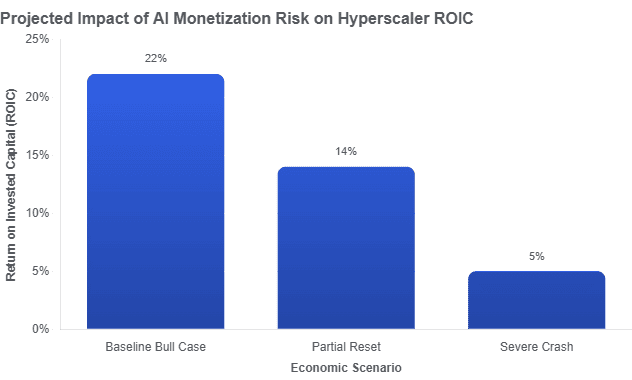
References:
https://www.nytimes.com/2026/08/10/business/ai-nvidia-lenders-500-billion.html
https://www.wheresyoured.at/dont-look-up/
Curmudgeon: Caveat Emptor: Huge Debt and Circular Financing Deals Dominate AI Build-Outs (07/23/26)
Merry-go-round of dog chasing its tail: Relationship between U.S. hyperscalers and private Gen AI companies
AI infrastructure spending boom: a path towards AGI or speculative bubble?
Expose: AI is more than a bubble; it’s a data center debt bomb
Will Google Cloud’s AI and data analytics revenue +TPU IP licensing income offset huge AI CAPEX to produce a decent ROI?
Amazon’s Jeff Bezos at Italian Tech Week: “AI is a kind of industrial bubble”
Big Tech AI spending binge results in massive job cuts!
AI spending boom accelerates: Big tech to invest an aggregate of $400 billion in 2025; much more in 2026!
FT: Scale of AI private company valuations dwarfs dot-com boom
Big tech spending on AI data centers and infrastructure vs the fiber optic buildout during the dot-com boom (& bust)
AI Data Center Boom Carries Huge Default and Demand Risks
Can the debt fueling the new wave of AI infrastructure buildouts ever be repaid?
Gartner: AI spending >$2 trillion in 2026 driven by hyperscalers data center investments
Will billions of dollars big tech is spending on Gen AI data centers produce a decent ROI?
Hyperscaler AI Race: Soaring Capex Wipes Out Free Cash Flow; AGI and Digital Gods
| Company | 2024 (Actual) | 2025 (Actual) | 2026 (Current Guidance / Est) | 2027 (Projected) |
|---|---|---|---|---|
| 📦 Amazon | $53B | $112B | $195B – $210B | $230B – $260B |
| 🔍 Alphabet (Google) | $51B | $104B | $195B – $205B | $240B – $280B |
| 💻 Microsoft | $56B | $108B | $185B – $195B | $220B – $250B |
| ♾️ Meta | $38B | $85B | $125B – $145B | $150B – $180B |
| 🗄️ Oracle | $13B | $25B | $45B – $50B | $55B – $65B |
| 🧮 Combined Aggregate | $211B | $434B | $745B – $805B | $895B – $1,035B |
The huge increase in hyperscaler capex, wipes out their free cash flow (revenues-expenses is now negative for all but Microsoft). The shift in focus by investors from earnings to free cash flow marks a turning point in market perceptions. The correct way to describe free cash flow is the cash flow a company generates during a period of time that is available to be paid to the company’s shareholders and debtholders.Companies with negative free cash flow are only able to cover the interest and principal on their debt by additional borrowing or by issuing new equity. In other words, cash is flowing from investors to the company, not the other way around. In a financial crisis, investors become unwilling to support companies not able to cover interest and principal, with the result being a cascade of defaults and runs on financial institutions.
A major concern with the massive AI-capex which has occurred during the last two years is that much of it is debt financed. As the real cost of generative AI-tokens is becoming clear, lower priced Chinese competitors are emerging, and AI customers are beginning to economize on their use of AI. As a result, investors are becoming increasingly alarmed about whether U.S. AI firms will be able to cover their debt obligations. AI-capex has been the main, and perhaps only driver of U.S. economic growth. If more companies announce negative free cash flows, that increase in magnitude, the financial system and overall economy will move closer to the tipping point.
…………………………………………………………………………………………………………………………………………………………………………………………………………………………………………………………………………….
But wait, Google/Alphabet co-founder says it’s more about winning AI market share than skyrocketing capex or ROI. On Patrick O’Shaughnessy’s Invest Like the Best podcast, Gavin Baker, Chief Investment Officer for Atreides Management, shared an anecdote about what’s been going on within Google/Alphabet offices. According to Baker, Google co-founder Larry Page has been telling Google employees, “I am willing to go bankrupt rather than lose this race.” That shows how high the person who led Alphabet through its halcyon days thinks the stakes are in AI.
References:
https://www.fool.com/investing/2024/08/31/thinking-of-selling-nvidia-stock-larry-page-quote/
Curmudgeon: Caveat Emptor: Huge Debt and Circular Financing Deals Dominate AI Build-Outs
Merry-go-round of dog chasing its tail: Relationship between U.S. hyperscalers and private Gen AI companies
Ookla: AI platform reliability decreases as outages surge
Nvidia CEO Huang: AI is the largest infrastructure buildout in human history; AI Data Center CAPEX will generate new revenue streams for operators
Hyperscaler capex > $600 bn in 2026 a 36% increase over 2025 while global spending on cloud infrastructure services skyrockets
Will billions of dollars big tech is spending on Gen AI data centers produce a decent ROI?
Ookla: AI platform reliability decreases as outages surge
So you thought “AI Hallucinations” were the only big problem with AI performance? Think again! In a new Ookla reliability report, data from its Downdetector reveals that AI platform outages surged from 6 high-disruption days in Q1 2025 to 51 in Q1 2026 , as AI tools transitioned from novelties to critical business infrastructure. These disruptions stem from rapid scale-up volatility, cloud provider failures, and complex, agentic workflows. Analysing 471 days of US Downdetector data from 1 January 2025 to 16 April 2026 across ChatGPT, Claude, Gemini, Microsoft Copilot, AWS and Microsoft Azure, Ookla recorded 3.7 million user-reported problems.
High-signal disruption days, defined as when a service recorded more than 10 times its own median daily report volume, rose from six across four major AI apps in Q1 2025 to 51 in Q1 2026, according to the report by Ookla analyst Luke Kehoe.

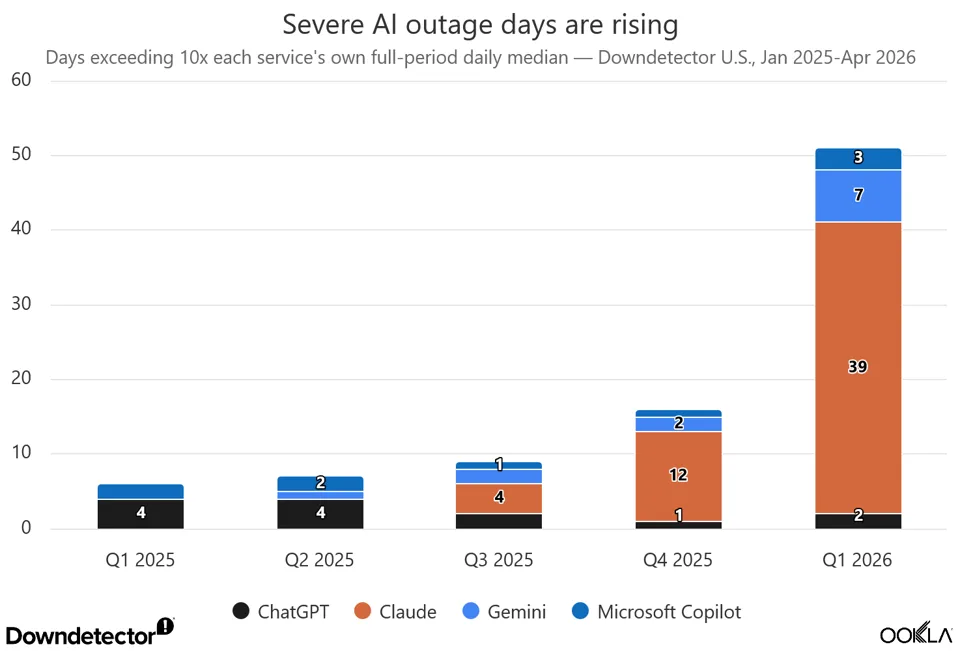
Anthropic’s Claude model accounted for 39 of those 51 disruption days. Gemini accounted for seven, Copilot three and ChatGPT two. Here’s a summary:
- Claude: Anthropic’s platform was the clearest example of scale-up volatility, accounting for 39 of the 51 high-signal disruption days in early 2026 due to rapid adoption and scaling.
- ChatGPT: While it generated some of the largest raw disruption spikes—often linked to model updates or demand surges—its median daily report trend improved compared to the prior year.
- Microsoft Copilot: Outage reports heavily clustered on weekdays, reflecting its core integration into enterprise business workflows rather than consumer use.
- Gemini: Incidents rose to seven alongside expanding user adoption.
- Cloud Infrastructure: A significant portion of AI downtime wasn’t the AI model itself, but outages at the cloud level that caused cascading failures. AWS’s 20 October 2025 DynamoDB DNS event generated more than 315,000 US disruption reports, while Microsoft’s Azure Front Door incident on 29 October produced nearly 96,000, illustrating how failures in cloud control planes can cascade into AI platform disruptions.
Claude’s growth over the past 12 months was accompanied by significant disruption. Ookla describes it as “the clearest example of scale-up volatility,” with disruptions to its offering starting to move the needle in July last year as adoption rose. There’s a hint that the upward trajectory will continue – Ookla notes that at 2,830 daily reports on average, Claude’s report volume in March was three times that it recorded in February.
AI reliability now spans multiple failure layers:
AI platforms are not single systems from the user’s point of view, even when they present a single interface. A ChatGPT, Claude, Gemini, or Copilot failure can sit in the product layer, the provider orchestration layer, the hyperscaler layer, or the edge and access layer. The product layer is what users actually see. The provider orchestration layer includes login, routing, model selection, rate limits, feature flags, inference scheduling, retry behavior, and capacity allocation. The hyperscaler layer includes compute, databases, storage, networking, and regional control planes. The edge and access layer includes DNS, web gateways, bot protection, content delivery, and authentication flows.
Ookla’s Kehoe wrote, “As AI systems move from short chat sessions into longer-running agentic tasks, a failed prompt, login loop, stalled code task, unavailable file, or broken connector can interrupt work that now sits inside real business processes.” This is a very serious concern!

Those layers are not always owned by different companies, and they are not the full physical internet stack. Network operators, subsea cables, data centers, and user access networks still matter. The focus here is narrower: the service and dependency layers that are most visible in Downdetector data and public incident records.
This distinction is important because the same user-facing symptom can have different operational meanings. A failed prompt, login loop, missing chat history, rate-limit error, unavailable file, or stalled agent task may not share the same root cause. For enterprise buyers and risk teams, resilience is about understanding more than whether an AI platform was simply available. They need to know where the issue occurred, which workflows were affected, and whether it reflected a problem with a single provider or a broader dependency across the AI stack.
…………………………………………………………………………………………………………………………………………
References:
https://www.ookla.com/articles/ai-platform-reliability
https://www.mobileworldlive.com/ai-cloud/ookla-finds-ai-platform-outages-surge-as-adoption-grows
https://www.telecoms.com/ai/ai-app-disruption-is-on-the-up
Will 2026 be the “Year of the AI Ontology” for telecoms?