

AI Partnerships
TM Forum’s DTW Ignite 2026: Open Digital Architecture (ODA); Nokia, Ericsson, IBM and Mavenir AI announcements/cloud partnerships
-
- Shift to Action: TM Forum Vice President Aaron Boasman-Patel and CEO Nik Willetts opened the summit emphasizing that the industry must move past abstract C-suite visions.
- The AI Economy: The flagship keynote officially launched the “Race to 2030,” a direct directive tasking operators to secure their market relevance by deploying high-velocity, production-grade architectures.
-
- On-Stage AI Co-Hosts: In an industry event first, agentic AI systems took the stage alongside human moderators to act as live panel co-hosts, digital analysts, and experts.
- Summit Intelligence Layer: Advanced AI systems recorded and indexed every keynote, panel, and breakout session, functioning as a real-time intelligence layer to deliver daily trend summaries to attendees.
-
- Autonomous Networks (AN): Featuring the largest showcase of live autonomous operating systems to date. Major case studies from carriers like China Mobile, China Telecom, TDC NET, and Telefónica showcased functional solutions for self-optimizing networks, RAN energy efficiency, and fast fault resolution.
- Trustworthy AI and Data: Discussions zeroed in on scaling responsible AI, exploring Models-as-a-Service (MODaaS) frameworks, managing tokenomics, and reinforcing cyber resilience.
- Composable IT and Ecosystems: Demonstrations focused on scaling Open Digital Architecture (ODA) from boardroom design into functional, interoperable engineering realities.
Practical Engineering & Showcases:
- Catalyst Showcases: The exhibition floor hosted over 60 collaborative proof-of-concept Catalyst projects and Innovation Engine live demonstrations.
- New Interactive Hubs: The event debuted dedicated “Mission Garages” for hands-on engineering collaboration, along with a specialized Future Skills program to help tech teams adapt to AI-native workflows. [1]
- Major Tech Partnerships: Industry titans—including IBM, Ericsson, Cisco, and Nokia—used the floor to debut subsea infrastructures, physical AI, and cloud-native automation frameworks.
Note 1. DTW Ignite 2026 is TM Forum’s flagship global connectivity event focused on accelerating AI-native telcos, autonomous networks, and composable IT. The event is from June 23 to June 25 at the Bella Center in Copenhagen, Denmark.
……………………………………………………………………………………………………………………………………………………………….
At the show, the TM Forum and its member alliance of over 850 companies across 180 countries, announced a major structural evolution for the Open Digital Architecture (ODA), shifting it from a cloud-native IT modernization blueprint into an AI-native execution environment. The core focus of these updates is to establish standardized, executable reference frameworks that allow operators to move beyond fragmented AI pilots and build an autonomous enterprise. The primary ODA updates and structural expansions announced at the summit include:
-
- Governed Execution Layer: TM Forum members launched AI-native extensions to the ODA specification, adding a governed execution layer. This allows autonomous AI agents and large language models to run natively within the existing ODA component architecture and Open APIs.
- Project Foundation & AI Canvas: Through the Demo ONE Catalyst project, tech leaders debuted an updated AI-Native ODA Canvas. This cloud-native runtime environment orchestrates data, AI models, and autonomous agents across fragmented BSS, OSS, and network domains to replace rigid legacy systems.
- Model-as-a-Service (MODaaS): To solve the challenge of rising token costs and fragmented model selection, an ODA-aligned MODaaS framework was introduced. It establishes a unified control plane to govern, secure, and manage AI model usage across the carrier architecture.
-
- Space-Telco Interoperability: In a major scope expansion, TM Forum officially launched the ODA for Satellite project. Supported by 16 foundational partners—including Airbus, Terrestar, and Vodacom—the initiative targets multi-billion dollar direct-to-device and space-connectivity markets.
- Unified Non-Terrestrial Frameworks: The project extends standard ODA components to satellite technology providers, standardizing how terrestrial mobile networks and non-terrestrial networks (NTNs) handle cross-industry billing, service delivery, and zero-touch roaming integrations.
- Plug-and-Play Validation: TM Forum rolled out its newly expanded ODA Component Certification. This toolkit gives vendors a programmatic way to verify that their commercial software components are truly plug-and-play ready, lowering custom integration costs for telecom buyers.
- “Running on ODA” Milestones: The alliance celebrated that 18 global Communication Service Providers (CSPs), representing over two billion subscribers globally, have officially achieved “Running on ODA” accreditation—confirming that modular, componentized architecture has reached full scale in production environments.
……………………………………………………………………………………………….
Vendor Announcements:
- Amazon Web Services (AWS) Expansion: Nokia and AWS expanded their partnership to run Nokia’s Autonomous Networks Fabric natively on AWS. The integration brings operators closer to Level 4 network autonomy, enabling networks to orchestrate, analyze, and heal themselves at machine speed.
- Google Cloud Integration: Nokia deepened its alliance with Google Cloud to integrate Gemini models into the Nokia Assurance Center. They unveiled six specialized generative AI agents (including a Router Agent and Event Triage Agent) to automatically process data and isolate the root causes of service faults. It launches as a SaaS offering in September 2026.
- Databricks Proof of Concept: Nokia and Databricks announced the completion of a joint project showing a unified, cloud-agnostic data platform. This resolves a legacy pain point by unifying hundreds of fragmented operational silo data architectures so multi-agent AI can run seamlessly across networks.
- GenAI-Native Operations: Instead of relying on traditional rules-based code, Nokia’s new interfaces allow field engineers to query complex multi-vendor topologies, generate diagnostic code, and run natural-language root-cause analyses on real-time traffic faults.
- Autonomous Network Scaling: Nokia presented multi-party Catalyst project solutions targeting network optimization, zero-touch slicing, and automated enterprise edge deployments tailored for the 5G-Advanced landscape.
……………………………………………………………………………………………………………………………………………………….
- EIAP Core Expansion: The headline announcement from the Ericsson Cloud Software and Services division was the expansion of the Ericsson Intelligent Automation Platform (EIAP). Formerly restricted to RAN operations, the platform now fully integrates and unifies Radio Access Network (RAN) and core network automation systems.
- Introduction of cApps: Ericsson claimed a major industry first by rolling out core-specific automation applications (cApps). These decentralized apps allow operators to run automated routines directly on core architectures, streamlining cross-domain workflows to cut operations costs.
- Business Value Pathways: Ericsson debuted a structured strategic blueprint designed to guide Communication Service Providers (CSPs) through the financial steps of scaling from Level 3 to Level 4 autonomous networks.
…………………………………………………………………………………………………………………………………………………….
- Addressing the “AI Trust Gap”: Responding to a TM Forum study revealing that only 14% of operators can prove their AI systems are fully reliable, IBM presented framework tools at DTW Ignite to address security and model bias.
- B2B2X Monetization: IBM focused its platform showcase on orchestrating automated workflows for multi-enterprise B2B2X networks, enabling secure data federation across third-party hyperscalers and edge servers.
……………………………………………………………………………………………………………………………………………………
- Telco-First Cloud Architecture: Stationed at Booth 334, Mavenir debuted its updated AI-by-design, cloud-native software portfolios built natively around TM Forum’s Open Digital Architecture (ODA) frameworks.
- Closed-Loop Automation: Mavenir demonstrated actionable frameworks that handle real-time resource adjustments, shifting power and processing capacity across base stations based on AI-predicted user demand cycles.
……………………………………………………………………………………………………………………………………………………
References:
https://www.tmforum.org/events/dtw/experience-dtw/new-for-2026
Inside TM Forum’s Catalyst project “Living Networks – Phase III”
Deloitte and TM Forum : How AI could revitalize the ailing telecom industry?
The Financial Trap of Autonomous Networks: Scaling Agentic AI in the Telecom Core
GSMA, ETSI, IEEE, ITU & TM Forum: AI Telco Troubleshooting Challenge + TelecomGPT: a dedicated LLM for telecom applications
SHIELD-6G with AI-native cyber threat intelligence platform to enhance cybersecurity for Europe’s future 6G networks
Verizon’s 6G Innovation Forum joins a crowded list of 6G efforts that may conflict with 3GPP and ITU-R IMT-2030 work
Private 5G networks move to include automation, autonomous systems, edge computing & AI operations
Ericsson integrates Agentic AI into its NetCloud platform for self healing and autonomous 5G private networks
Inside Nokia’s new AI Networking Innovation Lab
- Silicon & Compute: Collaborating with AMD to optimize enterprise AI workloads alongside Nokia data center switches.
- Testing & Infrastructure: Partnering with Keysight Technologies to emulate workloads across Ultra Ethernet Consortium (UEC) and RoCEv2 transports.
- Hardware & Servers: Integrating high-performance platforms from Lenovo and Supermicro.
- Data Storage & Cloud: Working with Weka and cloud builders like Nscale to eliminate storage bottlenecks during heavy computational training.
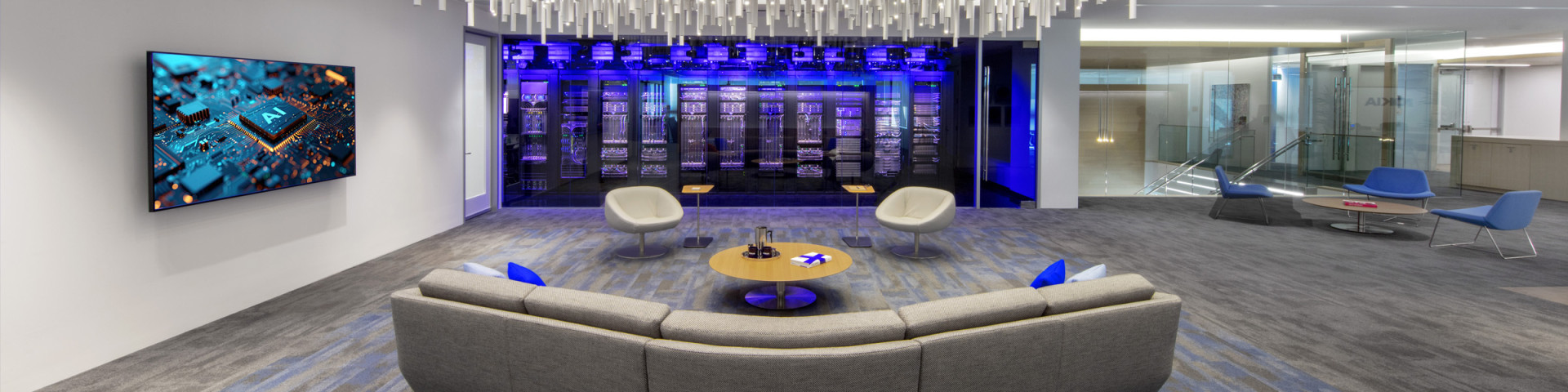
Nokia’s AI Networking Innovation Lab is built upon three fundamental pillars: Technology Innovation, Ecosystem Collaboration, and Validation. Image credit: Nokia
………………………………………………………………………………………………………………….
Technology Innovation: The lab provides a dedicated space for AI partners to experiment with next-gen solutions across the entire networking stack – driving emerging standards forward with pioneering approaches to new protocols, switching silicon, congestion control, real-time telemetry, and automation.
“Partnering with Nokia in the AI Networking Innovation Lab has enabled us to benchmark and optimize AI networks under real-world conditions…Together, we are helping accelerate AI network adoption by giving operators and hyperscalers the validated insights needed for confident, large-scale deployment.”
Ecosystem Collaboration: True progress depends on a strong ecosystem of technology providers – silicon manufacturers, GPU developers, system, storage and test vendors, and cloud platforms – that work together to create highly-compatible AI-ready solutions. This facilitates joint testing for interoperability, improves integration, and ensures roadmaps are aligned across different hardware, software, and orchestration layers.
Travis Karr, Corporate Vice President, HPC and Sovereign AI at AMD believes customer collaboration and an open ecosystem are fundamental to accelerating AI innovation:
“By co-developing solutions with partners, such as Nokia in their AI networking innovation lab, we ensure our AMD enterprise AI solutions are tested with Nokia data center switches on real-world workloads and network demands. An open, standards-driven approach empowers customers to integrate seamlessly across heterogeneous environments, avoiding lock-in and fostering industry-wide advancement in AI.”
Validation: This positions the lab as the testing ground for Nokia Validated Designs, where customers and partners rigorously validate multi-vendor data center architectures under authentic AI training and inference workloads. By testing failure scenarios, congestion behavior, and operational automation, the lab turns NVDs into proven, deployable solutions — enabling predictable performance, faster deployment, and reduced operational complexity and risk for organizations navigating the AI era.
Arno van Huyssteen, Vice President of Global Telecommunications for Nscale:
“Nokia is a strategic networking partner for Nscale as we build towards AI Grid, and the engineering rigour behind their Validated Designs reflects the kind of innovation needed to enable next-generation AI infrastructure. The depth of hardware, software and failure testing behind those blueprints is what will give operators the confidence to deploy complex AI environments faster, with fewer integration risks and less operational disruption. We’re excited to collaborate in the AI Networking Innovation Lab to help push the boundaries of AI-native networking and validate the next generation of solutions before they reach production.”
A primary focal point inside the lab is managing data center congestion. Unlike traditional cloud traffic, back-end AI networks feature high-density data synchronization across massive GPU clusters. The lab uses advanced automation, AIOps, and lossless Ethernet solutions—such as the Nokia 7220 IXR-H6 switches—to handle these intense uplink and synchronization demands safely.
The AI Networking Innovation Lab supports Nokia’s broader strategy to accelerate the next era of AI-driven connectivity. As demand for AI infrastructure continues to grow, data center networking has become one of the most critical foundations of the global AI ecosystem. Through this investment, Nokia is strengthening its capabilities in AI and cloud infrastructure while advancing its vision of AI-native networking.
Rudy Hoebeke, Vice President of Software Product Management at Nokia:
“The launch of Nokia’s AI Networking Innovation Lab marks a major milestone in our commitment to drive the next era of AI-native connectivity. As the industry continues to evolve with solutions like scale-across and AI-Grid, this lab is poised to accelerate AI networking technology that will not only support but optimize these emerging industry offerings. This center gives our customers and partners early access to new technologies, deeper collaboration with the world’s leading AI ecosystem players, and the confidence that their networks are validated under more realistic AI conditions. By accelerating innovation and reducing deployment risks, we’re enabling the industry to deliver faster, more reliable, and more sustainable AI experiences to people and businesses everywhere.”
………………………………………………………………………………………………………………………
References:
Analysis: Nokia’s strong growth in Optical Networks and AI network infrastructure
Orange, Nokia, Nvidia, and Intel debate: ASICs vs. GPUs vs. General-Purpose CPUs for RAN Baseband Processing
Nokia’s AI Applications Study: “Physical AI” may require RAN redesign to support high‑volume, low‑latency uplink traffic
Australia’s NBN and Nokia demonstrate multi-generation optical technologies concurrently over existing FTTP infrastructure
Nokia to showcase agentic AI network slicing; Ericsson partners with Ookla to measure 5G network slicing performance
Tampnet to expand 5G offshore connectivity in the Gulf of Mexico using Nokia AirScale 5G radios
Dell’Oro: Analysis of the Nokia-NVIDIA-partnership on AI RAN
Merry-go-round of dog chasing its tail: Relationship between U.S. hyperscalers and private Gen AI companies
1. Hyperscalers’ earnings growth this quarter was boosted by an unusually large contribution from “other income,” which was actually mark-ups of their equity stakes in private Gen AI companies. For example:
- Nearly half of Alphabet’s (Google) record $62.6 billion profit—about $28.7 billion—did not come from search ads, cloud services or any of its products at all. It came from Alphabet updating the value of the equity it owns in private AI companies, primarily Anthropic. Alphabet holds a 14% stake before the announcement of an additional $40 billion commitment last week.
- Amazon’s earnings release stated that first-quarter net income “includes pre-tax gains of $16.8 billion included in non-operating income from our investments in Anthropic”—more than half of Amazon’s pre-tax income (or profit) for the quarter.
- Alphabet and Amazon generated “other income” totaling $53 billion in Q1 2026, which accounted for nearly 60% of those two companies’ total net income in Q1 and 34% of the total $155 billion in income this quarter. Of this $53 billion in “other income,” $49 billion was explicitly due to equity stakes in private AI companies.
- Microsoft reported “only” $942mn of other income in the first three months of the year, but this line item has now made $7.2bn over the past nine months.
- Under U.S. accounting rules, publicly traded firms must adjust and report the assessed value of their private equity holdings every quarter. Because private AI start-ups like Anthropic experienced meteoric valuation updates (e.g., Anthropic climbing to an estimated $380 billion), both Alphabet and Amazon were required to record those massive “on-paper” gains directly to their bottom-line net income.
- When the AI bubble finally bursts (and it will) the private AI companies assessed market value will collapse, resulting in “impairment write-downs” and huge earnings declines for the hyperscalers, e.g. Amazon, Google/Alphabet, Microsoft, FB/Meta, and Oracle.
2. Now here’s the merry-go-round/ dog chasing its tail relationship:
Not only have private investments and increasingly engorged funding rounds become a meaningful driver of the hyperscalers’ aggregate earnings, but the money the hyperscalers have pumped into the likes of Anthropic and OpenAI has allowed those private AI companies to sign huge computing deals with Alphabet’s Google Cloud, Microsoft’s Azure and Amazon Web Services (AWS). OpenAI and Anthropic now make up about half of the entire cloud computing order books at Oracle, Alphabet, Amazon and Microsoft!
Indeed, AI startups have loaded up hyperscalers with unprecedented long-term financial commitments.
–>OpenAI and Anthropic make up over $1 trillion of the estimated $2 trillion cumulative revenue backlog currently held by major cloud service providers!
- OpenAI to Microsoft Azure: Internal documents show OpenAI’s massive server rentals have generated more than $23 billion in direct cloud spending for Microsoft.
- Anthropic to Google Cloud: Anthropic signed a contract committing to spend $200 billion over five years on Google’s cloud infrastructure and TPU chips.
- Anthropic to AWS: In tandem with a fresh $5 billion investment from Amazon, Anthropic committed to spend over $100 billion over the next decade on AWS technologies.

Image Generated by Chat GPT
……………………………………………………………………………………………………………………………………………………………
-
- Backlog Percentage: Over 40%. Anthropic‘s $200 billion Multi-Year Commitment accounts for nearly half of Google Cloud’s total disclosed $240 billion revenue backlog.
- Current Revenue Share: Estimated 12% to 15% of its current $20 billion quarterly revenue run-rate is driven directly by AI infrastructure consumption from startups (both frontier labs and over 40 mid-tier AI companies built on Google Cloud Vertex AI).
-
- Current Revenue Share: Estimated 15% to 18%. Microsoft’s annualized AI revenue run-rate hit $37 billion. A massive chunk of Azure’s overall 40% growth rate is anchored directly by OpenAI’s compute demands and the commercialization of OpenAI-tied products.
- Current Revenue Share: Estimated 6% to 8%. While AWS has the largest overall cloud scale ($150 billion annual run rate), its revenue is traditionally diversified across enterprise SaaS and retail. However, Anthropic’s new $100 billion infrastructure commitment means AWS’s revenue mix is aggressively shifting toward AI startups. [1, 2, 3, 4]
–>This is another sign of just how incestuously codependent the big tech industry is to astronomically valued private AI start-ups.
…………………………………………………………………………………………………………………………………………………………..
4. Another example of this codependency is Oracle and OpenAI’s massive, debt-fueled financial loop. In September 2025, the two companies signed a staggering five-year, $300 billion cloud-computing contract. This single deal radically transformed both companies’ financial profiles, binding their survival together as inextricably tied.
-
- For Oracle: The $300 billion contract instantly added to Oracle’s Remaining Performance Obligations (RPO), which skyrocketed 359% to $455 billion. This accounting metric allowed Oracle to position itself as a dominant “hyperscaler,” pushing its market cap upward.
- For OpenAI: The contract allowed OpenAI to claim it had secured the long-term compute capacity needed to achieve Artificial General Intelligence (AGI). This backed up its massive valuations, enabling OpenAI to close a historic $122 billion funding round in March 2026 at an $852 billion valuation.
- Oracle is a Financial Proxy for OpenAI: If OpenAI faces a “credit event” or cash crunch, Oracle’s stock directly plummets. Critics note that Oracle signed a contract with a startup that historically burns far more cash than it takes in, making OpenAI’s ability to actually pay the $300 billion highly volatile.
- The Debt Spiral: To physically fulfill OpenAI’s compute demands, Oracle has gone on a massive, debt-fueled construction spree. Oracle raised $18 billion in bonds in late 2025 and an additional $30 billion in early 2026. Its capital expenditures have eclipsed operating cash flows, leading to deeply negative free cash flow and over $134 billion in total corporate debt.
-
- Project Finance Bottlenecks: Major commercial banks have struggled to syndicate the massive multi-billion-dollar construction loans Oracle needs to build out the required data centers (such as its 4.5-gigawatt capacity goals).
- Bank Limits: The sheer volume of debt concentrated around this single enterprise relationship has pushed several Wall Street institutions against their regulatory exposure limits for a single corporate partnership.
……………………………………………………………………………………………………………………………………………………………………………………………
References:
https://www.ft.com/content/be97df0a-76b1-4cb0-9ba4-d1117d8d1450
https://fortune.com/2026/04/30/google-amazon-ai-profits-anthropic-stake-bubble-earnings-2026/
https://finance.yahoo.com/sectors/technology/articles/google-amazon-biggest-profit-driver-170449859.html
AI infrastructure spending boom: a path towards AGI or speculative bubble?
Expose: AI is more than a bubble; it’s a data center debt bomb
Amazon’s Jeff Bezos at Italian Tech Week: “AI is a kind of industrial bubble”
Open AI raises $8.3B and is valued at $300B; AI speculative mania rivals Dot-com bubble
China’s open source AI models to capture a larger share of 2026 global AI market
OpenAI and Broadcom in $10B deal to make custom AI chips
Generative AI Unicorns Rule the Startup Roost; OpenAI in the Spotlight
AI-RAN Reality Check: hype vs hesitation, shaky business case, no specific definition, no standards?
Introduction:
The narrative surrounding “AI-RAN” — a term thrust into the spotlight by Nvidia — may have left many believing that boatloads of GPUs are already powering baseband compute in RAN equipment across the world’s seven million mobile sites. In truth, the reality is far more nascent.
Among major RAN vendors, Nokia stands alone in adapting baseband software for GPU acceleration. Yet even Nokia does not anticipate commercial readiness until late 2026, as confirmed by its Chief Technology Officer, Pallavi Mahajan, during the company’s MWC press conference earlier this year. For now, no operator has announced a commercial deployment — despite the buzz around trials.
Early Movers, Limited Momentum:
Much of the current AI-RAN activity centers on two operators: T-Mobile US and Japan’s SoftBank. At MWC, T-Mobile’s Executive Vice President of Innovation and ex-CTO, John Saw, acknowledged the limited availability of deployable solutions, quipping that he hoped Nokia would deliver an AI-RAN product within the year. Nokia CEO Justin Hotard quickly assured him that such a milestone was indeed on track.
Still, the debut of a GPU-based RAN stack does not imply an imminent large-scale rollout. Without tangible network performance or cost advantages over existing virtualized or disaggregated RAN approaches, operators are unlikely to move past controlled trials.
SoftBank, while often positioned as an AI-RAN pioneer, remains cautious. As Ryuji Wakikawa, Vice President of its Advanced Technology Division, outlined last year, the operator aims to deploy only a handful of AI-RAN sites over the next fiscal cycle. Transitioning from testing to carrying live commercial traffic, he emphasized, demands a significant maturity leap in quality and feature completeness.
Beyond Hype: Limited Commercial Engagement:
Elsewhere, Indonesia’s Indosat Ooredoo Hutchison (IOH) was heralded in 2025 as the first operator in Southeast Asia pursuing AI-RAN. More than a year later, authoritative sources indicate IOH’s work remains confined to its research facility in Surabaya, with no near-term plans for GPU investment at cell sites until measurable value is demonstrated.
The challenge for Nokia — and for GPU-backed AI-RAN broadly — is convincing operators that general-purpose accelerators offer sufficient performance or efficiency gains for most RAN workloads. T-Mobile and SoftBank continue evaluating both Nokia and Ericsson, whose AI-RAN philosophies diverge sharply. Nokia is developing GPU-based baseband software, while Ericsson maintains its focus on custom silicon and CPU architectures.
Divergent Architectures and Use Cases:
Ericsson contends that no core RAN performance enhancements intrinsically require GPUs. Its ongoing collaboration with Nvidia leverages the latter’s Grace CPU technology rather than its GPU portfolio, reserving GPU acceleration only for compute-intensive functions like forward error correction (FEC).
If Ericsson’s premise holds, GPUs in the RAN become justifiable only when supporting AI inference workloads. Even then, inference at every radio site remains improbable. A more incremental strategy — deploying GPUs selectively at edge locations where AI workloads justify their cost — may prove more practical.
This modular approach aligns with existing virtual RAN deployments based on Intel CPUs, which already include native FEC acceleration. “It is an off-the-shelf card that you can slide right into an HPE or Dell or Supermicro server,” said Alok Shah, the vice president of network strategy for Samsung Networks. “That gets you the edge functionality you are looking for.”
Rethinking the Economic Case for AI RAN:
Initially, Nvidia positioned GPUs for AI-RAN as viable only if broadly utilized for AI inference across the RAN. Following its strategic alignment with Nokia, however, the company has softened its stance — now suggesting that appropriately sized, power-efficient GPUs could make sense even when dedicated solely to baseband computation.
For now, the global RAN landscape remains far from GPU-saturated. AI-RAN remains an exploratory frontier — one testing not only the technical feasibility of GPUs at the edge, but also the economic/business case rationale for re-architecting a trillion-dollar telecom infrastructure around them.
The AI models suitable for RAN environments must be compact and efficient, far slimmer than those that drive data center-scale AI. There’s no room for the massive, parameter-heavy neural networks that justify a GPU’s cost or energy appetite. In that light, a GPU looks less like a breakthrough and more like a mismatch — a chainsaw brought to a task better handled with a sharp pair of scissors.
Evaluating the Case for AI-RAN Acceleration:
The central question is whether GPUs can deliver meaningful benefits over custom silicon or conventional CPUs for RAN compute. Ericsson’s engineers argue that AI models deployed at the RAN must remain relatively lightweight, with far fewer parameters than those used in large-scale data centers. Excessive model complexity could introduce signaling delays unacceptable in real-time radio environments. In this context, deploying a GPU for such workloads might seem disproportionate — a high-powered tool for a low-demand task.
The most compelling defense of GPU-based RAN acceleration came from Ronnie Vasishta, Nvidia’s Senior Vice President for Telecom, who told Light Reading last summer, “The world is developing on Nvidia.” His point underscores a shift in semiconductor economics: the cost and risk of building dedicated silicon for a mature and shrinking RAN market make general-purpose processors — supported by large-volume ecosystems — increasingly attractive alternatives.
Intel’s difficulties further illustrate this dynamic. Despite $53 billion in revenue during 2025, the former microprocessor king barely broke even despite $53 billion in revenue, following a $19 billion loss the previous year. A major restructuring cut its headcount by nearly 24,000, and its planned spinoff of the Network and Edge division — serving telecom infrastructure customers — was ultimately abandoned in December. Nvidia, the world’s most valuable company, may be eager to step into that space — but the economic logic seems upside down. Wireless network operators are looking to reduce costs, not import data center economics into the RAN.
Ecosystem or Echo Chamber?
Nvidia’s Aerial platform and CUDA-based software ecosystem do present a compelling story: open infrastructure, modular APIs, and space for smaller developers to innovate alongside giants like Nokia. On paper, it’s an alluring image of democratized RAN software. In practice, it ties the industry even more tightly to a vertically integrated, proprietary ecosystem.
Nokia appears comfortable with that trade-off. Nokia CTO Pallavi Mahajan’s recent blog post framed AI-RAN as a vehicle for “software speed and innovation.” He added, “Nokia’s AI-RAN initiative begins with a simple observation: AI is changing not only how networks are operated, but also the nature of the traffic they carry. AI workloads have already reached massive scale, with mobile devices accounting for more than half of AI interactions. Large language model interactions introduce richer uplink flows and burstier patterns as devices continuously send context to models.”
Indeed, that me be true someday. But for now, most wireless network operators need stable, cost-efficient networks, not AI-driven complexity or GPU-level power draw.

Image Credit: Nokia
Conclusions:
The uncomfortable truth is that AI-RAN feels more like a vendor-driven experiment than an operator-driven demand. Until someone proves that GPUs in the RAN deliver a measurable payoff — in performance, cost, or operational simplicity — the whole concept risks joining the long list of telecom “game-changers” that never made it past the trial stage. The hype cycle is predictable; the economics are not. Unless that equation changes, the real intelligence may be knowing when not to deploy AI RAN.
………………………………………………………………………………………………………………
In a Substack post today, Sebastian Barros writes: What Does AI-RAN Even Mean?
Despite the crazy hype, there is no definition for AI-RAN. Today it is at best a vibe, a dangerous reality for an industry that moves on strict standards that are currently completely absent.
The AI RAN hype is crazy right now. But despite the endless talk and vendor announcements, there is no actual technical definition of what it even means. As wild as it sounds for an industry built on strict 3GPP and O-RAN standards (those are specs- not standards), AI RAN is currently just a vendor interpretation designed to move hardware. Moreover, telecom has been using AI in the RAN before it was even cool. In fact, we were among the first industries to use neural networks in signal processing back in the 80s.
The problem is that treating AI-RAN as a marketing narrative rather than a rigid standard actively stalls progress. When the definition of AI-RAN is as different as night and day depending on which OEM you ask, it becomes impossible for any Telco to accurately model TCO or make solid CAPEX decisions.
Editor Notes:
- ITU-R’s IMT-2030 framework (ITU-R Recommendation M.2160-0 for IMT-2030) calls for an AI-native new air interface and AI-enhanced radio networks, but does not mention Nokia’s AI RAN.
- 3GPP Release 18 and later have study/work items on AI/ML for RAN functions such as energy saving, load balancing, mobility optimization, and AI/ML on the RAN air interface, but again no specifics have been discussed let alone agreed upon.
- 3GPP Release 19 continues and expands this work, with reporting that it builds on Release 18’s normative work and adds new AI/ML-based use cases for NG-RAN. In other words, 3GPP does have AI-RAN-related specs in progress and some normative features, but they are distributed across multiple RAN work items rather than packaged as one standalone “AI RAN” specification.
- AI RAN Alliance “is dedicated to driving the enhancement of RAN performance and capability with AI.” However, they’ve not yet produced any implementable specifications for AI RAN. Yet there are only four carriers that are “executive members“: Vodafone, T-Mobile, and SK Telecom, and Softbank (which is a conglomerate).
In Japan, NTT Docomo holds the largest cellular market share, with KDDI second, followed by SoftBank and the rapidly expanding Rakuten Mobile.
References:
https://www.lightreading.com/5g/ai-ran-lots-of-talk-little-action-no-guarantees
https://www.nokia.com/blog/ai-ran-bringing-software-speed-innovation-into-the-radio-network/
Ericsson goes with custom silicon (rather than Nvidia GPUs) for AI RAN
Dell’Oro: RAN Market Stabilized in 2025 with 1% CAG forecast over next 5 years; Opinion on AI RAN, 5G Advanced, 6G RAN/Core risks
Dell’Oro: Analysis of the Nokia-NVIDIA-partnership on AI RAN
RAN silicon rethink – from purpose built products & ASICs to general purpose processors or GPUs for vRAN & AI RAN
Dell’Oro: AI RAN to account for 1/3 of RAN market by 2029; AI RAN Alliance membership increases but few telcos have joined
Dell’Oro: AI RAN to account for 1/3 of RAN market by 2029; AI RAN Alliance membership increases but few telcos have joined
AWS to deploy AI inference chips from Cerebras in its data centers; Anapurna Labs/Amazon in-house AI silicon products
Amazon Web Services (AWS) announced it plans to integrate AI processors from Cerebras Systems [1.] into its data centers, signaling growing confidence in the AI-focused semiconductor startup. Under a new multiyear partnership announced Friday, AWS will deploy Cerebras’s Wafer-Scale Engine (WSE) to accelerate inference workloads—the stage of AI operations where models generate responses to user queries. Financial details of the agreement were not disclosed.
Note 1. Founded in 2015 and headquartered in Sunnyvale, CA, Cerebras claims to have the world’s fastest AI inference and training platform.
The collaboration reflects a significant realignment in compute infrastructure strategies across the AI ecosystem. While initial industry focus centered on model training, the rapid expansion of deployed AI services is driving demand for optimized inference performance. Traditional GPUs, though unmatched for training, can be suboptimal for inference scenarios that require ultra-low latency and high throughput. Cloud and AI platform providers are therefore diversifying their silicon portfolios to better match workload profiles and to scale capacity efficiently.
AWS, the world’s largest cloud infrastructure provider, has traditionally relied on its in-house semiconductor division, Annapurna Labs, for custom chip design. Annapurna’s Trainium processors compete with GPUs from major suppliers such as Nvidia and AMD, offering cost and performance advantages for AI training workloads. The new partnership introduces Cerebras technology into AWS infrastructure, where it will work alongside Trainium to enhance large-scale inference capabilities.
Cerebras, best known for its wafer-scale architecture, markets its WSE processors as a high-speed inference platform capable of executing the decode phase of generative AI processing—where text, images, or other outputs are generated—at up to 25 times the speed of conventional GPU solutions. The company, valued at approximately $23 billion following a $1 billion funding round in February, has attracted backing from Fidelity, Benchmark, Tiger Global, Atreides, and Coatue.

The Cerebras deal underscores a major shift in the market for computing power. Image Credit: rebecca lewington/cerebras syste/Reuters
The AWS collaboration follows Cerebras’s major compute partnership with OpenAI, which reportedly involves deploying up to 750 MW of computing capacity powered by its chips. AWS and Cerebras will position their joint offering as a premium cloud inference solution, targeting enterprise AI developers requiring high-performance and scalable compute.
“The scale of AI demand is shifting from model creation to global deployment,” said Andrew Feldman, CEO of Cerebras. “Working with AWS aligns our technology with the industry’s largest cloud, giving us reach to a broad enterprise and developer base. If you want slow inference, there will be cheaper ways to go,” Feldman said. “But if you want fast tokens, if speed matters to you, if you’re doing coding or agentic work, not only are we the absolute fastest, but we intend to set the bar. We’re in this to win it.”

AWS and Cerebras will support both aggregated and disaggregated configurations. Disaggregated is ideal when you have large, stable workloads. Most customers run a mix of workloads with different prefill/decode ratios, where the traditional aggregated approach is still ideal. The start-up expects most customers will want access to both and the ability to route workloads to whichever configuration serves them best.
The move intensifies competition in the inference silicon segment, where Nvidia faces growing pressure from purpose-built processor architectures such as Cerebras’s WSE and other emerging alternatives. Nvidia, which recently announced a $20 billion licensing deal with Groq and plans to unveil a new inference-optimized platform, remains the dominant supplier but now contends with an accelerating wave of specialization across the AI compute stack.
AWS vice president and Annapurna Labs co-founder Nafea Bshara emphasized the company’s goal of offering flexible performance tiers. “Our job is to push the speed and lower the price,” he said, noting that AWS will continue to offer cost-optimized Trainium-only options alongside high-performance Cerebras-Trainium configurations.
………………………………………………………………………………………………………………………………………………………………………………………………….
Amazon’s Internally Designed AI Silicon:
Amazon has built a fairly broad internal AI-oriented silicon portfolio through Annapurna Labs, primarily for AWS:
-
Inferentia (Inferentia, Inferentia2) – Custom machine learning accelerators designed for high-throughput, low-cost inference at cloud scale. These power many AWS inference instances and are positioned as an alternative to Nvidia GPUs for production model serving.
-
Trainium (Trainium, Trainium2, Trainium3) – AI training accelerators optimized for large-scale model training (including frontier and foundation models), with Trainium2 and Trainium3 as newer generations offering materially higher performance and better $/compute than the first generation. These are central to projects such as the Rainier supercomputer for Anthropic.
-
Graviton (Graviton, Graviton2/3/4) – Arm-based general-purpose CPUs used heavily across EC2, increasingly in AI-adjacent roles (pre/post-processing, orchestration, model-serving microservices) and as part of cost-optimized AI stacks, even though they are not dedicated accelerators.
-
Nitro system – While not an AI accelerator per se, the Nitro family (offload cards and system) is an internally developed data-plane and virtualization offload architecture that underpins EC2 and works in tandem with Graviton, Inferentia, and Trainium to free CPU cycles and improve I/O for AI/ML workloads.
All of these are designed and iterated internally by Annapurna Labs for exclusive use in AWS data centers, then exposed to customers via AWS services rather than as standalone merchant silicon.
Amazon’s Annapurna Labs is an internal chip design group that has become a core strategic asset for AWS, especially for custom data center and AI silicon.
Origins and acquisition:
-
Annapurna Labs is an Israeli chip design startup founded in 2011 by semiconductor veterans of Intel and Broadcom, including Avigdor Willenz and Nafea Bshara.
- “When we talked with market sources and consulted with experts in the fields of data and servers, at that time only Amazon had a holistic vision and the ability to execute on a large scale,” recalls Bshara about the start of the romance with Amazon. “We were prepared to build the technology and at the same time were open to working with startups. From there we began a journey together with many meetings and shared thinking, among others with James Hamilton (Microsoft’s former data-base product architect and to AWS SVP), and from there within six months we found ourselves inside Amazon.”
-
Amazon began working with the company around 2013 and acquired it in 2015 for an estimated $350–$400 million.
-
Before the deal, Annapurna was in stealth, focusing on low‑power networking and server chips to improve data center efficiency.
Role inside Amazon and AWS:
-
Post‑acquisition, Annapurna was folded into AWS as a specialist microelectronics and custom silicon group, designing chips to reduce cost and power per unit of compute.
-
The group underpins several key AWS technologies: the Nitro system for offloading virtualization and I/O, Arm‑based Graviton CPUs for general compute, and Trainium and Inferentia accelerators for AI training and inference.
-
These chips let AWS optimize performance per watt and per dollar versus x86 servers and third‑party accelerators, improving margins and competitive pricing.
Key products and architectures:
-
Nitro: A combination of custom hardware and software that offloads storage, networking, and security functions from the host CPU, increasing tenant isolation and freeing CPU cycles for workloads.
-
Graviton: A family of Arm‑based server CPUs; by 2018 Graviton was widely adopted on AWS and is now used by most AWS customers for general cloud infrastructure workloads due to better price‑performance and energy efficiency.
-
Inferentia and Trainium: Custom accelerators designed by Annapurna for machine learning inference (Inferentia) and training (Trainium), intended to reduce AWS’s dependence on high‑priced Nvidia GPUs for AI workloads.
Strategic importance and AI focus:
-
Annapurna’s work is central to Amazon’s strategy of vertical integration in the cloud: owning the silicon stack as much as the software and services.
-
The group designs chips that power Amazon’s AI infrastructure, including systems used both by internal teams and external customers such as Anthropic, for which AWS is the primary cloud and silicon provider.
-
Amazon and Anthropic are collaborating on “Project Rainier,” a massive supercomputer built around hundreds of thousands of Annapurna‑designed Trainium2 chips, targeting more than five times the compute used to train current frontier models.
Organization, footprint, and industry impact:
-
Annapurna Labs maintains a significant presence in Israel, employing hundreds of engineers focused on advanced AI and networking processors for AWS.
-
It also operates major engineering hubs such as an Austin, Texas lab where advanced semiconductors and AI systems are designed and tested.
-
Analysts often describe the acquisition as one of Amazon’s most successful, arguing that Annapurna’s custom silicon is a “secret sauce” that helps AWS compete with Microsoft, Google, and others on performance, cost, and energy efficiency.
…………………………………………………………………………………………………………………………………………………………..
References:
https://www.cerebras.ai/company
https://www.cerebras.ai/blog/cerebras-is-coming-to-aws
https://www.wsj.com/tech/amazon-announces-inference-chips-deal-with-cerebras-109ecd31
https://en.globes.co.il/en/article-nafea-bshara-the-israeli-behind-amazons-graviton-chip-1001420744
Intel and AI chip startup SambaNova partner; SN50 AI inferencing chip max speed said to be 5X faster than competitive AI chips
Custom AI Chips: Powering the next wave of Intelligent Computing
RAN silicon rethink – from purpose built products & ASICs to general purpose processors or GPUs for vRAN & AI RAN
Will “AI at the Edge” transform telecom or be yet another telco monetization failure?
Huawei to Double Output of Ascend AI chips in 2026; OpenAI orders HBM chips from SK Hynix & Samsung for Stargate UAE project
OpenAI and Broadcom in $10B deal to make custom AI chips
U.S. export controls on Nvidia H20 AI chips enables Huawei’s 910C GPU to be favored by AI tech giants in China
Superclusters of Nvidia GPU/AI chips combined with end-to-end network platforms to create next generation data centers
2026 Consumer Electronics Show Preview: smartphones, AI in devices/appliances and advanced semiconductor chips
Networking chips and modules for AI data centers: Infiniband, Ultra Ethernet, Optical Connections
Google announces Gemini: it’s most powerful AI model, powered by TPU chips
Ericsson and Intel collaborate to accelerate AI-Native 6G; other AI-Native 6G advancements at MWC 2026
Ericsson and Intel at MWC 2026:
Building on milestones in Cloud RAN, 5G Core, and open network innovation, Ericsson and Intel are showcasing joint technology advancements at the Mobile World Congress (MWC) 2026 in Barcelona this week. Demonstrations can be experienced at the Ericsson Pavilion (Hall 2), Intel Booth (Hall 3, Stand 3E31), and across partner event spaces, highlighting the companies’ shared progress in enabling the next era of AI-driven networks.
The two companies are strengthening their long-standing technology partnership to accelerate ecosystem readiness for AI-native 6G networks and use cases. The expanded collaboration spans next-generation mobile connectivity, cloud infrastructure, and compute acceleration — with a focus on AI-driven RAN and packet core evolution, platform-level security, and scalable cloud-native architectures designed to shorten time-to-market for advanced network solutions.
“6G is not merely an iteration of mobile technology; it will serve as the foundational infrastructure distributing AI across devices, the edge, and the cloud,” said Börje Ekholm, President and CEO of Ericsson. “With our deep history in network innovation and global-scale operator deployments, Ericsson is uniquely positioned to drive practical 6G integration from research to commercialization.”
Lip-Bu Tan, CEO of Intel, added: “Intel’s vision is to lead the industry in unifying RAN, Core, and edge AI to enable seamless deployment of AI-native 6G environments. Together with Ericsson, we are proving that next-generation connectivity can be open, energy-efficient, secure, and intelligent. With future Ericsson Silicon built on Intel’s most advanced process technologies, coupled with Intel Xeon-powered AI-RAN ready Cloud RAN and collaborative multi-year research efforts, we are delivering the performance, efficiency, and supply assurance demanded by leading operators worldwide.”
As 6G transitions from research to commercialization, the industry must align around a mature, standards-based ecosystem. The Ericsson–Intel collaboration aims to accelerate development of high-performance, energy-efficient compute architectures optimized for both AI for Networks and Networks for AI.
AI-native 6G will fuse intelligent, programmable network functions with distributed compute and real-time sensing, bringing processing power closer to the network edge and enabling ultra-responsive, adaptive services. This convergence will enhance network efficiency, agility, and service intelligence across future deployments.
About Ericsson:
Ericsson‘s high-performing networks provide connectivity for billions of people every day. For 150 years, we’ve been pioneers in creating technology for communication. We offer mobile communication and connectivity solutions for service providers and enterprises. Together with our customers and partners, we make the digital world of tomorrow a reality.
About Intel:
Intel is an industry leader, creating world-changing technology that enables global progress and enriches lives. Inspired by Moore’s Law, we continuously work to advance the design and manufacturing of semiconductors to help address our customers’ greatest challenges. By embedding intelligence in the cloud, network, edge and every kind of computing device, we unleash the potential of data to transform business and society for the better.
…………………………………………………………………………………………………………………………………………………………
Related AI-Native 6G Announcements at MWC 2026:

In addition to the Ericsson-Intel collaboration, several vendors and operators announced AI-native 6G advancements or related demos at MWC Barcelona 2026. These initiatives emphasize AI-RAN integration, software-defined architectures, and ecosystem partnerships to bridge 5G-A to 6G.
NVIDIA Multi-Partner Commitment: NVIDIA rallied operators and vendors including Booz Allen, BT Group, Cisco, Deutsche Telekom, Ericsson, Nokia, SK Telecom, SoftBank, and T-Mobile to build open, secure AI-native 6G platforms. The focus is on software-defined wireless with AI embedded in RAN, edge, and core for integrated sensing, communications, and interoperability.
Nokia AI-RAN: Nokia highlighted new partnerships with Dell, Quanta, Red Hat, SuperMicro, NVIDIA, and operators like T-Mobile, Indosat Ooredoo Hutchison, BT, Elisa, NTT DOCOMO, and Vodafone for AI-RAN trials paving the way to cognitive 6G networks. Live demos at Nokia’s Hall 3 Booth 3B20 included Southeast Asia’s first AI-RAN Layer 3 5G call on shared GPU infrastructure and vision AI for immersive services.
T-Mobile & Deutsche Telekom Hub: T-Mobile US and (major shareholder) Deutsche Telekom launched a joint 6G Innovation Hub targeting AI-native autonomous networks, secure sensing/positioning, and connectivity-compute convergence for Physical AI. It builds on agentic AI proofs like network-integrated translation, emphasizing “kinetic tokens” for real-time physical world control.
ZTE GigaMIMO 6G Prototype: ZTE unveiled the world’s first 6G prototype with 2000+ U6G-band antenna elements (GigaMIMO), powered by AI algorithms for 10x capacity over 5G-A, 30% spectral efficiency gains, and AI-driven immersive services. Booth 3F30 demos integrate AI across connectivity, computing, and devices for “AI serves AI” networks.
Qualcomm Agentic AI RAN: Qualcomm announced AI-native RAN management services in its Dragonwing suite for autonomous 6G-grade networks, plus new Open RAN AI features for performance optimization. CEO Cristiano Amon’s keynote focused on “Architecting 6G for the AI Era,” with device-to-data-center transformations.
Huawei U6GHz for 6G Path:
Huawei released all-scenario U6GHz products (macro/micro sites, microwave) with AI-centric solutions for 5G-A capacity (100 Gbps downlink) and low-latency AI apps, enabling smooth 6G evolution. Emphasizes hyper-resolution MU-MIMO and multi-band coordination for indoor/outdoor AI experiences.
Summary Chart:
| Vendor/Operator | Key Focus | Partners/Demos | Booth/Location |
|---|---|---|---|
| NVIDIA | Open AI-native platforms | Multiple operators/vendors | MWC general |
| Nokia | AI-RAN trials & cognitive networks | NVIDIA, T-Mobile, IOH et al. | Hall 3, 3B20 |
| T-Mobile/DT | Physical AI hub | Joint R&D | Announced pre-MWC |
| ZTE | GigaMIMO 6G prototype | China Mobile, Qualcomm | Hall 3, 3F30 |
| Qualcomm | Agentic RAN automation | Open RAN ecosystem | Keynote & demos |
| Huawei | U6GHz AI-centric evolution | Carrier-focused | MWC showcase |
…………………………………………………………………………………………………………………………………………………………………………………….
References:
NVIDIA and global telecom leaders to build 6G on open and secure AI-native platforms + Linux Foundation launches OCUDU
Comparing AI Native mode in 6G (IMT 2030) vs AI Overlay/Add-On status in 5G (IMT 2020)
SKT 6G ATHENA White Paper: a mid-to-long term network evolution strategy for the AI era
Dell’Oro: RAN Market Stabilized in 2025 with 1% CAG forecast over next 5 years; Opinion on AI RAN, 5G Advanced, 6G RAN/Core risks
Nokia and Rohde & Schwarz collaborate on AI-powered 6G receiver years before IMT 2030 RIT submissions to ITU-R WP5D
SK Telecom, DOCOMO, NTT and Nokia develop 6G AI-native air interface
Market research firms Omdia and Dell’Oro: impact of 6G and AI investments on telcos
Ericsson goes with custom silicon (rather than Nvidia GPUs) for AI RAN
Dell’Oro: Analysis of the Nokia-NVIDIA-partnership on AI RAN
RAN silicon rethink – from purpose built products & ASICs to general purpose processors or GPUs for vRAN & AI RAN
Intel and AI chip startup SambaNova partner; SN50 AI inferencing chip max speed said to be 5X faster than competitive AI chips
Intel and AI chip startup SambaNova have entered into a multi-year strategic collaboration to deploy high-performance, cost-efficient AI inference solutions [1.] tailored for AI-native firms, enterprises, and government sectors. This global initiative leverages Intel® Xeon® infrastructure, with Intel Capital further signaling commitment through participation in SambaNova’s $350M Series E financing round. The collaboration will give customers a powerful alternative to GPU‑centric solutions, offering optimized performance for leading open‑source models with predictable throughput and total cost of ownership. Founded in 2017, the Palo Alto, CA company specializes in AI chips and software. SambaNova’s Chairman is Lip-Bu Tan, who is also the CEO of Intel!
Note 1. AI inferencing is the process of using a trained AI model to make real-time predictions, decisions, or generate content from new, previously unseen data. It transforms inputs (a query, image, sensor reading) into useful results (a sentence, classification, alert). Unlike training and language models, inference is about prompt execution, often requiring low-latency (speed) and high efficiency. AI Inference chips have attracted intense investor interest following a wave of deal making around rivals to Nvidia, as AI companies seek faster and more efficient hardware. See References below for more information.
………………………………………………………………………………………………………………………………………………………………………………………………………………………………….
For high-scale AI workloads, the integration of Intel CPUs with SambaNova’s specialized AI platform was said to offer a high-efficiency rack-level inference alternative. This partnership serves as a strategic bridge as Intel scales its independent GPU-based offerings. Intel remains fully committed to its internal GPU roadmap, continuing aggressive investment across architecture, software, and systems. This collaboration enhances Intel’s edge-to-cloud strategy without altering its competitive trajectory in the GPU market. By combining Xeon processors, Intel networking, and SambaNova systems, the two companies are positioned to capture a significant share of the multi-billion-dollar inference market through heterogeneous data center architectures.
As part of the collaboration, Intel plans to make a strategic investment in SambaNova to accelerate the rollout of an Intel‑powered AI cloud. The collaboration is expected to span three key areas:
- AI Cloud Expansion – Scaling SambaNova’s vertically integrated AI cloud, built on Intel Xeon‑based infrastructure and optimized for large language and multimodal models. The platform will deliver low‑latency, high‑throughput AI services, supported by reference architectures, deployment blueprints, and partnerships with system integrators and software vendors.
- Integrated AI Infrastructure – Combining SambaNova’s systems with Intel’s CPUs, accelerators, and networking technologies to power scalable, production‑ready inference for reasoning, code generation, multimodal applications, and agentic workflows.
- Go‑to‑Market Execution – Joint co‑selling and co‑marketing through Intel’s global enterprise, cloud, and partner channels to accelerate adoption across the AI ecosystem.
Together, SambaNova and Intel aim to shape the next generation of heterogeneous AI data centers — integrating Intel Xeon processors, Intel GPUs, Intel networking and storage, and SambaNova systems — to unlock a multi‑billion‑dollar inference market opportunity.
……………………………………………………………………………………………………………………………………………………………………………………………………………………………………
SambaNova also announced its SN50 AI chip, which boasts a max speed that’s 5X faster than competitive chips, according to the company.

Image Credit: SambaNova
Positioned as the most efficient chip for agentic AI, the SN50 chip offers enterprises a 3X lower total cost of ownership – a powerful foundation to scale fast inference and bring autonomous AI agents into full production. The SN50 will be shipping to customers later this year. To quickly scale and distribute SN50, SambaNova is collaborating with Intel, and has obtained $350 million in strategic Series E financing to expand manufacturing and cloud capacity.
“AI is no longer a contest to build the biggest model,” said Rodrigo Liang, co‑founder and CEO of SambaNova. “With the SN50 and our deep collaboration with Intel, the real race is about who can light up entire data centers with AI agents that answer instantly, never stall, and do it at a cost that turns AI from an experiment into the most profitable engine in the cloud.”
“Customers are asking for more choice and more efficient ways to scale AI,” said Kevork Kechichian, EVP, General Manager, Data Center Group, Intel. “By combining Intel’s leadership in compute, networking, and memory with SambaNova’s full-stack AI systems and inference cloud platform, we are delivering a compelling option for organizations looking for GPU alternatives to deploy advanced AI at scale.”
The SN50 delivers five times more compute per accelerator and four times more network bandwidth than the previous generation. It links up to 256 accelerators over a multi‑terabyte‑per‑second interconnect, cutting time‑to‑first‑token and supporting larger batch sizes. The result: Enterprises can deploy bigger, longer‑context AI models with higher throughput and responsiveness — while keeping performance high and costs and latency under control.
“AI is moving from a software story to an infrastructure story,” said Landon Downs, co-founder and managing partner at Cambium Capital. “SN50 is engineered for the real-world latency and economic requirements that will determine who successfully deploys agentic AI at scale.”
Built on SambaNova’s Reconfigurable Data Unit (RDU) architecture, SN50 delivers:
- Instant AI Experiences – Ultra‑low latency delivers real‑time responsiveness for next‑gen enterprise apps like voice assistants.
- Unmatched Scale and Concurrency – Power thousands of simultaneous AI sessions with consistent high performance.
- Breakthrough Model Capacity – Three‑tier memory architecture unlocks 10T+ parameter models and 10M+ context lengths for deeper reasoning and richer outputs.
- Maximum Efficiency at Scale – Higher hardware utilization lowers cost‑per‑token, driving greater performance and ROI.
- Smarter Memory, Smarter Efficiency – Resident multi‑model memory and agentic caching optimize the three‑tier architecture, cutting infrastructure costs for enterprise‑scale AI deployments.
“The new SambaNova SN50 RDU changes the tokenomics of AI inference at scale. By delivering both high performance and high throughput with a chip that uses existing power and is air cooled, SambaNova is changing the game,” said Peter Rutten, Research Vice-President Performance Intensive Computing at analyst firm IDC.
……………………………………………………………………………………………………………………………………………………………………………………………………………………………………
SoftBank Corp. will be the first customer to deploy SN50 within its next‑generation AI data centers in Japan. The deployment will power low‑latency inference services for sovereign and enterprise customers across Asia‑Pacific, supporting both open‑source and proprietary frontier models with aggressive latency and throughput requirements.
“With SN50, we are building an AI inference fabric for Japan that can serve our customers and partners with the speed, resiliency and sovereignty they expect from SoftBank,” said Hironobu Tamba, Vice President and Head of the Data Platform Strategy Division of the Technology Unit at SoftBank Corp. “By standardizing on SN50, we gain the ability to deliver world‑class AI services on our own terms — with the performance of the best GPU clusters, but with far better economics and control.”
The SN50 deployment deepens SambaNova’s existing relationship with SoftBank Corp., which already hosts SambaCloud to provide ultra‑fast inference for developers in the region. By anchoring its newest clusters on SN50, SoftBank positions SambaNova as the inference backbone for its sovereign AI initiatives and future large‑scale agentic services.
……………………………………………………………………………………………………………………………………………………………………………………………………………………………………
References:
Nvidia AI-RAN survey results; AI inferencing as a reinvention of edge computing?
CES 2025: Intel announces edge compute processors with AI inferencing capabilities
Groq and Nvidia in non-exclusive AI Inference technology licensing agreement; top Groq execs joining Nvidia
Analysis: Edge AI and Qualcomm’s AI Program for Innovators 2026 – APAC for startups to lead in AI innovation
Custom AI Chips: Powering the next wave of Intelligent Computing
RAN silicon rethink – from purpose built products & ASICs to general purpose processors or GPUs for vRAN & AI RAN
OpenAI and Broadcom in $10B deal to make custom AI chips
Huawei to Double Output of Ascend AI chips in 2026; OpenAI orders HBM chips from SK Hynix & Samsung for Stargate UAE project
U.S. export controls on Nvidia H20 AI chips enables Huawei’s 910C GPU to be favored by AI tech giants in China
Superclusters of Nvidia GPU/AI chips combined with end-to-end network platforms to create next generation data centers
Nscale pitches “Sovereign AI” to telecom operators to provide AI-as-a-service (AIaaS)
Nscale [1.], headquartered in London, UK, is suggesting that telecom networks host “Sovereign AI” infrastructure, to ensure that data remains within regional borders while driving efficiency and automation. The company is collaborating with Nokia to accelerate global AI infrastructure deployment and is showcasing these solutions at MWC 2026. The company is partnering with telecom operators to transform their existing national fiber and edge sites into high-performance AI data centers. They aim to leverage telco assets to deliver GPU-powered AI-as-a-Service (AIaaS), optimize their 5G networks, and support AI-driven analytics.
Note 1. Nscale is building the advanced infrastructure, systems and solutions that enables practitioners, enterprises, and governments across the globe to create, deploy, and scale their most transformative AI systems. Nscale’s AI Compute offering provides on-demand access to high-performance GPUs, enabling businesses and developers to execute complex computational tasks like AI model training and data analysis without the need for upfront investment in expensive hardware. Nscale is building its own high-density data centers with direct liquid cooling to support these initiatives.
Nscale says they are “empowering telecommunications providers to deliver a range of AI services and solutions which help support network optimization and network performance monitoring, alongside improving customer experience with AI-powered automation tools. With our scalable GPU infrastructure and AI expertise, our telco customers can provide industry-leading AI-as-a-service (AIaaS), scale for 5G and benefit from artificial intelligence.”
Last week at the UK Telecoms Innovation Network (UKTIN)’s AI & Advanced Connectivity: State of AI panel, Nscale’s Simon Rowell spoke about the importance of building infrastructure that is resilient and able to adapt over time. Technologies evolve, but what matters is whether the underlying infrastructure can accommodate that change. Across telco networks and digital services, the fundamentals remain consistent: efficiency, automation, productivity, and resilience. Nscale is focused on building flexible AI infrastructure that can support real services as requirements change.

UK Telecoms Innovation Network Panel Session State of AI in UK Telecoms. Photo Credit: Nscale
…………………………………………………………………………………………………………………………………………………………………
Nokia and Nscale are collaborating to accelerate the development of AI-ready data center infrastructure across Europe and globally. As part of this partnership, Nokia serves as the preferred networking partner for Nscale, providing IP, optical networking, and data center switching technology to support high-performance AI clusters. Key aspects of the collaboration include:
- Infrastructure Build-out: Nokia is supplying its 7220 IXR and 7750 SR platforms to support Nscale’s AI-ready data centers, including a key project in Stavanger, Norway, and a 50 MW AI Campus in Loughton, U.K..
- Strategic Investment: Nokia is an investor in Nscale’s Series B funding round, supporting the company’s expansion and the deployment of up to 300,000 GPUs.
- Technology & Innovation: The partnership focuses on co-developing networking stacks for AI clusters, utilizing Nokia’s Ethernet-based data center fabric for low-latency, high-performance computing. Sustainability
- Focus: The collaboration emphasizes energy-efficient cooling and 100% renewable energy for data center operations. Nokia Nokia +4
David Power CTO at Nscale said, “Our mission is to redefine the boundaries of AI and High-Performance Computing through innovative, sustainable solutions. Nokia’s data center fabric enables us to scale our GPU clusters while maintaining the reliability and performance needed to serve our customers with cutting-edge AI services. The flexibility of Nokia’s solution ensures we can bring advanced AI capabilities to market faster.”
……………………………………………………………………………………………………………………………………………………………………..
References:
Sovereign AI infrastructure for telecom companies: implementation and challenges
Nokia in major pivot from traditional telecom to AI, cloud infrastructure, data center networking and 6G
Nokia selects Intel’s Justin Hotard as new CEO to increase growth in IP networking and data center connections
Comparing AI Native mode in 6G (IMT 2030) vs AI Overlay/Add-On status in 5G (IMT 2020)
Private 5G networks move to include automation, autonomous systems, edge computing & AI operations
Big tech spending on AI data centers and infrastructure vs the fiber optic buildout during the dot-com boom (& bust)
Analysis: Rakuten Mobile and Intel partnership to embed AI directly into vRAN
Today, Rakuten Mobile and Intel announced a partnership to embed Artificial Intelligence (AI) directly into the virtualized Radio Access Network (vRAN) stack. While vRAN currently represents a small percentage of the total RAN market (Dell’Oro Group recently forecasts vRAN to account for 5% to 10% of the total RAN market by 2026), this partnership could boost increase that percentage as it addresses key adoption hurdles—performance, power, and AI integration. Key areas of innovation include:
- Enhanced Wireless Spectral Efficiency: Optimizing spectrum utilization for superior network performance and capacity.
- Automated RAN Operations: Streamlining network management and reducing operational complexities through intelligent automation.
- Optimized Resource Allocation: Dynamically allocating network resources for maximum efficiency and subscriber experience.
- Increased Energy Efficiency: Significantly reducing power consumption in the RAN, contributing to sustainable network operations.
The partnership essentially aims to make vRAN superior in performance and TCO (Total Cost of Ownership) compared to traditional, proprietary, purpose built RAN hardware.
“We are incredibly excited to expand our collaboration with Intel to pioneer truly AI-native RAN architectures,” said Sharad Sriwastawa, co-CEO and CTO, Rakuten Mobile. “Together, we are validating transformative AI-driven innovations that will not only shape but define the future of mobile networks. This partnership showcases how intelligent RAN can be achieved through the seamless and efficient integration of AI workloads directly within existing vRAN software stacks, delivering unparalleled performance and efficiency.”
Rakuten Mobile and Intel are engaged in rigorous testing and validation of cutting-edge RAN AI use cases across Layer 1, Layer 2, and comprehensive RAN operation and network platform management. A core objective is the seamless integration of AI directly into the RAN stack, meticulously addressing integration challenges while upholding carrier-grade reliability and stringent latency requirements.
Utilizing Intel FlexRAN reference software, the Intel vRAN AI Development Kit, and a robust suite of AI tools and libraries, Rakuten Mobile is collaboratively training, optimizing, and deploying sophisticated AI models specifically tailored for demanding RAN workloads. This collaborative effort is designed to realize ultra-low, real-time AI latency on Intel Xeon 6 SoC, capitalizing on their built-in AI acceleration capabilities, including AVX512/VNNI and AMX.
“AI is transforming how networks are built and operated,” said Kevork Kechichian, Executive Vice President and General Manager of the Data Center Group, Intel Corporation. “Together with Rakuten, we are demonstrating how AI benefits can be achieved in vRAN. Intel Xeon processors power the majority of commercial vRAN deployments worldwide, and this transformation momentum continues to accelerate. Intel is providing AI-ready Xeon platforms that allow operators like Rakuten to design AI-ready infrastructure from the ground up, with built-in acceleration capabilities.”
Rakuten says they are “poised to unlock new levels of RAN performance, efficiency, and automation by embedding AI directly into the RAN software stack, this AI-native evolution represents the future of cloud-native, AI-powered RAN – inherently software-upgradable and built on open, general-purpose computing platforms. Additionally, the extended collaboration between Rakuten Mobile and Intel marks a significant step toward realizing the vision of autonomous, self-optimizing networks and powerfully reinforces both companies’ commitment to open, programmable, and intelligent RAN infrastructure worldwide.”
……………………………………………………………………………………………………………………………………………………………………..
- AI-Native Efficiency & Performance: The collaboration focuses on integrating AI to improve network performance and energy efficiency, which is a major pain point for operators. By embedding AI directly into the vRAN stack, they are enhancing wireless spectral efficiency, reducing power consumption, and automating RAN operations.
- Leveraging High-Performance Hardware: The initiative utilizes Intel® Xeon® 6 processors with built-in vRAN Boost. This eliminates the need for external, power-hungry accelerator cards, offering up to 2.4x more capacity and 70% better performance-per-watt.
- Validation of Large-Scale Commercial Viability: Rakuten Mobile operates the world’s first fully virtualized, cloud-native network. Its continued collaboration with Intel to make the vRAN AI-native provides a proven blueprint for other operators, reducing the perceived risk of adopting vRAN, particularly in brownfield (existing) networks.
- Acceleration of Open RAN Ecosystem: The collaboration supports the broader push towards Open RAN, which is expected to see a significant rise in market share, doubling between 2022 and 2026.
………………………………………………………………………………………………………………………………………………………………
- Market Share Shift: Omdia forecasts that vRAN’s share of the RAN baseband subsector will reach 20% by 2028. That’s a significant jump from its current low single-digit percentage.
- Explosive CAGR: The global vRAN market is projected to grow from approximately $16.6 billion in 2024 to nearly $80 billion by 2033, representing a 19.5% CAGR.
- Small Cell Dominance: By the end of 2026, it is estimated that 77% of all vRAN implementations will be on small cell architectures, a key area where Rakuten and Intel have demonstrated success.
References:
https://corp.mobile.rakuten.co.jp/english/news/press/2026/0210_01/
Virtual RAN gets a boost from Samsung demo using Intel’s Grand Rapids/Xeon Series 6 SoC
RAN silicon rethink – from purpose built products & ASICs to general purpose processors or GPUs for vRAN & AI RAN
vRAN market disappoints – just like OpenRAN and mobile 5G
LightCounting: Open RAN/vRAN market is pausing and regrouping
Dell’Oro: Private 5G ecosystem is evolving; vRAN gaining momentum; skepticism increasing
https://www.mordorintelligence.com/industry-reports/virtualized-ran-vran-market
https://www.grandviewresearch.com/industry-analysis/virtualized-radio-access-network-market-report
Fiber Optic Boost: Corning and Meta in multiyear $6 billion deal to accelerate U.S data center buildout
Corning Incorporated and Meta Platforms, Inc. (previously known as Facebook) have entered a multiyear agreement valued at up to $6 billion. This strategic collaboration aims to accelerate the deployment of cutting-edge data center infrastructure within the U.S. to bolster Meta’s advanced applications, technologies, and ambitious artificial intelligence initiatives. The agreement specifies that Corning will furnish Meta with its latest advancements in optical fiber, cable, and comprehensive connectivity solutions. As part of this commitment, Corning plans to significantly scale its manufacturing capabilities across its North Carolina facilities.
A key element of this expansion is a substantial capacity increase at its fiber optic cable manufacturing plant in Hickory NC, for which Meta will serve as the foundational anchor customer. The construction and operation of these data centers — critical infrastructure that supports our technologies and moves us toward personalized superintelligence — necessitate robust server and hardware systems designed to facilitate information transfer and connectivity with minimal latency. Fiber optic cabling is a cornerstone component for enabling this high-speed, near real-time connectivity, powering applications from sophisticated wearable technology like the Ray-Ban Meta AI glasses to the global connectivity services utilized by billions of individuals and enterprises.
“This long-term partnership with Meta reflects Corning’s commitment to develop, innovate, and manufacture the critical technologies that power next-generation data centers here in the U.S.,” said Wendell P. Weeks, Chairman and Chief Executive Officer, Corning Incorporated. “The investment will expand our manufacturing footprint in North Carolina, support an increase in Corning’s employment levels in the state by 15 to 20 percent, and help sustain a highly skilled workforce of more than 5,000 — including the scientists, engineers, and production teams at two of the world’s largest optical fiber and cable manufacturing facilities. Together with Meta, we’re strengthening domestic supply chains and helping ensure that advanced data centers are built using U.S. innovation and advanced manufacturing.”
Meta is expanding its commitment to build industry-leading data centers in the U.S. and to source advanced technology made domestically. Here are two quotes from them:
- “Building the most advanced data centers in the U.S. requires world-class partners and American manufacturing,” said Joel Kaplan, Chief Global Affairs Officer at Meta. “We’re proud to partner with Corning – a company with deep expertise in optical connectivity and commitment to domestic manufacturing – for the high-performance fiber optic cables our AI infrastructure needs. This collaboration will help create good-paying, skilled U.S. jobs, strengthen local economies, and help secure the U.S. lead in the global AI race.”
- “As digital tools and generative AI continue to transform our economy — in fields like healthcare, finance, agriculture, and more — the demand for fiber connectivity will continue to grow. By supporting American companies like Corning and building and operating data centers in America, we’re helping ensure that our nation maintains its competitive edge in the digital economy and the global race for AI leadership.”
Key elements of the agreement:
- Multiyear, up to $6 billion commitment.
- Corning to supply latest generation optical fiber, cable and connectivity products designed to meet the density and scale demands of advanced AI data centers.
- New optical cable manufacturing facility in Hickory, North Carolina, in addition to expanded production capacity across Corning’s North Carolina operations.
- Agreement supports Corning’s projected employment growth in North Carolina by 15 to 20 percent, sustaining a skilled workforce of more than 5,000 employees in the state, including thousands of jobs tied to two of the world’s largest optical fiber and cable manufacturing facilities.
…………………………………………………………………………………………………………………………………………………………….
Comment and Analysis:
Corning’s “up to $6 billion” Meta agreement is essentially a long‑term, anchor‑tenant bet that AI‑era data centers will be fundamentally more fiber‑intensive than legacy cloud resident data centers, with Corning positioning itself as the default U.S. optical plant for Meta’s buildout through ~2030. In practice, this deal is a long‑term take‑or‑pay style capacity lock that de‑risks Corning’s capex while giving Meta priority access to scarce, high‑performance data‑center‑grade fiber and cabling.
AI data centers are becoming the new FTTH in the sense that hyperscale AI buildouts are now the primary structural driver of incremental fiber demand, design innovation, and capex prioritization—but with far higher fiber intensity per site and far tighter performance constraints than residential access ever imposed.
Why “AI Data Centers are the new FTTH” for fiber optic vendors:
For fiber‑optic vendors, AI data centers now play the role that FTTH did in the 2005–2015 cycle: the anchor use case that justifies new glass, cable, and connectivity capacity.
-
AI‑optimized data centers need 2–4× more fiber cabling than traditional hyperscalers, and in some designs more than 10×, driven by massively parallel GPU fabrics and east–west traffic.
-
U.S. hyperscale capacity is expected to triple by 2029, forcing roughly a 2× increase in fiber route miles and a 2.3× increase in total fiber miles, a demand shock comparable to or larger than the early FTTH boom but concentrated in fewer, much larger customers.
-
This is already reshaping product roadmaps toward ultra‑high‑fiber‑count (UHFC) cable, bend‑insensitive fiber, and very‑small‑form‑factor connectors to handle hundreds to thousands of fibers per rack and per duct.
In other words, where FTTH once dictated volume and economies of scale, AI data centers now dictate density, performance, and margin mix.
Carrier‑infrastructure: from access to fabric:
From a carrier perspective, the “new FTTH” analogy is about what drives long‑haul and metro planning: instead of last‑mile penetration, it’s AI fabric connectivity and east–west inter‑DC routes.
-
Each new hyperscale/AI data center is modeled to require on the order of 135 new fiber route miles just to reach three core network interconnection points, plus additional miles for new long‑haul routes and capacity upgrades.
-
An FBA‑commissioned study projects U.S. data centers alone will need on the order of 214 million additional fiber miles by 2029, nearly doubling the installed base from ~160M to ~373M fiber miles; that is the new “build everywhere” narrative operators once used for FTTH.
-
Carriers now plan backbone routes, ILAs, and regional rings around dense clusters of AI campuses, treating them as primary traffic gravity wells rather than as just a handful of peering sites at the edge of a consumer broadband network.
The strategic shift: FTTH made the access network fiber‑rich; AI makes the entire cloud and transport fabric fiber‑hungry.
Strategic implications:
-
AI is now the dominant incremental fiber use case: residential fiber adds subscribers; AI adds orders of magnitude more fibers per site and per route.
-
Network economics are moving from passing more homes to feeding more GPUs: route miles, fiber counts, and connector density are being dimensioned to training clusters and inference fabrics, not household penetration curves.
-
Policy and investment narratives should treat AI inter‑DC and campus fiber as “national infrastructure” on par with last‑mile FTTH, given the scale of projected doubling in route miles and more than doubling in fiber miles by 2029.
In summary, the next decade of fiber innovation and capex will be written less in curb‑side PON and more in ultra‑dense, AI‑centric data centers with internal fiber optical fabrics and interconnects.
……………………………………………………………………………………………………………………………………………………………………………………………….
References:
Meta Announces Up to $6 Billion Agreement With Corning to Support US Manufacturing
Big tech spending on AI data centers and infrastructure vs the fiber optic buildout during the dot-com boom (& bust)
Analysis: Cisco, HPE/Juniper, and Nvidia network equipment for AI data centers
Networking chips and modules for AI data centers: Infiniband, Ultra Ethernet, Optical Connections
Will billions of dollars big tech is spending on Gen AI data centers produce a decent ROI?
Superclusters of Nvidia GPU/AI chips combined with end-to-end network platforms to create next generation data centers
Lumen Technologies to connect Prometheus Hyperscale’s energy efficient AI data centers
Proposed solutions to high energy consumption of Generative AI LLMs: optimized hardware, new algorithms, green data centers
Hyper Scale Mega Data Centers: Time is NOW for Fiber Optics to the Compute Server