

AI in Telecom
AI-Native 6G RAN in Practice: Research and Validation Insights from 6G-MIRAI-HARMONY
By Shammi Thakur, Research Director, MarkNtel Advisors with Shazia Hasnie, PhD
Introduction:
A wireless AI model can perform well in the laboratory and still face a very different test once the radio environment changes. However, propagation conditions shift as users move. Traffic loads vary. Devices and carrier frequencies differ. Hardware introduces imperfections that a clean simulation may not capture. Distributed RANs add another complication because a decision made at one network element can affect conditions elsewhere.
A recent 5G trial shows why the distinction matters. In August 2026, SoftBank and Ericsson reported vendor results from a single commercial-network validation of an AI-native scheduler for link adaptation on SoftBank’s 5G network in Japan. The companies evaluated spectral efficiency, downlink user throughput, robustness, and stability under live network conditions. Average gains across the evaluated areas were about 10% for both spectral efficiency and downlink user throughput, while the highest reported gains reached approximately 25% and 50%, respectively. [1]
Commercial-network testing adds something a controlled simulation cannot: exposure to the variability that the system is expected to handle.
IEEE ComSoc TechBlog has already examined the move from AI as an overlay in 5G toward AI-native 6G, along with the developing IMT-2030 requirements and the role of AI in future RANs. [2][3] This article takes a narrower view. It examines how AI-native RAN functions can be trained, coordinated, and tested when wireless conditions, hardware, data, and network topology all change.
6G-MIRAI-HARMONY provides a concrete research setting for that question. The EU-Japan program connects realistic channel and hardware modeling, AI-based physical-layer functions, distributed coordination, AI-ready RAN architecture, and common approaches to data management, benchmarking, and validation. [4][5]
The Research Challenge for AI-Native 6G RAN:
Training data quietly becomes part of an AI model’s operating assumptions. Conventional wireless algorithms are generally built around assumptions that engineers can state explicitly. Machine learning adds another dependency: the examples used during training and evaluation influence what the model learns to recognize as normal.
A model can consequently look robust while remaining sensitive to conditions absent from its training environment.
Wireless conditions can change without the underlying network function changing. Users move through different propagation environments. Traffic loads rise and fall. Carrier frequencies and device characteristics vary. Hardware can introduce quantization, RF impairments, and converter limitations.
Distributed RANs add another layer. Measurements used by one function may come from elsewhere in the network. Beamforming and scheduling decisions can affect later decision cycles. Fronthaul capacity can determine how much information reaches another processing point before a coordinated action has to be taken.
An AI function therefore cannot always be judged as an isolated block. Network behavior around the function can influence the result just as much as the model architecture itself.
6G-MIRAI-HARMONY: Research Approach and Scope:
6G-MIRAI began on April 1, 2025, and runs for 36 months through March 2028 under Horizon Europe and the Smart Networks and Services Joint Undertaking. Grant Agreement 101192369 lists total project costs of €3,188,935 and an EU contribution of €2,979,966.50. Ericsson France is the coordinating organization. [5]
The European consortium includes Ericsson France, Fraunhofer, Telefónica, IS-Wireless, Sequans, Apple Technology Engineering, KU Leuven, CNIT, and the University of Pisa. The associated HARMONY work in Japan brings in organizations including the University of Tokyo, Kyocera, NEC Networks & System Integration, Shimizu, Tokyo University of Agriculture and Technology, and KDDI Research. [6]
Five Research and Technology Items connect the technical work:
- Realistic models and datasets covering channel, hardware, and measurement conditions.
- AI/ML for physical-layer components, including learning-based approaches to wireless functions.
- AI-driven coordination for distributed and cell-free deployments.
- AI-ready 6G-RAN architecture covering where intelligence, data, and computing are placed.
- Data management, testing, and validation for common scenarios and reproducible evaluation. [4][5]
The sequence matters because each part affects the next. Data conditions influence AI training. AI functions interact with distributed coordination. Architecture determines where models can run and what information they can access. Benchmarking and validation determine how the resulting measurements can be compared.
Realistic Models and AI-Based Physical-Layer Functions:
The wireless environment represented in an experiment becomes part of the AI system whether researchers intend it or not.
6G-MIRAI-HARMONY’s methodology combines link- and system-level modeling with analytical evaluation and later laboratory- or prototype-oriented validation. QuaDRiGa is identified for spatially and temporally consistent channel generation, while Sionna supports differentiable communication-system modeling. Measurement data and experimental RAN data provide additional routes toward less idealized evaluation conditions. [4]
Three parts of the modeling chain deserve particular attention:
- The channel: Propagation, mobility, and spatial variation determine the conditions presented to the model.
- The hardware: RF impairments, quantization, finite-resolution converters, and other non-idealities can alter physical-layer behavior.
- The data: Training and test datasets determine which situations the model encounters and which remain unseen.
Those conditions matter for functions such as channel estimation, CSI prediction and compression, neural receivers, precoding, power control, and link adaptation.
Independent research is addressing similar issues. A 2026 study of CNN-based hybrid precoding for cell-free massive MIMO evaluates imperfect CSI, phase noise, channel aging, molecular absorption, and transceiver hardware nonidealities in a THz simulation environment. The reported results include spectral-efficiency gains against several conventional approaches, while the study also measures the effect of individual hardware impairments on performance. [7]
Physical-layer intelligence therefore has to be tested against the radio conditions it is expected to encounter. An improvement under one channel or hardware assumption does not establish the same improvement under another.
Distributed Intelligence for Cell-Free Massive MIMO:
Distributed access points can work together, but the information needed to coordinate them is distributed as well. Beamforming decisions affect interference seen by other users. Scheduling changes the traffic mix entering later decision cycles. Power-control decisions can alter the conditions under which subsequent optimization takes place.
Fronthaul places a direct limit on how much information can be exchanged. Fully centralized processing can require substantial CSI and data transfer as the number of access points and users grows. Practical designs therefore have to balance cooperation against available transport and processing resources.
Independent cell-free massive MIMO research continues to address that scalability problem. A 2025 IEEE Access study describes network overloading and scalability as major design challenges and evaluates a joint pilot and access-point assignment method in systems tested with up to 150 access points. [8] The paper notes that fully centralized processing can create significant fronthaul signaling and computational demands as deployments expand.
Synchronization adds another requirement. Coherent joint processing depends on suitable phase and frequency alignment across distributed access points. A 2024 IEEE Open Journal of the Communications Society study examines phase misalignment among access points in cell-free massive MIMO and evaluates a partially coherent transmission framework designed to reduce the need for network-wide phase alignment. [9]
AI-driven coordination has to operate inside those constraints. Improving beamforming or scheduling is only part of the problem when the information required for that decision is delayed, compressed, or unavailable at the point where the model runs.
Designing an AI-Ready 6G RAN:
Where the model runs can be as important as what the model does.
A latency-sensitive control loop may need processing close to the network element generating the measurements. Another workload may benefit from a larger computational environment with access to a wider network view. Data access, inference latency, model updates, and control interfaces all affect that choice.
Four practical questions follow:
- Where does inference run?
- Which measurements reach the model?
- How frequently are those measurements updated?
- What happens when the required information sits elsewhere in the RAN?
O-RAN already has work addressing part of this problem. Its WG2 specifications cover the Non-Real-Time RAN Intelligent Controller, A1 and R1 interfaces, AI/ML learning and deployment, and the AI/ML workflow. [10]
O-RAN’s current work does not define the final architecture for 6G. It does show where AI lifecycle and deployment questions are already being addressed in today’s RAN architecture. 6G-MIRAI-HARMONY takes those concerns into a research setting that also includes distributed and potentially disaggregated 6G architectures. [4]
Common Data, Benchmarking and Validation:
Performance figures become difficult to compare when the experiments behind them use different conditions. Two studies might report higher spectral efficiency while using different datasets, channel assumptions, training procedures, hardware models, and test conditions. Without those details, the numbers are difficult to interpret.
The 6G-MIRAI-HARMONY D3.1 deliverable addresses this problem directly. It provides the project’s first consolidated framework for benchmarking and validation, data-management principles, and common scenarios. The document places particular emphasis on repeatability, traceability, comparability, data quality, and reuse. It also defines KPI/KVI considerations and protocols for training, evaluation, and generalization. [11] The evaluation chain is shown in Figure 1.
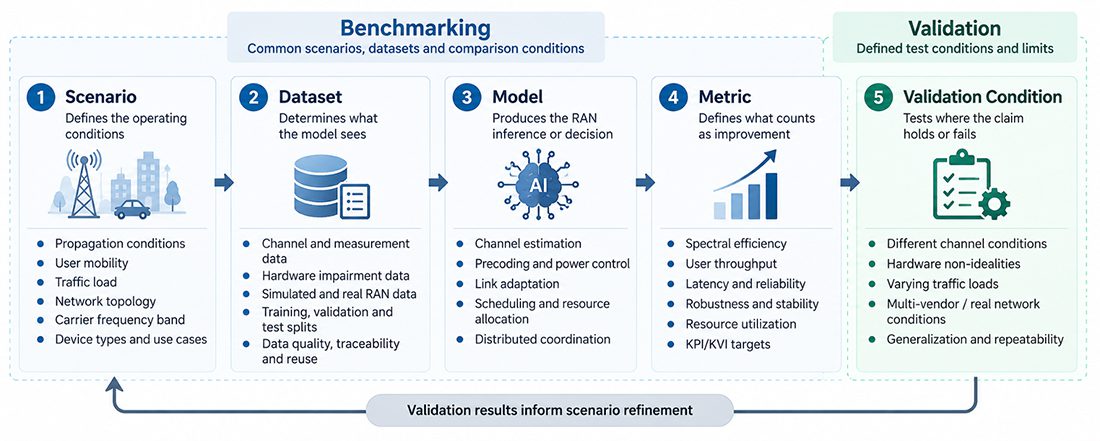
Figure 1. The evaluation chain for AI-native RAN research.
The scenario defines the conditions represented in the experiment. The dataset determines what the model sees. The model is evaluated through selected metrics and then tested under stated validation conditions.
Changing one part of that chain can change the result. An unseen propagation condition may expose a generalization problem. A realistic hardware model may reduce the gain seen with ideal hardware. A different metric may favor a different approach. Benchmarking and validation also answer different questions. Benchmarking establishes common conditions for comparing approaches. Validation examines whether the resulting system behaves as required under defined conditions.
D3.1 is an existing project output. Later deliverables are intended to add datasets and results covering common scenarios, validation, and benchmarking. Those later outputs should remain described as project work rather than completed findings until the corresponding evidence is published. [11][12]
From Research Validation to Standardization:s
ITU-R’s IMT-2030 work has already moved beyond the initial framework.
Recommendation ITU-R M.2160 established the framework and overall objectives for IMT-2030 in November 2023. The framework includes six usage scenarios, among them Artificial Intelligence and Communication (AIAC), and identifies ubiquitous intelligence as one of its overarching design principles. [13]
In February 2026, ITU-R Working Party 5D completed the draft report on minimum technical performance requirements for IMT-2030 radio interfaces. The draft defines 20 minimum technical performance requirements and provides a consistent basis for specification and evaluation. The draft has been submitted to Study Group 5 for consideration in December 2026. [14] In June 2026, Working Party 5D also completed the draft guidelines for evaluating candidate IMT-2030 radio interface technologies. The guidelines define three evaluation methods—simulation, analytical evaluation, and inspection—and specify seven test environments. The draft has likewise been submitted to Study Group 5 for approval in December 2026. [14]
ITU-R’s candidate radio-interface technology submission process is scheduled to begin in February 2027, with the candidate-submission window extending through February 2029. [14] 3GPP is pursuing AI/ML work within the RAN in parallel. TR 38.745, “Study on Artificial Intelligence (AI)/Machine Learning (ML) for NG-RAN Phase 3,” was created for Release 20 on September 5, 2025, and was placed under change control on March 19, 2026. [15]
Research results do not become standards simply because an algorithm performs well in one experiment. The useful evidence includes the conditions behind the result: the scenario, dataset, metrics, validation method, limitations, and reproducibility of the test.
Conclusions:
AI-native 6G RAN will require more than putting machine learning inside individual RAN functions.
Propagation changes. Hardware is imperfect. Network intelligence becomes distributed. Fronthaul and synchronization can limit coordinated processing. Architecture determines where data and computation are available. Training and evaluation conditions affect what an AI result actually shows.
6G-MIRAI-HARMONY brings these issues into one research program by connecting realistic wireless models, AI-based PHY techniques, cell-free coordination, AI-ready RAN architecture, and common approaches to data, benchmarking, and validation. The work points to a practical requirement for AI-native RAN research: performance results need enough information around them to show how they were produced, where they hold, and what changes when the underlying conditions change.
References:
- SoftBank Corp. and Ericsson, “SoftBank Corp. and Ericsson conduct Japan’s first trial of Ericsson AI in RAN on a 5G commercial network,” August 20, 2026.
https://www.ericsson.com/en/press-releases/2/2026/softbank-corp-and-ericsson-conduct-japans-first-trial-of-ericsson-ai-in-ran-on-5g-commercial-network - IEEE ComSoc Technology Blog, “Comparing AI Native mode in 6G (IMT 2030) vs AI Overlay/Add-On status in 5G (IMT 2020),” January 15, 2026.
https://techblog.comsoc.org/2026/01/15/comparing-ai-native-mode-in-6g-imt-2030-vs-ai-overlay-add-on-status-in-5g-imt-2020/ - IEEE ComSoc Technology Blog, “IMT-2030 (‘6G’) Minimum Technology Performance Requirements for Radio Interface Technologies,” March 17, 2026. https://techblog.comsoc.org/2026/03/17/update-imt-2030-6g-minimum-technology-performance-requirements/
- 6G-MIRAI-HARMONY, “Concept and Methodology,” 2026.
https://6g-mirai-harmony.eu/concept-and-methodology/ - European Commission, CORDIS, “Machine Intelligence based Radio Access Infrastructure (6G-MIRAI),” Grant Agreement No. 101192369.
https://cordis.europa.eu/project/id/101192369 - 6G-MIRAI-HARMONY, “Consortium and Objectives,” 2026.
https://6g-mirai-harmony.eu/consortium-and-objectives/ - Tadele A. Abose and Thomas O. Olwal, “Hardware-Impairment-Aware CNN-Based Hybrid Precoding for Cell-Free Massive MIMO Systems Under Imperfect CSI in Terahertz-Enabled 6G Networks,” Telecom, vol. 7, no. 3, 2026.
https://www.mdpi.com/2673-4001/7/3/70 - Mhammad B. Hmayed and Ali H. Bastami, “Scalable Cell-Free Massive MIMO System: Joint Optimal Pilot and Access Point Assignment,” IEEE Access, vol. 13, pp. 201778–201788, 2025. DOI: 10.1109/ACCESS.2025.3638655
https://ieeexplore.ieee.org/document/11271199 - Unnikrishnan Kunnath Ganesan, Tung Thanh Vu, and Erik G. Larsson, “Cell-Free Massive MIMO With Multi-Antenna Users and Phase Misalignments: A Novel Partially Coherent Transmission Framework,” IEEE Open Journal of the Communications Society, vol. 5, pp. 1639–1655, 2024.
DOI: 10.1109/OJCOMS.2024.3373170.
https://ieeexplore.ieee.org/document/10459246 - O-RAN Alliance, “WG2: Non-Real-time RAN Intelligent Controller and A1,” Technical Work Group scope.
https://www.o-ran.org/technical-groups/wg2 - 6G-MIRAI-HARMONY, “D3.1 — Definition of Initial Common Scenarios, Data Management and Benchmarking Methodology,” 2026.
https://6g-mirai-harmony.eu/wp-content/uploads/2026/02/6G-MIRAI_Deliverable_D3.1_Scenarios_Data_Bench_v1.0.pdf - 6G-MIRAI-HARMONY, “Deliverables, Publications and Workshops,” 2026.
https://6g-mirai-harmony.eu/deliverables-publications-and-workshops/ - ITU-R Recommendation M.2160-0, “Framework and overall objectives of the future development of IMT for 2030 and beyond,” November 2023.
https://www.itu.int/rec/R-REC-M.2160-0-202311-I/en - ITU-R, “IMT towards 2030 and beyond (IMT-2030),” current development, evaluation, and submission process.
https://www.itu.int/en/ITU-R/study-groups/rsg5/rwp5d/imt-2030/pages/default.aspx - 3GPP, TR 38.745, “Study on Artificial Intelligence (AI)/Machine Learning (ML) for NG-RAN Phase 3,” Release 20.
https://portal.3gpp.org/desktopmodules/Specifications/SpecificationDetails.aspx?specificationId=4445
Author Bio:
Shammi Thakur is Research Director at MarkNtel Advisors, with more than 15 years of experience in strategic market intelligence, industry forecasting, and competitive analysis. He leads research initiatives across global technology and communications markets, overseeing the development of market studies and strategic research frameworks. His work focuses on translating complex industry developments into evidence-based insights, with particular experience in emerging technologies, market evolution, and the forces shaping next-generation communication systems.
Website: MarkNtel Advisors
Telcos don’t have an AI problem; they have a voice estate visibility problem
By Satish Barot, Co-founder and CTO, Klearcom with Shazia Hasnie
AI is increasing telecom interdependence
This author has spent around twenty years building telephony products, and the last few watching what happens when AI gets added to them. The models are usually fine, but the voice estates around them are not.
Explanation: The voice estate is everything a voice call touches: the number dialed, the carriers delivering it, the menu that answers, the systems behind it, and in every country/location served.
NVIDIA’s February 2026 survey of roughly one thousand telecom respondents found that sixty percent of organizations are using or evaluating generative AI, up from forty nine percent in its 2024 edition. The voice call that once met a gateway and a queue now meets speech recognition, a language model, a synthetic voice, and also identity checks.
Every one of those can be healthy while the call goes wrong. So the useful test is whether you can prove, from outside your own network, that a real customer’s call still ends the way it should.
Why AI amplifies operational complexity
Old fashioned faults announce themselves: a line drops and something logs it. AI is quieter, and it fails in ways worth naming. It gets worse quietly: a model loses accuracy on one kind of request and nothing reports an error. It’s also confidently wrong. WildASR tested seven speech recognition systems on recordings degraded the way phone audio is. When a caller is cut off mid word, by a network delay or by the system deciding they had finished, the models fill in words nobody said. Further down the line that looks like a clean answer. The same benchmark makes a broader point: robustness measured in one language can substantially mispredict behavior in another, so a release validated in one market tells you little about the next.
Speed fails at the edges, not the average. A system that usually answers in under a second, but takes two and a half seconds on one call in ten, feels broken to those callers and healthy on every voice testing team chart. Nor is the result repeatable: EVA-Bench tested twelve systems and found a wide gap between passing once and passing every time, which undoes testing against a single expected answer.
Then the ones nobody looks at: the fallback menu that takes over when the AI gives up is usually the least maintained thing you own, and it runs exactly when things go wrong. None of this turns a light red on a contact center voice dashboard.
The other exposure is a number that anybody can dial. OWASP ranks prompt injection first among risks to applications built on language models, and a voice channel is an open microphone into the instruction path itself: a caller talks the model out of what it was built and told to do. Mitigations exist and they are worth naming. Treat caller speech as untrusted input and keep the transcript out of the context that carries instructions, constrain what the model can emit to a defined set of intents and slots rather than free text, and require confirmation for anything that moves money, changes credentials, or reads account data back.
The customer journey as the real test environment
Take a composite example, assembled from patterns that recur across multi country voice estates rather than drawn from one operator. An operator runs support numbers in fourteen countries behind one AI system. On Friday the team delivers an updated model and a new synthetic voice. Both pass in testing, no issues. By Monday, the share of calls handled without an agent is up by six points, complaints are up in three countries where the release went live first, and every dashboard is green. Nobody knows why.
The new voice made the menus two seconds longer, and nobody adjusted the window in which the system listens for a caller to stop talking. Callers spoke too early, the system heard fragments, filled the gaps, and guessed just confidently enough to keep a person out of the call.
The headline number improved because failures had stopped escalating. Every part did its job, so nothing raised an alarm. What broke was the outcome, and no single part owns the outcome. People given those same recordings transcribed them easily.
Those failures are not hypothetical. Test calls run by my own team over the past two years have found a global biopharmaceutical company whose menu prompts ran into each other faster than callers could answer, a financial services provider whose speech recognition intermittently failed on the word “agent”, so the route to a human worked on some calls and failed on others, and a healthcare data provider whose misrouted number reached an AI assistant that was never meant to answer it. In every case the systems carrying the call reported nothing wrong.
From system monitoring to outcome validation
Monitoring looks inward: are my systems up? Validation looks outward. It places a real call in country and checks the result against what should have happened: is a customer in this country, on this network, right now, getting the right answer?
Monitoring only sees what you own, and these failures hide inside the part causing them. So the two work together: validation tells you something is wrong and where, monitoring tells you why. Three changes follow. Report three numbers where you currently report one: calls the AI resolved correctly, calls it escalated correctly, and calls it failed. Report the slower calls alongside the average ones, and report by country and carrier instead of one global figure.
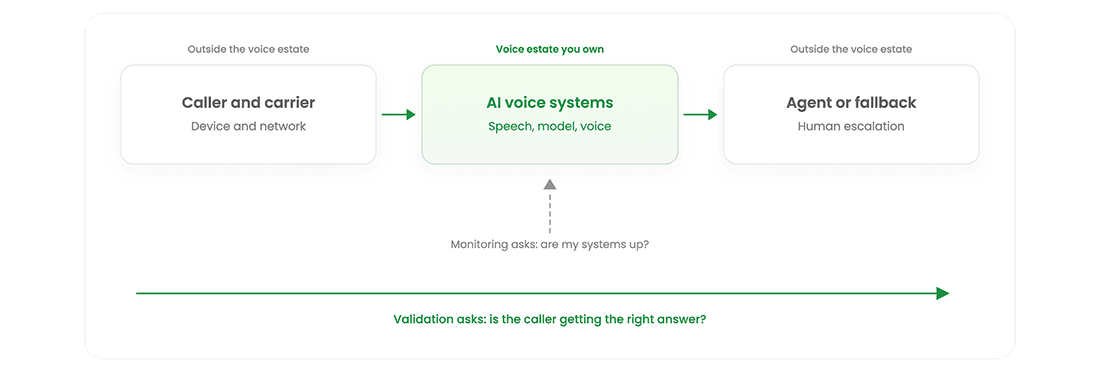
Figure 1. A single call crosses the voice estate an operator owns and systems it does not. Monitoring covers only the shaded stage. Validation traverses the whole path from the caller’s side.
Continuous testing as an assurance layer
The industry already has vocabulary for this. TM Forum’s autonomous network levels give operators a shared scale for how much of the “operate, assure and optimize” loop runs without people, and the same NVIDIA survey places 88% of organizations at Levels 1 to 3 on a scale of 0 to 5. Moving up that scale rests on evidence about delivered outcomes.
If the journey is what breaks, the journey is what you test. That means dialing the real public number, from a real device, on a real carrier in the country the customer is calling from, rather than looping a call back inside your own data center. It means testing from the outside in, and it means doing it on a schedule, across every country and carrier your customers use, fixed and mobile.
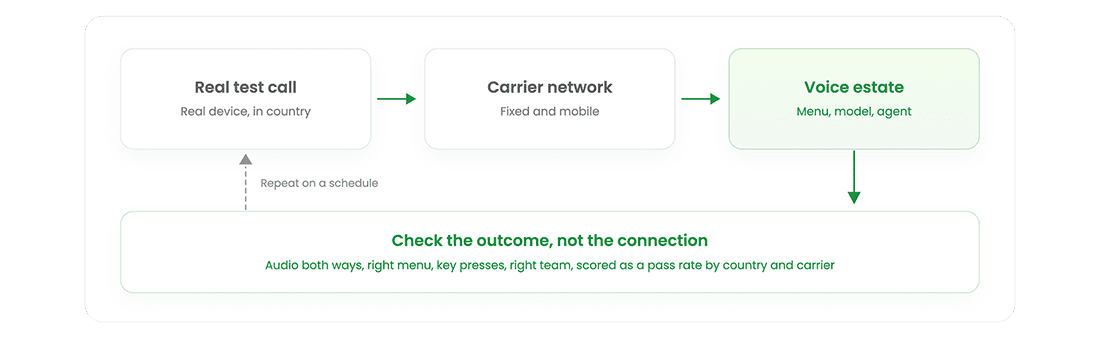
Figure 2. Testing the journey from the outside in. A scheduled call dialed from a real device in the country the customer calls from, scored on the delivered outcome.
Check outcomes, not connections: audio clear both ways, the right menu, key presses registered, the caller reaching the right team with their details intact. Score it across many calls with a library of realistic phrases, accepting a pass rate rather than an exact match, so decline shows as a trend. Treat a model update like a network change: try it on a few numbers first, then pull it back if the pass rate drops.
Several approaches are in this category. Synthetic transaction monitoring from operator owned probes, carrier side test call generation and crowdsourced testing on real handsets all produce outside in evidence, and they trade off differently on country coverage, cost and how closely the test resembles a real customer’s call. The common requirement is that the evidence originates outside the systems being assured, on a call placed in the country where the customer is dialing from.
Practical implications
Keep human escalation as a safety valve, not a number to drive down: cutting it without checking correctness makes the metric look better while the service gets worse. Then give the outcome an owner. Gartner’s June 2025 forecast that over 40% of agentic AI projects will be canceled by the end of 2027 attributes those cancellations to escalating costs, unclear business value and inadequate risk controls. Model capability doesn’t appear anywhere on that list. This is organizational before it’s technical.
These failures are seams between systems that break without producing an error, and monitoring your own equipment cannot see them: the gap sits between what your systems report and what your customer gets. Networks have been tested end to end for decades rather than trusted part by part. Voice estates deserve the same.
References
- NVIDIA (2026) State of AI in Telecommunications: 2026 Trends. Fourth annual survey report, published 19 February 2026, based on responses from 1,038 telecom professionals worldwide. Summary of findings: Survey Reveals AI Advances in Telecom.
- Tay, G., Ma, W., Lee, J., Tang, Y., Lee, D., Yin, W., Shen, D., Meng, S., Zhu, Y., Li, M. and Smola, A. (2026) Back to Basics: Revisiting ASR in the Age of Voice Agents. Boson AI. arXiv preprint arXiv:2603.25727, 26 March 2026. Introduces the WildASR benchmark. Dataset and code: bosonai/WildASR.
- Bogavelli, T., Gauthier Melançon, G., Stankiewicz, K., Bamgbose, O., Riols, F., Nguyen, H.H., Mehndiratta, R., Brin, L.D., Marinier, J., Subramani, H., Madamala, A., Nemala, S.K. and Sunkara, S. (2026) EVA-Bench: A New End-to-end Framework for Evaluating Voice Agents. arXiv preprint arXiv:2605.13841, 13 May 2026, revised 27 May 2026. DOI: 10.48550/arXiv.2605.13841.
- OWASP GenAI Security Project (2025) OWASP Top 10 for LLM Applications 2025. OWASP Foundation. Prompt injection is listed first, as LLM01.
- Gartner (2025) Gartner Predicts Over 40% of Agentic AI Projects Will Be Canceled by End of 2027. Press release, Sydney, 25 June 2025.
- TM Forum (2025) Autonomous Networks Framework v2.0.0 (IG1218F). Introductory Guide, published 20 March 2025, TM Forum Approved 9 May 2025. Levels of autonomy 0 to 5. Evaluation criteria for assigning a level are in Autonomous Network Levels Evaluation Methodology (IG1252).
-
Bain & Co: AI Infrastructure Buildout Will Require $6 Trillion Revenue by 2031 to Support Massive CAPEX
………………………………………………………………………………………………………………………………………………………………………..

About the author:
Satish Barot is co-founder and CTO of Klearcom. He has spent around twenty years building telephony products and leads the engineering team behind Klearcom’s voice testing platform.
Verizon offers free online AI training tailored to your interests!
Verizon has launched an online portal that curates AI training content from several tech giants, including IBM, Google, Microsoft, Anthropic, OpenAI, and online course provider Coursera. The U.S.’ largest wireless carrier by subscriber count says that the type of courses on offer normally cost in the region of $700 per year, but it is making them available for free.
“Strengthening the American economy starts with making sure every individual has the opportunity to adapt and succeed in a rapidly changing world. AI isn’t just a technological shift – it will change the face of every workforce around the world,” said Verizon CEO Dan Schulman.
“Companies, working closely together and with the public sector, have a responsibility to invest in people with the same urgency they invest in technology. By giving people and small businesses free access to the best AI training, we are helping workers retain their jobs, navigate transitions, support their families, and help small businesses grow – while building confidence in our American economy. When you empower people to embrace change rather than fear it, you create a ripple effect that builds healthier communities and a stronger and more resilient national economy.”

Linked to this initiative is a separate $1 million grant that Verizon has awarded to the Liberty Science Center (LSC) in Jersey City, New Jersey. The funds will be spend on providing practical AI skills to individuals and small businesses.
“As a company with a strong footprint in New Jersey, Verizon is deeply committed to supporting the communities we call home, and our longstanding partnership with Liberty Science Centre is a cornerstone of that commitment,” said Donna Epps, chief responsible business officer of Verizon. “Verizon and LSC have a shared vision of empowering the learners and leaders of tomorrow, and we’re excited to work together to create programming that evokes curiosity for new technologies for educators, families and students from across the state.”
The non-profit “Centre for Humane Technology (CHT)” – co-founded by ex-Googler Tristan Harris – has published a report (PDF) explaining how AI could damage everything from personal relationships to governments, and -most significantly- the workplace.
References:
https://www.verizon.com/ai-skills/home
The AI Infrastructure Build-Out: A $10 Trillion Bet on Compute, Power, and Networks
Dell’Oro: 2H2026 Data Center Capex to Accelerate due to massive AI Deployments
PwC: Global AI data center spending to hit $31.6tn by 2050; Role of full stack orchestration layer explained
Nvidia CEO Huang: AI is the largest infrastructure buildout in human history; AI Data Center CAPEX will generate new revenue streams for operators
AI risks and backlash increase; Recap of the circular loop of fake AI profits and hyperscaler markups of private AI companies
China vs U.S.: Race to Generate Power for AI Data Centers as Electricity Demand Soars
How will fiber and equipment vendors meet the increased demand for fiber optics in 2026 due to AI data center buildouts?
Expose: AI is more than a bubble; it’s a data center debt bomb
Will billions of dollars big tech is spending on Gen AI data centers produce a decent ROI?
Huge Risks for the proposed $500B AI Investments from Giant Wall Street firms
Can the debt fueling the new wave of AI infrastructure buildouts ever be repaid?
Analysis: Cisco, HPE/Juniper, and Nvidia network equipment for AI data centers
Networking chips and modules for AI data centers: Infiniband, Ultra Ethernet, Optical Connections
Bain: AI to greatly increase network operator expenses; network re-engineering needed!
Introduction by Bain:
“Over the next three to five years, the operating cost structure used by telecom operators is likely to undergo one of the most significant shifts in decades. As AI agents become embedded across customer care, network operations, software engineering, and enterprise functions, tokens will account for a growing share of operating expenditures.”
Key Points:
- Unless telcos proactively manage their costs, scaling up AI will simply add expenses to an already-heavy legacy base.
- An agentic operating model is emerging: a 70-to-30 ratio of legacy to AI costs, with AI automating or augmenting work across processes.
- Cost traps lurk: cheaper AI models, bigger bills; bolting AI onto legacy processes; and demos mistaken for transformation.
- Telco leaders can take five key actions today to avoid the traps.
Executive Summary:
Telecom operators are extending AI agents across network operations as they pursue higher levels of autonomy, but the shift could introduce a significant new operating-cost burden unless legacy processes, tooling and organizational structures are retired alongside the automation, according to Bain & Company.
Bain’s warning comes as operators accelerate plans for autonomous networks. TM Forum reported in June that 81% of 80 surveyed operators are targeting Level 4 autonomous networks or higher by 2030, and 20% expect to reach that threshold by 2027.
Under TM Forum’s Autonomous Networks framework, Level 4 moves beyond rule-based or preconfigured automation toward closed-loop, intent-driven decision-making within defined network domains. Current Level 4 work includes deployment of closed-loop operations in production networks, agent-based operating architectures, and metrics intended to quantify the operational and business value of autonomous-network use cases.
-
- Lagging Returns: According to Bain’s Automation and AI Pathfinder Survey, nearly 40% of companies saw AI cost savings land below 10%.
- Growing Budgets: Despite missing initial savings targets, 90% of these companies are still increasing their AI budgets.
- Autonomous Agents: Only 7% of companies currently run fully autonomous AI agents in production. Data access remains the top barrier to progress.
- AI Summaries: Bain’s research on Zero-Click Search shows that 80% of consumers rely on AI-written results for at least 40% of their searches.
- Fewer Clicks: About 60% of searches now end without the user clicking through to another website. This shift reduces organic web traffic by 15% to 25%.
Bain estimates that AI agents and associated token consumption could represent 20% to 30% of a telecom operator’s operating-cost base within the next three to five years, leaving conventional operating costs at 70% to 80%.
As AI spending rises, telcos risk increasing total costs without generating proportional gains in productivity or growth.
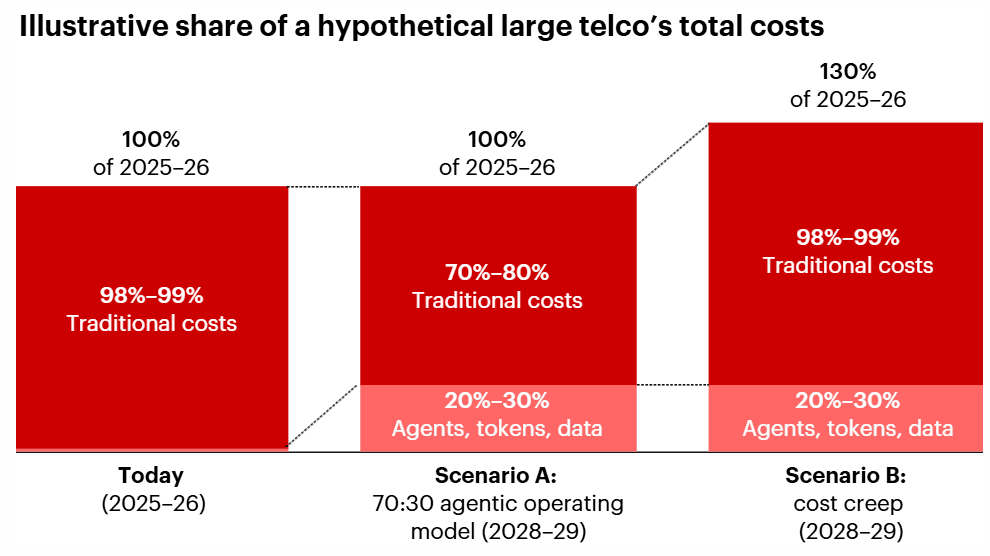
Notes: Illustration doesn’t incorporate absolute value changes; traditional costs are fully loaded, including costs from traditional software-as-a-service and cloud infrastructure, agency/outsourcing, depreciation, and more. Source: Bain estimates
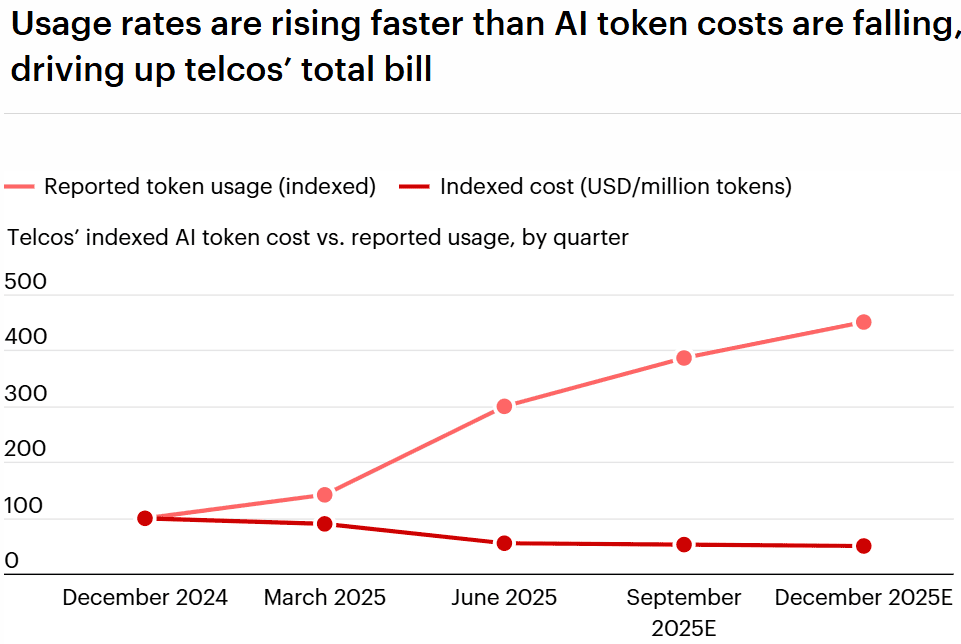
Sources: Wells Fargo (October 2025); Barclays (November 2025); company websites; news and industry reports; Bain analysis.
…………………………………………………………………………………………………………………………………………………………………………………..
However, cost is not the main issue. The principal risk is that network operators can create a parallel operating model when they layer agentic AI onto established network-operations processes without eliminating the people, software, outsourced functions and infrastructure those processes were designed to support.
In that scenario, AI compute, model inference and agent orchestration become incremental expenses, while legacy network operations centers, monitoring platforms, user-facing software licenses, managed-service arrangements and manual operational handoffs remain largely intact.
Network Re-engineering Required:
Avoiding this outcome requires process re-engineering rather than task-level automation. Bain recommends that operators redesign end-to-end workflows around the work agents assume, including:
-
Reducing manual monitoring, ticket triage and operational handoffs.
-
Reassessing workforce requirements as agents absorb repeatable diagnostic and remediation tasks.
-
Reviewing software, tooling and managed-service contracts when agents begin performing functions previously executed through conventional applications or outsourced processes.
-
Removing redundant operational steps rather than simply automating them.
-
Measuring the cost of an operational outcome, rather than the unit cost of model inference or token consumption.
This distinction is especially important in network operations, where an agent may continuously ingest alarms, correlate events, retrieve telemetry, diagnose faults, select a remediation action, trigger network tools, validate results and escalate exceptions to human operators. Each stage can add cost.
Inference is therefore only one component of the AI operating model. A production-grade agentic workflow may also require orchestration, tool and API calls, runtime evaluation, observability, data storage, policy enforcement, security controls, human-in-the-loop escalation and supporting compute infrastructure.
Bain argues that operators should evaluate the complete cost of the resolved operational event. For a service-affecting incident, that includes the total cost of detection, triage, diagnosis, remediation, validation and any remaining human intervention—not simply the marginal cost of the model invocation.
Closed-Loop Operations and Opex Reduction:
Bain cited Vivo in Brazil as an example of an operator redesigning a complete network workflow around AI-enabled automation rather than applying automation to discrete tasks. As part of Telefónica’s Autonomous Network Journey program, Vivo implemented a self-healing mechanism for its virtualized standalone 5G core.
The implementation monitors network-function performance, detects anomalies, identifies root causes and applies corrective actions automatically. It then validates whether the action restored normal operation and can progress to an additional remediation level when required.
Telefónica said the system correlates events across logical and physical infrastructure and completes the detect-to-resolve sequence without human intervention. For the targeted incidents, the company reported a 30-minute reduction in mean time to resolution.
The deployment also reduces repetitive work and manual intervention, while improving the use of computational resources. Telefónica has not disclosed a monetary estimate of the operating-cost savings associated with the implementation, however.
The significance of the Vivo deployment is architectural as much as operational. It integrates detection, correlation, diagnosis, remediation and verification into a closed-loop workflow. That is materially different from deploying an AI assistant within an otherwise unchanged operating model.
Other operator deployments illustrate the potential conventional opex benefits associated with higher autonomy. In a TM Forum case study, China Mobile reported that intelligent agents helped its network operations center achieve Level 4 autonomy under its self-assessment using TM Forum’s Autonomous Networks Levels framework.
China Mobile reported:
-
More than 30% reduction in backend operations-and-maintenance manpower.
-
More than 5% savings in frontline installation-and-maintenance manpower.
-
An average 30% reduction in mean time to repair for network faults and customer complaints.
An earlier TM Forum autonomous-network case study involving China Mobile reported O&M efficiency improvements of 10% to 20%, service-provisioning time reductions of 30% to 50%, and energy-consumption reductions of 3% to 5% across participating internet data centers and base stations.
The reported figures are operator-reported results published through TM Forum case studies. They demonstrate the possible efficiency gains from closed-loop automation, but they do not eliminate the need to account for AI-specific costs such as inference, orchestration, tool execution, supporting infrastructure and operational governance.
Measure Autonomous Networks by Outcomes:
TM Forum is also developing mechanisms to measure the value generated by autonomous-network deployments. In July, it approved version 2.0 of its Autonomous Networks High-Value Scenarios Effectiveness Indicators guide, intended to help operators quantify the impact of Level 4 autonomous-network scenarios.
This outcome-based approach aligns with Bain’s recommendation. For network operations, operators should move beyond narrow AI measures such as token counts, model cost per query or inference latency. Those measures remain operationally useful, but they do not establish whether an AI deployment improves the economics of network operation.
The most relevant measures include:
An operator may accept higher AI spending per workflow if it meaningfully reduces outage duration, truck rolls, customer-impacting incidents, workforce requirements or service-activation delays. Conversely, a deployment that lowers model-inference costs but leaves manual handoffs, duplicate monitoring tools and legacy support structures unchanged may offer limited net operating benefit.
AI Consumption at Telecom Scale:
AT&T has illustrated the potential scale of enterprise AI consumption, although its reported figures span AI workloads across the business and are not limited to autonomous network operations. The operator said in July that it processes an average of 45 billion tokens per day.
AT&T uses an AI gateway to route tasks among models based on cost, latency and expected output quality. The company said the platform can switch models during multi-turn interactions and has reduced costs for certain AI workloads by as much as 90%, producing multimillion-dollar savings.
The operating principle is relevant to telecom network automation: only a minority of tasks require the most capable—and most expensive—models. Routine classification, alarm enrichment, knowledge retrieval, configuration validation and other bounded operational tasks may be suitable for smaller models, purpose-built models or conventional deterministic automation. More capable reasoning models can be reserved for ambiguous, multi-domain or exception-heavy cases.
Bain similarly recommends matching model capability to task complexity rather than applying a single model class across every AI workload. Operators should establish dedicated compute budgets, instrument workflow-level economics and treat inference capacity as an operational resource that requires active governance.
Governing Agentic Network Operations:
Agent behavior itself can become a material source of cost and operational risk. Poorly designed agents may repeatedly transmit large context windows, loop without completing a task, invoke overlapping diagnostic tools or conduct duplicative checks that add token and infrastructure consumption without improving the result.
Bain recommends guardrails that limit both expenditure and runtime. In a telecom network-operations environment, those controls could include:
-
Maximum token, compute and tool-call budgets per incident or workflow.
-
Time limits before an agent must escalate an unresolved task to a human operator.
-
Context-management rules that prevent unnecessary repetition of telemetry, alarms and historical ticket data.
-
Controls to consolidate overlapping diagnostic checks and duplicate agent activity.
-
Policy constraints governing which network changes an agent may propose, execute or validate autonomously.
-
Continuous monitoring for model drift, abnormal agent behavior, spending anomalies and degraded operational outcomes.
-
Explicit business and financial ownership for each production agent and workflow.
The central issue is that autonomous networks will not necessarily lower opex simply because they reduce manual work. Operators must also remove the legacy cost structures that agentic systems replace. Otherwise, AI agents risk becoming an additional layer of expense on top of existing network operations rather than the foundation for a more efficient operating model.
……………………………………………………………………………………………………………………………………….
References:
Bain & Co, McKinsey & Co, AWS suggest how telcos can use and adapt Generative AI
McKinsey: AI infrastructure opportunity for telcos? AI developments in the telecom sector
AI risks and backlash increase; Recap of the circular loop of fake AI profits and hyperscaler markups of private AI companies
5G infrastructure moves from coverage and speeds to cloud-native, orchestration, automation and AI-assisted networks
Analysis: Nvidia–MediaTek Deepen AI Platform Collaboration -What it Means for AI RAN & DCI
Executive Summary:
Nvidia has expanded its partnership with Taiwan based semiconductor firm MediaTek, committing $3.5 billion to a bond investment the two companies describe as a deepening of their “longstanding collaboration to build the next generations of AI computing platforms.” The move extends Nvidia’s pattern of strategic capital deployment across its compute ecosystem, this time reaching into custom silicon and advanced packaging.
According to the announcement, the collaboration couples Nvidia’s accelerated computing, AI, graphics, and software stack with MediaTek’s capabilities in custom silicon, high-performance computing (HPC), system-on-chip (SoC) design, and advanced packaging. MediaTek vice chairman and CEO Rick Tsai framed the investment as reinforcing a relationship spanning “cloud AI infrastructure, local AI computing and automotive in the era of physical AI,” combining Nvidia’s accelerated-computing and AI software ecosystem with MediaTek’s AI technology portfolio and custom-silicon resources.
Over the past several years, MediaTek has repositioned itself from a supplier of predominantly mid- and low-tier handset chipsets into a presence across smartphones, AI data centers, automotive, and IoT. Securities firm Yuanta Financial Holdings expects the closer alignment to accelerate MediaTek’s transition from edge AI into data-center infrastructure, device-based AI computing, and automotive platforms. Trading in MediaTek shares was suspended on the Taipei exchange Tuesday after the stock hit its daily 10% upside limit. The shares closed at NT$4,315 (about US$136.05), reflecting investor enthusiasm for the deepening of the collaboration.
NVIDIA and MediaTek are collaborating in three major areas:
- AI infrastructure: MediaTek will work with NVIDIA’s NVLink Fusion ecosystem to enable customers to develop custom AI infrastructure designed to integrate with NVIDIA rack-scale systems and AI factories.
- Local AI computing: The companies will continue to collaborate on multiple generations of NVIDIA RTX Spark™ and DGX Spark™ PC chips, powering consumer PCs, AI developer supercomputers and enterprise-class workstations, that integrate NVIDIA GPUs with MediaTek SoCs.
- Automotive: MediaTek and NVIDIA will continue developing platforms for AI-powered, software-defined vehicles in the era of physical AI.
“AI is transforming every computing platform — from the world’s largest AI factories to the PC and the car,” said Jensen Huang, founder and CEO of NVIDIA. “MediaTek is one of the world’s great semiconductor companies, with exceptional expertise in system-on-chip design, connectivity, leading performance and power efficiency. Together, we’re building platforms that bring NVIDIA accelerated computing to new markets and give customers the freedom to create differentiated AI systems at enormous scale.”
“MediaTek and NVIDIA share a vision for making advanced AI computing pervasive across the technology landscape,” said Rick Tsai, vice chairman and CEO of MediaTek. “NVIDIA’s investment strengthens a collaboration that spans cloud AI infrastructure, local AI computing and automotive in the era of physical AI. By combining NVIDIA’s leadership in accelerated computing and AI software ecosystem with MediaTek’s expertise in a diverse AI technology portfolio from edge to cloud, and our leadership position in custom silicon, we can accelerate innovation for our customers.”
Custom AI Infrastructure and NVLink Fusion:
Yuanta identified MediaTek’s participation in Nvidia’s NVLink Fusion as the most consequential element of the arrangement. Through that linkage, MediaTek could support the design of custom AI chips for clients while connecting them directly into Nvidia’s AI infrastructure — a complementary rather than competing role alongside the GPU vendor’s proprietary interconnect fabric.
The scale of the bond purchase also signals Nvidia’s long-term commitment to the relationship. Nvidia, currently the world’s most valuable company at roughly a $5 trillion market capitalization, has been deploying capital aggressively across both upstream and downstream partners. This latest deal, however, inevitably risks overlapping with other Nvidia investments — notably its $2 billion partnership with Marvell, which is also heavily oriented around NVLink Fusion and pitch-for the RAN with a one-chip architecture.
NVLink Fusion vs. Ethernet Scale-Out Interconnect:
NVLink Fusion and Ethernet-based scale-out interconnects target fundamentally different layers of the AI fabric, and the distinction turns on memory semantics rather than raw link rate. NVLink Fusion sits in the scale-up domain: it delivers memory-coherent, tightly coupled attachment for custom XPUs into Nvidia’s rack-scale NVLink fabric, with point-to-point GPU/XPU-to-GPU/XPU connectivity and an integrated high-bandwidth-memory interface (NVHBM) that trades die area and power for latency and bandwidth. It is proprietary, closed, and full-coherency by design — precisely the properties that make it hard for open standards to clone. Ethernet scale-out, by contrast, is the scale-out workhorse governing traffic between racks, pods, and clusters; it is loss-based, coarser-grained, and standardized through Ultra Ethernet and the broader IEEE 802.3 ecosystem.
The real contest is not NVLink against Ethernet so much as how much of the memory-coherent scale-up domain Ethernet-based challengers can capture. Standards-backed alternatives — UALink 2.0, Ultra Ethernet, and Broadcom’s Scale-Up Ethernet (SUE) — are pressing into scale-up territory, but they lack NVLink’s memory coherency and direct XPU-to-XPU connectivity, and SUE explicitly does not wire GPUs directly to GPUs. Meanwhile Nvidia’s strategy with NVLink Fusion is to co-opt custom XPUs (AWS Trainium4, and now MediaTek- and Marvell-designed silicon) into its fabric rather than let them migrate to those open scale-up paths. The practical outcome in the data center is a layered model — Ethernet surging in scale-out, and NVLink Fusion consolidating the latency-sensitive, memory-coherent scale-up spine — with Nvidia working to keep its proprietary layer the mandatory gateway that custom accelerators must pass through to reach the wider Ethernet-based world.
The $3.5 billion convertible-bond investment is best read not as a portfolio decision but as a defensive move within the AI rack-scale interconnect stack. The technical centerpiece is MediaTek’s adoption of the NVLink Fusion platform. Nvidia positions it as the connectivity technology and intellectual property that lets hyperscalers and AI-native operators drop custom accelerators (“XPUs”) and CPUs directly into its NVLink scale-up fabric.
MediaTek will now build against the three subsystems that define NVLink Fusion: the NVLink Fusion chiplet, which bridges a customer’s custom XPU to the NVLink scale-up domain over photonic or electrical interconnects (the chiplet itself carries up to ~1.8 TB/s of bidirectional bandwidth); NVLink-C2C, the high-bandwidth die-to-die link between XPUs, Nvidia’s Vera/Rosa CPUs, and other compatible processors; and NVHBM, a customized high-bandwidth-memory interface that trades off die area and power efficiency. The strategic significance is that Nvidia is effectively licensing its interconnect and memory layer as a licensable subsystem rather than enforcing a closed, all-Nvidia island — which lets it absorb “frenemy” silicon into the fabric instead of fighting it.
Two implications stand out for interconnect strategy:
-
A hedge on hyperscaler in-house silicon. AWS has already integrated its Trainium4 custom ASICs with NVLink Fusion for rack-scale deployment, and Google, Meta, Microsoft, and OpenAI are all advancing private accelerators. By standardizing the interface (NVLink Fusion, NVLink-C2C, NVHBM, chiplets, and rack-scale integration) that these custom XPUs must speak, Nvidia keeps chiplets, packages, memory, and racks—the connective infrastructure itself—inside its own revenue funnel. MediaTek, in turn, becomes the design conduit that helps hyperscalers and frontier model firms get to that tape-out without building an independent scale-up stack.
-
The scale-up vs. scale-out contest sharpens. NVLink remains essentially the only mature, memory-coherent scale-up fabric in production, whereas Ethernet is consolidating its dominance in scale-out (front-end and increasingly AI back-end) fabrics, and standards like Ultra Ethernet, UALink, and Broadcom’s Scale-Up Ethernet (SUE) are pressing into the scale-up domain. UALink and SUE, notably, lack NVLink’s memory coherency and point-to-point GPU-to-GPU connectivity, so NVLink Fusion’s positioning — co-opting custom XPUs rather than competing with them — lowers the attack surface those open standards could otherwise exploit.
The buy-in therefore consolidates Nvidia’s grip on the two layers that are hardest to commoditize: the latency-sensitive scale-up interconnect and the custom-silicon design flow that feeds it. What operators and chip partners give up is architectural independence — the bond structure and NVLink Fusion licensing effectively bind MediaTek into Nvidia’s ecosystem rather than allowing it to become an independent AI data-center silicon house.
What It Means for AI-RAN:
For the RAN, this is arguably a more consequential signal than the data-center economics. Nvidia’s AI-RAN play, via the AI Aerial software-defined accelerated-computing platform and its founding role in the AI-RAN Alliance, is built on having vRAN and AI workloads share the same GPU-accelerated infrastructure — what the community variously calls “AI for RAN,” “AI on RAN,” and “AI-and-RAN” on common hardware.nvidia+1
Here the MediaTek deal intersects directly with Nvidia’s earlier $2 billion Marvell partnership, which last year wired Marvell into the same NVLink Fusion platform for both the AI factory and AI-RAN ecosystem — Marvell supplying custom XPUs and NVLink Fusion-compatible scale-up networking, while Nvidia contributes the Vera CPU, ConnectX NICs, BlueField DPUs, Spectrum-X switches, and the rack-scale AI compute. The two arrangements are complementary in practice but overlapping in intent: Marvell owns the scale-up networking and the “one-chip-to-rule-the-RAN” custom silicon angle, while MediaTek brings SoC design, advanced packaging, and stronger reach into edge, automotive, and device-grade silicon. Together they give Nvidia two design houses capable of producing custom XPUs that plug into both data-center racks and AI-RAN infrastructure.
The operative question for IEEE readers is whether this broadens the AI-RAN supplier base going forward. Ericsson and Samsung have indicated their vRAN software built for Intel could be ported to AMD or Arm silicon with relatively modest effort, and Dell’Oro projections already have AI-RAN taking a significant share of the broader RAN market. Nvidia’s strategy is to ensure that, however the RAN silicon shakes out, the scale-up fabric and the custom-XPU design path remain NVLink Fusion-based — extending its data-center interconnect franchise into the radio access domain itself. The risk, flagged in the news report, is over-concentration: stacking Marvell and MediaTek onto the same NVLink Fusion foundation concentrates architectural leverage in Nvidia’s hands and could crowd out the open, multi-vendor fabric choices that O-RAN advocates would prefer to see served by standard Ethernet and UALink-style paths.
References:
https://www.lightreading.com/finance/nvidia-tips-3-5b-into-mediatek-in-latest-tech-partnership
Analysis: Nvidia’s $2 billion investment in Marvell; NVLink Fusion ecosystem & RAN vendor silicon strategy
Ericsson and MediaTek Demonstrate 3GPP-Based GNSS RTK Positioning with Sub-30cm Accuracy Over a Commercial 5G Network
5G infrastructure moves from coverage and speeds to cloud-native, orchestration, automation and AI-assisted networks
MediaTek overtakes Qualcomm in 5G smartphone chip market
Structured Error Analysis: The Missing Pre-Deployment Step for Machine Learning in Telecom Operations
By Priyank Jain with Alan J Weissberger
Introduction:
Machine learning now sits inside telecom operations. Models predict equipment failures before they become outages, forecast traffic for capacity planning, flag telemetry anomalies, and estimate quality of experience from indirect signals—decisions that carry real financial weight. Yet most teams still approve a model for deployment on a single number: accuracy, AUC, or a concordance index computed once on a held-out set. That number is a poor predictor of production behavior. This post argues that structured error analysis belongs before deployment, and walks through five failure modes a single aggregate metric reliably hides.
Terms:
Training fits parameters on historical data; inference applies the fitted model to new data in production. These are two different software environments, and that difference causes more production failures than bad modeling does. Train-serve skew is any gap between training and serving conditions [10]. A fault-prediction model trained on offline-cleaned, gap-filled, five-minute telemetry may encounter a streaming collector that handles missing samples differently and closes its window a few seconds early. A feature named mean_utilization_5m exists in both places and means something slightly different in each. Nothing errors; accuracy just quietly drops.
Censoring matters whenever a model predicts time-to-event. An asset that has not failed yet is censored: we know it survived to now, not how long it will last. Censored observations are legitimate training data; mislabeled ones are poison [4], [5]. Data drift is a change in the model’s inputs—a firmware release that changes how a counter is reported [1], [2]. Concept drift is a change in the underlying relationship—say, a topology change that makes a predictive signal meaningless [3]. Both degrade a validated model, and neither appears in the original evaluation. The residual—the gap between prediction and outcome for one case—is the raw material of error analysis.
Five Failure Modes:
Environment mismatch. Models rarely fail because the mathematics was wrong; they fail because training misrepresented production. A feature computed one way offline and another online, a timezone off by an hour, a normalization constant recomputed over the wrong window—each is trivial, and together they are the most common reason validated performance does not survive deployment. The defense is computing features once and consuming them in both paths. Where that is impossible, run an automated comparison: sample cases, compute features through both paths, and assert agreement within tolerance. Sharing one feature pipeline and persisting trained preprocessors prevents this.
Wrong population. A time-to-failure model over a fleet defines the population by a rule such as “decommission date is empty.” That looks reasonable but is wrong whenever a status field and a date field disagree. An asset marked failed that never had a decommission date written satisfies the rule; the model treats it as healthy and learns that dead things are alive. Survival estimates come out optimistic, worst where data hygiene is worst. Every model-side metric looks fine because the model faithfully learns its labels. When a result contradicts domain knowledge, interrogate the population definition before touching the model.
Metric too good. If a feature table is assembled alongside the outcome, the outcome—or a near-copy such as observed duration—can end up in the feature set, and the model reports near-perfect discrimination. The same happens with fields populated only after the event, such as a diagnostic code set once a fault is confirmed. These are not predictive features; they are the answer arriving late. Treat an unexpectedly excellent score as a bug report and audit whether each feature would be available at scoring time and could have been influenced by the outcome.
The average hid the failure. A single metric over an evaluation set is an average, and averages destroy structure. An anomaly detector at 94% accuracy nationally is consistent with 97% on dense urban sites and 61% on rural sites with sparse telemetry. The aggregate is not wrong; it just does not answer where the model can be trusted. Networks are heterogeneous—multiple hardware generations, uneven telemetry coverage—and model performance is almost never uniform across that variation. The weakest segments usually have the least training data and matter most operationally.
Wrong objective. A model minimizes a loss that stands in for the outcome you care about. When the two drift apart, the model optimizes the stand-in faithfully and fails the objective—Goodhart’s law inside a training loop [6], [7]. In operations the common form is class imbalance: a maintenance model drives aggregate loss down by predicting no failure for a rarely failing class, learning to ignore the cases it was deployed to find [8], [9]. A subtler form ignores cost asymmetry—a missed fault causing an outage and a false alarm wasting a site visit are not equally expensive, but a symmetric loss treats them as equal. State the operational objective in plain language before training, then ask whether the loss actually rewards it.
The Procedure:
Structured error analysis characterizes where and how a model is wrong, not how often. The output is a map of competence. Five steps: build an evaluation set that looks like production, deliberately including every hardware generation, site class, and traffic regime; score and keep everything—prediction, outcome, residual, and full feature vector; stratify by operationally meaningful dimensions and recompute performance within each segment; cluster the residuals to find signatures in data quality, configuration, or thinly sampled regions; and write a disposition for each cluster—fix, accept and document, or exclude from operating scope. That document, the explicit statement of where the model can and cannot be trusted, is the actual artifact of validation.
The artifact also builds operator trust. Engineers dispatching a crew want to know when to believe the model; an aggregate figure is not actionable. A ranked risk score with its two or three drivers attached becomes a claim network operators can check, agree with, or push back on. Models are ignored far more often for being unexplainable than for being inaccurate.
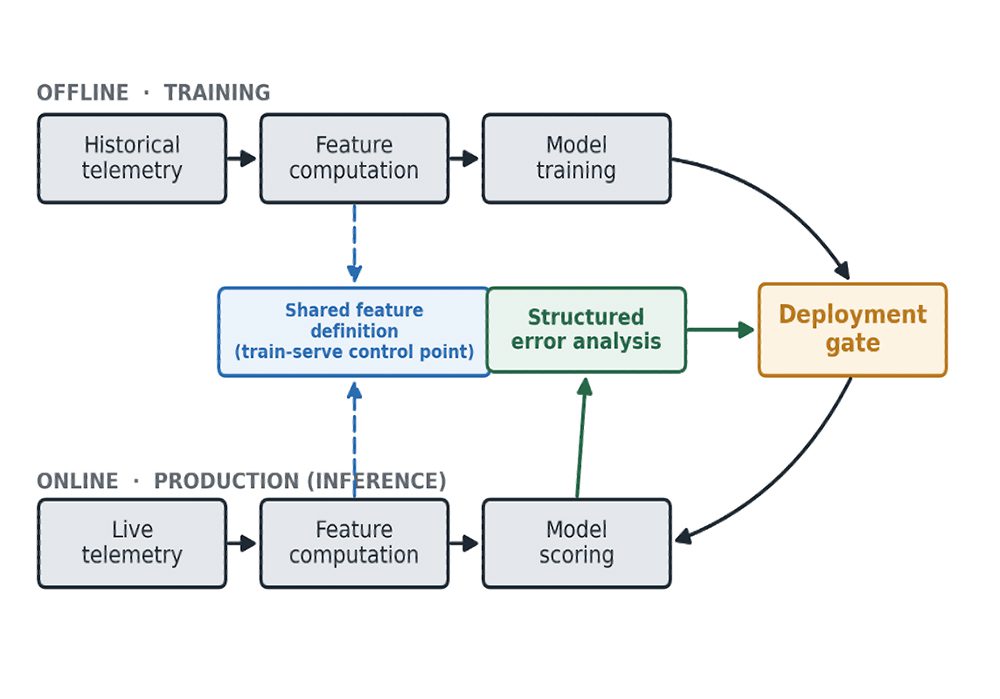
Figure 1. Validation architecture. Features are defined once and consumed by both the training and inference paths (the train-serve control point). Model scoring feeds structured error analysis, whose results decide whether a model clears the deployment gate.
Conclusions:
If a model reports a quantity over a horizon longer than the observed data, part is measurement and part is assumption—report the split, test against several tail assumptions, and decline horizons where extrapolation dominates. That omission matters because the two parts carry very different risk: a precise-looking figure can be almost entirely assumption, and any decision anchored to it—capital planning, replacement schedules, contractual commitments—inherits a fragility nobody has accounted for. Reporting the split is the difference between acting on evidence and acting on a guess wearing a decimal point.
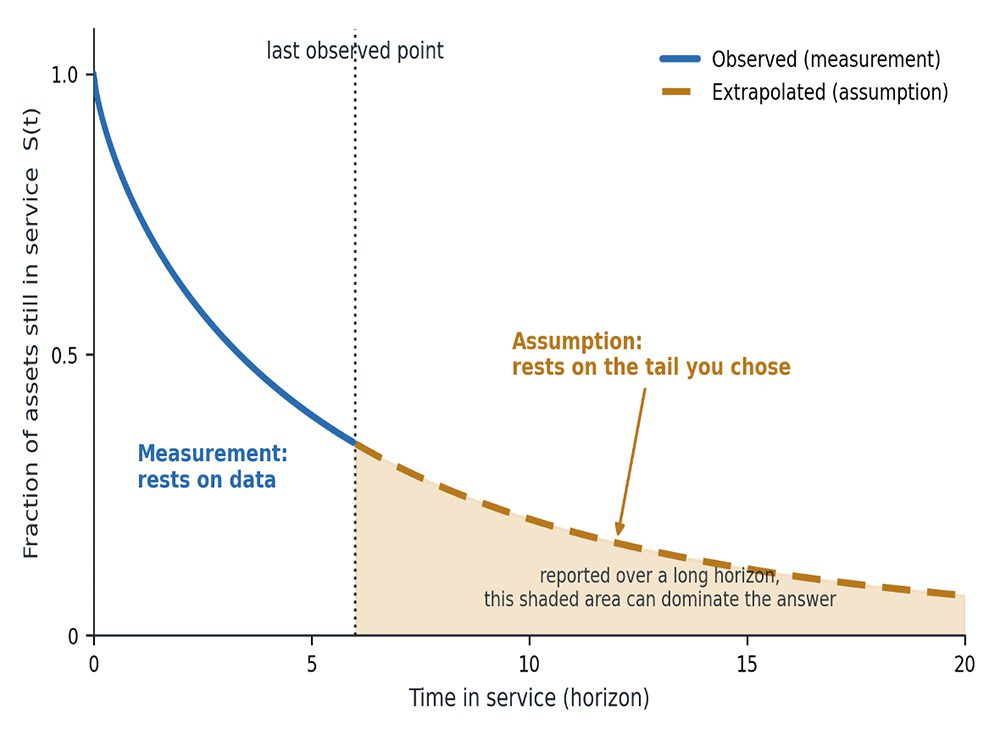
Figure 2. Reporting beyond the observed window, shown for an equipment time-to-failure (survival) model. Up to the last observed point the fraction of assets still in service rests on data (solid); beyond it, the curve rests on a chosen tail assumption (dashed). When such a model reports remaining useful life over a long horizon, the assumed portion can dominate the reported number.
Second, validation expires: because of drift, a model is only validated as of a date. Repeat the error analysis on a fixed cadence against recent data, compare segment-level results to baseline, and give every deployed model a named owner, a review date, and documented dependencies [10], [11]. The absence of a decommissioning plan turns a stale model into a permanent liability.
For telecom operations, where networks are heterogeneous and the consequential cases are usually the rare ones, the recommendation is blunt: require the error map, not the accuracy number, before deployment.

About the Author:
Priyank Jain is a Data Scientist II at Boost Mobile, where he builds production machine learning across retail and telecom, including subscriber survival and churn models, demand and traffic forecasting, and location recommendation systems. He has over seven years in applied machine learning, is an IEEE graduate student member, and has authored peer-reviewed journal and conference papers.
LinkedIn: https://www.linkedin.com/in/priyankjn7/
………………………………………………………………………………………………………………….
References:
[1] “What is data drift in ML, and how to detect and handle it,” Evidently AI, Jan. 9, 2025. [Online]. Available: https://www.evidentlyai.com/ml-in-production/data-drift
[2] “What is data drift in machine learning,” Chalk AI, Apr. 9, 2026. [Online]. Available: https://chalk.ai/blog/data-drift
[3] “Concept drift,” Wikipedia. [Online]. Available: https://en.wikipedia.org/wiki/Concept_drift
[4] “Survival analysis and interpretation of time-to-event data,” PMC/NIH, Jul. 13, 2018. [Online]. Available: https://pmc.ncbi.nlm.nih.gov/articles/PMC6110618/
[5] “Survival analysis,” Wikipedia. [Online]. Available: https://en.wikipedia.org/wiki/Survival_analysis
[6] “Measuring Goodhart’s law,” OpenAI, Apr. 13, 2022. [Online]. Available: https://openai.com/index/measuring-goodharts-law/
[7] “On Goodhart’s law, with an application to value alignment,” arXiv:2410.09638, Oct. 12, 2024.
[8] “Class-imbalanced datasets,” Google Machine Learning Crash Course. [Online]. Available: https://developers.google.com/machine-learning/crash-course/overfitting/imbalanced-datasets
[9] “5 effective ways to handle imbalanced data in machine learning,” MachineLearningMastery, Apr. 20, 2025. [Online]. Available: https://machinelearningmastery.com/5-effective-ways-to-handle-imbalanced-data-in-machine-learning/
[10] “MLOps: Continuous delivery and automation pipelines in machine learning,” Google Cloud, Aug. 28, 2024. [Online]. Available: https://docs.cloud.google.com/architecture/mlops-continuous-delivery-and-automation-pipelines-in-machine-learning
[11] “MLOps lifecycle: Stages, workflow, and best practices,” LaunchDarkly, May 30, 2026. [Online]. Available: https://launchdarkly.com/blog/mlops-lifecycle/
South Korean startup Rebellions to use open source software for carriers to quickly build AI stacks with its AI inferencing chips
South Korean chip startup Rebellions builds purpose-engineered Al accelerators to redefine energy-efficiency and scale in the age of large-scale Al. It aims to deliver the best performance per dollar per watt possible for inferencing and lower both capex and opex associated with running AI infrastructure. The company has been very selective about where it has established office locations and staffing: Korea, Japan, Singapore, Saudi Arabia and the United States.
Their flagship semiconductor product is the Rebel100, which uses a predictive, software-controlled DMA engine tightly coupled with an on-chip mesh to prefetch KV data proactively. This enbales 2.7TB/s effective bandwidth and reduces token-level latency in 32K+ context LLMs.
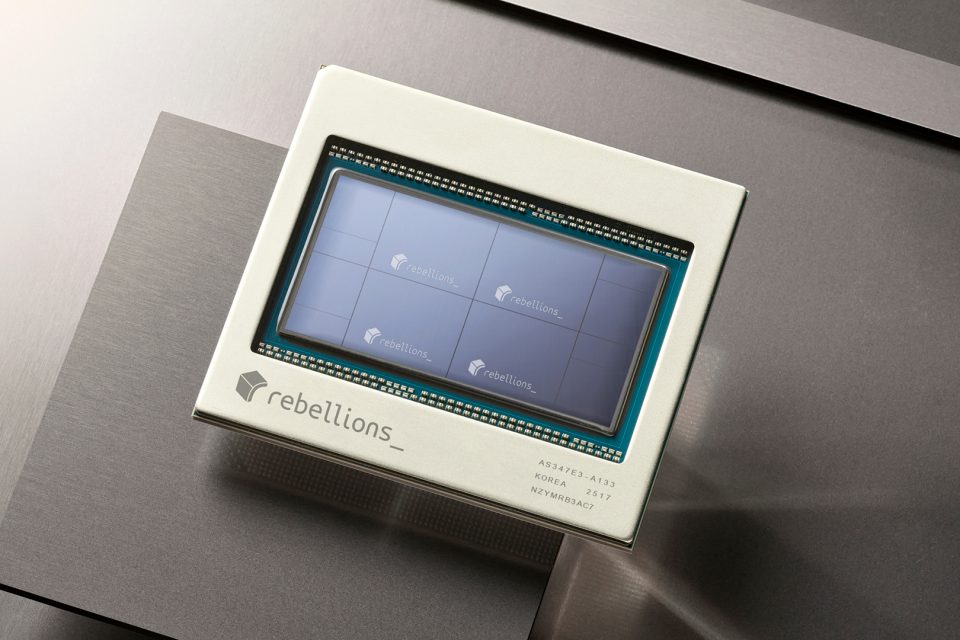
Image Credit: Rebellions
Gaining valuable experience in building an AI stack with SK Telecom, it’s pairing its field experience with an open source-first software strategy it said can help carriers move faster without locking scarce engineering talent into yet another proprietary AI stack. The company says it’s dedicated to using open-source software – everything from vLLM and OpenShift to PyTorch – with a “no forks” rule. The rule is designed to help customers avoid skills issues and ensure engineers don’t have to learn non-transferrable skills just to use its equipment.
Rebellions’ work with SK Telecom (SKT) has served as a foundational pillar of its engagement with other operators, according to Marshall Choy, Rebellions’ Chief Business Officer (CBO). The company is in conversations with between 10 and 20 operators around the world.
“Our systems have been deployed at SKT for nearly three years,” Choy said. “What does that mean? It means three years of lessons learned, institutional knowledge gain, product improvement and deep engagement with an end user customer working on real problems… It’s three years of blood sweat and tears that has become institutional knowledge,” he added.
The network operators in its pipeline are in “different stages of engagement and deployment” with Rebellions, Choy said, saying there will be “more to come on that.” While SK Telecom has been its most publicized partner to date, Choy said over the next 12 months Rebellions plans to highlight more of what has been going on under cover. That includes work with other telecom operators as well as neocloud operators, enterprises and governments.
According to Choy, the architecture prioritizes low-latency, high-throughput compute infrastructure. From a cost-efficiency perspective, the company targets a price-to-performance ratio that is two to three times more cost-effective than comparable Nvidia hardware. Furthermore, Rebellions delivers significantly higher energy efficiency. While an Nvidia DGX GB200 NVL72 system consumes upwards of 120 kilowatts per rack, Rebellions averages 4 kilowatts per system, or approximately 20 kilowatts per rack.
Choy noted that this power reduction yields a 6x savings in operational expenditure (OpEx). It also enables telecommunications providers to deploy Rebellions infrastructure in edge environments with stringent power constraints, such as legacy central offices. By retrofitting these distributed facilities with modern inference compute to serve LLM tokens, operators can maximize the lifecycle and return on investment (ROI) of their existing physical assets.
“Our goal is to reduce the unit economics of AI inferencing to near zero,” Choy said. While he admitted that sounds strange coming from an AI inferencing chip company, Choy explained that it’s all about making AI accessible for even more use cases – the ones where the math doesn’t work out today. “If you’re a telephone operator and you have an existing line card of services you provide, I can make you more profitable because I can lower your costs. But more strategically, what I can do is I can enable you to introduce a lower tier of services at a lower cost, which then makes AI inferencing accessible to a whole set of applications where it was previously too expensive,” he added.
It should be noted that Groq and SambaNova (see References below) are similarly working on chips to reduce the cost of inferencing. OpenAI appears to be moving in a similar direction with its Jalapeño chip.
Through its work with SK Telecom and others (unnamed), Choy said Rebellions has learned that customers aren’t just looking for hardware or software but for fully optimized infrastructure that cuts across both. That’s where Rebellions’ open-source ethos comes into play. “We didn’t want to have this mainframe model where everything is custom and bespoke and we’re this weird thing off in the side of the data center that doesn’t get touched by anything else,” Choy said. “It’s all about interoperability and integration.”
In conclusion, Choy opined, “Let’s be honest, the telcos don’t necessarily have all the right skills in place. So, being able to spread that across more of an open-source ecosystem means they can be in service and productive faster.”
References:
https://rebellions.ai/company/about/
https://rebellions.ai/category/blogs/
https://rebellions.ai/rebellions-product/rebel100/
SambaNova targets AI inference boom with chips built for existing data centers
Intel and AI chip startup SambaNova partner; SN50 AI inferencing chip max speed said to be 5X faster than competitive AI chips
AWS to deploy AI inference chips from Cerebras in its data centers; Anapurna Labs/Amazon in-house AI silicon products
Custom AI Chips: Powering the next wave of Intelligent Computing
Huawei to Double Output of Ascend AI chips in 2026; OpenAI orders HBM chips from SK Hynix & Samsung for Stargate UAE project
Huawei to Double Output of Ascend AI chips in 2026; OpenAI orders HBM chips from SK Hynix & Samsung for Stargate UAE project
Huawei to Double Output of Ascend AI chips in 2026; OpenAI orders HBM chips from SK Hynix & Samsung for Stargate UAE project
Superclusters of Nvidia GPU/AI chips combined with end-to-end network platforms to create next generation data centers
Ericsson leads SK Telecom AI RAN vs. NVIDIA’s GPU centric AI RAN Alliance
Executive Summary:
Ericsson says it has been selected as the sole global technology partner in SK Telecom’s consortium for Korea’s Hyper-AI Network Infrastructure Demonstration Project, a South Korea government-backed initiative led by the Ministry of Science and ICT and the National Information Society Agency. The program is intended to validate AI-RAN pilot networks as a cornerstone of Korea’s national “AI Highway” strategy and its longer-term 6G roadmap.
Ericsson’s contribution [1.] to this project centers on the RAN and the automation layer that surrounds it. According to Ericsson, its role in the project includes 5G Standalone expertise, AI-in-RAN capabilities, and intelligent network automation through the Ericsson Intelligent Automation Platform (EIAP) and AI-powered rApps, enabling autonomous control, resource orchestration, and real-time optimization for physical AI services. Ericsson is not being positioned as a general AI infrastructure provider, but as the core network technology partner bringing telco-grade RAN, automation, and orchestration into a live industrial validation environment. Ericsson will contribute what it calls an “end-to-end network foundation” to the project that is intended to connect and continuously optimize intelligent machines and autonomous industrial operations. In the second phase of the project, Ericsson’s AI-RAN pilot network is expected to be applied to a real-world logistics environment at KG Mobility’s Pyeongtaek plant.
Note 1. It’s interesting to note that Ericsson is a founding member of the Nvidia GPU centric AI-RAN Alliance, contributing the operator-centric “AI-for-RAN” perspective by embedding telco-grade AI into basebands and radios to improve network performance, automation, and energy efficiency. The company’s delegates hold leadership roles in the alliance’s working groups and technical committees.
For telecom operators, the significance is not just radio performance but the shift toward a network architecture that can support physical AI use cases with tighter latency, stronger uplink capacity, and higher service assurance. SK Telecom plans to demonstrate AI-RAN pilots through 2027 across scenarios such as autonomous transport, industrial safety monitoring, and humanoid robotics, with a second-phase deployment targeted for KG Mobility’s Pyeongtaek plant.

Sibel Tombaz, Head of Customer Unit Korea, Ericsson, says: “Being selected as a key global technology partner in this government-backed Hyper-AI Network consortium is a significant recognition of Ericsson’s technology leadership and our long-term partnership with SK Telecom. Korea is moving with clear ambition to shape the future of AI-native networks and 6G, and Ericsson is proud to contribute our global expertise in 5G, AI-RAN, orchestration, and intelligent network automation to this important national initiative. We look forward to working closely with SK Telecom and the consortium partners to help turn Korea’s 6G vision into real industrial value.”
Takki Yu, VP and Head of Network R&D at SK Telecom, says: “As a key national project supporting Korea’s Hyper-AI Network strategy, SK Telecom is pleased to collaborate with Ericsson as a key technology partner to advance AI-RAN technology through global cooperation. Together, we aim to build a strategic win-win partnership, demonstrate real industrial value, and help strengthen Korea’s AI-RAN technology capabilities and ecosystem for the future.”
Comparison with NVIDIA GPU centric AI-RAN Alliance:
The SK Telecom–Ericsson initiative and the NVIDIA-led AI-RAN ecosystem share a common thesis: the RAN is evolving into a distributed compute platform that can host or coordinate AI workloads closer to where data is generated. But they emphasize different layers of the stack. SK Telecom’s Ericsson-led project is centered on operator-grade RAN validation, network autonomy, and physical AI service delivery in industrial settings, while NVIDIA’s effort is broader and more compute-centric, tied to AI factories, GPU infrastructure, and open 6G ecosystem development.
- NVIDIA is a founding member of the AI-RAN Alliance and acts as one of its most visible technical drivers, contributing reference architectures and accelerated-computing platforms for AI-RAN.
- Ericsson is the operator-focused RAN technology partner proving AI-RAN in live telco and industrial network deployments.
The practical takeaway is that Ericsson’s role is more narrowly telecom-native, while NVIDIA’s consortium is more infrastructure- and compute-oriented. For 6G, the two approaches are complementary rather than contradictory: one is proving how the network behaves as a deterministic industrial platform, the other is building the compute substrate that can feed AI-native services into that platform.ericsson+2
Why it matters:
SKT announced the Hyper-AI Network Infrastructure Development project last month, and at the time Ericsson, Nokia, Samsung and private mobile networking specialist HFR were named as those providing the kit and related network and software solutions.
South Korea has become one of the most advanced and competitive mobile markets, and this makes it a useful proving ground for AI-RAN. If the SK Telecom pilot succeeds, it could strengthen the case that future mobile networks must support not only connectivity, but distributed inference, orchestration, and machine control for robots, vehicles, and industrial systems.
From a standards and market perspective, the more interesting question is how these pilots influence the eventual division of labor between RAN, edge compute, and centralized AI infrastructure in 6G-era networks. That is where the SK Telecom–Ericsson model, with its operator-led network validation, may prove especially influential.
…………………………………………………………………………………………………………………………………………………………………………………………………
References:
https://www.ericsson.com/en/press-releases/2026/8/skt-hyper-ai-consortium
https://www.telecoms.com/ai/ericsson-named-sole-global-vendor-for-sk-telecom-s-hyper-ai-consortium
Ericsson goes with custom silicon (rather than Nvidia GPUs) for AI RAN
Dell’Oro: AI RAN revenue forecast: $35B from 2026-to-2030; 3 types of AI RAN explained
Dell’Oro: RAN Market Stabilized in 2025 with 1% CAG forecast over next 5 years; Opinion on AI RAN, 5G Advanced, 6G RAN/Core risks
Dell’Oro: Analysis of the Nokia-NVIDIA-partnership on AI RAN
RAN silicon rethink – from purpose built products & ASICs to general purpose processors or GPUs for vRAN & AI RAN
Dell’Oro: AI RAN to account for 1/3 of RAN market by 2029; AI RAN Alliance membership increases but few telcos have joined
Dell’Oro: RAN revenue growth in 1Q2025; AI RAN is a conundrum
Autonomous customer experience required for AI-Native 6G and distributed intelligence at the network edge
Executive Sumary:
Communications service providers (CSPs) have historically competed on network-centric KPIs—coverage, capacity, reliability, and price—anchored in 3GPP performance and management frameworks (e.g., TS 28-series, TS 23.501 QoS models). However, these metrics alone are no longer sufficient to sustain differentiation in increasingly saturated and capital-intensive markets, according to Chantel Cary, Product Marketing Senior Manager at Oracle Communications [1],
“The battleground has shifted,” Cary told Capacity Global. “Today, customer experience is becoming the clearest point of differentiation, and in many cases, the most important driver of growth.”
This shift is unfolding alongside structural constraints: flat ARPU, rising capex associated with 5G standalone, fiber access (FTTx), and edge cloud expansion, and increasing customer acquisition and retention costs. At the same time, customer expectations—benchmarked against hyperscaler-grade digital platforms—are becoming uniformly high across mobile and fixed broadband services.
“They do not compare a telecom provider only to other providers,” she said. “They compare every experience to the best experience they have anywhere.”
…………………………………………………………………………………………………………………………………………………………………………………………………………………..
Note 1. Oracle Communications is a dedicated global business unit and product portfolio fully owned and operated by Oracle. It provides enterprise software and infrastructure designed specifically for telecommunications service providers (like AT&T or Verizon) and large enterprises. Their solutions manage everything from network routing, security, and signaling (including 5G) to back-office billing, revenue management, and customer experience operations,
…………………………………………………………………………………………………………………………………………………………………………………………………………………..
Analysys Mason reports that 97% of operators view AI-powered automation as essential for survival and growth, reinforcing alignment with TM Forum’s Autonomous Networks framework and the broader industry transition toward AI-native system design.
AI-Native Customer Experience Architecture:
Cary’s concept of “autonomous customer experience” maps directly to the emerging paradigm of AI-native networks, where intelligence is embedded across both network and service layers rather than applied as an overlay. “It is not about removing the human element from engagement,” she explained. “It is about using AI to continuously orchestrate the customer lifecycle in ways that humans alone cannot manage at scale.”
In wireless networks, this evolution is reflected in 3GPP-defined enablers such as the Network Data Analytics Function (NWDAF, TS 23.288), which provides real-time analytics to optimize policy control, mobility, and QoS. In parallel, O-RAN Alliance architectures introduce the near-real-time and non-real-time RAN Intelligent Controllers (near-RT RIC, non-RT RIC), enabling AI-driven control loops for radio resource management and service optimization.

Image Credit: Aisera
In wireline and converged networks, similar principles are emerging through SDN-based control planes, broadband network gateways (BNG) with telemetry streaming, and ITU-T frameworks (e.g., Y.3172 for machine learning in future networks), enabling closed-loop optimization across access, aggregation, and core domains.
However, Cary notes that most OSS/BSS environments remain fragmented, limiting the ability to operationalize these capabilities at the customer experience layer. Data silos, batch-oriented processing, and loosely coupled workflows constrain real-time, cross-domain orchestration.
AI Across Commercial and Network Domains:
Cary identifies three primary domains of impact, increasingly converging with network intelligence:
-
Marketing: AI-driven personalization is evolving toward real-time, context-aware engagement informed by both customer behavior and network conditions (e.g., location, QoS state, congestion). This aligns with event-driven architectures and customer data platforms integrated with network analytics (e.g., NWDAF exposure via APIs). “Personalisation shifts from broad audiences to the individual,” she said, adding that relevance is now “a prerequisite for attention.”
-
Sales: AI enables next-best-action and dynamic offer generation, incorporating network-aware insights such as service availability, slice characteristics (in 5G SA), and fiber capacity constraints. Integration with policy control (3GPP TS 23.203) and service orchestration frameworks supports closed-loop order capture and fulfillment. “That combination of higher conversion and lower friction is valuable,” she said.
-
Service: AI-driven assurance is transitioning from reactive fault management to predictive and intent-based service assurance across both wireless and wireline domains. Telemetry from RAN, transport, and fixed access networks feeds AI models that anticipate degradation and trigger remediation before customer impact. “Human agents still play a central role,” Cary said, “but they can be augmented with real-time recommendations, contextual history and autonomous processes that improve both speed and consistency.”
Scaling Challenges in AI-Native Transformation:
Despite progress in AI models and domain-specific analytics, Cary highlights a systemic gap in operationalization.
“What it lacks, in many cases, is the ability to turn fragmented customer data into real-time decisions that can actually be executed across marketing, sales and service,” she said.
Analysys Mason data indicates that only 6% of operators achieve ROI above 25% from AI initiatives, while 60% advance just 20% of proofs of concept into production. This reflects challenges in integrating heterogeneous data sources across OSS, BSS, and network domains, as well as limitations in MLOps and real-time orchestration frameworks.
Fragmentation is compounded in converged networks, where wireless (3GPP-based) and wireline (e.g., Broadband Forum TR-369/USP, TR-383 for disaggregated BNG) ecosystems often evolve independently. Additionally, 93% of operators cite multi-vendor complexity as increasing total cost of ownership, underscoring the need for interoperable, standards-based integration across AI, network, and IT domains.
“That creates an unfortunate pattern across the industry,” she said, “promising AI initiatives that demonstrate value in isolation but fail to scale because they are not connected to the data, systems and processes where real work happens.”
Toward Fully AI-Native Operations:
Cary emphasizes that the target state is not incremental automation but fully AI-native operations, where intelligence is embedded into both network control loops and customer engagement workflows.
“This is why the future of customer experience in communications is not about layering AI onto the edge of the enterprise,” Cary said. “It is about making AI operational at the core of engagement.”
This vision aligns with emerging 6G research directions, where AI is treated as a native design primitive across RAN, core, and service layers, as well as with TM Forum’s Open Digital Architecture (ODA), which promotes composable, API-driven integration between OSS, BSS, and AI components.
Oracle’s approach reflects this convergence by unifying customer data, embedding AI into engagement and orchestration layers, and integrating these capabilities with telecom operational systems across both wireless and wireline domains.
Implementation Suggestions:
Cary said that network providers do not need to transform everything at once. She recommends starting by unifying customer data across touchpoints to establish a trusted, real-time view, before activating high-value AI use cases across marketing, sales and service. From there, providers can embed AI into workflows so insight translates into action rather than sitting in dashboards, eventually connecting those capabilities into end-to-end orchestration.
Indeed, Cary advocates a phased approach consistent with AI-native transformation:
-
Establish a unified, real-time data fabric spanning customer, service, and network domains.
-
Deploy high-value AI use cases (e.g., next-best-action, churn prediction, predictive assurance) leveraging both IT and network telemetry.
-
Embed AI into execution workflows to enable closed-loop, intent-driven orchestration across the customer lifecycle.
This progression reflects the broader industry trajectory toward converged, AI-native networks, where customer experience is no longer an overlay on connectivity, but a direct outcome of tightly coupled intelligence across wireless and wireline infrastructures.
“The communications providers that lead in the years ahead will not be the ones that simply adopt more AI tools. They will be the ones that use AI to rethink how customer engagement works across the enterprise. AI is not just enhancing customer experience,” she added. “It is redefining how customer experience is delivered, and in communications, that shift is likely to separate the providers that keep pace from the ones that set the pace.”
………………………………………………………………………………………………………………………………
Editorial Analysis:
Cary’s vision aligns with IMT 2030/6G’s shift from AI as an overlay to AI as an architectural primitive, spanning the air interface, semantic service handling, and distributed edge intelligence across wireless and wireline domains. The cleanest way to map her suggestions into 6G is to treat “autonomous customer experience” as the service-layer expression of an AI-native network stack: AI decisions would no longer sit only in OSS/BSS, but would be distributed across RAN, transport, core, and edge applications, with closed-loop control spanning wireless and wireline domains. That maps well to current AI-native 6G proposals that emphasize model interdependencies, distributed intelligence, and AI embedded directly in the architecture rather than layered on top.
For the AI native air interface, the link is to AI-assisted radio control, where the network uses learned models to optimize scheduling, mobility, beam management, and QoS-aware policy decisions in real time. In a 6G framing, that extends beyond today’s AI for RAN optimization and toward an AI-native air interface in which the radio stack itself is designed for machine-driven adaptation, including distributed control loops between UE, RAN, and core. For your article, this supports language that customer experience is increasingly shaped by network intelligence at the point of access, not just by back-office engagement systems.ieeexplore.ieee+2
Semantic communications maps to the idea that the network should optimize for meaning or task relevance, not simply bit delivery. In practice, that means a 6G service layer could prioritize the semantic value of an interaction—such as whether a customer is trying to resolve an outage, confirm a move order, or change a plan—and allocate resources accordingly across wireless and wireline paths. The relevance to Cary’s argument is that customer experience becomes more contextual and intent-aware when the network itself can distinguish between low-value traffic and high-importance service interactions.
Distributed intelligence at the network edge is the most direct bridge between CSP operations and 6G design. In a converged wireless-wireline environment, edge AI can fuse RAN telemetry, fixed access metrics, subscriber context, and service history to trigger local decisions such as proactive care, dynamic QoS adjustment, or preemptive fault mitigation. That makes the experience layer more autonomous because the decision point moves closer to where the event occurs, reducing dependence on centralized, slower, batch-oriented processing.
…………………………………………………………………………………………………………………………………………………………………………………………………………………………………………
References:
https://www.nokia.com/6g/unlocking-the-full-potential-of-ai-native-6g-through-standards/
Comparing AI Native mode in 6G (IMT 2030) vs AI Overlay/Add-On status in 5G (IMT 2020)
SHIELD-6G with AI-native cyber threat intelligence platform to enhance cybersecurity for Europe’s future 6G networks
AT&T and Ericsson boost Cloud RAN performance with AI-native software running on Intel Xeon 6 SoC
Ericsson and Intel collaborate to accelerate AI-Native 6G; other AI-Native 6G advancements at MWC 2026
NVIDIA and global telecom leaders to build 6G on open and secure AI-native platforms + Linux Foundation launches OCUDU
AT&T and Ericsson boost Cloud RAN performance with AI-native software running on Intel Xeon 6 SoC
Meta’s “Iris” AI Chip for MTIA: Implications for Telecom-Grade Optical Networking, DCI and High Capacity Ethernet Fabrics
Executive Summary:
According to Reuters, Meta Platforms (previously known as Facebook) plans to start manufacturing an artificial intelligence (AI) chip in September as part of its plan to boost overall computing power to 14 gigawatts in 2027. The social media firm’s data center chip, code-named “Iris,” is part of a four-generation project for Meta Training and Inference Accelerators (MTIA) that it will design in-house. The plan is to use custom-built silicon to improve the AI that powers its Facebook and Instagram social media platforms.
This move by Meta marks a pivotal moment in hyperscaler AI infrastructure strategy. This vertical integration play, executed through a multi-vendor supply chain (Broadcom design, TSMC manufacturing, Samsung RAM, SanDisk storage, Sumitomo fiber-optic equipment), has profound implications for telecom-grade optical networking, data center interconnect (DCI), and high-capacity Ethernet fabrics.
For IEEE Techblog readers focused on network architecture, standards, and infrastructure economics, the Meta MTIA story illuminates three critical trends:
- Hyperscaler silicon sovereignty as a cost and performance lever.
- Scaling challenge of 14 GW AI compute for optical transport and DCI.
- The emerging “Network Supercycle” driven by agentic AI workloads as per Cisco.

Image Credit: Meta Platforms
…………………………………………………………………………………………………………………………………………………………………………………………………………………………..
The MTIA “Iris” Roadmap: Accelerating AI Silicon Cadence:
Meta’s Meta Training and Inference Accelerator (MTIA) program—now in its third generation with “Iris”—is pursuing an aggressive development cadence: a new chip every six months through 2027. This contrasts sharply with the industry-standard 12–18 month cadence for AI accelerators from NVIDIA, AMD, and even hyperscaler custom silicon programs (Google TPU, AWS Trainium)
Key MTIA milestones:
-
MTIA v1 (2024): First-generation training/inference chip, proof-of-concept for Meta’s internal AI workloads
-
MTIA v2 (early 2026): Performance and efficiency improvements, scaled deployment for Llama model training
-
MTIA v3 “Iris” (September 2026): Production ramp, targeting higher throughput and lower power per inference
-
MTIA v4 (2027): Next-generation architecture, expected to integrate advanced packaging, higher-bandwidth memory, and improved interconnect topologies
This cadence is not merely a technical achievement—it’s a strategic signal. Meta is betting that in-house silicon, even if initially less performant than NVIDIA’s H100/B100 or AMD’s MI300X, can deliver better total cost of ownership (TCO) when optimized for Meta’s specific workloads (Llama LLMs, recommendation systems, ad targeting).
Broadcom + TSMC: A Multi-Vendor Supply Chain Play:
Meta’s MTIA program is not a pure in-house design effort. The company is partnering with Broadcom for chip design and TSMC for advanced-node manufacturing (likely 5nm or 3nm process). This hybrid approach—hyperscaler architectural control with foundry and design partner execution—is becoming the dominant model for AI silicon:techcrunch
Why this matters: The multi-vendor AI chip supply chain is becoming a critical dependency for telecom-grade infrastructure. Broadcom’s involvement in both Meta’s MTIA and Apple’s $30B RF/FBAR deal (announced July 7–8, 2026) positions the company as a central player in both AI compute and 5G/6G RF ecosystems. For network architects, this means tracking Broadcom’s packaging, interconnect, and I/O roadmaps—not just NVIDIA’s.
14 GW Computing Target: The Optical and DCI Challenge:
Meta’s internal memo, reported by Reuters on July 9, 2026, outlines a target of 14 GW of computing capacity by 2027. To put this in perspective:
-
14 GW ≈ 14 large nuclear power plants (each ~1 GW)
-
Current hyperscaler data center power draw: ~50–100 GW total across all hyperscalers (2025 estimate)
-
Meta’s 2025 data center power: ~10–12 GW (estimated)
-
Growth rate: ~15–20% CAGR in hyperscaler power draw, but Meta is targeting a step-function increase
This is not just a compute scaling story—it’s an optical transport and DCI scaling story. Each GW of AI compute requires:
-
High-bandwidth optical interconnect within data centers (400G/800G/1.6T Ethernet, optical circuit switching)
-
Long-haul DCI between data center campuses (coherent 800G/1.6T, subsea cable systems)
-
Power and cooling infrastructure (liquid cooling, direct-to-chip, immersion)
-
Fiber-optic cabling and fiber-optic equipment (Sumitomo, Corning, Prysmian)
Optical Transport Implications:
Meta’s 14 GW target implies a massive buildout of optical infrastructure. Key considerations for IEEE ComSoc readers:
-
Intra-DC Optical Fabrics: AI clusters (e.g., 10K–100K GPU/TPU/MTIA nodes) require non-blocking, low-latency optical fabrics. Meta’s 2025–2026 data center designs likely use:
-
800G/1.6T optical transceivers (OSFP, QSFP-DD)
-
Optical circuit switching (OCS) for dynamic bandwidth allocation (e.g., Oriole Networks PRISM, Google Apollo)
-
Co-packaged optics (CPO) and near-packaged optics (NPO) for power efficiency
-
-
Inter-DC DCI: Meta operates multiple data center campuses globally (U.S., Europe, Asia). Connecting these for AI workload distribution requires:
-
Coherent 800G/1.6T DCI (400ZR/ZR+, OpenROADM)
-
Subsea cable systems (e.g., Meta’s 2024–2026 investments in transatlantic and transpacific cables)
-
Terragraph-inspired metro fiber for regional campus interconnects
-
-
Fiber-Optic Equipment: Meta’s supply chain includes Sumitomo Electric for fiber-optic equipment, per the July 2026 memo. Sumitomo is a key supplier of:reuters
-
Optical amplifiers (EDFA)
-
Optical switches and ROADMs
-
Fiber-optic cables and connectors
-
Standards relevance: IEEE 802.3 (Ethernet), IEEE 802.1 (Time-Sensitive Networking), and ITU-T G.709 (OTN) are all directly impacted by Meta’s custom AI chip development program.
Cost Reduction vs. NVIDIA/AMD: The Vertical Integration Calculus & Why Hyperscalers Are Building Their Own AI Chips:
Meta’s MTIA program is part of a broader hyperscaler trend: vertical integration in AI silicon. The economic rationale is straightforward:
-
NVIDIA H100/B100 pricing: $30K–$40K per GPU (2025–2026 list prices)
-
AMD MI300X pricing: $20K–$30K per accelerator (2025–2026)
-
Hyperscaler custom silicon TCO: 30–50% lower than NVIDIA/AMD at scale, despite lower peak performance
Meta’s internal analysis (per their July 2026 internal memo) likely shows that MTIA v3 “Iris” can deliver comparable inference throughput per dollar to NVIDIA H100 for Llama workloads, even if peak FLOPS are lower. This is because:
-
Workload-specific optimization: MTIA is tuned for Meta’s LLM architectures (Llama 2/3/4), recommendation systems, and ad targeting—not general-purpose AI training.
-
Supply chain control: Meta can negotiate better TSMC wafer pricing, avoid NVIDIA’s 20–30% gross margin, and reduce dependency on a single vendor.
-
Software stack integration: Meta can optimize PyTorch, Llama inference libraries, and Meta’s internal AI frameworks for MTIA, reducing software overhead.
NVIDIA’s AI Chip “tax” vs. Hyperscaler Pushback:
NVIDIA’s dominance in AI accelerators (80–90% market share in 2025) has created what hyperscalers call the “NVIDIA tax”: premium pricing, limited supply, and software lock-in (CUDA ecosystem). Meta’s MTIA, Google’s TPU, Amazon’s Trainium, and Microsoft’s Maia are all attempts to reduce this dependency.
This is analogous to the telecom industry’s historical pushback against Cisco/Juniper proprietary switching ASICs. Open networking (Barefoot Tofino, Broadcom StrataXGS, P4 programmability) and disaggregated hardware (white-box switches, SONiC NOS) emerged as responses. AI silicon is following a similar path: disaggregation, open software stacks, and multi-vendor supply chains.
Full AI Infrastructure Stack Diversification: Samsung, SanDisk, Sumitomo:
Meta’s July 2026 memo outlines a fully diversified AI infrastructure stack:
-
AI accelerators: Meta MTIA (Broadcom design, TSMC fab)
-
DRAM: Samsung (HBM3/HBM3e for high-bandwidth memory)
-
Storage: SanDisk (NVMe SSDs, QLC/TLC NAND for model checkpoints and data lakes)
-
Fiber-optic equipment: Sumitomo (optical amplifiers, switches, cables)
-
Networking: Broadcom (Ethernet switches, NICs), potentially NVIDIA (Spectrum-X, Quantum InfiniBand for some clusters)
This diversification is not just about cost—it’s about supply chain resilience. The 2020–2023 chip shortage, U.S.-China trade tensions, and Taiwan geopolitics have made hyperscalers acutely aware of single-vendor risk.
Telecom relevance: This mirrors the telecom industry’s shift from Cisco/Juniper monolithic routers to disaggregated white-box switches, open optical line systems, and multi-vendor RAN (O-RAN, vRAN). The AI infrastructure stack is undergoing a similar transformation.
The “Network Supercycle” Narrative: AI Compute as a WAN Traffic Driver:
Cisco executives have framed agentic AI workloads as driving a new infrastructure investment wave, with AI inference projected to account for ~25% of total WAN traffic by 2035. Meta’s 14 GW target is a concrete manifestation of this thesis.
Key implications for WAN and DCI:
-
Bursty, Low-Latency Uplink Traffic: Agentic AI (e.g., autonomous coding agents, multi-agent collaboration) requires high uplink capacity, low latency, and guaranteed connectivity—exactly the traffic patterns Ookla’s July 2026 report highlighted as stressors for 5G networks.
-
East-West DCI Traffic: AI training and inference workloads require massive data movement between storage, compute, and memory across data center campuses. This drives demand for:
-
Coherent 800G/1.6T DCI
-
Optical circuit switching for dynamic bandwidth allocation
-
Subsea cable systems for intercontinental AI workload distribution
-
-
Token/Byte Monetization: Huawei’s July 2026 AI-centric network vision includes “token/byte” monetization strategies for AI-driven services in the upper-6 GHz band. Meta’s AI infrastructure buildout is the supply-side enabler for this demand-side monetization.techblog.comsoc+1
Nokia’s “Physical AI” Warning:
Nokia’s “Physical AI” study (covered in earlier Techblog posts) warns that high-volume, low-latency uplink traffic from physical AI applications (e.g., robotics, autonomous systems) may require a fundamental RAN redesign. Meta’s 14 GW target is a parallel data center-side manifestation of this trend: AI workloads are reshaping both RAN and DCI/optical architectures.techblog.comsoc+1
Standards and Interoperability:
Meta’s MTIA “Iris” and 14 GW target have direct implications for several IEEE and standards activities:
IEEE 802.3 (Ethernet):
-
800G/1.6T Ethernet: IEEE 802.3df (800G/1.6T) and IEEE 802.3dj (1.6T/3.2T) are critical for AI cluster fabrics.
-
Power over Ethernet (PoE) for AI racks: Higher-power PoE standards may be needed for AI accelerator racks and liquid-cooled systems.
IEEE 802.1 (Time-Sensitive Networking):
-
Deterministic Ethernet for AI: Low-latency, jitter-free traffic for AI inference may require TSN profiles or new deterministic Ethernet extensions.
IEEE 802.15 (Wireless Personal Area Networks):
-
AI-native wireless for edge inference: Meta’s MTIA may eventually extend to edge inference (e.g., AR/VR, metaverse), requiring low-power, high-bandwidth wireless standards.
ITU-T and OIF:
-
Coherent DCI: ITU-T G.709 (OTN), G.709.x (coherent OTN), and OIF 400ZR/ZR+ are critical for inter-DCI.
-
Open optical line systems: OpenROADM, OpenCable, and disaggregated optical line systems are relevant for hyperscaler DCI builds.
O-RAN and AI-RAN Alliance:
-
AI-for-RAN vs. AI-on-RAN: Meta’s AI infrastructure could eventually support AI-on-RAN workloads (running AI inference on RAN/edge infrastructure), aligning with the AI-RAN Alliance’s vision.
Competitive Landscape – How Meta’s MTIA Compares:
Key takeaway: Meta’s MTIA is not the most performant AI accelerator, but it’s part of a broader hyperscaler strategy to reduce NVIDIA dependency, control TCO, and optimize for specific workloads.
Conclusions – The AI Infrastructure Stack as a Telecom-Grade Opportunity:
Meta’s MTIA “Iris” chip and 14 GW computing target are not just hyperscaler news—they are telecom-grade infrastructure news. For IEEE ComSoc readers, the implications are clear:
-
Optical transport and DCI will scale dramatically to support 14 GW of AI compute, creating demand for 800G/1.6T coherent optics, optical circuit switching, and subsea cable systems.
-
Hyperscaler silicon sovereignty is reshaping the AI accelerator market, with direct implications for Broadcom, TSMC, and the broader semiconductor supply chain.
-
The “Network Supercycle” is real, driven by agentic AI workloads that require high uplink capacity, low latency, and guaranteed connectivity.
-
Standards bodies (IEEE, ITU-T, OIF, O-RAN) must track AI infrastructure trends to ensure interoperability, performance, and cost efficiency.
For telecom network architects, optical engineers, and standards professionals, the Meta MTIA story is a call to action: AI infrastructure is the next frontier for telecom-grade networking. The question is not whether telecom and AI will converge—it’s how quickly and effectively the industry can adapt.
References:
Cisco Execs: New “Network Supercycle” as Agentic AI Workloads Reshape Telecom Infrastructure
Ookla: AI workloads will force changes in 5G mobile network infrastructure
Nokia’s AI Applications Study: “Physical AI” may require RAN redesign to support high‑volume, low‑latency uplink traffic
Ookla: AI platform reliability decreases as outages surge
Huawei’s AI-Centric Network Vision: Six Imperatives for the Next Decade; Critical Questions for IEEE Techblog Community
Dell’Oro: AI RAN revenue forecast: $35B from 2026-to-2030; 3 types of AI RAN explained
AI-RAN and Agentic AI get real: Ericsson, Nokia, Verizon & other operators enter into a new network automation era
AI-RAN Reality Check: hype vs hesitation, shaky business case, no specific definition, no standards?
Analysis: Nvidia’s rumored new 6G AI-RAN – likely features/functions and industry impact
Dell’Oro: 2H2026 Data Center Capex to Accelerate due to massive AI Deployments
Dell’Oro: Analysis of the Nokia-NVIDIA-partnership on AI RAN