

Vodafone3
VodafoneThree to study a new UK–Norway submarine cable system with route diversity
Disclaimer:
ChatGPT was used to assist with research, technical analysis, and drafting. The author reviewed and edited the material for accuracy and final content. He also provided additional information, quotes and images.
Introduction:
On November 10th, VodafoneThree (UK) [1.] announced a feasibility study for a proposed submarine telecommunications cable connecting mainland Scotland, the Shetland Islands and Norway. The proposed UK–Norway digital corridor is intended to strengthen international connectivity, improve geographic route diversity and enhance the resilience of critical digital infrastructure supporting businesses, public services, defense, data centers and other essential services.
Note 1. VodafoneThree was formed as a merger between Vodafone UK and Three UK. It became 100% owned by Vodafone Group Plc following full acquisition completion in July 2026.
The study, expected to begin in summer 2027, will examine potential cable routes from Shetland to Norway, possible landing locations in the Bergen region and the delivery partnerships needed to develop the connection. It builds on VodafoneThree’s earlier feasibility work on an additional submarine cable connecting Shetland with mainland Scotland.
Importantly, this is a feasibility study, not an approved, financed or under-construction cable project. The final route, landing locations, cable specifications, equipment suppliers, financing and deployment schedule have not been established.
The proposed corridor could strengthen the security, resilience and capacity of the UK’s digital infrastructure, supporting defense, critical national infrastructure and essential services. Analysis commissioned by VodafoneThree estimates it could protect up to £6.6 million of UK economic activity for each day of severe disruption affecting multiple existing routes where traffic cannot be rerouted. This highlights the value of geographically diverse subsea infrastructure: an alternative northern route could bolster resilience as government identifies coordinated disruption to critical undersea infrastructure as a growing national security risk. The proposed route could deliver up to £8.2 billion in economic value over the next ten years, according to research conducted by consultancy firm WPI Strategy and commissioned by Vodafone Business.

Photo Credit: VodafoneThree
………………………………………………………………………………………………………………………………………………………………………………………………………………………………………..
Executive Quotes:
Protecting our network of undersea cables is vital to keeping our country safe. Our adversaries are increasingly targeting our critical national infrastructure, including the cables that carry data and enable internet traffic and financial transactions. This is a very welcome step that could not only improve connectivity and boost our economy, especially in Scotland, but strengthen the UK’s national resilience, prevent disruption, and keep us all safe
UK Defense Secretary, Wes Streeting MP
Reliable international connectivity is vital to the UK’s defence, strengthening our resilience to disruption and enhancing the security of the critical infrastructure on which our economy and public services depend. Norway is a strategically important partner, with a shared commitment to protecting infrastructure across the North Atlantic. A new digital corridor would strengthen the physical links between our countries, add vital route diversity and support secure, resilient connectivity for critical infrastructure on both sides of the North Sea. It could also unlock investment in data centres and AI, creating skilled jobs and wider economic opportunities. This study will help establish the economic and strategic case for the route and identify the partnerships needed to deliver it
Nick Gliddon, Business Director, VodafoneThree
ITU’s Global Submarine Cable Resilience Recommendations:
VodafoneThree’s announcement comes at an important time for the submarine cable industry. In July 2026, the International Telecommunication Union (ITU) approved a comprehensive set of global recommendations for improving submarine cable resilience. These recommendations provide a useful framework for evaluating the proposed Scotland–Shetland–Norway corridor and its potential contribution to international network resilience. On July 10, 2026, the ITU International Advisory Body on Submarine Cable Resilience approved its final report, International Advisory Body on Submarine Cable Resilience – Report of the Working Groups 2026. The Advisory Body was established jointly by the ITU and the International Cable Protection Committee (ICPC) in November 2024.
The effort brought together 175 experts representing governments, regulators, submarine cable operators, telecommunications companies, industry organizations, academia and international organizations. Its work was organized into three Working Groups addressing different but complementary dimensions of submarine cable resilience.
The resulting recommendations are nonbinding global guidance intended to inform government policy, industry practices, investment decisions and international cooperation. They are not mandatory technical standards or certification requirements.
The Advisory Body was established jointly by ITU and the International Cable Protection Committee (ICPC) in 2024.

Source ITU
There are three ITU working groups involved:
| Working group | Technical focus |
|---|---|
| WG1 | Timely cable deployment and repair |
| WG2 | Risk identification, monitoring and mitigation |
| WG3 | Connectivity and geographic diversity |
Working Group 1: Timely Deployment and Repair:
WG1 addresses regulatory, logistical and operational obstacles that delay submarine cable deployment and repair. Its recommendations seek to reduce the time required to install new infrastructure and restore connectivity following cable damage.
Key recommendations include:
- Streamline permitting and regulatory approvals: Establish transparent, predictable permitting requirements and timelines. Reduce regulatory barriers involving customs, cabotage, ship and crew clearances, and emergency repairs.
- Designate government coordination contacts: Establish a single point of contact (SPOC) to coordinate submarine cable deployment and repair approvals across government agencies.
- Improve regional cooperation: Encourage regional cable protection committees and other cooperative frameworks to harmonize regulatory practices and share industry best practices.
- Expand global repair capabilities: Increase the availability and geographic diversity of repair vessels, spare parts and maintenance resources, particularly in remote and underserved regions.
- Develop rapid-response capabilities: Consider shallow-water repair teams equipped with remotely operated vehicles (ROVs) for near-shore incidents.
- Promote shared repair infrastructure: Encourage shared vessels, spare-parts pools, maintenance agreements and strategically located repair hubs.
- Improve public-private coordination: Establish operational contacts, 24-hour escalation procedures, joint exercises and information-sharing arrangements between governments and cable operators.
For the proposed Scotland–Shetland–Norway corridor, these recommendations are relevant to permitting in multiple jurisdictions, access to repair vessels in the North Atlantic and North Sea, maintenance agreements and emergency restoration planning.
Working Group 2: Risk Identification, Monitoring and Mitigation:
WG2 addresses physical, environmental, operational and security threats to submarine cable infrastructure. Its recommendations recognize that cable damage is not limited to deliberate attacks. Fishing activity, ship anchoring, seabed conditions, earthquakes, underwater landslides, climate change and maritime congestion all create risks.
Its 14 recommendations cover several important areas:
1. Risk assessment and information sharing
Governments should develop national submarine cable risk strategies based on reliable data concerning cable locations, vulnerabilities, faults and outages. Industry and government should improve information sharing while protecting sensitive infrastructure information.
2. Standardized incident reporting
WG2 encourages voluntary, standardized reporting of cable faults, outages, repair delays and other incidents. Anonymized information shared among governments and industry organizations could improve risk analysis and identify recurring vulnerabilities.
3. Legal frameworks and enforcement
Governments should establish clear legal and operational frameworks for cable protection, implement applicable international treaty obligations and strengthen enforcement against intentional or negligent cable damage. Improved coordination with law enforcement and maritime authorities is also encouraged.
4. Maritime safety and route protection
Recommendations address maritime training, accidental anchor deployment, marine spatial planning and improved nautical charting. Digital navigation and updated cable-risk information can help ships and maritime operators avoid damaging existing infrastructure.
5. Redundancy audits and stress testing
Cable operators should conduct audits and stress tests to evaluate network redundancy and the ability to maintain connectivity during multiple failures. Decommissioning decisions should also account for their impact on remaining network diversity and resilience.
6. Landing-station and outside-plant security
Cable landing stations (CLS) and associated outside-plant (OSP) infrastructure require appropriate physical and cybersecurity protections. Recommendations also address data security, monitoring and early-warning capabilities.
7. Investment in cable protection
WG2 encourages investment in physical protection measures, including appropriate cable burial and armoring. Route-specific risk assessments should determine the level of protection required.
These recommendations are particularly relevant to VodafoneThree’s proposed feasibility study. The route assessment should examine seabed conditions, fishing and anchoring activity, maritime traffic, environmental hazards, cable burial requirements and the security of landing stations and terrestrial connections.
Working Group 3: Fostering Connectivity and Geographic Diversity:
WG3 addresses the investment, economic, regulatory and network-architecture requirements for improving global connectivity and geographic diversity.
A major concern identified by the ITU is the concentration of submarine cable infrastructure along a limited number of geographic corridors and chokepoints. Countries and regions dependent on only one or a few cable systems are particularly vulnerable to disruptions.
Its recommendations include:
- Blended financing and investment: Encourage financing platforms and partnerships that support submarine cable projects in underserved regions, including Small Island Developing States (SIDS), Least Developed Countries (LDCs) and remote coastal areas.
- Early coordination among investors and operators: Involve governments, financing institutions and cable operators during the design process to identify investment opportunities and reduce project risks.
- Public-private partnerships: Encourage partnership structures that make strategically important cable routes economically viable when private investment alone may be insufficient.
- Insurance and risk mitigation: Develop insurance mechanisms that improve project financing and reduce investment risks.
- Predictable regulatory frameworks: Establish clear licensing and permitting processes to reduce uncertainty, costs and deployment delays.
- Access to landing stations: Encourage nondiscriminatory access consistent with national regulations and security requirements, enabling competing carriers to obtain capacity.
- Branching-unit planning: Consider incorporating branching units into initial cable system designs to facilitate future connections and improve regional connectivity.
- Anchor tenancy: Encourage government or other institutional commitments to purchase minimum capacity on new systems where this helps make investment viable.
- Route diversity guidelines: Promote industry best practices for evaluating geographic diversity and resilience requirements, including exposure to environmental and human-caused hazards.
WG3 is particularly relevant to the proposed UK–Norway corridor. The feasibility study should determine whether the route provides genuinely independent international connectivity or introduces additional capacity along existing vulnerable corridors.
That requires evaluating seabed route separation, independent landing stations, terrestrial backhaul diversity and the ability to reroute traffic when other cable systems fail. Simply adding another submarine cable does not automatically provide meaningful network redundancy.
Taken together, the three ITU Working Groups provide a comprehensive framework covering cable deployment, operational protection, monitoring, repair readiness, investment and geographic diversity. VodafoneThree’s feasibility study offers an opportunity to evaluate these recommendations before the eventual cable architecture and procurement decisions are finalized. The company has not announced formal adoption of the ITU recommendations. Here’s a functional block diagram of the entire cable system, including land and submarine portions:
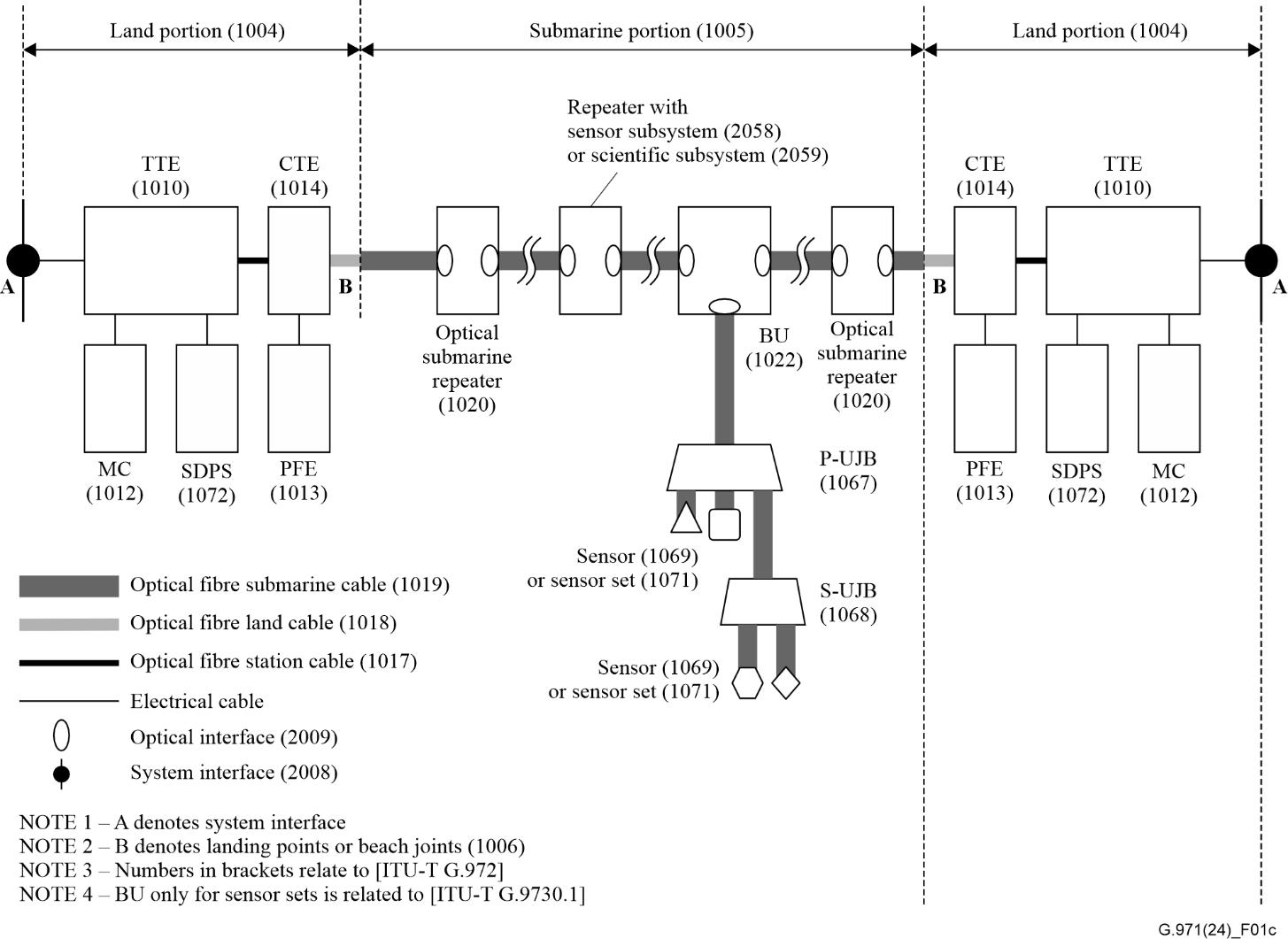
Source: ITU
Fiber-Optic Monitoring and Threat Detection:
Another important aspect of submarine cable resilience is the ability to detect and locate physical disturbances before they result in service interruptions. Distributed Acoustic Sensing (DAS) and Distributed Temperature Sensing (DTS) can turn optical fibers into distributed sensors, providing information about physical and environmental conditions along a cable route.
DAS detects acoustic and vibration-related disturbances that can be associated with nearby vessel activity, anchoring, fishing operations and other seabed events. DTS measures temperature variations along the fiber and can help identify certain environmental and cable-related anomalies.
Research conducted in Norway has demonstrated the potential of DAS for detecting and tracking vessels near submarine telecommunications infrastructure. A 2026 study using a fiber-optic cable in Trondheim Fjord reported ship detection at distances of up to 1.6 km from the cable, with localization results compared against Automatic Identification System (AIS) data.
These technologies could provide additional monitoring capabilities for submarine cable operators. However, detection is not equivalent to identifying hostile intent, and performance depends on the sensing system, fiber configuration, environmental conditions and signal-processing capabilities.
There is also an important ITU standards connection. ITU-T Recommendation G.979 (November 2025), Characteristics of Monitoring Systems for Optical Fiber Submarine Cable Systems, addresses monitoring-system architecture, equipment characteristics and monitored parameters. Its third edition includes generic monitoring requirements for sensing functionalities.
The proposed feasibility study should evaluate whether suitable fiber-optic monitoring and threat-detection capabilities can be incorporated into the eventual cable system, consistent with applicable ITU-T recommendations.
Multi-Vendor Optical Equipment Interoperability:
An additional consideration is whether the eventual submarine cable architecture will support multi-vendor interoperability among optical transmission equipment suppliers.
VodafoneThree’s announcement does not identify equipment vendors, open cable architecture requirements or multi-vendor interoperability as objectives of the feasibility study. Nevertheless, these issues should be considered before system architecture and procurement decisions are finalized.
Traditionally, many repeatered submarine cable systems have been supplied as integrated, turnkey solutions by a single vendor. This can create long-term supplier dependencies and limit equipment replacement and upgrade flexibility.
ITU-T G Supplement 41 (July 2024), Design Guidelines for Optical Fiber Submarine Cable Systems, describes different physical-layer compatibility architectures, including black-box transverse compatibility and configurations permitting equipment from different vendors to interoperate under defined interface and performance requirements.
ITU-T G.971 also addresses general characteristics of optical fiber submarine cable systems.
There are important engineering distinctions between these architectures. Multi-vendor compatibility at submarine line terminal equipment (SLTE) and coherent optical transmission interfaces is more readily achievable than interoperability involving submerged repeaters, amplifiers and branching units, which are often integrated into a single-vendor wet-plant system.
The feasibility study should therefore evaluate:
- Standardized interfaces between SLTE and the submarine optical line system.
- Multi-vendor compatibility of coherent optical transmission equipment.
- Opportunities to separate wet-plant and dry-plant procurement.
- Common optical performance specifications and interoperability testing.
- Long-term supplier flexibility and future transmission-capacity upgrades.
An appropriately designed open submarine cable architecture could increase equipment supplier choice, facilitate future upgrades and reduce unnecessary vendor lock-in. Whether VodafoneThree will pursue such an architecture remains an open question.
Conclusions:
VodafoneThree’s proposed Scotland–Shetland–Norway submarine cable corridor is an opportunity to improve international connectivity while addressing broader submarine infrastructure resilience requirements.
The most important evaluation criteria extend beyond route capacity and commercial viability. They include genuine geographic independence, landing-station and terrestrial backhaul diversity, fiber-optic monitoring, repair readiness, cybersecurity and multi-vendor optical equipment compatibility.
The ITU’s July 2026 global submarine cable resilience recommendations provide a timely framework for evaluating these requirements. Complementary ITU-T Recommendations G.979, G Supplement 41 and G.971 provide relevant technical guidance on monitoring and optical-system compatibility.
VodafoneThree has not announced formal adoption of these recommendations or a commitment to open, multi-vendor equipment architecture. These should be considered during the feasibility and subsequent system-design stages.
Ultimately, the value of a new UK–Norway submarine cable should be measured not simply by the additional transmission capacity it provides, but by how much independently routed, secure, maintainable and interoperable connectivity it contributes to the wider international telecommunications infrastructure.
References:
https://www.vodafonethree.com/explore-uk-norway-digital-corridor-subsea-cable/ [Press Release]
https://pubmed.ncbi.nlm.nih.gov/42200624/ [2026 Norwegian research, Tracking Ships with Submarine Cables]
https://www.itu.int/hub/publication/s-iab-wg-2026/
https://www.itu.int/rec/T-REC-G.979/en
https://www.itu.int/rec/T-REC-G.Sup41/en
https://www.itu.int/rec/T-REC-G.971/en
Fiber Optic Networks & Subsea Cable Systems as the foundation for AI and Cloud services
Subsea cable systems: the new high-capacity, high-resilience backbone of the AI-driven global network
Hyperscalers Dominance of Subsea Cable Capacity to Increase in the AI Era
Meta’s Petal Subsea Cable to Bring Petabit-Class Optics to the Atlantic
TechCrunch: Meta to build $10 billion Subsea Cable to manage its global data traffic
FCC updates subsea cable regulations; repeals 98 “outdated” broadcast rules and regulations