

Roles of 3GPP and ITU-R WP 5D in the IMT 2030/6G standards process
Setting the Record Straight: Many pundits and tech media outlets have been buzzing about 6G. One of many examples is today’s featured Light Reading post titled, “Looking ahead: Ready or not, here comes 6G.” There are also a plethora of 6G alliances and consortiums that are working on proposed 6G technologies — long before the 3GPP specifications or ITU-R IMT 2030/6G standards have been completed. We endeavor to provide an accurate summary of the standardization work in this article, including the delineation of activates between ITU-R and 3GPP.
Executive Summary:
As we’ve explained in numerous IEEE Techblog posts (see References below), ITU-R establishes the technical requirements and minimal performance objectives for IMT 2030 (6G) Radio Interface Technologies (RITs), and Sets of RITs (SRITs). As in IMT 2020 (5G RITs/SRITs), 3GPP develops the actual RIT/SRIT specifications, which are then contributed to ITU-R WP 5D (via ATIS) where they are discussed and agreed upon as a candidate ITU-R IMT 2030 RIT/SRIT for the forthcoming recommendation (i.e. standard). Other IMT 20230 RIT/SRITs might also be considered by 5D.
Author’s Note on IMT 2020: In addition to the 3GPP 5G-NR specs included in IMT 2020 standard (ITU-R M.2150), there were also two others (5Gi/LMLC and ETSI/DECT 5G-SRIT) which have not been widely deployed (ETSI/DECT 5G-SRIT) or deployed at all (5Gi/LMLC). The ITU-R standard for IMT 2020 Frequency Arrangements is ITU-R M.1036, which provides templates and guidelines for implementing IMT in the WRC identified bands, while Recommendation ITU-R M.2150 details the radio interfaces.
5G and 6G Frequency Bands and Arrangements: In addition to IMT 2020/5G and IMT 2030/6G RIT/SRITs, ITU-R WP5D develops the associated 5G and 6G Frequency Arrangements, based on the inputs received from the most recent ITU-R World Radio Communications (WRC) conference. The most recent WRC (#23) was held Dec 2023 in Dubai, UAE which did not definitively identify specific frequency bands for IMT-2030 (6G) deployment, but rather agreed on frequency bands to be studied as potential candidates for WRC-27 (in 2027) and beyond. So we don’t even know which frequencies will be used for IMT 2030/6G at this time.
5G and 6G Non-Radio Specifications: As with IMT 2020, 3GPP will develop all the non-radio specifications for IMT 2030/6G but will not likely send them to ITU-T for standardization as 3GPP did not do that for IMT 2020. Those non-radio specs include: mobile core network (and the role AI will play), signaling, security (including cryptography), network management (including AI), integrated sensing and communications, distributed access points, digital models for network optimization and planning, extending MEC, etc.
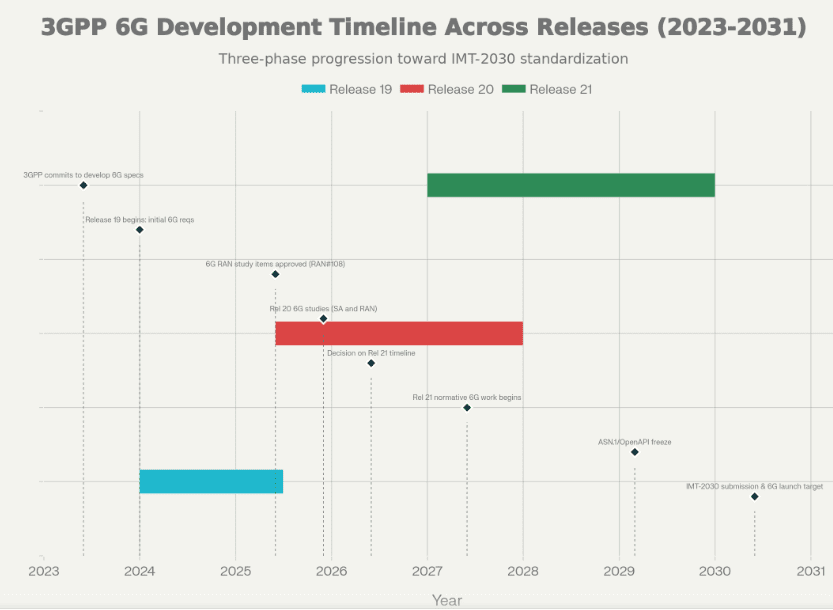
3GPP 6G Status: 3GPP’s specification work on 6G is currently in the early stages, focusing on requirements, architecture, and key technology enablers with a projected timeline that targets initial 6G specifications by 2028–2030 for commercial systems. The work is organized through 3GPP’s releases:
- Release 19 initiating 6G requirement studies in 2024.
- Release 20 expanding on 6G architecture and technology exploration in 2025 in parallel with 5G advanced.
- Release 21 delivering the first concrete 6G specifications, and subsequent releases refining features and interoperability toward mass deployment around 2030. The timeline for the actual spec work for this release is to be decided by June 2026.
The overall plan aligns with ITU’s timeline for 6G ecosystem readiness and commercial availability by roughly 2030, though exact finish dates depend on evolving technical, regulatory, and market conditions.
3GPP Release 20 concurrent work on 5G Advanced and 6G: This approach reflects a general view that 6G should be more of an evolution rather than a revolution. The big three equipment vendors Ericsson, Huawei and Nokia see 5G Advanced as a foundation for 6G, but in their own specific ways. “This dual focus on both 5G Advanced and 6G we needed to ensure that there is a continuity and to create a framework that allows the two tracks to complement but not compete with each other,” said Puneet Jain, Chair of 3GPP’s Service and Systems Aspects working group and senior principal engineer for technical standards at Intel, in a video interview.
Examples of 5G Advanced capabilities that are expected to be further developed in 6G include: the integration of machine learning into the RAN and core networks, energy efficiency, low latency, advanced MIMO techniques and satellite integration, according to 5G Americas. The latest 5G Advanced specs also address integrated sensing and communication (ISAC), which is considered to be an important new capability for 6G.
……………………………………………………………………………………………………………………………………………………….
Here’s a concise technical summary of the 6G standardization work in both ITU-R and 3GPP:
-
Scope and objectives
-
Establish 6G service requirements and use cases, including extreme data rates, ultra-low latency, high reliability, and enhanced AI-driven network management, while ensuring backward compatibility where feasible.
-
Define a scalable, flexible air interface and spectrum strategy to support wide bandwidths (including frequencies above 7 GHz and potential THz considerations) and diverse deployment scenarios.
-
-
Core architectural themes
-
Enhanced cloud-native, end-to-end network architecture with distributed computing, edge capabilities, and AI/ML-driven orchestration for dynamic resource management.
-
Native support for integrated space-air-ground networks and network slicing to enable heterogeneous service delivery and global coverage.
-
-
Air interface and radio aspects
-
Investigations into wider channel bandwidths, robust channel coding hybrids (LDPC and Polar codes as baselines with extensions), and numerology that can span multiple bands while maintaining scalable, energy-efficient designs.
-
Emphasis on robust coverage, especially at cell edges, and efficient use of mid-band and higher-frequency spectrum to balance performance and practical deployment considerations.
-
-
Mobility and latency
-
Aiming for lower end-to-end latency, improved reliability, and advanced mobility support to enable new immersive and industrial applications, while ensuring interoperability with 5G and future network layers.
-
-
Security and privacy
-
Early attention to security-by-design within the 6G architecture, including native protection of data planes and resilient identity/authentication mechanisms across heterogeneous networks.
-
Timeline and milestones (progress up to projected completion dates):
-
2024: Initiation of 6G work in Release 19, focused on requirements and initial study items for 6G SA1 service requirements.
-
2025–2026: Continued refinement of use cases, service requirements, and architectural concepts; preparatory work for Release 20 items.
-
2027–2028: First concrete 6G specifications anticipated in Release 21, with core radio and network framework definitions, and initial protocol stack extensions.
-
2029–2030: Further releases (Release 22 onward) expand interoperability, optimization, and ecosystem compatibility, moving toward commercial deployment and early trials.
-
Target commercial availability: Roughly 2030, with initial systems expected to appear earlier in some pilots or regional deployments depending on market and regulatory readiness.
-
Public summaries and industry analyses triangulate the timeline and major themes from 3GPP plenaries and RAN/SA/WG discussions, with dates anchored to 2024–2028 planning and the stated aim of Release 21 delivering the first 6G specifications.
-
Draft documents and WG SID proposals provide insight into technical directions (coding, bandwidth, channel modeling, and spectrum considerations), though these are interim and subject to change as the standardization process evolves.
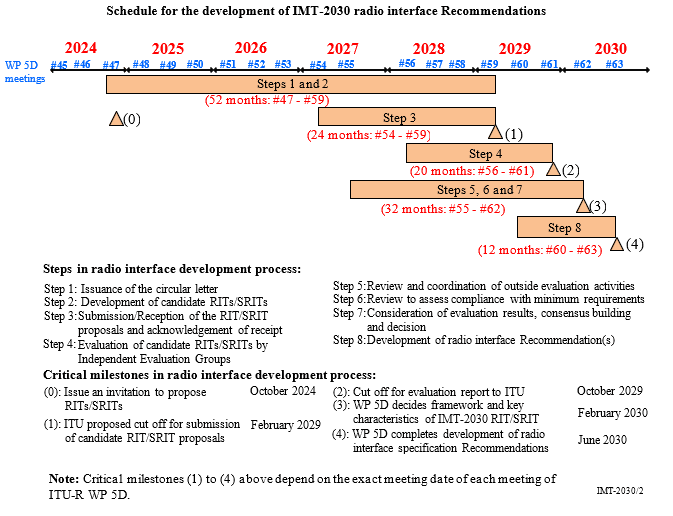
Submission of IMT 2030 RIT/SRIT proposals may begin at 54th meeting of ITU-R WP 5D, currently planned for February 2027. The final deadline for submissions is 16:00 hours UTC, 12 calendar days prior to the start of the 59th meeting of WP 5D in February 2029.
The evaluation of the proposed RITs/SRITs by the independent evaluation groups and the consensus-building process will be performed throughout this time period and thereafter. Subsequent calendar schedules will be decided according to the submissions of proposals.
After ITU-R WP 5D approves a recommendation (e.g for IMT 2030) it then goes through a formal approval process before it becomes a standard. It is sent to ITU-R SG 5 for approval, then all ITU member states review the draft and if there is near unanimous approval it is adopted as an official ITU-R recommendation or standard. That ITU-R recommendation approval process takes ~3 or 4 months. Therefore, we expect the ITU-R IMT 2030 RIT/SRIT standard to be approved in late 2030 to early 2031 with early 6G deployments to begin at that time.
………………………………………………………………………………………………………………………………………..
References:
https://www.itu.int/en/ITU-R/study-groups/rsg5/rwp5d/imt-2030/Pages/default.aspx
https://www.lightreading.com/6g/looking-ahead-ready-or-not-here-comes-6g
https://www.3gpp.org/specifications-technologies/releases/release-20
https://www.5gamericas.org/5g-advanced-overview/
ITU-R WP5D IMT 2030 Submission & Evaluation Guidelines vs 6G specs in 3GPP Release 20 & 21
ITU-R WP 5D Timeline for submission, evaluation process & consensus building for IMT-2030 (6G) RITs/SRITs
ITU-R WP 5D reports on: IMT-2030 (“6G”) Minimum Technology Performance Requirements; Evaluation Criteria & Methodology
AI wireless and fiber optic network technologies; IMT 2030 “native AI” concept
Highlights of 3GPP Stage 1 Workshop on IMT 2030 (6G) Use Cases
Should Peak Data Rates be specified for 5G (IMT 2020) and 6G (IMT 2030) networks?
GSMA Vision 2040 study identifies spectrum needs during the peak 6G era of 2035–2040
Highlights and Summary of the 2025 Brooklyn 6G Summit
NGMN: 6G Key Messages from a network operator point of view
Nokia and Rohde & Schwarz collaborate on AI-powered 6G receiver years before IMT 2030 RIT submissions to ITU-R WP5D
Verizon’s 6G Innovation Forum joins a crowded list of 6G efforts that may conflict with 3GPP and ITU-R IMT-2030 work
Nokia Bell Labs and KDDI Research partner for 6G energy efficiency and network resiliency
Deutsche Telekom: successful completion of the 6G-TakeOff project with “3D networks”
Market research firms Omdia and Dell’Oro: impact of 6G and AI investments on telcos
Qualcomm CEO: expect “pre-commercial” 6G devices by 2028
Ericsson and e& (UAE) sign MoU for 6G collaboration vs ITU-R IMT-2030 framework
KT and LG Electronics to cooperate on 6G technologies and standards, especially full-duplex communications
Highlights of Nokia’s Smart Factory in Oulu, Finland for 5G and 6G innovation
Nokia sees new types of 6G connected devices facilitated by a “3 layer technology stack”
Rakuten Symphony exec: “5G is a failure; breaking the bank; to the extent 6G may not be affordable”
India’s TRAI releases Recommendations on use of Tera Hertz Spectrum for 6G
New ITU report in progress: Technical feasibility of IMT in bands above 100 GHz (92 GHz and 400 GHz)
2 thoughts on “Roles of 3GPP and ITU-R WP 5D in the IMT 2030/6G standards process”
Leave a Reply

6G Related Standards Activities:
–ETSI’s Industry Specification Groups (ISGs): 1] ISG ISAC (Integrated Sensing and Communications) coordinates 6G pre‑standard research (use cases, channel models, KPIs, architecture and deployment) with the stated aim of feeding systematic outputs into “future 6G releases of 3GPP, IEEE and ITU‑R IMT‑2030.”
2] ISG MAT (Multiple Access Techniques): Focuses on physical layer techniques (NOMA, SDMA, etc.) for better spectrum/power efficiency in 6G.
–IEEE operates a 5G/6G Innovation Testbed aimed at “collaborative testing,” where operators, vendors, and researchers validate performance, interoperability, and security of 5G/6G‑class technologies. This testbed approach is positioned as a way to develop and evaluate test methodologies and technologies that can later support formal conformance and interoperability testing in 6G deployments.
Reference: https://testbed.ieee.org/exploring-the-role-of-6g-technology-in-enhancing-quality/
–IEEE originated specifications (e.g. IEEE 802.11be/WiFi 7 Extremely High Throughput includes time‑sensitive networking, and high‑frequency links up to the sub‑THz range) are being developed with explicit 6G interoperability in mind.
Unlike previous generations that focused primarily on speed, the development of 6G is being shaped by hard-learned lessons from 5G’s mixed commercial success. Mobile network operators invested billions of dollars in new equipment, expecting consumers to adopt the technology. For the most part, consumers saw the improvements as table stakes and weren’t willing to pay more.
IEEE Fellow William Webb says operators will likely be wary this time.
“I expect 6G to be lower key, with less of a ‘build it and they will come’ mentality and an understanding that operators will not deploy brand-new equipment to all their base station sites,” Webb said.
In an article for IEEE Spectrum published earlier this year, Webb noted that many of the use cases envisioned by 6G proponents already exist, and may not need all the bandwidth 6G promises. He notes, for example, that autonomous vehicles would probably be able to take advantage of more data, but many are built to work without it. He envisions 6G as a much more modest offering.
“I expect 6G to be more aligned with the requirements of operators,” Webb said. “It will deliver efficiencies, lower operational costs, lower power consumption and better integrate with other networks.”
https://transmitter.ieee.org/whats-in-store-for-6g-in-2026/