

Market research firms Omdia and Dell’Oro: impact of 6G and AI investments on telcos
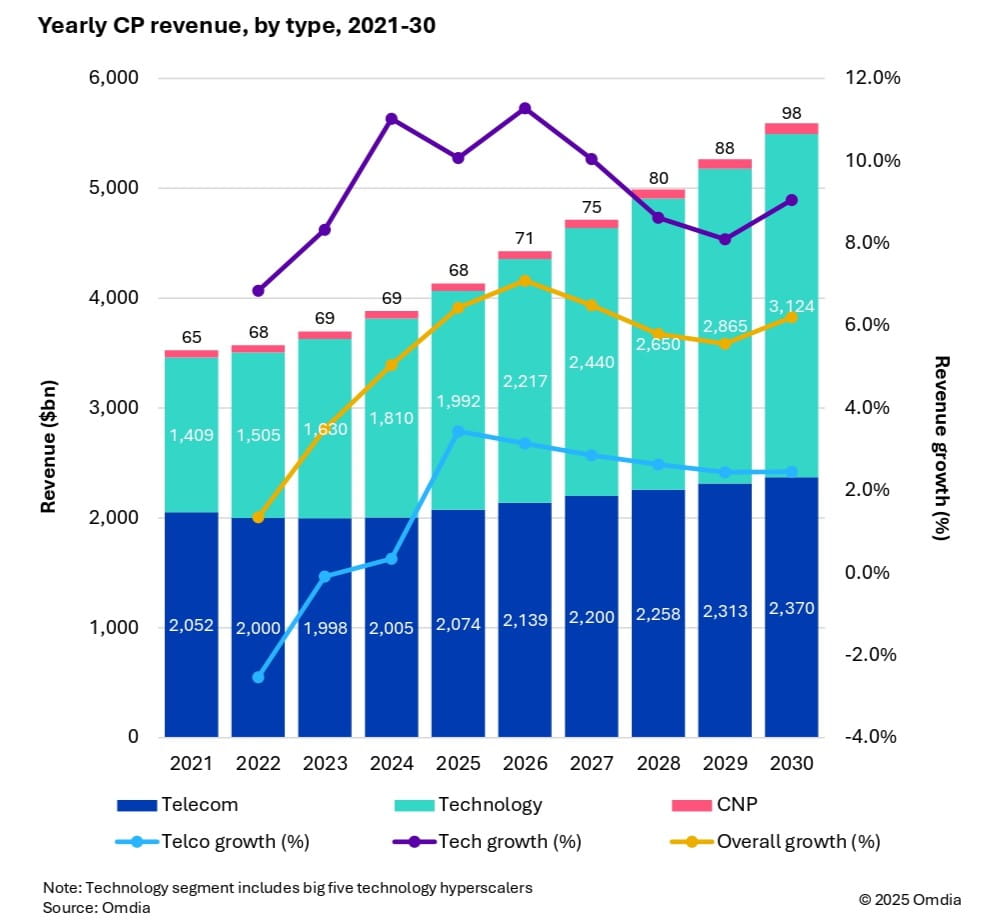
Market research firm Omdia (owned by Informa) this week forecast that 6G and AI investments are set to drive industry growth in the global communications market. As a result, global communications providers’ revenue is expected to reach $5.6 trillion by 2030, growing at a 6.2% CAGR from 2025. Investment momentum is also expected to shift toward mobile networks from 2028 onward, as tier 1 markets prepare for 6G deployments. Telecoms capex is forecast to reach $395 billion by 2030, with a 3.6% CAGR, while technology capex will surge to $545 billion, reflecting a 9.3% CAGR.
Fixed telecom capex will gradually decline due to market saturation. Meanwhile, AI infrastructure, cloud services, and digital sovereignty policies are driving telecom operators to expand data centers and invest in specialized hardware.
Key market trends:
- CP capex per person will increase from $74 in 2024 to $116 in 2030, with CP capex reaching 2.5% of global GDP investment.
-
Capital intensity in telecom will decline until 2027, then rise due to mobile network upgrades.
-
Regional leaders in revenue and capex include North America, Oceania & Eastern Asia, and Western Europe, with Central & Southern Asia showing the highest growth potential.
 Dario Talmesio, research director at Omdia said, “telecom operators are entering a new phase of strategic investment. With 6G on the horizon and AI infrastructure demands accelerating, the connectivity business is shifting from volume-based pricing to value-driven connectivity.”
Omdia’s forecast is based on a comprehensive model incorporating historical data from 67 countries, local market dynamics, regulatory trends, and technology migration patterns.
…………………………………………………………………………………………………………………………………………………
Separately, Dell’Oro Group sees 6G capex ramping around 2030, although it warns that the RAN market remains flat, “raising key questions for the industry’s future.” Cumulative 6G RAN investments over the 2029-2034 period are projected to account for 55% to 60% of the total RAN capex over the same forecast period.
“Our long-term position and characterization of this market have not changed,” said Stefan Pongratz, Vice President of RAN and Telecom Capex research at Dell’Oro Group. “The RAN network plays a pivotal role in the broader telecom market. There are opportunities to expand the RAN beyond the traditional MBB (mobile broadband) use cases. At the same time, there are serious near-term risks tilted to the downside, particularly when considering the slowdown in data traffic,” continued Pongratz.
Additional highlights from Dell’Oro’s October 2025 6G Advanced Research Report:
- The baseline scenario is for the broader RAN market to stay flat over the next 10 years. This is built on the assumption that the mobile network will run into utilization challenges by the end of the decade, spurring a 6G capex ramp dominated by Massive MIMO systems in the Sub-7GHz/cm Wave spectrum, utilizing the existing macro grid as much as possible.
- The report also outlines more optimistic and pessimistic growth scenarios, depending largely on the mobile data traffic growth trajectory and the impact beyond MBB, including private wireless and FWA (fixed wireless access).
- Cumulative 6G RAN investments over the 2029-2034 period are projected to account for 55 to 60 percent of the total RAN capex over the same forecast period.
Dell’Oro Group’s 6G Advanced Research Report offers an overview of the RAN market by technology, with tables covering manufacturers’ revenue for total RAN over the next 10 years. 6G RAN is analyzed by spectrum (Sub-7 GHz, cmWave, mmWave), by Massive MIMO, and by region (North America, Europe, Middle East and Africa, China, Asia Pacific Excl. China, and CALA). To purchase this report, please contact by email at [email protected].
References:
https://www.lightreading.com/6g/6g-momentum-is-building
6G Capex Ramp to Start Around 2030, According to Dell’Oro Group
https://www.lightreading.com/6g/6g-course-correction-vendors-hear-mno-pleas
https://www.lightreading.com/6g/what-at-t-really-wants-from-6g
2 thoughts on “Market research firms Omdia and Dell’Oro: impact of 6G and AI investments on telcos”
Leave a Reply

Both market research reports make a compelling point for capex shifting toward AI and 6G infrastructure. It’s worth noting that as telecoms expand their data center capacity, liquid cooling and advanced optical interconnects will become essential for maintaining performance and energy efficiency.
We’ve been working on customized optical assemblies designed for high-power, AI-driven environments — an area that’s definitely aligned with the trends mentioned here.
Omdia and Dell’Oro Group project that 6G and AI investments will revitalize a stagnant telecom market, shifting operators from volume-based pricing to value-driven, AI-native connectivity by 2030. While near-term traditional RAN spending remains flat in 2026, both firms highlight that AI infrastructure and upcoming 6G architectures represent the industry’s primary long-term growth catalysts.
Dell’Oro Group predicts flat RAN growth (1% CAGR) through 2030. It should pick up by 2031 when 6G is first set to be deployed.
Core Market Projections (2026–2030): Omdia forecasts global communications provider revenue to reach $5.6 trillion by 2030, expanding at a 6.2% CAGR. This growth is heavily polarized: the technology/hyperscaler segment will expand at a 9.4% CAGR, while traditional telecom revenue grows at a slower 2.7% to 2.8%.
Capex Realignment: Global telecom capex is expected to dip by 2% in 2026 as 5G rollouts peak, but it will pivot upward after 2027 to reach $395 billion by 2030 as 6G preparations ramp up. Concurrently, specialized technology capex (cloud, AI hardware, data centers) will jump at a 9.3% CAGR to $545 billion.