

AT&T and AWS to deliver last mile connectivity for AI workloads; AT&T Geo Modeler™ AI simulation tool
AT&T is strategically re-architecting its infrastructure for the AI era through high-capacity network modernization and deep integration with hyperscale cloud providers.
In addition to its almost six year old deal to run its 5G SA core network in Microsoft Azure’s cloud, AT&T announced at MWC 2026 that it’s now woring with Amazon Web Services (AWS) to extend 5G and fiber connectivity from business customers and locations directly into AWS environments, creating secure, resilient and reliable premises‑to‑cloud architectures for AI workloads. The collaboration is designed to reduce network complexity and latency while supporting real‑time analytics, machine learning, and agentic AI use cases.
This collaboration continues a long-standing relationship between AT&T and AWS and follows recent news outlining broader efforts to modernize the nation’s connectivity infrastructure by providing high-capacity fiber to AWS data centers, migrate AT&T workloads to AWS cloud capabilities and explore emerging satellite technologies.
AWS Interconnect – last mile embeds AT&T‑delivered connectivity directly into AWS workflows, designed to enable customers to provision and manage last‑mile connectivity within the AWS environment and lays the foundation for the use of AI agents to monitor and manage the AI experience from the user to the cloud. This streamlined, self‑managed approach helps enterprises reduce network complexity while maintaining control of their extended enterprise network, allowing businesses to move faster as they scale AI.
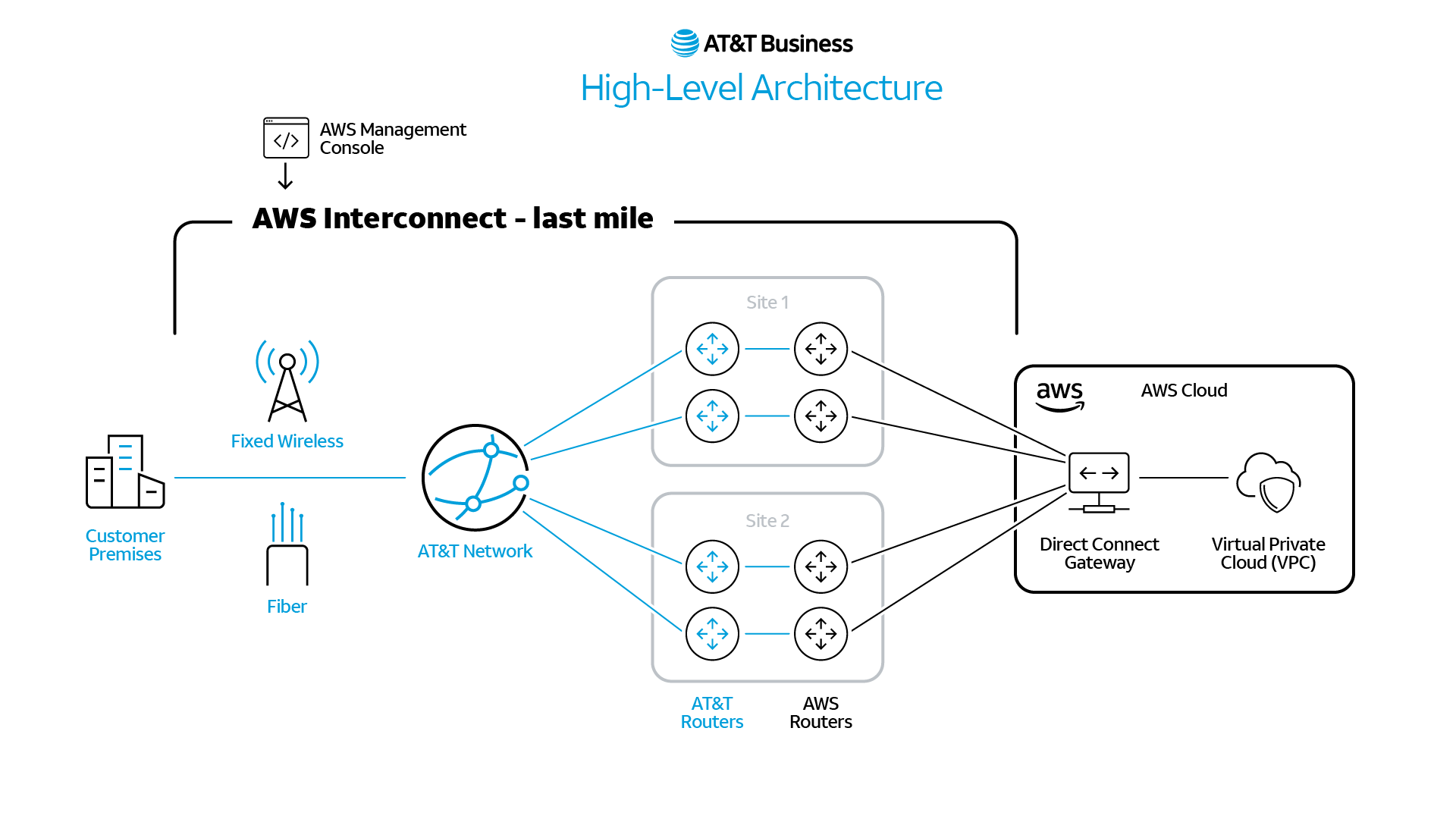
High level illustration of the planned AWS Interconnect – last mile architecture, showing how resilient interconnections and AT&T Fiber and fixed wireless access are intended to simplify private connectivity from customer locations into AWS environments.
Diagram Source: AT&T
………………………………………………………………………………………………………
“AI does not just need more compute; it needs flatter networks and faster connections,” said Shawn Hakl, SVP & Head of Product, AT&T Business. “By bringing high‑capacity connectivity closer to cloud platforms, integrating the management of the networks directly into the cloud provisioning process and engineering for resiliency at the metro level, AT&T is helping enterprises streamline their networks, improve performance, security, and scale AI with confidence.”
AT&T says they are building an AI‑ready network (?) designed to scale performance by continuing ongoing network investment, including the growth of capacities up to 1.6Tbps across key metro and long‑haul routes.
AT&T also announced it would work with Nvidia, Microsoft and MicroAI through its Connected AI platform for “smart manufacturing.”
………………………………………………………………………………………………………………..
Finally, AT&T described AT&T Geo Modeler™ which is able to better predict connectivity for emerging technologies like autonomous vehicles, drones, and robotics.
The Geo Modeler is an AI-powered simulation tool that helps predict, in near real time, how a wireless network will perform in the real world. Inspired by the video games Kounev played with his family growing up, the virtual model and simulation is “essentially like a giant video game of the United States” that, infused with AI tools, gives engineers a clearer picture of where potential weak spots may appear. Then issues can be addressed earlier and fixes can roll out faster. In essence, it creates virtual models, similar to the way video games are designed and developed.
“The Geo Modeler helps us see how the real world will shape coverage before we build, so we can deliver connectivity that’s ready for what’s next,” said AT&T scientist Velin Kounev.
Matt Harden, VP of Connected Solutions at AT&T, agrees. “The Geo Modeler is a foundational capability for the connected mobility era,” he said. “By marrying advanced geospatial simulation with AI-driven network orchestration, we can deliver predictable, high-performance connectivity that adapts with the environment. Whether it’s a hurricane, a packed stadium, or a city corridor full of autonomous vehicles, we will be prepared.”
References:
https://about.att.com/story/2026/aws-collaboration-scalable-business-ai.html
https://about.att.com/blogs/2026/150-years-of-connection.html
https://about.att.com/blogs/2025/geo-modeler.html
AT&T and Ericsson boost Cloud RAN performance with AI-native software running on Intel Xeon 6 SoC
AT&T deploys nationwide 5G SA while Verizon lags and T-Mobile leads
AT&T to buy spectrum licenses from EchoStar for $23 billion
AT&T’s convergence strategy is working as per its 3Q 2025 earnings report
Progress report: Moving AT&T’s 5G core network to Microsoft Azure Hybrid Cloud platform
AT&T 5G SA Core Network to run on Microsoft Azure cloud platform