

Deutsche Telekom: Network APIs with RCS to Enhance AI Enterprise Network Engagements
The telecom industry’s network API (Applications Program Interface) journey is transitioning from capability exposure to measurable enterprise value creation. Initial efforts focused on standardizing and exposing network functions through developer-friendly interfaces. The current phase centers on driving adoption and embedding those capabilities into enterprise workflows with demonstrable ROI.
Deutsche Telekom’s Chathurangi Wickramasinghe, SVP Magenta Business API, frames this shift succinctly: “Building APIs is right now not the challenge. But scaling adoption is a challenge.” This reflects a broader industry inflection point where technical feasibility has largely been established through initiatives such as CAMARA (Linux Foundation), GSMA Open Gateway, and TM Forum Open APIs, but commercial scalability remains constrained by integration complexity, fragmented exposure models, and unclear enterprise value propositions.
Deutsche Telekom has been an active contributor to both standardization and commercialization of network APIs. Its MagentaBusiness API platform, launched in Germany in 2023 in collaboration with Vonage, aggregates communications and network APIs into a unified exposure layer. Initial service APIs—Quality-on-Demand (QoD), Device Status–Roaming, and Device Location—align with CAMARA-defined abstractions designed to ensure interoperability across operators and geographies. CAMARA’s northbound API framework, increasingly aligned with 3GPP Service-Based Architecture (SBA) principles, is intended to decouple application logic from underlying network complexity, enabling portability across multi-operator environments.
However, as Wickramasinghe emphasizes, enterprise demand is not driven by APIs per se but by business outcomes. “No customer wakes up in the morning and asks for APIs. They have real business challenges they want to solve.” These challenges increasingly map to identity assurance, fraud mitigation, customer engagement, and operational efficiency—domains where telecom networks possess unique, non-replicable data assets.
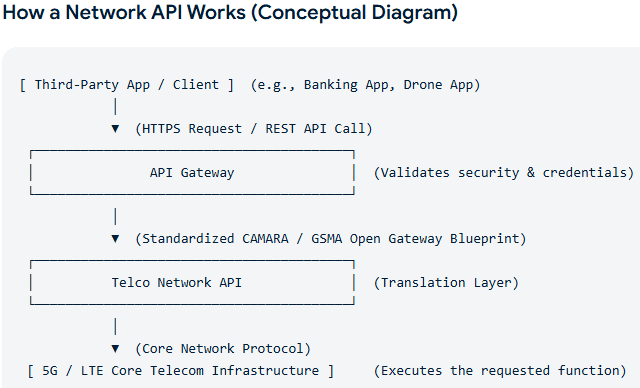
A representative use case is the integration of Rich Communication Services (RCS) with network APIs. RCS, specified by GSMA and widely deployed across Android ecosystems, enables branded and interactive messaging for enterprise engagement. When combined with network APIs such as Number Verify and SIM Swap, RCS workflows can incorporate real-time identity validation and fraud detection. This convergence is particularly relevant given persistent vulnerabilities in SMS-based OTP authentication, including SIM swap fraud and phishing attacks.
Deutsche Telekom’s commercial launch of Number Verify in Germany in 2024—implemented in collaboration with Vodafone and O2 Telefónica under GSMA Open Gateway—demonstrates early multi-operator federation. The API enables silent authentication by verifying a user’s MSISDN via network signaling, eliminating reliance on SMS OTP while reducing latency and attack surface. Similarly, the SIM Swap API allows enterprises, particularly in financial services, to query recent SIM change events before authorizing high-risk transactions. GSMA reports indicate that fraud losses linked to account takeover and identity compromise exceed tens of billions of dollars annually, reinforcing the economic rationale for such capabilities.
The relevance of network APIs is further amplified by the emergence of AI-native enterprise architectures. At MWC 2026, Deutsche Telekom positioned network APIs as foundational infrastructure for AI-driven applications, highlighting trusted network signals, real-time context, and programmable QoS as key enablers. This aligns with broader industry trends toward “Network as Code,” where network capabilities are abstracted and consumed dynamically by applications and, increasingly, by AI agents.
Wickramasinghe underscored that enterprise AI adoption is constrained by “trust, security and governance.” Network APIs can address these constraints by providing deterministic, operator-verified signals for identity, location, device state, and session quality. As agentic AI systems begin executing transactions and interacting autonomously with users and services, the integrity of these signals becomes critical. “They rely on trusted signals. They need [them] to carry out their tasks autonomously.”
This framing also clarifies the monetization pathway for operators. Network APIs represent a shift from connectivity-centric revenue models toward exposure of differentiated network intelligence. However, achieving scale requires three conditions: standardized interfaces (e.g., CAMARA-aligned APIs), low-friction developer onboarding (including SDKs and hyperscaler integrations), and direct alignment with high-value enterprise use cases such as fraud prevention, identity verification, and service assurance.
Ecosystem developments in 2026 reinforce this trajectory. Nokia’s Network as Code platform includes Deutsche Telekom among its operator partners and highlights a deployment with Blocksport, where Number Verification enables seamless authentication in sports-oriented super apps. Nokia has also linked network APIs with agentic AI through collaboration with Google Cloud, aiming to make network capabilities programmatically accessible to enterprise AI systems via cloud-native interfaces. Hyperscaler involvement is particularly significant, as it addresses distribution and developer reach—historically a bottleneck for telecom API adoption.
From an architectural perspective, network APIs function as a control plane for trust. They expose network-derived assertions that cannot be replicated at the application layer: subscriber authenticity, SIM lifecycle events, device reachability, and network-validated location. In a zero-trust security paradigm and increasingly automated digital economy, these attributes become foundational primitives for secure transactions and interactions.
The concept of the “agentic network” extends beyond autonomous network operations (e.g., closed-loop assurance in 5G-Advanced and future 6G systems). It encompasses the ability of the network to provide verifiable, real-time context to external AI systems. As AI assumes greater responsibility for decision-making, customer engagement, and service orchestration, telecom operators are positioned to supply high-integrity signals that enhance reliability and reduce risk.
In this context, Wickramasinghe’s central argument is that network APIs achieve mainstream adoption not when they are marketed as technical interfaces, but when they are delivered as embedded, outcome-oriented capabilities. The transition from “API products” to “trusted outcomes”—fraud reduction, seamless authentication, and verified engagement—marks the critical step toward sustainable monetization and strategic relevance in the AI-driven digital ecosystem.
………………………………………………………………………………………………………………………………………………………………………………….
Network API Specifications and Frameworks:
These specifications and frameworks collectively enable the convergence of RCS and network APIs, supporting use cases such as trusted customer engagement, silent authentication, and fraud mitigation in enterprise workflows.
-
CAMARA Project APIs (Linux Foundation)
-
Provides northbound service API definitions aligned with GSMA Open Gateway.
-
As of 2026, over 60 APIs are defined, including stable APIs such as:
-
Number Verification,SIM Swap,SIM Swap Subscriptions -
Quality-on-Demand (QoD),QoS Profiles,QoS Provisioning -
Device Reachability Status,Device Roaming Status,Device Swap -
Location Verification,Location Retrieval,Geofencing Subscriptions -
One Time Password SMS,Customer Insights,KYC (Know Your Customer)APIs -
Simple Edge Discovery,Network Slice Booking,Traffic Influence
-
-
APIs are hosted on GitHub and follow OpenAPI 3.0 schema conventions.telecomtv+2
-
-
GSMA Open Gateway API Descriptions
-
Defines a universal set of northbound APIs for mobile network capabilities.
-
Includes APIs such as
Call Forwarding Signal,Device Identifier,Connected Network Type,Scam Signal, andCarrier Billing. -
Intended to ensure interoperability across operators and geographies, with CAMARA as the technical reference implementation.gsma+1
-
-
3GPP TS 23.222 – Common API Framework (CAPIF)
-
Specifies architecture and procedures for exposing network capabilities via APIs within 5G systems.
-
Defines API invoker, API provider, and CAPIF core functions for discovery, authentication, and logging.
-
3GPP TS 29.222 – Common API Framework for 3GPP Northbound APIs
-
Defines RESTful API design principles and procedures for communication between Application Functions (AFs) and the 5G Core.
-
Includes procedures for monitoring, device triggering, and traffic influence.
-
-
3GPP TS 29.522 – Network Exposure Function (NEF) Services
-
Specifies northbound interfaces between the NEF and external AFs.
-
Covers monitoring, device triggering, background data transfer, PFD management, traffic influence, and QoS session setup.
-
-
ETSI GS OSM 003 – RESTful API Specification and Testing
-
Provides methodology for specifying and testing RESTful APIs in telecom contexts.
-
Aligns with OpenAPI and includes guidelines for versioning, error handling, and security.
-
-
OMA RESTful Network API (OMA-TS-REST_NetAPI)
-
Early specification for RESTful exposure of network services such as messaging, location, and payment.
-
Predecessor to 3GPP CAPIF and NEF-based frameworks.
-
………………………………………………………………………………………………………………………………………………………………………………….
RCS (Rich Communication Services) Specifications:
-
GSMA RCC.71 – RCS Universal Profile Service Definition
-
Defines the baseline service capabilities for RCS Universal Profile, including chat, file transfer, audio/video messaging, and group chat.
-
Current version (v3.0) aligns with 3GPP IMS specifications and Android/Jibe ecosystem requirements.gsma
-
-
GSMA RCC.08 – Rich Communications Suite Endorsement of 3GPP TS 29.311
-
Specifies interworking between RCS and 3GPP messaging services.
-
Endorses relevant sections of 3GPP TS 29.311 for service-level interworking.gsma
-
-
3GPP TS 23.228 – IP Multimedia Subsystem (IMS)
-
Core IMS architecture specification enabling RCS services over LTE and 5G.
-
Defines session control, registration, and service delivery mechanisms.3gpp
-
-
3GPP TS 24.229 – IMS Signaling Flows and Procedures
-
Specifies SIP-based signaling for IMS sessions, including RCS chat and multimedia sessions.3gpp
-
-
3GPP TS 29.311 – Interworking for Messaging Services
-
Defines interworking between IMS messaging and external systems, including SMS and MMS gateways.gsma
-
-
ETSI TS 102 901 – Rich Communication Suite (RCS)
-
European standard specifying RCS service architecture and capabilities.
-
Aligns with GSMA RCS Universal Profile and 3GPP IMS framework.etsi
-
-
GSMA RCS Business Messaging (RBM) Guidelines
-
Defines enterprise messaging use cases, A2P workflows, and brand verification mechanisms.
-
Supports integration with network APIs for authentication and fraud prevention.5gamericas
-
……………………………………………………………………………………………………………………………………………………………………………….
References:
https://www.rcrwireless.com/20260716/carriers/deutsche-telekom-ai-apis
New Linux Foundation white paper: How to integrate AI applications with telecom networks using standardized CAMARA APIs and the Model Context Protocol (MCP)
Telefónica and Nokia partner to boost use of 5G SA network APIs
New venture to sell Network Application Programming Interfaces (APIs) on a global scale
AI-Era Cloud Network Transformation: A Reference Architecture and Implementation Roadmap
Fierce Network Research report examines telcos role in the AI economy and profiles early AI adopters
China’s big 3 telcos offer 5G Rich Communication Services (RCS)