

Analysis: Nokia’s new AI-RAN platform and Standalone AI-RAN node with Nvidia GPUs
Nokia today announced what it describes as the first commercial AI-RAN platform, signaling a potentially significant inflection point in radio access network architecture. As AI workloads increasingly influence network design and operations, service providers are under pressure to deliver higher capacity, improved cost efficiency, and faster service innovation without depending on traditional hardware refresh cycles. Nokia’s AI-RAN platform is positioned to address these requirements by extracting greater uplink and downlink performance from existing spectrum and radio assets, while enabling a transition toward AI-native network architectures through software-centric evolution. Key take-aways:
- Nokia launches the industry’s first commercial AI-RAN platform, turning AI-RAN from vision into reality and providing a practical path to AI-native networks.
- Built on Nokia’s AI-native anyRAN software and NVIDIA’s Aerial AI-RAN platform, it will deliver more than 100% spectral efficiency gains by 2028, doubling the capacity of existing spectrum assets.
- Nokia’s anyRAN software will support three new accelerated computing baseband platforms. In addition, its existing portfolio will be fully ORAN compliant so operators can modernize at their own pace.
“AI-RAN is the biggest innovation in radio in decades. AI-RAN makes the network intelligent, extends AI into the physical world, and allows telcos to get more from their existing infrastructure, including a software upgrade path to 6G. Nokia’s anyRAN software, powered by NVIDIA’s Aerial AI-RAN platform, unlocks greater performance from the spectrum operators already have and can be deployed with existing Nokia or ORAN-compliant radio units. For operators, that means more performance, better returns and faster delivery of new services,” said Justin Hotard, President and Chief Executive Officer at Nokia.
The platform is built on Nokia’s AI-native network architecture and leverages NVIDIA’s accelerated computing stack to enable AI-driven radio optimization. Initial results indicate spectral efficiency gains exceeding 20% through AI-enhanced radio resource management and signal processing techniques. Nokia’s roadmap targets up to 50% gains by 2027 and greater than 100% by 2028, with the objective of increasing capacity in dense deployments while reducing cost per bit and improving user experience.
“Telecommunications is entering the AI era — the radio access network is the next AI infrastructure,” said Jensen Huang, CEO and founder of NVIDIA. “Together with Nokia, we are bringing NVIDIA CUDA and AI into the baseband, transforming RAN into a planet-scale AI computer. This is a generational shift for operators — unlocking more capacity and efficiency from today’s spectrum while creating the foundation for new AI services and the 6G era.”
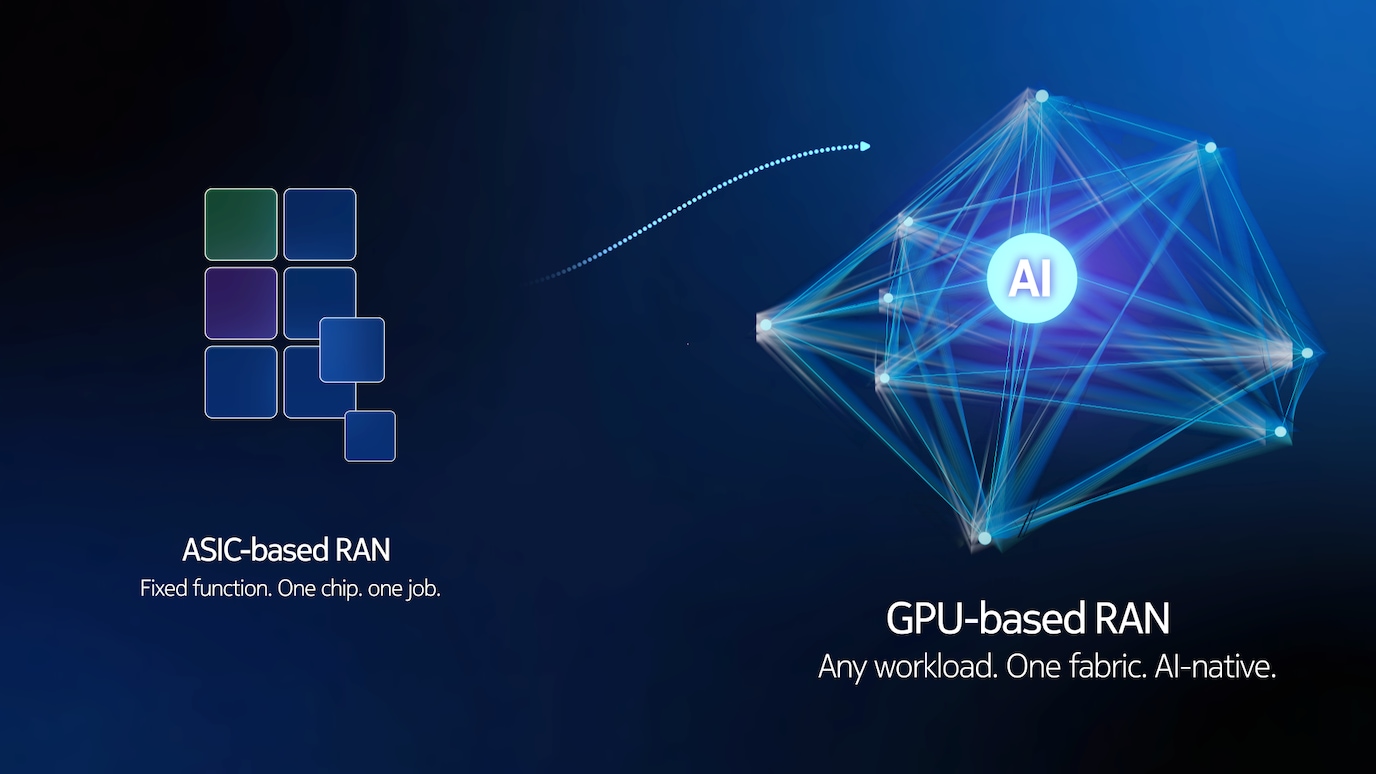
Image credit: Nokia
A key element of the offering is a software subscription model that enables operators to access ongoing AI-driven enhancements, feature updates, and performance improvements independent of hardware upgrade cycles. Nokia expects pilot deployments to begin by the end of the year, with broader commercial availability targeted for 2027. The roadmap incorporates NVIDIA’s programmable merchant silicon to support continued performance scaling and feature evolution.
“Nokia’s AI-RAN launch represents an important step in bringing AI-RAN from industry vision to commercial reality. The addition of the new AI-RAN node alongside the AirScale capacity plug-in unit and cloud-native deployment options gives operators practical choices for adopting AI-native networks based on their existing infrastructure and transformation goals. By combining AI-accelerated computing with a software-defined architecture and a clear product roadmap, Nokia is helping operators unlock greater capacity, improve network economics and accelerate the transition toward AI-native RAN,” commented Rémy Pascal, Practice Leader, Mobile Infrastructure at Omdia.
Light Reading’s Iain Morris wrote:
Nokia’s vision, outlined during an exclusive interview with Light Reading, is that the Nvidia-based hardware products announced today and available from next year will potentially last customers deep into the 6G era. That cannot be said of the latest Nokia hardware in commercial use, based on custom silicon provided by Marvell Technology, according to Atkinson. The same would be true of the latest hardware from rival Ericsson, he believes: “It will get them into 6G, but it won’t see them long into 6G.”
The Nokia pivot to GPUs sets up a riveting clash between the two Nordic companies. Ericsson remains firmly attached to its own custom silicon, and its top executives think writing code for CUDA, Nvidia’s software platform, could make Nokia a victim of “vendor lock-in,” imprisoned by a single vendor’s hardware.
For telcos interested in general-purpose processors and the greater freedom they promise, Ericsson instead offers a set of “virtual” RAN products. While based today on Intel’s central processing units (CPUs), the same software can run on CPUs from other chipmakers after minimal tweaks, according to Ericsson. Only a small amount of code remains hardware-dependent, it says.
,,,,,,,,,,,,,,,,,,,,,,,,,,,,,,,,,,,,,,,,,,,,,,,,,,,,,,,,,,,,,,,,,,,,,,,,,,,,,,,,,,,,,,,,,,,,,,,,,,,,,,,,,,,,,,,,,,,,,,,,,,,,,,,,,,,,,,,,,,,,,,,,,,,,,,,,,,,,,,,,,,,,,,,,,,,,
Nokia’s AI-RAN platform is based on a common, software-defined architecture integrating its anyRAN software with NVIDIA’s accelerated computing. The platform supports 4G, 5G, and forward evolution toward 6G, while maintaining compliance with Open RAN specifications to enable multi-vendor interoperability. Operators can select from multiple deployment options aligned with their installed base and transformation strategy, while leveraging a unified software roadmap.
For network operators with existing Nokia AirScale deployments, the introduction of a GPU-accelerated capacity plug-in unit provides a relatively low-friction upgrade path. This approach integrates accelerated computing into the current RAN footprint, enabling step-function capacity improvements while preserving prior infrastructure investments. Nokia also highlights support for AI-optimized merchant silicon, including contributions from partners such as Marvell, reflecting a broader ecosystem strategy for AI-RAN evolution.
Nokia is also introducing a GPU-based standalone AI-RAN node designed for flexible deployment across diverse network environments. The platform supports 4G, 5G, and future 6G workloads and can be deployed as a discrete node, in clustered configurations, or integrated with existing AirScale systems as a logical baseband. This enables scalable deployment of AI-native capacity while maintaining architectural flexibility.
For network operators pursuing cloud-native RAN strategies, Nokia’s AI-RAN capabilities extend to GPU-enabled COTS server platforms delivered through ecosystem partners. This approach supports deployment on standardized, accelerated infrastructure while aligning with open and secure supply chain principles. It combines cloud-native operational models with the performance requirements of AI-intensive RAN workloads.
Nokia’s AI-RAN introduces a shift from hardware-centric lifecycle management to a software-driven innovation model. Through its subscription-based framework, operators gain continuous access to evolving AI algorithms, spectral efficiency enhancements, and network optimization capabilities. This model enables ongoing improvements in performance, efficiency, security, and resilience without requiring discrete hardware upgrades, thereby improving total cost of ownership and extending asset lifecycles.
By combining AI-accelerated computing, software-defined RAN architecture, and an open ecosystem approach, Nokia’s AI-RAN platform is intended to provide operators with a scalable pathway to increased capacity, improved economic performance, and continuous innovation as networks evolve toward the 6G era.
References:
https://www.nokia.com/radio-access/ai-ran/
https://www.lightreading.com/6g/nokia-says-long-term-6g-is-not-doable-without-nvidia