

Highlights from Ookla’s U.S. Speedtest Connectivity Report-Mobile & Fixed Networks
Executive Summary:
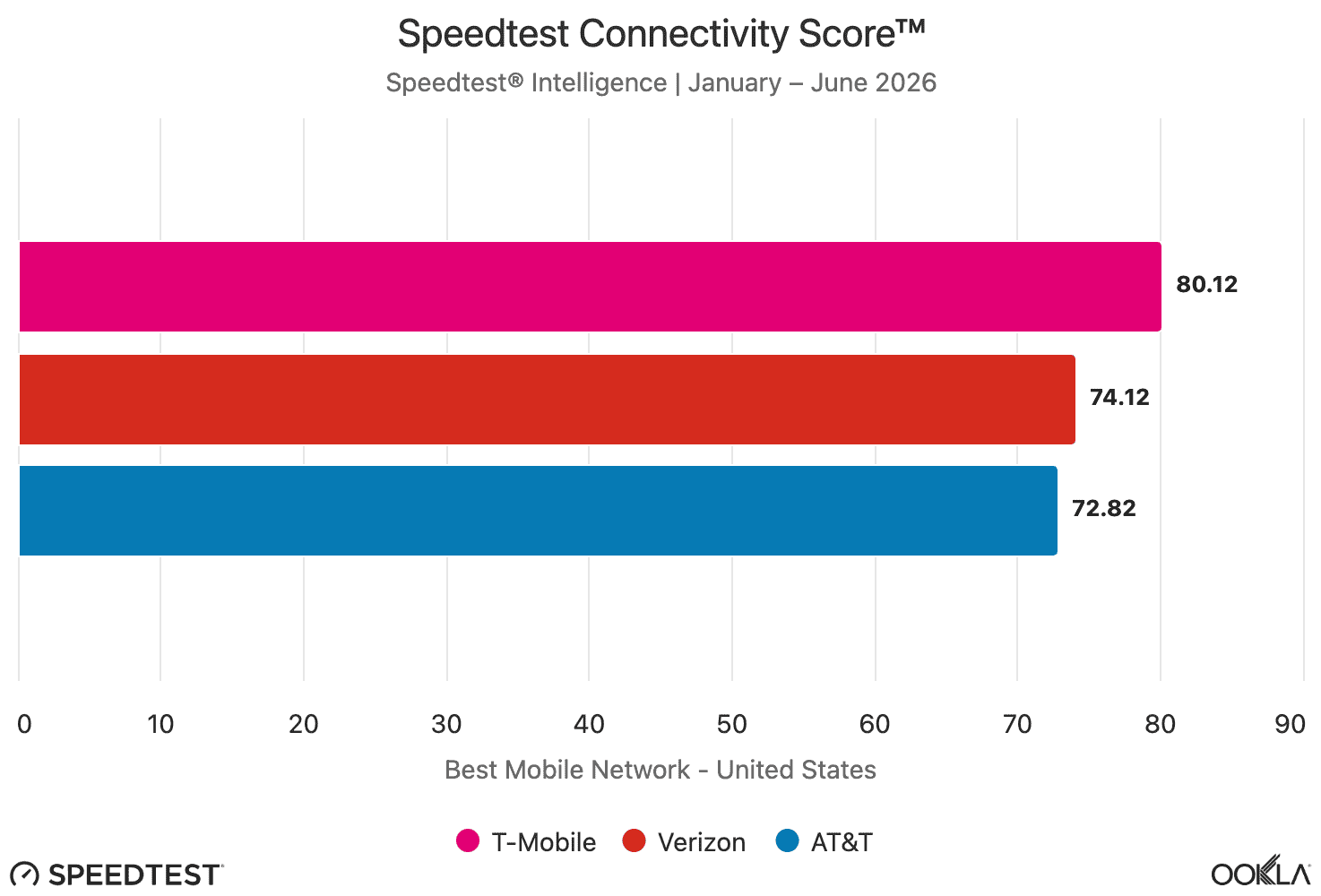
Ookla’s United States Speedtest Connectivity Report H1 2026 provides a detailed snapshot of network performance across the U.S. mobile and fixed broadband markets, based on Speedtest Intelligence data. The findings point to a competitive landscape in which T-Mobile continued to distinguish itself in mobile connectivity, while AT&T Fiber led the fixed broadband segment.
In the mobile network category, T-Mobile was named the Best Mobile Network overall and also claimed the Best 5G Network award for the first half of 2026. The “un-carrier” recorded a median download speed of 275.55 Mbps across all technologies combined, and a median 5G download speed of 314.38 Mbps. These results underscore the strong performance of T-Mobile’s network, particularly in 5G-centric use cases where throughput remains a key differentiator.
………………………………………………………………………………………………………………………………………………………………………………………………………………………………………………………………………………………………
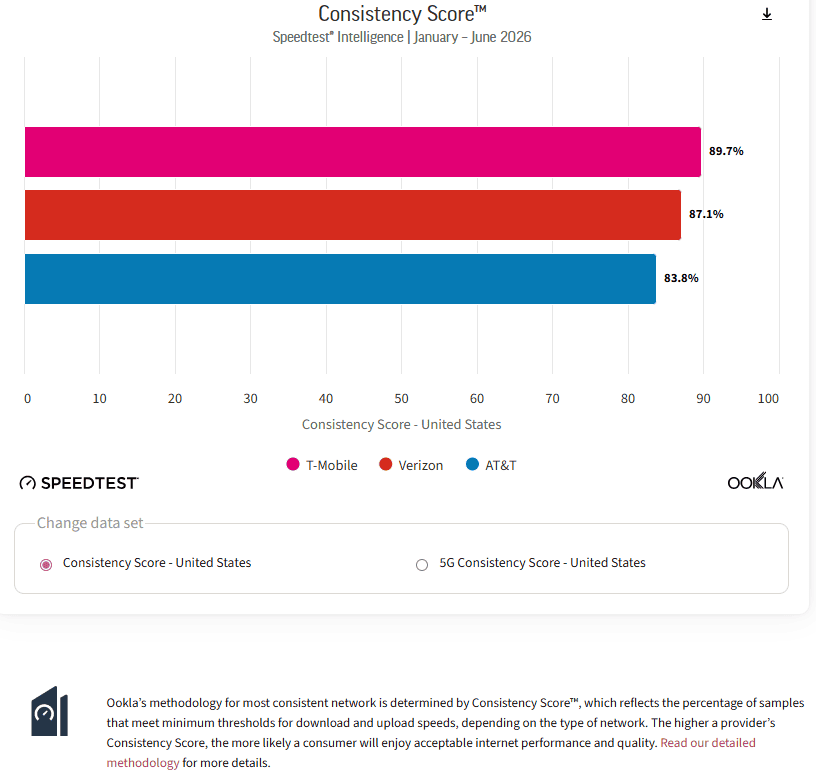
T-Mobile recorded the best mobile network consistency in the United States, for all technologies combined and for 5G. Across all technologies, 89.7% of its samples met or exceeded the threshold of 5 Mbps download and 1 Mbps upload, while 79.3% of its 5G samples met or exceeded the higher threshold of 25 Mbps download and 3 Mbps upload.
………………………………………………………………………………………………………………………………………………………………………………………………………………………………………………………………………………………………
For the fixed line networks, AT&T Fiber was recognized as the Best Internet provider and the Fastest Fixed Network in the United States during the same period. The oldest U.S. network operator posted a median download speed of 374.75 Mbps and a median upload speed of 320.65 Mbps, reflecting the growing importance of high-capacity fiber access in home broadband markets. As fixed and mobile connectivity continue to converge in consumer experience expectations, these metrics highlight the increasingly performance-driven nature of broadband competition.
The report also indicates that T-Mobile delivered the best gaming and video streaming experiences in the United States during 1H 2026, both across all technologies combined and in the 5G-only category. This is notable because it extends the company’s advantage beyond raw speed metrics into application-level quality, where latency sensitivity, jitter, and consistency can be as important as peak throughput.
At the city level, Lincoln, Nebraska recorded the fastest median mobile download speed among the most populous U.S. cities at 395.83 Mbps. In fixed broadband, Durham, NC led the group with a median download speed of 380.47 Mbps. These city-level results reinforce the fact that network performance varies significantly by market, even within a single national assessment, and that local deployment density and backhaul quality can materially influence user experience.
Editorial Analysis & Conclusions:
Taken together, the report suggests that U.S. network leadership in 1H 2026 was shaped by both access technology and service quality. Mobile operators are increasingly being judged not only by coverage and 5G speed, but also by end-user experience across demanding applications, while fiber providers continue to push the upper bounds of fixed-line performance. Ookla’s latest data therefore offers a useful benchmark for understanding where the U.S. connectivity market stands — and where competition is most intense.
- The U.S. mobile market appears to be shifting from a simple coverage contest toward a performance-and-experience contest. T-Mobile’s lead in overall mobile, 5G, gaming, and video-streaming experience suggests that end-user quality is now being shaped by a combination of throughput, consistency, and 5G availability rather than raw coverage alone.
- The results reinforce that 5G leadership is increasingly tied to how well operators can translate spectrum, radio access optimization, and transport capacity into sustained user experience. T-Mobile’s strong median download speeds across both blended and 5G-only measurements indicate that its network engineering is delivering not just peak performance, but performance that is visible in real-world usage patterns.
- The fixed broadband results show that fiber remains the benchmark for high-capacity access in the U.S. AT&T Fiber’s strong download and upload figures illustrate why fiber continues to set the standard for symmetrical, high-throughput residential service, especially as cloud applications, video conferencing, and multi-device home traffic continue to grow.
- Application-centric metrics are becoming more relevant in how networks are evaluated. The fact that T-Mobile led in gaming and video streaming experience suggests that operators are increasingly judged on latency-sensitive and consistency-sensitive workloads, not just speed-test averages. For ComSoc readers, that is a reminder that network KPIs are evolving in step with how people actually use the network.
- At the city level, the report also highlights how uneven performance can be across markets. Lincoln’s leading mobile result and Durham’s leading fixed result suggest that local infrastructure, spectrum conditions, and deployment density still matter significantly even within a mature national market. This is especially relevant for planners and researchers interested in the last mile, metro-area capacity, and regional quality-of-experience gaps.
Overall, the report suggests that U.S. connectivity competition is entering a more mature phase in which operators are differentiated less by whether they can deliver 5G or fiber at all, and more by how well they can optimize those platforms for sustained, application-level performance. For IEEE Techblog readers, that makes the report useful not only for network operator rankings, but as a snapshot of where network engineering priorities are heading.
………………………………………………………………………………………………………………………………………………………………………………………………………………………………….
References:
https://www.ookla.com/research/reports/united-states-speedtest-connectivity-report-h1-2026
https://www.ookla.com/resources/guides/speedtest-methodology
Ookla: AI workloads will force changes in 5G mobile network infrastructure
Ookla: AI platform reliability decreases as outages surge
Ookla on the Global D2D Market
Ookla: Starlink a viable competitor for hybrid 5G/NTN services due to network performance improvements and larger coverage area
Ookla: D2D satellite connectivity surged 24.5% during last 9 months; Starlink’s footprint expansion leads the way
Nokia to showcase agentic AI network slicing; Ericsson partners with Ookla to measure 5G network slicing performance