

What Might Qualify as an Equivalent Replacement for a Copper Based Telephone Landline?
Introduction:
Retiring a copper telephone network is not simply a change of transmission medium. A migration can change where power is supplied, how calls are established, how connected equipment communicates, and which components must remain operational during an emergency. The objective is equivalence of required service outcomes—not replication of every characteristic of the old network. This article proposes a framework for evaluating those outcomes; it does not describe an existing regulatory certification.
The issue is becoming concrete for California customers. In its May 20, 2026 announcement, AT&T committed $19 billion through 2030 to fiber and wireless investment and described plans to discontinue specified copper-based services in parts of California on or after June 1, 2027. The company also committed to continued access to voice and 911 service. These are announced plans and commitments, not evidence of completed migration outcomes (more below).
The engineering question is more demanding than whether a replacement produces dial tone. A meaningful assessment should examine the functions customers depend on: conversational performance, emergency calling, power resilience, connected-device compatibility, and recovery after failure.
Separate the Access Connection From the Telephone Service:
“Fiber,” “wireless,” and “digital voice” describe different aspects of a communications system. A migration assessment should identify both the connection serving the premises and the voice service operating over it. Ofcom describes the UK’s digital-landline transition as a move to Voice over Internet Protocol, or VoIP. Its guidance also explains that customers do not necessarily need to purchase a high-speed broadband package to retain telephone service. The service requirement and the broadband product offered to a customer are therefore not interchangeable.
For evaluation purposes, three questions should remain separate:
-
Is the access connection operational?
-
Can the telephone service establish and receive calls?
-
Does the complete installation deliver the functions the customer requires?
An answer to the first question does not settle the other two. The proposed assessment should follow the entire service path, rather than treating the access technology as a proxy for telephone-service performance.
Power Resilience Requires a Complete Installation Test:
Traditional exchange-powered telephone service could keep a basic corded telephone working during a household power failure. Broadband-based voice introduces a different dependency: equipment at the customer’s premises needs electricity. Ofcom warns that digital landlines require a resilience solution if they are to remain usable during a power cut.
That distinction should not become a claim that copper service was immune to failure. It identifies a particular capability that a migration may need to preserve: telephone access when household mains power is unavailable.
The proposed acceptance procedure should identify every premises component required for calling and establish which backup arrangement powers each one. The test should then disconnect household mains power and verify the installed service—not merely inspect a battery indicator.
The resulting record should state:
-
Which equipment receives backup power.
-
Whether incoming and outgoing calls remain possible.
-
The tested standby duration and calling duty cycle.
-
The battery condition and replacement responsibility.
-
What happens when mains power returns.
A premises test also has a boundary: it cannot establish how long the provider’s external network will remain available during a regional outage. Installation-level results and provider-level resilience evidence should be documented separately.
Evaluate Conversation, Not Just Call Establishment:
The framework should distinguish successful call setup from an acceptable conversation.
A practical test program would evaluate incoming and outgoing calls under representative conditions, including simultaneous household broadband use where applicable. It should record call completion, audible interruptions, conversational delay, unexpected disconnections, and performance during relevant busy periods.
Rather than prescribing one universal numerical threshold, the migration plan should identify the applicable performance objectives and their basis. The acceptance record should make clear what was measured, under which conditions, and what constituted a passing result.
This approach avoids declaring one technology inherently superior. It asks whether the deployed service meets an explicit requirement.
Wireless Replacements Need Site-Specific Evidence:
AT&T’s California announcement identifies AT&T Phone – Advanced and AT&T Business Voice among its replacement offerings. The company states that these products provide battery backup and support existing telephones and various connected devices. Those statements should be presented as provider claims, not independent compatibility findings for every installation.about.att
The assessment should identify the product’s actual access arrangement rather than grouping every wireless-enabled voice product under one technical description.
For a wireless installation, the proposed checks include:
-
Reception at the equipment’s installed location.
-
Call completion and conversational performance at relevant busy periods.
-
Operation with household mains power disconnected.
-
Recovery after a loss of connectivity.
-
Successful operation of identified connected devices.
-
Any alternative communications path included in the service design.
A coverage statement and an installation acceptance result answer different questions. The proposed framework requires evidence about the installed service.
A Telephone Socket Does Not Establish Device Compatibility:
Some telephone connections support applications beyond conversation. Ofcom specifically advises customers to check equipment such as telecare devices and burglar alarms before switching to digital landlines.
The technical distinction is important: a signal that remains intelligible to a person may not be reproduced accurately enough for a machine. RFC 4733 explains that low-bit-rate speech codecs cannot be assumed to reproduce signaling tones reliably for automatic recognition. It defines mechanisms for transporting telephone events, including keypad digits, separately from ordinary encoded speech.
IETF RFC 4733 also discusses distinct approaches for fax, voice-band data, and modem communications, including T.38, V.152, and V.150.1. These mechanisms address different signal types; their existence is not a universal compatibility guarantee. Acceptance should therefore test the application’s complete transaction. For an alarm, that would mean verifying that the event reaches the monitoring center, identifies the correct account or location, and receives the expected acknowledgment. If migration requires replacing the connected device, the replacement should be evaluated as a new end-to-end system, including fault reporting and recovery—not simply described as preservation of the old telephone interface.
Emergency Access Needs Its Own Acceptance Plan:
The proposed framework should treat emergency access as a separate service requirement, with documented arrangements for:
-
Call origination and routing.
-
Service-location information.
-
Callback capability.
-
Operation during a premises power failure.
-
Recovery after equipment restart or access failure.
Verification should use provider-supported procedures and an agreed process with the relevant emergency organization. The framework does not call for unsolicited test calls to emergency numbers.
Any live emergency-calling validation must follow an agreed procedure with the provider and relevant emergency organization—not an unsolicited test call.
Network-side resilience also deserves attention. U.S. rules for covered 911 service providers address physical diversity, operational integrity, and monitoring. These obligations concern specified emergency-network facilities; they should not be confused with a blanket guarantee that every residential connection survives a prolonged outage. Evidence should also be matched to its scope. A successful installation test does not demonstrate regional emergency-network availability, just as a provider’s network-resilience statement does not demonstrate that a particular household has functioning backup power.
Fiber-based voice: access capacity is not the same as voice assurance:
ITU-T Recommendation G.9807.1 specifies XGS-PON, a 10-Gigabit-capable symmetric passive optical network. It is an access-network specification—not a certification that a particular retail telephone service reproduces every function of an analog line.
The voice service has additional layers. IETF RFC 3261 defines the Session Initiation Protocol, or SIP, used to establish, modify, and terminate sessions. Voice quality also depends on the media path and signal processing, not merely successful session establishment.rfc-editor+1
This creates an important distinction between three tests:
-
The access connection is operational.
-
A telephone call can be established.
-
The resulting conversation meets an acceptable quality and reliability target.
ITU-T G.114 addresses the effect of one-way transmission delay. G.107’s E-model provides a planning framework for considering transmission impairments, including delay and codec-related effects. ITU technical guidance also explains the jitter-buffer trade-off: buffering can accommodate variations in packet arrival time, but adds delay.itu+1
A proposed migration test should therefore measure conversational performance under realistic simultaneous broadband use—not only with an otherwise idle connection. The relevant evidence would include delay, packet loss, conversational interruptions, call completion, and performance at busy periods.
The objective is not to declare IP voice inherently inferior or superior. It is to establish whether the deployed service meets its stated performance objectives.
Fixed wireless (FWA): validate the installation, not just the coverage map:
Fixed-wireless voice is another migration option. AT&T’s May 2026 California announcement describes a transition toward fiber and wireless services, including AT&T Phone – Advanced and AT&T Business Voice. The company states that these products include battery backup and support existing telephones and various connected devices. Those are provider claims, not independent compatibility results for every installation.
For a fixed-wireless replacement, a useful acceptance procedure would examine:
-
Reception at the actual installed equipment location.
-
Call completion and audio quality during busy periods.
-
Battery operation with household electricity disconnected.
-
Recovery after loss of radio connectivity.
-
The behavior of connected alarms and monitoring equipment.
-
Whether an alternative communication path is available when the primary service fails.
These are proposed engineering checks, not assertions that a particular wireless product fails them.
“Wireless coverage exists” and “this installation provides an adequate replacement” are different propositions. The second requires site-specific evidence.
Legacy devices: intelligible speech does not prove compatibility:
An analog telephone line may carry more than conversation. Ofcom specifically warns customers to check equipment such as telecare devices and burglar alarms before migration.
The technical difficulty is that a signal understandable to a person is not necessarily reproduced accurately enough for a machine.
RFC 4733 explains why separate transport of telephone events is useful: low-bit-rate speech codecs cannot be assumed to reproduce signaling tones accurately enough for automatic recognition. The RFC defines RTP payload formats for DTMF digits and other telephone events and tones.
Relevant standards address different aspects of the problem:
| Standard | Relevance to migration |
|---|---|
| IETF RFC 4733 | Transport of DTMF digits and other telephone events and tones in RTP. |
| ITU-T T.38 | Specialized transport for Group 3 fax over IP networks. |
| ITU-T V.152 | Procedures for supporting voice-band data over IP networks. |
| ITU-T V.150.1 | Procedures for modem relay across IP networks. |
These mechanisms are distinct; they are not a universal compatibility guarantee. RFC 4733 identifies T.38, V.152, and V.150.1 as alternative approaches for particular signal types. ITU guidance further explains that voice-band data may require changes such as disabling voice-activity detection and comfort-noise generation during data transfer.itu+1
Consequently, an adapter with a familiar telephone socket should not be treated as proof that every attached application will work.
A stronger migration procedure would test the complete transaction: an alarm reaches its monitoring center, receives the expected acknowledgment, and reports the correct account or location. Where replacement equipment is needed, the installation should be evaluated as a new end-to-end system rather than as transparent preservation of the old interface.
Backup-power requirements: distinguish a minimum from a guarantee:
Ofcom’s guidance calls for a solution enabling access to emergency organizations for at least one hour during a premises power cut. Providers should offer the solution free to customers dependent on their landline for emergency calling. Ofcom’s consumer guidance recognizes that a mobile solution is appropriate only where there is usable mobile coverage.
The United States requires particular care when discussing historical rules. The retrieved text of 47 CFR §9.20 describes requirements to offer eight-hour and twenty-four-hour standby backup options for covered residential services that are not line-powered. However, that same text contains an explicit September 1, 2025 sunset provision. It should not be cited without qualification as an ongoing October 2026 requirement. Even as an engineering benchmark, standby duration is not identical to continuous talk time, network availability, or guaranteed operation throughout a regional emergency. A replacement-service specification should state the assumed duty cycle, battery condition, maintenance responsibility, and equipment included in the backup arrangement.
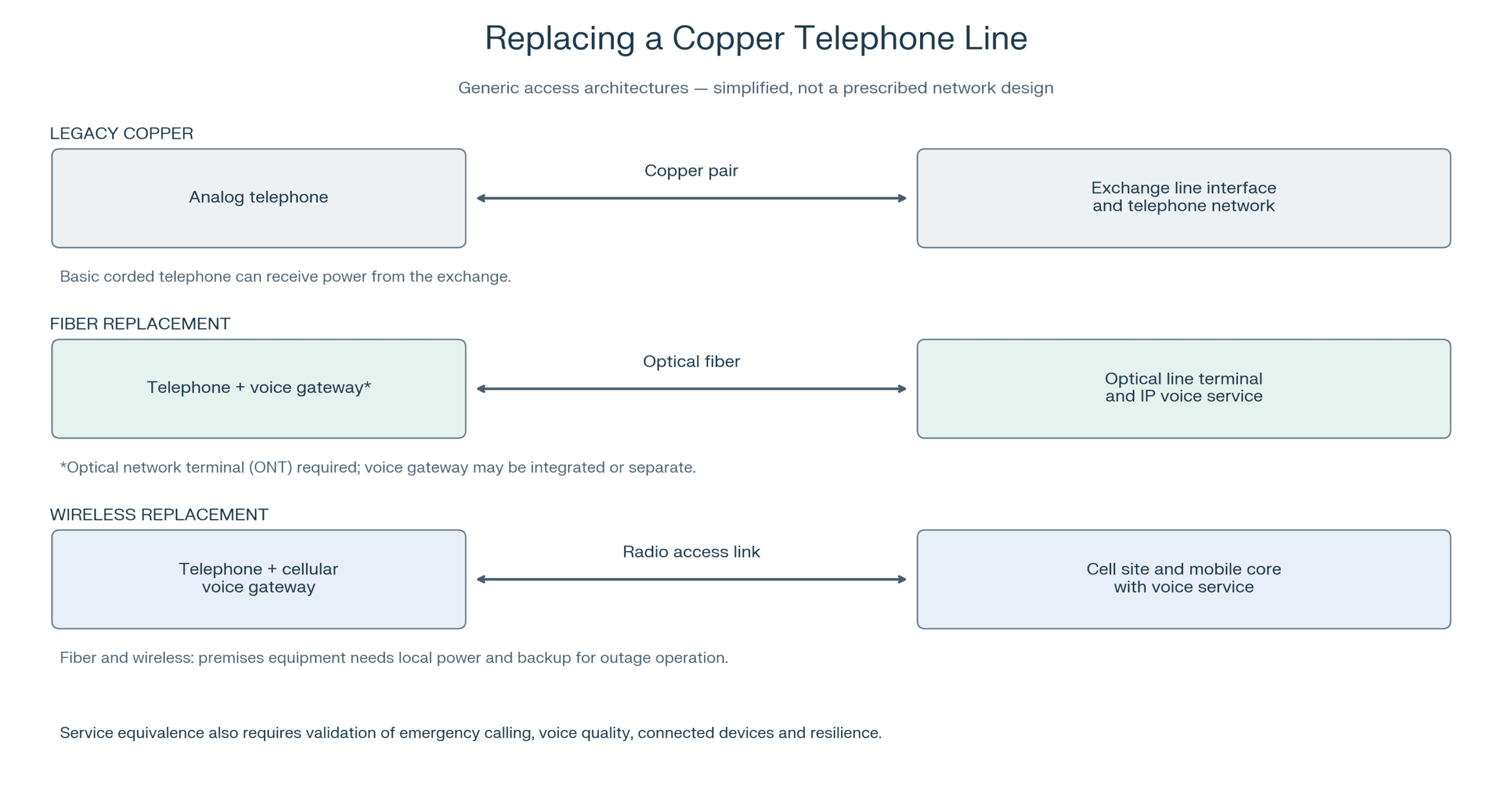
Image Generated by Perplexity.ai which was also used for research contained in this article.
……………………………………………………………………………………………………………………………………………………………………………………………………………………………………………………
Industry activity makes this a high priority issue:
AT&T’s May 20, 2026 California announcement commits $19 billion through 2030 to fiber and wireless investment. It also describes plans to discontinue specified copper-based services in parts of California on or after June 1, 2027, while committing that customers will retain access to voice and 911 service.
“Californians depend on and expect fast, reliable connectivity every day and AT&T is committed to delivering it,” said Susan Santana, state president of AT&T California. “With recent, forward-looking federal network modernization policies, we’re able to make our largest-ever California investment commitment ($19 billion) as we transition away from copper networks. As the largest fiber builder in the state, this expands future-ready fiber and wireless services at affordable prices and modernizes copper networks. By investing in newer, more reliable technology, we can deliver better service, reach more customers, improve our communities, and support California’s economy for years to come.”
–>These are AT&T announced plans and commitments, not completed migration outcomes.
In the UK, Ofcom’s digital-landline guidance places particular emphasis on customers dependent on telephone service and on equipment connected to the line. The transition is therefore not solely an infrastructure replacement program; it also requires identifying customer needs and resolving application-level dependencies.ofcom+1
The common challenge is translating broad continuity commitments into installation-level evidence.
A proposed replacement-service acceptance framework:
No single standard cited above defines a universal substitute for every telephone landline. A practical assessment could instead use a documented service profile:
| Dimension | Proposed acceptance evidence |
|---|---|
| Basic calling | Successful incoming and outgoing calls, ringing, required calling features, and number retention where applicable. |
| Conversational performance | Results against stated objectives under representative operating conditions. |
| Premises power resilience | Demonstrated operation of all necessary equipment for an agreed duration and calling duty cycle. |
| Emergency access | Documented verification of routing, location handling, and callback arrangements through an approved procedure. |
| Connected applications | Successful end-to-end transactions for identified alarms, monitoring systems, fax devices, or other required equipment. |
| Recovery and restoration | Observed restart and reconnection behavior, plus documented fault-reporting and repair arrangements. |
| Costs and responsibilities | Clear allocation of equipment, battery replacement, maintenance, compatibility remediation, and support obligations. |
https://www.ecfr.gov/current/title-47/chapter-I/subchapter-A/part-9/subpart-H/section-9.20
https://www.ecfr.gov/current/title-47/chapter-I/subchapter-A/part-9/subpart-H
https://www.itu.int/dms_pubrec/itu-t/rec/g/T-REC-G.9807.1-202010-S!Amd2!TOC-HTM-E.htm
https://www.rfc-editor.org/info/rfc4733/
https://about.att.com/story/2026/att-makes-ca-commitment.html
AT&T’s Fiber Expansion Strengthens Its Converged Wireless and Home Broadband Strategy
S&P Global Market Intelligence Surveys: Fiber Deployments in U.S. and Europe + AI Infrastructure Causes Market Shift
T-Mobile expands FTTH footprint via 50-50 JVs with Oak Hill Capital and Wren House
2026 Fiber Connect Keynote: “The Future of Fiber Optics: AI and the Quantum”
More KPN customers use fiber vs copper for broadband services in Nederlands
U.S. fiber rollouts now pass ~52% of homes and businesses but are still far behind HFC
One thought on “What Might Qualify as an Equivalent Replacement for a Copper Based Telephone Landline?”
Leave a Reply

From chatGPT (which was not used at all for this article):
This is an important and timely examination of what it really means to replace traditional copper-based telephone service. The article goes beyond the ability to make a voice call and addresses the critical requirements of reliability, emergency communications, power independence, and network resilience. The transition away from copper should not be judged solely on cost savings or the availability of newer technologies. Any proposed replacement must demonstrate that it can deliver the essential functionality and public-safety benefits that generations of telephone subscribers have come to expect. This article provides a useful framework for evaluating those alternatives and should stimulate an important discussion among service providers, regulators, and consumers.
Congrats on a technically grounded contribution to an increasingly important telecommunications policy debate. Well done, Alan!