

AI Power Grid Crisis Triggers $30 Billion “Fuel-Cell Boom” for Data Centers
Introduction:
The compounding power demands of generative AI clusters have outpaced the capacity of traditional electrical infrastructure, sparking an immediate energy availability crisis for hyperscale data centers. As connection times for high-density compute facilities stretch toward a half-decade, operators are abandoning the conventional model of total utility grid reliance. This infrastructure bottleneck has catalyzed a major architectural pivot toward localized, decentralized microgrids. By deploying on-site solid oxide fuel cells (SOFCs) as primary baseload power sources, AI infrastructure engineers are effectively decoupling data center deployment schedules from utility interconnect pipelines.
The Grid Interconnection Bottleneck:
The explosive growth of generative AI workloads has pushed the U.S. electrical grid to its absolute breaking point. Hyperscalers planning mega-scale data centers now face interconnect queue delays stretching from three to six years. These long timelines are driven by a shortage of high-voltage transformers, transmission capacity constraints, and lengthy regulatory approvals. Because traditional utilities cannot keep pace with the aggressive deployment cycles required for AI compute clusters, hardware providers and operators are shifting toward decentralized, on-site power generation architectures.
To eliminate these utility queues entirely, operators are turning to solid oxide fuel cells (SOFCs) as a primary power source rather than a backup system. Recent field deployments demonstrate how effectively this approach bypasses traditional infrastructure bottlenecks:
- Oracle (Utah): Bypassed standard grid delays by deploying an on-site fuel-cell configuration to supply dedicated power directly to its local data center facility.
- Nebius (New Jersey): Brought a high-density AI compute site online with fully operational on-site power in less than two months.
By utilizing modular fuel-cell installations, these companies are compressing power deployment timelines from years down to weeks. This speed is critical when trying to bring thousands of high-TDP GPUs online ahead of the competition.
Capital Expenditure and Market Forecasts:
This structural shift from centralized utility dependence to microgrid deployment is driving massive capital reallocations across the energy and technology sectors. According to data released today by Rystad Energy, capital expenditure on fuel-cell technology specifically for AI data centers is projected to expand dramatically over the next few years:
| Metric | 2025 Allocation | 2030 Projection |
|---|---|---|
| Global Data Center Fuel-Cell Market Size | $2.8 Billion | $30.0 Billion |
This projected spending represents a primary shift in how data center infrastructure is budgeted. Capital that was once reserved for substations and utility transmission line co-investments is now flowing directly to on-site chemical-to-electrical energy conversion systems.
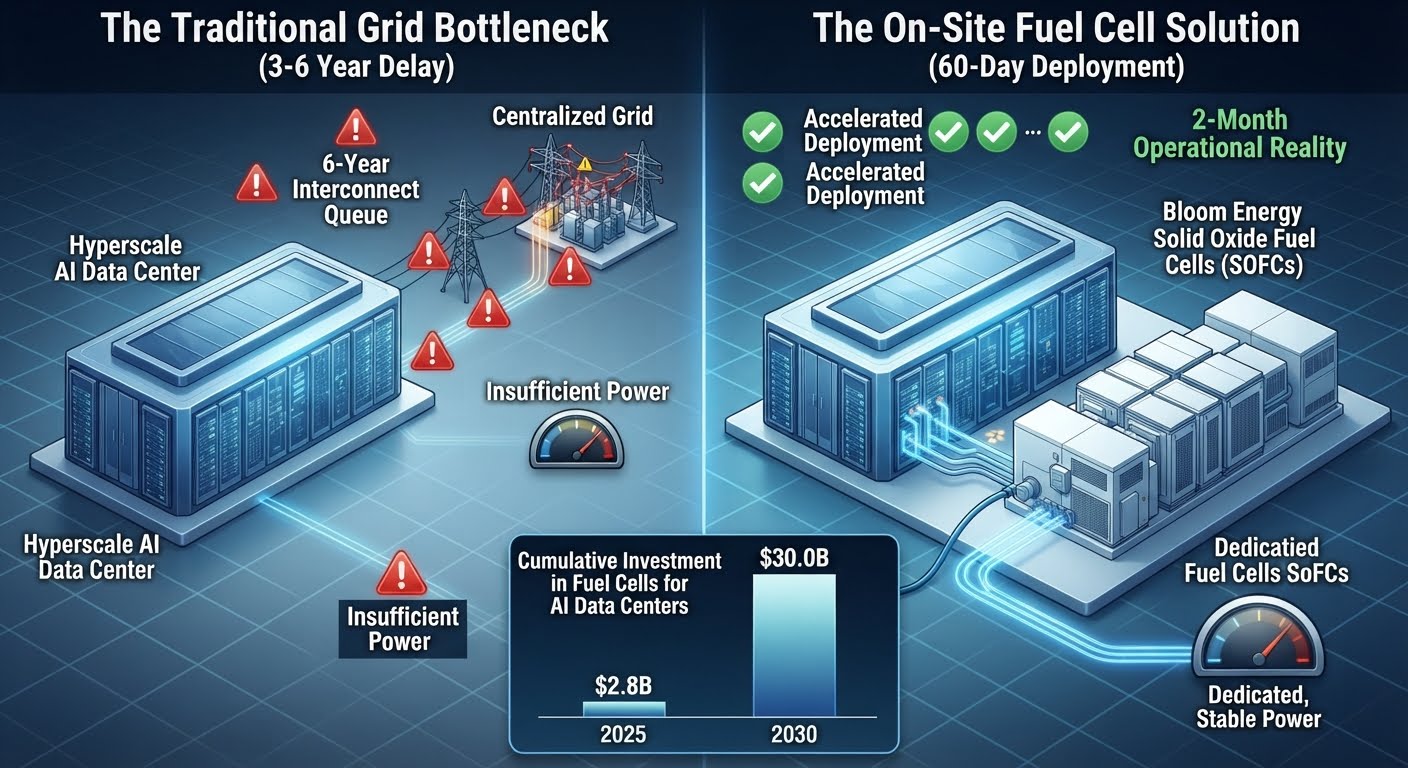
Image created by Google Gemini which helped research this article
………………………………………………………………………………………………………………………………………
Technical and Environmental Implications:
From a systems engineering perspective, solid oxide fuel cells offer a highly stable power profile well-suited for the dynamic, step-function load profiles of AI training and inference. Unlike intermittent renewable sources like solar or wind, fuel cells provide a constant baseload with high power quality, minimizing the need for extensive battery storage buffers or static uninterruptible power supplies (UPS).
However, this transition introduces complex design trade-offs:
- Fuel Infrastructure Dependence: Most current SOFC deployments rely on a continuous supply of natural gas via existing pipeline networks.
- Carbon Footprint Realities: While fuel cells eliminate local particulate emissions and are more efficient than traditional combustion turbines, utilizing natural gas still generates carbon dioxide (\(CO_{2}\)).
- The Hydrogen Transition: To achieve true net-zero operations, hyperscalers must eventually transition these fuel cells to run on green hydrogen. This pivot will require a massive buildout of hydrogen production, transport, and storage infrastructure that does not exist today.
Conclusions:
The explosive rise of the on-site fuel-cell market highlights a fundamental reality: the timeline for training next-generation foundational AI models cannot wait for the multi-year upgrade cycles of traditional regulated utilities. Compressing power provisioning timelines from five years down to sixty days provides a significant competitive advantage that justifies the initial capital premium of microgrid deployment. Over the long term, however, this strategy will face strict architectural and regulatory scrutiny. If hyperscalers are to fulfill their corporate net-zero mandates, this massive fuel-cell infrastructure must eventually transition from natural gas to green hydrogen. Until that clean fuel supply chain reaches commercial scale, the AI industry’s rush for power will rely on a pragmatic compromise—trading immediate grid independence for an ongoing reliance on fossil-fuel gas networks.
…………………………………………………………………………………………………………………………………………………………….
References:
https://pgjonline.com/news/2026/october/fuel-cell-investment-for-data-centers-to-reach-30-b-by-2030-as-hyperscalers-seek-on-site-gas-power-rystad-says