

AI infrastructure
AI Debt Wave Implications: Higher interest rates with enormous AI sales required for ROI
Executive Summary:
Artificial Intelligence (AI) debt fueled infrastructure buildouts have become a broad fixed-income-market supply shock. The Wall Street Journal reports that 49% of new investment-grade bond issuance year to date in 2026 has been AI-linked—a figure that underscores how the financing of data centers, compute infrastructure and supporting power systems is reshaping bond market fundamentals and technical factors.
As the supply of long-dated bonds rises, prices fall and yields rise until investors are compensated enough to absorb them. The AI buildout is adding enormous corporate debt from hyperscalers, data-center developers, semiconductor and networking suppliers, and utilities—while also driving public borrowing for grid, power, water and transportation infrastructure. This is putting upward pressure on yields across Treasuries, corporate bonds and municipal debt. This heavy concentration of long-dated supply creates a crowding-out effect that forces non-AI issuers to compete against elevated benchmark yields and potentially stifles broader economic growth, especially for companies not involved in circular AI funding deals (see References).
AI is capital intensive (see Table 1. below). Building data-center capacity requires cash not only for GPUs and servers, but also for land, buildings, fiber, networking, cooling, power procurement, backup generation, substations, transmission and water systems. The major hyperscalers can fund part of that investment from cash flow, but they are also issuing lots of new bonds and notes to preserve liquidity and accelerate buildouts. Their suppliers, data-center partners and power providers are doing the same. Much of this borrowing is long dated—exactly where the Treasury is issuing heavily to finance federal deficits.
The result is an expanding pool of long-duration debt competing for the same institutional buyers: insurers, pension funds, mutual funds, banks, foreign investors and asset managers. When those buyers do not increase their allocations at the same pace as supply, issuers must offer higher yields. Here’s the flow chart that loops around indefinitely until there is an AI crash!:
More AI related bond supply→lower prices→higher yields→higher term premium for U.S. Treasuries→higher budget deficits to finance the increased debt→more bond supply→etc.
……………………………………………………………………………………………………………………………………………………………………………………………………………………………………………………………………………….
- 2026 Debt Issuance: Projected between $220 billion and $250+ billion for major US hyperscalers (Alphabet / Google, Amazon, Meta, Microsoft, and Oracle), with broader AI-related market debt reaching up to $570 billion.
- 2027 Forecast: Goldman Sachs projects direct hyperscaler debt issuance to nearly double to around $400 billion (Jeff Pu estimates $419 billion) as companies finance over a third of their infrastructure needs.
- Aggregate Capex: Combined capital expenditures are expected to hit roughly $940 billion in 2026 and scale past $1.3 trillion in 2027.
- Market Share: Hyperscaler investment-grade bond sales have jumped from roughly 2% of total US supply (2022–2024) to roughly 9% in 2026.
- Credit Impact: Credit spreads on a 10-year hyperscaler credit basket have widened from historical 40–75bp ranges toward 90bp+, driven by leverage concerns.
- Cash Flow Outlook: S&P Global Ratings expects all major hyperscalers to run negative free operating cash flow through 2026 and 2027, with a cash-flow inflection point not projected until 2028–2029.
Hyperscaler Funding Boom: Debt vs. Capex Projections (2026–2027):
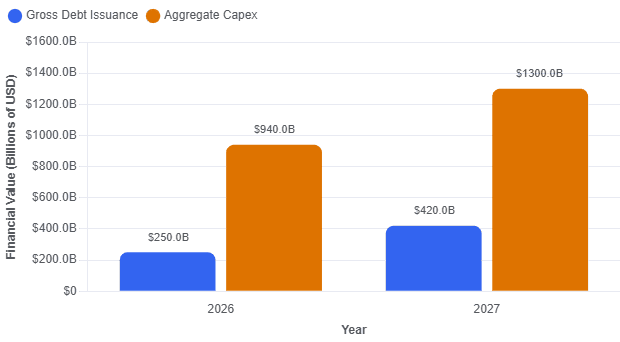
Source: Google Gemini
……………………………………………………………………………………………………………………………………………………………………………………………………………………………………
Corporate Borrowing Negatively Impacted by AI Debt Financing:
Corporate bonds face the most direct effect. When hyperscalers, data-center operators, chip suppliers and utilities all enter the fixed income market at once, they compete for investor capital and dealer balance sheets.
The bond market adjusts through the following mechanisms:
- Larger new-issue concessions, meaning issuers must offer higher yields than comparable bonds already trading.
- Lower prices for outstanding corporate bonds as investors sell them to make room for new issues.
- Wider credit spreads, particularly for lower-rated investment-grade borrowers.
- Higher borrowing costs for non-AI companies that must compete with AI-linked supply for investor allocations.
The pressure is not limited to companies directly building AI agents or systems. A telecom operator, industrial firm, REIT or consumer company will likely pay more to borrow because investors can buy a new, liquid, highly rated hyperscaler bond at a potentially higher and attractive yield. That discourages non-AI corporate borrowing and leads to slower economic growth.
………………………………………………………………………………………………………………………………………………………………………………………………
AI Pain Points Personified:
1. Ares reports, “We documented well more than 100 digital-infrastructure financings from just the past twelve months… Despite different issuers, different structures, different rating agencies and different credit markets, all of the risk converges on just eight (AI tech) names: Meta, Oracle, Microsoft, Amazon, Google, Nvidia, and, on a look-through basis, OpenAI and Anthropic.”
2. Analysts at Goldman Sachs Group and elsewhere have calculated that more than $1 trillion has already been spent on the data center build-out since the launch of ChatGPT in late 2022. Presumably, other large American businesses would need to pay for AI tools to justify all of this investment. That money needs to come from somewhere. but who’s going to pay for those AI tools?
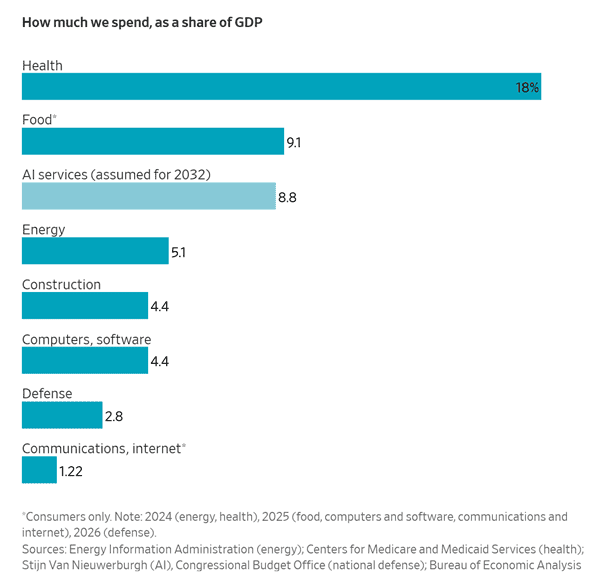
3. From Greg Ip of the WSJ: “Will America Spend 9% of Its GDP on AI? The Industry Is Counting on It“:
“Is it plausible that Americans will spend as much of their income on this one technology as they do on food? Roughly twice what the nation pays for all forms of energy or all computers and software? Seven times what consumers spend on phone, streaming, and internet services combined?”
“You should be skeptical. Even the most transformative inventions eventually run into the law of diminishing returns: each additional dollar a user spends yields less additional productivity (or enjoyment) than the last. That imposes a natural ceiling. The question, of course, is where that ceiling is. Whether or not you think 9% of GDP is right, you have to care, because this figure isn’t some fever dream: it is implicit in the dollars that investors and companies are committing right now.”
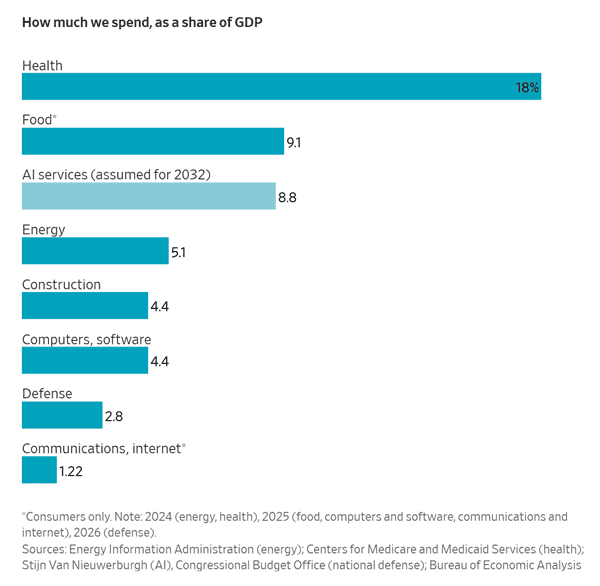
Chart Credit: Greg Ip, Wall Street Journal
………………………………………………………………………………………………………………..
Dire Warnings:
Nobel laureate Daron Acemoglu writes about “Distorted Intelligence at the AI Frontier” (emphasis added):
“The real problem for the frontier AI labs is not that their models are too powerful and already “misaligned” with the goals their creators set for them. Rather, it is that the models are being trained in ways that may be leading to a type of intelligence that will become less predictable. AI frontier labs are training their models in ways that may be leading to a type of distorted intelligence.
“This is what I mean by distorted intelligence. If my suspicion is correct, what we are dealing with is not a model racing toward superintelligence, but a brittle house of cards that becomes more and more likely to malfunction and collapse as we demand more from it.”
Conclusions:
The above analysis outlines critical structural risks and concerns directly related to the AI infrastructure (capex) spending boom. It references several articles which highlight the risks of circular financing loops where hardware suppliers (like Nvidia and Broadcom) fund their buyers (like Anthropic and Open AI). Additionally, hyperscalers face structural cash deficits with negative free operating cash flows projected through 2027, alongside rising sovereign risk and potential conflicts of interest from intertwined debt and leasing arrangements. This table balances the author’s views with a counter-perspective:
| IEEE Techblog Warning | The Nuanced Counter-Perspective |
|---|---|
| Circular Funding Risk: Massive vendor lending deals (like Broadcom lending Anthropic $42 billion) are artificially inflating revenue and building a brittle house of cards. | Balance Sheet Cushion: Unlike the 2000 Dot-Com crash where telecom infrastructure was built on speculative, junk-rated leverage, 2026 hyperscalers possess massive cash-generative core businesses (search, cloud, e-commerce) to subsidize their debt service even if AI returns are delayed. |
| Diminishing Returns: Society cannot plausibly spend 9% of GDP on AI, meaning demand will hit a hard ceiling and spark a debt bust. | Productivity Deflation: AI infrastructure spending may not need to justify itself through direct “software sales.” If the technology lowers the baseline operating costs of the global services economy, the ROI manifests as structural corporate margin expansion rather than retail sales. |
………………………………………………………………………………………………………………………………………………………………………………………………
References:
Curmudgeon: Caveat Emptor: Huge Debt and Circular Financing Deals Dominate AI Build-Outs (07/23)
Broadcom lending Anthropic up to $42 billion in yet another AI circular financing deal
Bain & Co: AI Infrastructure Buildout Will Require $6 Trillion Revenue by 2031 to Support Massive CAPEX
The AI Infrastructure Build-Out: A $10 Trillion Bet on Compute, Power, and Networks
Nvidia CEO Huang: AI is the largest infrastructure buildout in human history; AI Data Center CAPEX will generate new revenue streams for operators
AI risks and backlash increase; Recap of the circular loop of fake AI profits and hyperscaler markups of private AI companies
China vs U.S.: Race to Generate Power for AI Data Centers as Electricity Demand Soars
How will fiber and equipment vendors meet the increased demand for fiber optics in 2026 due to AI data center buildouts?
Expose: AI is more than a bubble; it’s a data center debt bomb
Will billions of dollars big tech is spending on Gen AI data centers produce a decent ROI?
Huge Risks for the proposed $500B AI Investments from Giant Wall Street firms
Can the debt fueling the new wave of AI infrastructure buildouts ever be repaid?
Broadcom lending Anthropic up to $42 billion in yet another AI circular financing deal
Backgrounder:
According to Reuters, which obtained Anthropic’s IPO prospectus, the Big Tech giants are depicted in multiple ways in the IPO filing- as distribution partners, financial backers, computer suppliers, and competitors, all at once. They uncovered the clearest view yet of how circular the AI world really is, and how much an AI lab’s success depends on the giants it’s also competing against.
Reuters was able to calculate that Anthropic pays roughly 16% of every dollar it earns from its cloud partners (Amazon, Google, Microsoft) back to those same big tech partners. It counts the full value of contracts sold through a cloud marketplace as revenue, then treats the cloud platform’s cut of revenue as a marketing cost.
OpenAI does the opposite by only counting what it keeps after the cloud partner takes its share. That difference matters for understanding the big numbers floating around, and how to actually compare the two rivals’ toplines as they both eye the public market.
Broadcom’s relationship with Anthropic spans compute supply, equipment leasing and financing — giving the semiconductor company a central role in Anthropic’s infrastructure buildout. That differentiates it from other major partners and investors such as Amazon which primarily provide cloud infrastructure and distribution for Anthropic’s AI model Claude.
As part of that complex relationship, revealed in the IPO filing, Broadcom has agreed to lend Anthropic up to $42 billion to finance infrastructure spending. In turn, Anthropic stands to become the largest customer in Broadcom’s entire chip design business next year, making their relationship a prime example of the reciprocal spending that has animated AI skeptics on Wall Street, even as the AI lab readies a public offering that could see it valued at $2 trillion.
“It feels that there’s quite a concentrated bet right now on two companies being able to generate enough revenues to support all the financing that’s happened,” said Robert Leitao, managing partner of Rothschild & Co.
Anthropic disclosed that Broadcom’s role in supplying hardware and acting as a financing partner creates “potential conflicts of interest” that might affect Anthropic’s ability to access the computing power needed for its work, according to the prospectus.
The AI lab also warned that Broadcom’s decisions around pricing and hardware could affect its ability to procure enough computing infrastructure. Broadcom did not comment. Anthropic declined to comment to Reuters.
In April, Anthropic announced it was teaming up with Broadcom and Google for a deal that would see Google provide its Tensor Processing Unit (TPU) chip capacity to Anthropic, with the supply coming online in 2027. Broadcom designs Google’s TPUs that are manufactured by TSMC in Taiwan.

A Broadcom circuit board for chip testing is pictured during a lab tour as Broadcom prepares to launch new optical chip tech to fend off Nvidia in San Jose, California, U.S., September 5, 2025. Brittany Hosea-Small · REUTERS via Yahoo Finance.
Anthropic is also relying on Broadcom for equipment leasing and financing. Broadcom could designate a financing partner, and the debt instruments could be converted into Anthropic shares. Anthropic said in its filing it doesn’t expect any notes to be sold before it completes its IPO. The convertible note Anthropic would issue could finance about a third of the $125.2 billion commitment the AI lab has made for a five-year lease of tensor processing unit (TPU) computing capacity.
Other Players:
Broadcom rivals Nvidia and AMD have also provided funding to their own customers, including OpenAI and Anthropic, which the labs then used to pay for access to the companies’ high-powered chips. The concern about such circular financial schemes is that if one domino in the row falls, it will cause a chain reaction that will decimate the AI trade and, as a result, the global equities markets that have benefited from and come to rely on AI firms and hyperscalers.
As to the circularity of all of this financing, the BIS notes (via FT Alphaville):
“… circular relationships make reported demand partly endogenous to firms’ own financing decisions. For example, when a supplier finances a customer, part of the supplier’s revenue growth reflects its own capital investment, rather than organic final demand. This makes it harder for investors, lenders and supervisors to gauge what part of the current AI boom is based on organic demand.”
“The parallel with the telecom boom of the late 1990s is instructive: upstream equipment vendors financed network operators so they could buy the vendors’ equipment. This meant that part of the equipment vendors’ reported sales was being funded by the vendors themselves. For a time, as operators expanded their networks, equipment orders also expanded and vendors booked both the sales and loans as assets. However, when operators’ own revenues failed to materialize or slowed, they could neither repay the loans nor sustain the equipment purchases. Equipment vendors then sustained both financial losses and a loss of sales. Such dynamics may also play out in AI if revenue growth and end user demand fall short of firms’ expectations.”
……………………………………………………………………………………………………………………………………………………………………………………………..
- 2026 Debt Issuance: Projected between $220 billion and $250+ billion for major US hyperscalers (Alphabet / Google, Amazon, Meta, Microsoft, and Oracle), with broader AI-related market debt reaching up to $570 billion.
- 2027 Forecast: Goldman Sachs projects direct hyperscaler debt issuance to nearly double to around $400 billion (Jeff Pu estimates $419 billion) as companies finance over a third of their infrastructure needs.
- Aggregate Capex: Combined capital expenditures are expected to hit roughly $940 billion in 2026 and scale past $1.3 trillion in 2027.
- Market Share: Hyperscaler investment-grade bond sales have jumped from roughly 2% of total US supply (2022–2024) to roughly 9% in 2026.
- Credit Impact: Credit spreads on a 10-year hyperscaler credit basket have widened from historical 40–75bp ranges toward 90bp+, driven by leverage concerns.
- Cash Flow Outlook: S&P Global Ratings expects all major hyperscalers to run negative free operating cash flow through 2026 and 2027, with a cash-flow inflection point not projected until 2028–2029.
Source: Google Gemini
…………………………………………………………………………………………………………………………………………………………
References:
https://www.ft.com/content/87875b20-4081-4511-9afe-4ee389409742
Curmudgeon: Caveat Emptor: Huge Debt and Circular Financing Deals Dominate AI Build-Outs (07/23)
Bain & Co: AI Infrastructure Buildout Will Require $6 Trillion Revenue by 2031 to Support Massive CAPEX
The AI Infrastructure Build-Out: A $10 Trillion Bet on Compute, Power, and Networks
Nvidia CEO Huang: AI is the largest infrastructure buildout in human history; AI Data Center CAPEX will generate new revenue streams for operators
AI risks and backlash increase; Recap of the circular loop of fake AI profits and hyperscaler markups of private AI companies
China vs U.S.: Race to Generate Power for AI Data Centers as Electricity Demand Soars
How will fiber and equipment vendors meet the increased demand for fiber optics in 2026 due to AI data center buildouts?
Expose: AI is more than a bubble; it’s a data center debt bomb
Will billions of dollars big tech is spending on Gen AI data centers produce a decent ROI?
Huge Risks for the proposed $500B AI Investments from Giant Wall Street firms
Can the debt fueling the new wave of AI infrastructure buildouts ever be repaid?
Bain & Co: AI Infrastructure Buildout Will Require $6 Trillion Revenue by 2031 to Support Massive CAPEX
Introduction:
Bain & Company estimates that the AI industry will need to generate approximately $6 trillion in annual revenue by 2031 to support the capital intensity (CAPEX) of the global AI infrastructure buildout, including investment in data centers, accelerated computing, memory, networking and power systems. In its latest technology report, released September 29th, Bain projects that new AI-enabled products could account for roughly $4.2 trillion of that revenue requirement. The firm identifies AI-driven innovation across search, advertising, autonomous systems and physical AI as major prospective sources of value creation.
Enterprise adoption could contribute a further $1 trillion to $1.4 trillion annually through productivity gains in software engineering, sales, marketing, customer service and IT operations. Bain characterizes “absorption speed”—the rate at which enterprises operationalize AI—as the emerging competitive variable, with leading AI labs investing more than $9.75 billion in engineering models intended to accelerate enterprise deployment and integration.
“The debate today is fixated on employee productivity. The economics of AI infrastructure demand trillions in new revenue beyond productivity gains. What the industry needs is a wave of innovation that will dwarf what mobile and cloud unlocked,” said David Crawford, chairman of Bain’s global technology practice and lead author of the report.
At a Glance:
- AI infrastructure investment is racing ahead, but generating enough economic value to justify it will require trillions of dollars in new AI-driven revenue.
- Productivity gains from existing enterprise and consumer applications won’t be enough; entirely new markets must emerge to close the funding gap.
- The winners will be those that create breakthrough AI applications that transform industries and expand the global economy.
Consumer AI services, including subscription and advertising-supported offerings, are projected to contribute between $200 billion and $400 billion in annual revenue. This segment is central to the commercial scaling of AI because it extends AI-enabled services to billions of users through consumer platforms, devices and digital-service ecosystems.
“New products and uses that don’t exist today will enable new markets and opportunities from abundant intelligence – these may include drug discovery, mental health and energy generation,” Bain said.
Bain forecasts annual AI infrastructure spending of up to $1.5 trillion by 2031. The figure encompasses greenfield data-center construction, expansion of existing facilities, and continuing investment in GPUs, memory, network fabrics and related infrastructure. Bain assumes that capital expenditure could represent approximately one-quarter of total AI-industry revenue—“an ambitious but reasonable percentage based on trends among cloud providers.” On that basis, the firm calculates that the AI market would need to approach $6 trillion in annual revenue to sustain the projected infrastructure investment cycle.
“The unprecedented speed and scale of the AI buildout, with billions flowing into chips, data centers, networks and power systems, have focused attention on the challenge of building capacity. But the more important question may be whether enough economic value can be created to justify it.”
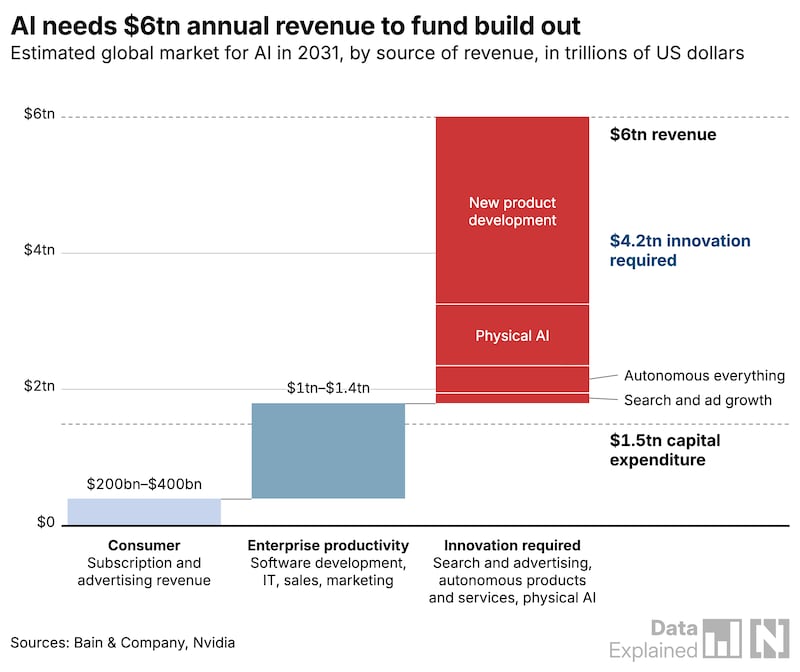
Consider the scale of investment and the gap between that and the revenue model necessary to fund it.
- The arms race among hyperscalers (Microsoft, Google, Amazon, Meta, and Oracle) is accelerating: Their capital expenditures could reach $780 billion in 2026, nearly five times the level of just three years earlier.
- Leading-edge AI data centers today are approaching 1 gigawatt (GW) of power capacity. By 2027, many are expected to approach 2 GW facilities, with 9 GW campuses emerging by the end of the decade.
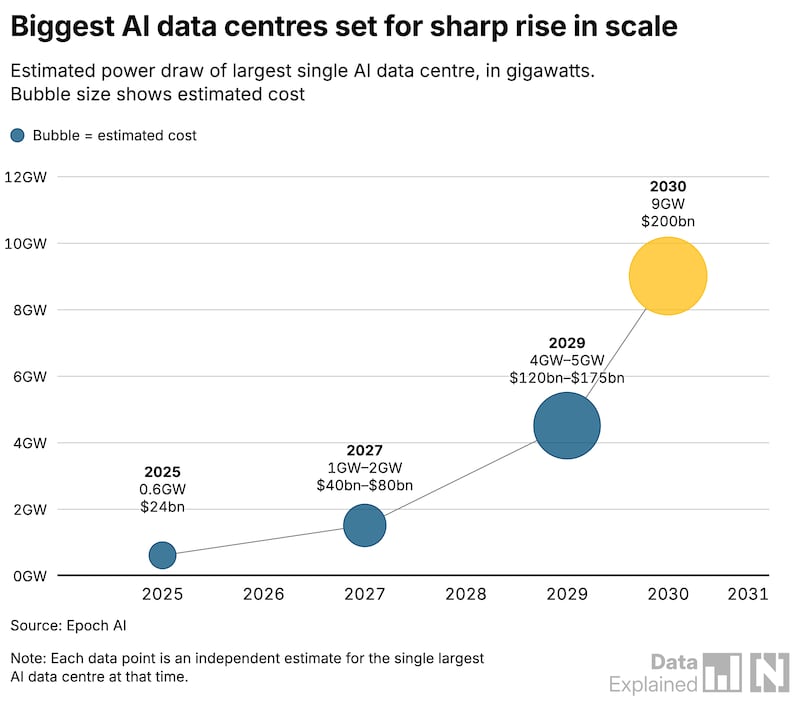
The scale of individual AI data-center projects illustrates the infrastructure requirements underlying those projections. Bain said AI data-center size and cost are increasing rapidly, with leading facilities approximately doubling in scale every 12 to 16 months. Meta Platforms’ Prometheus data center in Ohio, for example, had approximately 600 MW of capacity and an estimated cost of $24 billion in 2025, according to Epoch AI. The facility is projected to reach as much as 2 GW of capacity and cost approximately $80 billion by 2027. Epoch AI projects that Prometheus could reach 5 GW by 2029, with costs of up to $175 billion, and 9 GW by 2030, at an estimated cost of $200 billion.
Such growth places data-center infrastructure squarely within the telecommunications and network-infrastructure domain. Multi-gigawatt AI campuses require high-density optical interconnects, large-scale Ethernet or InfiniBand fabrics, low-latency east-west traffic engineering, high-capacity metro and long-haul connectivity, and resilient access to electric generation and transmission capacity. The infrastructure challenge consequently extends beyond data-center construction to the coordinated scaling of semiconductor supply chains, transport networks, power systems, cooling infrastructure and specialized technical labor.
Bain identified electric-grid capacity, access to GPUs and other critical infrastructure components, talent availability, workforce retention, public acceptance and regulatory requirements as important factors shaping the pace and geography of AI data-center deployment. Resource consumption, noise and community impacts are also becoming material considerations in project planning and approval processes.
Governments in the UAE, Saudi Arabia, the European Union, South Korea and the United States are supporting the expansion of AI and data-centre infrastructure, Bain said. The firm described data centres as increasingly important to technology innovation, economic development and national sovereignty.
The Bain report stated: “Capital needs for data infrastructure will remain high … bottlenecks in power, semiconductors, and other inputs carry large capital needs of their own, opening additional entry points for investors. And as sovereign infrastructure becomes a bigger part of national strategies, partnerships offer both a way in and geographic diversification.”
…………………………………………………………………………………………………………………………………………………………………………………………………………………….
Greg Ip of the WSJ: Believers in the artificial-intelligence boom need to take a very close look at this number: 9% of GDP. That is how much American businesses and consumers eventually have to spend per year on the services of companies like Anthropic and OpenAI to justify the staggering sums being committed to the technology right now.
Is it plausible that Americans will spend as much of their income on this one technology as they do on food? Roughly twice what the nation pays for all forms of energy or all computers and software? Seven times what consumers spend on phone, streaming, and internet services combined?
You should be skeptical. Even the most transformative inventions eventually run into the law of diminishing returns: each additional dollar a user spends yields less additional productivity (or enjoyment) than the last. That imposes a natural ceiling. The question, of course, is where that ceiling is. Whether or not you think 9% of GDP is right, you have to care, because this figure isn’t some fever dream: it is implicit in the dollars that investors and companies are committing right now.
The figure is courtesy of Columbia University finance professor Stijn Van Nieuwerburgh. His paper, first presented at the Brookings Institution, showed that the AI build-out is now bigger than any investment boom in American history. His more intriguing, and sobering, statistic is how much revenue AI would have to garner to justify that boom.
Conclusions:
- Dramatic innovation will be required to deliver the revenue necessary to fund the gap.
- The economics required to generate ROI from AI infrastructure are demanding trillions in new revenue, not just cost savings.
- The industry needs a wave of application innovation comparable with what mobile and cloud unlocked, not just productivity gains on existing workflows.
- The infrastructure is being built ahead of the demand curve, and funding it sustainably will require adding approximately 1% to the annual global GDP growth rate.
- The question is whether the applications arrive in time to pay for it.
……………………………………………………………………………………………………………………………………………………………………………………………………………….
References:
https://www.bain.com/insights/topics/technology-report/
https://www.wsj.com/tech/ai/will-america-spend-9-of-its-gdp-on-ai-the-industry-is-counting-on-it-3501bb4f?st=HkbAZs&reflink=desktopwebshare_permalink&mc_cid=65590ec418&mc_eid=5917efd771
The AI Infrastructure Build-Out: A $10 Trillion Bet on Compute, Power, and Networks
Dell’Oro: Data Center capex grew 92% in 2Q-2026 (caveats galore)
Dell’Oro: 2H2026 Data Center Capex to Accelerate due to massive AI Deployments
PwC: Global AI data center spending to hit $31.6tn by 2050; Role of full stack orchestration layer explained
Nvidia CEO Huang: AI is the largest infrastructure buildout in human history; AI Data Center CAPEX will generate new revenue streams for operators
AI risks and backlash increase; Recap of the circular loop of fake AI profits and hyperscaler markups of private AI companies
China vs U.S.: Race to Generate Power for AI Data Centers as Electricity Demand Soars
How will fiber and equipment vendors meet the increased demand for fiber optics in 2026 due to AI data center buildouts?
Expose: AI is more than a bubble; it’s a data center debt bomb
Will billions of dollars big tech is spending on Gen AI data centers produce a decent ROI?
Huge Risks for the proposed $500B AI Investments from Giant Wall Street firms
Can the debt fueling the new wave of AI infrastructure buildouts ever be repaid?
The Infrastructure Behind the AI Economy
Introduction:
Public discussion of artificial intelligence tends to focus on the models developed by companies such as OpenAI, Anthropic, xAI, Perplexity, Google, Amazon, and Microsoft. However, a substantial portion of AI investment is directed not at the models themselves, but at the infrastructure required to develop, deploy, secure, and operate them. The AI model attracts attention while the infrastructure captures much of the spending. Tayo Lusi, founder of The Apex Institute cloud and AI infrastructure program, says the more useful story is happening underneath, in a layer nobody puts in a headline.
“People think AI spending means someone building a better chatbot,” Tayo said. “Most of that money is not going toward the model. It is going toward the servers, the storage, the security and the systems required just to keep that model running at all.”
AI Requires an Operational Foundation:
Even an advanced AI model cannot operate independently. Production deployments depend on a broad AI technology stack [1.] that includes:
-
Compute and storage capacity at a scale many organizations have not previously managed.
-
Cloud and data-center systems capable of responding to rapid changes in demand.
-
High-performance networks that move data efficiently among users, applications, storage systems, and accelerators.
-
Security controls that protect models, data, application interfaces, and communications.
-
Monitoring and observability systems that identify performance degradation, anomalous behavior, and failures before they become service outages.
-
Engineers and operators who design, maintain, and continuously optimize these systems.
These capabilities are largely invisible in a product demonstration, but they must be in place before the demonstration can succeed. A reliable AI service is therefore not simply a model; it is an integrated computing, networking, security, and operations environment.
Note 1. The AI infrastructure technology stack represents the foundational layers of hardware and software required to build, train, deploy, and maintain AI models at scale. Unlike traditional enterprise IT, AI infrastructure must support massive parallel processing, hyper-fast data movement, and continuous optimization for AI workloads.

Image Credit: Mahmoud AbuFadda on LinkedIn
…………………………………………………………………………………………………………………………………………………………………………………………………
Where the Jobs Are Emerging:
The concentration of investment in infrastructure is also influencing workforce demand. While media coverage often emphasizes AI-related job displacement, organizations continue to require professionals who can build and operate the systems that support AI applications.
Roles associated with this infrastructure include:
-
Cloud and platform engineering.
-
AI infrastructure and machine-learning operations.
-
Site reliability engineering and systems support.
-
Data-center and accelerator operations.
-
Network engineering for high-bandwidth AI clusters.
-
Cybersecurity, identity management, and data protection.
-
Observability, performance engineering, and service management.
The U.S. Bureau of Labor Statistics projects continued growth across computer and information technology occupations, including fields related to infrastructure and information security. BLS
This does not mean that every technology role is insulated from automation or restructuring. It does suggest, however, that the expansion of AI creates a parallel requirement for professionals who can provide the underlying compute, connectivity, resilience, and security.
Why Perception and Investment Diverge:
Public perception is shaped primarily by visible outcomes: automation, workforce reductions, and uncertainty about the future of employment. Investment decisions reveal a broader picture. Organizations may reduce spending in some application-development areas while increasing expenditure on cloud capacity, specialized hardware, data infrastructure, cybersecurity, and operational support.
This distinction matters for individuals making career decisions. Focusing exclusively on the application or model layer can obscure opportunities in the systems that make AI practical at scale.
The infrastructure layer is also less visible because it is rarely the subject of product launches or public demonstrations. Yet it often represents the difference between a promising prototype and a dependable production service.
A Skills Gap at the Infrastructure Layer:
Many traditional education and career pathways have emphasized application development, data science, or model development. Those areas remain important, but the rapid expansion of AI is increasing demand for a complementary set of skills.
Relevant capabilities include:
-
Designing cloud architectures that scale under variable workloads.
-
Managing distributed systems and containerized environments.
-
Operating accelerator-based compute platforms.
-
Automating deployment and lifecycle management through DevOps practices.
-
Applying security controls throughout the AI system lifecycle.
-
Establishing monitoring, logging, and observability for production services.
-
Evaluating reliability, latency, utilization, and cost.
-
Connecting AI workloads through high-performance networks and storage systems.
The resulting skills gap is not necessarily a consequence of insufficient technical ability. In many cases, professionals have simply been directed toward the most visible parts of the AI ecosystem rather than toward the infrastructure supporting them.
That imbalance can create an unusual labor-market dynamic: substantial budgets coexist with a limited pool of engineers who possess the required systems, cloud, networking, and security expertise. Organizations may therefore leave positions open for extended periods or offer premium compensation for experienced candidates.
AI Infrastructure is a Global Opportunity:
The infrastructure requirements of AI are not limited to the United States. Organizations worldwide are investing in cloud services, data centers, networking, security, and operational capabilities as they adopt AI technologies.
This creates a global need for engineers and technical professionals who can design and operate reliable infrastructure. It also creates an opportunity for education and workforce-development initiatives in regions that have historically had limited access to advanced technology training.
If AI investment continues to expand globally, access to the resulting career opportunities should not depend solely on proximity to established technology hubs. Foundational instruction in cloud engineering, networking, cybersecurity, automation, and systems operations can provide a pathway into the infrastructure economy.
The central point is straightforward: AI progress depends on more than model innovation. It depends on the infrastructure that enables those models to function reliably, securely, and economically. As organizations move from experimentation to large-scale deployment, the professionals who build and operate that foundation will become increasingly important.
……………………………………………………………………………………………………………………………………………………………………………………………………………………………………..
References:
S&P Global Market Intelligence Surveys: Fiber Deployments in U.S. and Europe + AI Infrastructure Causes Market Shift
Goldman Sachs report: Optical Networking is the next mega trend in AI infrastructure
AI infrastructure spending boom: a path towards AGI or speculative bubble?
Sovereign AI infrastructure for telecom companies: implementation and challenges
OCP 2025 Meta keynote: Scaling the AI Infrastructure to Data Center Regions