

AI Power Grid
AI Power Grid Crisis Triggers $30 Billion “Fuel-Cell Boom” for Data Centers
Introduction:
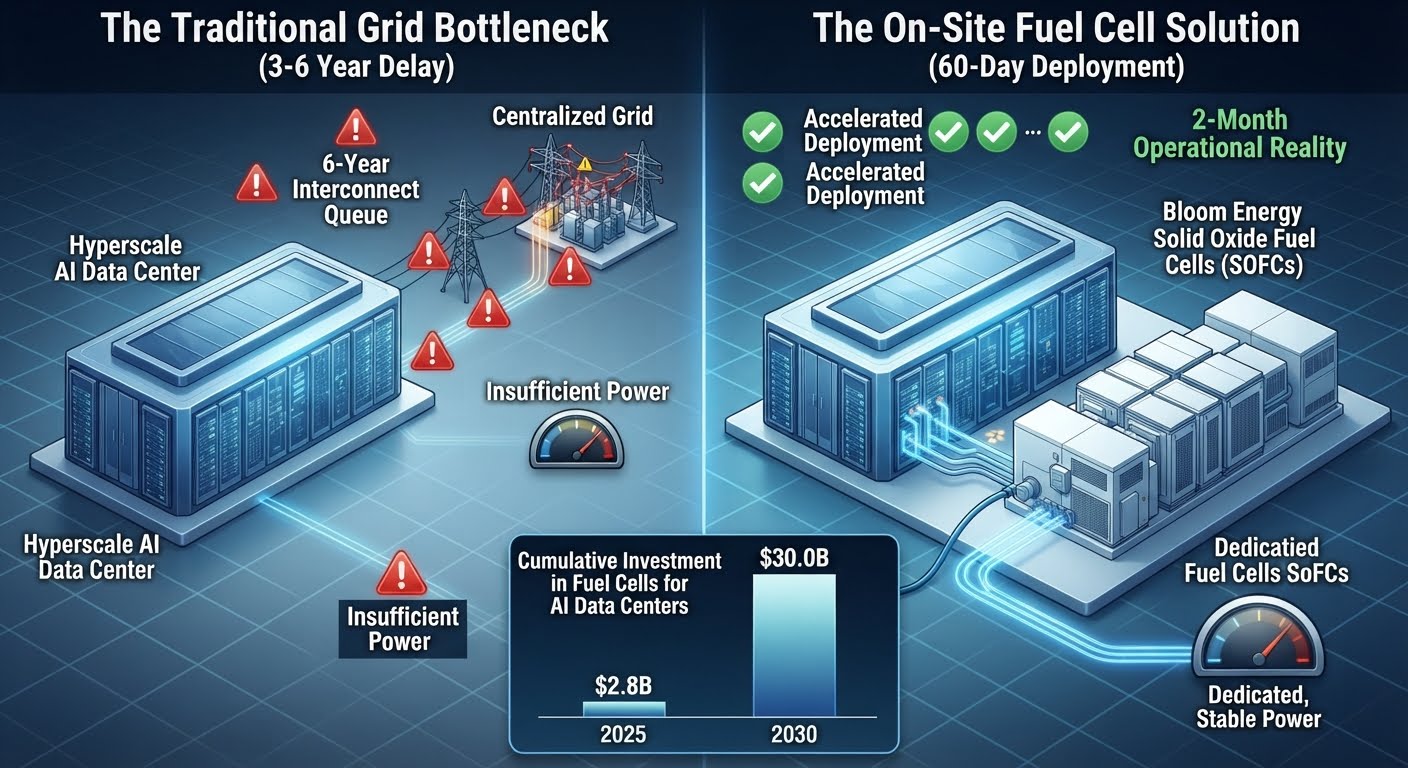
The compounding power demands of generative AI clusters have outpaced the capacity of traditional electrical infrastructure, sparking an immediate energy availability crisis for hyperscale data centers. As connection times for high-density compute facilities stretch toward a half-decade, operators are abandoning the conventional model of total utility grid reliance. This infrastructure bottleneck has catalyzed a major architectural pivot toward localized, decentralized microgrids. By deploying on-site solid oxide fuel cells (SOFCs) as primary baseload power sources, AI infrastructure engineers are effectively decoupling data center deployment schedules from utility interconnect pipelines.
- Oracle (Utah): Bypassed standard grid delays by deploying an on-site fuel-cell configuration to supply dedicated power directly to its local data center facility.
- Nebius (New Jersey): Brought a high-density AI compute site online with fully operational on-site power in less than two months.
- Fuel Infrastructure Dependence: Most current SOFC deployments rely on a continuous supply of natural gas via existing pipeline networks.
- Carbon Footprint Realities: While fuel cells eliminate local particulate emissions and are more efficient than traditional combustion turbines, utilizing natural gas still generates carbon dioxide (\(CO_{2}\)).
- The Hydrogen Transition: To achieve true net-zero operations, hyperscalers must eventually transition these fuel cells to run on green hydrogen. This pivot will require a massive buildout of hydrogen production, transport, and storage infrastructure that does not exist today.
Conclusions:
Fuel cells are becoming a significant option for developers facing lengthy grid-connection schedules. Their principal attraction is the possibility of obtaining continuous on-site power sooner than a conventional utility connection would permit. However, an individual deployment completed in less than two months does not establish a universal sixty-day time-to-power benchmark. The strategic trade-off is a shift in infrastructure dependencies—not their disappearance.
Data-center developers must weigh potential scheduling advantages against gas availability, permitting, electrical equipment, manufacturing capacity, supplier concentration, and emissions obligations. Rystad’s $30 billion forecast indicates the scale of the opportunity, while its supply-chain findings show why that opportunity should not be mistaken for assured deployment.
The explosive rise of the on-site fuel-cell market highlights a fundamental reality: the timeline for training next-generation foundational AI models cannot wait for the multi-year upgrade cycles of traditional regulated utilities. Compressing power provisioning timelines from five years down to sixty days provides a significant competitive advantage that justifies the initial capital premium of microgrid deployment. Over the long term, however, this strategy will face strict architectural and regulatory scrutiny.
If hyperscalers are to fulfill their corporate net-zero mandates, this massive fuel-cell infrastructure must eventually transition from natural gas to green hydrogen. Until that clean fuel supply chain reaches commercial scale, the AI industry’s rush for power will rely on a pragmatic compromise—trading immediate grid independence for an ongoing reliance on fossil-fuel gas networks. …………………………………………………………………………………………………………………………………………………………….
References: