

Will Nvidia’s Retreat from Circular Financing Deals Curtail the AI CAPEX Infrastructure Spending Frenzy?
Disclaimer: ChatGPT was used extensively to help select the topic of this IEEE Techblog post and to assist with the research, analysis, and drafting of the article. The author reviewed, edited, and fact-checked the material and is 100% responsible for the final content and conclusions.
Introduction:
Jensen Huang’s resignation as Nvidia CEO could have consequences extending well beyond the leadership of the world’s dominant AI semiconductor supplier. One of the most important questions is whether Nvidia will continue playing its central role in financing the companies, infrastructure operators and AI developers that purchase its GPUs and related computing platforms.
For several years, Huang championed an aggressive investment strategy that placed Nvidia at the center of an interconnected AI financing ecosystem. Nvidia invested in frontier AI developers, supported emerging AI infrastructure providers and participated in financing arrangements that helped companies build data centers equipped with Nvidia processors. These relationships helped accelerate AI infrastructure deployment while reinforcing demand for Nvidia’s products.
However, Huang’s departure raises questions about whether Nvidia’s next CEO and board will maintain that strategy. A November 12th PitchBook article, “Can Nvidia Keep Writing AI’s Checks Without Jensen Huang?,” examines the future of Nvidia’s investment activities and the possibility of a more selective approach under new leadership.
This is potentially a pivotal development for the AI industry. If Nvidia retreats from its role as a major source of capital and financing support, frontier AI laboratories, neocloud operators and other infrastructure developers could find it considerably harder to finance their ambitious expansion plans. The resulting reduction in available financing could eventually force hyperscalers and AI developers to reconsider, defer or reduce planned capital expenditures (CAPEX).
–>Could the departure of Nvidia CEO Jensen Huang undermine the circular financing arrangements that have helped sustain the AI infrastructure spending boom—and potentially burst the AI investment bubble?
Nvidia: At the Center of Circular AI Financing Deals:
Nvidia’s financial influence throughout the AI ecosystem is unusually extensive. It is not simply the supplier of GPUs, networking equipment and computing platforms. It has also become a major investor in the companies developing AI models and building the infrastructure needed to train and deploy them.
Figure 1. Nvidia Is at the Center of Circular AI Deals. (Source: Bloomberg, company valuations as of October 27, 2026.)
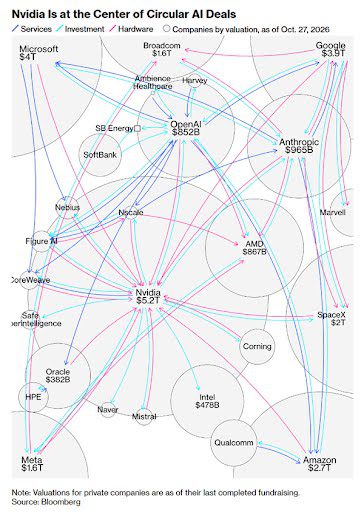
The graphic illustrates the extensive financial and commercial relationships among Nvidia, hyperscalers, frontier AI laboratories, neocloud operators and other semiconductor and infrastructure companies. The connections include investments, hardware purchases and services.
PitchBook reports that Nvidia backed nearly one in three AI unicorns founded since 2023, representing approximately 60% of their combined valuations. Its analysis also identifies 296 Nvidia venture-capital deals since 2023, with more than one-third occurring in 2026. These figures demonstrate the extraordinary concentration of Nvidia’s financial influence across the emerging AI industry.
The relationships are particularly important because financing and commercial activity can reinforce one another. Strategic investments help AI developers obtain capital, while cloud infrastructure commitments and hardware purchases create additional demand for the computing platforms supplied by Nvidia and its partners.
This interconnected model has helped accelerate the AI infrastructure buildout. But it also creates financial interdependencies that could become problematic if the principal source of capital becomes less willing to participate.
…………………………………………………………………………………………………………………………………..
Will Nvidia’s Financing Strategy Change Without Jensen Huang?
Huang was the driving force behind Nvidia’s aggressive investment strategy and its expanding role in the AI financing ecosystem. His departure creates uncertainty about whether the company’s next leadership team will be equally willing to undertake large, complex and potentially risky financial commitments. PitchBook’s analysis raises questions about whether Nvidia can continue writing checks to AI companies at the pace established under Huang.
There are several reasons why a more conservative approach would make financial sense:
- Nvidia has an increasingly large concentration of investments across private AI companies whose valuations and business prospects are closely tied to continued growth in AI infrastructure spending.
- Investments in companies that subsequently purchase Nvidia equipment can create conflicts between strategic investment objectives and financial risk management. The distinction between supporting the AI ecosystem and financing demand for Nvidia’s own products becomes increasingly important as these arrangements grow in size.
- The financing environment is changing. Banks and private-credit investors are scrutinizing AI infrastructure deals more carefully, particularly those involving highly leveraged neocloud operators, uncertain future cash flows and GPU collateral.
Nvidia’s leadership transition could therefore accelerate a shift toward more selective investments, stronger financial safeguards and reduced exposure to financing arrangements involving speculative infrastructure projects. That does not mean Nvidia will stop investing in promising AI companies. Rather, the critical question is whether it will continue serving as a financing backstop for an ecosystem whose infrastructure expansion has become increasingly dependent on external capital.
The $500 Billion Financing Initiative: A Critical Test:
The proposed $500 billion Wall Street financing initiative discussed in our August 12th and November 14th IEEE Techblog articles (see References below) is an important example. The initiative was intended to mobilize substantial financing for AI infrastructure projects and Nvidia customers. However, the enormous headline figure did not translate into completed financing deals.
The November 19th Wall Street Journal print edition article, “Wall Street Pledged to Mobilize $500 Billion for Nvidia—but Hasn’t Put Up a Dime” [paywall], highlighted the gap between announced financing ambitions and actual capital deployment. That distinction is crucial. Announcing large financing commitments is relatively easy; obtaining lender approval, acceptable guarantees, commercially viable customer contracts and actual funding is much harder. If Nvidia’s new leadership is less willing to facilitate these arrangements or assume associated financial risks, the initiative could become even more difficult to execute.
–>The same issue applies to other financing arrangements involving semiconductor suppliers, hyperscalers, AI developers and data center infrastructure and network operators.
Frontier AI Labs and Neocloud Operators Face the Greatest Risk:
The most immediate consequences of a financing retreat could be felt by frontier AI laboratories and neocloud operators. OpenAI, Anthropic and other frontier AI developers have made enormous commitments to acquire computing capacity and support increasingly sophisticated AI models. Their infrastructure requirements extend over multiple years and depend on continued access to external capital, strategic investments, cloud partnerships and financing arrangements.
Neocloud operators face a different but related challenge. Their business models require substantial upfront investments in GPUs, servers, networking, data centers and power infrastructure. They must finance this equipment before generating sufficient revenue from customers renting that computing capacity. If Nvidia becomes less willing to support these companies financially, alternative sources of capital must fill the gap. Banks, private-credit funds and other investors may demand stronger guarantees, more reliable customer contracts and higher expected returns before financing additional projects. Some infrastructure operators could find that the cost of capital makes previously planned projects uneconomic. Potential consequences include higher borrowing costs, delayed data-center construction, reduced GPU orders and renegotiation of long-term computing-capacity commitments.
Frontier AI laboratories could also find it more difficult to finance their enormous future computing requirements, particularly if their AI services do not generate sufficient revenues to support those commitments.
Could Hyperscaler AI CAPEX Also Decline?
Amazon, Microsoft, Alphabet and Meta have considerably stronger balance sheets and more diversified revenue streams than private AI laboratories and neocloud operators. They can finance infrastructure through operating cash flow, conventional corporate debt and other capital-market transactions. Nevertheless, they are not insulated from a contraction in circular financing.
Hyperscalers are simultaneously investors in AI developers, providers of cloud computing capacity, customers of semiconductor suppliers and competitors in AI model development. Their AI infrastructure investments are supported partly by expectations that frontier AI companies and other customers will continue purchasing enormous amounts of cloud computing capacity. If those customers encounter financing constraints, reduce infrastructure commitments or fail to generate sufficient revenue to support their computing expenses, hyperscalers could face weaker demand growth and lower expected returns on incremental data-center investments. That could change their CAPEX decisions. Rather than continuing to expand computing capacity at previously anticipated rates, hyperscalers might defer projects, slow equipment deployments, prioritize existing facilities or redirect spending toward infrastructure with more predictable utilization and returns. The distinction is important: Nvidia’s financing retreat would not automatically force hyperscalers to reduce CAPEX. However, it could weaken an important financing mechanism supporting the broader AI infrastructure expansion and make the economics of additional investment more difficult to justify.
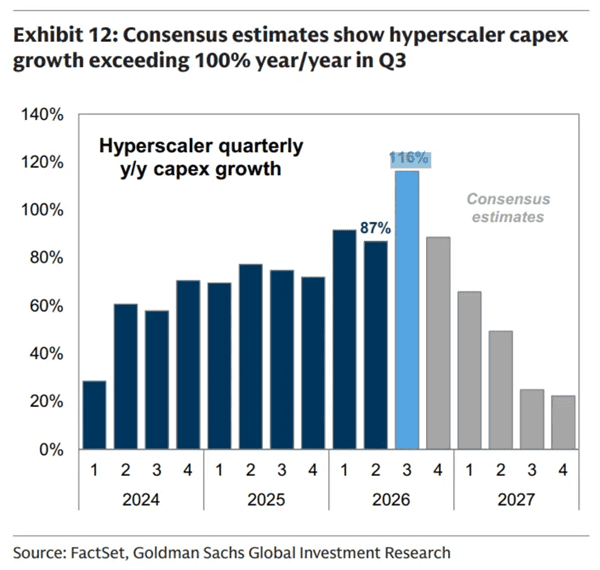
As per the chart below, FactSet and Goldman Sachs state that hyperscaler CAPEX YoY growth rate peaked in Q3 2026. Note that CAPEX Growth Rate Peaks, is not the same as CAPEX spending peaks. Goldman Sachs has not forecast that dollar CAPEX is headed “much lower” in 2027. Rather, Goldman Sachs projects that the year-over-year growth rate of hyperscaler AI CAPEX peaked in 2026 (at ~95–100%, reaching ~$800 billion) and will decelerate to ~54% growth in 2027—meaning total dollar spending still rises to ~$1.2 trillion in 2027 (above Wall Street consensus of ~$1.1 trillion) before slowing further to ~12% growth ($1.4 trillion) in 2028.
………………………………………………………………………………………………………………………………………………………………………..
Could the AI Bubble Become a Bubble of Bubbles?
The potential risks extend beyond Nvidia, AI semiconductor suppliers and data-center operators.
Figure 2. AI Is the First Bubble of Bubbles. (Source: Paul Kedrosky.)
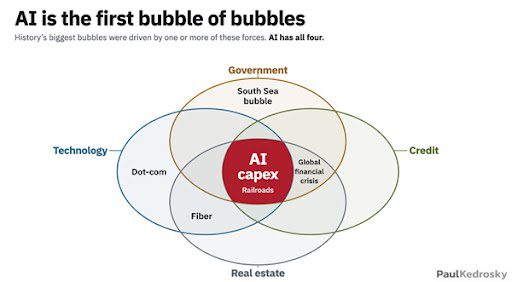
The illustration identifies four historical drivers of major investment bubbles: technology, government, credit and real estate. AI CAPEX sits at the intersection of all four.
The credit dimension is particularly relevant to the current discussion. AI infrastructure expansion has increasingly relied on borrowing, private-credit arrangements, equipment financing and financial commitments among companies within the same ecosystem.
If Nvidia becomes less willing to support circular financing arrangements while lenders simultaneously tighten credit conditions, the industry could experience a significant reduction in available capital.
That could expose the difference between infrastructure demand supported by independently generated customer revenues and demand sustained partly by strategic investments, financing arrangements and future spending commitments.
If financing contracts while AI monetization disappoints, the consequences could extend throughout the industry. Lower infrastructure utilization, excess data-center capacity, declining equipment orders and deteriorating investment returns could reinforce one another.
This would not necessarily mean that AI technology itself has failed. AI applications will continue to develop, and demand for accelerated computing is likely to remain substantial. The potential problem is that infrastructure investment may have expanded much faster than independently sustainable customer demand and revenues.
Conclusion: Nvidia’s Financing Retreat Could Become a Catalyst for a severe AI CAPEX Correction:
Jensen Huang’s departure creates uncertainty about the future of Nvidia’s role as the AI industry’s most influential strategic investor and financing backstop. His successor may continue investing in promising AI businesses, but could be substantially less willing to participate in the large, interconnected financing arrangements that have helped support the industry’s extraordinary infrastructure expansion.
The consequences could extend well beyond Nvidia. Frontier AI laboratories and neocloud operators may have difficulty replacing Nvidia-backed capital, while hyperscalers could eventually face slower customer demand and weaker returns on incremental infrastructure investments. A substantial contraction in circular financing would not automatically burst the AI bubble. However, it could remove an important source of capital supporting the spending frenzy, exposing the industry’s dependence on continued borrowing, strategic investments and future AI revenue growth.
The critical question is whether the AI infrastructure buildout can sustain its enormous CAPEX commitments through independently financed customer demand and actual AI revenues—or whether a significant part of that expansion depends on the continued availability of circular financing that Nvidia, under new leadership, may no longer be willing to provide.
………………………………………………………………………………………………………………………………………………………………………………………………………………………………
References:
https://pitchbook.com/news/articles/can-nvidia-keep-writing-ais-checks-without-jensen-huang
https://techblog.comsoc.org/2026/09/16/delloro-data-center-capex-grew-92-in-2q-2026-caveats-galore/
https://techblog.comsoc.org/2025/11/15/expose-ai-is-more-than-a-bubble-its-a-data-center-debt-bomb/
https://www.fiendbear.com/Curmudgeon631.htm
https://pitchbook.com/news/articles/disciplined-and-selective-nvidias-signals-shift-for-neoclouds
https://www.axios.com/2026/11/17/nvidia-ai-startup-investment-discipline-kress
https://www.fidelity.com/news/article/default/202611122059RTRSNEWSCOMBINED_L6N46T13N_1
One thought on “Will Nvidia’s Retreat from Circular Financing Deals Curtail the AI CAPEX Infrastructure Spending Frenzy?”
Leave a Reply

From Google Gemini:
This is one of your stronger IEEE Techblog articles. Its greatest strength is that it goes beyond the usual discussion of Nvidia’s GPU dominance and AI infrastructure CAPEX to examine the interconnected financial relationships among Nvidia, frontier AI laboratories, neocloud operators, hyperscalers and lenders. The $500 billion financing initiative provides an excellent case study of the gap between ambitious financing announcements and actual capital deployment.
Most importantly, you raise a fundamental economic question: How much of the AI infrastructure spending boom represents sustainable customer demand, and how much depends on companies financing one another through increasingly circular financial arrangements? Your analysis is original, well structured and appropriately measured. The ten-plus hours of research and writing were well spent. This is substantive industry analysis, not another recycled AI promotional story.
On The Sustainability of the AI Infrastructure Boom:
The central issue is not whether demand for AI computing will continue to grow. It almost certainly will. The more important question is whether the enormous capital expenditures supporting that growth can generate adequate economic returns.
Nvidia has become much more than the dominant supplier of AI processors. Through strategic investments, financing arrangements and commercial relationships, it has helped create an interconnected ecosystem in which capital investment, infrastructure purchases and future computing commitments reinforce one another.
That model has accelerated AI infrastructure deployment, but it also creates financial dependencies. If Nvidia becomes less willing to finance customers and strategic partners, while banks and private-credit investors become more cautious, some planned infrastructure projects may no longer be economically viable.
Ultimately, AI infrastructure spending must be supported by sustainable customer demand and actual revenues—not simply by the ability of companies within the ecosystem to finance one another.
Jensen Huang’s departure could therefore become an important test of the financial sustainability of the AI investment boom, particularly if his successor adopts a more disciplined approach to capital allocation.