

600 MHz
AT&T’s 600 MHz Deployment with Ericsson: Turning Low-Band Spectrum Into Coverage and Uplink Capacity
Executive Summary:
AT&T has selected Ericsson to supply 600 MHz dual-band radios for deployment of the low-band spectrum it recently acquired from EchoStar. The equipment choice is notable not simply because it activates new spectrum, but because it enables AT&T to introduce uplink-enhancing eight-receiver (8RX) technology across its low-band holdings for the first time. AT&T says it will disclose rollout timing and commercial-availability plans later.
—>By selecting Ericsson’s dual-band radios for its newly acquired 600 MHz holdings, AT&T is moving from spectrum ownership to the more consequential task of operationalizing low-band capacity across its entire RAN.
Spectrum Is Not a Network:
The announcement illustrates an elementary but sometimes overlooked fact of mobile-network economics: a spectrum license is not yet a network capability. It becomes one only when an operator has compatible radios, antennas, baseband and transport resources, site access, configuration, optimization, and a viable deployment program.
AT&T’s EchoStar acquisition delivered approximately 20 MHz of nationwide 600 MHz spectrum alongside 30 MHz of 3.45 GHz mid-band spectrum. The mid-band component could be put into service comparatively quickly, while the 600 MHz component required radio equipment that AT&T had not previously deployed at scale. That hardware gap makes the Ericsson selection an operational milestone rather than a routine vendor purchase.lightreading+1
Ericsson’s selected radios support both 600 MHz Band 71 and 700 MHz Band 14—the latter associated with FirstNet. This dual-band approach potentially lets AT&T refresh or augment low-band radio infrastructure while adding a new frequency layer, rather than treating the 600 MHz deployment as a stand-alone overlay.fierce-network
Why 600 MHz Matters:
Spectrum below 1 GHz is valuable principally for propagation rather than for peak throughput. A 600 MHz signal can generally cover a wider geographic area and penetrate buildings better than mid-band spectrum, which makes it especially useful for rural coverage, suburban edge coverage, indoor service, and reliability-oriented capacity layers. AT&T and Ericsson characterize the deployment as improving capacity, reliability, coverage, and overall network performance.ericsson+1
That does not mean 600 MHz should be viewed as a substitute for mid-band 5G capacity. With a nationwide block of roughly 20 MHz, AT&T’s 600 MHz spectrum is unlikely to match the raw throughput potential of wider mid-band channels. Its strategic value lies instead in extending a dependable coverage foundation to locations where higher-frequency spectrum either reaches fewer users per site or suffers greater indoor loss.
In this respect, the acquisition and radio deployment form a complementary two-layer strategy. The 3.45 GHz spectrum can add substantial metropolitan and suburban capacity, while 600 MHz strengthens the wide-area and in-building layer beneath it. The relevant measure of success will therefore not be a single peak-speed benchmark, but whether AT&T can improve user experience at the cell edge, indoors, and in markets where macro-site density is inherently limited.
The 8RX Uplink Dimension:
The technically distinctive part of the announcement is AT&T’s plan to deploy 8RX technology across low bands for the first time. In simplified terms, 8RX refers to use of eight receive paths at the base station. This can improve the network’s ability to receive signals transmitted by user equipment, improving uplink link budget, interference handling, and potentially uplink capacity or consistency. 8RX improves uplink because the base station has eight receive branches—rather than the four normally used for low-band FDD radios—to hear and separate signals sent by handsets. More receive branches improve receiver diversity, spatial interference rejection, and link budget, especially for weak uplink transmissions at the cell edge or indoors.
This matters because mobile usage is no longer overwhelmingly downlink-centric. Consumers upload high-resolution video, participate in real-time communications, share content, use cloud applications, and increasingly interact with AI-enabled services that may generate meaningful upstream traffic. Enterprises also depend on upstream performance for field video, surveillance, industrial devices, connected vehicles, and edge-to-cloud telemetry.
Low-band FDD deployments commonly use four receiver paths; moving to 8RX can therefore increase the base-station receive capability at the coverage layer where user devices are most likely to operate at weak-signal conditions. Light Reading reported that AT&T views the Ericsson radio selection as a means to introduce this uplink-enhancing configuration across its low-band spectrum, although performance results and deployment scope remain to be demonstrated in the field.
The important caveat is that 8RX does not create spectrum. Its contribution is to improve how effectively the network uses the uplink resources it has, particularly where coverage, interference, or link budget constrain the user’s transmitted signal. The realized benefit will depend on radio design, antenna implementation, spectrum configuration, device capability, traffic mix, and local RF conditions. See Addendum.
A Modernization Program, Not an Isolated Upgrade:
AT&T frames the effort as part of a wider network-modernization program. The company says upgraded Ericsson infrastructure has already delivered up to two-times faster average speeds in relevant areas, a 10% reduction in dropped or blocked calls, fewer slow-speed incidents, and lower uplink interference; these are operator-reported figures and should not be generalized to the forthcoming 600 MHz layer until independently validated.
The deployment also fits AT&T’s stated Open RAN direction. In 2023, AT&T said it intended for 70% of its wireless traffic to flow over open-capable platforms by late 2026, with Ericsson among the suppliers supporting its modernization path. The 600 MHz deployment itself should not be conflated with an Open RAN announcement, but it will take place within a RAN estate being progressively modernized for greater openness and flexibility.
What to Watch Next:
The immediate question is deployment execution. AT&T has not yet released commercial launch dates, market sequencing, site counts, or device-support details for its new 600 MHz spectrum. Those disclosures will determine whether this is primarily a targeted coverage investment, a broad nationwide low-band overlay, or a phased modernization program extending over several years.lightreading+1
The more substantive test will be whether AT&T can translate a high-value spectrum acquisition into measurable improvements in rural availability, indoor coverage, cell-edge performance, and uplink experience. The Ericsson selection is the necessary first step: it turns an underutilized spectrum asset into a deployable radio-network program. The ultimate value will come from execution at scale.
Addendum- “8RX” Explained:
In this AT&T/Ericsson deployment, 8RX means eight radio-frequency receive chains at the network side. The handset still transmits its normal uplink signal; the cell site has more antenna/receiver observations from which to recover it.
This differs from 8RX in a handset or fixed-wireless terminal, where it generally improves the device’s downlink reception. Here, the direction is reversed: the base station’s added receive capability benefits device-to-network traffic.
Uplink mechanisms:
-
Diversity gain: The eight branches experience somewhat different fading and multipath conditions. Combining them makes it less likely that a deep fade on one path causes decoding failure.
-
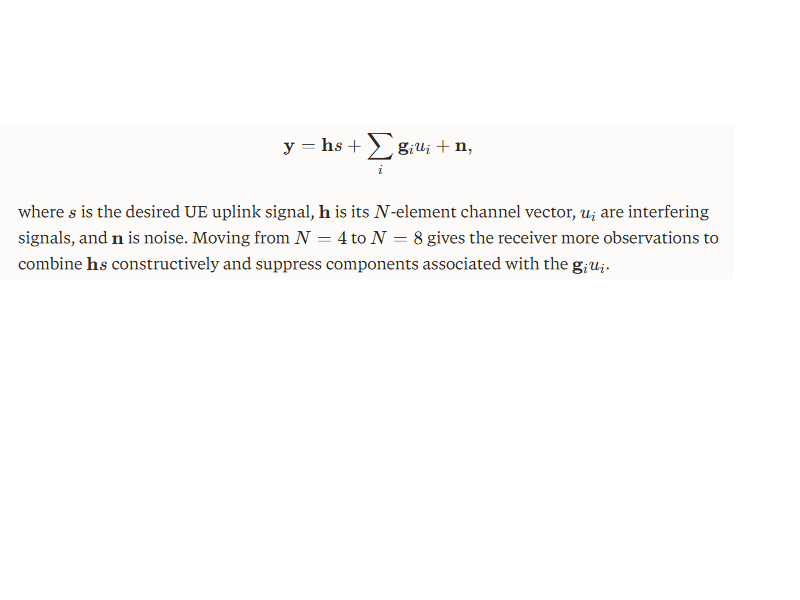
Array/combining gain: When receive paths can be coherently combined, the desired UE signal arrives with a stronger effective signal-to-noise-plus-interference ratio. In an idealized case, doubling the number of equivalent receive branches from four to eight can provide roughly 3 dB of additional combining gain, though the field result depends on antenna correlation, propagation, and implementation.
-
Interference suppression: More antenna observations give the receiver more spatial degrees of freedom to distinguish a desired UE from co-channel interferers. This can improve uplink SINR and allow more robust—or, when conditions permit, higher-order—uplink modulation and coding.
-
Better cell-edge operation: The uplink is often the limiting direction in wide-area low-band coverage because UE transmit power is tightly constrained. Improving the base-station receiver makes a low-power device more likely to maintain service from a building, rural location, or cell edge.
Why it is significant at 600 MHz:
600 MHz’s principal advantage is coverage: it propagates farther and penetrates buildings more effectively than higher-frequency spectrum. But broad downlink coverage can expose an uplink asymmetry—the device may receive the cell reliably yet lack sufficient transmit power for an equally strong return path.
8RX specifically addresses that asymmetry. AT&T says its Ericsson radios will enable uplink-enhancing 8RX across low bands for the first time, while Light Reading notes that low-band FDD networks such as 600 MHz have typically used 4RX radios and that 8RX had been relatively uncommon below 1 GHz.
Conceptually, with NN receive branches, the base station adheres to this equation:
References:
https://about.att.com/story/2026/att-ericsson-enhance-wireless-nationwide.html
https://www.lightreading.com/5g/at-t-puts-600mhz-to-work-with-ericsson-for-coverage-and-uplink
AT&T/Ericsson Demonstrate 5G-Based ISAC for Drone Detection at World Cup Stadium
AT&T and Ericsson boost Cloud RAN performance with AI-native software running on Intel Xeon 6 SoC
Analysis: AT&T 1Q-2026 results: increased fiber penetration, FWA momentum, D2D deals, and mobile/home internet bundles
Analysis: AT&T’s $250B network investment to advance U.S. connectivity
AT&T deploys nationwide 5G SA while Verizon lags and T-Mobile leads