

PsiQuantum Targets AI Data Center Networks with Silicon-Photonic Optical Switching
Disclaimer: ChatGPT was used extensively for research contained in this article.
……………………………………………………………………………………………………………………………………..
Introduction:
As AI workloads expand and AI clusters grow, the networks connecting GPUs and other accelerators are becoming an increasingly important constraint on performance, power consumption and cost. Optical circuit switching (OCS) offers one way to improve connectivity by establishing direct optical paths between network ports without converting optical signals into electrical signals for packet-by-packet switching.
On October 28th, PsiQuantum [1.] unveiled an 8×8 optical circuit-switching demonstration built on its low-loss silicon-photonics platform, originally developed for quantum computing. The company reports promising laboratory results and is sharing demonstration samples with selected prospective customers. The key question is whether this technology can scale into a commercially competitive product for AI data centers.
Note 1. PsiQuantum was founded on the premise that photonic qubits, together with leverage of mature semiconductor manufacturing processes, would provide the fastest path to commercially useful, fault-tolerant quantum computers. Today, PsiQuantum builds tens of thousands of wafers of quantum chips in a tier-1 foundry, operates cryogenic cabinets supporting hundreds of chips, advances fault-tolerant algorithm development to solve critical problems across industries, and is developing a modular quantum computing platform designed to increase capability and scale. Each milestone brings us closer to delivering commercially useful quantum computing. The company’s headquarters is in Palo Alto, CA. Source: PsiQuantum
Optical Circuit Switching (OCS) for AI Data Centers:
Large AI clusters rely on high-speed interconnects to move model parameters, gradients, activations and other data among processors. Network congestion, communication overhead and power consumption can limit how effectively expensive accelerators are utilized. Ethernet and InfiniBand networks rely primarily on packet switches to route traffic dynamically.
OCS takes a different approach: it establishes direct optical connections between selected ports, allowing light to pass through the switching fabric without optical-electrical-optical conversion at the switch. This approach can complement conventional packet switching in AI clusters, particularly when communication patterns are predictable or recurring. A network controller can establish optical paths between selected racks or groups of accelerators, while packet switches handle traffic requiring flexible, fine-grained routing.
OCS is therefore a potential complement to conventional switching fabrics, not a wholesale replacement for Ethernet or InfiniBand. Its benefits depend on network architecture, traffic patterns, connection utilization and the overhead of reconfiguring optical paths.
Here’s an illustration of optical circuit switching in an AI data-center network. Optical circuit switches establish direct optical paths between selected network ports, complementing conventional packet switching. Conceptual illustration—not a depiction of PsiQuantum’s specific product or a verified implementation.
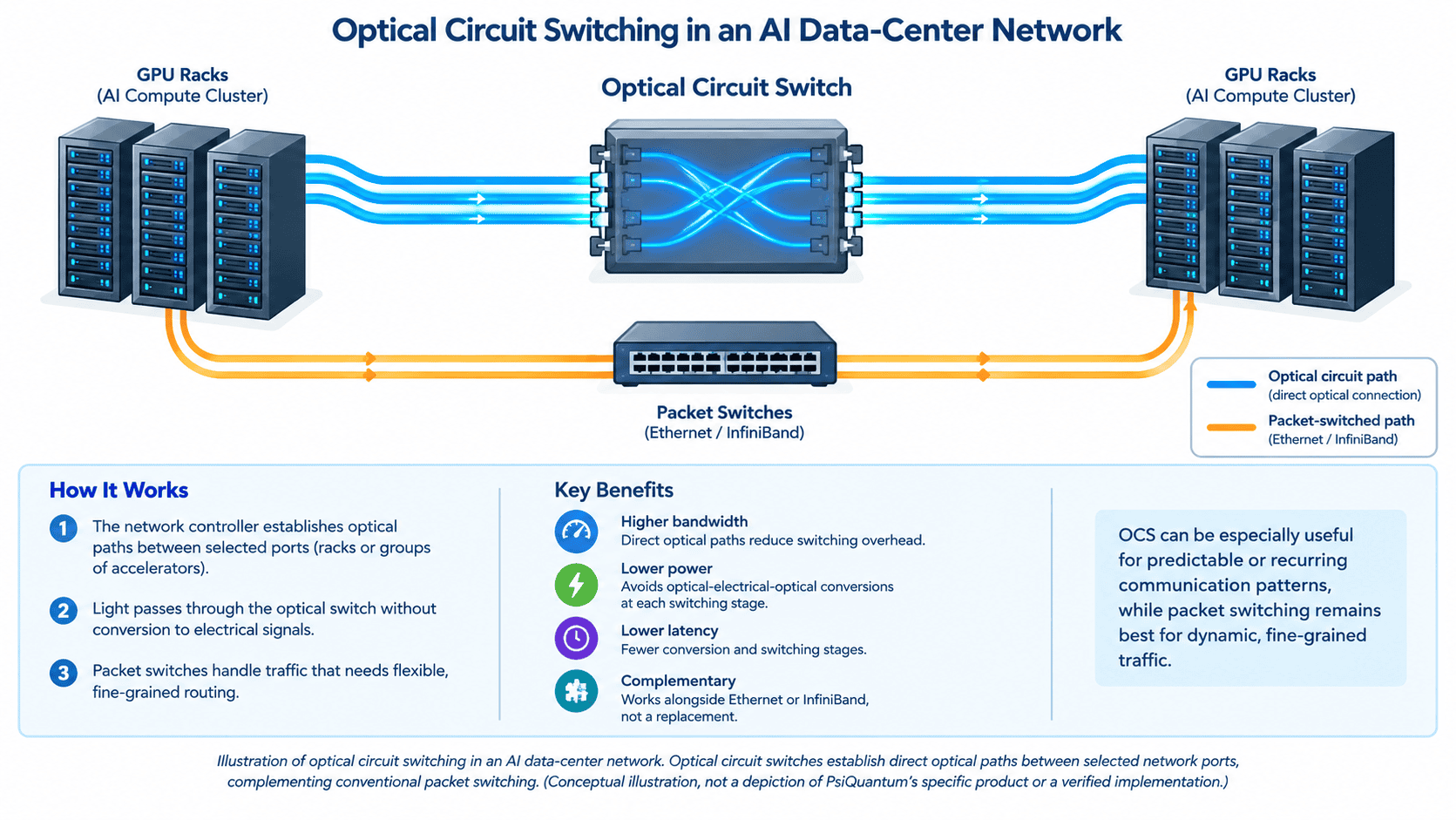
Image Credit: ChatGPT
………………………………………………………………………………………………………………………………………………………………………………………………………….
PsiQuantum’s 8×8 Demonstration:
PsiQuantum describes its first publicly disclosed device as a strictly non-blocking 8×8 switch, meaning any input can connect to any output. The silicon-photonic device operates without moving parts.
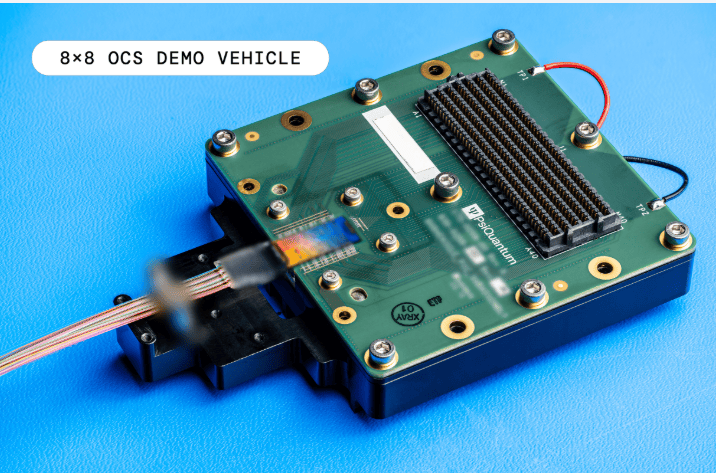
The company reports the following laboratory results:
| Parameter | Company-reported result |
|---|---|
| Switch configuration | 8×8 |
| Typical insertion loss | 1.2 dB |
| Crosstalk | 40 dB |
| Reconfiguration time | Less than 3 ms |
| Optical amplification | Not required |
Source: PsiQuantum, October 28, 2026. These are company-reported laboratory results, not independently verified benchmarks.
“This opportunity exists because we chose to solve the hardest scaling problems at the beginning of our roadmap to utility-scale quantum computing,” said Victor Peng, Chief Executive Officer of PsiQuantum. “As AI computing pushes infrastructure to its limits, we now have an opportunity to put our state-of-the-art technology to work today while continuing toward our ultimate goal: building and deploying the world’s first useful, fault-tolerant quantum computers.”
“AI is driving extraordinary growth in the scale and complexity of computing infrastructure, and optics will play an increasingly important role in enabling that growth,” said Rob Soderbery, Executive Vice President at PsiQuantum. “PsiQuantum has spent nearly a decade developing silicon photonics against some of the most demanding requirements imaginable. What we are demonstrating today is that this platform can deliver exceptional performance for optical circuit switching for AI computing.”
PsiQuantum has also developed barium titanate (BTO) integration at the 300mm wafer scale and uses a 64×64 BTO switch in its quantum systems. BTO is not required for the demonstration vehicle or initial products announced today, highlighting the performance of the underlying silicon photonics platform while preserving an additional path to faster, more advanced future products.
…………………………………………………………………………………………………………………………………………………………………………………………………………………………………………………………….
EE Analysis:
Insertion loss measures the optical power lost as a signal passes through the switch. The reported 1.2 dB figure suggests that relatively little power is lost in the device itself. Crosstalk measures unwanted signal leakage between channels, while reconfiguration time indicates how quickly the switch can establish a new connection arrangement.
A switching time below 3 milliseconds could support some scheduled or recurring AI communication patterns. However, suitability depends on workload characteristics, connection-management overhead and how effectively established paths are utilized.
PsiQuantum says its silicon-photonics platform leverages semiconductor manufacturing at GlobalFoundries. It has also developed barium titanate integration at 300-mm wafer scale, but the company says this technology is not required for the demonstrated switch or its initial products. Its 8×8 device should therefore be judged on its own reported performance, rather than the potential capabilities of future products.
……………………………………………………………………………………………………………………………………………………………………………………………………………………………………………………………………..
Google Provides a Production-Scale Benchmark:
Optical circuit switching is already deployed in hyperscale data-center networks. Google’s Jupiter architecture provides an important real-world comparison.
In a 2022 ACM SIGCOMM paper, Google engineers described how Jupiter evolved from a conventional Clos network toward a direct-connect topology between aggregation blocks. Its Apollo optical circuit switches use micro-electromechanical systems (MEMS) mirrors to steer light between fiber ports. A software-defined networking (SDN) control plane dynamically adjusts the network’s logical topology and traffic paths, while packet switches continue to handle traffic routing.
Google’s paper reported that the broader evolution of Jupiter delivered a fivefold increase in network speed and capacity, a 30% reduction in capital expenditure and a 41% reduction in power consumption while serving live production traffic. These improvements resulted from the overall architecture—including optical switching, traffic engineering and network-management changes—not from the optical switches alone.
The distinction is important. Google has demonstrated production-scale OCS integrated with network control and traffic engineering. PsiQuantum has reported promising component-level results from an 8×8 silicon-photonic laboratory demonstration. The two systems also use different switching technologies.
Google’s experience nevertheless demonstrates that OCS can deliver substantial benefits when integrated into a carefully engineered network. PsiQuantum’s challenge is to show that its silicon-photonics approach can provide comparable practical value at scale.
The Commercial Test:
PsiQuantum must now demonstrate that its reported performance can be maintained in larger configurations and integrated into real AI data-center networks. The main questions are:
- Scalability: Can port counts increase without unacceptable optical losses, crosstalk, complexity or cost?
- Network integration: Can the switches work effectively alongside existing Ethernet and InfiniBand fabrics, with appropriate traffic scheduling and network management?
- Power and economics: Will the complete implementation reduce system-level power consumption or operating costs enough to justify adoption?
- Manufacturing and reliability: Can PsiQuantum deliver consistent production quality, operational reliability and competitive costs at the volumes data-center customers require?
The company says it plans to announce commercial products in the coming months. Larger configurations, independent performance measurements, customer trials and system-level demonstrations will be important milestones.
Lessons from the All-Optical Networking Hype Dictate Caution:
During the 1998–2001 telecom boom, all-optical networking was heavily promoted as the future of telecommunications, promising to eliminate electronic switching bottlenecks by keeping traffic optical throughout the network. Despite substantial investment and years of development, that broad vision never became the dominant commercial network architecture. NTT’s current IOWN and All-Photonics Network initiatives reflect renewed ambitions for end-to-end optical connectivity, but they do not erase the industry’s long history of overpromising.
This history warrants caution in evaluating PsiQuantum’s 8×8 demonstration. Optical circuit switching has proven useful in specific architectures, including Google’s production data-center network, but that does not establish a broad emerging market for every new OCS technology. PsiQuantum must demonstrate that its silicon-photonic approach can scale economically and deliver measurable system-level benefits in real AI data centers—not simply promising laboratory specifications.
Conclusions:
PsiQuantum’s 8×8 demonstration extends its silicon-photonics technology beyond quantum computing into a potentially valuable AI infrastructure market. Its reported insertion loss, crosstalk and sub-3-millisecond reconfiguration time warrant attention, but do not yet establish commercial scalability or an economic advantage over existing technologies.
Google’s Jupiter network shows that optical circuit switching can deliver benefits at hyperscale when combined with software-defined networking and traffic engineering. PsiQuantum must demonstrate that its distinct silicon-photonic approach can deliver similar practical value through larger switches, reliable integration and measurable system-level savings.
For AI data-center operators, the ultimate test is whether optical switching can deliver reliable, scalable and economically attractive connectivity that keeps expensive AI accelerators productively utilized.
……………………………………………………………………………………………………………………………………………………………………………………………………..
References:
PsiQuantum, “Optical Circuit Switch.” https://www.psiquantum.com/optical-circuit-switch
PsiQuantum, “PsiQuantum Unveils Optical Circuit Switch Technology Built on Advanced, Low-Loss Silicon Photonics Platform,” October 28, 2026. https://www.businesswire.com/news/home/20261028890054/en/
Leon Poutievski et al., “Jupiter Evolving: Transforming Google’s Datacenter Network via Optical Circuit Switches and Software-Defined Networking,” ACM SIGCOMM 2022. https://doi.org/10.1145/3544216.3544265
Google Cloud, “The Evolution of Google’s Jupiter Data Center Network,” August 23, 2022. https://cloud.google.com/blog/topics/systems/the-evolution-of-googles-jupiter-data-center-network/
NTT’s IOWN is (finally) evolving to an All Photonics Network (APN); Physics based AI for enterprise OT
NTT’s IOWN provides ultra low latency and energy efficiency in Japan and Hong Kong
Oriole Networks photonic networking platform to be integrated with AMD GPUs/CPUs for next-gen AI data center fabrics
Technavio: Silicon Photonics market estimated to grow at ~25% CAGR from 2024-2028
LightCounting: Silicon Photonics chip market to hit $3 billion in 2029
Light Counting on Silicon Photonics and Optical Switching at SC22
Synopsys and Juniper Networks form new company to pursue “open” silicon photonics platform