

AI Bubble
IBM and Groq Partner to Accelerate Enterprise AI Inference Capabilities
IBM and Groq [1.] today announced a strategic market and technology partnership designed to give clients immediate access to Groq’s inference technology — GroqCloud, on watsonx Orchestrate – providing clients high-speed AI inference capabilities at a cost that helps accelerate agentic AI deployment. As part of the partnership, Groq and IBM plan to integrate and enhance RedHat open source vLLM technology with Groq’s LPU architecture. IBM Granite models are also planned to be supported on GroqCloud for IBM clients.
………………………………………………………………………………………………………………………………………………….
Note 1. Groq is a privately held company founded by Jonathan Ross in 2016. As a startup, its ownership is distributed among its founders, employees, and a variety of venture capital and institutional investors including BlackRock Private Equity Partners. Groq developed the LPU and GroqCloud to make compute faster and more affordable. The company says it is trusted by over two million developers and teams worldwide and is a core part of the American AI Stack.
NOTE that Grok, a conversational AI assistant developed by Elon Musk’s xAI is a completely different entity.
………………………………………………………………………………………………………………………………………………….
Enterprises moving AI agents from pilot to production still face challenges with speed, cost, and reliability, especially in mission-critical sectors like healthcare, finance, government, retail, and manufacturing. This partnership combines Groq’s inference speed, cost efficiency, and access to the latest open-source models with IBM’s agentic AI orchestration to deliver the infrastructure needed to help enterprises scale.
Powered by its custom LPU, GroqCloud delivers over 5X faster and more cost-efficient inference than traditional GPU systems. The result is consistently low latency and dependable performance, even as workloads scale globally. This is especially powerful for agentic AI in regulated industries.
For example, IBM’s healthcare clients receive thousands of complex patient questions simultaneously. With Groq, IBM’s AI agents can analyze information in real-time and deliver accurate answers immediately to enhance customer experiences and allow organizations to make faster, smarter decisions.
This technology is also being applied in non-regulated industries. IBM clients across retail and consumer packaged goods are using Groq for HR agents to help enhance automation of HR processes and increase employee productivity.
“Many large enterprise organizations have a range of options with AI inferencing when they’re experimenting, but when they want to go into production, they must ensure complex workflows can be deployed successfully to ensure high-quality experiences,” said Rob Thomas, SVP, Software and Chief Commercial Officer at IBM. “Our partnership with Groq underscores IBM’s commitment to providing clients with the most advanced technologies to achieve AI deployment and drive business value.”
“With Groq’s speed and IBM’s enterprise expertise, we’re making agentic AI real for business. Together, we’re enabling organizations to unlock the full potential of AI-driven responses with the performance needed to scale,” said Jonathan Ross, CEO & Founder at Groq. “Beyond speed and resilience, this partnership is about transforming how enterprises work with AI, moving from experimentation to enterprise-wide adoption with confidence, and opening the door to new patterns where AI can act instantly and learn continuously.”
IBM will offer access to GroqCloud’s capabilities starting immediately and the joint teams will focus on delivering the following capabilities to IBM clients, including:
- High speed and high-performance inference that unlocks the full potential of AI models and agentic AI, powering use cases such as customer care, employee support and productivity enhancement.
- Security and privacy-focused AI deployment designed to support the most stringent regulatory and security requirements, enabling effective execution of complex workflows.
- Seamless integration with IBM’s agentic product, watsonx Orchestrate, providing clients flexibility to adopt purpose-built agentic patterns tailored to diverse use cases.
The partnership also plans to integrate and enhance RedHat open source vLLM technology with Groq’s LPU architecture to offer different approaches to common AI challenges developers face during inference. The solution is expected to enable watsonx to leverage capabilities in a familiar way and let customers stay in their preferred tools while accelerating inference with GroqCloud. This integration will address key AI developer needs, including inference orchestration, load balancing, and hardware acceleration, ultimately streamlining the inference process.
Together, IBM and Groq provide enhanced access to the full potential of enterprise AI, one that is fast, intelligent, and built for real-world impact.
References:
FT: Scale of AI private company valuations dwarfs dot-com boom
AI adoption to accelerate growth in the $215 billion Data Center market
Big tech spending on AI data centers and infrastructure vs the fiber optic buildout during the dot-com boom (& bust)
Will billions of dollars big tech is spending on Gen AI data centers produce a decent ROI?
Can the debt fueling the new wave of AI infrastructure buildouts ever be repaid?
FT: Scale of AI private company valuations dwarfs dot-com boom
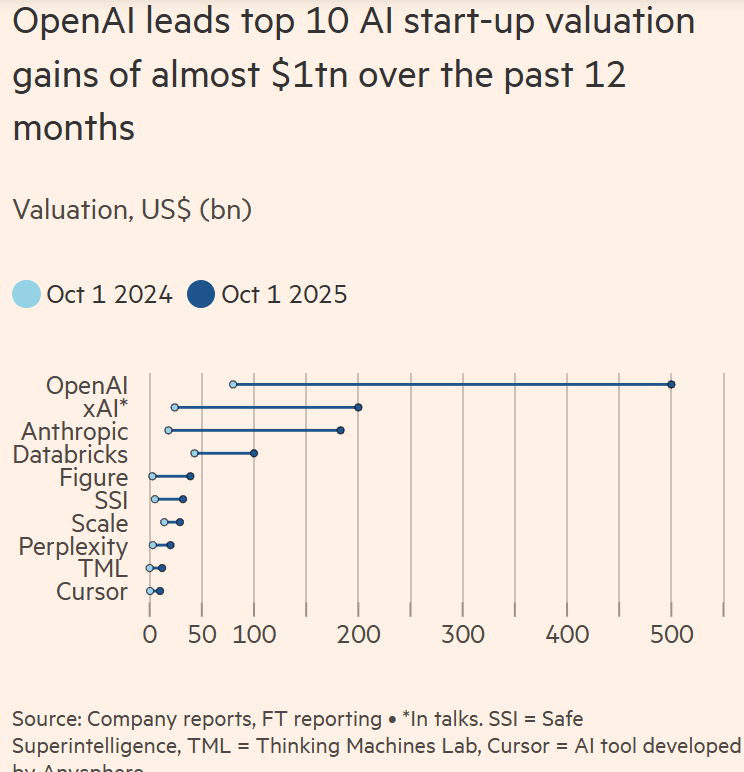
The Financial Times reports that ten loss making artificial intelligence (AI) start-ups have gained close to $1 trillion in private market valuation in the past 12 months, fuelling fears about a bubble in private markets that is much greater than the dot com bubble at the end of the 20th century. OpenAI leads the pack with a $500 billion valuation, but Anthropic and xAI have also seen their values march higher amid a mad scramble to buy into emerging AI companies. Smaller firms building AI applications have also surged, while more established businesses, like Databricks, have soared after embracing the technology.
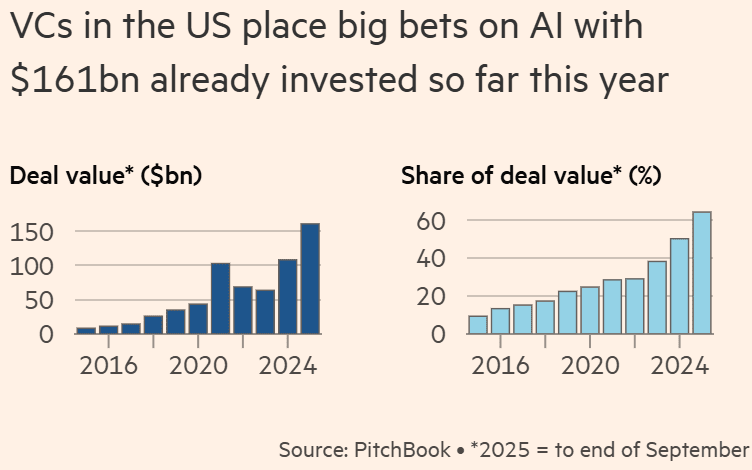
U.S. venture capitalists (VCs) have poured $161 billion into artificial intelligence startups this year — roughly two-thirds of all venture spending, according to PitchBook — even as the technology’s commercial payoff remains elusive. VCs are on track to spend well over $200bn on AI companies this year.
Most of that money has gone to just 10 companies, including OpenAI, Anthropic, Databricks, xAI, Perplexity, Scale AI, and Figure AI, whose combined valuations have swelled by nearly $1 trillion, Financial Times calculations show. Those AI start-ups are all burning cash with no profits forecasted for many years.
Start-ups with about $5mn in annual recurring revenue, a metric used by fast-growing young businesses to provide a snapshot of their earnings, are seeking valuations of more than $500mn, according to a senior Silicon Valley venture capitalist.
Valuing unproven businesses at 100 times their earnings or more dwarfs the excesses of 2021, he added: “Even during peak Zirp [zero-interest rate policies], these would have been $250mn-$300mn valuations.”
“The market is investing as if all these companies are outliers. That’s generally not the way it works out,” he said. VCs typically expect to lose money on most of their bets, but see one or two pay the rest off many times over.
“There will be casualties. Just like there always will be, just like there always is in the tech industry,” said Marc Benioff, co-founder and chief executive of Salesforce, which has invested heavily in AI. He estimates $1tn of investment on AI might be wasted, but that the technology will ultimately yield 10 times that in new value.
“The only way we know how to build great technology is to throw as much against the wall as possible, see what sticks, and then focus on the winners,” he added.
“Of course there’s a bubble,” said Hemant Taneja, chief executive of General Catalyst, which raised an $8 billion fund last year and has backed Anthropic and Mistral. “Bubbles align capital and talent around new trends. There’s always some destruction, but they also produce lasting innovation.”
Venture investors have weathered cycles of boom and bust before — from the dot-com crash in 2000 to the software downturn in 2022 — but the current wave of AI funding is unprecedented. In 2000, VCs invested $10.5 billion in internet startups; in 2021, they deployed $135 billion into software firms. This year, they are on pace to exceed $200 billion in AI. “We’ve gone from the doldrums to full-on FOMO,” said one investment executive.
OpenAI and its start-up peers are competing with Meta, Google, Microsoft, Amazon, IBM, and others in a hugely capital-intensive race to train ever-better models, meaning the path to profitability is also likely to be longer than for previous generations of start-ups.
Backers are betting that AI will open multi-trillion-dollar markets, from automated coding to AI friends or companionship. Yet some valuations are testing credulity. Startups generating about $5 million in annual recurring revenue are seeking valuations above $500 million, a Silicon Valley investor said — 100 times revenue, surpassing even the excesses of 2021. “The market is behaving as if every company will be an outlier,” he said. “That’s rarely how it works.”
The enthusiasm has spilled into public markets. Shares of Nvidia, AMD, Broadcom, and Oracle have collectively gained hundreds of billions in market value from their ties to OpenAI. But those gains could unwind quickly if questions about the startup’s mounting losses and financial sustainability persist.
Sebastian Mallaby, author of The Power Law, summed it up beautifully:
“The logic among investors is simple — if we get AGI (Artificial General Intelligence, which would match or exceed human thinking), it’s all worth it. If we don’t, it isn’t…. “It comes down to these articles of faith about Sam’s (Sam Altman of OpenAI) ability to work it out.”
References:
https://www.ft.com/content/59baba74-c039-4fa7-9d63-b14f8b2bb9e2
Big tech spending on AI data centers and infrastructure vs the fiber optic buildout during the dot-com boom (& bust)
Can the debt fueling the new wave of AI infrastructure buildouts ever be repaid?
Amazon’s Jeff Bezos at Italian Tech Week: “AI is a kind of industrial bubble”
Gartner: AI spending >$2 trillion in 2026 driven by hyperscalers data center investments
AI Data Center Boom Carries Huge Default and Demand Risks
Canalys & Gartner: AI investments drive growth in cloud infrastructure spending