

Starlink
Starlink’s huge ambition and deployment plan may clash with reality
Starlink’s first mission of 2022 launched another 49 satellites into orbit, extending its grand total to nearly 2,000. But since completing its first orbital shell of about 1,600 satellites last May, “Starlink’s launch frequency has slowed dramatically with only four rocket launches over the past seven months, or roughly one every seven weeks,” explained Craig Moffett, principal analyst at MoffettNathanson in a note to clients. Craig wrote:
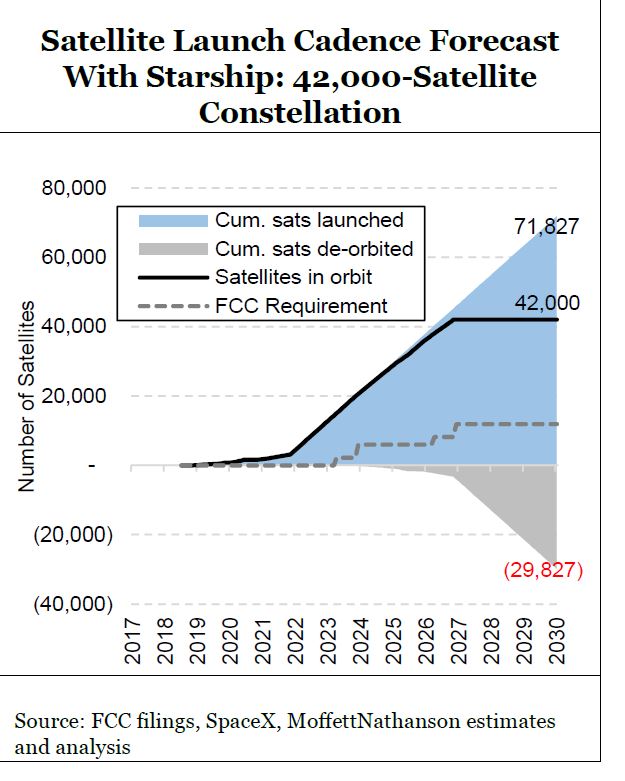
Starlink’s ambition is huge (a constellation of as many as 42,000 satellites). And the implied valuation for the still-private company is huge ($100B+ for all of SpaceX).
This “hugeness” has captured investors’ imaginations and no doubt hugeness itself is very much part of its appeal. But we haven’t yet seen investors come to grips with all of the implications of this bigness. We were struck by Elon Musk’s recent tweet conceding a “genuine risk of bankruptcy” – immediately dismissed by some as hyperbole – and it got us thinking about scale, and risk, in ways we really hadn’t considered before.
Moffett notes that the new Starlink V1.5 satellites are heavier, leading to fewer satellites per launch. “At a payload of 50 satellites per launch for Falcon 9 rockets – down from 60 per launch for V1.0 satellites – SpaceX would need to drastically increase launch frequency to once every seven days for five consecutive years just to launch the satellites required for their planned constellation of ~12,000 by their FCC deadline in 2027.”
In low-Earth orbit, satellites will drift back to Earth and burn up on re-entry. Assuming the satellites have an average lifespan of five years, the number of launches to simply replace expiring satellites will, by year five, be as large as the number of launches required over the next five years to grow the constellation. By the end of 2030, just nine years from now, they would have had to launch nearly 23,000 satellites in support of a 12,000 bird constellation. Assuming a Falcon 9 payload of 50 satellites, that would imply 48 launches each year – roughly one every seven days – just to sustain a constellation of 12,000 satellites even after the constellation is “finished.”
Privately held SpaceX (Starlink’s owner) will also need to strongly increase manufacturing capacity and manage tricky supply chain logistics to meet the needs for Starlink, as well as for SpaceX’s clients.
Based on $30 million per launch, Moffett estimates that it would cost about $15 billion to build a constellation of 30,000 satellites, with satellite replacement (production and launch) alone costing more than $3.6 billion per year. Please see chart below.
Starlink hopes to beef up its capabilities with Starship, a larger launch vehicle that’s had its share of problems, with an orbital test flight that could take place as soon as March. However, Craig suggests that Starship isn’t necessarily the answer to the problem, considering that new V2.0 satellites will be perhaps four times as massive as previous generation Starlink LEO satellites.
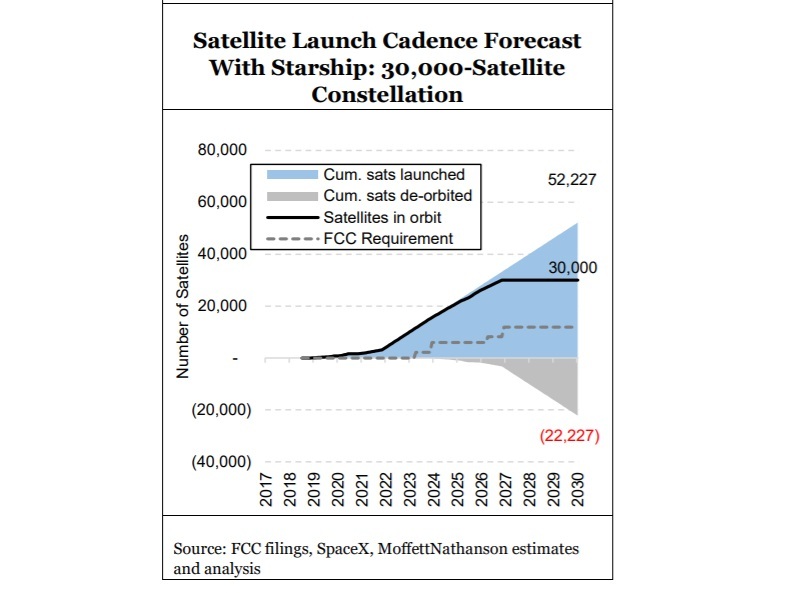
In November 2021, Elon Musk distributed a companywide email stating that a production crisis centered on the Starship rocket engine puts SpaceX on a path to “genuine risk of bankruptcy if we cannot achieve a Starship flight rate of at least once every two weeks next year.”
However, the costs will be very high. Moffett says the “sustenance” cost of the constellation, before considering any costs associated with overhead, engineering, ground facilities, network operations centers, or end-user support, installation, and/or maintenance, could tally $5B per year as per this chart:
Satellite projects are, by their very nature, huge. A defining characteristic of big infrastructure investments is that they demand that investors be confident about the success and payoffs from infrastructures that may take as much as a decade to build.
Moffett is concerned that investors [1.] have yet to “come to grips with all of the implications” of the audaciousness of the Starlink’s huge ambitions.
Note 1. It’s important to note that Starlink is part of SpaceX, which is still a privately owned company. As of October 2021, Barron’s said that “Elon Musk owns roughly 50% of SpaceX.” It is not known who or whom owns the other half of SpaceX
…………………………………………………………………………………………………………………………….
References:
https://www.barrons.com/articles/elon-musk-net-worth-trillionaire-51634679420?tesla=y
Verizon partners with Amazon Project Kuiper to offer FWA in unconnected and underserved areas
Today at the 2021 Mobile World Congress (MWC) Los Angeles CA, Verizon and Amazon announced a strategic collaboration that will combine Verizon’s 5G wireless network with Amazon’s Project Kuiper constellation of low-Earth orbit (LEO) satellites. The first offering from the new partnership will backhaul Verizon’s cell sites through Amazon’s LEO satellites, enabling Verizon to offer fixed wireless access (FWA) in unconnected rural or underserved areas.
As part of the collaboration, Project Kuiper and Verizon have begun to develop technical specifications [1.] and define preliminary commercial models for a range of connectivity services for U.S. consumers and global enterprise customers operating in rural and remote locations around the world.
Note 1. There are no 3GPP specifications or ITU recommendations for the use of LEO satellites for 5G (IMT 2020/ITU-R M.2150) backhaul. Therefore, new carrier specifications are needed for 5G RANs to use LEO satellite networks for backhaul.
However, 3GPP is planning to include non-terrestrial networks (NTN) and to address satellite’s role in the 5G vision in their Release 17 package of specifications, to be released next year. You can read an overview of 3GPP NTN’s here.
ITU-R SG 4 is responsible for Satellite services. That includes Systems and networks for the fixed-satellite service, mobile-satellite service, broadcasting-satellite service and radiodetermination-satellite service. In particular,
ITU-R WP4B carries out studies on performance, availability, air interfaces and earth-station equipment of satellite systems in the FSS, BSS and MSS. This group has paid particular attention to the studies of Internet Protocol (IP)-related system aspects and performance and has developed new and revised Recommendations and Reports on IP over satellite to meet the growing need for satellite links to carry IP traffic. This group has close cooperation with the ITU Telecommunication Standardization Sector. Of particular interest are:
- Terms of Reference for Working Party 4B Correspondence Group on satellite radio interface technologies for the satellite component of IMT-2020.
- Working document towards a preliminary draft new Report ITU-R M.[XYZ.ABC] on Vision and requirements for satellite radio interface(s) of IMT-2020
…………………………………………………………………………………………………………………………………………………….
Amazon’s Project Kuiper is an initiative to increase global broadband access through a constellation of 3,236 satellites in low Earth orbit (LEO) around the planet. The system will serve individual households, as well as schools, hospitals, businesses and other organizations operating in places where internet access is limited or unavailable. Amazon has committed an initial $10 billion to the program, which will deliver fast, affordable broadband to customers and communities around the world.
The Verizon-Amazon partnership seeks to expand coverage and deliver new customer-focused connectivity solutions that combine Amazon’s advanced LEO satellite system and Verizon’s world-class wireless technology and infrastructure. To begin, Amazon and Verizon will focus on expanding Verizon data networks using cellular backhaul solutions from Project Kuiper. The integration will leverage antenna development already in progress from the Project Kuiper team, and both engineering teams are now working together to define technical requirements to help extend fixed wireless coverage to rural and remote communities across the United States.
Verizon Chairman and CEO Hans Vestberg said, “Project Kuiper offers flexibility and unique capabilities for a LEO satellite system, and we’re excited about the prospect of adding a complementary connectivity layer to our existing partnership with Amazon. We know the future will be built on our leading 5G network, designed for mobility, fixed wireless access and real-time cloud compute. More importantly, we believe that the power of this technology must be accessible for all. Today’s announcement will help us explore ways to bridge that divide and accelerate the benefits and innovation of wireless connectivity, helping benefit our customers on both a global and local scale.”

Amazon CEO Andy Jassy said, “There are billions of people without reliable broadband access, and no single company will close the digital divide on its own. Verizon is a leader in wireless technology and infrastructure, and we’re proud to be working together to explore bringing fast, reliable broadband to the customers and communities who need it most. We look forward to partnering with companies and organizations around the world who share this commitment.”
This partnership will also pave the way for Project Kuiper and Verizon to design and deploy new connectivity solutions across a range of domestic and global industries, from agriculture and energy to manufacturing and transportation. The Kuiper System is designed with the flexibility and capacity to support enterprises of all sizes. By pairing those capabilities with Verizon’s wireless, private networking and edge compute solutions, the two will be able to extend connectivity to businesses operating and deploying assets on a global scale.
Betsy Huber, President, The National Grange said: “The agriculture industry is going to see dramatic changes in how it operates and succeeds in the next several years. Smart farms, bringing technology to agriculture, and connecting the last mile of rural America will be at the forefront of helping our industry to provide food for billions around the globe. Ensuring connectivity in rural areas will be key to making these endeavors a success. We’re excited to see the leadership from both companies working together to help take our industry to the next level.”
Financial analysts at New Street Research said the opportunity could be worth billions of dollars to the two companies. Specifically, they argued that Verizon’s wireless network currently does not cover around 7 million Americans. “If 50% of these people become Kuiper/Verizon customers and assuming Verizon’s phone ARPU [average revenue per user] of ~$60, there could be $2.4 billion in annual revenue,” they wrote.
Amazon and Verizon have previously teamed up to serve customers across many industries, including integrating Verizon’s 5G Edge MEC platform with AWS Wavelength and forming the Voice Interoperability Initiative. This collaboration builds on the relationship between the two companies, and lays the groundwork for Amazon and Verizon to serve additional consumer and global enterprise customers around the world.
Executives from Verizon and Amazon hinted that backhaul is only the start of the companies’ new partnership. They noted that Verizon’s plan to use Amazon’s LEO satellites is just the latest in a long line of pairings between the companies stretching from edge computing to private wireless networks.
“We’ve worked with Verizon on many complex projects over the years,” Amazon SVP David Limp said during a keynote presentation at MWC LA. Limp said Amazon continues to design and build its LEO satellites at the company’s Redmond, Washington, offices.
Verizon’s Chief Strategy Officer Rima Qureshi suggested Amazon and Verizon would explore other offerings beyond cell-site backhaul in the future. She said the companies would pursue “joint solutions” for large enterprise customers in industries stretching from agriculture to energy to education. She also said Verizon and Amazon would look for opportunities both domestically and internationally.
Qureshi noted Verizon’s deal with Nokia to deploy a private 5G network for Southampton in the UK – the largest of the 21 Associated British Ports. She suggested an Amazon-powered satellite component to that offering could extend connectivity beyond the port and into the ocean.
A spokesman for Verizon told Bloomberg it’s a global partnership with Amazon and it’s open to exploring similar deals with other companies, but declined to comment on the finances of the deal.
5G wireless telco’s deals with LEO satellite companies:
This new alliance between Verizon and Project Kuiper comes six weeks after AT&T made a similar deal with LEO satellite operator OneWeb. Just like Verizon, AT&T said it would use that agreement LEO (OneWeb) satellites to extend its connectivity reach to hard-to-serve areas that fall outside of AT&T’s fiber footprint or are beyond the reach of AT&T’s cell towers. AT&T said it would use LEO technology to enhance connectivity when connecting to its enterprise, small and medium-sized business and government customers as well as hard-to-reach cell towers.
In January, KDDI in Japan said it would use Starlink – the LEO offering from Elon Musk’s SpaceX – to connect 1,200 of its remote cell towers with backhaul. KDDI said it would begin offering services under that new teaming as soon as next year.
However, Project Kuiper is way behind both Starlink and OneWeb in terms of satellite deployments. As noted by GeekWire, Starlink already counts 1,650 satellites in orbit (and around 100,000 users), while OneWeb’s constellation is now up to around 358 satellites. Amazon, meantime, has received FCC approvals for the operation of more than 3,000 LEO satellites but has yet to launch any of them. Amazon has committed $10 billion toward the construction of its Kuiper LEO satellite network.
References:
https://www.verizon.com/about/news/5g-leo-verizon-project-kuiper-team
https://www.bloomberg.com/news/articles/2021-10-26/amazon-signs-satellite-pact-with-verizon-in-challenge-to-musk
To learn more about partnering with Amazon and the Project Kuiper team, email [email protected]
……………………………………………………………………………………….
Related Articles:
https://news.kddi.com/kddi/corporate/english/newsrelease/2021/09/13/5400.html
Ookla: Starlink’s Satellite Internet service vs competitors around the world
Starlink’s broadband internet speeds continue to outpace those of competitive satellite broadband internet providers Viasat and HughesNet, according to telecom speed tracker Ookla.
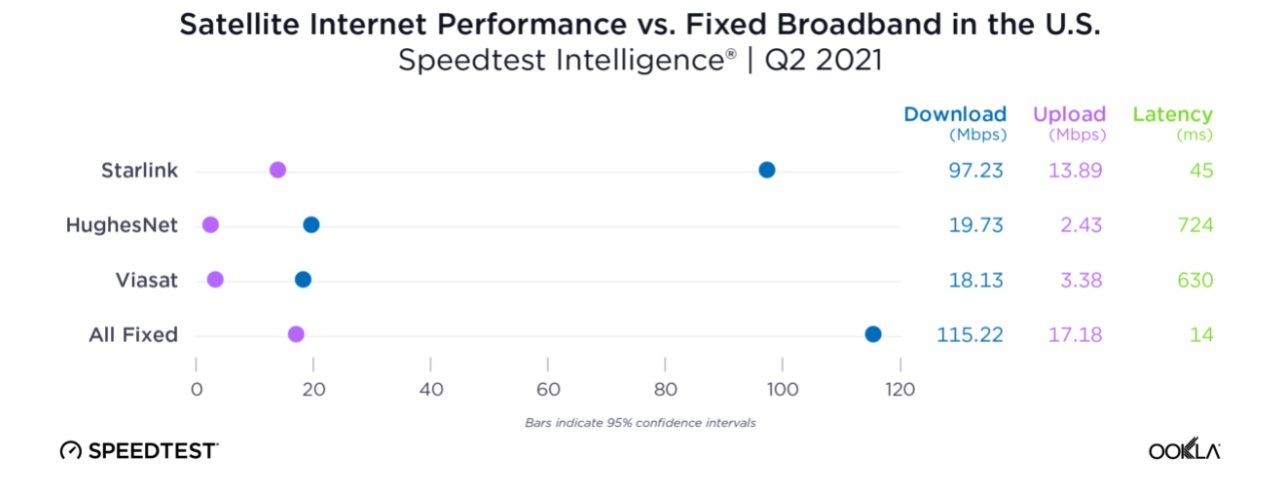
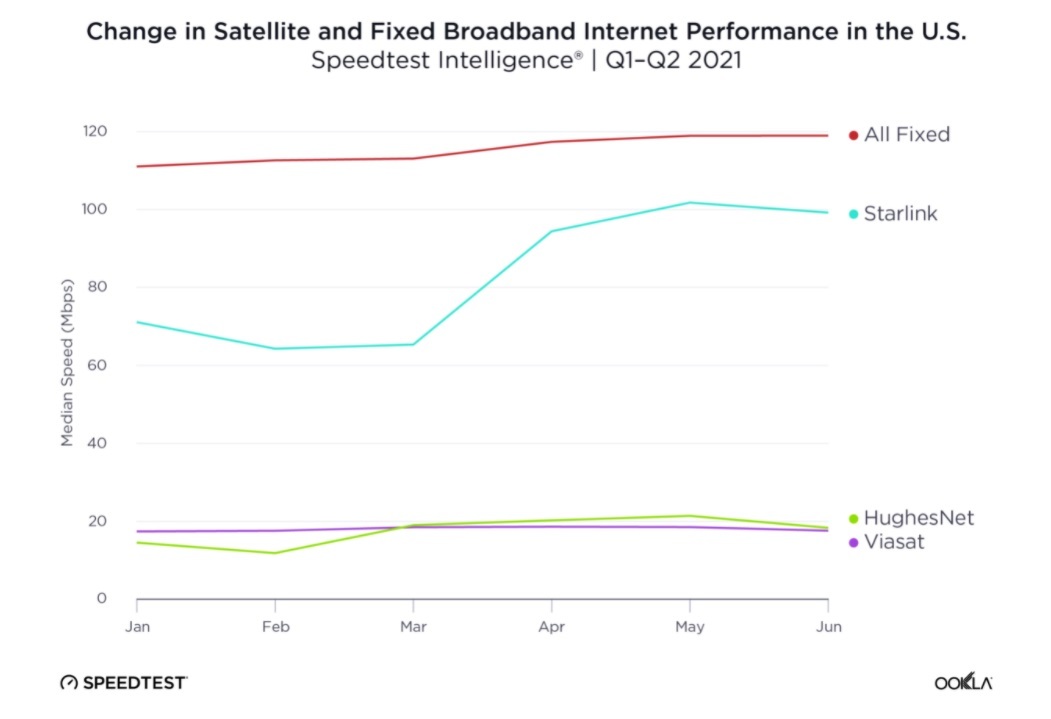
Given that satellite internet is often the only solution for folks in rural or underserved areas with little to no fixed broadband access, the Speedtest® results from HughesNet, Starlink and Viasat during Q2 2021 were encouraging. HughesNet was a distant second at 19.73 Mbps (15.07 Mbps in Q1 2021) and Viasat third at 18.13 Mbps (17.67 Mbps in Q1 2021). None of these are as fast as the 115.22 Mbps median download speed for all fixed broadband providers in the U.S. during Q2 2021, but it beats digging twenty miles (or more) of trench to hook up to local infrastructure.
Moreover, Starlink was the only satellite internet provider in the United States with fixed-broadband-like latency figures, and median download speeds fast enough to handle most of the needs of modern online life at 97.23 Mbps during Q2 2021 (up from 65.72 Mbps in Q1 2021).
Starlink’s median download speeds in the U.S. are starting to rival those of fixed-line broadband networks, according to Ookla’s latest round of Speedtest data.
While Starlink’s U.S. download speeds are “fast enough to handle most of the needs of modern online life,” they do trail the 115.22 Mbit/s median download speed for all U.S. fixed broadband providers, Ookla explained in its report.
In some areas, Starlink’s U.S. download median speed has surpassed those of fixed wireline network providers.
In its analysis of the Ookla data, PCMag (Ookla and PCMag are both owned by Ziff Davis) notes that Starlink’s median download speed in Morgan County, Alabama, reached 168 Mbit/s. Starlink’s slowest median download speed for the U.S. in the quarter, at 64.5 Mbit/s, appeared in Madison County, Indiana.
There’s only a slight difference between Starlink and broadband wireline networks in the upstream direction. Ookla said Starlink’s median upload speed for Q1 2021 was 13.89 Mbit/s, compared to a median upload speed of 17.18 Mbit/s among U.S. fixed wireline broadband networks. Meanwhile, both Viasat and HughesNet trailed with median upload speeds of 3.38 Mbit/s and 2.43 Mbit/s, respectively.
Starlink’s growing network of low-Earth orbit (LEO) satellites continued to deliver relatively low latencies, important for apps such as online gaming and videoconferencing, when compared to geosynchronous (GEO) systems. Ookla said Starlink’s median latency in Q1 2021 was 45 milliseconds. While that was well behind the 14 milliseconds of latency found on fixed-line networks, it was considerably better than the median latency for Viasat (630 milliseconds) and HughesNet (724 milliseconds).
saw sufficient samples during Q2 2021 to analyze Starlink performance in 458 counties in the U.S. While there was about a 100 Mbps range in performance between the county with the fastest median download speed (Morgan County, Alabama at 168.30 Mbps) and the county with the slowest median download speed (Madison County, Indiana at 64.51 Mbps), even the lower-end speeds are well above the FCC’s Baseline performance tier of at least a 25 Mbps download speed. We also saw many more counties qualify for analysis during Q2 2021 than we saw in Q1 2021.
United Kingdom: Starlink beats fixed broadband providers
Starlink showed a much faster median download speed in the U.K. during Q2 2021 (108.30 Mbps) than the country’s average for fixed broadband (50.14 Mbps). Starlink’s upload speed was also slightly faster (15.64 Mbps vs. 14.76 Mbps), and the latency was pretty good, given the distance traveled (37 ms vs. 15 ms). This brings Starlink closer to contender status for consumers across the U.K., not just those stranded in internet-free zones in Northern Scotland, once the service interruptions are under control. It also shows that because satellite internet is not constrained by the infrastructure of a given country, there is the potential to radically outperform fixed broadband.
This data is changing rapidly as satellite internet providers launch new service locations and improve their technology. Ookla will be excited to see if Starlink is still the satellite provider to beat next quarter and in what other countries satellite internet provides a viable alternative to fixed broadband.
……………………………………………………………………………………….
References:
https://www.speedtest.net/insights/blog/starlink-hughesnet-viasat-performance-q2-2021/
https://www.pcmag.com/news/starlink-moves-closer-to-matching-or-even-beating-fixed-broadband-speeds
https://www.lightreading.com/satellite/starlink-speeds-accelerate-in-q2-ookla-says-/a/d-id/771322?
Starlink now covers all of UK; Plans to connect vehicles with satellite Internet service
Starlink Internet could be a game changer with 100 megabytes per second download speed
Elon Musk’s Space Exploration Technologies Corp (Space X) has launched more than 1,000 satellites for its Starlink internet service and is signing up early customers in the U.S., U.K. and Canada. SpaceX has told investors that Starlink is angling for a piece of a $1 trillion market made up of in-flight internet, maritime services, demand in China and India — and rural customers such as Brian Rendel. He became a Starlink tester in November after struggling for years with sluggish internet speeds at his 160-acre farm overlooking Lake Superior in Michigan’s Upper Peninsula. After he paid about $500 for the equipment, FedEx arrived with a flat dish and antenna. For $99 a month, Rendel is now getting speeds of 100 megabytes per second for downloads and 15 to 20 for uploads — far faster, he says, than his previous internet provider.
“This is a game changer,” said Rendel, a mental health counselor, who can now easily watch movies and hold meetings with clients over Zoom. “It makes me feel like I’m part of civilization again.”
For months, SpaceX has been launching Starlink satellites on its Falcon 9 rockets in batches of 60 at a time, and the 17th Starlink launch was on Jan. 20. There are now roughly 960 functioning satellites in orbit, heralding an age of mega-constellations that have prompted worries about visual pollution for astronomers.
But the Starlink array in low-Earth orbit, closer to the planet than traditional satellites, is enough to enable SpaceX to roll out service along a wide swath of North America and the U.K. As SpaceX sends up more satellites, the coverage area will grow, expanding the potential customer base — and revenue stream — beyond the initial stages of today.
“The big deal is that people are happy with the service and the economics of Starlink versus other alternatives,” said Luigi Peluso, managing director with Alvarez & Marsal, who follows the aerospace and defense industries. “SpaceX has demonstrated the viability of their solution.”
Last year, SpaceX Chief Operating Officer Gwynne Shotwell said that Starlink is a business that SpaceX– one of the most richly valued venture-backed companies in the U.S. — is likely to spin out and take public. That dangles the possibility of another Musk enterprise offering shares after last year’s sensational stock-market gains by Tesla Inc.
Starlink will face plenty of competition. While fiber optic cable is widely considered too expensive to lay down in remote regions and many rural locations, cellular connectivity is expected to make big advances with 5G and then 6G. Meanwhile, a number of innovative attempts to extend cellular to unserved areas are being developed by other well-heeled companies such as Facebook Inc.
“There will always be early Starlink adopters who think that anything from Elon Musk is cool,” said John Byrne, a telecom analyst at GlobalData. “But it’s hard to see the satellite trajectory keeping pace with the improvements coming with cellular.”
SpaceX, based in Hawthorne, California, is primarily known for launching rockets for global satellite operators, the U.S. military, and NASA. Last year, SpaceX made history by becoming the first private company to fly astronauts to the International Space Station. Maintaining strong service while growing the customer base is something SpaceX has never tried before.
“Like any network, Starlink is going to enjoy rave reviews while it is underutilized,” said industry analyst Jim Patterson. “However, it will be challenged with the same congestion issues as their peers as they grow their base.”
Then again, SpaceX says the service will improve as it builds out more infrastructure.
“As we launch more satellites, install more ground stations and improve our networking software, data speed, latency and uptime will all improve dramatically,” Kate Tice, a senior engineer at SpaceX, said in a livestream of a Starlink mission in November.
Starlink is gearing up for a big 2021, hiring software engineers, customer support managers, a director of sales, and a country launch manager. The fan fervor that made Tesla cars such a hit with consumers and retail investors extends to Starlink. Facebook groups, Reddit threads and Twitter are filled with reports from early customers sharing images of their download speeds. You Tube has videos of people “unboxing” their Starlink dish and going through the initial set-up.
Ross Youngblood lives in Oregon and works remotely as an engineer for a tech company in San Jose. He owns a Tesla Model X and follows All Things Musk pretty closely. He got Starlink before Thanksgiving.
“I just plugged it all in and it started to work,” said Youngblood. “It’s going to be very disruptive, and I don’t think enough people are paying attention.”
Many other customers are waiting in the wings. In December, the Federal Communications Commission awarded SpaceX $885.5 million in subsidies as part of a wider effort to bring broadband to over 10 million Americans in rural areas. SpaceX will focus on 35 states, including Alabama, Idaho, Montana and Washington.
“We can’t continue to throw money at aging infrastructure,” said Russ Elliot, director of the Washington State Broadband Office. “With Starlink, you can be anywhere. The cost to build in deep rural or costly areas is now less of an issue with this technology as an option.”
Early in the coronavirus pandemic, Elliot connected SpaceX with members of the Hoh Tribe in far western Washington. The Native American community had struggled for years to bring high-speed internet to their remote reservation, which spans about 1,000 acres and has 23 homes. Kids struggled to access remote learning, and internet connections were so slow that downloading homework could take all day.
“SpaceX came up and just catapulted us into the 21st century,” said Melvinjohn Ashue, a member of the Hoh Tribe, in a short video produced by the Washington State Department of Commerce. In a phone interview with the Economic Times of India, Ashue said that the first thing he did once he connected to Starlink was download a long movie: Jurassic Park. Now most of the reservation’s households have Starlink, making it possible for families to access not just online schooling but tele-health appointments and online meetings.
“Internet access is a utility. It’s no longer a luxury,” said Maria Lopez, the tribal vice chairwoman. Lopez said that Starlink was easy to hook up. The scariest part was climbing up a ladder to set up the dish on her roof. “Every now and then it will glitch,” she said. “But it quickly reboots itself,” Ms. Lopez added.
References:
PCMag Study: Starlink speed and latency top satellite Internet from Hughes and Viasat’s Exede
Recent tests revealed in a PCMag study show that speeds and latency levels delivered by Starlink, Elon Musk’s emerging low-Earth orbit satellite broadband service (owned by SpaceX), far exceed those from satellite-powered rivals. However, initial high costs for the new service could be a show stopper even for consumers in rural areas who lack access to broadband Internet service. Starlink has deployed almost 900 satellites to date. The company appears to be ramping up its beta tests ahead of its commercial service launch. SpaceX founder Elon Musk tweeted Monday that “several thousand” additional beta invites are going out this week.
Average Starlink speeds jumped to 79 Mbit/s down and 13.8 Mbit/s up in October, improving on an average speed of 42 Mbit/s down and 9.7 Mbit/s up, according to the PCMag study. The speed tests were conducted by Ookla (Ookla is owned by Ziff Davis, PCMag’s parent company). Starlink quoted speeds of “50Mb/s to 150Mb/s” in a recent email to beta test users, so the results we’re seeing are in that range.

Starlink is joining HughesNet and Viasat’s Exede as a last-resort internet service provider for rural users who can’t get cable or fiber. Starlink’s speeds are a huge jump over existing satellite systems. According to Speedtest Intelligence, in October 2020 HughesNet averaged 19.84Mbps down while Viasat’s Exede system averaged 24.75Mbps down.

Starlink’s latency numbers were outstanding. Latency in recent tests varied wildly, but averaged at 42ms. That’s much longer than wired internet systems but shorter than HughesNet and Exede, which averaged 728ms and 643ms in September, respectively. The company says it expects “to achieve 16ms to 19ms by summer 2021.” 4G LTE is currently in the 40ms range for latency, according to Speedtest Intelligence data. My home fiber connection gets 2-3ms latency.
Latency is extremely important for 2 way video conferencing. Participating in Zoom calls requires both a clear uplink and relatively low latency, which means it’s been very difficult for people using existing satellite connections. Starlink could bring rural users much better remote learning capabilities.
Lower latency is one of the big advantages of the new “low earth orbit (LEO)” satellite systems. Starlink’s many small satellites orbit at about 340 miles above the Earth, while the satellites for HughesNet and Exede are up at 22,000 miles (geostationary orbit). So it takes much longer for a signal to get up to and back down from the older-model satellites.
Satellite internet service is relatively expensive: $99/month in Starlink’s beta phase pricing, plus $499 for the satellite dish and a Wi-Fi router for customer premises transmission/reception. The PCMag report notes that HughesNet’s 25 Mbit/s service with 20 gigabytes of data costs $69.99 per month, while Viasat’s 12 Mbit/s unlimited plan (users can use up to 40GB before data is prioritized behind other customers during periods of network congestion, resulting in slower speeds) goes for $100 per month along with a 30 Mbit/s plan that costs $200 per month.
Starlink’s Beta Program and Future Plans:
According to Business Insider, Musk also noted that Starlink’s beta program, which is focused today on the northern U.S. and southern Canada, could be extended into Florida by January 2021. If Starlink gets the necessary approvals, it could get to parts of Europe by February 2021 and India by mid-2021.
Musk said European countries would get access “as soon as we get country approval,” which he estimated would be in February or March. “This is required for each country individually, as no EU-wide approval system exists. Probably start receiving final (there are many steps) approvals around Feb/March,” he said.
Florida could get access to the public beta in January, he said, adding that “lower latitude states need more satellites in position.”
India can expect connectivity “as soon as we get regulatory approval,” likely in mid-2021, Musk replied to another user.
SpaceX has not said how many people are taking part in its Starlink beta program, but it said this summer that nearly 700,000 people across the US had expressed interest in the service, CNBC reported.
References:
https://www.pcmag.com/news/tested-spacexs-starlink-satellite-internet-service-is-fast-but-itll-cost
http://www.broadbandworldnews.com/author.asp?section_id=733&doc_id=765187&#msgs