

WiFi 7
Ookla: U.S. dominates global WiFi 7 while adoption grew 4X to 7.2% by Q1-2026
Introduction:
According to Ookla’s new WiFi report, cablecos Spectrum (Charter) is the largest Wi-Fi 7 provider in the world! WiFi 7 is actually IEEE 802.11be, also known as Extremely High Throughput (EHT).
Following Ookla’s recent report on The Global State of Wi-Fi , this article focuses on the U.S. and updates last year’s Wi-Fi 7 Speeds Up in the U.S. report. Key points:
- Adoption of Wi-Fi 7—the latest Wi-Fi generation currently in market deployment—has only just started to gain meaningful traction in the United States.
- Prototypes for Wi-Fi 8 are expected soon, and commercial availability could follow in roughly two years. Meanwhile, discussion of Wi-Fi 9 is already beginning among industry observers.
- Fiber drives penetration, Cable drives scale: National Wi-Fi 7 adoption hit 7.2% in Q1 2026. Non-cable ISPs led in customer base penetration by CenturyLink (14.7%) and Frontier (14.3%). Cable giants owned the total volume, with Spectrum alone commanding 24.9% of all U.S. Wi-Fi 7 Speedtest samples.
- U.S. dominated global Wi-Fi 7 footprint: U.S. providers accounted for half of the top 10 Wi-Fi 7 networks globally by sample volume, with Spectrum taking the #1 spot in the world, followed by Comcast Xfinity at #2.
- Cable upstream upgrades paying off: Cable’s spectrum splits combined with Wi-Fi 7 drove large performance gains, particularly for Xfinity’s median Wi-Fi 7 upload speeds, which more than doubled YoY to 108.8 Mbps.
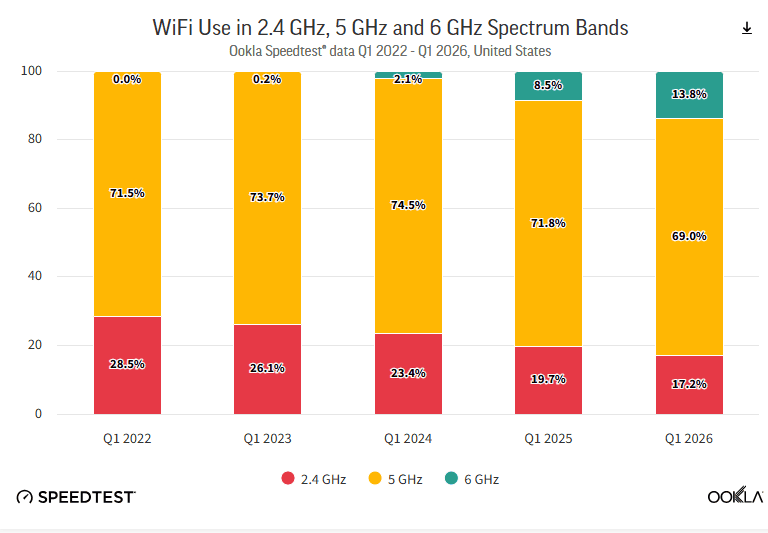
- 6 GHz band enters the mainstream: Unlicensed 6 GHz spectrum usage jumped 62% YoY to represent 13.8% of total U.S. Wi-Fi sample traffic, reflecting both router upgrades and user device (smartphone/laptop) maturity.
- FCC security rules won’t stifle next-gen Wi-Fi: While foreign router restrictions initially cast a broad net, the FCC’s conditional approval process established a de facto ban isolated to Chinese entities. Because Chinese vendors hold nearly no share of 6 GHz / Wi-Fi 7 hardware, regulatory actions appear unlikely to impede U.S. Wi-Fi 7 rollout momentum.
Wi-Fi 7 is finally here:
Wi-Fi 7 began commercial rollout in early 2024. At the end of Q1 2024, Speedtest samples showed adoption below 1%. One year later, sample shares remained in the low single digits across providers, reaching only 1.8% overall in Q1 2025. By Q1 2026, however, Wi-Fi 7 adoption had increased by 300%, reaching a 7.2% share of Wi-Fi router generations across all providers. That average masks substantial variation by operator. Among leading providers, CenturyLink (14.7%) and Frontier Fiber (14.3%) were about twice the national adoption rate, while Ziply Fiber (13.3%) and MetroNet (13.0%) were also close to that level. These customer bases appear to be moving from the early-adopter phase toward the early majority, using the terminology of Crossing the Chasm.
The cable operators Cox, Spectrum, and Xfinity reported lower Wi-Fi 7 shares among their own customer samples—4.5%, 6.6%, and 4.0%, respectively—than the national average. However, because of their large subscriber bases, their relative importance becomes more apparent when Wi-Fi 7 samples are measured as a share of all U.S. Wi-Fi 7 observations. On that basis, Spectrum’s 6.6% share within its customer base translated to 24.9% of all U.S. Wi-Fi 7 samples in Q1 2026.
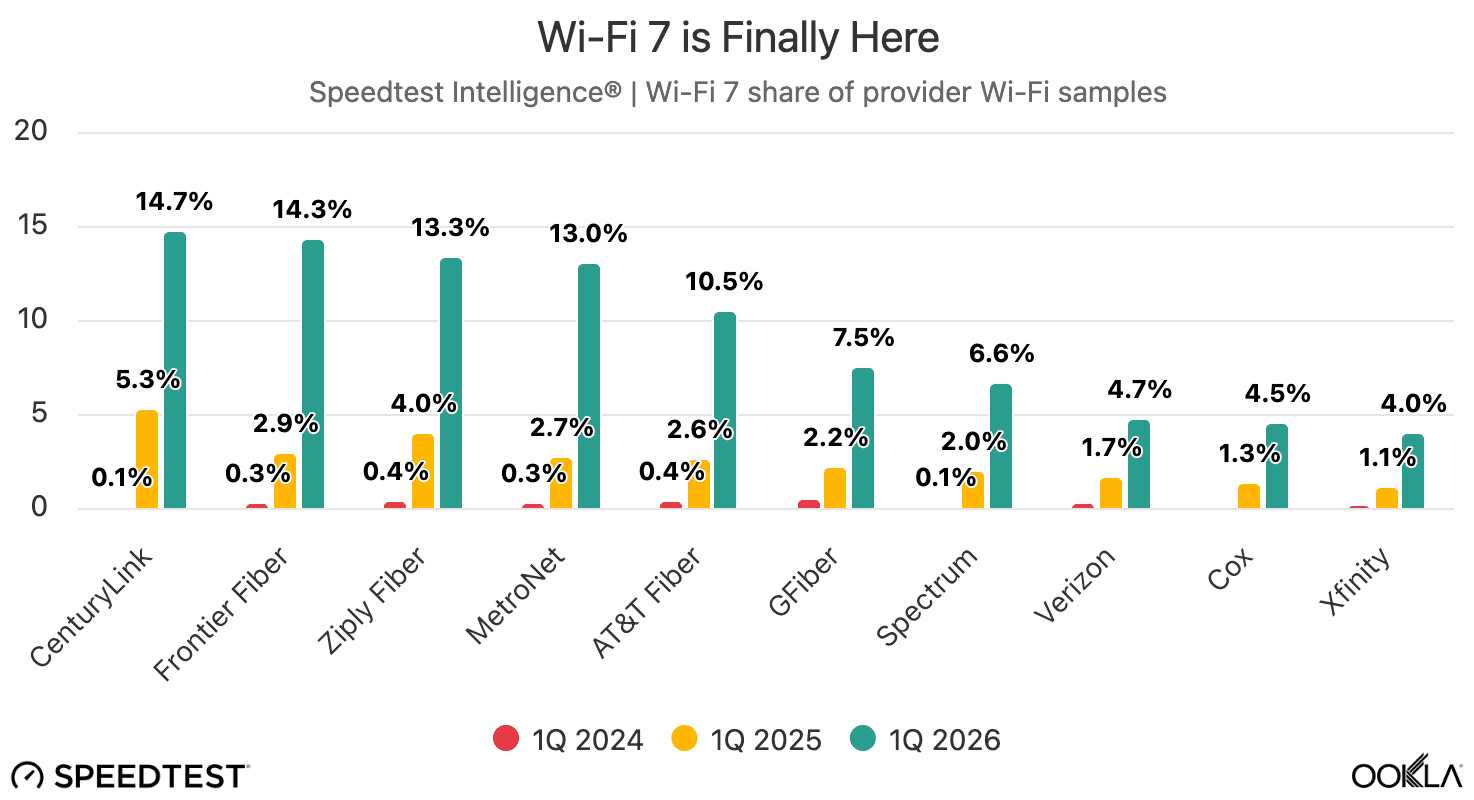
CableCos: The cable companies Cox, Spectrum, and Xfinity had relatively lower shares of Wi-Fi 7 samples (4.5%, 6.6%, and 4.0%) than the national average. However, with Spectrum’s and Xfinity’s large customer bases, their Wi-Fi 7 leadership is revealed by flipping from Wi-Fi 7 adoption among providers’ customer base to a providers’ share of all Wi-Fi 7 Speedtest samples. In other words, Spectrum’s 6.6% share of Wi-Fi 7 Speedtest users in its customer base (above), instead compared to all Wi-Fi 7 samples in the U.S. reveals that Spectrum owned a quarter (24.9%) of all Wi-Fi 7 (below) in Q1 2026.
Spectrum’s share of Wi-Fi 7 was 2x larger than Xfinity (12.4%) and Frontier (11.9%). On the other end, the long tail of “Other ISPs” averaged just 0.03% share across the 689 providers measured with Speedtest samples (24.0% all together).
Wi-Fi 7 adoption in the U.S. also leads Wi-Fi 7 globally. Based on its share of Speedtest samples, Spectrum is the world’s largest provider of Wi-Fi 7, heading a pack of five U.S. providers out of the top 10.
Top 10 Rank of Global Wi-Fi 7 Speedtest Samples, Q1 2026
| Rank | Provider | Country |
| 1 | Spectrum | United States |
| 2 | Xfinity | United States |
| 3 | China Telecom | China |
| 4 | Frontier Fiber | United States |
| 5 | WINDTRE | Italy |
| 6 | AT&T Fiber | United States |
| 7 | Free | France |
| 8 | CenturyLink | United States |
| 9 | China Unicom | China |
| 10 | HiNet | Taiwan |
Spectrum will add to its total of Wi-Fi 7 users when parent Charter Communications completes its anticipated Cox Communications merger in mid-to-late August. However, as a share of its own customer base, Cox had just 4.5% of its customers measured on Wi-Fi 7 with Speedtest samples. This will slightly dilute the share of Wi-Fi 7 of the merged entity’s base.
China Telecom and China Unicom make the list because their customer bases are massive (439 million mobile subscribers and 232 million 5G network customers in Q4 2025, respectively). However, the 6 GHz spectrum band in China, that Wi-Fi 7 could take advantage of, is licensed for mobile telecommunications (i.e., 5G and 6G) rather than for public, unlicensed Wi-Fi use.
More spectrum, more capacity, faster Wi-Fi:
Adoption of Wi-Fi 7 (and Wi-Fi 6E) has led to increased use of the 6 GHz spectrum frequency band (1,200 MHz from 5.925 GHz to 7.125 GHz of unlicensed spectrum). The growth in the use of this band not only comes from Wi-Fi routers, but also the end-user device – laptops, tablets, and smartphones. (Both ends of the connection require the newer Wi-Fi technology capability.) 6 GHz usage increased 62% from Q1 2025 to Q1 2026, accounting for 13.8% of Speedtest samples in the U.S.
Overall, speeds by providers across different generations of Wi-Fi have not changed much from the prior year. While headline-grabbing multi-gig speed rate plan announcements draw eyeballs, what really helped overall speeds and latency improve is what happens when customers upgrade their devices and routers. (The latest Wi-Fi 7 doesn’t have to be the solution to a better customer experience. Sometimes an upgrade to Wi-Fi 6E, or even just Wi-Fi 6 is the right fit for the customer’s needs.) In the case of the router upgrade, if it is leased or purchased through their provider, the customer may be optimizing their plan to a faster (or slower, but usually faster) speed tier to better align their needs with the technology’s capabilities. This mix shift to newer technologies lifts speed performance at each step in Wi-Fi generation.
References:
Research & Markets: WiFi 6E and WiFi 7 Chipset Market Report; Independent Analysis
Analysis: Broadcom’s end-to-end 50G PON Edge AI portfolio with WiFi 8 support
WiFi 7 and the controversy over 6 GHz unlicensed vs licensed spectrum
Analysis and Impact of Blockbuster FCC ban on foreign made WiFi routers