

WiFi 8
Ookla: U.S. dominates global WiFi 7 while adoption grew 4X to 7.2% by Q1-2026
Introduction:
According to Ookla’s new WiFi report, cablecos Spectrum (Charter) is the largest Wi-Fi 7 provider in the world! WiFi 7 is actually IEEE 802.11be, also known as Extremely High Throughput (EHT).
Following Ookla’s recent report on The Global State of Wi-Fi , this article focuses on the U.S. and updates last year’s Wi-Fi 7 Speeds Up in the U.S. report. Key points:
- Adoption of Wi-Fi 7—the latest Wi-Fi generation currently in market deployment—has only just started to gain meaningful traction in the United States.
- Prototypes for Wi-Fi 8 are expected soon, and commercial availability could follow in roughly two years. Meanwhile, discussion of Wi-Fi 9 is already beginning among industry observers.
- Fiber drives penetration, Cable drives scale: National Wi-Fi 7 adoption hit 7.2% in Q1 2026. Non-cable ISPs led in customer base penetration by CenturyLink (14.7%) and Frontier (14.3%). Cable giants owned the total volume, with Spectrum alone commanding 24.9% of all U.S. Wi-Fi 7 Speedtest samples.
- U.S. dominated global Wi-Fi 7 footprint: U.S. providers accounted for half of the top 10 Wi-Fi 7 networks globally by sample volume, with Spectrum taking the #1 spot in the world, followed by Comcast Xfinity at #2.
- Cable upstream upgrades paying off: Cable’s spectrum splits combined with Wi-Fi 7 drove large performance gains, particularly for Xfinity’s median Wi-Fi 7 upload speeds, which more than doubled YoY to 108.8 Mbps.
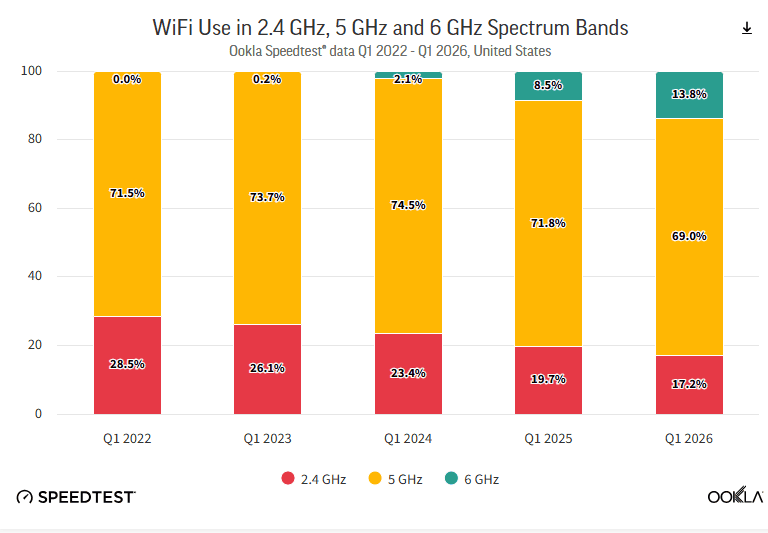
- 6 GHz band enters the mainstream: Unlicensed 6 GHz spectrum usage jumped 62% YoY to represent 13.8% of total U.S. Wi-Fi sample traffic, reflecting both router upgrades and user device (smartphone/laptop) maturity.
- FCC security rules won’t stifle next-gen Wi-Fi: While foreign router restrictions initially cast a broad net, the FCC’s conditional approval process established a de facto ban isolated to Chinese entities. Because Chinese vendors hold nearly no share of 6 GHz / Wi-Fi 7 hardware, regulatory actions appear unlikely to impede U.S. Wi-Fi 7 rollout momentum.
Wi-Fi 7 is finally here:
Wi-Fi 7 began commercial rollout in early 2024. At the end of Q1 2024, Speedtest samples showed adoption below 1%. One year later, sample shares remained in the low single digits across providers, reaching only 1.8% overall in Q1 2025. By Q1 2026, however, Wi-Fi 7 adoption had increased by 300%, reaching a 7.2% share of Wi-Fi router generations across all providers. That average masks substantial variation by operator. Among leading providers, CenturyLink (14.7%) and Frontier Fiber (14.3%) were about twice the national adoption rate, while Ziply Fiber (13.3%) and MetroNet (13.0%) were also close to that level. These customer bases appear to be moving from the early-adopter phase toward the early majority, using the terminology of Crossing the Chasm.
The cable operators Cox, Spectrum, and Xfinity reported lower Wi-Fi 7 shares among their own customer samples—4.5%, 6.6%, and 4.0%, respectively—than the national average. However, because of their large subscriber bases, their relative importance becomes more apparent when Wi-Fi 7 samples are measured as a share of all U.S. Wi-Fi 7 observations. On that basis, Spectrum’s 6.6% share within its customer base translated to 24.9% of all U.S. Wi-Fi 7 samples in Q1 2026.
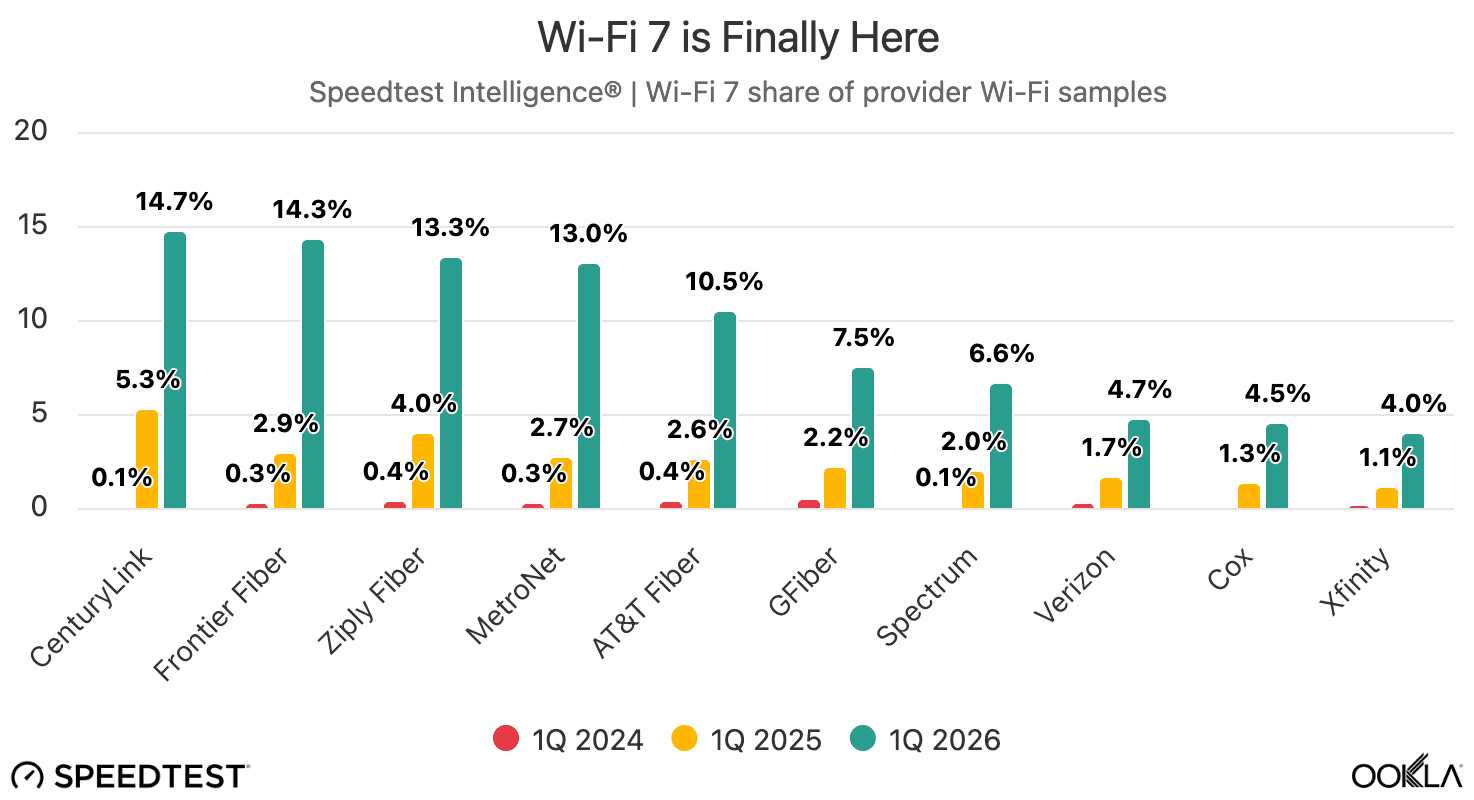
CableCos: The cable companies Cox, Spectrum, and Xfinity had relatively lower shares of Wi-Fi 7 samples (4.5%, 6.6%, and 4.0%) than the national average. However, with Spectrum’s and Xfinity’s large customer bases, their Wi-Fi 7 leadership is revealed by flipping from Wi-Fi 7 adoption among providers’ customer base to a providers’ share of all Wi-Fi 7 Speedtest samples. In other words, Spectrum’s 6.6% share of Wi-Fi 7 Speedtest users in its customer base (above), instead compared to all Wi-Fi 7 samples in the U.S. reveals that Spectrum owned a quarter (24.9%) of all Wi-Fi 7 (below) in Q1 2026.
Spectrum’s share of Wi-Fi 7 was 2x larger than Xfinity (12.4%) and Frontier (11.9%). On the other end, the long tail of “Other ISPs” averaged just 0.03% share across the 689 providers measured with Speedtest samples (24.0% all together).
Wi-Fi 7 adoption in the U.S. also leads Wi-Fi 7 globally. Based on its share of Speedtest samples, Spectrum is the world’s largest provider of Wi-Fi 7, heading a pack of five U.S. providers out of the top 10.
Top 10 Rank of Global Wi-Fi 7 Speedtest Samples, Q1 2026
| Rank | Provider | Country |
| 1 | Spectrum | United States |
| 2 | Xfinity | United States |
| 3 | China Telecom | China |
| 4 | Frontier Fiber | United States |
| 5 | WINDTRE | Italy |
| 6 | AT&T Fiber | United States |
| 7 | Free | France |
| 8 | CenturyLink | United States |
| 9 | China Unicom | China |
| 10 | HiNet | Taiwan |
Spectrum will add to its total of Wi-Fi 7 users when parent Charter Communications completes its anticipated Cox Communications merger in mid-to-late August. However, as a share of its own customer base, Cox had just 4.5% of its customers measured on Wi-Fi 7 with Speedtest samples. This will slightly dilute the share of Wi-Fi 7 of the merged entity’s base.
China Telecom and China Unicom make the list because their customer bases are massive (439 million mobile subscribers and 232 million 5G network customers in Q4 2025, respectively). However, the 6 GHz spectrum band in China, that Wi-Fi 7 could take advantage of, is licensed for mobile telecommunications (i.e., 5G and 6G) rather than for public, unlicensed Wi-Fi use.
More spectrum, more capacity, faster Wi-Fi:
Adoption of Wi-Fi 7 (and Wi-Fi 6E) has led to increased use of the 6 GHz spectrum frequency band (1,200 MHz from 5.925 GHz to 7.125 GHz of unlicensed spectrum). The growth in the use of this band not only comes from Wi-Fi routers, but also the end-user device – laptops, tablets, and smartphones. (Both ends of the connection require the newer Wi-Fi technology capability.) 6 GHz usage increased 62% from Q1 2025 to Q1 2026, accounting for 13.8% of Speedtest samples in the U.S.
Overall, speeds by providers across different generations of Wi-Fi have not changed much from the prior year. While headline-grabbing multi-gig speed rate plan announcements draw eyeballs, what really helped overall speeds and latency improve is what happens when customers upgrade their devices and routers. (The latest Wi-Fi 7 doesn’t have to be the solution to a better customer experience. Sometimes an upgrade to Wi-Fi 6E, or even just Wi-Fi 6 is the right fit for the customer’s needs.) In the case of the router upgrade, if it is leased or purchased through their provider, the customer may be optimizing their plan to a faster (or slower, but usually faster) speed tier to better align their needs with the technology’s capabilities. This mix shift to newer technologies lifts speed performance at each step in Wi-Fi generation.
References:
Research & Markets: WiFi 6E and WiFi 7 Chipset Market Report; Independent Analysis
Analysis: Broadcom’s end-to-end 50G PON Edge AI portfolio with WiFi 8 support
WiFi 7 and the controversy over 6 GHz unlicensed vs licensed spectrum
Analysis and Impact of Blockbuster FCC ban on foreign made WiFi routers
Broadcom with Samsung Electronics: Integrated 5G and Wi-Fi 8 FWA Platform
Broadcom has announced a collaboration with Samsung Electronics Co., Ltd. to develop a reference platform for fixed wireless access (FWA) deployments, combining Broadcom’s BCM6776 Wi-Fi system-on-chip (SoC) with Samsung’s B1320 5G modem. The platform is designed to integrate 3GPP Release 17 5G connectivity with emerging IEEE 802.11bn (Wi-Fi 8) capabilities, supporting convergence between wide-area and local-area broadband technologies.
The reference design targets global FWA use cases, where operators seek to deliver high-throughput broadband services using 5G radio access in conjunction with advanced in-home wireless distribution. By aligning 5G and Wi-Fi 8 performance characteristics, the platform addresses requirements for sustained throughput, low latency, and reliability under variable radio conditions. The design also emphasizes scalability for high-volume deployments, with integration intended to reduce system complexity and cost.
The Broadcom BCM6776 is a tri-band Wi-Fi 8 SoC designed for residential and small enterprise access points. It integrates a quad-core Arm-based network processor with Wi-Fi 8 radio functionality in a single device. The SoC supports 2-stream operation with 40 MHz channels in the 2.4 GHz band, and 4-stream operation with up to 160 MHz channels in the 5 GHz and 6 GHz bands. This configuration enables multi-gigabit aggregate throughput while maintaining compatibility with evolving IEEE 802.11bn features.
Integration of compute and radio subsystems within a single SoC reduces bill of materials (BOM) requirements and simplifies hardware design. Power efficiency is also improved relative to prior architectures that relied on discrete components, supporting deployment in thermally constrained residential environments.

Image Credit: Broadcom
…………………………………………………………………………………………………………………………………………………
The Samsung B1320 modem is a 5 nm-class integrated 5G chipset compliant with 3GPP Release 17. It supports peak downlink throughput of up to 3.43 Gbps and uplink throughput of up to 1.17 Gbps, depending on deployment configuration. The modem incorporates a quad-core Arm CPU, RF transceiver, power management functions, and a global navigation satellite system (GNSS) receiver.
The platform further supports non-terrestrial network (NTN) operation, including both NR-NTN and NB-NTN modes, enabling compatibility with satellite-based extensions of 5G coverage.
The combined architecture is designed to sustain end-to-end throughput between the 5G access link and the in-home Wi-Fi network, minimizing bottlenecks between the wide-area and local domains. This is particularly relevant for FWA deployments, where performance is constrained by both radio access conditions and in-premises distribution efficiency.
By providing a pre-integrated reference design, the platform enables original equipment manufacturers (OEMs) and operators to accelerate development cycles and standardize system performance across deployments. This approach supports broader adoption of FWA as a complement to fixed broadband infrastructure, particularly in scenarios where fiber deployment is limited or economically constrained.
“At Computex 2026, we are highlighting that the future of home internet can be both accessible and affordable,” said Joonsuk Kim, Executive Vice President and Head of CP Development at Samsung Electronics. “This platform is designed to deliver reliable performance across a wide range of environments, helping operators bring high-quality connectivity experiences to subscribers.”
“Broadcom is proud to lead the Wi-Fi 8 transition alongside Samsung and our valued ODM partners,” said Vijay Nagarajan, Vice President of Marketing, Wireless and Broadband Communications Division at Broadcom. “This partnership is a game-changer for the FWA market. The combination of Wi-Fi 8 and 5G prioritizes coordinated reliability, giving operators a tool that delivers a consistent experience to every corner of the home.”
Product Features:
The Samsung B1320 is a broadband-optimized 5G platform with the following features:
- 3GPP Release 17
- 4Rx/2Tx radio chain support
- Power Class 1.5 support (TDD bands)
- LPDDR4x / LPDDR5x support
- 1.6 GHz quad-core ARM Cortex-A55 CPU
- 5 Gbps USXGMII, PCIe Gen 3, USB 2.0
- GNSS
- NR-NTN and NB-NTN support for n255 and n256 (L- and S-bands)
The Broadcom BCM6776 is a single-chip Wi-Fi SoC and multi-band radio supporting the following:
- High performance quad-core CPU complex
- Dedicated network processing engine freeing the CPU complex for operator-specific applications and utilities
- Integrated 2×2 2.4 GHz and 4×4 5 GHz and 6 GHz Wi-Fi 8 MAC/PHY/Radio functionality, simplifying system design and lowering cost
- On-chip 2.4 GHz power amplifiers (PAs) and support for third-generation digital pre-distortion for reduced external components and improved RF efficiency
- Versatile memory controller supporting DDR4, LPDDR4, DDR5, and LPDDR5
- Dual PCIe Gen3 controllers to enable simultaneous tri-band applications with a single additional chip
- Integrated multi-gig PHY
A Global Ecosystem of Support:
The launch is supported by the world’s leading original equipment manufacturers (OEMs), who are already integrating the B1320 / BCM6776 platform into their next-generation gateway portfolios.
“HUMAX Networks is delighted to pioneer the next-generation 5G CPE market alongside global technology leaders Broadcom and Samsung. At the recent MWC 2026, we successfully showcased the industry’s first Wi-Fi 8 solution, which integrates Samsung’s cutting-edge 5G technology with Broadcom’s next-generation silicon. Through our ongoing partnership, we remain committed to driving market innovation and consistently delivering top-tier experiences and innovative devices to our global customers,” said Jerry Lee, CEO of Humax Networks.
“We are delighted to collaborate with Broadcom and Samsung to develop our next generation Wi-Fi 8 gateway addressing MSO CBU/FWA market. This solution is capable of delivering a smarter, more secure, and future-ready network optimized solution to meet MSO/FWA customers’ increasing demands of cost competitive 5G NR connectivity,” said Johnson Hsu, SVP & GM of WNC’s Connectivity & Solutions BG.
Availability:
Global carrier trials and OEM sampling of the Samsung B1320 / Broadcom BCM6776 FWA platform are underway.
About Broadcom:
Broadcom Inc. (NASDAQ: AVGO) is a technology leader that designs, develops, and supplies semiconductors and infrastructure software for global organizations’ complex, mission-critical needs. Broadcom combines long-term R&D investment with superb execution to deliver the best technology, at scale. Broadcom is a Delaware corporation headquartered in Palo Alto, CA. For more information, visit www.broadcom.com.
Broadcom, the pulse logo, and Connecting everything are among the trademarks of Broadcom. The term “Broadcom” refers to Broadcom Inc., and/or its subsidiaries. Other trademarks are the property of their respective owners.
…………………………………………………………………………………………………………………..
References:
Extreme Networks deploys Wi‑Fi 7 (IEEE 802.11be) at University of Florida’s “Swamp”
Ookla: FWA Speed Test Results for big 3 U.S. Carriers & Wireless Connectivity Performance at Busy Airports
Aviat Networks and Intracom Telecom partner to deliver 5G mmWave FWA in North America
T-Mobile’s growth trajectory increases: 5G FWA, Metronet acquisition and MVNO deals with Charter & Comcast
Analysis: AT&T 1Q-2026 results: increased fiber penetration, FWA momentum, D2D deals, and mobile/home internet bundles
Latest Ericsson Mobility Report talks up 5G SA networks and FWA