

184K global tech layoffs in 2025 to date; ~27.3% related to AI replacing workers
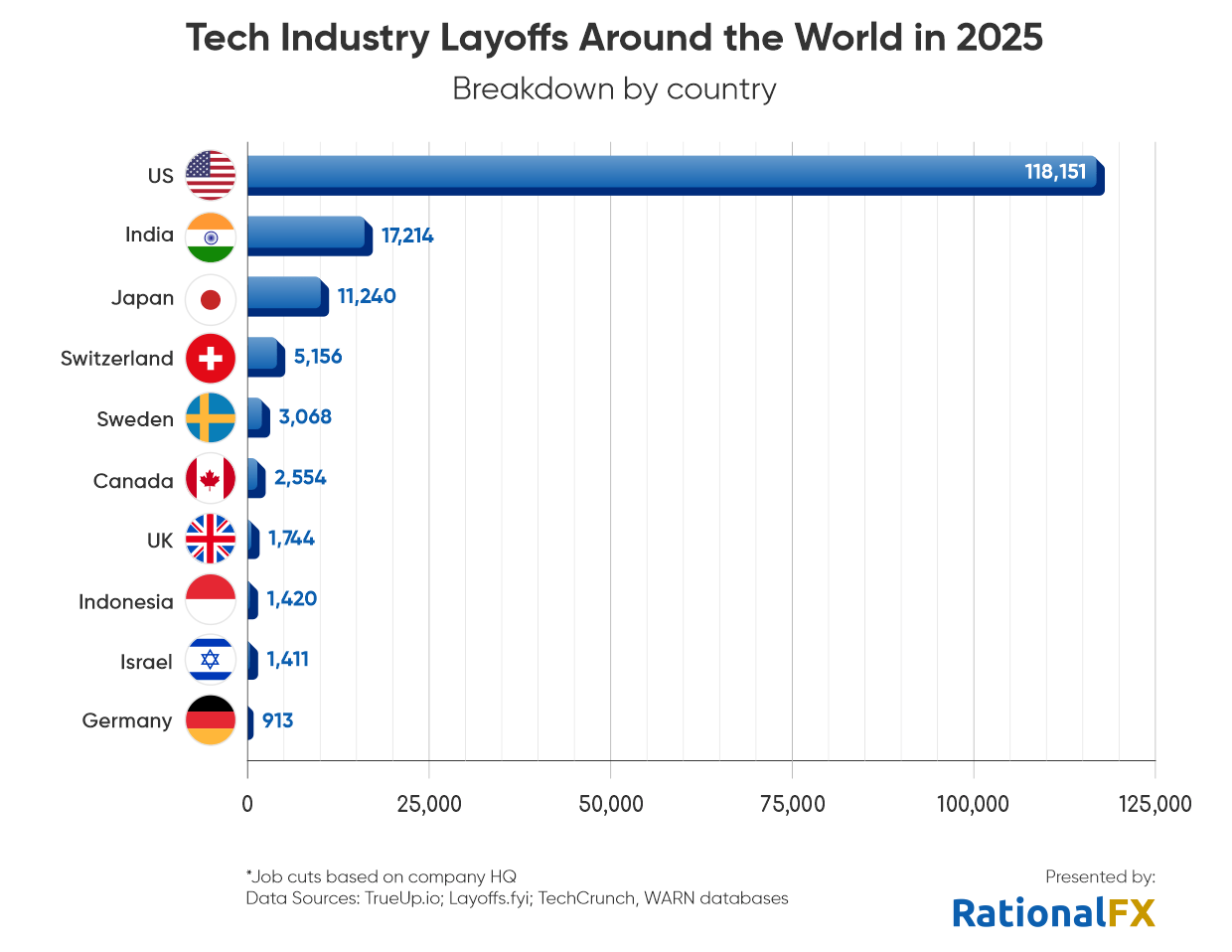
As of October, over 184,000 global tech jobs were cut in 2025, according to a report from Silicon Valley Business Journal. 50,184 were directly related to the implementation of artificial intelligence (AI) and automation tools by businesses. Silicon Valley’s AI boom has been pummeling headcounts across major companies in the region — and globally. U.S. companies accounted for about 123,000 of the layoffs.
These are the 10 tech companies with the most significant mass layoffs since January 2025:
- Intel: 33,900 layoffs. The company has cited the need to reduce costs and restructure its organization after years of technical and financial setbacks.
- Microsoft: 19,215 layoffs. The tech giant has conducted multiple rounds of cuts throughout the year across various departments as it prioritizes AI investments.
- TCS: 12,000 layoffs. As a major IT firm, Tata Consultancy Services’ cuts largely affected mid-level and senior positions, which are becoming redundant due to AI and evolving client demands.
- Accenture: 11,000 layoffs. The consulting company reduced its headcount as it shifts toward greater automation and AI-driven services.
- Panasonic: 10,000 layoffs. The Japanese manufacturer announced these job cuts as part of a strategy to improve efficiency and focus on core business areas.
- IBM: ~17,000 to 19,700 layoffs as part of a restructuring effort to shift some roles to India and align the workforce with areas like AI and hybrid cloud. The layoffs were reportedly concentrated in certain teams, including the Cloud Classic division, and impacted locations such as Raleigh, New York, Dallas, and California.
- Amazon: 14,000 layoffs in October 2025. Cuts have impacted various areas, including the Amazon Web Services (AWS) cloud unit and the consumer retail business.
- Salesforce: 5,000 layoffs. Many of these cuts impacted the customer service division, where AI agents now handle a significant portion of client interactions.
- STMicro: 5,000 cuts in the next three years, including 2,800 job cuts announced earlier this year, its chief executive said on Wednesday. Around 2,000 employees will leave the Franco-Italian chipmaker due to attrition, bringing the total count with voluntary departures to 5,000, Jean-Marc Chery said at a June 4th event in Paris, hosted by BNP Paribas.
- Meta: 3,720 layoffs. The company has made multiple rounds of cuts targeting “low-performers” and positions within its AI and virtual reality divisions. More details below.
……………………………………………………………………………………………………………………………………………………………………..
Feb 3, 2026 Update from Light Reading:
- Verizon’s new CEO Dan Schulman in October said that 13,000 employees would soon be laid off. When results were published last week, as reported by Light Reading, they showed that 10,300 jobs had been cut from the total in the final three months of the year, leaving Verizon with 89,900 employees on New Year’s Eve.
- AT&T eliminated about 8,000 jobs in 2025, finishing the year with 133,000 employees.
- That total net loss of 17,700 jobs at AT&T and Verizon was equal to about 7% of the combined workforce at the end of 2024.
Last year’s job losses were not an isolated event but the continuation of a decade-old trend that has gutted the telco workforce. At its high point for staff numbers in 2017, AT&T employed as many as 280,000 people, including those it would acquire with its $85 billion takeover of Time Warner. Around 147,000 jobs have subsequently disappeared, showing the workforce has more than halved in just eight years.
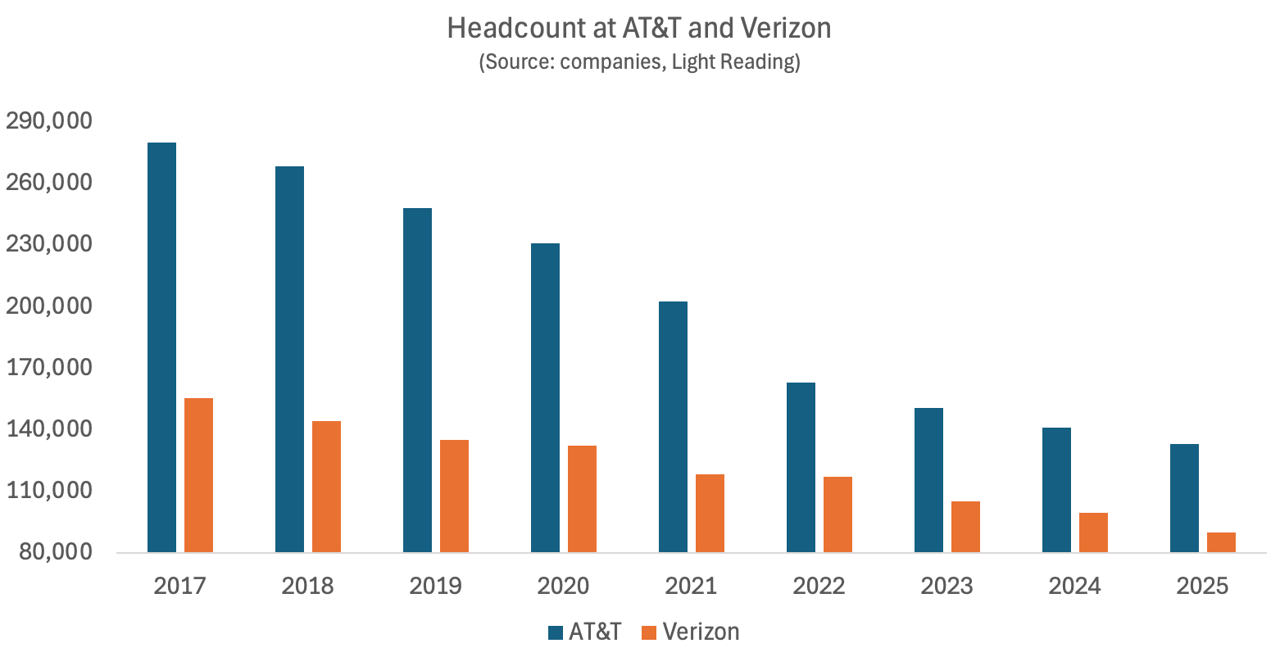
Pie Chart Credit: Light Reading
…………………………………………………………………………………………………………………………………………………………………………….
In a direct contradiction in August, Cisco announced layoffs of 221 employees in the San Francisco Bay Area, affecting roles in Milpitas and San Francisco. This occurred despite strong financial results and the CEO’s previous statement that the company would not cut jobs in favor of AI. The cuts, which included software engineering roles, are part of the company’s broader strategy to streamline operations & focus on AI.
About two-thirds of all job cuts — roughly 123,000 positions — came from U.S.-based companies, with the remainder spread across mainly Ireland, India and Japan. The report compiles data from WARN notices, TrueUp, TechCrunch and Layoffs.fyi through Oct. 21st.
- Shift to AI and automation: Many companies are restructuring their workforce to focus on AI-centric growth and are automating tasks previously done by human workers, particularly in customer service and quality assurance.
- Economic headwinds: Ongoing economic uncertainty, inflation, and higher interest rates are prompting tech companies to cut costs and streamline operations.
- Market corrections: Following a period of rapid over-hiring, many tech companies are now “right-sizing” their staff to become leaner and more efficient.
References:
Report: Broadcom Announces Further Job Cuts as Global Tech Layoffs Approach 185,000 in 2025
Tech layoffs continue unabated: pink slip season in hard-hit SF Bay Area
HPE cost reduction campaign with more layoffs; 250 AI PoC trials or deployments
High Tech Layoffs Explained: The End of the Free Money Party
Massive layoffs and cost cutting will decimate Intel’s already tiny 5G network business
Big Tech post strong earnings and revenue growth, but cuts jobs along with Telecom Vendors
Telecom layoffs continue unabated as AT&T leads the pack – a growth engine with only 1% YoY growth?
Cisco restructuring plan will result in ~4100 layoffs; focus on security and cloud based products
Cloud Computing Giants Growth Slows; Recession Looms, Layoffs Begin
5 thoughts on “184K global tech layoffs in 2025 to date; ~27.3% related to AI replacing workers”
Leave a Reply to Anonymous Cancel Reply

Amazon plans to cut 30,000 employees- largest layoff in the company’s history!
Amazon CEO Andy Jassy said in June that the increased use of artificial intelligence tools would likely lead to further job cuts, particularly through automating repetitive and routine tasks.
“This latest move signals that Amazon is likely realizing enough AI-driven productivity gains within corporate teams to support a substantial reduction in force,” said Sky Canaves, an eMarketer analyst. “Amazon has also been under pressure in the short-term to offset the long-term investments in building out its AI infrastructure.”
https://www.reuters.com/business/world-at-work/amazon-targets-many-30000-corporate-job-cuts-sources-say-2025-10-27/
The 20 largest network operators tracked by Light Reading cut headcount by more than 400,000 jobs, or 23% of the total, between 2016 and 2024.
Generative AI has been especially disruptive in the BSS/OSS space. It may be allowing companies to build software products with smaller teams and fewer resources, putting further downward pressure on prices. Taking advantage of the latest AI tools, a new entrant called Totogi last year claimed its BSS Magic product could build a complete BSS system, comprising half a million lines of code, in one day with a single engineer.
https://www.lightreading.com/5g/telecom-is-suffering-a-big-exodus-of-vendors
Feb 3, 2026 Update
1. From Light Reading:
AT&T and Verizon cut 17,700 jobs in 2025, with AI in its infancy:
Verizon’s new CEO Dan Schulman entered his new office in October and immediately erected a makeshift guillotine, promising the US telco’s glum investors that 13,000 heads would soon roll. When results were published last week, as reported by Light Reading, they showed that 10,300 jobs had been cut from the total in the final three months of the year, leaving Verizon with 89,900 employees on New Year’s Eve.
AT&T eliminated about 8,000 jobs in 2025, finishing the year with 133,000 employees.
That total net loss of 17,700 jobs at AT&T and Verizon was equal to about 7% of the combined workforce at the end of 2024. Last year’s job losses were not an isolated event but the continuation of a decade-old trend that has gutted the telco workforce. At its high point for staff numbers in 2017, AT&T employed as many as 280,000 people, including those it would acquire with its $85 billion takeover of Time Warner. Around 147,000 jobs have subsequently disappeared, showing the workforce has more than halved in just eight years.
https://www.lightreading.com/ai-machine-learning/at-t-and-verizon-cut-17-700-jobs-in-2025-with-ai-in-its-infancy
2. Amazon is slashing about 16,000 corporate jobs in the second round of mass layoffs for the ecommerce cloud computing company in three months.
The tech giant has said it plans to use generative artificial intelligence to replace corporate workers. It has also been reducing a workforce that swelled during the pandemic. The latest reductions follow a round of job cuts in October, when Amazon said it was laying off 14,000 workers.
CEO Andy Jassy, who has aggressively cut costs since succeeding founder Jeff Bezos in 2021, said in June that he anticipated generative AI would reduce Amazon’s corporate workforce in the next few years. The layoffs announced Jan 28, 2026 are Amazon’s biggest since 2023, when the company cut 27,000 jobs.
https://apnews.com/article/amazon-layoffs-job-cuts-tech-74387fae2313ff7b0b1e638c00863443
Oracle is hustling to build AI-capable data centers worldwide and taking on tens of billions of dollars of debt to finance those projects. Companies such as OpenAI, xAI, Meta, Nvidia and others have generated a pledged pipeline of $553 billion in future spending with Oracle.
The company began laying off thousands of workers worldwide on March 31st, just days after announcing a massive office expansion in Nashville. It’s estimated that between 20,000 and 30,000 employees were laid off.
https://www.bizjournals.com/nashville/news/2026/03/31/oracle-layoffs-global-data-center-ai.html
Meta CEO Mark Zuckerberg predicted in January that 2026 would be the “year AI starts to dramatically change the way we work.” For the Facebook parent’s nearly 80,000 employees, the change is indeed dramatic. The tech behemoth recently revealed plans to lay off 10% of its staff, highlighting a stark new trend: AI layoffs.
Massive job cuts are suddenly in vogue among tech’s biggest names. Meta Platforms (META), Microsoft (MSFT), Oracle (ORCL) and Amazon (AMZN) all have unveiled plans to cut jobs as they dedicate more of their spending toward investments to build AI data centers and other infrastructure. Another goal seems to lurk below the surface: to demonstrate that, with the power of AI, businesses can indeed be leaner, more efficient organizations.
“We are seeing more and more examples where one or two people are building something in a week that would have previously taken dozens of people months,” Zuckerberg told analysts on the Meta second-quarter earnings call Wednesday.
“They are doing it because the others are doing it, and the perception of being aggressive about AI is very important to them,” Tavis, chair of the human capital management department at NYU’s School of Professional Studies, told Investor’s Business Daily. “They are kind of trying to outdo each other.”
Wall Street’s reaction to the layoffs has been mixed. Investors’ ears generally perk up at mentions of efficiency. But the cuts come as investment in AI infrastructure is surging. Cloud hyperscalers signaled more AI spending in this week’s Big Tech earnings. A Jefferies analyst projected Amazon, Microsoft, Alphabet (GOOGL), Meta and Oracle will spend $769 billion in capital expenditures this year.
As talk of AI layoffs mount, a debate is raging on AI’s role in the workforce, including what jobs the technology can actually replace. Prominent voices argue that tech companies are using AI as a smoke screen to cover up previous overhiring. Some experts, including Tavis, warn mass layoffs can have long-term consequences, particularly for employee morale.
Tech Job Cuts Reach Three-Year High:
Layoffs numbered 81,747 across 83 tech companies during the first three months of the year, according to the tracking website Layoffs.fyi. That was the highest total since tech employers cut 167,000 jobs in the first three months of 2023.
U.S. employers across sectors cut 60,620 jobs in March, up 25% from a month earlier, according to a report from outplacement firm Challenger, Gray & Christmas. AI was cited in 25% of the layoffs. That placed ahead of business closings and restructurings as the most common job-cut explanation during the month, according to the report.
April has been a rough month as well as AI layoffs have mounted. Up to 20,000 roles were targeted for elimination on April 23 alone, when Microsoft reportedly offered buyouts for a reported 7% of staff and Meta said it would lay off 10% of its workforce in late May. Meta also canceled hiring for 6,000 open roles.
The spike in AI layoffs has ignited fears among tech workers and economists that artificial intelligence is headed toward upending the labor market. For tech companies in particular, AI tools such as Anthropic’s Claude AI agent are helping to write computer code and generate content such as marketing materials and internal presentations.
Research published in March by Anthropic identified computer programmers among the most exposed occupations to AI’s current capabilities.
Fintech company Block (XYZ), parent of Square, cited AI directly when it announced in February a plan to cut 40% of its workforce, or roughly 4,000 employees.
“Something has changed,” Block Chief Executive Jack Dorsey said in posts to social media. “We’re already seeing that the intelligence tools we’re creating and using, paired with smaller and flatter teams, are enabling a new way of working.”
Rising Costs Drive AI Layoffs:
For Meta, Microsoft, Amazon and Oracle, the job cuts come as the companies are making huge bets on AI. That spending has included dangling eye-popping salaries to lure top AI researchers in some cases. But most AI investment is on infrastructure, such as data centers filled with advanced computing chips from Nvidia (NVDA).
Meta, for instance, expects to plow between $125 billion and $145 billion into capital expenditures this year, the company told investors on Wednesday. That was marked up from prior guidance of $115 billion to $135 billion. The new $135 billion midpoint of Meta’s range is nearly double the $70 billion Meta invested on capex last year.
Janelle Gale, the company’s chief people officer, said in a letter to Meta employees on April 23 that its layoffs were part of a “continued effort to run the company more efficiently and to allow us to offset the other investments we’re making.”
Zuckerberg underlined the importance of efficiency in a call with employees on Thursday, according to the Wall Street Journal. But he also said the company is balancing its two main costs of “people oriented things” and computing infrastructure.
“If we’re investing more in one area to serve our community, then that means that we have less capital to basically allocate to the other,” Zuckerberg said.
AI Layoffs Amid Free-Cash-Flow Crunch
In a client note earlier this month, Evercore ISI analyst Mark Mahaney estimated Meta’s job cuts could generate $3 billion in annual savings. But “we would expect those savings to be plowed back into investment spend,” he said.
That may be a reason why Meta stock slipped the day it announced the AI layoffs. The response contrasts with the last time Meta conducted a mega round of layoffs in late 2022 and early 2023. Zuckerberg’s commitment to a “Year of Efficiency” at the time helped spark a huge rally for Meta stock.
Also different this time is that Meta’s business is growing rapidly. Analysts project Meta’s revenue will rise 25% this year, according to FactSet, whereas 2022 revenue fell 1%.
But Meta fell even further following its Q1 results that included the hike in capex spending. Some analysts highlighted that Meta’s total expense guidance for 2026 went unchanged despite the layoffs.
The layoffs come as rising capex has eaten into a key metric for tech stocks: free cash flow. Following its first-quarter results Wednesday, Wall Street projects Meta’s free cash flow will decline to $2.3 billion this year from $44 billion in 2025.
Meta won’t be alone. Amazon reported trailing 12-month free-cash-flow of $1.2 billion for its March quarter. That’s cut down from $25.9 billion in Q1 2025. Oracle is expected to have negative free cash flow for its next three fiscal years, according to the FactSet analyst consensus.
AI Job Cuts As A Signal:
But not all AI layoffs are a byproduct of hyperscale cloud investments. For smaller tech players, the job cuts could offer a signal to investors that the business is ready to use AI to cut costs or boost growth.
In some cases, that has helped boost investor confidence. Block stock was down by roughly 16% year-to-date when it revealed its mass layoff plan Feb. 26, along with its Q4 earnings results. Block stock popped more than 20% immediately following the news. Shares were ahead 8% year-to-date as of Thursday.
Morgan Stanley upgraded Block from a neutral view to an overweight, or buy, rating after the announcement. The analysts pointed to the company’s overall momentum but also said its “audacious AI gambit” could deliver improved profits.
On the other hand, AI-focused layoffs in January by Pinterest (PINS) were seen by Wall Street as “foreshadowing a revenue shortfall,” analysts with RBC Capital said at the time. Shares slumped, contributing to a 22% decline over the past year and a 70% drop from an early 2021 peak.
AI Layoffs Or ‘AI Washing?’
Claims that AI is driving mass job cuts have been met with skepticism on Wall Street and beyond.
Attributing layoffs to AI has even led to a new buzzword, “AI washing,” amid claims that companies are using AI as a scapegoat. The term has been used by even some of the technology’s biggest proponents, including OpenAI Chief Executive Sam Altman.
Marc Andreessen, cofounder and general partner of the influential venture capital firm Andreessen Horowitz, said on a recent podcast that the real issue driving “AI layoffs” is that many companies are overstaffed by as much as 50% to 75%.
“Now they all have the silver bullet excuse: Ah, it’s AI,” Andreessen said.
On that note, Block’s layoffs could be more about “bloat” than AI, said Alex Johnson, author of the Fintech Takes newsletter.
“There are likely many other late-stage fintech companies (public and private) that over-hired during the pandemic and in its immediate aftermath and now need to shed staff,” Johnson told IBD.
State Of The Tech Workforce:
Indeed, overall technology industry hiring swelled in 2020 and 2021, as companies reacted to a jump in demand for digital services brought on by Covid-19.
Net technology employment in the U.S. grew from 8.7 million in 2020 to 9.6 million in 2023, according to an analysis of federal data by IT trade group CompTIA. But total tech employment has remained flat since then, still at an estimated 9.6 million for 2025.
Meta’s headcount climbed to 86,482 by the end of 2022, nearly double its 2019 levels. Layoffs in 2023 cut the total by 22%. However, Meta’s headcount climbed back up to 77,986 as of March 31, according to its Q1 earnings report.
Seth Robinson, vice president of industry research at CompTIA, said tech hiring has historically swung between periods of significant investments and pullbacks.
“We believe that there is some correction happening, where companies have heavily invested, maybe overinvested, in digital transformation,” Robinson told IBD. “Now they’re trying to rightsize that, or they’re at least trying to make sure that their investments are making sense.”
AI is “part of the mix” of reasons companies are pulling back, Robinson said. But tech hiring has shown softness since 2023, he added, when few companies were positioned to implement AI tools.
“The softness actually lines up quite a bit better with actions of the Federal Reserve, in terms of raising interest rates,” Robinson said.
AI Adoption By Enterprises:
Adoption of AI tools among businesses has been increasing, according to data tracked by Ramp, a company that offers corporate credit cards and expense management tools. The Ramp AI Index estimates that roughly half of U.S. businesses are paying for subscriptions to AI tools as of March. That’s up from 23.5% at the start of 2025.
Subscribing to AI tools, though, is not the same as using those tools to replace workers. The March 2026 study from Anthropic found that AI hasn’t led to any clear increase in unemployment within fields most exposed to the technology, such as computer programming and customer service.
However, the Anthropic economic researchers found evidence that hiring has slowed in some exposed categories, particularly for entry-level roles.
“I think companies are being more cautious about hiring, with the potential that AI is going to increase the productivity of their current workers,” Brent Schutte, chief investment officer at Northwestern Mutual Wealth Management, told IBD. “I don’t think firms as of yet have gone through and started laying off people en masse.”
Risks From AI Layoffs:
Laying off staff as a path toward AI-powered efficiency can be risky, experts warn.
“The irony is, it can end up costing them more,” said NYU’s Tavis, who has served as a human resources executive at AIG among other companies.
That’s because companies eventually may need to hire people to fill roles in a different area, or rehire for some of the same roles. That’s on top of severance payments and other costs associated with the layoffs themselves.
“Many organizations are rushing to reduce headcount before they’re actually seeing the gains of the AI investments,” Gartner analyst Kathy Ross told IBD.
The research firm recently predicted about half of companies that cut customer service staff in “AI layoffs” will rehire for those roles within a year.
Companies that conduct mass layoffs now could also suffer from damaged morale, or lose other employees who seek more stable environments.
Some large-scale layoffs are “punishing people in the workforce for, at this point, very vague ideas of what the future will look like,” Tavis said. “That does not prepare you for resilience. Resilience comes from the culture within an organization.”
Tech Industry Hiring And AI Layoffs
The unemployment rate for technology occupation employment — a category that includes tech professionals across sectors — edged up to 3.9% in March from 3.8% a month earlier, according to a CompTIA analysis of federal data. That remains below the national average of 4.3%, however.
But the CompTIA analysis also found that active job postings related to tech climbed by about 9% in March.
For job seekers, there is a “lot of confusion and a lot of frustration,” according to Chris Allaire, CEO of Averity, a New York-based tech recruiting firm.
Along with fears about the technology driving layoffs, AI has exacerbated a problem Allaire called the “application black hole.” Every open role is seeing hundreds of applicants who are using AI to optimize their resume, he said. On the other end, however, are more AI tools being used to whittle down candidates.
What Happens To Entry-Level Tech Jobs
One area that is clearly feeling the squeeze in the current market is entry-level roles.
“We’ve seen for years now that companies have been targeting slightly higher levels of experience, especially in areas like cybersecurity or data,” CompTIA’s Robinson said. “But there’s a limited pool of those types of employees. And if there continues to be pressure on early career (hiring), that pool is just going to shrink and shrink.”
Some tech companies have expressed similar concerns. IBM (IBM) Chief Executive Arvind Krishna recently told The Verge’s Decoder podcast that he disagrees with the view that AI agents can replace the work done by entry-level employees.
“Wouldn’t you rather have an entry-level person and AI makes them more like a 10-year expert?” Krishna said.
He added, “Otherwise, where is the talent who’s going to come up with the next great product?”
Johnson of Fintech Takes compared AI models to interns who are “enthusiastic and smart but lacking in wisdom and requiring tremendous amounts of supervision.”
What’s Next In The AI Layoffs Trend
Meanwhile, the S&P 500 bounced back to highs in April, helped by a strong month for technology stocks. Northwestern Mutual’s Schutte sees the risks of labor market disruption as part of the “delicate balance” investors are weighing. For now, optimism about productivity growth seems to be outweighing fears about inflation, the Iran war, the labor market and tariffs.
“In the longer term, the likely answer is (AI) is a positive for the entirety of the economy with some displaced workers in the near term, which is unfortunately always something that happens when you have technological innovation,” Schutte said. “But what impact does that have in the here and now? That’s still up for grabs.”
AI’s impact on the workforce also came up in the past week’s earnings reports.
Microsoft Chief Financial Officer Amy Hood told analysts the company expects headcount to decrease this year as it evolves “how we operate to increase our pace and agility. Therefore, we expect headcount will decrease year over year”
Zuckerberg echoed Big Tech’s optimism about AI’s promise of leaner, more streamlined organizations, with a smaller workforce. “There is a lot that we can do to enable this: building the best infrastructure for creating and delivering products at scale, streamlining our teams so they are not bigger than they need to be,” he told analysts.
https://www.investors.com/news/technology/ai-layoffs-tech-what-investors-should-know/