

Non-Terrestrial Networks (NTN) Tutorial: Architecture, Spectrum, and Technical Foundations
by Paresh Panchal, Principal Engineer – Charter Communications
Abstract:
Several Non-Terrestrial Network (NTN) related articles have appeared on the IEEE ComSoc Techblog over the past year. They include: Alan J Weissberger’s market overview (December 2025), the Keysight/Samsung frequency band n252 demonstration (January 2026), the Telecoms.com survey summary (July 2025), and the enterprise IoT hybrid-network article (January 2026). These contributions provide useful market context and early deployment perspective, but they do not fully address the engineering considerations that determine how an NTN system is actually designed, dimensioned, and deployed.
Importantly, they do not examine the 3GPP Release 18 NTN architecture options (A1–A4), which define key implementation choices for operator and satellite network integration. They also do not analyze NTN band planning and its regulatory variability across CEPT and FCC jurisdictions, or the propagation-delay effects that must be accounted for in HARQ timing, scheduling, and other RAN procedures. These issues are central to practical deployment planning and to the selection of an appropriate NTN architecture for a given use case.
This article fills that gap by providing a practitioner-oriented technical reference that complements the existing market-level coverage with engineering detail, e.g. NTN deployment options, spectrum applicability, and protocol-level implications. It is intended to serve as a practical guide for engineers and network planners assessing NTN architecture, spectrum strategy, and protocol behavior in real deployment scenarios. You can read my entire article at https://wireless-vector.com/ntn-article.
Here’s a concise summary:
Orbital Classes Set the Constraints:
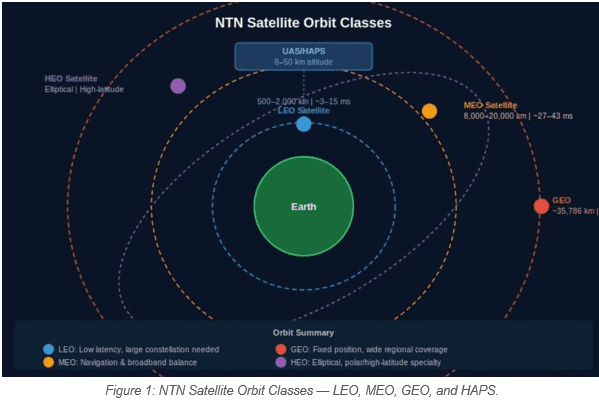
Orbit choice drives every downstream decision. LEO (500–2,000 km) gives near-terrestrial latency (3–15 ms) but needs large constellations and Doppler pre-compensation for ~7.5 km/s satellite velocity. MEO (8,000–20,000 km, 27–43 ms) balances coverage and delay. GEO (~35,786 km, 120–140 ms) is fixed-position with HARQ effectively disabled — fine for broadband and IoT, not real-time voice. HAPS (8–50 km) is quasi-terrestrial, under 1 ms.
Four Architecture Options, One Real Decision:
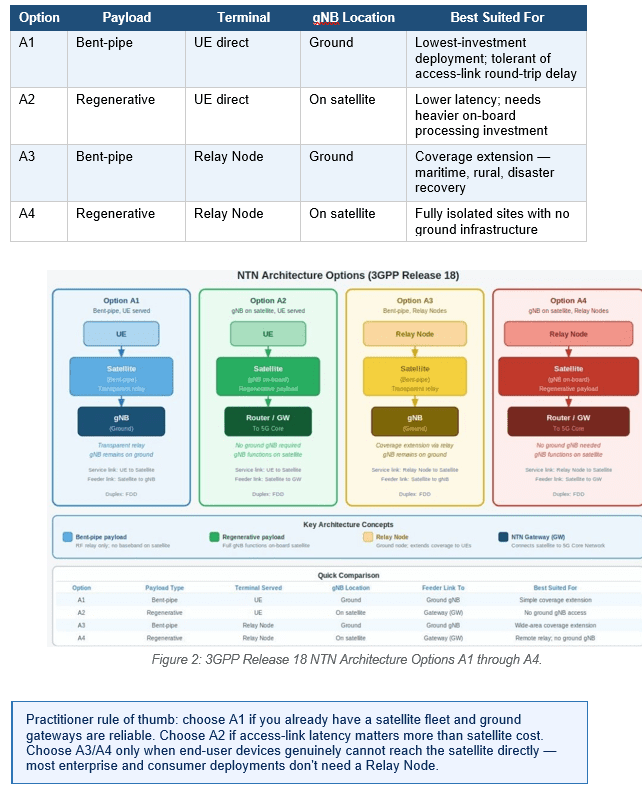
3GPP Release 18 defines four NTN architectures (A1–A4), split along two axes: payload type — bent-pipe transparent relay vs. regenerative on-board gNB — and terminal type — UE served directly vs. through a ground Relay Node.
Spectrum: Two Bands, Two Jurisdictions:
FR1-NTN uses S-band (n256) and L-band (n255/n254) below 6 GHz with conducted RF requirements — n256 has the broadest operator interest given its IMT-MSS allocation and global roaming potential. FR2-NTN uses Ka-band (17.3–30 GHz) with radiated (OTA) requirements, reflecting phased-array terminals. Critically, band applicability is regional: n512 applies in CEPT countries, n511 in the USA and FCC-aligned jurisdictions. Operators planning service across both regions need to validate band selection during planning, not after satellite procurement — this is the single most common spectrum-planning oversight in early NTN programs.
Propagation Delay: Where NTN Breaks Terrestrial Assumptions:
5G NR’s HARQ timing, scheduling, and timing-advance procedures were built for microsecond-scale terrestrial delay. NTN introduces delays of milliseconds to hundreds of milliseconds. For GEO, Release 18 specifies timing advance values up to 1,282,172 Tc — over 19,000 times the terrestrial NR maximum. That’s not a parameter tweak; it changes how uplink timing is managed entirely. For LEO, the bigger issue is often Doppler: a satellite moving at ~7.5 km/s introduces frequency offsets that must be pre-compensated at the UE or satellite to preserve waveform integrity. For MEO, the practical adaptation is HARQ process extension and longer scheduling windows.
Three Things Worth Knowing Before You Deploy
Drawing on experience deploying timing-synchronization systems across thousands of terrestrial cell sites, three points stand out for operators evaluating NTN:
- Timing infrastructure maturity matters more than people expect. Operators without strong precision-timing discipline on their terrestrial networks will find GEO/MEO timing advance values genuinely difficult — this isn’t an incremental extension of existing systems.
- Architecture choice is a capex decision disguised as a technical one. A1 vs. A2 isn’t really about latency preference; it’s about whether you’d rather spend on satellite payload complexity now or accept ground-segment round-trip delay indefinitely.
- Hybrid NTN/terrestrial, not standalone NTN, is what’s actually getting deployed. O-RAN’s open interfaces let the same RAN Intelligent Controller managing terrestrial cells extend to NTN parameters via the E2 interface — this is the path most operators are taking in practice.
Conclusions:
3GPP Release 18 gives operators a mature, well-specified set of choices for NTN — four architecture options with clear trade-offs, a band plan that bridges satellite and terrestrial spectrum, and explicit protocol adaptations for propagation delay that terrestrial 5G never had to consider. The decisions are more consequential than they look on paper. Starting from what Release 18 actually specifies, rather than from market framing, is the right way into an NTN deployment program. A more detailed technical reference — including full FR1/FR2-NTN band tables and a deployment readiness checklist — is available at wireless-vector.com/ntn-article.
………………………………………………………………………………………………………………………………………………………………………………………………………………
References:
3GPP, “NR and NG-RAN Overall Description,” Technical Specification TS 38.300, Release 18, 2024. [NTN architecture options A1–A4.]
3GPP, “NR; UE radio transmission and reception; Part 5: Satellite Access RF and performance requirements,” Technical Specification TS 38.101-5, Release 18, 2024.
3GPP, “NR; Physical channels and modulation,” Technical Specification TS 38.211, Release 18, 2024. [Timing advance and Doppler compensation for NTN.]
3GPP, “Solutions for NR to support Non-Terrestrial Networks (NTN),” Technical Report TR 38.821, Release 16, 2021.
CEPT Electronic Communications Committee, “ECC Decision (05)01 on the use of the band 27.5–29.5 GHz by Earth Stations in Motion (ESIM),” as amended, 2005/2013.
Federal Communications Commission, “Satellite Communications,” Code of Federal Regulations Title 47, Part 25.
………………………………………………………………………………………………………………………………………………………………………………………………………
About the Author:
Paresh Panchal is a wireless communications professional with deep expertise in RAN systems and architecture, network design, performance engineering, and network analytics. He’s been an active contributor to radio access network innovation with deep expertise in 5G/4G/CBRS RF design and optimization, specializing in cloud-native and O-RAN environments. Proven track record across multi-vendor, multi-country engagements covering greenfield and commercial networks. Core competencies span RF network modeling, performance analytics, and cross-functional program execution. Inventor with 25+ patent applications in radio network technologies.

………………………………………………………………………………………………………………………………………………………………………………………………………………………………..
References:
Non-Terrestrial Networks (NTNs): market, specifications & standards in 3GPP and ITU-R
Ookla: Starlink a viable competitor for hybrid 5G/NTN services due to network performance improvements and larger coverage area
Keysight Technologies Demonstrates 3GPP Rel-19 NR-NTN Connectivity in Band n252 (using Samsung modem chip set)
Telecoms.com’s survey: 5G NTNs to highlight service reliability and network redundancy
ITU-R recommendation IMT-2020-SAT.SPECS from ITU-R WP 5B to be based on 3GPP 5G NR-NTN and IoT-NTN (from Release 17 & 18)
China ITU filing to put ~200K satellites in low earth orbit while FCC authorizes 7.5K additional Starlink LEO satellites
Samsung announces 5G NTN modem technology for Exynos chip set; Omnispace and Ligado Networks MoU
One thought on “Non-Terrestrial Networks (NTN) Tutorial: Architecture, Spectrum, and Technical Foundations”
Leave a Reply

ITU-R WP 4B treatment of 3GPP NTN specs:
WP 4B does not edit, amend, or “correct” 3GPP technical specifications. It evaluates a submitted 3GPP NTN Radio Interface Technology (RIT) or Set of RITs (SRIT) against ITU-R satellite-IMT requirements, then develops an ITU-R Recommendation that identifies and references the applicable 3GPP specifications.
Separation of responsibilities
Body Role
3GPP Creates, maintains, and changes the normative NR-NTN, IoT-NTN, 5G Core, RAN, protocol, RF, and conformance specifications.
ITU-R WP 4B Establishes satellite-IMT requirements and evaluation methodology; evaluates candidate RIT/SRIT submissions; determines whether the proposed technology meets the requirements; and drafts the ITU-R satellite-IMT Recommendation.
ITU-R SG 4 Approves the WP 4B draft through the ITU-R Recommendation approval process.
Thus, WP 4B may determine that a submitted 3GPP technology does not yet demonstrate compliance with a required characteristic, lacks needed documentation, or must be evaluated further. It can communicate observations, requests for clarification, or technical concerns to 3GPP through formal liaison mechanisms. But it cannot make a change to a 3GPP TS or TR; only 3GPP’s relevant Technical Specification Groups and Working Groups can approve that change.
What WP 4B can change
WP 4B can change the ITU-R layer, including:
The ITU-R satellite-IMT vision, performance requirements, and evaluation criteria.
The scope, conditions, and presentation of a candidate RIT/SRIT in an ITU-R Recommendation.
Which 3GPP Global Core Specification versions, features, bands, or profiles are referenced as the basis of the recognized satellite radio interface.
Supplementary ITU-R material on system characteristics, satellite service performance, availability, spectrum compatibility, and earth-station matters.
For example, Recommendation ITU-R M.2177 recognizes the 3GPP 5G-NTN RIT and SRIT, but it does so by referencing externally maintained 3GPP specifications. The normative details remain under 3GPP version control.
Practical consequence for Release 19
If WP 4B concludes that a Release 19 NTN capability—say, regenerative payload operation or an IoT-NTN enhancement—does not meet a satellite-IMT requirement as submitted, it may withhold its recognition of that capability or request additional evaluation evidence. It may also recommend that 3GPP address a gap.
But the result would be one of these outcomes, not a WP 4B rewrite of the specification:
3GPP revises the relevant Release 19 or later specification through its ordinary change-request process, then resubmits or provides an updated reference.
WP 4B recognizes a narrower profile of the 3GPP submission that has demonstrated compliance.
WP 4B defers inclusion of the feature until supporting specification and evaluation material are mature.
WP 4B updates M.2177 to reference an approved later 3GPP specification version after the feature has been accepted.
“Rubber stamp” is therefore too strong, because there is an independent ITU-R evaluation and consensus step. But “specification modification” is also inaccurate: WP 4B evaluates and references 3GPP work; it does not exercise change control over it.
Source: Perplexity.ai