

Broadcom’s SC26 Open Ethernet Fabric: AI Tail Latency vs. Proprietary Interconnects and Cisco Silicon One
Introduction:
On November 15, 2026, Broadcom showcased its open Ethernet fabric portfolio for artificial intelligence (AI) and high-performance computing at the Super Computing 2026 (SC26) event in Chicago, IL. The silicon included the 102.4-terabit Tomahawk 6 switch, Tomahawk Ultra, Jericho 4, and the 800G Thor Ultra network interface card with enhanced RoCE. Those components are designed to rival proprietary systems like Nvidia’s InfiniBand and NVLink in AI and HPC clusters. With bandwidth reaching parity across ASICs, competition now centers on tail-latency determinism in collective operations.
Here’s a comparison chart that provides a quick comparison of the individual Broadcom component attributes:
| Component | Silicon Class | Throughput | Key Architectural Features | Target Topology Role |
|---|---|---|---|---|
| Tomahawk 6 (BCM78910) | Ethernet Switch ASIC | 102.4 Tbps | 3nm process, 512 × 200G SerDes, dynamic load balancing, UEC telemetry | Scale-out spine/leaf fabrics for massive GPU clusters |
| Tomahawk Ultra | Low-Latency Switch ASIC | 51.2 Tbps | ~250ns latency, Credit-Based Flow Control (CBFC), Link Layer Retry (LLR) | Intra-rack scale-up accelerator memory fabrics |
| Thor Ultra | AI Network Interface Card | 800 Gbps (2 × 400G / 1 × 800G) | PCIe Gen6 x16, eRoCE, direct GPU memory placement, packet trimming | Host accelerator endpoints (GPUs, TPUs, XPUs) |
| Jericho 4 | Fabric / Core Router ASIC | Multi-Tbps Modular | Deep HBM packet buffers, virtual output queuing (VOQ) | Inter-pod aggregation and multi-datacenter AI federations |
Architectural Evolution: Toward Open Ethernet Fabrics:
Broadcom’s Tomahawk 6 switches and Thor Ultra Ethernet NICs illustrate the growing role of Ethernet in high-performance AI and HPC networking. Rather than relying solely on conventional RoCEv2 behavior, this architecture combines higher switching capacity with packet-level multipathing, out-of-order data placement, selective retransmission, and programmable congestion control. These capabilities address key transport and congestion-management challenges in large accelerator clusters.
Thor Ultra’s enhanced RDMA over Converged Ethernet, or eRoCE, allows supported RDMA traffic to reach accelerator memory even when packets arrive out of order. This capability enables packet spraying across multiple network paths, improving load distribution without requiring every packet in a transfer to follow the same route. Ordering requirements still apply to some operations, including sends and atomics; out-of-order placement is not universal across all RDMA traffic.
The architecture also supports selective retransmission and packet trimming. Selective retransmission improves recovery efficiency by resending missing packets rather than unnecessarily retransmitting data already received. Packet trimming provides a congestion signal by removing a packet’s payload while preserving header information, helping endpoints detect loss and initiate recovery. These mechanisms support more responsive congestion handling, but should not be characterized as providing instantaneous recovery or eliminating every source of network congestion.broadcom+1
This direction is consistent with the Ultra Ethernet Consortium’s goal of developing an open, interoperable communications architecture for AI and HPC. The consortium emphasizes multipathing, congestion management, scalability, and compatibility with widely deployed APIs. Support for individual UEC features, however, should be distinguished from demonstrated interoperability across a complete multivendor deployment.
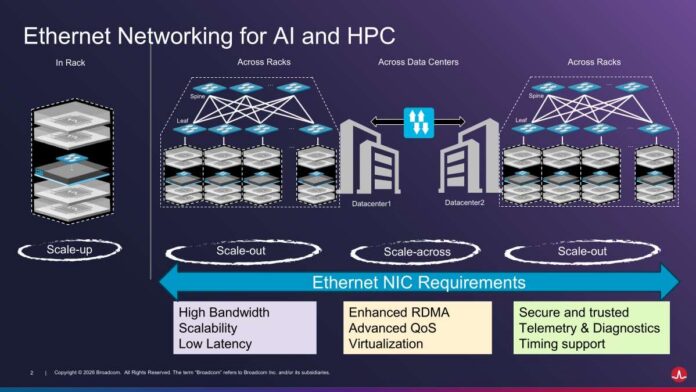
Hot Chips 2026 Broadcom Thor Ultra Ethernet NIC -Ethernet Networking for AI and HPC
……………………………………………………………………………………………………………………………………………………………..
dma-buf, the fabric eliminates ECMP elephant-flow collisions without incurring CPU reordering overhead. Simultaneously, switch-level packet trimming and link-local LLR/CBFC recover transient 200G SerDes bit errors and queue spikes in nanoseconds, matching proprietary collective completion times while avoiding vendor lock-in.Implications for Research and Cloud Infrastructure:
Tomahawk 6 provides 102.4 Tbps of switching capacity on a single ASIC. Broadcom has described architectures using this capacity to connect approximately 128,000 accelerators through two switching tiers. Depending on port speeds, topology, and oversubscription requirements, higher switch radix can reduce switching stages and the associated optics, cabling, latency, and power overhead.broadcom+1
For university computing centers, national laboratories, and cloud operators, the broader opportunity is an Ethernet-based infrastructure strategy supported by a wider supplier ecosystem. The UEC explicitly identifies manufacturer choice and interoperability as intended benefits, alongside performance, scalability, and total cost of ownership. These goals make open Ethernet relevant to organizations evaluating both technical requirements and long-term procurement flexibility.
For application and systems teams, the objective is to expose advanced network capabilities through compatible software interfaces—not to imply that high-performance RDMA traffic must traverse the conventional Linux networking data path. The UEC’s stated emphasis on compatibility with widely deployed APIs provides a more precise basis for discussing software portability and ecosystem continuity.
The strongest architectural conclusion is that Ethernet is evolving beyond higher link speeds alone: endpoint transport capabilities and fabric-level congestion management are becoming central to its suitability for large-scale AI and HPC workloads. Broadcom’s published features support that conclusion, while workload-performance and energy-efficiency comparisons still require clearly defined test conditions.
References:
https://casrai.org/news/broadcom-sc26-tomahawk-6-thor-ultra-open-ethernet-ai-2026
https://www.servethehome.com/broadcom-tomahawk-ultra-launch-for-scale-up-ethernet/
https://www.broadcom.com/company/news/product-releases/63361
https://www.servethehome.com/broadcom-thor-ultra-ethernet-nic-at-hot-chips-2026/
https://www.cisco.com/c/en/us/solutions/collateral/silicon-one/silicon-one-g300-ds.html
https://blogs.cisco.com/datacenter/ai-network-performance-with-cisco-intelligent-packet-flow
Ethernet Advances Towards 400 Gb/s-per-Lane Signaling for AI Networks: IEEE P802.3dv, Copper and Optical Interconnects
1.6T Ethernet Packet Loss Problem Solved: PHY-Layer Buffer Exhaustion with MAC-Layer Credit-Based Flow Control
2026 OCP Summit: Full-Stack AI Networking Silicon from Nvidia/Cisco and Broadcom; Ethernet vs InfiniBand Interconnects
The AI Infrastructure Build-Out: A $10 Trillion Bet on Compute, Power, and Networks