

After Bell Labs: Telecom Industry Funds Only a Fraction of the Innovation Needed
Many telecom analysts have noted former Bell Labs CTO and President Marcus Weldon scathing linkedin post, sharply criticizing deep staff cuts and warnings of “erasure” at the iconic research division. Weldon said he believes Bell Labs staffing has been cut to nearly half of the 1,200 strong workforce that was in place during his tenure (2013-to-2021). While he acknowledged that restructuring could account for some of those changes, he argued a 50% reduction in force in five years “is both shocking and unprecedented.”
An unidentified Nokia spokesperson told Fierce that Bell Labs “remains a deeply important part of Nokia, with a long track record of turning world-class research into technologies that deliver commercial impact and move our industry forward.” However, the company acknowledged that the hundred-year-old Bell Labs is “entering a new chapter.”
It’s important to recognize that Bell Labs is not the only big research house that’s disappeared. There’s also Bellcore/Telcordia, Nortel Networks R&D (Bay Street Labs), Xerox PARC, HP Labs, Telco labs (e.g. Pac Bell/SBC, Ameritech, Bell South, Bell Northern Research, GTE Labs, Sprint Labs, and many more).
Meanwhile, telecom analyst Sebastian Barros states “the $1.3 trillion telecom industry is funding only a fraction of the innovation it will need for whatever comes after 6G.” It appears to us that the industry’s economic model is badly failing to fund future innovation needed for growth.
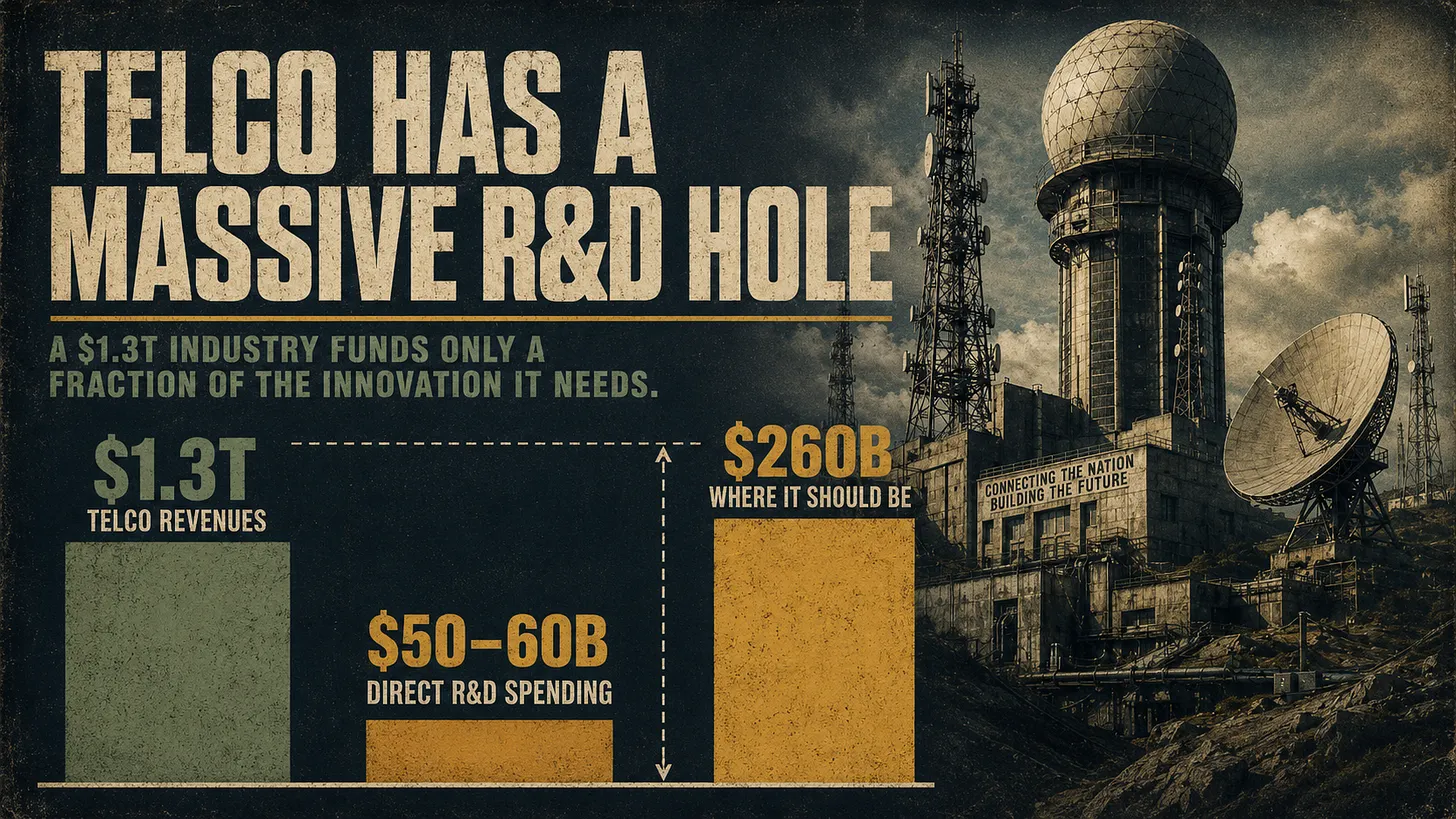
Image Credit: Sebastian Barros
………………………………………………………………………………………………………………………………………………………………………………………………
Our Analysis:
The core problem — R&D was outsourced and never replaced. After the 1984 Bell System breakup and liberalization in Europe and Asia, operators pivoted to customers, spectrum, deployment, and operations, while Ericsson, Nokia, Huawei, Qualcomm, ZTE, Samsung, and a long tail of suppliers took over most technology development. Operators became buyers of innovation rather than creators of it.
The Bell Labs model that produced the transistor, information theory, Unix, and modern AI is gone. That institution ran on an economic engine that no longer exists: in 1974 AT&T booked about 1.4% of US GDP, with Bell Labs alone spending roughly 2% of revenue on nonmilitary R&D — over four cents of every AT&T dollar. That stable, massive funding let researchers pursue problems that wouldn’t become products for fifteen years. Expecting a vendor like Nokia (€19.9B annual sales) to recreate that under today’s competitive economics ignores the financial logic of modern telecom. The contraction is visible: Marcus Weldon estimates Bell Labs research staff has fallen from over 1,200 to roughly 600 since he left the labs.
The industry is capex-heavy but R&D-light. Telecom invests more in capital expenditures than almost any other sector — over $350 billion per year — yet only the top 10 technology providers collectively spend around $50 billion annually on R&D. The capex money flows into deploying networks, not inventing or researching new technologies.
–>Yet in 2025, Huawei invested $27.5 billion in R&D. That was ~22% of its total revenue for that year.
The next cycle looks even more disciplined. Analysts expect 6G RAN capex to ramp only toward the end of the decade, with cumulative 6G RAN revenue in the first six years projected 10–20% lower than the comparable 5G period. Nearly 400 organizations are investing in 6G R&D, but venture-backed startups barely participate in a material way, leaving innovation concentrated among incumbents.
The takeaway: a $1.3 trillion industry funds only a fraction of the innovation it needs because its institutional R&D engine was dismantled decades ago and never rebuilt — operators spend on capex, vendors own the R&D, and the pipeline of disruptive new entrants is thin. That’s why “whatever comes after 6G” may arrive with far less foundational research behind it than the generations that preceded it.
Telecom Capex vs. AI Hyperscaler Capex:
The headline shift is quite stark. In 2026, the AI hyperscalers alone are on track to outspend the entire global telecom industry on capital investment — roughly doubling their own 2025 figures while telecom capex flattens or edges down. Here are the numbers side by side:
-
Hyperscalers are sprinting. Amazon alone plans ~$200B in 2026 capex (up from ~$125–132B), Alphabet $175–185B, Meta $115–135B, Microsoft $110–120B, and Oracle ~$50B. The vast majority goes to AI compute, data centers, and networking.
-
Telecom is grinding. Analysts see global operator capex edging down slightly by 2026, with spending holding near 20% of sales as fiber completion and 5G Standalone upgrades wind down. US telco capex was $80.5B in 2024.
-
Capital intensity is extreme. 2026 hyperscaler capex runs at roughly 86% of revenue for Oracle, 54% for Meta, and 46–47% for Microsoft and Alphabet.
Why this matters for the Barros argument: This is the flip side of the underinvestment thesis. Hyperscalers are channeling unprecedented capital into AI infrastructure — funded increasingly by debt, with incremental borrowing as a share of hyperscaler capex rising from ~9% in FY-2024 to ~32% by mid-2026 — while telecom operators, the sector that historically built the networks, are cutting back. The investment gravity has shifted from connectivity infrastructure to AI models andcompute, which is exactly why a $1.3 trillion industry funds only a fraction of the innovation it will need after 6G.
References:
https://sebastianbarros.substack.com/p/telecom-is-massively-underinvesting
https://www.fierce-network.com/wireless/nokia-defends-bell-labs-future-after-ex-chief-blasts-cuts
Dell’Oro: 6G RAN Capex to reach $500 billion by 2034 + Counterpoint
Dell’Oro: 2H2026 Data Center Capex to Accelerate due to massive AI Deployments
Hyperscaler AI Race: Soaring Capex Wipes Out Free Cash Flow; AGI and Digital Gods
China’s state owned telcos slash CAPEX to the lowest in decades!
Dell’Oro: Global telecom CAPEX declined 10% YoY in 1st half of 2024
Nvidia CEO Huang: AI is the largest infrastructure buildout in human history; AI Data Center CAPEX will generate new revenue streams for operators