

The AI-RAN Silicon Conundrum: GPUs, General-Purpose CPUs, or Custom ASICs?
Disclaimer:
Introduction:
anyRAN software running on NVIDIA’s Aerial RAN Computer platform and Red Hat OpenShift. That same day, Vodafone Group opened a European AI-RAN test hub in Málaga, Spain, designed to benchmark GPUs side-by-side against purpose-built telecom ASICs and Intel Xeon 6 (Granite Rapids) x86 processors.Comparing AI RAN Implementation Alternatives:
-
- Architectural Approach: In VodafoneThree’s UK trial architecture, Nokia’s
anyRANsoftware runs atop NVIDIA’s Aerial RAN Computer (such as the MGX 2U Short platform) orchestrated by Red Hat OpenShift. The design targets three operational tiers: AI-for-RAN (using machine learning for channel estimation, link adaptation, and beamforming), AI-and-RAN (sharing GPU resources dynamically between RAN functions and external AI workloads), and AI-on-RAN (hosting low-latency edge AI services such as vision or robotics near end users). - The Engineering Trade-Offs: GPUs offer massive parallel compute density and software programmability, which advocates argue can extend hardware lifecycles as AI algorithms evolve. However, real-time RAN processing operates under sub-millisecond timing budgets—often requiring link-adaptation inference decisions within roughly 40 microseconds. Critics contend that deploying high-wattage data center GPUs to execute compact RAN neural models at distributed cell sites creates severe power, thermal, and cost penalties unless workloads are heavily consolidated in centralized Cloud RAN hubs.
- Architectural Approach: In VodafoneThree’s UK trial architecture, Nokia’s
-
- AMD’s Accelerator-Free CPU Strategy: After its earlier Xilinx FPGA-based T2 Telco Accelerator Card faced operator pushback over power draw, AMD pivoted away from discrete hardware accelerators. Instead, AMD relies on high core density—such as its 84-core server processors—to execute compute-intensive L1 tasks, including Forward Error Correction (FEC), entirely in software on general-purpose cores. Samsung Networks (via VP of Network Strategy Alok Shah) has validated multi-cell capacity on AMD’s 84-core platform without external acceleration. AMD argues this eliminates hardware lock-in and lets operators dynamically partition CPU cores across L1–L3 baseband tasks, AI-RAN models, and edge applications. AMD claims to have a big enough CPU core count per chip to handle a software-based FEC on the CPU. A model advertised earlier this year features as many as 84 cores, exceeding the 72 found in the most advanced Granite Rapids product from Intel. “Forward error correction increasingly could be done on software on general-purpose cores, and the consequences of that are huge,” Weglicki said during the Omdia symposium.
- Intel’s Integrated Acceleration (Granite Rapids-D): Intel’s Xeon 6 SoC (Granite Rapids-D, scaling up to 72 cores) integrates dedicated silicon acceleration blocks for L1 FEC alongside built-in AI inference instructions and integrated Ethernet. While integrated acceleration improves watts-per-bit efficiency for L1 processing compared to pure-software execution, competitors argue it complicates multi-vendor software portability across different x86 platforms.
-
- Architectural Approach: Leading RAN suppliers continue to embed specialized neural network accelerators directly into custom baseband and radio silicon. For example, Ericsson’s Head of RAN Strategy, Gabriel Foglander, has highlighted running AI-native link adaptation directly on custom ASICs to guarantee deterministic, sub-40-microsecond inference latency. Similarly, VodafoneThree recently deployed Ericsson’s AIR 3266 Massive MIMO radios with integrated neural accelerators in London, while Virgin Media O2 demonstrated a 20% spectral efficiency gain in an AI-RAN trial running on existing Nokia-Marvell custom silicon.
- The Engineering Trade-Offs: Custom ASICs remain unmatched in power efficiency and deterministic L1 performance. Their primary vulnerability is economic: unlike general-purpose CPUs or GPUs, RAN ASICs are confined to a roughly $35 billion global RAN equipment market, limiting R&D amortization and risking premature hardware obsolescence if rapidly evolving AI models require architectural changes.
| Architectural Attribute | GPU-Accelerated AI-RAN (NVIDIA Aerial / Nokia) | Accelerator-Free x86 CPU (AMD 84-Core) | Accelerated x86 CPU (Intel Xeon 6 / Granite Rapids) | Purpose-Built RAN ASIC (Ericsson / Marvell) |
|---|---|---|---|---|
| Layer 1 & FEC Execution | Offloaded to GPU parallel tensor/CUDA cores | Pure software execution on general-purpose CPU cores | Integrated on-die hardware FEC accelerator + CPU cores | Hardwired baseband pipeline + integrated neural blocks |
| Power & Thermal Profile | High; best suited for centralized vRAN / Cloud RAN hubs | Moderate; scales with core utilization and software efficiency | Moderate-to-low; hardware offload reduces L1 core draw | Lowest watts-per-Gbps; optimized for distributed cell sites |
| Hardware Portability | Tied to GPU software stack (e.g., CUDA / Aerial) | High; standard x86 software portability without custom offload | Moderate; software must target integrated accelerator APIs | Low; tightly coupled to vendor-specific silicon |
| Multi-Tenant AI Sharing | High capacity for concurrent RAN and third-party AI inference | Flexible core partitioning between L1–L3 and edge AI | Supports edge AI inference alongside vRAN workloads | Limited to embedded RAN inference models |
| Primary Deployment Risk | Cell-site power/cooling limits and unclear edge AI monetization | Power efficiency of software-only FEC at high cell densities | Architectural lock-in to vendor-specific acceleration | Narrow RAN R&D amortization and slower hardware refresh cycles |
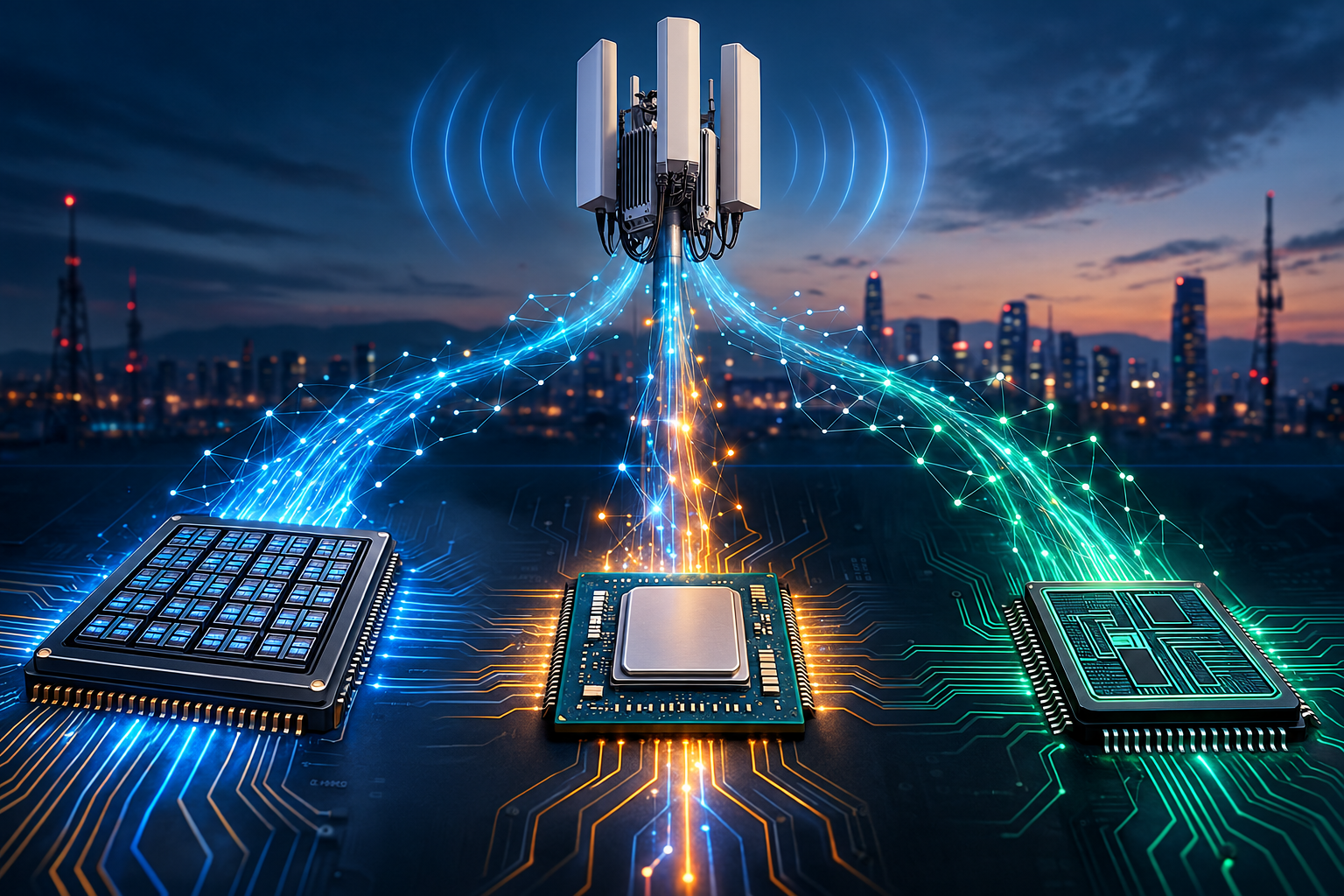
Image Generated by ChatGPT
………………………………………………………………………………………………………………………………………………………………………………………………………………………………………………………
AI RAN Telco Trials:
Readers should pay attention to the results of AI RAN trials this year and next for clues. Nine major telecom operators are conducting or have scheduled live network AI-RAN field trials across 2026 and 2027, distinguishing over-the-air commercial testing from early laboratory evaluations.
- T-Mobile US (United States). Completed the world’s first live AI-RAN call on its commercial 5G network in Bellevue, Washington, in October 2026 with Nokia and NVIDIA, alongside live non-GPU AI beamforming trials with Ericsson.
- Verizon (United States). Initiating live U.S. site rollouts of the AI-native Ericsson Intelligent Controller (EIC) before the end of 2026.
- Elisa (Finland). Completed Europe’s first over-the-air 5G Advanced AI-RAN field trial in October 2026 ahead of planned commercial deployments in 2027.
- Virgin Media O2 (United Kingdom). Completed a live London AI-RAN deployment in late October 2026.
- VodafoneThree (United Kingdom). Transitioning from late-2026 lab validation into live U.K. mobile site trials with Nokia and NVIDIA, alongside live Ericsson neural-accelerator radio testing in London.
- BT / EE (United Kingdom). Scheduled live over-the-air network trials in Birmingham for 2027 using Nokia anyRAN and NVIDIA hardware.
- Deutsche Telekom (Germany). Moving from late-2026 lab measurements into live field trials in 2027 to test AI-based uplink channel estimation.
- Orange (France). Conducting phased lab-to-live network AI-RAN trials across 2026 and 2027.
- SoftBank (Japan). Scheduled live commercial network trials in 2027 running Nokia anyRAN on its AITRAS platform and NVIDIA ARC-Pro hardware.
…………………………………………………………………………………………………………………………………………………………………………………………………………………..
Conclusions:
The telecom industry is unlikely to converge on a single “winner-take-all” AI-RAN silicon architecture. Instead, deployments will segment by network topology and power envelope:
- Rigorous Multi-Platform Benchmarking: Vodafone’s new Málaga test hub—which evaluates NVIDIA Aerial GPUs, Intel Granite Rapids CPUs, and custom ASICs using SPEC, MLPerf, and AI-RAN Alliance metrics—will provide essential empirical data. Engineers should look beyond headline spectral efficiency claims (such as Nokia’s target to double spectral efficiency by 2028) and demand normalized watts-per-Gbps and total cost per bit comparisons.
- Deterministic Isolation in Shared Compute: For AI-and-RAN multi-tenancy to succeed commercially, vendors must prove that bursty third-party AI inference workloads cannot introduce scheduling jitter or missed deadlines into real-time L1 baseband processing.
- Topology-Driven Silicon Selection: Custom ASICs with integrated neural accelerators will remain difficult to displace at power-constrained macro cell sites, whereas general-purpose CPUs and GPU-accelerated servers will compete primarily in centralized Cloud RAN and regional edge aggregation nodes where power, cooling, and multi-tenant enterprise AI demand can justify the infrastructure investment.
Bottom Line: The AI-RAN silicon debate is moving from raw compute capability to software portability, real-time performance, and total cost of ownership at the cell site. For general-purpose CPUs and GPUs to replace baseband ASICs at scale, the industry must overcome hurdles regarding hardware abstraction, thermal limits, and workload coexistence.
References:
AMD Telco Position: Light Reading, “AMD telco chief says GPU ‘backlash’ is coming in AI-RAN,” November 18, 2026
https://www.lightreading.com/5g/amd-telco-chief-says-gpu-backlash-is-coming-in-ai-ran
Nokia & NVIDIA Trials: Light Reading, “VodafoneThree to test Nokia’s AI-RAN with Nvidia GPUs,” November 18, 2026 https://www.lightreading.com/ai-machine-learning/vodafonethree-to-test-nokia-s-ai-ran-with-nvidia-gpus
NVIDIA Arc Connect:
https://developer.nvidia.com/blog/deploy-ai-ran-at-cell-sites-with-nvidia-arc-compact/
Vodafone AI-RAN Hub: Vodafone Newsroom, “Vodafone builds AI-RAN test hub to improve mobile connectivity and support new AI services,” November 18, 2026
https://www.vodafone.com/news/newsroom/technology/malaga-lab-ai-ran
Vodafone Strategy: Light Reading, “Vodafone is sold on AI-RAN but not yet on need for GPUs,” November 17, 2026
https://www.lightreading.com/5g/vodafone-is-sold-on-ai-ran-but-not-yet-on-need-for-gpus
Industry Ecosystem: RCR Wireless News, “VodafoneThree joins Nokia/Nvidia test squad as carriers kick tires on AI-RAN,” November 18, 2026
IEEE ComSoc Technology Blog, “Orange, Nokia, Nvidia, and Intel debate: ASICs vs. GPUs vs. General-Purpose CPUs for RAN Baseband Processing,” April 29, 2026
Ericsson goes with custom silicon (rather than Nvidia GPUs) for AI RAN
Marvell shrinking share of the RAN custom silicon market & acquisition of XConn Technologies for AI data center connectivity
RAN silicon rethink – from purpose built products & ASICs to general purpose processors or GPUs for vRAN & AI RAN
RAN Silicon Rethink- Part II; vRAN and General-Purpose Compute
Analysis: Nvidia’s $2 billion investment in Marvell; NVLink Fusion ecosystem & RAN vendor silicon strategy
Jensen Huang’s Resignation as CEO Creates Uncertainty for Nvidia and Opportunities for Competing AI Chip Suppliers
2 thoughts on “The AI-RAN Silicon Conundrum: GPUs, General-Purpose CPUs, or Custom ASICs?”
Leave a Reply

From ChatGPT- which was NOT used at all to research or write this article:
This is an important subject for IEEE Techblog because the choice of silicon architecture is one of the fundamental engineering and economic challenges facing AI-RAN.
The article goes beyond the usual AI-RAN promotional narrative to examine a genuine technology trade-off: whether future RAN processing should rely on specialized ASICs, general-purpose CPUs, GPUs, or combinations of these architectures. This is precisely the kind of technically substantive discussion that benefits an IEEE audience.
Several aspects deserve particular attention:
-GPU-accelerated RAN: The issue is not simply processing performance. It is whether GPU programmability and flexibility justify the additional power consumption, cooling requirements, hardware costs and software complexity associated with deploying data-center-class accelerators in telecom networks.
-General-purpose CPUs: AMD and Intel offer competing approaches to virtualized RAN processing. AMD emphasizes increasingly powerful general-purpose CPU cores, while Intel integrates dedicated acceleration for demanding Layer 1 workloads. Both approaches challenge the assumption that specialized RAN hardware is always necessary.
-Custom ASICs: Purpose-built silicon retains significant advantages in power efficiency, deterministic Layer 1 processing and hardware/software optimization. These advantages are particularly important at power-constrained cell sites, although development costs and limited market scale present economic challenges.
-Economics and deployment considerations: Ultimately, total cost of ownership, watts per Gbps, processing latency and network topology may matter more than raw computing performance. GPUs could prove attractive in centralized Cloud RAN facilities while remaining economically and operationally challenging at distributed cell sites.
–>The broader issue is that AI-for-RAN and AI-on-RAN are different workloads with different processing requirements. Using AI to improve radio performance is not the same as hosting external AI applications on telecom infrastructure. There is no compelling reason to assume that one silicon architecture will be optimal for both.
Bottom line: The industry needs independently verified field-trial results demonstrating measurable improvements in spectral efficiency, throughput, latency and energy efficiency, together with credible TCO comparisons, before operators make large-scale commitments to GPU-based RAN deployments.
The eventual outcome is likely to be a heterogeneous silicon environment in which GPUs, general-purpose CPUs and custom ASICs coexist, each serving workloads and deployment scenarios where they offer the best technical and economic advantages.
……………………………………………………………………………………………………………………………………….
An important IEEE Techblog differentiator from the mainstream (commercial backed) telecom trade press is explaining why AI-RAN competing technology strategies matter to the future architecture of telecommunications networks. I particularly like that the article ends with a Conclusion rather than simply leaving readers with a collection of vendor announcements.
Excellent analysis—clearly written and well organized. Separating the silicon choices, engineering trade-offs, and operator trials makes a complex debate easy to follow. The emphasis on deployment topology and measurable economics, rather than a single silicon “winner,” is particularly valuable.
The distinction between AI-for-RAN and AI-and-RAN seems central to this AI RAN silicon debate. Demonstrating that AI improves a radio algorithm does not, by itself, establish that GPUs are the most economical platform for executing it. Conversely, a GPU platform might have a compelling business case at an aggregation hub even if it is not the lowest-power option for baseband processing alone.
The forthcoming AI RAN trial results would be most useful if they distinguish gains from better algorithms from gains attributable to the underlying compute architecture.