

AI semiconductors
Microsoft Maia 300 Accelerator Chip: Co-Designing AI Inference for Improved Performance per Watt
Microsoft’s third-generation custom AI accelerator silicon (made by TSMC) combines a multi-process-node chiplet architecture with higher-density racks, targeting improved compute efficiency and lower infrastructure costs.
Executive Summary:
Microsoft announced its Maia 300 AI accelerator on October 12, 2026, outlining plans for multi-gigawatt deployments beginning in 2027. The company is positioning the third generation of its custom AI silicon as a key component of Azure’s infrastructure for inference workloads, including coding, long-context reasoning, and multi-step AI agent tasks.
Maia 300 reflects a broader shift in AI infrastructure design: optimizing the complete computing system rather than maximizing accelerator performance in isolation. Its chiplet architecture, high-bandwidth memory subsystem, and system-level integration are intended to improve throughput, power efficiency, and the economics of delivering AI services at scale.
Microsoft claims that Maia 300 delivers approximately 40% more tokens per megawatt than leading GPU-based systems. However, independent validation will require comparable workloads, clearly defined power boundaries, and measurements of throughput, latency, and output quality. The accelerator’s significance will ultimately depend on whether its architectural choices translate into lower costs per useful AI task under real-world operating conditions.

Azure Maia 200 now in production; Azure Maia 300 coming in 2027. Image credit: Microsoft
…………………………………………………………………………………………………………………………………………………………………………………………….
At a Glance- Key capabilities of the Maia 300 system:
Less data movement, more useful compute: Moving data efficiently, rather than raw compute power, is increasingly the bottleneck in large inference systems. Maia 300’s software-defined dataflow architecture and AI-assisted kernel optimization work together to maximize locality, reduce data movement and improve utilization across compute, memory and networking resources. By treating dataflow as a first-class design principle, Maia 300 delivers a significant performance-per-watt advantage over traditional GPU architectures.
Higher memory bandwidth within every watt: As AI workloads become increasingly context and memory-bound, Maia 300 delivers industry-leading HBM bandwidth per watt. Eight HBM4 stacks provide 18.0 TB/s of peak memory bandwidth within a 950-watt TDP, enabling efficient execution of large models and long-context workloads. Specialized kernel support uses on-die SRAM as a software-managed scratchpad, reducing pressure on HBM.
Chiplet architecture for enhanced efficiency: A new multi-chiplet architecture separates compute, memory-controller and I/O functions, improving efficiency, scalability and cost structure. Compute chiplets are built on TSMC’s N2P process node to maximize performance-per-watt.
Larger context, richer intelligence: By designing for advanced low-precision formats, including enhanced MXFP4, Maia 300 reduces memory and bandwidth requirements for both computation and KV-cache storage. The result is larger context windows, higher throughput and improved model efficiency within the same power envelope.
Scale-up networking at datacenter scale: Maia 300 treats networking as a seamless extension of the software-defined dataflow architecture. Rather than moving data through separate communication layers, dataflow operations span compute, memory and network resources as a single system. High-bandwidth interconnects between Maia accelerators are optimized for tensor parallelism, while a custom AI transport delivers performant and reliable scale-up communication across accelerators and racks. The AI-optimized transport leverages Ethernet-based networking infrastructure to enable a unified topology that scales efficiently from a single rack to datacenter-scale deployments.
Higher AI throughput from every rack: Maia 300 rack systems bring together 96 accelerators within a 167-kilowatt power envelope, delivering 27.6 TB of HBM capacity and 1.7 PB/s of aggregate HBM bandwidth across a high-speed scale-up domain. That density allows Microsoft to serve more simultaneous AI interactions and larger workloads from each rack, improving datacenter capacity and the economics of expanding AI services.
………………………………………………………………………………………………………………………………………………………………………………………….
Chiplet Architecture and Process Technology:
Maia 300 uses a chiplet architecture that partitions functions across multiple dies manufactured using different semiconductor process technologies. According to the reported design, the primary compute chiplets use TSMC’s advanced 2 nm-class technology, while other components use a 3 nm process. Other components, including those handling data movement between the processor and the rest of the system, use TSMC’s less expensive 3-nanometer process.
This approach differs from the Nvidia AI accelerator architecture described in the Reuters article, which combines a large central compute die with surrounding high-bandwidth memory chips. Microsoft’s design assigns different functions to different process nodes rather than manufacturing all components using the most advanced process.
This approach reflects an important principle in accelerator design: not every component benefits equally from the most advanced manufacturing process. Allocating compute-intensive functions to leading-edge technology while implementing other functions on different process nodes can improve manufacturing flexibility and potentially reduce overall costs.
However, process-node selection is only one aspect of the design. The performance of a chiplet-based accelerator also depends on die-to-die interconnect bandwidth, communication latency, packaging efficiency, power delivery, and thermal management. These factors determine how effectively the individual components operate as a unified processor.
For AI inference, this system-level perspective is particularly important. Increasing arithmetic throughput provides limited benefit when memory access or data movement becomes the dominant bottleneck. The architectural challenge is therefore to balance compute resources, memory bandwidth, and communication paths to sustain high utilization across representative workloads.
Memory Bandwidth and Inference Performance:
Memory architecture is central to the performance of large language model inference. Maia 300 incorporates eight high-bandwidth memory (HBM4) stacks, with Microsoft reporting peak memory bandwidth of 18.0 TB/s and a thermal design power of 950 W per accelerator.
These specifications provide useful indicators of the accelerator’s intended operating envelope, but peak bandwidth alone does not establish application performance. Actual results depend on memory access patterns, model architecture, batch size, sequence length, cache behavior, and the efficiency of the software stack.
Inference also encompasses distinct computational phases. During prompt processing, or prefill, accelerators process input tokens and may be constrained primarily by compute throughput. During autoregressive token generation, or decode, performance can become more sensitive to memory bandwidth, model-weight movement, and the size of the key-value (KV) cache used to retain context.
Long-context reasoning and agentic workloads introduce additional demands on memory capacity, data movement, and repeated model execution. Consequently, evaluating Maia 300 requires more than peak compute specifications: it requires sustained measurements across realistic inference workloads, including both throughput and latency.
Microsoft’s emphasis on inference-oriented design is therefore significant. The practical advantage will depend on how effectively the architecture converts available compute and memory resources into useful output tokens while meeting application-level latency requirements.
Rack Density, Power, and System-Level Efficiency:
Microsoft plans to deploy Maia 300 in racks containing 96 accelerators, with reported power consumption of approximately 167 kW per rack. For comparison, Nvidia’s GB300 rack configuration has been reported to contain 72 GPUs and consume approximately 142 kW. These figures illustrate the increasing power density of AI infrastructure, but they do not establish comparative performance or energy efficiency. Accelerator counts, rack configurations, and power measurements must be interpreted in the context of the complete system, including memory, networking, power conversion, and cooling.
Dividing reported rack power by accelerator count yields approximately 1.74 kW per Maia 300 accelerator position and 1.97 kW per GB300 GPU position. These are normalized rack-level figures, not measurements of individual accelerator power consumption. Differences in system configuration and measurement boundaries also limit their value as a direct comparison.
Microsoft separately claims that Maia 300 delivers approximately 40% more tokens per megawatt than leading GPU-based systems. This is a potentially important improvement because energy consumption is a major component of the cost of operating large-scale AI infrastructure. Nevertheless, the claim cannot be evaluated rigorously without identifying the comparison systems, workloads, software configurations, and power boundaries.
“It’s basically delivering more intelligence for every watt, every dollar, and every byte of memory by optimizing across the entire system,” Rani Borkar, president of Azure hardware systems and infrastructure at Microsoft, told Reuters.
A meaningful comparison should report aggregate token throughput alongside time to first token, inter-token latency, and sustained utilization. It should also distinguish accelerator or rack power from total facility power, which includes cooling and other datacenter overheads.
Ultimately, the relevant metric is not simply how many accelerators fit into a rack or how much power each rack consumes. It is how much useful inference work the complete system delivers for a given energy budget, while satisfying latency and quality requirements.
Hardware–Software Co-Design and Infrastructure Economics:
Custom AI silicon gives Microsoft greater control over the interaction between accelerator architecture, inference software, networking, and Azure’s datacenter infrastructure. This control can enable workload-specific optimization, improved resource utilization, and greater flexibility in deploying models across different hardware platforms.
However, custom silicon does not automatically produce lower costs. Its economics depend on manufacturing yields, packaging costs, software maturity, deployment scale, utilization, and the engineering effort required to optimize models and inference runtimes. Hardware specialization can also introduce trade-offs in flexibility as models and workloads evolve.
Microsoft’s reported plans for Maia 300 deployments spanning multiple gigawatts beginning in 2027 indicate the scale at which these considerations become important. The company also expects capital expenditures to exceed $175 billion in calendar year 2026, reflecting a broader investment in AI infrastructure rather than spending attributable solely to Maia 300.
At this scale, small improvements in sustained throughput per watt can have substantial operational consequences. Higher throughput may increase service capacity within a fixed power envelope, while lower energy consumption per token may reduce operating costs. Yet the financial benefit depends on actual utilization, workload mix, hardware lifecycle, and the total cost of operating the infrastructure.
The strategic objective is therefore broader than reducing dependence on third-party accelerators. It is to improve control over the cost, capacity, and performance of AI services through coordinated hardware and software design.
Deployment Scale and Validation Challenges:
Microsoft’s planned Maia 300 deployment raises several engineering questions that cannot be resolved by specifications alone.
First, how does the accelerator perform across different model sizes, context lengths, and inference patterns? Second, can its reported efficiency advantage be sustained under production concurrency and latency constraints? Third, how do networking, memory utilization, and software optimization affect performance when hundreds or thousands of accelerators operate as part of a larger service?
Independent evaluation should compare Maia 300 against clearly identified competing systems using equivalent models, output-quality requirements, precision settings, and inference software configurations. Measurements should include tokens per second, time to first token, inter-token latency, energy per generated token, and cost per million tokens. Agentic workloads may additionally require cost and latency measurements per successfully completed task.
These results should be reported with explicit power boundaries and sufficient methodological detail to permit reproduction. Without such evidence, peak specifications and vendor-reported efficiency figures remain useful indicators of design objectives, but not definitive proof of superior system performance.
Conclusions:
Microsoft Maia 300 illustrates how AI accelerator development is moving beyond the pursuit of peak compute performance toward system-level optimization. Its chiplet architecture, HBM4 memory subsystem, and integration with Azure’s inference infrastructure reflect the importance of balancing computation, memory bandwidth, data movement, and power consumption.
The central question is whether these architectural choices deliver sustained improvements in useful inference throughput, latency, and cost under real production conditions. Microsoft’s reported 40% advantage in tokens per megawatt is a promising claim, but its significance depends on transparent and comparable measurements.
As AI deployments grow, the competitive advantage of custom silicon will increasingly be determined by the efficiency of the complete system—not the specifications of the accelerator alone. Maia 300’s long-term importance will depend on whether Microsoft can translate hardware–software co-design into measurable gains in service capacity, energy efficiency, and the cost of delivering useful AI results.
…………………………………………………………………………………………………………………………………………………………………………………………………………………………………………..
References:
Reuters, “Microsoft plans huge deployment of its own AI chips, with an eye on saving costs,” Oct. 12, 2026.
Microsoft, official Maia 300 announcement and technical architecture materials, Oct. 12, 2026.
Nvidia, GB300 rack architecture and system power specifications. Cite the specific product documentation used to establish the 72-GPU configuration and 142 kW power figure.
TSMC, semiconductor process technology documentation. Cite the relevant process-node documentation to substantiate the manufacturing-node assignments reported for Maia 300.
Google’s TPU Business Outpaces Rivals as Hyperscalers Accelerate Custom AI Silicon Strategies
AWS to deploy AI inference chips from Cerebras in its data centers; Anapurna Labs/Amazon in-house AI silicon products
Huawei’s Ascend Silicon Roadmap Extends From AI Chips to Cluster-Scale Infrastructure
Custom AI Chips: Powering the next wave of Intelligent Computing
The AI Infrastructure Build-Out: A $10 Trillion Bet on Compute, Power, and Networks
Analysis: Nvidia–MediaTek Deepen AI Platform Collaboration -What it Means for AI RAN & DCI
Will Google Cloud’s AI and data analytics revenue +TPU IP licensing income offset huge AI CAPEX to produce a decent ROI?
Google’s Project Suncatcher: Satellite Orbit Validation of AI Accelerator Compute and Thermal Management
Executive Summary:
On Thursday, October 1st, Google plans to launch an experimental satellite designed to assess whether AI inference workloads can operate correctly in low Earth orbit. The spacecraft, designated MVP, is a technology demonstrator for Project Suncatcher, Google’s research initiative exploring space-based, solar-powered AI infrastructure.
Last month, technicians in protective suits and hairnets inspected, handled and tested the refrigerator-sized satellite commissioned by Google. They evaluated its deployable solar panels, which will unfold after launch and orient toward the sun. The spacecraft then underwent vibration testing to determine whether launch loads could damage its onboard processors or compromise mechanical assemblies. Technicians also applied witness marks across fasteners to identify any loosening during the test.
The satellite passed the vibration test: its fasteners remained secured, and its chips showed no apparent damage. James Manyika, Google’s senior vice president for research, described the outcome as “great,” while noting that orbital operations remain the more consequential test.
Project Suncatcher seeks to evaluate the technical viability of placing AI-compute infrastructure in space, where photovoltaic power is potentially abundant and uninterrupted by terrestrial weather or nighttime cycles. On Oct. 1, the MVP spacecraft is scheduled to launch aboard a SpaceX Falcon 9 from Vandenberg Space Force Base near Santa Barbara, California. Google provided The New York Times with an early inside look at the project, which would have appeared largely science fictional only a year ago.
Elon Musk, Jeff Bezos, Sam Altman and others have pledged support for orbital data centers, but the concept remains constrained by significant technical and economic barriers. These include launch cost, radiation tolerance, thermal management, intersatellite communications, orbital operations and eventual spacecraft disposal. At the same time, mounting local opposition to terrestrial data-center construction, together with power-grid, land-use and transmission constraints, has increased industry interest in off-planet computing infrastructure.
Google is not launching a data center. MVP is an experimental precursor intended to validate selected subsystem and operational assumptions. The spacecraft carries four tensor processing units (TPUs), specialized AI accelerators whose aggregate compute capability is approximately comparable to that of a single data-center server. Its solar-array system will provide roughly 1 kW of power, broadly comparable to the consumption of a household hair dryer.
That power budget is sufficient to evaluate how Google’s hardware performs under orbital radiation, vacuum and thermal conditions. The spacecraft will process simple AI queries and is intended to operate for approximately one year, although it is expected to remain in orbit for as long as six years before orbital decay causes atmospheric reentry and burnup.

Google tested A.I. chips at Crocker Nuclear Laboratory in Davis, Calif., with a particle accelerator known as a cyclotron. The goal was to test whether the chips could survive radiation in space.
Photo Credit…Jason Henry for The New York Times
………………………………………………………………………………………………………………………………………………………………….
Mr. Manyika emphasized that Google’s expectations are measured. “We don’t expect, to be perfectly frank, that we’ll have anything usefully operational in the next few years,” he said, comparing the mission to the company’s early efforts to build driverless cars. “Remember how Google was researching for like 15 years, before anything showed up? I think this is going to look like that.”
Scaling from one technology-demonstration satellite to a distributed orbital-computing system would require substantial capital and years of development, according to Brandon Lucia, a professor of electrical and computer engineering at Carnegie Mellon University. “If you do this on a large scale, there are additional engineering problems,” he said. “That is uncharted waters.”
From concept to flight test:
Project Suncatcher originated with Blaise Agüera y Arcas, a Google vice president and AI researcher who leads a team focused on intelligence research. Approximately three years ago, he attended a gathering of entrepreneurs and AI researchers centered on the escalating energy requirements of AI systems. He left convinced that space-based computing could eventually provide access to large-scale solar generation.
The idea “has been on my mind since I was kid,” he said. “There are longstanding ideas in science fiction about using stars for computation.”
Mr. Agüera y Arcas subsequently presented the concept to Mr. Manyika, who was initially skeptical but agreed to investigate whether AI processors could survive the radiation environment of space and be cooled effectively in vacuum.
In February 2025, Google began exposing AI chips to radiation at the Crocker Nuclear Laboratory in Davis, California. There, a cyclotron subjected the chips to radiation doses intended to approximate five years of space exposure. Radiation can induce “bit flips”—single-event errors that alter a circuit’s binary state from zero to one or from one to zero. Such faults can degrade or interrupt computation and can be particularly consequential in AI accelerators, memory systems and control electronics.
Google’s tests produced encouraging results. The company found that restarting the chips could generally clear the observed bit flips, suggesting that reset and recovery mechanisms may mitigate at least some radiation-induced errors. The test does not, however, eliminate the broader need for fault tolerance, error detection and recovery across a space-qualified computing system.
In May 2025, Mr. Agüera y Arcas joined a meeting arranged by Mr. Manyika to present the project to Sundar Pichai, Google’s chief executive. Sergey Brin, Google’s co-founder, also attended.
Mr. Brin and Mr. Pichai quickly greenlit the project. “OK, so this is a good idea,” Mr. Brin had said, according to Mr. Agüera y Arcas. “Let’s talk about how we’re doing it.”
Google has not disclosed Project Suncatcher’s budget. The company has said it expects orbital data-center costs to approach terrestrial data-center costs in the mid-2030s, assuming continuing reductions in launch costs. That assumption is central to the commercial premise: spacecraft hardware, launch, insurance, operations, networking and replacement cycles must collectively become competitive with land, power, cooling, grid interconnection and construction costs on Earth.
Satellite platform and thermal design:
Google contracted with Planet Labs, a satellite-imagery provider in which it had previously invested, to develop spacecraft capable of carrying its AI processors. James Mason, Planet Labs’ chief space officer, said discussions with Mr. Brin about performing computing tasks in space had occurred over several years, although the concept had previously appeared more distant.
“Back then, it seemed further off,” Mr. Mason said. “That was really before large language models took off and A.I. demand really started going exponential.”
Planet Labs agreed to launch two Google satellites in 2027. Google subsequently sought an earlier on-orbit demonstration and accepted additional programmatic risk to accelerate the schedule, according to Eric Stevens, a director of systems engineering at Planet Labs. To meet that timeline, Google integrated its AI chips into an existing Planet Labs satellite platform and initiated qualification testing.
Thermal management is among the program’s most consequential engineering challenges. AI accelerators produce substantial heat during computation, while convection-based cooling systems—including conventional fans—cannot operate in vacuum. Heat must instead move through conductive paths and be rejected through radiation.
Google’s design uses a layered thermal architecture. TPU devices are mounted on a green motherboard, above which sits thermal interface material—a compliant, pale-green compound supplied in sheets and intended to improve heat transfer between the chips and the adjacent metallic heat-spreading structure. Aluminum and copper layers conduct heat away from the motherboard to a radiator panel, which rejects thermal energy into space.
The initial system will operate in duty cycles rather than continuously. Travis Beals, Google’s senior director of product management for Project Suncatcher, said the chips can operate for approximately 15 minutes before they must be shut down to cool. Within those intervals, the processors will handle short inference requests for Google’s Gemini AI system.
The scaling challenge:
Google’s roadmap extends beyond the MVP mission. The company plans to launch two additional satellites next year and has developed concepts for constellations of more than 80 spacecraft flying in close formation and communicating with one another while processing AI workloads. Google is also evaluating the prospect of a purpose-built spacecraft approximately the length of a soccer field.
The key question is not whether a few AI accelerators can operate in orbit, but whether an orbital compute system can scale economically and reliably. A commercially useful architecture would need to solve several interdependent issues:
-
Radiation hardening, fault detection, redundancy and recovery for processors, memory, networking and spacecraft-control systems.
-
Continuous thermal rejection at substantially higher compute densities than the MVP demonstration.
-
High-capacity intersatellite links and ground connectivity capable of moving model inputs, outputs and potentially model parameters.
-
Autonomous fleet management, precise formation flying, collision avoidance and debris-risk mitigation.
-
Launch, replacement and disposal economics that compete with terrestrial data-center construction and power procurement.
-
A sustainable operating model for systems whose computing resources, maintenance cycles and network topology are inherently orbital rather than terrestrial.
The MVP mission does not resolve those issues, but it should generate operational data on the foundational constraints: radiation effects, thermal behavior, processor reliability, power availability and the feasibility of serving simple AI inference requests from orbit.
“If, five years from now, everything we’ve done has worked perfectly, it probably means we’ve not taken enough risk and we’ve not learned as much as we could,” Mr. Beals said. “If we’re really successful with this in the long run, this will ultimately be boring and people won’t think anything at the fact that their Gemini query might be getting served in space.”
References:
https://www.nytimes.com/2026/09/24/technology/google-suncatcher-ai-data-center-space.html
South Korean startup Rebellions to use open source software for carriers to quickly build AI stacks with its AI inferencing chips
South Korean chip startup Rebellions builds purpose-engineered Al accelerators to redefine energy-efficiency and scale in the age of large-scale Al. It aims to deliver the best performance per dollar per watt possible for inferencing and lower both capex and opex associated with running AI infrastructure. The company has been very selective about where it has established office locations and staffing: Korea, Japan, Singapore, Saudi Arabia and the United States.
Their flagship semiconductor product is the Rebel100, which uses a predictive, software-controlled DMA engine tightly coupled with an on-chip mesh to prefetch KV data proactively. This enbales 2.7TB/s effective bandwidth and reduces token-level latency in 32K+ context LLMs.
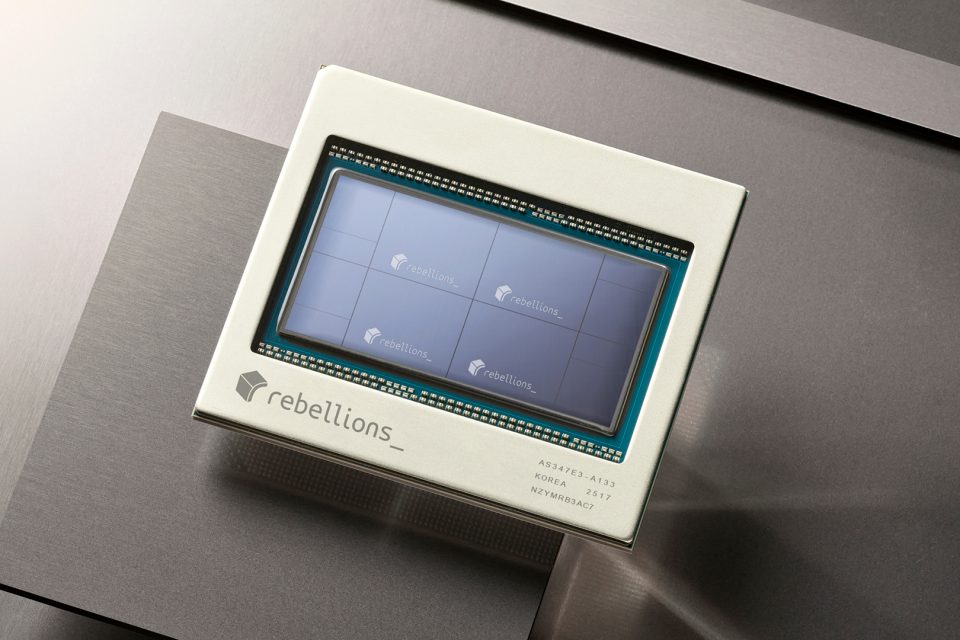
Image Credit: Rebellions
Gaining valuable experience in building an AI stack with SK Telecom, it’s pairing its field experience with an open source-first software strategy it said can help carriers move faster without locking scarce engineering talent into yet another proprietary AI stack. The company says it’s dedicated to using open-source software – everything from vLLM and OpenShift to PyTorch – with a “no forks” rule. The rule is designed to help customers avoid skills issues and ensure engineers don’t have to learn non-transferrable skills just to use its equipment.
Rebellions’ work with SK Telecom (SKT) has served as a foundational pillar of its engagement with other operators, according to Marshall Choy, Rebellions’ Chief Business Officer (CBO). The company is in conversations with between 10 and 20 operators around the world.
“Our systems have been deployed at SKT for nearly three years,” Choy said. “What does that mean? It means three years of lessons learned, institutional knowledge gain, product improvement and deep engagement with an end user customer working on real problems… It’s three years of blood sweat and tears that has become institutional knowledge,” he added.
The network operators in its pipeline are in “different stages of engagement and deployment” with Rebellions, Choy said, saying there will be “more to come on that.” While SK Telecom has been its most publicized partner to date, Choy said over the next 12 months Rebellions plans to highlight more of what has been going on under cover. That includes work with other telecom operators as well as neocloud operators, enterprises and governments.
According to Choy, the architecture prioritizes low-latency, high-throughput compute infrastructure. From a cost-efficiency perspective, the company targets a price-to-performance ratio that is two to three times more cost-effective than comparable Nvidia hardware. Furthermore, Rebellions delivers significantly higher energy efficiency. While an Nvidia DGX GB200 NVL72 system consumes upwards of 120 kilowatts per rack, Rebellions averages 4 kilowatts per system, or approximately 20 kilowatts per rack.
Choy noted that this power reduction yields a 6x savings in operational expenditure (OpEx). It also enables telecommunications providers to deploy Rebellions infrastructure in edge environments with stringent power constraints, such as legacy central offices. By retrofitting these distributed facilities with modern inference compute to serve LLM tokens, operators can maximize the lifecycle and return on investment (ROI) of their existing physical assets.
“Our goal is to reduce the unit economics of AI inferencing to near zero,” Choy said. While he admitted that sounds strange coming from an AI inferencing chip company, Choy explained that it’s all about making AI accessible for even more use cases – the ones where the math doesn’t work out today. “If you’re a telephone operator and you have an existing line card of services you provide, I can make you more profitable because I can lower your costs. But more strategically, what I can do is I can enable you to introduce a lower tier of services at a lower cost, which then makes AI inferencing accessible to a whole set of applications where it was previously too expensive,” he added.
It should be noted that Groq and SambaNova (see References below) are similarly working on chips to reduce the cost of inferencing. OpenAI appears to be moving in a similar direction with its Jalapeño chip.
Through its work with SK Telecom and others (unnamed), Choy said Rebellions has learned that customers aren’t just looking for hardware or software but for fully optimized infrastructure that cuts across both. That’s where Rebellions’ open-source ethos comes into play. “We didn’t want to have this mainframe model where everything is custom and bespoke and we’re this weird thing off in the side of the data center that doesn’t get touched by anything else,” Choy said. “It’s all about interoperability and integration.”
In conclusion, Choy opined, “Let’s be honest, the telcos don’t necessarily have all the right skills in place. So, being able to spread that across more of an open-source ecosystem means they can be in service and productive faster.”
References:
https://rebellions.ai/company/about/
https://rebellions.ai/category/blogs/
https://rebellions.ai/rebellions-product/rebel100/
SambaNova targets AI inference boom with chips built for existing data centers
Intel and AI chip startup SambaNova partner; SN50 AI inferencing chip max speed said to be 5X faster than competitive AI chips
AWS to deploy AI inference chips from Cerebras in its data centers; Anapurna Labs/Amazon in-house AI silicon products
Custom AI Chips: Powering the next wave of Intelligent Computing
Huawei to Double Output of Ascend AI chips in 2026; OpenAI orders HBM chips from SK Hynix & Samsung for Stargate UAE project
Huawei to Double Output of Ascend AI chips in 2026; OpenAI orders HBM chips from SK Hynix & Samsung for Stargate UAE project
Huawei to Double Output of Ascend AI chips in 2026; OpenAI orders HBM chips from SK Hynix & Samsung for Stargate UAE project
Superclusters of Nvidia GPU/AI chips combined with end-to-end network platforms to create next generation data centers
Analysis: Nvidia’s rumored new 6G AI-RAN – likely features/functions and industry impact
Executive Summary:
According to Light Reading, Nvidia is working on a GPU combo chip that would sit directly in the 6G radio unit [1.], extending its AI-RAN push from baseband/server into the radio itself. It’s reported to be a more hardware-integrated, sub-100W embedded design rather than just GPU acceleration in centralized RAN compute.
Note 1. 6G/IMT 2030 Radio Interface Technologies (RITs) have yet to be defined, let alone specified by 3GPP or ITU-R WP5D. They won’t be solidified until the end of 2030 so any specific silicon design won’t be completed until then or 2031!
……………………………………………………………………………………………………………………………………………………….
Light Reading’s headline frames it as a “radical new AI-RAN plan and they wrote that “the move was confirmed by knowledgeable sources, with Nvidia saying GPUs in more advanced radios will become “essential” in future. It marks a dramatic new development in the GPU giant’s “AI-RAN” strategy.”
If accurate, this would be a notable shift for Nvidia, because it would let them influence the whole RAN stack, not just centralized compute. That could matter for performance, power efficiency, and AI-native functions such as sensing, spectrum optimization, and real-time signal processing. Nvidia’s broader 6G messaging already emphasizes AI-native wireless, integrated sensing and communications, and spectrum agility as core themes.
The unconfirmed report fits Nvidia’s existing telecom roadmap rather than appearing out of nowhere. Nvidia has already announced an AI-native wireless stack for 6G with partners including Cisco, MITRE, Booz Allen, ODC, and T-Mobile, and it has promoted AI-RAN as a way to combine connectivity, computing, and sensing on one platform. It also aligns with the company’s recent partnership with Nokia, where Nvidia introduced the ARC-Pro 6G-ready accelerated computing platform and described it as a software-upgradable path from 5G-Advanced to 6G. That makes the rumored radio-chip move look like a vertical extension of the same strategy.
For wireless network operators, a radio-unit chip from Nvidia would be significant only if it improves cost, power, or flexibility versus incumbent RU silicon. The practical test will be whether it can deliver enough RF, baseband, and AI function integration to justify another architecture layer at the edge. It would also intensify competition in the radio-access supply chain and reinforce the trend toward AI-native, software-defined RANs. It also suggests Nvidia wants to shape not only the compute layer but the physical radio layer of 6G networks.
Possible AI Silicon Features and Functions:
Nvidia would most likely add AI-for-RAN features into radio silicon first, because those map directly to signal processing and link adaptation rather than to generic “AI at the edge.” Nvidia’s own AI-RAN materials emphasize embedding AI/ML into the radio signal-processing layer to improve spectral efficiency, coverage, capacity, and performance. Here are a few likely AI features/functions for the rumored 6G AI Nvidia super chip:
-
Neural channel estimation and equalization, to infer cleaner channel state from noisy RF observations and improve link reliability. Nvidia’s open-source Aerial release specifically calls out advanced neural models for channel estimation.
-
Real-time beam management, including beam selection, beam tracking, and beam refinement for massive MIMO and mmWave/upper-midband deployments. These are natural AI-RAN use cases because they depend on fast adaptation to changing propagation conditions.
-
Spectrum agility and interference mitigation, such as identifying jammed or congested resource blocks and dynamically avoiding them. NVIDIA and partners have already described spectrum agility applications that freeze only affected frequencies while keeping the rest of the system online.
-
Dynamic resource scheduling, using learned traffic and channel patterns to allocate PRBs, power, and compute more efficiently in real time. Nvidia describes AI-RAN as improving spectral efficiency and dynamic traffic handling through AI.
-
Integrated sensing and communications support, where the radio helps detect objects, motion, or environmental context in parallel with communication. Nvidia has already highlighted ISAC-style applications with camera/RF fusion and object tracking.
-
Edge inference hooks, letting the RU expose real-time PHY data to AI applications or a dApp-style framework. Nvidia’s open-source Aerial stack says third-party apps can access physical-layer data through secure APIs and modify RAN behavior in real time.
-
Self-optimization and closed-loop control, where the radio silicon learns local conditions and continuously retunes thresholds, coding, MCS selection, and precoding policies. That fits Nvidia’s broader framing of AI-native networks as software-defined and continuously adaptable.
The most plausible first wave is not a fully autonomous “AI radio,” but a hybrid RU chip that accelerates selected PHY functions and exposes telemetry/data paths to the rest of the AI-RAN stack. Nvidia’s current messaging emphasizes software-defined infrastructure, deterministic performance, and layered AI-RAN capabilities rather than replacing the entire RAN with a black-box model.
The real differentiator would be whether Nvidia can combine RF signal processing with its GPU/CUDA ecosystem, so the same platform handles channel learning, inference, and orchestration across RU/DU/CU tiers. That would let operators optimize for spectral efficiency and OPEX while still keeping a software-upgrade path to 6G. Radio electronics is constrained by power, latency, determinism, and certification, so Nvidia would need to prove these AI features help without destabilizing PHY timing. That is why the likely starting point is assistive AI inside the signal chain, not a fully learned end-to-end radio.
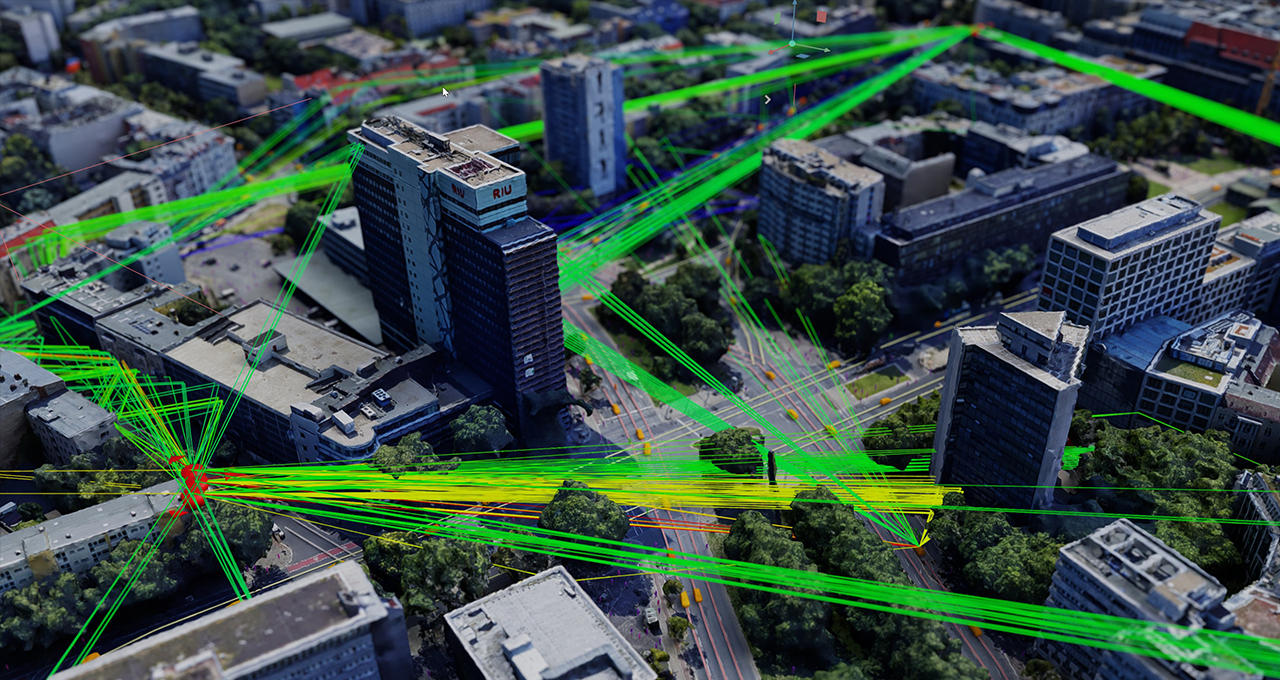
Image Credit: Nvidia
…………………………………………………………………………………………………………………………………………………………………………………………………………..
Competitive Analysis:
Nvidia’s reported move into a 6G radio-unit chip is most threatening to Marvell and Qualcomm at the silicon layer, while it is more of a strategic architecture challenge to Nokia and Ericsson at the system level. The immediate effect is less about a single chip and more about Nvidia trying to pull compute, connectivity, and AI deeper into the RAN value chain
Qualcomm is the closest direct competitor if Nvidia is trying to put silicon into the radio or near-radio layer. Qualcomm already has a Layer 1 strategy that combines silicon and software in SmartNIC/server-adjacent form factors, so Nvidia would be moving into a space where Qualcomm has both telecom credibility and established IP.
The risk for Qualcomm is that Nvidia can use its AI brand, CUDA ecosystem, and hyperscale relationships to redefine what “performance” means in RAN silicon, especially if AI-native functions become a buying criterion. The counterpoint is that Qualcomm still has a strong edge in wireless-specific silicon integration and standards heritage, which matters if the 6G radio path remains RF- and modem-centric.
Nokia looks less exposed in the short term because it is already partnering with Nvidia rather than treating it as a pure adversary. Nvidia and Nokia have publicly framed their relationship as an AI-native 5G-Advanced/6G platform effort, and Nokia says it will add NVIDIA-powered commercial AI-RAN products to its RAN portfolio.
Nonetheless, a Nvidia radio-chip push could still compress Nokia’s differentiation over time if more of the RAN stack becomes software-defined and GPU-centric. The strategic question is whether Nokia remains the integrator and operator-facing systems vendor, or whether Nvidia gradually becomes the architectural center of gravity.
Ericsson is the most structurally interesting case because it sits at the high end of global RAN share and has been more cautious about Nvidia as a Layer 1 option. Light Reading notes Ericsson is currently dismissive of Nvidia as a Layer 1 choice, even while the broader ecosystem explores AI-RAN collaboration.
For Ericsson, the threat is not immediate revenue loss from a single chip; it is erosion of the traditional assumption that RAN leadership comes from proprietary radio and baseband stacks. If Nvidia can make AI-native RAN a default design paradigm, Ericsson may be forced to defend its software and systems value rather than simply its box-selling model.
Samsung Electronics contacted Light Reading after their story was published to point out that it also works with AMD as a chip partner. “Samsung supports full Layer 1 (L1) processing using Intel’s telco CPUs (e.g., Xeon 6 Granite Rapids) and lookaside accelerator approach and in addition has successfully demonstrated full L1 processing on AMD’s CPUs without relying on dedicated L1 accelerators,” a Samsung spokesperson said via email.
Marvell is the most exposed chip supplier in this story because its telecom position is more concentrated in custom Layer 1 silicon. Light Reading specifically points out that Marvell is a critical supplier to Nokia in Layer 1, which makes a Nvidia radio-chip effort a direct substitution threat in portions of the stack.
If Nvidia succeeds, Marvell faces a two-sided squeeze: loss of design wins in telecom silicon and a narrative shift toward AI-native programmable platforms that favor Nvidia’s broader ecosystem. Marvell’s defense is that telecom operators still care about power, latency, and deterministic functionality, areas where custom silicon can remain more efficient than a generalized AI-compute approach.
…………………………………………………………………………………………………………………………………………………………………………
Summary Table:
| Company | Impact level | Why |
|---|---|---|
| Qualcomm | High | Direct silicon adjacency and overlapping Layer 1 ambitions. |
| Marvell | High | Telecom custom-silicon exposure, especially Layer 1. |
| Ericsson | Medium | Strategic and architectural threat more than immediate chip displacement. |
| Nokia | Medium to low near term | Partnered with Nvidia, so risk is more about future dependence and stack control. |
Source: Perplexity.ai
…………………………………………………………………………………………………………………………………………………………………………
Conclusions:
It’s unknown whether Nvidia’s rumored radio chip becomes a product, a reference design, or just an extension of its AI-RAN platform. If it ships, watch for operator trials, power-envelope disclosures, and whether it targets RU integration, DU acceleration, or a hybrid AI-RAN endpoint. If it stays at the partnership/reference-design level, the market impact will be more narrative than revenue-relevant.
Another unanswered question is whether Nokia and Ericsson keep treating Nvidia as a collaborator while preserving their own Physical layer control, or whether they start to see Nvidia as a platform owner in the making. That boundary will determine whether this is a tactical ecosystem play or the beginning of a deeper industry reset.
…………………………………………………………………………………………………………………………………………………………………………
References:
https://www.lightreading.com/6g/nvidia-has-a-radical-new-ai-ran-plan-a-6g-radio-unit-chip
https://www.lightreading.com/6g/analyst-insight-6g-coming-into-focus
https://www.nvidia.com/en-us/industries/telecommunications/ai-ran/
RAN Silicon Rethink- Part II; vRAN and General-Purpose Compute
Orange, Nokia, Nvidia, and Intel debate: ASICs vs. GPUs vs. General-Purpose CPUs for RAN Baseband Processing
RAN silicon rethink – from purpose built products & ASICs to general purpose processors or GPUs for vRAN & AI RAN
Dell’Oro: Analysis of the Nokia-NVIDIA-partnership on AI RAN
Nvidia pays $1 billion for a stake in Nokia to collaborate on AI networking solutions
Inside Nokia’s new AI Networking Innovation Lab
Analysis: Nvidia’s $2 billion investment in Marvell; NVLink Fusion ecosystem & RAN vendor silicon strategy
Marvell shrinking share of the RAN custom silicon market & acquisition of XConn Technologies for AI data center connectivity
Orange, Nokia, Nvidia, and Intel debate: ASICs vs. GPUs vs. General-Purpose CPUs for RAN Baseband Processing
For Orange CTO Laurent Leboucher, the main attraction of AI today lies in its potential to improve the efficiency of 5G radio access networks (RANs). That helps explain Orange’s recent collaboration with Nokia and Nvidia. Orange already deploys Nokia’s purpose-built 5G network equipment and software at mobile sites in France and other markets. Until recently, it had little obvious need for Nvidia, the U.S. chip making king best known for the graphics processing units (GPUs) used to train large language models. But Nokia and Nvidia became closely aligned last October, when Nvidia took a 3% stake in Nokia as part of a $1 billion investment. Nokia is now developing AI RAN software designed to run on GPUs.
Leboucher’s interest is driven in part by concerns over the cost of custom silicon — the application-specific integrated circuits (ASICs) used in purpose-built 5G networks. “It creates an opportunity to bring a general-purpose chipset instead of an ASIC implementation,” he told Light Reading at last week’s FutureNet World event in London. “I think we could, at some point, benefit from the economies of scale of new chipsets. That could be Nvidia.”
The rationale is much easier to understand than arguments about 5G for autonomous vehicles. Chip manufacturing is already expensive, and both Nokia and Ericsson expect component costs to rise further this year amid relentless AI demand. At the same time, the RAN market remains relatively small and has contracted. According to market research firm Omdia, telco spending fell from $45 billion in 2022 to $35 billion last year and is expected to stay at that level. In that context, it is increasingly difficult to justify designing high-cost chips with limited reuse outside telecom.

Image Credit: Orange
Last year, Nvidia spent about $18.5 billion on research and development, generated nearly $216 billion in revenue, and reported a gross margin of more than 70%. Its financial strength is not in question. If telecom operators can use its GPUs for RAN software, they may face less pressure to secure the long-term economics of 5G and 6G development. That alone could be enough to support the case for Nvidia. The counterarguments are cost and power consumption. By design, custom silicon is optimized for a specific workload and will always outperform a more general-purpose processor at that task. An Nvidia GPU in the RAN could therefore be seen as excessive — like using a crop duster to water a hanging basket.
Leboucher, believes that Nokia and Nvidia are developing something far more compact than a typical data-center deployment. “It is not a Blackwell GPU,” he said, referring to Nvidia’s current hyperscaler-class product line. “I have an understanding it’s something which is a little bit smaller.” One of the first GPU-based products is expected to come on a card that Orange can insert into an existing Nokia AirScale chassis.
He is also interested in replacing traditional RAN algorithms with AI to improve spectral efficiency and overall performance. Through trials with Nokia and Nvidia, Orange wants to determine whether a GPU is actually required to capture the full benefit. “We can completely rethink the way we are doing algorithms today, using AI for the radio Layer 1,” he said, referring to the most compute-intensive part of the RAN software stack. Some of the “AI-RAN” narrative still sounds “a little bit like science fiction,” Leboucher admitted. “But I think there are some very interesting ideas behind that. We want to understand where we are.”
This is not the first time the industry has debated a shift from ASICs to general-purpose processors for RAN equipment. Alongside its purpose-built 5G portfolio, Ericsson already offers cloud RAN products based on Intel CPUs. Samsung is now focused on Intel-based virtual RAN and has recently predicted the end of purpose-built 5G. Even so, cloud and virtual RAN still account for only a small share of live 5G deployments. Huawei and Ericsson, the two largest RAN vendors, remain committed to custom silicon development.
Nvidia’s entry into the market has clearly given Leboucher and his team more to evaluate as RAN technology becomes more sophisticated. “We are introducing new requirements for radio networks, typically for beamforming, and we have to consider the need for quite powerful chipsets,” he said. “Whether the best way to keep going is using ASICs or a general-purpose architecture – I think this is a good time to ask the question. Before, it was too early.”
The answer could shape Orange’s next major RAN decisions. The operator is preparing for what Leboucher describes as a “refresh” of RAN equipment across several countries ahead of the expected 6G launch in 2030. For the first time, he said, Orange will include cloud RAN as a “major option” in its request for proposal.
The concern around Intel as an alternative to Nvidia is its still-fragile financial position. Before December, Intel had been trying to spin off its network and edge group (NEX), which develops RAN chips. Those plans were later shelved, but the company’s net loss widened to about $4.3 billion in the most recent first quarter, from $887 million a year earlier, while revenue rose only 7% year over year to $13.6 billion. Cristina Rodriguez, who had led NEX, left this month to join Coherent, and Intel has not yet named a successor. “The shares jumped 28% in after-hours trading, taking Intel firmly into meme-stock territory,” said Radio Free Mobile analyst Richard Windsor in a blog published after results came out on April 23. “I say meme-stock because there is no other way to describe it when the shares are on a 2026 PER [price-to-earnings ratio] of 137x, and its technology looks obsolete.”
Orange places significant value on separating hardware from software, allowing the same RAN software to run across multiple hardware platforms. Ericsson and Samsung both say the virtual RAN software they have built for Intel CPUs could, with relatively modest changes, be ported to AMD silicon using the same x86 architecture or to Arm-based CPUs.
By contrast, Layer 1 code written for Nvidia GPUs and the CUDA software stack would not be portable to other platforms, according to Ericsson. “I think the main challenge we see with that is we are trying very hard to keep our stack portable, to give hardware options,” Michael Begley, Ericsson’s head of RAN compute, told Light Reading at MWC Barcelona this year. “If you go all in on one, it’s great, but you’re all in on one, and you can’t offer those other options to the operators or the ecosystem.”
Leboucher acknowledges that risk. “The risk of lock-in exists, definitely,” he said. “We really want to stay open. At the same time, we know that benefiting from a very, very large-scale general-purpose architecture should improve the TCO [total cost of ownership]. At the end of the day, it will be a trade-off. But we would welcome an architecture where we have the capacity at some point to decide to swap if we need to swap.”
Nokia’s hope is that much of the Layer 1 software written for Nvidia GPUs will eventually be deployable on other GPU platforms. But Nvidia’s near-monopoly in that segment leaves the industry with few alternatives for now. There is also optimism inside Nokia that GPU-based code could later be adapted for capable CPUs, although Ericsson’s comments suggest that would be much harder. For telecom executives, the choices made over the next couple of years may be pivotal as 6G approaches.
………………………………………………………………………………………………………………………………………………………
References:
https://www.lightreading.com/5g/orange-weighs-nvidia-against-intel-for-5g-chips-ahead-of-new-rfp
RAN Silicon Rethink- Part II; vRAN and General-Purpose Compute
RAN silicon rethink – from purpose built products & ASICs to general purpose processors or GPUs for vRAN & AI RAN
Analysis: Nokia and Marvell partnership to develop 5G RAN silicon technology + other Nokia moves
Analysis: Nvidia’s $2 billion investment in Marvell; NVLink Fusion ecosystem & RAN vendor silicon strategy
Ericsson goes with custom silicon (rather than Nvidia GPUs) for AI RAN
Marvell shrinking share of the RAN custom silicon market & acquisition of XConn Technologies for AI data center connectivity
Custom AI Chips: Powering the next wave of Intelligent Computing
OpenAI and Broadcom in $10B deal to make custom AI chips
Will Google Cloud’s AI and data analytics revenue +TPU IP licensing income offset huge AI CAPEX to produce a decent ROI?
Big Tech AI spending binge results in massive job cuts!
Cisco’s Silicon One G300 as the dominant AI networking fabric, competing with Broadcom’s Tomahawk 6 series
On February 10, 2026, Cisco announced the Silicon One G300 102.4 Tbps Ethernet switch silicon, claiming it can power gigawatt-scale AI clusters for training, inference, and real-time agentic workloads, while maximizing GPU utilization with a 28% improvement in job completion time. The G300 was said to offer Intelligent Collective Networking, which combines an industry-leading fully shared packet buffer, path-based load balancing, and proactive network telemetry to offer better performance and profitability for large-scale data centers. It efficiently absorbs bursty AI traffic, responds faster to link failures, and prevents packet drops that can stall jobs, ensuring reliable data delivery even over long distances. With Intelligent Collective Networking, Cisco can deliver 33% increased network utilization, and a 28% reduction in job completion time versus simulated non-optimized path selection, making AI data centers more profitable with more tokens generated per GPU-hour. Also, the Cisco Silicon One G300 is highly programmable, enabling equipment to be upgraded for new network functionality even after it has been deployed. This enables Silicon One-based products to support emerging use cases and play multiple network roles, protecting long-term infrastructure investments. And with security fused into the hardware, customers can embrace holistic, at-speed security to keep clusters up and running.
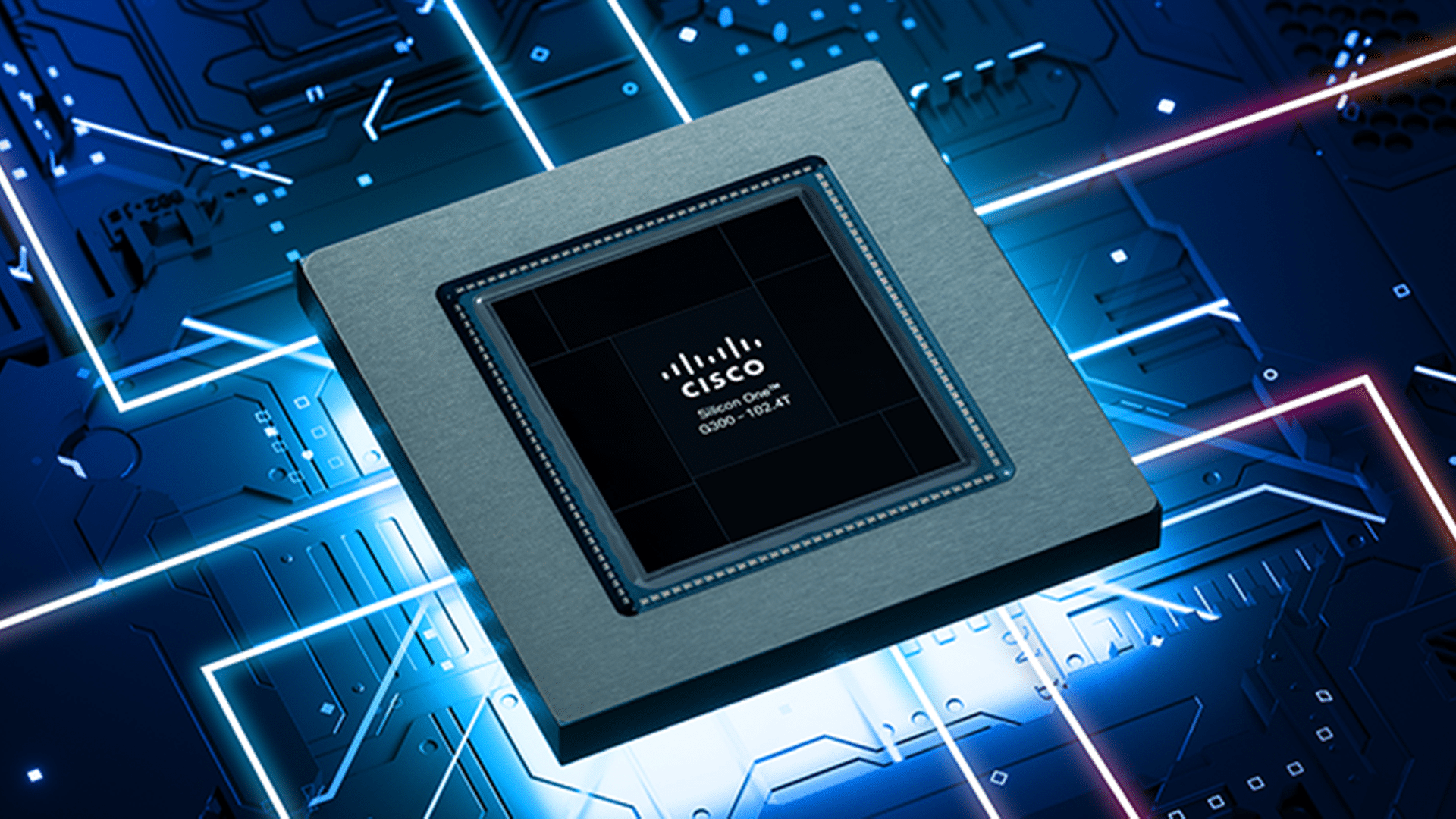
The Cisco Silicon One G300 will power new Cisco N9000 and Cisco 8000 systems that push the frontier of AI networking in the data center. The systems feature innovative liquid cooling and support high-density optics to achieve new efficiency benchmarks and ensure customers get the most out of their GPU investments. In addition, the company enhanced Nexus One to make it easier for enterprises to operate their AI networks — on-premises or in the cloud — removing the complexity that can hold organizations back from scaling AI data centers.
“We are spearheading performance, manageability, and security in AI networking by innovating across the full stack – from silicon to systems and software,” said Jeetu Patel, President and Chief Product Officer, Cisco. “We’re building the foundation for the future of infrastructure, supporting every type of customer—from hyperscalers to enterprises—as they shift to AI-powered workloads.”
“As AI training and inference continues to scale, data movement is the key to efficient AI compute; the network becomes part of the compute itself. It’s not just about faster GPUs – the network must deliver scalable bandwidth and reliable, congestion-free data movement,” said Martin Lund, Executive Vice President of Cisco’s Common Hardware Group. “Cisco Silicon One G300, powering our new Cisco N9000 and Cisco 8000 systems, delivers high-performance, programmable, and deterministic networking – enabling every customer to fully utilize their compute and scale AI securely and reliably in production.”
The networking industry reaction to Cisco’s newest ASIC has been largely positive, with industry analysts and partners highlighting its role in reclaiming Cisco’s dominance in the AI infrastructure market. For example, Brendan Burke of Futurium thinks Cisco’s Silicon One G300 could be the backbone of Agentic AI Inference. His take: “Cisco’s latest announcements represent a calculated move to assert dominance in the AI networking fabric by attacking the specific bottlenecks of GPU cluster efficiency. As AI workloads shift toward agentic inference, where autonomous agents continuously interact across distributed environments, the network must handle unpredictable traffic patterns, unlike the structured flows of traditional training. Cisco is leveraging its vertical integration strategy to address the reliability and power constraints that plague these massive clusters. By emphasizing programmable silicon and rigorous optic qualification, Cisco aims to decouple network lifespan from rapid GPU innovation cycles, ensuring infrastructure can adapt to new traffic steering algorithms without hardware replacements. The G300 is a bid to make Ethernet the undisputed standard for AI back-end networks.”
- Industry-Leading Specs: Market analysts have noted that the G300’s 102.4 Tbps switching capacity sets a new benchmark for AI scale-out and scale-across networking.
- Efficiency Gains: Initial simulations showing a 28% reduction in job completion time (JCT) and a 33% increase in network utilization have been cited as major differentiators for large-scale AI clusters.
- Sustainability Focus: The shift toward liquid-cooled systems for the G300, which offers 70% greater energy efficiency per bit, is being viewed as a critical move for sustainable AI growth.
- Competitive Positioning: Experts from HyperFRAME Research suggest that the new silicon signals a “new confidence” from Cisco, positioning them as the “Apple of infrastructure” by tightly integrating hardware and software.
- AI Infrastructure Pivot: Financial analysts at Seeking Alpha have upgraded Cisco’s outlook, viewing the company no longer as just a legacy hardware firm but as a central player in the AI revolution.
- Partner Confidence: Major partners, such as Shanghai Lichan Technology, have expressed excitement about the Nexus 9100 Series powered by this silicon, specifically for its ability to simplify and scale AI deployments.
- Nvidia & Broadcom Competition: While the G300 is seen as a strong challenger to Nvidia’s Spectrum-X and Broadcom’s Tomahawk/Jericho lines, some observers note that Cisco still faces a steep climb to regain market share lost to these competitors in recent years.
- Complexity Concerns: Some industry veterans have pointed out that while the silicon is “hyperscale ready,” the success of these ASICs in the enterprise will depend on Cisco’s ability to maintain operational simplicity through tools like the Nexus Dashboard.
……………………………………………………………………………………………………………………………………………………………………………………………
|
Cisco Silicon One G300
|
Broadcom Tomahawk 6 (BCM78910 Series)
|
|---|---|
|
Bandwidth
102.4 Tbps  |
Bandwidth
102.4 Tbps  |
|
Manufacturing Process
TSMC 3nm  |
Manufacturing Process
3nm technology |
|
SerDes Lanes & Speed
512 lanes at 200 Gbps per link  |
SerDes Lanes & Speed
512 lanes at 200 Gbps per link, or 1024 lanes at 100G |
|
Port Configuration
Up to 64 x 1.6TbE ports or 512 x 200GbE ports |
Port Configuration
Up to 64 x 1.6TbE ports or 512 x 200GbE ports |
|
Target AI Cluster Size
Supports deployments of up to 128,000 GPUs |
Target AI Cluster Size
Supports over 100,000 XPUs (accelerators) Broadcom |
- Congestion Management: Cisco differentiates its G300 with an “Intelligent Collective Networking” approach featuring a fully shared packet buffer and a load-balancing agent that communicates across all G300s in the network to build a global map of congestion. Broadcom’s Tomahawk series also includes smart congestion control and global load balancing, though Cisco claims its implementation achieves higher network utilization (33% better).
- Programmability: Cisco emphasizes P4 programmability, allowing customers to update network functionality even after deployment.
- Ecosystem & Integration: Broadcom operates primarily in the merchant silicon market, with their chips used by various partners like HPE Juniper Networking. Cisco uses its own silicon to power its
Nexus 9000 and 8000 Series switches, tightly integrating hardware with software management platforms like Nexus One for a unified solution.
- Cooling Solutions: The Cisco G300 is designed to support high-density optics and is offered in new systems that include liquid-cooled options, providing 70% greater energy efficiency per bit compared to previous generations.
………………………………………………………………………………………………………………………………………………………………………………
References:
https://newsroom.cisco.com/c/r/newsroom/en/us/a/y2026/m02/cisco-announces-new-silicon-one-g300.html
https://blogs.cisco.com/sp/cisco-silicon-one-g300-the-next-wave-of-ai-innovation
Will Cisco’s Silicon One G300 Be the Backbone of Agentic Inference?
Analysis: Ethernet gains on InfiniBand in data center connectivity market; White Box/ODM vendors top choice for AI hyperscalers
Cisco CEO sees great potential in AI data center connectivity, silicon, optics, and optical systems
Networking chips and modules for AI data centers: Infiniband, Ultra Ethernet, Optical Connections
Nvidia enters Data Center Ethernet market with its Spectrum-X networking platform
Will AI clusters be interconnected via Infiniband or Ethernet: NVIDIA doesn’t care, but Broadcom sure does!
Custom AI Chips: Powering the next wave of Intelligent Computing
by the Indxx team of market researchers with Alan J Weissberger
The Market for AI Related Semiconductors:
Several market research firms and banks forecast that revenue from AI-related semiconductors will grow at about 18% annually over the next few years—five times faster than non-AI semiconductor market segments.
- IDC forecasts that global AI hardware spending, including chip demand, will grow at an annual rate of 18%.
- Morgan Stanley analysts predict that AI-related semiconductors will grow at an 18% annual rate for a specific company, Taiwan Semiconductor (TSMC).
- Infosys notes that data center semiconductor sales are projected to grow at an 18% CAGR.
- MarketResearch.biz and the IEEE IRDS predict an 18% annual growth rate for AI accelerator chips.
- Citi also forecasts aggregate chip sales for potential AI workloads to grow at a CAGR of 18% through 2030.
AI-focused chips are expected to represent nearly 20% of global semiconductor demand in 2025, contributing approximately $67 billion in revenue [1]. The global AI chip market is projected to reach $40.79 billion in 2025 [2.] and continue expanding rapidly toward $165 billion by 2030.

…………………………………………………………………………………………………………………………………………………
Types of AI Custom Chips:
Artificial intelligence is advancing at a speed that traditional computing hardware can no longer keep pace with. To meet the demands of massive AI models, lower latency, and higher computing efficiency, companies are increasingly turning to custom AI chips which are purpose-built processors optimized for neural networks, training, and inference workloads.
Those AI chips include Application Specific Integrated Circuits (ASICs) and Field- Programmable Gate Arrays (FPGAs) to Neural Processing Units (NPUs) and Google’s Tensor Processing Units (TPUs). They are optimized for core AI tasks like matrix multiplications and convolutions, delivering far higher performance-per-watt than CPUs or GPUs. This efficiency is key as AI workloads grow exponentially with the rise of Large Language Models (LLMs) and generative AI.
OpenAI – Broadcom Deal:
Perhaps the biggest custom AI chip design is being done by an OpenAI partnership with Broadcom in a multi-year, multi-billion dollar deal announced in October 2025. In this arrangement, OpenAI will design the hardware and Broadcom will develop custom chips to integrate AI model knowledge directly into the silicon for efficiency.
Here’s a summary of the partnership:
- OpenAI designs its own AI processors (GPUs) and systems, embedding its AI insights directly into the hardware. Broadcom develops and deploys these custom chips and the surrounding infrastructure, using its Ethernet networking solutions to scale the systems.
- Massive Scale: The agreement covers 10 gigawatts (GW) of AI compute, with deployments expected over four years, potentially extending to 2029.
- Cost Savings: This custom silicon strategy aims to significantly reduce costs compared to off-the-shelf Nvidia or AMD chips, potentially saving 30-40% on large-scale deployments.
- Strategic Goal: The collaboration allows OpenAI to build tailored hardware to meet the intense demands of developing frontier AI models and products, reducing reliance on other chip vendors.
AI Silicon Market Share of Key Players:
- Nvidia, with its extremely popular AI GPUs and CUDA software ecosystem., is expected to maintain its market leadership. It currently holds an estimated 86% share of the AI GPU market segment according to one source [2.]. Others put NVIDIA’s market AI chip market share between 80% and 92%.
- AMD holds a smaller, but growing, AI chip market share, with estimates placing its discrete GPU market share around 4% to 7% in early to mid-2025. AMD is projected to grow its AI chip division significantly, aiming for a double-digit share with products like the MI300X. In response to the extraordinary demand for advanced AI processors, AMD’s Chief Executive Officer, Dr. Lisa Su, presented a strategic initiative to the Board of Directors: to pivot the company’s core operational focus towards artificial intelligence. Ms. Su articulated the view that the “insatiable demand for compute” represented a sustained market trend. AMD’s strategic reorientation has yielded significant financial returns; AMD’s market capitalization has nearly quadrupled, surpassing $350 billion [1]. Furthermore, the company has successfully executed high-profile agreements, securing major contracts to provide cutting-edge silicon solutions to key industry players, including OpenAI and Oracle.
- Intel accounts for approximately 1% of the discrete GPU market share, but is focused on expanding its presence in the AI training accelerator market with its Gaudi 3 platform, where it aims for an 8.7% share by the end of 2025. The former microprocessor king has recently invested heavily in both its design and manufacturing businesses and is courting customers for its advanced data-center processors.
- Qualcomm, which is best known for designing chips for mobile devices and cars, announced in October that it would launch two new AI accelerator chips. The company said the new AI200 and AI250 are distinguished by their very high memory capabilities and energy efficiency.
Big Tech Custom AI chips vs Nvidia AI GPUs:
Big tech companies, including Google, Meta, Amazon, and Apple—are designing their own custom AI silicon to reduce costs, accelerate performance, and scale AI across industries. Yet nearly all rely on TSMC for manufacturing, thanks to its leadership in advanced chip fabrication technology [3.]
- Google recently announced Ironwood, its 7th-generation Tensor Processing Unit (TPU), a major AI chip for LLM training and inference, offering 4x the performance of its predecessor (Trillium) and massive scalability for demanding AI workloads like Gemini, challenging Nvidia’s dominance by efficiently powering complex AI at scale for Google Cloud and major partners like Meta. Ironwood is significantly faster, with claims of over 4x improvement in training and inference compared to the previous Trillium (6th gen) TPU. It allows for super-pods of up to 9,216 interconnected chips, enabling huge computational power for cutting-edge models. It’s optimized for high-volume, low-latency AI inference, handling complex thinking models and real-time chatbots efficiently.
- Meta is in advanced talks to purchase and rent large quantities of Google’s custom AI chips (TPUs), starting with cloud rentals in 2026 and moving to direct purchases for data centers in 2027, a significant move to diversify beyond Nvidia and challenge the AI hardware market. This multi-billion dollar deal could reshape AI infrastructure by giving Meta access to Google’s specialized silicon for workloads like AI model inference, signaling a major shift in big tech’s chip strategy, notes this TechRadar article.
- According to a Wall Street Journal report published on December 2, 2025, Amazon’s new Trainium3 custom AI chip presents a challenge to Nvidia’s market position by providing a more affordable option for AI development. Four times as fast as its previous generation of AI chips, Amazon said Trainium3 (produced by AWS’s Annapurna Labs custom-chip design business) can reduce the cost of training and operating AI models by up to 50% compared with systems that use equivalent graphics processing units, or GPUs. AWS acquired Israeli startup Annapurna Labs in 2015 and began designing chips to power AWS’s data-center servers, including network security chips, central processing units, and later its AI processor series, known as Inferentia and Trainium. “The main advantage at the end of the day is price performance,” said Ron Diamant, an AWS vice president and the chief architect of the Trainium chips. He added that his main goal is giving customers more options for different computing workloads. “I don’t see us trying to replace Nvidia,” Diamant said.
- Interestingly, many of the biggest buyers of Amazon’s chips are also Nvidia customers. Chief among them is Anthropic, which AWS said in late October is using more than one million Trainium2 chips to build and deploy its Claude AI model. Nvidia announced a month later that it was investing $10 billion in Anthropic as part of a massive deal to sell the AI firm computing power generated by its chips.

Image Credit: Emil Lendof/WSJ, iStock
Other AI Silicon Facts and Figures:
- Edge AI chips are forecast to reach $13.5 billion in 2025, driven by IoT and smartphone integration.
- AI accelerators based on ASIC designs are expected to grow by 34% year-over-year in 2025.
- Automotive AI chips are set to surpass $6.3 billion in 2025, thanks to advancements in autonomous driving.
- Google’s TPU v5p reached 30% faster matrix math throughput in benchmark tests.
- U.S.-based AI chip startups raised over $5.1 billion in venture capital in the first half of 2025 alone.
Conclusions:
Custom silicon is now essential for deploying AI in real-world applications such as automation, robotics, healthcare, finance, and mobility. As AI expands across every sector, these purpose-built chips are becoming the true backbone of modern computing—driving a hardware race that is just as important as advances in software. More and more AI firms are seeking to diversify their suppliers by buying chips and other hardware from companies other than Nvidia. Advantages like cost-effectiveness, specialization, lower power consumption and strategic independence that cloud providers gain from developing their own in-house AI silicon. By developing their own chips, hyperscalers can create a vertically integrated AI stack (hardware, software, and cloud services) optimized for their specific internal workloads and cloud platforms. This allows them to tailor performance precisely to their needs, potentially achieving better total cost of ownership (TCO) than general-purpose Nvidia GPUs
However, Nvidia is convinced it will retain a huge lead in selling AI silicon. In a post on X, Nvida wrote that it was “delighted by Google’s success with its TPUs,” before adding that Nvidia “is a generation ahead of the industry—it’s the only platform that runs every AI model and does it everywhere computing is done.” The company said its chips offer “greater performance, versatility, and fungibility” than more narrowly tailored custom chips made by Google and AWS.
The race is far from over, but we can expect to surely see more competition in the AI silicon arena.
………………………………………………………………………………………………………………………………………………………………………………….
Links for Notes:
2. https://sqmagazine.co.uk/ai-chip-statistics/
3. https://www.ibm.com/think/news/custom-chips-ai-future
References:
https://www.wsj.com/tech/ai/amazons-custom-chips-pose-another-threat-to-nvidia-8aa19f5b
https://www.wsj.com/tech/ai/nvidia-ai-chips-competitors-amd-broadcom-google-amazon-6729c65a
AI infrastructure spending boom: a path towards AGI or speculative bubble?
OpenAI and Broadcom in $10B deal to make custom AI chips
Reuters & Bloomberg: OpenAI to design “inference AI” chip with Broadcom and TSMC
RAN silicon rethink – from purpose built products & ASICs to general purpose processors or GPUs for vRAN & AI RAN
Dell’Oro: Analysis of the Nokia-NVIDIA-partnership on AI RAN
Cisco CEO sees great potential in AI data center connectivity, silicon, optics, and optical systems
Expose: AI is more than a bubble; it’s a data center debt bomb
China gaining on U.S. in AI technology arms race- silicon, models and research