

1.6T Ethernet
1.6T Ethernet Packet Loss Problem Solved: PHY-Layer Buffer Exhaustion with MAC-Layer Credit-Based Flow Control
Introduction:
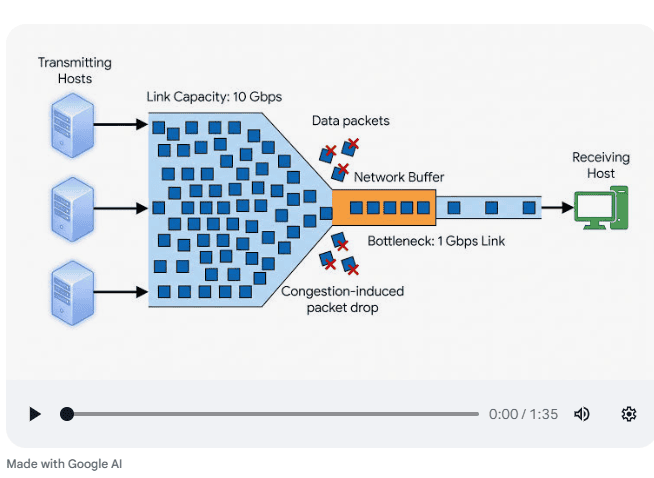
As network fabrics scale to support next-generation AI clusters and workloads, the industry is confronting a harsh physical-layer reality. Recent laboratory benchmarks evaluating 1.6 Terabit Ethernet (1.6T) data streams confirm that under saturated, wire-speed workloads, traditional packet-forwarding logic triggers instantaneous Physical layer (PHY) memory buffer exhaustion.
Recently released laboratory validation data provides the first definitive, real-world proof that the 1.6 Terabit Ethernet (1.6T) PHY layer packet loss problem has been solved in hardware. That’s enabled the networking industry to go from theoretical design to proven physical deployment for next-generation multi-terabit fabrics. While the Open Compute Project (OCP) outlined the architectural blueprint for Ethernet for Scale-Up Networks (ESUN) in February 2026, the live telemetry published from production-ready merchant silicon testbeds establishes a critical milestone: under saturated, wire-speed workloads, hardware-enforced Credit-Based Flow Control (CBFC) at the Media Access Control (MAC) layer successfully prevents physical layer (PHY) memory buffer exhaustion. In synchronized, collective AI training workloads (such as All-Reduce), dropping a single packet introduces a catastrophic tail-latency penalty that leaves expensive GPU clusters sitting idle.
This solution is primarily based on the data link-layer protocol stack defined by the Open Compute Project’s (OCP’s) Ethernet for Scale-Up Networks (ESUN) specification which was successfully tested at the OCP Summit last week by Keysight.
Last week’s hardware test results confirm that by combining the physical signaling foundation of the IEEE P802.3dj Task Force (within the IEEE 802.3 Working Group) with the active pacing blocks of the OCP ESUN specification, silicon architects can guarantee zero-packet-discard performance at full 1.6T line rates without relying on physically impractical silicon buffer footprints.
The Root Cause – Synchronized Bursts vs. PHY Buffers:
Traditional Ethernet was designed for asynchronous, distributed internet traffic where transient congestion could be absorbed by deep-buffer switches or managed gracefully by top-of-stack TCP/IP windows. AI scale-up environments flip this paradigm. Thousands of processing nodes push traffic simultaneously in synchronized, bursty phases. When a 1.6T pipe—operating on 8 channels of 224G SerDes using PAM4 modulation—receives an unpaced burst, the sheer data density overflows the tight SRAM allocation of the physical coding and routing components.
-
- Priority Flow Control (PFC / Pause Frames): Operates too coarsely. Sending a pause frame halts an entire traffic class across the link, creating head-of-line blocking, buffer bloat, and potential deadlock cascades across the data center fabric [Keysight Technologies Protocol Analysis].
- TCP/RoCEv2 Retransmissions: Re-sending a dropped packet introduces millisecond-level delays. In a tightly coupled cluster, the entire training job stalls until that single packet is recovered, destroying overall cluster efficiency.
| Architectural Dimension | IEEE P802.3dj Draft Standard | OCP ESUN Open Specification |
|---|---|---|
| Primary Layer Focus | Physical Layer (PHY) & Electrical Interfaces | Media Access Control (MAC) & Link Sublayer |
| Signaling & Plumbing | 8 lanes of 224G SerDes via PAM4 modulation | Inherits IEEE physicals, modifies packet frame encapsulation |
| Error Handling | Concatenated Forward Error Correction (Inner/Outer RS-FEC) | Link-Level Retry (LLR) for microsecond-range hardware recovery |
| Congestion Control | None (Best-effort link transport) | Credit-Based Flow Control (CBFC) per virtual channel |
| Header Efficiency | Retains standard 28–48 byte IP/UDP network headers | Strips network overhead down to a lightweight 4-byte L2 header |
-
- Short-Range Data Center Clusters (Up to 500 meters):
-
- Standard designation:
1.6TBASE-DR8 - Fiber Type:OS2 Single-Mode Fiber (SMF)
- Cabling Infrastructure: Uses a 16-fiber MPO/MTP connector layout. It utilizes a parallel structure with 8 fibers for transmitting (Tx) and 8 fibers for receiving (Rx) to run eight concurrent 200 Gbps PAM4 pathways.
- Standard designation:
-
- Campus and Intra-Data Center Links (Up to 2 kilometers):
-
- Standard designation:
1.6TBASE-DR8-2 - Fiber Type:OS2 Single-Mode Fiber (SMF)
- Cabling Infrastructure: Also utilizes parallel fibers over a 16-fiber MPO/MTP connector.
- Note: Non-IEEE multi-source agreements (MSAs) have also developed Wavelength Division Multiplexing (WDM) variants like 2×FR4 to hit this 2 km reach. These multiplex eight channels down onto a simpler, standard LC or dual mini-MPO/MTP duplex fiber layout over a standard OS2 cable.
- Standard designation:
-
- Short-Range Data Center Clusters (Up to 500 meters):
-
- Credit Allocation: The downstream receiving node advertises explicit buffer availability to the upstream transmitting node in the form of “credits,” segmented down to granular virtual channels
- Strict Transmission Gate: The upstream MAC transmitter is prohibited from sending a frame unless it possesses a valid credit for that specific virtual channel [Synopsys Architecture Blog].
- Hardware-Enforced Backpressure: As the receiving node’s physical buffers fill, it stops issuing credits. The transmitting node immediately pauses transmission at the silicon boundary, holding packets safely in scale-out network queues before they ever touch the physical wire [Keysight Technologies Protocol Analysis].
-
- Hyperscale Cloud Operators: Meta, Microsoft
- Silicon Architecture & Chip Design: AMD, Broadcom, Cisco, Intel, Marvell, NVIDIA
- Network & Optical Systems: Arista, Hewlett Packard Enterprise (HPE)
- Design & Automation Software: Cadence, Synopsys
+-------------------------------------------------------------------------+

|                  AI WORKLOAD LAYER (All-Reduce / Collective Communications) |
+-------------------------------------------------------------------------+

|                 OCP ESUN LINK LAYER (Base Specification 1.0)             |
|   - 4-Byte Segmented Frame Header (Stripped of traditional IP overhead) |
|   - Credit-Based Flow Control (Proactive virtual-channel buffering)     |
|   - Link-Level Retry (Microsecond-range local hardware error recovery)  |
+-------------------------------------------------------------------------+

|                 IEEE P802.3dj PHYSICAL LAYER (Draft Amendment)          |
|   - Multi-rate MAC Configuration (1.6 Terabits per second throughput)   |
|   - Concatenated Forward Error Correction (Inner & Outer RS-FEC)        |
|   - Physical Media Dependent Signaling (8 Lanes x 224G SerDes via PAM4) |
+-------------------------------------------------------------------------+

|                 PHYSICAL LAYER MEDIA (Data Center Infrastructure)       |
|   - OS2 Single-Mode Fiber (Max 500m via DR8 / Max 2km via 2xFR4 WDM)    |
|   - MPO-16 / MTP-16 High-Density Connectors                             |
+-------------------------------------------------------------------------+
References:
OCP ESUN – Network Operator Requirements – Base Specification 1.0. https://www.opencompute.org/news/the-ocp-esun-10-specification-has-been-released/