

Brooklyn AI-Native 6G Summit Highlights: Verizon’s 7 GHz Field Tests with Ericsson, AI-RAN Demonstrations and Wireless AI Interop

Introduction:

The Brooklyn AI-Native 6G Summit, held November 3–5, 2026, at NYU Tandon and hosted by Nokia and NYU WIRELESS, brought together industry and academic researchers to examine how artificial intelligence (AI) could reshape wireless networks and the infrastructure supporting them. The program covered AI-native radio access networks (AI-RAN), distributed AI computing, IP and optical networking, integrated sensing and communications (ISAC), and Physical AI.
Several demonstrations and announcements stood out, although most represent early-stage research or technology trials rather than commercially proven 6G capabilities.

Verizon’s 7 GHz 6G field testing:

Verizon CTO Yago Tenorio discussed the company’s ongoing 7 GHz field trials with Ericsson. The companies announced in October that they had completed a pre-standard 6G field call at a commercial site in Concord, California, using a 400 MHz carrier and Ericsson proof-of-concept equipment. The trial is examining propagation under different conditions, including line-of-sight and non-line-of-sight coverage, foliage, obstacles, and building penetration.  These trials are important because wide channels at higher frequencies could support the high data rates and sensing resolution envisioned for 6G. However, the coverage and deployment economics remain unresolved.

AI-RAN and wireless AI demonstrations:

  • China’s DeepSig demonstrated an over-the-air AI-RAN system using the open-source OCUDU RAN ecosystem and NVIDIA DGX Spark. Its demonstrations included neural receiver processing, ray-traced channel emulation and AI-based spectrum sensing. This was a meaningful integration demonstration, but publicly available information did not provide independent quantitative results for throughput, latency, spectral efficiency, power consumption or performance against conventional receivers. It therefore should not be interpreted as evidence of commercial readiness.
  • InterDigital and Arizona State University demonstrated research on interoperable AI-based channel-state-information (CSI) feedback. Their approach uses independently trained encoder and decoder models designed to interoperate without exchanging model parameters or requiring identical architectures. The prototype used an OpenAirInterface-based testbed. The researchers reported performance approaching jointly trained models.

–>This is a potentially important research direction: future wireless systems may need AI models from different suppliers to work together. However, the work remains limited in scope and does not establish a standardized interface or universal multi-vendor interoperability.
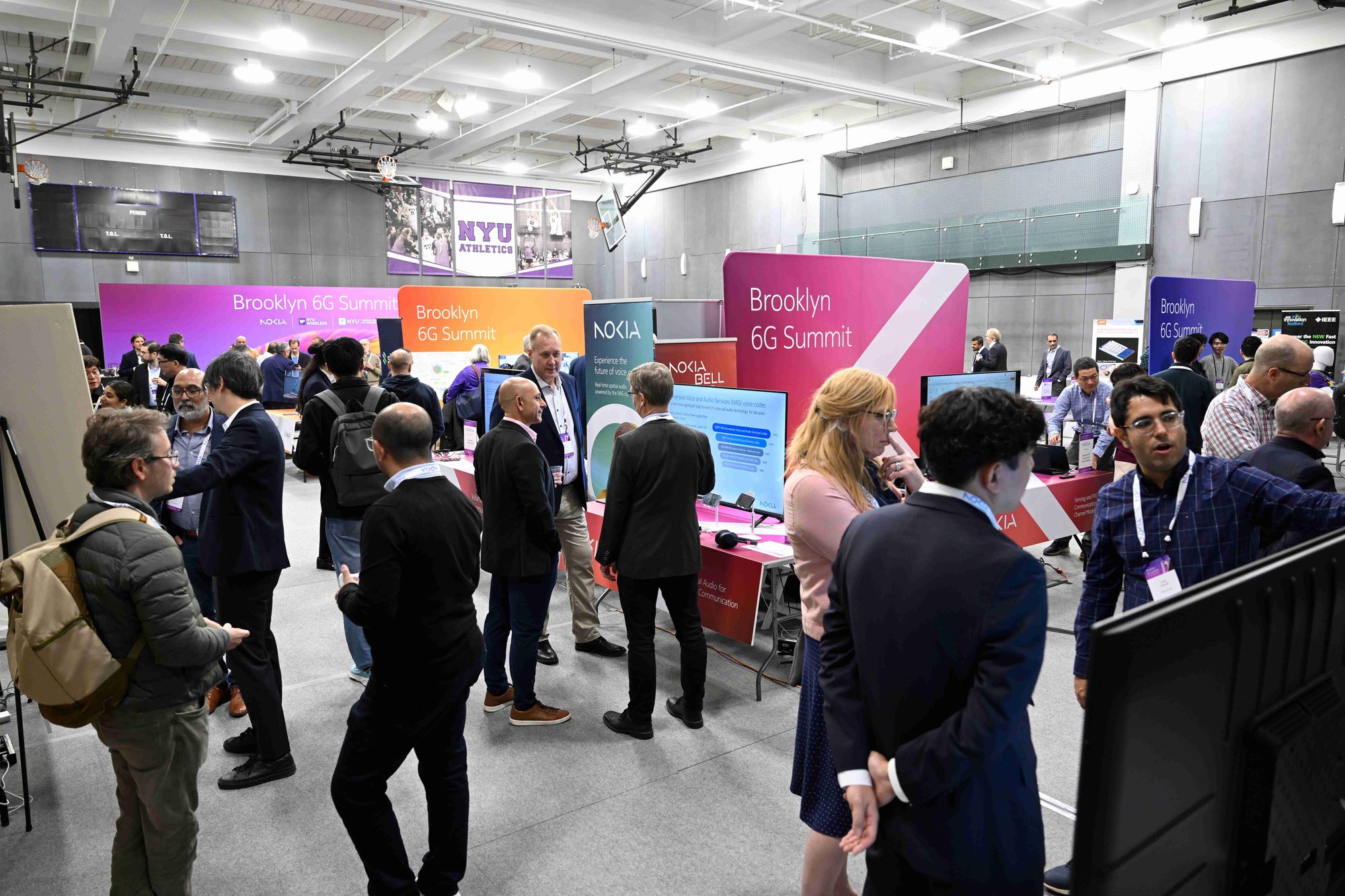
2026 6G Summit Exhibits

Physical AI and distributed infrastructure:

Another demonstration connected humanoid robots in Singapore with synchronized digital twins in Brooklyn. The project brought together Singapore’s Future Communications Program, NeuroRAN, Qualcomm Technologies, NVIDIA and MediaTek. Its workflow combined AI model selection, action generation, digital-twin validation and execution over a 5G/AI-RAN connection.

The demonstration illustrated how wireless connectivity, edge computing and AI orchestration could support remotely coordinated physical systems. However, the public description did not provide detailed measurements of end-to-end latency, synchronization accuracy, packet loss or operational reliability.

More broadly, the Brooklyn 6G Summit emphasized that AI-native networks will require coordination across mobile networks, cloud and edge computing, data-center switching, IP and optical transport. These infrastructure requirements are important, but the event did not establish a proven commercial business model for AI-RAN or AI-native 6G services.

Conclusions:

The Summit’s most useful contribution was to highlight both the opportunities and the engineering challenges facing AI-native 6G. Verizon’s 7 GHz trials exposed the propagation and coverage trade-offs associated with higher-frequency spectrum, emphasizing that future hardware architectures must evolve to overcome severe indoor building penetration limitations. DeepSig demonstrated an integrated AI-RAN research system, while InterDigital and Arizona State University explored a potentially important approach to interoperability between independently trained wireless AI models. The Physical AI demonstration illustrated how wireless connectivity and distributed computing could support connected robotic systems.
Ultimately, this 6G event underscored that scaling these technologies relies heavily on navigating broader, systemic bottlenecks. Chief among these is a shared sense of urgency regarding infrastructure power constraints, which threaten to restrict high-capacity AI-RAN and edge deployment at scale. True commercial realization will not come from advancing computing, AI, or networking in isolation, but through their absolute, cross-layer convergence into a workload-aware, distributed infrastructure.
These developments are worth watching, but they should not be confused with standardized, commercially deployable 6G technology. Significant work remains in radio performance, spectrum availability, AI model interoperability, network architecture, and deployment economics.

Editor’s Note: This summary is based on publicly available Summit announcements, demonstration descriptions, the published agenda and post-event reporting. Presentation slides and full session recordings were not publicly available at the time of writing. Where detailed performance data were unavailable, claims are attributed to the participating organizations.


References:

https://www.b6gs.com/

https://www.b6gs.com/exhibits

IEEE.tv — Brooklyn AI-Native 6G Summit

https://www.lightreading.com/6g/verizon-cto-assesses-7ghz-band-for-6g-after-first-call-in-the-field

Nokia — Brooklyn 6G Summit

Nokia: https://www.youtube.com/watch?v=og3f2v_WTSk

Ericsson’s announcement


Leave a Reply

Your email address will not be published.

You may use these HTML tags and attributes: <a href="" title=""> <abbr title=""> <acronym title=""> <b> <blockquote cite=""> <cite> <code> <del datetime=""> <em> <i> <q cite=""> <s> <strike> <strong>

*