

Data Center Cooling
Can Digital Twins Deliver Real Energy Savings for AI Data Center Cooling?
Disclaimer: ChatGPT was used extensively for research and writing this article.
………………………………………………………………………………………………………………….
Introduction:
Data center cooling systems consume significant auxiliary energy, yet optimization studies rarely quantify the gap between theoretically optimal and operationally deployable control strategies. The rapid expansion of AI infrastructure is creating a difficult engineering problem: how to remove increasing amounts of heat from densely packed accelerators without consuming an excessive share of the electricity needed to run them. Digital twins—virtual models of physical systems—are increasingly proposed as a way to optimize cooling. But can they consistently deliver meaningful energy savings in operating data centers, or will their benefits fall short of simulations and vendor expectations?
A new collaboration between Synopsys and the National University of Singapore (NUS) aims to help answer that question. Announced on October 29th, the project will combine engineering simulation, AI-assisted design, reduced-order modeling and physical testing through the Sustainable Tropical Data Center Testbed Phase 2.0 (STDCT 2.0). Its initial research concepts include two-phase direct-to-chip liquid cooling for high-heat AI accelerators and digital twins for predictive thermal management.
The proposed work is relevant well beyond Singapore. Data centers operating in hot, humid climates face demanding cooling conditions, while AI workloads are pushing rack power densities higher. NUS has identified cooling and ventilation as major contributors to data-center energy consumption in tropical environments. However, the collaboration is a research and validation effort—not evidence that the proposed digital twins have already delivered commercial-scale savings.
Brandon Wang, Strategic Management, Vice President, Technology Strategy & New Horizons, Synopsys, said:
“At Synopsys, we look beyond today’s opportunities to the new horizons that can strengthen our technology long term. Through our Technology Intelligence Center, our team connects emerging technology shifts with Synopsys capabilities and leading research ecosystems to turn promising ideas into strategic opportunities. Our collaboration with STDCT 2.0 reflects that commitment by bringing our silicon-to-systems engineering capabilities into a real-world environment for sustainable AI infrastructure.”
Source: Synopsys announcement via HPCwire.
What a digital twin can and cannot do:
A digital twin combines a model of a physical system with operational data to estimate its current state, predict its behavior and help determine how it should be operated. For data-center cooling, that can mean modeling coolant flow, temperatures, heat exchangers, pumps and the interaction between IT equipment and facility cooling systems.
The potential benefit is straightforward. Cooling equipment is often operated conservatively to maintain safe temperatures under changing workloads and environmental conditions. A sufficiently accurate model could identify opportunities to adjust coolant flow, supply temperatures and other control settings while maintaining thermal limits.
But a digital twin does not inherently save energy. It provides predictions and recommendations; actual savings depend on the accuracy of those predictions, the available control mechanisms and whether the operating system can safely implement the recommended changes.
There is also an important distinction between using a digital twin to evaluate a proposed design and using it to optimize a live data center. A model that predicts the behavior of a system under selected test conditions may not remain accurate as rack configurations, workloads, ambient temperatures and cooling hardware change.
The modeling challenge: accuracy under changing conditions:
Cooling a modern AI data center is a multiscale engineering problem. Heat originates at individual chips, moves through server cooling components and coolant loops, and ultimately must be rejected through facility-level equipment. The system’s behavior depends on interactions among thermal loads, fluid dynamics, control systems and the surrounding environment.
High-fidelity computational fluid dynamics and multiphysics simulations can help engineers understand these interactions. But detailed simulations can be computationally expensive, making them impractical for every real-time operational decision.
This is where reduced-order models (ROMs) become important. They approximate a more complex physical model using a computationally simpler representation. A digital twin can use such a model to estimate temperatures and evaluate operating changes more quickly.
The trade-off is that simplification can sacrifice accuracy outside the conditions used to develop and validate the model. AI-assisted models introduce additional questions: How well do they generalize to previously unseen conditions? How are prediction errors detected? What happens when sensors drift, telemetry is missing or an operating regime changes abruptly?
Synopsys and NUS propose to connect high-fidelity simulation with measurements from a physical testbed before developing reduced-order models. This is the right general direction. The critical test, however, will be whether model accuracy remains adequate across a broad range of operating conditions—not simply whether a model matches a limited set of laboratory measurements.
Evidence that optimization can work—but with constraints:
Research on liquid-cooled supercomputers illustrates both the opportunity and the need for caution. A 2026 study, Digital Twin-Based Cooling System Optimization for Data Center, examined liquid-cooling infrastructure at the Frontier exascale supercomputer. The researchers developed a surrogate model and validated it against a year of operational data. Their modeled optimization scenarios reported energy savings of 20.4% for flow-only optimization, 30.1% when jointly optimizing coolant flow and supply temperature, and 27.8% when practical actuator ramp-rate constraints were included.
These are encouraging results, but they are specific to the system, baseline operating conditions and optimization methods studied. They should not be interpreted as a forecast of savings for a typical enterprise or hyperscale AI data center. Nor do model-based estimates automatically establish that the same savings can be sustained after deployment.
The result also illustrates a central engineering point: the theoretical optimum is not necessarily the operational optimum. Cooling controls must respect equipment limits, thermal safety margins, response times and reliability requirements. Source: Research paper.
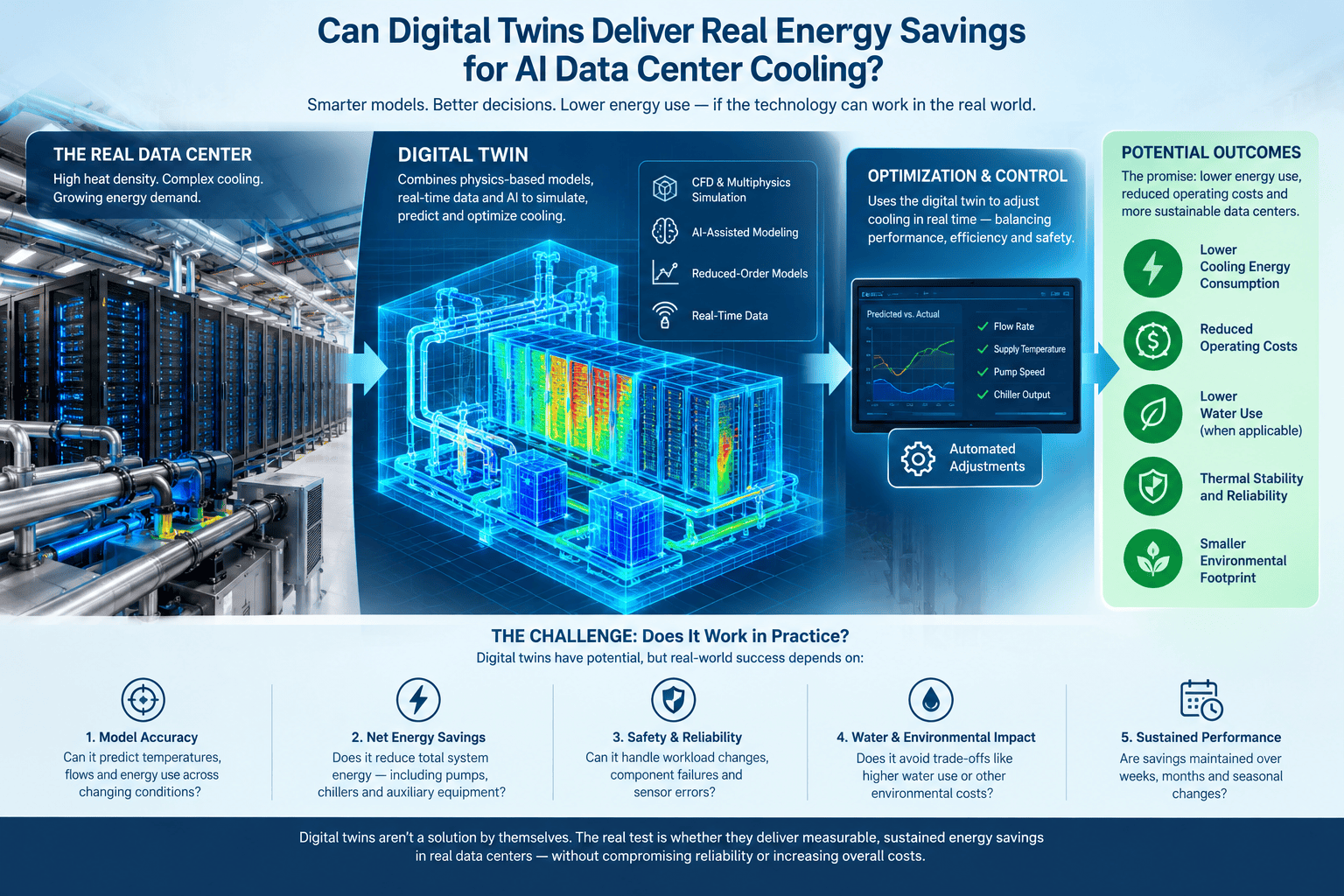
Image Generated by ChatGPT
………………………………………………………………………………………………………………………………………………………………………………………………
Five tests for a credible cooling digital twin explained:
Before data-center operators accept claims of substantial digital-twin-driven energy savings, they should ask for evidence on five fronts.
1. Independent validation of Model Accuracy. Does the model predict measured temperatures, flow rates and energy consumption accurately across different workloads, ambient conditions and cooling configurations? Validation should use data not employed to tune the model.
2. Net energy savings. Are savings measured across the complete cooling system, including pumps, coolant distribution units, heat rejection and other auxiliary equipment? Reducing one component’s power consumption is not enough if another component consumes more energy as a result.
3. Thermal safety and reliability. Can the controller respond safely to sudden workload changes, component failures, sensor errors and loss of cooling capacity? Energy optimization must not increase the risk of thermal excursions or equipment shutdowns.
4. Water and environmental impact. Does the proposed operating strategy reduce electricity consumption at the expense of greater water use or other environmental costs? The answer depends on the cooling architecture and local conditions, so both energy and water should be measured.
5. Sustained, real-world performance. Are the reported savings maintained over weeks or months, including seasonal changes and varying AI workloads? A controlled experiment is useful, but sustained operational evidence is more persuasive.
–>The comparison must also use an appropriate baseline. If a digital twin is compared with an unnecessarily conservative cooling configuration, the reported savings may overstate the benefit available in a well-tuned facility. Operators should compare it with existing best-practice controls under equivalent workloads and environmental conditions.
Why the Synopsys–NUS collaboration matters:
The STDCT 2.0 testbed offers a potentially useful environment for evaluating cooling technologies under tropical operating conditions. The collaboration’s proposed sequence—high-fidelity simulation, physical validation, reduced-order modeling and digital-twin integration—provides a framework for testing whether virtual models can support reliable operational improvements.
The planned investigation of two-phase direct-to-chip cooling is also significant. As AI accelerator heat flux rises, removing heat close to its source can become increasingly important. Yet the performance of a cooling technology cannot be judged by heat-transfer capability alone. Pressure drop, pumping requirements, fluid management, maintenance, reliability and heat rejection all affect the system-level result.
The same standard should apply to digital twins. A sophisticated model is not an outcome in itself. Its value lies in whether it helps operators make better decisions than existing monitoring and control systems—and whether those decisions produce measurable improvements without compromising reliability.
Conclusions:
The key take-away is to measure the savings, not the sophistication of the proposed solution for data center cooling. Digital twins could become valuable tools for managing AI data-center cooling, particularly as liquid-cooling systems grow more complex and operating conditions become less predictable. However, their effectiveness depends on the quality of the underlying physics, the representativeness of validation data, the reliability of sensors and controls, and the ability to maintain accuracy as the physical system changes.
The Synopsys–NUS project is worth watching because it proposes to connect simulation with physical testing rather than relying on modeling alone. Its significance will ultimately depend on the results: independently validated model accuracy, sustained reductions in total cooling energy, acceptable water use and reliable operation under real workloads.
For data-center operators, the decisive question is not whether a digital twin can predict cooling behavior. It is whether using one saves more energy than existing controls—consistently, safely and at an operational cost that makes deployment worthwhile.
……………………………………………………………………………………………………………………………………………………………..
References:
https://arxiv.org/abs/2410.05133
https://arxiv.org/abs/2605.15516
https://arxiv.org/abs/2610.33148
https://arxiv.org/abs/2603.01198
https://www.sciencedirect.com/science/article/pii/S0306261924012236
https://www.sciencedirect.com/science/article/pii/S030626192501791X
https://doi.org/10.1016/j.apenergy.2024.125100
AI Power Grid Crisis Triggers $30 Billion “Fuel-Cell Boom” for Data Centers
Telecom data centers must be redesigned for the AI era with rack scale architectures, enhanced power & cooling requirements
Liquid Dreams: The Rise of Immersion Cooling and Underwater Data Centers
PwC: Global AI data center spending to hit $31.6tn by 2050; Role of full stack orchestration layer explained
AI Compute Has a Switchboard Problem: Orchestration & Data Center Fabric Explained
Dell’Oro: Data Center Physical Infrastructure revenue to grow at 22% CAGR from 2025-2025/forecast comparisons, analysis, risks