
use cases
STL Partners webinar: Agentic AI needed for RAN autonomy & efficiency
Yesterday, a STL Partners webinar titled “Turning autonomy into margin: Agentic AI and the autonomous RAN,” suggested agentic AI is the missing layer that can turn RAN autonomy from a technical goal into a direct profit margin booster. It argues that operators should prioritize autonomy use cases by business impact, not just by how much automation coverage they add, and that the right roadmap can move autonomy from an engineering KPI to a commercial advantage.
The central message was that autonomy only matters if it improves economics (see poll results below). The webinar revealed that network operators need a dual-axis framework that combines the usual autonomous-network maturity view with a value-creation lens, so they can focus on the capabilities that scale into measurable business outcomes.
Agentic AI is presented as the practical enabler for moving beyond human-in-the-loop operations. In this framing, agents help orchestrate tasks, make decisions, and coordinate network actions in ways that support more closed-loop automation than traditional workflows can deliver.
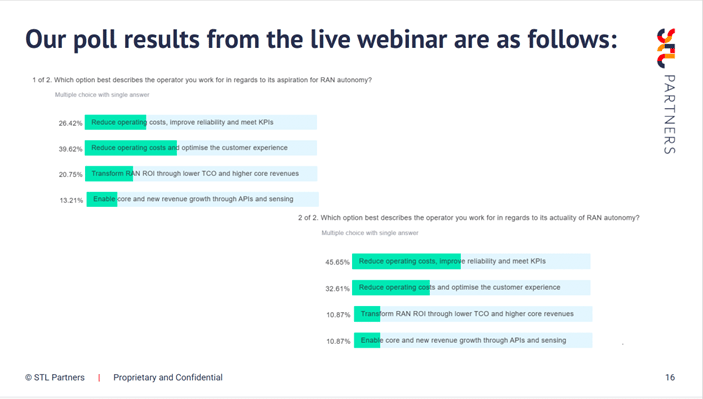
The results of an “actuality” poll relating to RAN autonomy revealed that controlling costs and reliability were most important, with the enablement of new revenue growth through APIs and sensing only scoring 10.87% of respondents. Similarly, results for an “aspirations” poll for RAN autonomy were also fairly evenly spread between reducing costs and optimizing the customer experience, with just 13.21% citing new revenue growth.
Source: STL Partners
Terje Jensen, SVP, global business security officer and head of network and cloud technology strategy at Telenor, said that he had expected to see network operators’ aspirations shift more clearly towards improving customer experience and even revenue generation, not just efficiency.
Darwin Janz, strategic technology planner at SaskTel, also thought network operators’ ambitions would be higher, but he noted that they still struggle to identify concrete, monetizable use cases. Without that, there’s a real risk of building technical solutions in search of a problem, rather than starting from clear enterprise needs and value, Darwin noted. “We really need to see those use cases and enterprise customer needs,” he added.
……………………………………………………………………………………………………………………….
The webinar was built around four practical questions:
- Which use cases create real commercial impact?
- How to shift from autonomy as an engineering metric to a margin driver?
- Where agentic does AI add value today?
- What data, orchestration, and organizational foundations are needed to scale beyond pilots.
For network operators, the implication is that autonomous RAN strategy should be tied to P&L outcomes such as lower operating cost, better resource utilization, and faster optimization cycles. The webinar’s message is that autonomy becomes strategically important only when it is deployed in a way that compounds across the network and business.
…………………………………………………………………………………………………………………..
References:
The Financial Trap of Autonomous Networks: Scaling Agentic AI in the Telecom Core
Nokia to showcase agentic AI network slicing; Ericsson partners with Ookla to measure 5G network slicing performance
T-Mobile US announces new broadband wireless and fiber targets, 5G-A with agentic AI and live voice call translation
Telecom operators investing in Agentic AI while Self Organizing Network AI market set for rapid growth
IEEE 802.11 considering LiFi as complement to WiFi
Executive Summary:
The Light Fidelity (LiFi) wireless protocol, which works from transmitters in light-emitting diode lamp bulbs, could function as a complement to Wi-Fi connectivity by offering faster internet access for mobile devices. The IEEE 802.11 standards committee is collecting industry feedback on a potential Li-Fi standard as noted in the section below.
Li Fi is an emerging wireless protocol that uses visible light spectrum to provide wireless networking access. A Li-Fi transmitter uses LED lights to modulate light intensity – mostly beyond what our eyes can perceive – and that is read as data by a photosensitive receiver. Because LEDs already use a chip to control their output they can modulate up to millions of times per second, theoretically allowing them to transmit data up to 100 times faster than Wi-Fi.
![fig(i)..Sending of data [2]](https://image.slidesharecdn.com/li-filatest-131027005455-phpapp02/95/li-fi-technology-6-638.jpg?cb=1382835371)
IEEE 802.11 Standards Status of LiFi:
IEEE 802.11 notes on the Topic Interest Group (TIG) page, “The introduction of light emitting diodes (LED) for general purpose lighting has created a growing interest in using the visible light spectrum for wireless communications……It is felt that the IEEE 802.11 is the best forum to drive forward the global standardization efforts for light communications with manufacturers, operators and end customers all present during the standardization process. If the TIG should progress to a Study Group and eventually into a Task Group, then this will not only help users within home, enterprise and industrial environments, but also assist manufacturers and operators to provide common components and services for IEEE 802.11 customers.”
At their July 2017 meeting, the IEEE 802.11 LC TIC unanimously recommended the continuation of the LiFi work via formation of a 802.11 LC Study Group. Hence, the 802.11 standards body is still seeking contributions before LiFi can become an official IEEE 802 standards project.
………………………………………………………………………………………………………..
Light Communications (LC) use cases:
-
Enterprise
-
Data access: where network connections are based on LC for daily work, conference streaming remote desktops along with potential video, etc. Enhanced data security can be achieved for organizations that require high level of confidentiality. The directionality of light propagation can effectively reduce interferences in heavily populated offices. Wireless off-loading to light releases spectrum for connecting other devices.
-
Use cases for RF sensitive facilities: for RF sensitive facilities such as hospital and mining, LC can provide safe data access where RF may not be allowed.
-
-
Home
-
Data access: where mobile devices use LC for high data rate network access. Especially for heavily populated apartments so that reduced interference and enhanced privacy can be achieved.
-
Home theater: Indoor use cases where high definition video and audio equipment connect to a LC AP
-
Virtual reality (VR): use cases where VR goggles are connected to a LC AP
-
-
Retail
-
Currently, delivery of high-bandwidth data at particular points in store requires cabled connection, making these spots immobile. Alteration of retail space to enable new customer experiences is a key part of retailer strategy. High-bandwidth flexible retail space through LC enables cost reductions for retailers when modifying or refitting the space.
-
LC can offer high data density that can enable very-high bandwidth content streaming without fear of interference with other wireless resources.
-
……………………………………………………………………………………………………………………..
Sidebar: The Problem with WiFi & How LiFi Complements it
WiFi signals don’t travel far, especially through walls. WiFi routers, operating on the traditional 2.4 GHz band, reach up to 150 feet (46 m) indoors and 300 feet (92 m) outdoors. At 5 GHz, WiFi signals only reach 40 or 50 feet. The higher the frequency, the shorter the wavelength. Hence, there’s less range at the same sensitivity and transmit power for 5 GHz vs 2.4 GHz WiFi.
Also, WiFi is notoriously insecure and easy to spoof by hackers. And even with the bandwidth increases over the years, an access point can be overwhelmed rather easily when too many people try to access it at the same time.
Li-Fi is meant to complement, not replace, Wi-Fi. It will co-exist in devices like smartphones, tablets and laptops, which would require a special receiver and transmitter to send and receive Li-Fi signals. That would also require a special encoder/decoder chip to convert the light signal to data.
………………………………………………………………………………………………………………..
Analyst Opinion:
Will Stofega, program manager for mobile device technology and trends at IDC, says good luck with that.
“Getting any standard approved is tough,” he told Network World. “There is always an ecosystem and political interests to play out. I think overall it needs a lot of work, but it’s the most promising of the alternative connection technologies.”