

Ookla: Starlink a viable competitor for hybrid 5G/NTN services due to network performance improvements and larger coverage area
SpaceX’s Starlink low-Earth orbit (LEO) satellite constellation providing high speed internet service is increasingly positioning itself as a scalable broadband access platform within the global telecom ecosystem. It now has growing relevance for both retail and enterprise connectivity use cases.
Network performance improvements (see below) have occurred alongside substantial subscriber growth. Starlink’s global user base expanded from approximately 4.6 million at the end of 2024 to over 10 million by early 2026, underscoring the LEO satellite platform’s ability to scale capacity while maintaining service quality.
This evolution is exemplified by T-Mobile’s “SuperBroadband” offering, which integrates 5G fixed wireless access (FWA) with Starlink satellite connectivity to deliver hybrid terrestrial–non-terrestrial network (NTN) solutions for business customers. The viability of such architectures is directly dependent on sustained improvements in satellite network throughput, latency, and service consistency.
Ookla Speedtest® data for the second half of 2025 indicates significant year-over-year improvements in Starlink’s performance across key network metrics. Median download speeds exceeded 100 Mbps in 49 states, compared to 23 states in 2H 2024, reflecting both increased system capacity and improved spectral efficiency. Performance gains were also observed across the lower quartile of users: 25th percentile download speeds improved in 48 states, with the number of states below 50 Mbps declining from eleven to two (Alaska and Florida). This shift indicates not only higher peak throughput but also improved quality of experience (QoE) consistency across the subscriber base.
Latency performance has also trended positively, driven by both constellation densification and architectural enhancements. While Starlink continues to target ~20 ms median latency, the number of states with median multi-server latency below 40 ms increased from one to ten between 2H 2024 and 1H 2025. By 2H 2025, top-performing regions—including New Jersey, Colorado, Arizona, and Washington, D.C.—achieved median latencies of approximately 37 ms, approaching parity with certain terrestrial broadband deployments and enabling latency-sensitive applications.
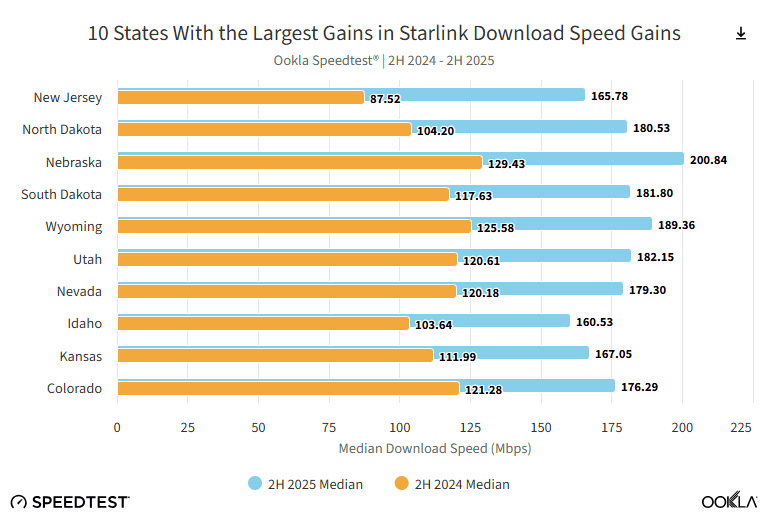
There has been a rapid expansion of the Starlink constellation and ongoing satellite technology upgrades. As of February 2026, the constellation exceeded 10,000 satellites in orbit, materially increasing aggregate network capacity and reducing cell congestion through greater spatial reuse. The deployment of Generation 3 (V3) satellites—featuring an order-of-magnitude increase (~10×) in downlink capacity relative to prior generations—has further enhanced throughput. Concurrently, upgrades to inter-satellite laser links have enabled more efficient space-based routing, reducing dependency on terrestrial gateway infrastructure, minimizing bottlenecks, and improving end-to-end latency performance.
Notably, these network enhancements have coincided with rapid subscriber growth. Starlink’s global user base expanded from approximately 4.6 million at year-end 2024 to over 10 million by early 2026, demonstrating the platform’s ability to scale capacity in line with demand while maintaining or improving key performance indicators.
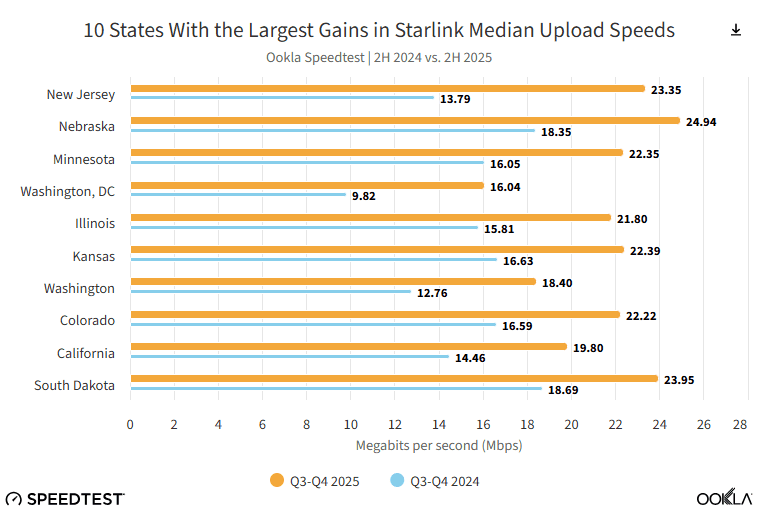
Uplink performance has also improved materially, with 22 states achieving median upload speeds ≥20 Mbps in 2H 2025, compared to zero states in the prior-year period. This threshold is aligned with the FCC’s current broadband definition, underscoring Starlink’s increasing capability to meet regulatory benchmarks for two-way broadband services. Nebraska, New Jersey, and Minnesota recorded the largest gains, with Nebraska leading overall at 24.94 Mbps median upload throughput.
However, performance gains remain uneven across certain geographies. States including Connecticut, Hawaii, and New Hampshire exhibited relatively modest uplink improvements, suggesting localized constraints related to capacity allocation, gateway distribution, or demand density. These variances highlight the continued importance of targeted constellation scaling and ground segment optimization to ensure uniform service quality.
In Q4, 44.7% of Starlink’s user base achieved the FCC’s 100/20 Mbps broadband benchmark, signaling the provider’s transition from a niche rural solution to a high-performance market disruptor. By scaling its LEO constellation to over 10,000 nodes and deploying higher-throughput payloads, Starlink has successfully optimized spectral efficiency and reduced latency, maintaining QoS even as its global subscriber base scaled to 10 million.
While the U.S. remains Starlink’s primary market, the competitive landscape is shifting. Amazon’s Project Kuiper faces significant deployment headwinds; despite an FCC mandate to orbit 1,618 satellites by July 2026, the company has only deployed roughly 240 units and has petitioned for a two-year extension due to launch capacity constraints. This market penetration places legacy GEO operators like Hughesnet and Viasat at a strategic disadvantage. Although these incumbents are leveraging aggressive pricing and CPE (Customer Premises Equipment) refreshes to stem churn, the inherent latency limitations of GEO architecture continue to pose a significant structural barrier to competing with LEO-based performance.
Overall, the data indicates that Starlink is transitioning from a niche rural broadband solution toward a more robust, high-capacity access network capable of supporting hybrid 5G/NTN architectures and enterprise-grade connectivity services.
…………………………………………………………………………………………………………………………………………………………………………………………………………….
Addendum – LEO vs GEO satellite internet:
The technical architectures of Low Earth Orbit (LEO) and Geostationary Earth Orbit (GEO) systems are fundamentally defined by their orbital altitude, which dictates their latency, link budget, and network complexity.
- Orbital Mechanics and Altitude:
- GEO satellites reside at a fixed altitude of approximately 35,786 km. They orbit at the same speed as the Earth’s rotation, appearing stationary from the ground, which allows for simple, fixed-point antenna installations.
- LEO satellites operate at significantly lower altitudes, typically between 160 km and 2,000 km. Because they are closer to Earth, they must travel at much higher velocities (approx. 28,000 km/h) to maintain orbit, completing a full revolution in about 90–128 minutes.
- Latency and Propagation Delay:
- GEO: The extreme distance results in a high propagation delay, with a typical round-trip time (RTT) of 500–600 ms. This is unsuitable for real-time applications like VoIP, gaming, or high-frequency trading.
- LEO: Proximity to Earth reduces latency to 20–50 ms, making the performance comparable to terrestrial fiber.
- Link Budget and Power Requirements:
- GEO: High path loss over 36,000 km requires high-power Traveling Wave Tube Amplifiers (TWTAs) and large, high-gain satellite antennas to maintain signal integrity. However, the terminal transmit power required for low-bitrate applications can actually be lower than LEO due to the stable, optimized architecture of legacy GEO MSS systems.
- LEO: Lower path loss enables the use of lower-power RF systems. However, the rapid movement requires complex phased array antennas at the user terminal to electronically track satellites and manage seamless handoffs between nodes in the constellation.
- Network Resilience and Capacity:
- GEO: A single satellite can cover up to 42% of the Earth’s surface, but capacity is centralized; a single point of failure can impact an entire region.
- LEO: Resilience is achieved through distributed constellations of thousands of satellites. These systems often utilize Intersatellite Links (ISLs)—optical or RF mesh networks in space—to route data between satellites, reducing the need for local ground gateways.
| Feature | LEO Architecture | GEO Architecture |
|---|---|---|
| Altitude | 160 – 2,000 km | ~35,786 km |
| Latency (RTT) | 20 – 50 ms | 500 – 600 ms |
| Coverage | Regional/Global via large constellation | ~1/3 of Earth per satellite |
| Terminal Type | Advanced tracking/Phased array | Fixed parabolic dish |
| Operational Life | ~5 years (due to atmospheric drag) | ~15 years |
…………………………………………………………………………………………………………………………………………………………………………………………………………….
References:
https://www.ookla.com/articles/starlink-hits-new-us-highs
Ookla: D2D satellite connectivity surged 24.5% during last 9 months; Starlink’s footprint expansion leads the way
US Mobile’s new bundle combines its multi-network mobile service with Starlink residential internet
Starlink doubles subscriber base; expands to to 42 new countries, territories & markets
Elon Musk: Starlink could become a global mobile carrier; 2 year timeframe for new smartphones
Direct-to-Device (D2D) satellite network comparison: Starlink V2 (Starlink Mobile) vs “Satellite Connect Europe”
Blue Origin announces TeraWave – satellite internet rival for Starlink and Amazon Leo
Amazon Leo (formerly Project Kuiper) unveils satellite broadband for enterprises; Competitive analysis with Starlink
China ITU filing to put ~200K satellites in low earth orbit while FCC authorizes 7.5K additional Starlink LEO satellites
GEO satellite internet from HughesNet and Viasat can’t compete with LEO Starlink in speed or latency
2 thoughts on “Ookla: Starlink a viable competitor for hybrid 5G/NTN services due to network performance improvements and larger coverage area”
Leave a Reply to Alan Weissberger Cancel Reply

Cable One, which operates in largely rural areas, is seeing competition from Starlink, but the pressure it is receiving from the satellite broadband service provider has been far from uniform.
There’s been “no consistency” from Starlink in the 70 days or so since Jim Holanda took the helm of the company, the CEO said Thursday on Cable One’s Q1 2026 earnings call. Starlink’s offers, installation costs and monthly pricing “is widely varied territory-to-territory, market-to-market,” said Holanda, who succeeded former CEO Julie Laulis earlier this year. Though Cable One has yet to see much consistency from Starlink, he views satellite broadband as a “formidable competitor.”
Those comments come as Starlink has become more aggressive with its pricing and its marketing, particularly at retail. And while Starlink started out primarily as a rural option, it has been encroaching into more suburban and urban settings as it seeks ways to monetize capacity. Starlink also has partnered with a couple of cable operators – Comcast and Alaska’s GCI – to help them provide connectivity to business customers that are out of the reach of terrestrial networks. Starlink leveled up on partnerships this week when it teamed with T-Mobile on a new, fully integrated business-focused offering called SuperBroadband that enables the carrier to use satellite broadband as a fallback.
Although Starlink has not stolen a lot of subs yet, Starlink’s haphazard market approach could make it difficult for Cable One to come up with a response, MoffettNathanson analyst Craig Moffett said in a research note (registration required).
Holanda said Cable One is keeping a close eye on satellite broadband and how Cable One will need to respond to this emerging threat. “While satellite shows up in very low circumstances and quantities, it certainly continues to go up,” he said. “We’re not going to let what happened kind of with FWA happen on the satellite front or even going back to my Dish and DirecTV days back in the early ’90s.”
https://www.lightreading.com/cable-technology/cable-one-seeing-inconsistent-competition-from-starlink
While satellites “are the most exciting thing out there” these days, their role is still limited when it comes to overall connectivity, said Srini Kalapala, Verizon’s SVP and chief network officer, wireless. “We see [satellite] as complementary,” Kalapala said Tuesday during a keynote discussion at Connect(X) in Ft. Lauderdale, Florida.
For example, support for direct-to-device (D2D) satellite services supplements emergency connectivity for Verizon’s mobile users, Kalapala explained. But, he added, it obviously plays a “critical role” in rural and low-density areas where it’s difficult to run fiber or even fixed wireless access (FWA).
And satellite’s capabilities are improving. Ookla reported today that Q4 2025 data from Speedtest users shows that 47.7% of Starlink users are getting the FCC’s minimum standard for broadband (100 Mbit/s down by 20 Mbit/s up). That’s well up from the 17.4% of Starlink users who could get that level of speed in Q1 2025.
But satellite runs into challenges in high-density areas. “In the most dense areas of our network…we deliver hundreds of gigs in a one square mile area. Satellite technologies cannot, at least under current physical principles, deliver that sort of throughput,” said Kalapala.
https://www.lightreading.com/satellite/satellite-still-a-complement-for-overall-connectivity-verizon-exec-says