

Dell’Oro: AI RAN revenue forecast: $35B from 2026-to-2030; 3 types of AI RAN explained
According to a new AI RAN Advanced Research Report published by Dell’Oro Group, cumulative AI RAN revenue is projected to reach $35 B over the next five years (2026-2030). However, AI RAN is not expected to expand the overall RAN market.
“Our market assessment and long-term AI RAN position remain unchanged,” said Stefan Pongratz, Vice President at Dell’Oro Group. “AI RAN is already happening and will scale ahead of 6G. At the same time, these tools will enhance the RAN, but they are unlikely to expand the overall RAN market. Even as suppliers introduce new software-based subscription models, we expect AI RAN to generate little, if any, incremental RAN revenue the end of the forecast period,” continued Pongratz.
Additional highlights from the June 2026 AI RAN Advanced Research Report:
- The base-case forecast assumes that AI RAN will not expand the RAN market. Nevertheless, AI RAN is expected to become an important technology enabler as operators incorporate greater virtualization, intelligence, automation, and O-RAN capabilities into their RAN roadmaps.
- GPU RAN projections have been revised upward—GPU RAN is now expected to be a $1 B+ market by the end of the forecast period.
- In the near term, the AI RAN market will remain centered on AI-for-RAN, single-purpose deployments, non-GPU architectures, D-RAN, and 5G.
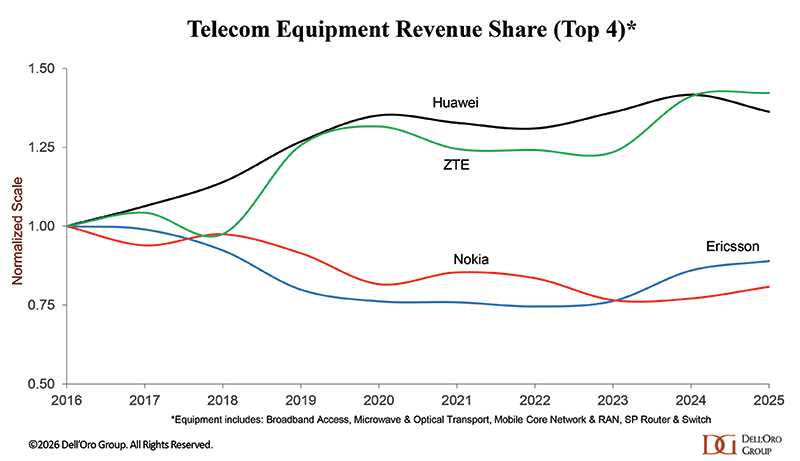
- Incumbent RAN radio and baseband suppliers are well-positioned in the initial AI RAN phase, driven primarily by AI-for-RAN upgrades leveraging existing hardware. Per Dell’Oro Group’s regular RAN coverage, the top five RAN suppliers contributed approximately 96 percent of 2025 RAN revenue. See charts below.
Dell’Oro Group’s AI RAN Advanced Research Report includes a 5-year forecast for AI RAN by location, tenancy, technology, and region. To purchase this report, please contact us at [email protected].
………………………………………………………………………………………………………………………………………………………………………….
Total & Wireless Telecom Equipment Revenue- top 4 and top 3:

………………………………………………………………………………………………………………………………………………………………………………….
Analysis (Source: Perplexity.ai AND Google Gemini):
There are three versions of AI-RAN which are not mutually exclusive:
- AI for RAN: Embeds AI into the base software stack to automatically manage radio waves, optimize spectrum efficiency, enhance beamforming, and reduce energy consumption in real time. Nokia, Ericsson, NVIDIA.
- AI on RAN: Uses cell towers and base stations as decentralized computing nodes. This allows telecom networks to host AI workloads locally rather than sending all data to distant cloud servers, providing ultra-low latency for applications like robotics, AR/VR, and autonomous vehicles. Nokia, NVIDIA, and operator trial partners like T-Mobile, Indosat, and SoftBank.
- AI and RAN: Combines the two to support “Networks for AI,” where distributed telecom networks act as an active, intelligent backbone to serve end-user AI traffic. AI-RAN Alliance plus Nokia and NVIDIA as the most visible industry champions.
References:
AI RAN to Reach $35 B Over Next Five Years, According to Dell’Oro Group
NVIDIA AI RAN video: youtube.com/watch?v=hwLLBfzoSko&t=26
AI-Era Cloud Network Transformation: A Reference Architecture and Implementation Roadmap
Ericsson goes with custom silicon (rather than Nvidia GPUs) for AI RAN
Dell’Oro: RAN Market Stabilized in 2025 with 1% CAG forecast over next 5 years; Opinion on AI RAN, 5G Advanced, 6G RAN/Core risks
AI-RAN Reality Check: hype vs hesitation, shaky business case, no specific definition, no standards?
Analysis: Nvidia’s rumored new 6G AI-RAN – likely features/functions and industry impact
Dell’Oro: 2H2026 Data Center Capex to Accelerate due to massive AI Deployments
Dell’Oro: Analysis of the Nokia-NVIDIA-partnership on AI RAN
RAN silicon rethink – from purpose built products & ASICs to general purpose processors or GPUs for vRAN & AI RAN
Dell’Oro: AI RAN to account for 1/3 of RAN market by 2029; AI RAN Alliance membership increases but few telcos have joined
Dell’Oro: RAN revenue growth in 1Q2025; AI RAN is a conundrum
3 thoughts on “Dell’Oro: AI RAN revenue forecast: $35B from 2026-to-2030; 3 types of AI RAN explained”
Leave a Reply

This forecast is too optimistic! Dell’Oro’s own recent commentary says AI RAN is already happening, but the current market is still mostly distributed AI-for-RAN. GPU-heavy “AI-and-RAN” remains small and non-GPU RAN should dominate over the forecast period. They also say AI RAN is expected to surpass $10B and reach about one-third of total RAN by 2029, but that is NOT new revenue.
The $35B figure from 2026 to 2030 implies very large cumulative spending or revenue capture over a short window, yet Dell’Oro is still describing the overall RAN market as essentially flat in 2026, with growth concentrated in a few subsegments rather than a broad market inflection.
That makes a $35B cumulative AI RAN number plausible ONLY if adoption broadens quickly across existing RAN deployments, and Dell’Oro itself flags structural constraints: tight power budgets, strict cost controls, and the difficulty of deploying power-hungry compute at every cell site. In other words, the market may grow, but the pace could be slower than a hype-driven reading of the headline suggests.
Dell’Oro’s latest view is clearly more bullish than a year ago: AI RAN is now described as moving “to the center court,” with broad adoption expected in the latter half of 5G and from the outset of 6G. They also say nearly all RAN roadmaps now incorporate AI-RAN capabilities, and that several operators and vendors are already shipping or piloting relevant solutions. On top of that, their 2025 forecast already pointed to AI RAN becoming roughly a third of the RAN market by 2029, which is a strong directional indicator even if the revenue accounting can be easy to misread.
If Dell’Oro is presenting its $35B forecast as a clean, new-revenue market opportunity for 2026–2030, that is likely too optimistic. If it is aggregating a broad definition of AI-related RAN spend across software, upgrades, and compute embedded in existing RAN refresh cycles, it becomes much more believable.
The key question is whether the $35B counts genuinely incremental AI-RAN revenue or just re-bundled RAN capex under a new label?
Dell’Oro has explicitly stated n its March 18, 2026 post “All Roads Lead to AI RAN”, where the forecast update states: “AI RAN is expected to surpass $10B and account for roughly one-third of the total RAN market by 2029 (this is not new revenue).”
It also made the same point more broadly in the July 10, 2025 press release “AI RAN to Top $10 Billion by 2029, According to Dell’Oro Group,” saying, “Near-term priorities are more about efficiency gains than new revenue streams,” and that “the base case is built on the assumption that AI RAN is not a growth vehicle.”
–>So Dell’Oro has explicitly framed its AI RAN forecast as a reallocation/efficiency story, not pure incremental revenue growth.
I agree! If one interprets the $35 billion as new, incremental money for wireless telecom operators, it is absolutely an overestimation. Dell’Oro explicitly states that AI RAN will generate “little, if any, incremental RAN revenue” by 2030. So AI RAN won’t generate any new revenue, according to Stefan.
Carrier Capex: Telecom operators are under massive financial strain. They are not growing their budgets; they are simply carving out a portion of their existing, flat RAN budgets (which are tracking at a stagnant 1% CAGR through 2030) to spend on AI-driven upgrades.
Finally, AI RAN equipment using GPUs will be much more expensive and consume much more power than conventional baseband silicon. Network operators can’t afford that!
Stefan Pongratz via LinkedIn:
The key takeaways from the recently updated AI RAN forecast are:
1) Our AI RAN position remains unchanged. AI RAN is accelerating rapidly and will scale before 6G. Cumulative AI RAN revenue is projected to reach $35 B over the next five years
2) AI RAN tools enhance the RAN, but they are not expected to grow the RAN market. Incremental RAN revenue from new AI RAN offerings is expected to be negligible.
3) Near-term AI RAN is centered on AI-for-RAN, single-purpose deployment, non-GPU, D-RAN, and 5G.
4) GPU RAN projections have been revised upward—GPU RAN is now expected to be a $1 B+ market by the end of the forecast period.
5) Incumbent RAN radio and baseband suppliers are well-positioned in the initial AI RAN phase, driven primarily by AI-for-RAN upgrades leveraging existing hardware.
Please note that, per Dell’Oro Group’s RAN coverage, the top five RAN suppliers (Huawei, Ericsson, Nokia, ZTE Corporation, Samsung Networks) accounted for approximately 96 percent of 2025 RAN revenue.