

Dell’Oro: High End Routing Revenue Increased 25% YoY in 2Q-2026; Cisco’s Resurgence due to Silicon One ASIC
According to a recently published report by Dell’Oro Group, High End Routing and Aggregation equipment revenue grew 25% year-over-year in the second quarter of 2026, fueled by stronger demand across all regions and customer segments. Notably, vendor direct sales revenue to cloud providers surged 94 percent year-over-year during the same quarter, driven by hyperscalers’ AI infrastructure push.
“Demand for High End Routers is growing at a very fast pace,” said Jimmy Yu, Vice President at Dell’Oro Group. “One reason for this accelerated growth is that hyperscalers are building more data centers and adding capacity to existing ones. This not only drives direct sales to cloud providers for data center interconnect and cloud access, but also indirect sales to communication service providers that build the wide area network and connections to enterprises,” added Yu.

Additional highlights from the 2Q 2026 High End Routing and Aggregation Report:
- For a fifth consecutive quarter, Core Router revenue grew at a high double-digit rate, reaching a new record revenue level in 2Q 2026. Edge Router and Enterprise High End Router also posted strong results this quarter, with revenue growing 20 percent and 31 percent, respectively.
- All three customer verticals—communication service provider, cloud provider, and enterprise/public—grew at a double-digit rate in the quarter. Communication service providers accounted for the majority of router revenue, followed by cloud providers.
- All of the major regions—North America, EMEA, Asia Pacific, and Latin America—grew at a double-digit rate in the quarter. The highest growth rates occurred in North America and Latin America.
………………………………………………………………………………………………………………………………………………………………………………………………………….
Analysis of Cisco’s Resurgence:
Silicon One has been a major enabler of Cisco’s improved position in high-end routing, particularly in hyperscale and AI-oriented backbone/interconnect deployments. But it is not the sole explanation, and “market-share gain” needs to be segmented carefully by routing category, geography, and customer type.
Cisco’s Silicon One strategy gave the company a competitive, internally controlled routing-silicon platform—initially embodied in the Cisco 8000 family—that combines high forwarding capacity, deep buffering, large-scale routing tables, programmable packet processing, and a common architecture spanning router and switch roles. Those capabilities matter directly in the high-end provider/core-routing market, where Cisco competes principally with Juniper, Nokia, and Huawei, as well as with white-box/merchant-silicon architectures in webscale environments. Cisco itself said Silicon One-based 8000 systems contributed to growth in its core-routing portfolio and webscale-provider business in fiscal 2024.
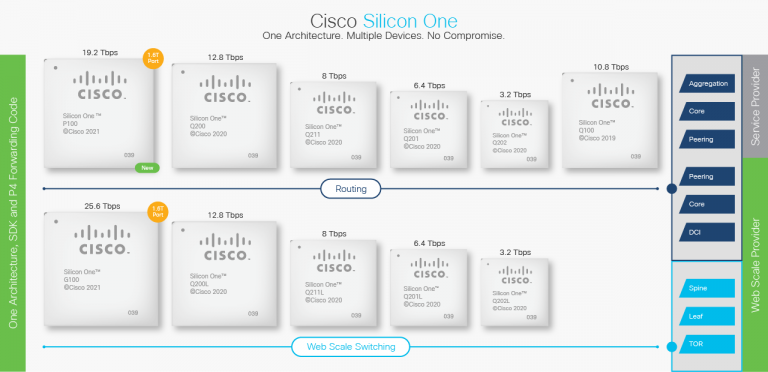
Image Credit: Cisco
……………………………………………………………………………………………………………………………………………………….
Silicon One changed Cisco’s proposition in several ways:
The original Q100 Silicon One device was introduced with roughly 10 Tb/s-class routing capacity and was designed for high-scale routing, programmable forwarding, deep buffering, and large distributed-router configurations. Cisco positioned it as a common platform capable of replacing different specialized roles—line-card processing, route processing, and fabric functions—with a unified architecture.
Subsequent devices increased the technical competitiveness of the platform. Cisco’s P100, for example, was positioned as a 19.2-Tb/s full-duplex routing ASIC with 112G SerDes, deep buffers, large tables, and a 28.8-Tb/s, 36-port 800GbE line-card design.
Silicon One is likely the technical foundation of Cisco’s recovery or expansion in high-end routing, while AI demand and optical/system integration are the near-term accelerants.
The AI impact is newer—and real:
The recent acceleration in Cisco’s high-performance networking business is increasingly tied to AI infrastructure, but this should not be confused with conventional service-provider routing share.
Cisco’s more recent Silicon One products span distinct roles:
-
G-series, such as G200, are particularly associated with high-radix Ethernet switching for AI back-end networks.
-
P-series, including P200, are deep-buffer routing silicon targeted at scaling AI infrastructure across data centers, not merely inside a single cluster.
-
Q-series devices have been central to Cisco 8000 routing platforms for service-provider and webscale use.
Cisco reported that approximately 60% of its fiscal-2026 AI-infrastructure orders were Silicon One-based systems, with the other 40% optics. It also attributed hyperscaler success to the scalability and programmability of Silicon One and said it expected further design wins around G300, G200, and P200 devices. This supports the conclusion that Silicon One is now central to Cisco’s high-performance networking momentum.
However, the G200-driven surge is more directly a data-center AI Ethernet switching story than proof of a broad-based win in the traditional carrier high-end-routing market. Industry reporting described G200 as the core of Cisco’s AI systems orders in 2025, aimed at Ethernet AI-cluster fabrics.
Attributing market-share progress wholly to the ASIC would overstate the case. Silicon One is necessary competitive infrastructure, but routing wins still depend on a larger system proposition:
-
IOS XR and operational maturity. Large carriers buy a software, automation, telemetry, reliability, and lifecycle platform—not merely a forwarding chip.
-
Optics integration. Cisco’s Acacia coherent-optics assets and pluggable optics portfolio strengthen the routed-optical/network-interconnect proposition. Cisco reported service-provider-routing and Acacia-optics growth together in fiscal 2026.
-
400G/800G upgrade cycles. Capacity migration creates opportunities for vendors with credible density, power, and system-roadmap advantages.
-
AI data-center interconnection. Distributed AI introduces demand for high-capacity routed interconnects between clusters, campuses, and data centers—an adjacent growth vector that favors high-scale routing platforms.
-
Supply-chain and product control. Owning silicon lets Cisco coordinate ASICs, systems, software, and optics rather than aligning its roadmap entirely to merchant-chip availability.
-
Commercial execution. Hyperscaler design wins, account relationships, pricing, support, and ability to meet qualification requirements remain decisive.
Cisco’s stated plan to extend Silicon One throughout its high-performance networking systems by fiscal 2029 makes clear that it regards vertical integration as a strategic differentiator rather than merely a component substitution.
In conclusion, Cisco’s gain in high-end routing is substantially enabled by Silicon One because the ASIC family restored Cisco’s competitiveness in bandwidth density, routing scale, buffering, programmability, and power efficiency—especially in webscale, cloud, and emerging AI interconnect opportunities. But the resulting commercial gains reflect the combined offer of Silicon One, Cisco 8000 platforms, IOS XR, coherent optics, customer relationships, and favorable upgrade cycles—not the ASIC in isolation.
………………………………………………………………………………………………………………………………………………………………………………………
References:
High End Routing and Aggregation Market Grew 25 Percent in 2Q 2026, According to Dell’Oro Group
https://blogs.cisco.com/sp/ciscosilicononep100announcement
Cisco’s Silicon One G300 as the dominant AI networking fabric, competing with Broadcom’s Tomahawk 6 series
Cisco Execs: New “Network Supercycle” as Agentic AI Workloads Reshape Telecom Infrastructure
Cisco report: Agentic AI to reshape WAN traffic, AI inference will be ~25% of total traffic by 2035
Analysis: Cisco, HPE/Juniper, and Nvidia network equipment for AI data centers
Impact of optical component shortages & bottlenecks explained + Hyperscaler’s CAPEX
Cisco CEO sees great potential in AI data center connectivity, silicon, optics, and optical systems
Cisco 800G line card for Cisco 8000 Series Routers powered by Silicon One ASIC
Cisco’s ‘Internet of the Future’ Strategy with Silicon One Architect
Cisco restructuring plan will result in ~4100 layoffs; focus on security and cloud based products
One thought on “Dell’Oro: High End Routing Revenue Increased 25% YoY in 2Q-2026; Cisco’s Resurgence due to Silicon One ASIC”
Leave a Reply

Record 2Q 2026 WLAN Shipments Drive Market to Double-Digit Growth:
Dell”Oro says WiFi vendors sold over 10 billion Access Points (APs) in 2Q 2026, setting an industry-wide record for the volume of AP shipments.
“WLAN average selling prices (ASPs) increased only moderately, while AP shipments soared,” said Siân Morgan, Senior Director at Dell’Oro Group. “Enterprises have squeezed in orders before prices rise further. We expect ASPs to rise throughout the year, reflecting the growing cost of memory components due to the AI build-out.
“Sales of Wi-Fi 7 accounted for over half the market in 2Q26. We expect to see some revenue from Wi-Fi 8 as early as next year, but Wi-Fi 7 adoption will continue to rise into 2028,” added Morgan.
Additional highlights from the 2Q 2026 Wireless LAN Quarterly Report:
With the shortage of memory components still not resolved, we expect prices to continue rising, and equipment lead times to be variable in a supply-driven market.
Vendors shipped the highest number of access points with multi-gig and 10 Gbps interfaces ever.
The WLAN market grew by double digits across all regions, with the highest growth in Europe.
Revenue from Outdoor APs has outpaced the market for 7 of the last 8 quarters.
https://www.delloro.com/news/wi-fi-7-surpasses-50-percent-of-the-market-with-wi-fi-8-on-the-horizon/