

FCC plans 6G spectrum auctions before IMT 2030 frequencies have been identified and without a 6G frequency arrangement standard
Executive Summary:
Federal Communications Commission (FCC) Chairman Brendan Carr said Wednesday that a series of planned wireless-spectrum auctions could generate more than $100 billion in proceeds over the next several years. In July, the FCC voted to conduct a 2027 auction of 160 megahertz of mid-band spectrum in the Upper C-Band (3.98–4.2 GHz), creating a contiguous “super band” of over 440 megahertz.
Mr. Carr said the agency is also preparing three additional auctions targeting pipeline bands such as 1.6 GHz, 2.7 GHz, 4.4 GHz, and 7 GHz for 6G commercial use. The FCC has formally notified stakeholders of those plans and is targeting completion of all four auctions by the end of 2028.
Carr said demand for licensed spectrum extends beyond the three national mobile network operators—AT&T, Verizon, and T-Mobile, which collectively provide nearly all U.S. mobile service. He said the planned auctions could broaden participation in the wireless ecosystem and promote additional competition. “We’re seeing real response in the market in ways that we didn’t see just a couple of years ago,” Carr said.
–>We sincerely doubt that after Dish Wireless’ spectaular 5G O-RAN failure!
The FCC’s auction strategy follows several high-profile spectrum transactions. In May, the agency approved EchoStar’s $40 billion sale of wireless-spectrum assets to SpaceX, AT&T, and Verizon. It also approved Verizon’s 2024 $1 billion transaction to acquire selected spectrum assets from U.S. Cellular.
SpaceX acquired spectrum to support Starlink’s direct-to-device service and other satellite-enabled connectivity offerings. Last week, the FCC said it was advancing efforts to make additional spectrum available for space-based broadband services. The agency had previously approved SpaceX’s plan to deploy thousands of additional satellites intended to support next-generation mobile services and broadband speeds of up to 1 Gbit/s.
The Trump administration said Friday that it is laying the policy and regulatory groundwork for multiple 6G-focused spectrum auctions in 2028. The FCC is accelerating its spectrum-auction agenda in response to rapid growth in wireless demand and emerging applications, including artificial intelligence workloads, autonomous vehicles, connected sensors, and other advanced connectivity use cases.
“It’s more competition. It drives prices down for consumers. It raises money for the Treasury,” Carr said, noting that a prior auction raised funds to replace Chinese gear in U.S. networks that raised national security concerns.
The planned auctions come as mobile-data demand continues to increase, albeit at a slower rate. CTIA, the wireless-industry association, reported that U.S. consumers used 159.3 trillion MB of mobile data in 2025, a 20% increase from 2024. CTIA also said AI-related traffic is growing at roughly three times the rate of conventional wireless traffic and could account for nearly one-third of all broadband traffic by 2034.
Nokia’s 6G Spectrum Vision:
From a regulatory perspective, IMT’s identification of new spectrum in the extended mid-band will be vital for the industry, as it can enable global or regional harmonization, provide regulatory certainty for technological investments in the ecosystem, and create economies of scale for faster development and broader adoption.

Nokia on 6G Drivers:
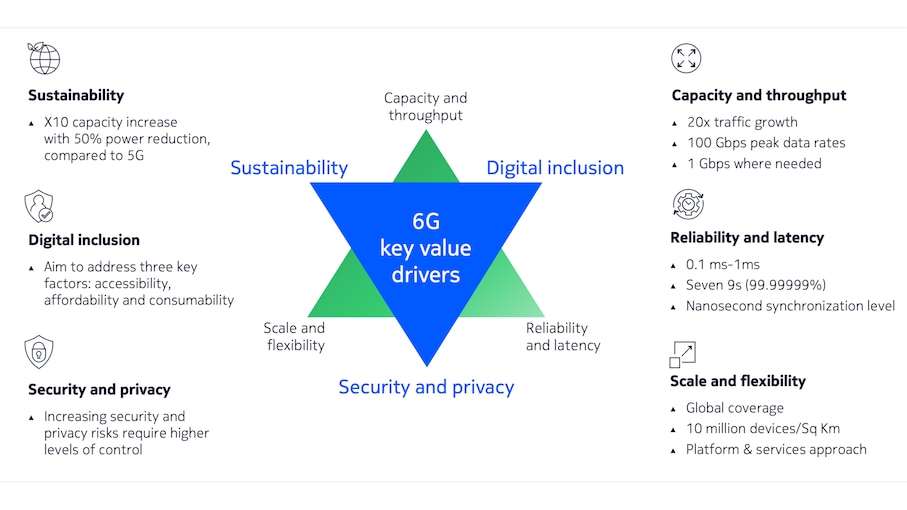
Analysis- What the FCC is Totally Missing:
What the FCC’s 6G auction planning appears to overlook is the international spectrum-harmonization timeline. The FCC’s accelerated 6G auction agenda risks getting ahead of the global standards and spectrum-harmonization process. Frequency bands for 6G, formally addressed by the ITU as IMT-R-2030, will not be identified at the international level until the ITU-R World Radiocommunication Conference 2027 (WRC-27) which will take place in Shanghai, China, from October 18 to November 12, 2027.
Starting at ITU-R WP 5D meeting #57, which takes place in Jan/Feb 2028, 5D will start to develop IMT-2030 frequency arrangements for the designated bands identified at WRC-27. Those frequenc arrangements are vitally important because they establish the technical basis for globally or regionally harmonized use of spectrum, including band plans and deployment approaches that support equipment interoperability, scale, and international roaming. They should greatly simplify IMT 2030 roaming between carriers that use the same 6G frequency bands.
As a result, auctioning spectrum specifically characterized as “6G” before that process is complete could force U.S. policy ahead of the eventual international framework. The FCC can prepare candidate bands, study sharing and coexistence conditions, and develop auction authority and rules in advance, but it cannot yet know which bands will ultimately receive broad international support for IMT-2030.
Importance of a 6G Frequency Arrangements Standard:
The explicit purpose of this ITU-R recommendation (international standard) is to guide administrations in selecting transmitting and receiving frequency arrangements for terrestrial IMT and to promote efficient spectrum use.
Core functions of IMT frequency arrangements:
In summary, IMT frequency arrangements do considerably more than identify whether a band uses FDD or TDD. They define the uplink and downlink frequency blocks, duplex direction, duplex separation, center gap, carrier-pairing relationships, usable sub-band segmentation, and alternative arrangements needed to translate an IMT identification into an interoperable and commercially deployable spectrum plan.
A Very Bad Omen from ITU-R WP5D – 2.8 Year Gap Between IMT 2020 Co-Recommendations M.2150-0 and M.1036-7:
One should not equate a WRC-27 IMT frequency identification with a completed 6G spectrum standard. The IMT-2020 precedent is highly instructive: after WRC-19 identified new 5G bands, ITU-R WP 5D did not complete the corresponding ITU-R M.1036 frequency arrangements recommendation on the same timetable as the IMT-2020 RIT/SRIT specification. despite being a co-requisite standard. The ITU-R M.2150-0 radio-interface recommendation (IMT 2020 RIT/SRIT) was approved and published on February 1, 2021, while the internationally agreed IMT 2020 frequency band (M.1036-7) recommendation wasn’t approved until December 13, 2023. [All versions of ITU-R M.1036 (IMT 2020 frequency arrangements) are available for download here.]
For over two and 10 months, 5G (IMT-2020 RIT/SRIT ) was actively deployed globally without a finalized, globally harmonized UN/ITU-R standard for its internationally specified frequency arrangements (specifically the mmWave bands designated by WRC-19). During that interval, the formal 5G radio-interface standard existed, but the internationally agreed spectrum-arrangements framework remained incomplete for the major new WRC-19 IMT 2020 frequency bands. The nearly three-year disconnect demonstrated that an IMT RIT/SRIT recommendation, by itself, was not a complete international 5G standardization outcome. Without settled arrangements for duplexing, spectrum segmentation, uplink/downlink operation, carrier placement, and coexistence, WRC-identified spectrum does not automatically become harmonized, deployable IMT spectrum. Let’s hope WP 5D learned a lesson from that fiasco.
–>Since ITU-R Recommendations are technically voluntary and non-binding, national regulators and regional bodies simply bypassed the ITU-R impasse to build their 5G networks. Nonetheless, several 5G deployment problems resulted:
-
- The Problem: WRC-19 had identified these bands for 5G, but because a geopolitical impasse (largely driven by the Russian Federation over existing satellite/military service protections) blocked the M.1036 frequency arrangement consensus, there was no UN-sanctioned blueprint for channel channeling plans or guard bands.
- The Impact: Outside of early adopters like the US (via the FCC), most global operators refused to touch mmWave spectrum. Capital expenditure shifted entirely to mid-band (C-band) frequencies, stalling the rollout of ultra-low latency, high-capacity 5G applications for years.
-
- The Problem: The industry treated 3GPP Release 16 and subsequent spectrum definitions as the de facto authority.
- The Impact: Rather than utilizing an internationally validated ITU framework, global network vendors and national regulators (like the FCC in the US or CEPT in Europe) executed their own domestic spectrum rules. This reduced the ITU’s role during that window from an active coordinator to a passive archivist validating rules after the networks were already built.
-
- The Problem: Without a finalized international agreement on exact band arrangements, device OEMs (Original Equipment Manufacturers) faced uncertainty about which exact block matrices and duplexing directions would become standard globally.
- The Impact: Early 5G smartphones required highly fragmented, region-specific RF front-end architectures. This slowed down the decline of 5G handset prices, particularly for phones capable of international roaming on high-frequency bands.
- The Problem: In regions like Europe, Africa, and parts of Asia, countries sit in close geographical proximity. Without M.1036 specifying standard guard bands and TDD (Time Division Duplexing) synchronization models for the newly opened frequencies, there was no international baseline for interference mitigation.
- The Impact: Neighboring nations had to negotiate messy, bilateral spectrum-sharing agreements to prevent base stations in one country from bleeding over and blinding mobile networks or satellite receivers in another
Bottom Line:
For IMT-2030, the same distinction will be decisive. WRC-27 may identify additional bands for IMT-2030, but identification alone will not produce globally usable 6G spectrum. WP 5D must subsequently develop agreed IMT-2030 frequency arrangements for those bands. Until that work is concluded, it is premature to presume that frequencies auctioned in 2028 will have internationally harmonized 6G band plans or broad device-ecosystem support. Make no mistake that detailed IMT 2030 (6G) frequency arrangements will be needed for interoperable 6G deployment.
The ITU-R IMT 2030 Frequency Arrangements recommendation, expected to be approved in late 2030 or early 2031, will provide the internationally recognized implementation alternatives for arranging that spectrum. A national regulator may still adopt a different domestic plan, but departure from that standard will likely reduce device scale, raise RF complexity, and weaken prospects for roaming and cross-border 6G compatibility.
An FCC auction in 2028 may be feasible as a U.S. domestic spectrum-policy action, but calling it a “6G auction” would be technically way premature until the relevant IMT-2030 frequency arrangements have been completed by WP 5D and internationally supported.
………………………………………………………………………………………………………………………………………………………………………………………………..
References:
https://www.itu.int/rec/R-REC-M.1036/en
https://www.nokia.com/6g/spectrum-for-6G-explained/
GSMA Vision 2040 study identifies spectrum needs during the peak 6G era of 2035–2040
ITU-R M.[IMT-2030.EVAL] & ITU-R M.[IMT-2030.SUBMISSION] reports: Evaluation & Submission Guidelines for 6G RIT/SRITs (6G)
Roles of 3GPP and ITU-R WP 5D in the IMT 2030/6G standards process
ITU-R M.2150: Detailed specifications of the radio interfaces of IMT-2020
IMT 2020.SPECS approved by ITU-R but may not meet 5G performance requirements; no 5G frequencies (revision of M.1036); 5G non-radio aspects not included
Only domestic network equipment may be used for 5G in Russia; Revision of ITU-R M.1036 urgently needed