

ITU-R WP5D & 3GPP work schedules for development of IMT-2030 terrestrial radio interface (RIT/SRIT) recommendations
Explanation:
This post is an update of an IEEE Techblog published October 20, 2025. It also includes the 3GPP Release 21 timeline, which was previously published (see References below). This author expects that the proposed IMT 2030 RIT/SRIT specs submitted will be primarily from 3GPP (contributed to ITU-R WP5D by ATIS). However, any ITU member is invited to submit proposals.
ITU-R Working Party (WP) 5D Backgrounder:
WP 5D is responsible for the vision and overall system aspects of the terrestrial component of IMT, comprising IMT-2000, IMT-Advanced, IMT-2020 and IMT-2030; has the prime responsibility within ITU-R for issues related to the terrestrial component of IMT, including technical, operational and spectrum related issues to meet the objectives of current and future IMT systems; is the lead group for the overall maintenance of existing and the development of new Reports/Recommendations on IMT; is responsible for studies related on aspects supporting the evolving deployment of IMT including aspects such as regulatory impacts and operational matters within the purview of Study Group (SG) 5; will continue to work closely with Working Parties 4B and 4C on issues related to the satellite component of IMT; will continue to work closely with other Working Parties on issues relevant for IMT systems; for the study period between WRC-23 and WRC-27, WP 5D has the lead responsibility for the preparatory work on WRC-27 agenda item (AI) 1.7 and collaborates closely with WP 4C on agenda item 1.13 and in particular WP 5D will perform those studies on agenda item 1.13 that were assigned to WP 5D by CPM27-1.
IMT 2030 (6G) Backgrounder:
- Resolution ITU-R 65-1 on the “Principles for the process of future development of IMT-2020 and IMT-2030” outlines the essential criteria and principles that will be used in the process of developing the Recommendations and Reports for IMT-2020 and IMT-2030, including Recommendation(s) for the radio interface specification.
- Recommendation ITU-R M.2160, “Framework and overall objectives of the future development of IMT for 2030 and beyond” identifies six usage scenarios for IMT-2030 and envisions a broad variety of capabilities, tightly coupled with intended usage scenarios and applications for IMT-2030, resulting in a great diversity/variety of requirements. Recommendation ITU-R M.2160 also identifies the capabilities of IMT-2030, recognizing that they will have different relevance and applicability for the different use cases and scenarios addressed by IMT-2030, some of which are currently not foreseen. In addition, IMT-2030 can be applied in a variety of scenarios, and therefore different test environments are to be considered for evaluation purposes.
- A test environment is defined as the combination of usage scenario and geographic environment as described in Report ITU-R M.[IMT-2030.EVAL].
- IMT-2030 Minimum Technology Performance Requirements for Radio Interface Technologies is a report which outlines 20 technical performance requirements (TPR). Seven of them are new and specific to describe the 6G performances. Those IMT 2030 technical performance requirements will be used as unified requirements to evaluate the 6G radio interfaces (RITs/SRITs).
- WP 5D completed the draft IMT-2030 minimum technical performance requirements in February 2026 and the draft evaluation guidelines in June 2026. Both have been submitted to ITU-R Study Group 5 for approval in December 2026.
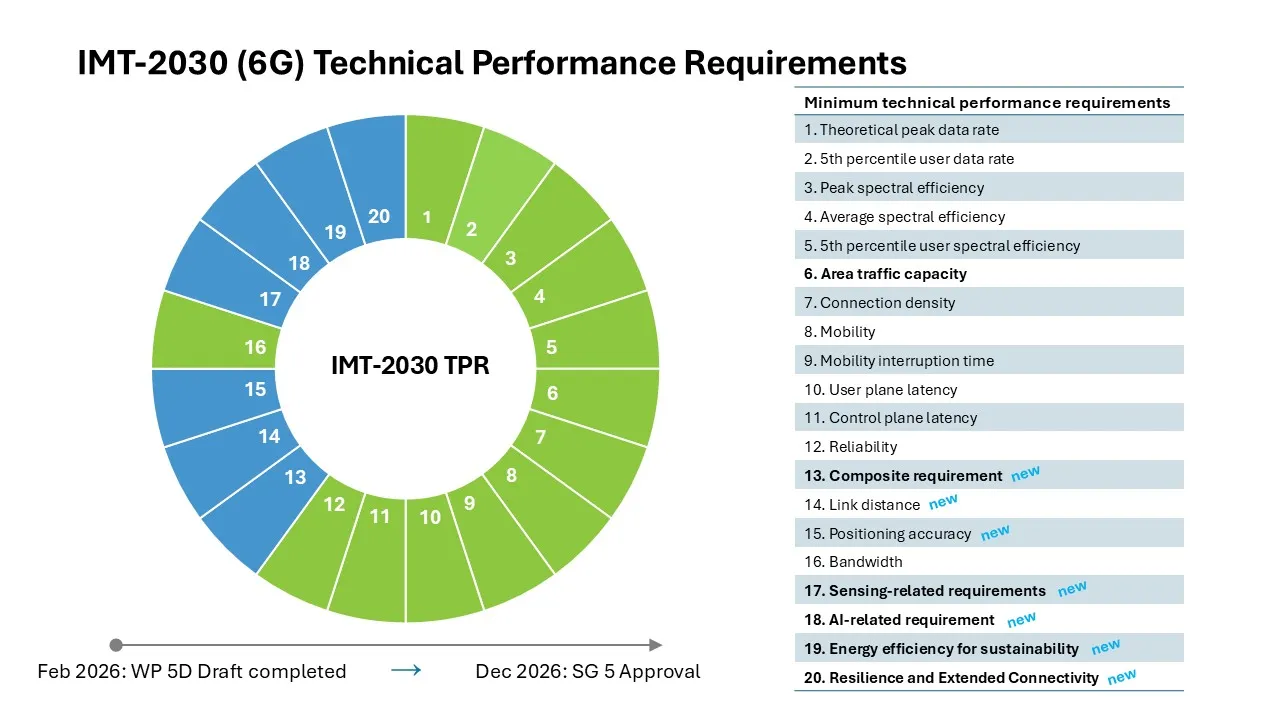
Image Credit: ITU-R WP5D
………………………………………………………………………………………………………………………………………………………………………………………………
ITU-R WP 5D Work Plan for IMT-2030 RIT/SRITs:
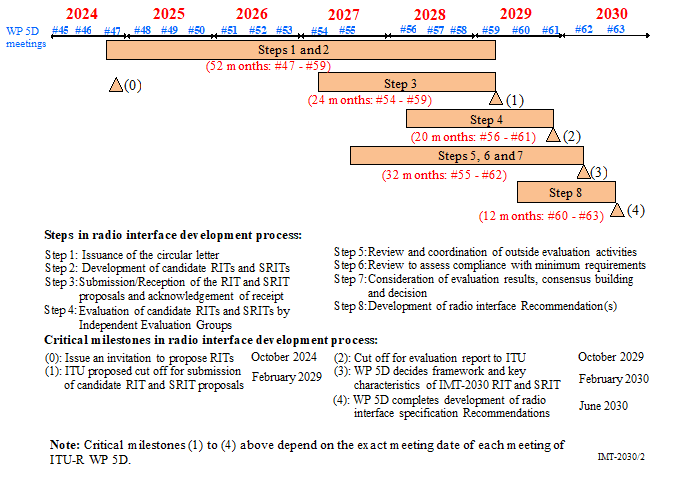
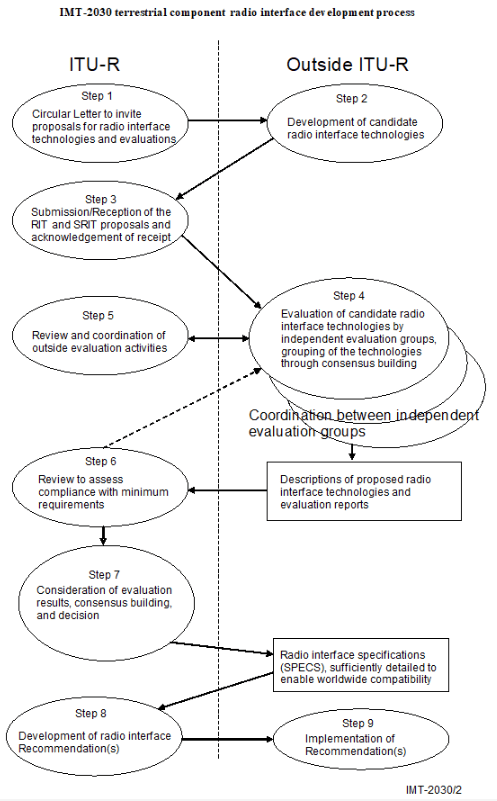
Submission of IMT 2030 RIT/SRIT proposals will begin at 54th meeting of Working Party (WP) 5D (currently planned for February 2027). The final deadline for submissions is 12 calendar days prior to the start of the 59th meeting of WP 5D in February 2029. The evaluation of the proposed RITs and SRITs by the independent evaluation groups and the consensus-building process will be performed throughout this time period and thereafter. The detailed schedule and development process are shown in the two figures below.
 ………………………………………………………………………………………………………………………………………………………………………………
……………………………………………………………………………………………………………………………………………………………………….
Follow on Process for IMT-2030 Final Approval (author’s conjecture):
- The IMT 2030 RIT/SRITs development are scheduled to be completed at WP5D Meeting #63 in June 2030.
- At the next 5D meeting (#64), likely to be in October 2030 (but not yet scheduled), any draft revisions and specification updates will be reviewed and finalized.
- Following completion in WP 5D, the draft IMT 2030 RIT/SRITs and IMT 2030 Frequency Arrangements [1.], recommendations would proceed to ITU-R SG5 (Terrestrial Services) for adoption and then approval under the applicable ITU-R procedure. The dates and approval route remain to be confirmed. However, final approval is likely to be in November or December of 2030.
Note 1: These two IMT 2030 companion recommendations should be finalized and approved as a package (that didn’t happen with IMT 2020 because the ITU-R M.1036-7 Frequency Arrangements recommendation was approved after ITU-R M.2150 was finalized and approved).
………………………………………………………………………………………………………………………………………………………………………………………………
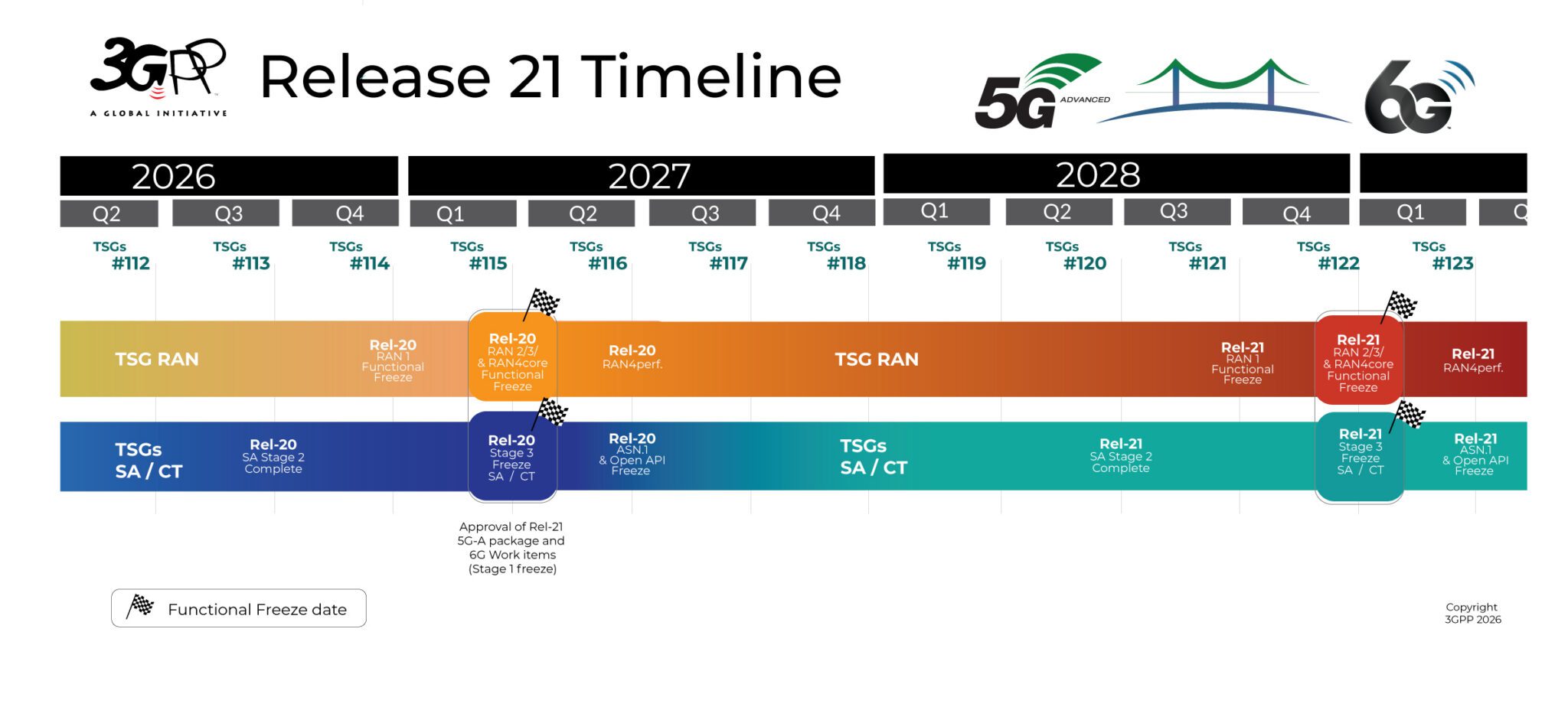
3GPP Release 21 (6G)Timeline:
The crucial ITU-R/3GPP schedule relationship:
Here is how the ITU-R submission deadline relates to the 3GPP Release 21 freeze:.
…………………………………………………………………………………………………………………………………………………………….
References:
https://www.itu.int/en/ITU-R/study-groups/rsg5/rwp5d/imt-2030/pages/default.aspx
ITU-R WP 5D Timeline for submission, evaluation process & consensus building for IMT-2030 (6G) RITs/SRITs
Roles of 3GPP and ITU-R WP 5D in the IMT 2030/6G standards process
IMT-2030 (“6G”) Minimum Technology Performance Requirements for Radio Interface Technologies
ITU-R M.[IMT-2030.EVAL] & ITU-R M.[IMT-2030.SUBMISSION] reports: Evaluation & Submission Guidelines for 6G RIT/SRITs (6G)
Sept 2026 3GPP meeting updates for 5G Advanced and 6G planning (with timeline for submisson to ITU-R WP 5D via ATIS)
3GPP approves timelines for Release 21 which will specify 6G RAN, Core and 5G Advanced
Warning: 6G core network must not repeat the 5G SA 3GPP architecture specs vs lack of interoperable standards
FCC plans 6G spectrum auctions before IMT 2030 frequencies have been identified and without a 6G frequency arrangement standard
How NTIA “Call to Action for 6G Leadership and Security” might influence 6G/IMT-2030 standards and 3GPP specifications
Comparing AI Native mode in 6G (IMT 2030) vs AI Overlay/Add-On status in 5G (IMT 2020)
AI-Native 6G RAN in Practice: Research and Validation Insights from 6G-MIRAI-HARMONY
5 thoughts on “ITU-R WP5D & 3GPP work schedules for development of IMT-2030 terrestrial radio interface (RIT/SRIT) recommendations”
Leave a Reply

From Ericsson’s 6G network architecture direction – The 2030 perspective (link below):
6G will act as a foundation for a cyber-physical continuum, merging the digital and physical worlds, supporting extreme usage scenarios and massive scaling, with demanding applications across industries, society, and consumer domains.
Key capabilities such as ultra-low latency, high precision positioning, sensing, etc. will enable advanced industrial and societal applications while merged reality, digital twins, and collaborative robotics, will be driving innovation in mission-critical and consumer services.
Obviously 6G will be AI-native and Agentic AI in place from the start. This will be part of introducing automation, based on intent for self-optimization with a smooth and spectrum-efficient integration leveraging multi-RAT spectrum sharing and evolving 5G core components.
Ericsson is embracing all RAN-internal interfaces above as potential multivendor interfaces, where we need to comply and be prepared to do interoperability testing, at least with basic/limited performance/features,” said the company. “However, it is expected that the main deployment model for multi-vendor RAN will continue to be by RAN vendor geographic areas, using interoperable Inter-RAN Area Mobility i/f.
In 6G the lower-layer-split (LLS)/O-RAN Open Fronthaul (OFH) interface between the RANAF and the RU should be standardized and implemented as a multi-vendor interface. Currently an (typically single-vendor-) LLS is used in practice in all RAN products and deployments thereof.
6G should be a new stand-alone RAT, meaning 6G capable UEs will connect directly to 6G capable base-stations when in coverage. Simultaneous 5G and 6G connectivity (similar to the NSA NR) should not be standardized since it will delay stand-alone 6G deployments, increase the overall development effort (maintain several tracks) and limit the performance potential of the 6G.
The 6G radio standard should support optimized spectrum sharing between 6G and 5G, and non-optimized spectrum sharing between 6G and LTE (incl. NB-IoT), aka Multi-RAT Spectrum Sharing (MRSS). This will quick support and efficient single vendor deployment of 6G in existing 5G bands maximizing spectrum, power and HW usage.
https://www.ericsson.com/en/future-technologies/architecture/network-architecture-domains
Following the Recommendation ITU‑R M.2160, which defines the framework and overall objectives of the future development of IMT for 2030 and beyond, WP 5D has completed the following draft new Reports related to the IMT-2030 terrestrial radio interfaces on:
“Minimum requirements related to technical performance for IMT-2030 radio interface(s)” (Document 5/116).
“Guidelines for evaluation of radio interface technologies for IMT-2030” (Document 5/119)
WP 5D is still working on the following draft new Report/revision of Document, which are expected to be completed in October 2026.
“Requirements, evaluation criteria and submission templates for the development of IMT-2030”.
Revision 1 of Document IMT-2030/2 on “Submission, evaluation process and consensus building for IMT-2030”.
From the 54th meeting of WP 5D in February 2027, Step 3 of the IMT-2030 developing process “Submission/Reception of the Radio Interface Technology (RIT)/Set of RIT (SRIT) proposals and acknowledgement of receipt” will start in accordance with Document IMT-2030/2(Rev.1).
Therefore, in conjunction with the 54th meeting, WP 5D will be holding a workshop on IMT-2030 focusing on the terrestrial radio interfaces.
Objectives
The objectives of the workshop are as follows:
to provide information from WP 5D on the IMT-2030 development process, including minimum technical performance requirements and evaluation guidelines;
to invite proponents of IMT-2030 RIT/SRIT to present current and future development aspects of their technologies;
to invite registered independent evaluation groups to present information about their evaluation group and planned actions; and in particular;
to facilitate dialogue between ITU-R WP 5D and potential proponents of technology and evaluation groups.
Further information on the invitation for submission of proposals for candidate radio interface technologies for the terrestrial components of the radio interface(s) for IMT-2030 and invitation to participate in their subsequent evaluation can be found in Add. 2 to Circular Letter 5/LCCE/115.
The workshop will be held on the second day of the 54th meeting of WP 5D from approximately 09:00 to 17:00 hours on [10 February 2027], at the same venue (A dedicated CL with the official meeting invitation will be issued after WP 5D#53).
Working Party 5D delegates, representatives from potential RIT/SRIT proponents, registered independent evaluation groups.
Organizations wishing to present at the IMT-2030 workshop are required to contact the Convener (WP 5D Vice-Chair, Mr. Stuart Cooke, [email protected])
Organizations wishing to become independent evaluation groups and present at the IMT-2030 workshop are encouraged to register with ITU-R as independent evaluation groups at their earliest convenience, i.e., starting from June 2026. The evaluation group registration form is available at ITU web page for the IMT-2030 submission and evaluation process (Contact: Mr. Uwe Löwenstein, [email protected])
https://www.itu.int/en/ITU-R/study-groups/rsg5/rwp5d/Pages/ws-20270210.aspx
IMT-2030 Evaluation guidelines:
Report ITU-R M.[IMT-2030.EVAL] provides guidelines for the procedure, the methodology and the criteria (technical performance, spectrum and service) to be used in evaluating the candidate IMT-2030 RITs/SRITs for a number of test environments. The evaluation procedure is designed in such a way that the overall performance of a candidate RIT/SRIT is fairly and consistently assessed on a technical basis.
Candidate RITs or SRITs shall be evaluated according to the guidelines in Report ITU-R M.[IMT-2030.EVAL].
Criteria to be fulfilled by candidate IMT-2030 RITs/SRITs:
The process, the steps and the relevant timelines for the development of IMT-2030 are described in Document IMT-2030/2(Rev.1) – Submission, evaluation process and consensus building for IMT-2030. Additional specific details may be found on the ITU-R IMT-2030 web page under the link “Web page for the IMT-2030 submission and evaluation process.”
Description template – characteristics template:
The characteristics template includes the description of the characteristics of a candidate RIT or SRIT. It shall be used by the proponents to describe their proposal for a radio interface for IMT-2030 to a level of detail that will facilitate a sufficient understanding of the proposed technology in order to enable an independent technical assessment of compliance with the IMT-2030 minimum requirements as specified in this Report.
The inclusion of an item in this template shall not imply that it is a minimum requirement of IMT-2030. Proponents are encouraged to extend beyond the template if additional information would assist in the assessment.
Further, where an item is not relevant to or for a proposal, it should be answered N/A (Not Applicable); optionally with an explanation of why the item is not applicable. However, the proponents should be aware that providing sufficient information relevant to the assessment will assist in the evaluation of their proposal by avoiding requests for additional information
This excellent IEEE Techblog article highlights a structural dependency mismatch between ITU-R WP5D submission deadlines and 3GPP Release 21 specification maturity for the IMT-2030 (6G) radio interface standardization timeline. The analysis also reveals potential risks in early candidate IMT-2030 RIT/SRIT evaluations and historical decoupling between IMT-2020/5G radio interface specifications and the companion 5G frequency arrangements.
Key areas of friction include the tight dependency on the December 2028 freeze for 3GPP Release 21 ahead of the February 2029 ITU-R submission cutoff, alongside historical concerns regarding the enforcement of baseline performance IMT-2030 KPIs as per “IMT-2030 Minimum Technology Performance Requirements for Radio Interface Technologies.”
Draft new Report ITU-R M.[IMT-2030.SUBMISSION] – Requirements, evaluation criteria and submission templates for the development of IMT-2030 was finalized at the 53rd meeting of WP 5D in October 2026. This draft new Report provides the IMT-2030 submission guidelines and templates, taking into account the minimum requirements including technical performance requirements as defined in the draft new Report ITU-R M.[IMT-2030.TECH PERF REQ] and evaluation guidelines in the draft new Report ITU R M.[IMT-2030.EVAL].
It should be noted these draft new Reports are to be submitted for consideration by Study Group (SG) 5 in November/December 2026. After approval by SG 5, these Reports will be used for the submission and evaluation process of candidate terrestrial radio interface technologies of IMT-2030:
– Report ITU-R M.[IMT-2030.SUBMISSION] – Requirements, evaluation criteria and submission templates for the development of IMT-2030.
– Report ITU-R M.[IMT-2030.TECH PERF REQ] – Minimum requirements related to technical performance for IMT-2030 radio interface(s).
– Report ITU-R M.[IMT-2030.EVAL] – Guidelines for evaluation of radio interface technologies for IMT-2030.
Revision to Document IMT-2030/2:
Revision 1 to Document IMT-2030/2 – Submission, evaluation process and consensus building for IMT-2030, is now available on the web page “IMT-2030 documents”. This revision contains the criteria to be fulfilled by proposed candidate radio interface technologies (RITs) or a set of RITs (SRITs) for the terrestrial components of IMT-2030.
https://www.itu.int/md/R23-IMT2030-C