

Telecom Equipment Market Extends Recovery as AI Infrastructure Spending Accelerates
Executive Summary:
Global telecom equipment revenues have been in a state of steady decline until last year. While there was an increase in spending for 5G FWA & 5G SA core networks, the main revenue driver was strong growth in fiber-optic-based network gear needed for connectivity inside and between AI data centers.
Market research firm Dell’Oro Group has just published findings that analyze how that trend has extended into the first half of this year. To no one’s surprise, AI data center connectivity now accounts for nearly all telco equipment revenue growth.
Preliminary Dell’Oro Group estimates indicate that aggregate global revenues across six tracked equipment domains—Broadband Access, Microwave Transport, Optical Transport, Mobile Core Network (MCN), Radio Access Network (RAN), and High-End Routing and Aggregation—increased 5% year over year (YoY) in 1H2026. The result represents a sixth consecutive quarter of year-over-year expansion.
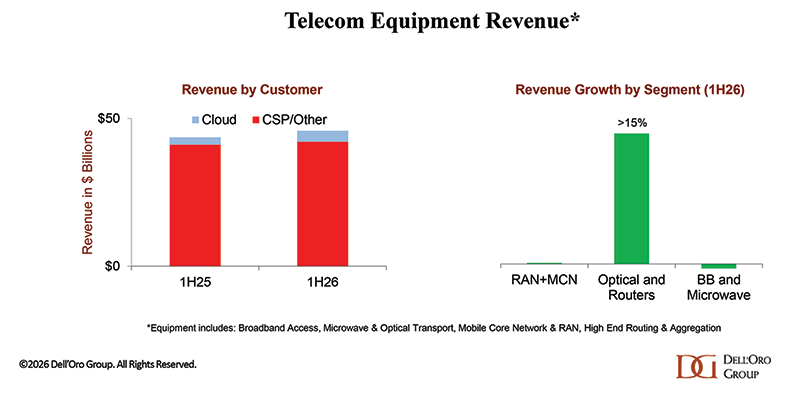
The 1H2026 performance follows a 4% telecom equipment spending increase in 2025, when the industry returned to growth after aggregate revenues declined 14% between 2022 and 2024. The 2025 rebound was supported by inventory normalization, easier year-over-year comparisons, improving wireless and wireline demand, and rising cloud capital expenditure. In 1H2026, however, the growth mix shifted more decisively toward equipment categories linked to AI infrastructure and hyperscale data-center connectivity.
Cloud investment reshapes demand:
Traditional communications service providers (CSPs) still generate more than 90% of worldwide telecom equipment revenue. However, cloud providers are now an increasingly consequential source of incremental demand. Dell’Oro Group estimates that cloud providers accounted for approximately 55% of total equipment-market revenue growth in 1H26, driven by sustained investment in AI compute infrastructure, data-center expansion, and the high-capacity transport and routing layers required to interconnect those facilities.
This does not signal a wholesale replacement of telecom operator demand by hyperscaler spending. Rather, it illustrates how the equipment market’s near-term growth profile is being reshaped by the convergence of telecom networking, cloud architecture, and AI infrastructure. The technologies benefiting most are those closest to data-center interconnect, backbone capacity expansion, and high-performance IP networking.
Optical and routing lead growth:
Growth was concentrated in Optical Transport and High-End Routing and Aggregation—the two segments with the most direct exposure to cloud and data-center investment cycles.
Optical Transport revenue increased at a double-digit rate in 1H26, supported by demand for data-center interconnect capacity and the expansion of high-bandwidth optical infrastructure. High-End Routing and Aggregation also recorded strong gains, reflecting robust spending from both cloud providers and CSPs.
By comparison, more traditional telecom infrastructure categories remained comparatively stable:
-
Aggregate RAN and MCN revenue was broadly flat.
-
Broadband Access revenue was relatively unchanged.
-
Microwave Transport revenue also showed limited growth.
The divergence underscores an important market distinction: AI-related infrastructure spending is currently lifting transport, optical, and routing investment more directly than it is stimulating broad-based growth in mobile access or core-network equipment.
Regional and supplier trends:
Regional conditions were favorable outside China. North America, EMEA, the Caribbean and Latin America (CALA), and Asia-Pacific excluding China all contributed to the 1H26 market expansion. North America continued to benefit disproportionately from AI- and cloud-driven infrastructure investment, including demand for optical transport, routing, and fiber-access platforms.
China remained the principal weak point. Telecom infrastructure investment is increasingly being displaced by compute-oriented capital expenditure. China’s three largest CSPs are collectively targeting 40% growth in computing capex during 2026, while conventional connectivity capex is expected to decline by 24%. That reallocation reinforces the broader shift from traditional network buildouts toward AI infrastructure, although the equipment beneficiaries differ substantially by technology segment.
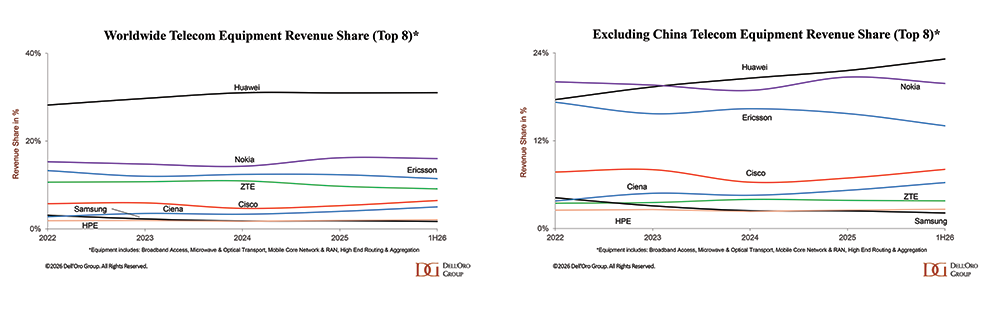
Global supplier rankings remained broadly stable during the first half of the year. Huawei retained its position as the largest worldwide telecom equipment supplier, followed by Nokia and Ericsson. Outside China, however, market-share shifts were more pronounced:
-
Huawei and Cisco gained share in 1H26 relative to 2025.
-
Ericsson and Nokia together lost roughly three percentage points of revenue share.
-
The changes partly reflect differing exposure to the faster-growing optical and routing segments, as well as regional demand patterns.
Revised Outlook:
Dell’Oro Group’s analyst team has raised its 2026 outlook for the six tracked equipment markets. Worldwide revenue is now projected to grow 3% to 5% for the full year, compared with a previous forecast of 2% to 4%.
The risk profile has also changed. China is tracking below earlier full-year expectations, while rising memory and component costs have become more significant second-half concerns. Those headwinds are being offset, at least in part, by continued strength in cloud and AI infrastructure investment.
Telecom equipment demand has stabilized and entered a renewed growth phase, supported by sustained hyperscale investment in AI compute, optical interconnect, and high-end routing. The key question for 2026 is whether this momentum broadens into a more balanced, network-wide recovery—particularly across RAN, core, and access segments, which have not yet participated materially in the expansion.
The central market question is whether sustained hyperscale investment in AI compute, optical interconnect, and high-end routing can broaden into a more durable, network-wide equipment recovery.
……………………………………………………………………………………………………………………………………………………………….
References:
Cloud Providers Drive Telecom Equipment Growth in 1H26 – Dell’Oro Group
Dell’Oro: Data Center capex grew 92% in 2Q-2026 (caveats galore)
Dell’Oro: AI RAN revenue forecast: $35B from 2026-to-2030; 3 types of AI RAN explained
Dell’Oro: Telecom carriers are on a 5G SA spending spree with more to come
Dell’Oro: Global RAN market stable (again) in 1Q 2026; top 5 RAN vendors are unchanged
Dell’Oro: RAN Market Stabilized in 2025 with 1% CAG forecast over next 5 years; Opinion on AI RAN, 5G Advanced, 6G RAN/Core risks
Dell’Oro: RAN market stable, Mobile Core Network market +14% Y/Y with 72 5G SA core networks deployed
Dell’Oro Group: RAN Market Grows Outside of China in 2Q 2025
Dell’Oro: Fixed Wireless Access revenues +10% in 2025 & will continue to grow 10% annually through 2029
Dell’Oro: AI RAN to account for 1/3 of RAN market by 2029; AI RAN Alliance membership increases but few telcos have joined
One thought on “Telecom Equipment Market Extends Recovery as AI Infrastructure Spending Accelerates”
Leave a Reply

TPON in the data center to replace copper was a key takeaway from the Broadband Forum’s BASe session at OFC 2026. Dell’Oro’s reinforces that takeaway. https://www.broadband-forum.org/video-insights/base-at-ofc2026/