

AI-Native 6G RAN in Practice: Research and Validation Insights from 6G-MIRAI-HARMONY
By Shammi Thakur, Research Director, MarkNtel Advisors with Shazia Hasnie
Introduction:
A wireless AI model can perform well in the laboratory and still face a very different test once the radio environment changes. However, propagation conditions shift as users move. Traffic loads vary. Devices and carrier frequencies differ. Hardware introduces imperfections that a clean simulation may not capture. Distributed RANs add another complication because a decision made at one network element can affect conditions elsewhere.
A recent 5G trial shows why the distinction matters. In August 2026, SoftBank and Ericsson reported vendor results from a single commercial-network validation of an AI-native scheduler for link adaptation on SoftBank’s 5G network in Japan. The companies evaluated spectral efficiency, downlink user throughput, robustness, and stability under live network conditions. Average gains across the evaluated areas were about 10% for both spectral efficiency and downlink user throughput, while the highest reported gains reached approximately 25% and 50%, respectively. [1]
Commercial-network testing adds something a controlled simulation cannot: exposure to the variability that the system is expected to handle.
IEEE ComSoc TechBlog has already examined the move from AI as an overlay in 5G toward AI-native 6G, along with the developing IMT-2030 requirements and the role of AI in future RANs. [2][3] This article takes a narrower view. It examines how AI-native RAN functions can be trained, coordinated, and tested when wireless conditions, hardware, data, and network topology all change.
6G-MIRAI-HARMONY provides a concrete research setting for that question. The EU-Japan program connects realistic channel and hardware modeling, AI-based physical-layer functions, distributed coordination, AI-ready RAN architecture, and common approaches to data management, benchmarking, and validation. [4][5]
The Research Challenge for AI-Native 6G RAN:
Training data quietly becomes part of an AI model’s operating assumptions. Conventional wireless algorithms are generally built around assumptions that engineers can state explicitly. Machine learning adds another dependency: the examples used during training and evaluation influence what the model learns to recognize as normal.
A model can consequently look robust while remaining sensitive to conditions absent from its training environment.
Wireless conditions can change without the underlying network function changing. Users move through different propagation environments. Traffic loads rise and fall. Carrier frequencies and device characteristics vary. Hardware can introduce quantization, RF impairments, and converter limitations.
Distributed RANs add another layer. Measurements used by one function may come from elsewhere in the network. Beamforming and scheduling decisions can affect later decision cycles. Fronthaul capacity can determine how much information reaches another processing point before a coordinated action has to be taken.
An AI function therefore cannot always be judged as an isolated block. Network behavior around the function can influence the result just as much as the model architecture itself.
6G-MIRAI-HARMONY: Research Approach and Scope:
6G-MIRAI began on April 1, 2025, and runs for 36 months through March 2028 under Horizon Europe and the Smart Networks and Services Joint Undertaking. Grant Agreement 101192369 lists total project costs of €3,188,935 and an EU contribution of €2,979,966.50. Ericsson France is the coordinating organization. [5]
The European consortium includes Ericsson France, Fraunhofer, Telefónica, IS-Wireless, Sequans, Apple Technology Engineering, KU Leuven, CNIT, and the University of Pisa. The associated HARMONY work in Japan brings in organizations including the University of Tokyo, Kyocera, NEC Networks & System Integration, Shimizu, Tokyo University of Agriculture and Technology, and KDDI Research. [6]
Five Research and Technology Items connect the technical work:
- Realistic models and datasets covering channel, hardware, and measurement conditions.
- AI/ML for physical-layer components, including learning-based approaches to wireless functions.
- AI-driven coordination for distributed and cell-free deployments.
- AI-ready 6G-RAN architecture covering where intelligence, data, and computing are placed.
- Data management, testing, and validation for common scenarios and reproducible evaluation. [4][5]
The sequence matters because each part affects the next. Data conditions influence AI training. AI functions interact with distributed coordination. Architecture determines where models can run and what information they can access. Benchmarking and validation determine how the resulting measurements can be compared.
Realistic Models and AI-Based Physical-Layer Functions:
The wireless environment represented in an experiment becomes part of the AI system whether researchers intend it or not.
6G-MIRAI-HARMONY’s methodology combines link- and system-level modeling with analytical evaluation and later laboratory- or prototype-oriented validation. QuaDRiGa is identified for spatially and temporally consistent channel generation, while Sionna supports differentiable communication-system modeling. Measurement data and experimental RAN data provide additional routes toward less idealized evaluation conditions. [4]
Three parts of the modeling chain deserve particular attention:
- The channel: Propagation, mobility, and spatial variation determine the conditions presented to the model.
- The hardware: RF impairments, quantization, finite-resolution converters, and other non-idealities can alter physical-layer behavior.
- The data: Training and test datasets determine which situations the model encounters and which remain unseen.
Those conditions matter for functions such as channel estimation, CSI prediction and compression, neural receivers, precoding, power control, and link adaptation.
Independent research is addressing similar issues. A 2026 study of CNN-based hybrid precoding for cell-free massive MIMO evaluates imperfect CSI, phase noise, channel aging, molecular absorption, and transceiver hardware nonidealities in a THz simulation environment. The reported results include spectral-efficiency gains against several conventional approaches, while the study also measures the effect of individual hardware impairments on performance. [7]
Physical-layer intelligence therefore has to be tested against the radio conditions it is expected to encounter. An improvement under one channel or hardware assumption does not establish the same improvement under another.
Distributed Intelligence for Cell-Free Massive MIMO:
Distributed access points can work together, but the information needed to coordinate them is distributed as well. Beamforming decisions affect interference seen by other users. Scheduling changes the traffic mix entering later decision cycles. Power-control decisions can alter the conditions under which subsequent optimization takes place.
Fronthaul places a direct limit on how much information can be exchanged. Fully centralized processing can require substantial CSI and data transfer as the number of access points and users grows. Practical designs therefore have to balance cooperation against available transport and processing resources.
Independent cell-free massive MIMO research continues to address that scalability problem. A 2025 IEEE Access study describes network overloading and scalability as major design challenges and evaluates a joint pilot and access-point assignment method in systems tested with up to 150 access points. [8] The paper notes that fully centralized processing can create significant fronthaul signaling and computational demands as deployments expand.
Synchronization adds another requirement. Coherent joint processing depends on suitable phase and frequency alignment across distributed access points. A 2024 IEEE Open Journal of the Communications Society study examines phase misalignment among access points in cell-free massive MIMO and evaluates a partially coherent transmission framework designed to reduce the need for network-wide phase alignment. [9]
AI-driven coordination has to operate inside those constraints. Improving beamforming or scheduling is only part of the problem when the information required for that decision is delayed, compressed, or unavailable at the point where the model runs.
Designing an AI-Ready 6G RAN:
Where the model runs can be as important as what the model does.
A latency-sensitive control loop may need processing close to the network element generating the measurements. Another workload may benefit from a larger computational environment with access to a wider network view. Data access, inference latency, model updates, and control interfaces all affect that choice.
Four practical questions follow:
- Where does inference run?
- Which measurements reach the model?
- How frequently are those measurements updated?
- What happens when the required information sits elsewhere in the RAN?
O-RAN already has work addressing part of this problem. Its WG2 specifications cover the Non-Real-Time RAN Intelligent Controller, A1 and R1 interfaces, AI/ML learning and deployment, and the AI/ML workflow. [10]
O-RAN’s current work does not define the final architecture for 6G. It does show where AI lifecycle and deployment questions are already being addressed in today’s RAN architecture. 6G-MIRAI-HARMONY takes those concerns into a research setting that also includes distributed and potentially disaggregated 6G architectures. [4]
Common Data, Benchmarking and Validation:
Performance figures become difficult to compare when the experiments behind them use different conditions. Two studies might report higher spectral efficiency while using different datasets, channel assumptions, training procedures, hardware models, and test conditions. Without those details, the numbers are difficult to interpret.
The 6G-MIRAI-HARMONY D3.1 deliverable addresses this problem directly. It provides the project’s first consolidated framework for benchmarking and validation, data-management principles, and common scenarios. The document places particular emphasis on repeatability, traceability, comparability, data quality, and reuse. It also defines KPI/KVI considerations and protocols for training, evaluation, and generalization. [11] The evaluation chain is shown in Figure 1.
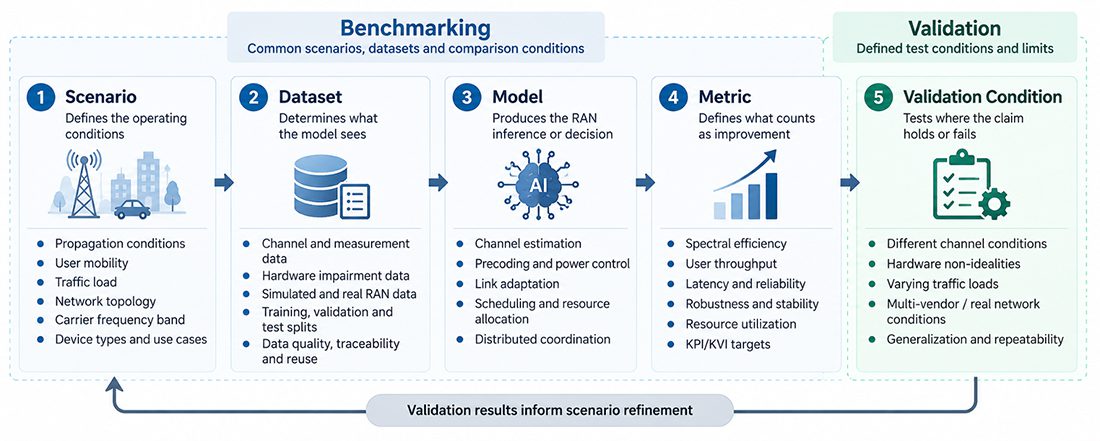
Figure 1. The evaluation chain for AI-native RAN research.
The scenario defines the conditions represented in the experiment. The dataset determines what the model sees. The model is evaluated through selected metrics and then tested under stated validation conditions.
Changing one part of that chain can change the result. An unseen propagation condition may expose a generalization problem. A realistic hardware model may reduce the gain seen with ideal hardware. A different metric may favor a different approach. Benchmarking and validation also answer different questions. Benchmarking establishes common conditions for comparing approaches. Validation examines whether the resulting system behaves as required under defined conditions.
D3.1 is an existing project output. Later deliverables are intended to add datasets and results covering common scenarios, validation, and benchmarking. Those later outputs should remain described as project work rather than completed findings until the corresponding evidence is published. [11][12]
From Research Validation to Standardization:s
ITU-R’s IMT-2030 work has already moved beyond the initial framework.
Recommendation ITU-R M.2160 established the framework and overall objectives for IMT-2030 in November 2023. The framework includes six usage scenarios, among them Artificial Intelligence and Communication (AIAC), and identifies ubiquitous intelligence as one of its overarching design principles. [13]
In February 2026, ITU-R Working Party 5D completed the draft report on minimum technical performance requirements for IMT-2030 radio interfaces. The draft defines 20 minimum technical performance requirements and provides a consistent basis for specification and evaluation. The draft has been submitted to Study Group 5 for consideration in December 2026. [14] In June 2026, Working Party 5D also completed the draft guidelines for evaluating candidate IMT-2030 radio interface technologies. The guidelines define three evaluation methods—simulation, analytical evaluation, and inspection—and specify seven test environments. The draft has likewise been submitted to Study Group 5 for approval in December 2026. [14]
ITU-R’s candidate radio-interface technology submission process is scheduled to begin in February 2027, with the candidate-submission window extending through February 2029. [14] 3GPP is pursuing AI/ML work within the RAN in parallel. TR 38.745, “Study on Artificial Intelligence (AI)/Machine Learning (ML) for NG-RAN Phase 3,” was created for Release 20 on September 5, 2025, and was placed under change control on March 19, 2026. [15]
Research results do not become standards simply because an algorithm performs well in one experiment. The useful evidence includes the conditions behind the result: the scenario, dataset, metrics, validation method, limitations, and reproducibility of the test.
Conclusions:
AI-native 6G RAN will require more than putting machine learning inside individual RAN functions.
Propagation changes. Hardware is imperfect. Network intelligence becomes distributed. Fronthaul and synchronization can limit coordinated processing. Architecture determines where data and computation are available. Training and evaluation conditions affect what an AI result actually shows.
6G-MIRAI-HARMONY brings these issues into one research program by connecting realistic wireless models, AI-based PHY techniques, cell-free coordination, AI-ready RAN architecture, and common approaches to data, benchmarking, and validation. The work points to a practical requirement for AI-native RAN research: performance results need enough information around them to show how they were produced, where they hold, and what changes when the underlying conditions change.
References:
- SoftBank Corp. and Ericsson, “SoftBank Corp. and Ericsson conduct Japan’s first trial of Ericsson AI in RAN on a 5G commercial network,” August 20, 2026.
https://www.ericsson.com/en/press-releases/2/2026/softbank-corp-and-ericsson-conduct-japans-first-trial-of-ericsson-ai-in-ran-on-5g-commercial-network - IEEE ComSoc Technology Blog, “Comparing AI Native mode in 6G (IMT 2030) vs AI Overlay/Add-On status in 5G (IMT 2020),” January 15, 2026.
https://techblog.comsoc.org/2026/01/15/comparing-ai-native-mode-in-6g-imt-2030-vs-ai-overlay-add-on-status-in-5g-imt-2020/ - IEEE ComSoc Technology Blog, “IMT-2030 (‘6G’) Minimum Technology Performance Requirements for Radio Interface Technologies,” March 17, 2026. https://techblog.comsoc.org/2026/03/17/update-imt-2030-6g-minimum-technology-performance-requirements/
- 6G-MIRAI-HARMONY, “Concept and Methodology,” 2026.
https://6g-mirai-harmony.eu/concept-and-methodology/ - European Commission, CORDIS, “Machine Intelligence based Radio Access Infrastructure (6G-MIRAI),” Grant Agreement No. 101192369.
https://cordis.europa.eu/project/id/101192369 - 6G-MIRAI-HARMONY, “Consortium and Objectives,” 2026.
https://6g-mirai-harmony.eu/consortium-and-objectives/ - Tadele A. Abose and Thomas O. Olwal, “Hardware-Impairment-Aware CNN-Based Hybrid Precoding for Cell-Free Massive MIMO Systems Under Imperfect CSI in Terahertz-Enabled 6G Networks,” Telecom, vol. 7, no. 3, 2026.
https://www.mdpi.com/2673-4001/7/3/70 - Mhammad B. Hmayed and Ali H. Bastami, “Scalable Cell-Free Massive MIMO System: Joint Optimal Pilot and Access Point Assignment,” IEEE Access, vol. 13, pp. 201778–201788, 2025. DOI: 10.1109/ACCESS.2025.3638655
https://ieeexplore.ieee.org/document/11271199 - Unnikrishnan Kunnath Ganesan, Tung Thanh Vu, and Erik G. Larsson, “Cell-Free Massive MIMO With Multi-Antenna Users and Phase Misalignments: A Novel Partially Coherent Transmission Framework,” IEEE Open Journal of the Communications Society, vol. 5, pp. 1639–1655, 2024.
DOI: 10.1109/OJCOMS.2024.3373170.
https://ieeexplore.ieee.org/document/10459246 - O-RAN Alliance, “WG2: Non-Real-time RAN Intelligent Controller and A1,” Technical Work Group scope.
https://www.o-ran.org/technical-groups/wg2 - 6G-MIRAI-HARMONY, “D3.1 — Definition of Initial Common Scenarios, Data Management and Benchmarking Methodology,” 2026.
https://6g-mirai-harmony.eu/wp-content/uploads/2026/02/6G-MIRAI_Deliverable_D3.1_Scenarios_Data_Bench_v1.0.pdf - 6G-MIRAI-HARMONY, “Deliverables, Publications and Workshops,” 2026.
https://6g-mirai-harmony.eu/deliverables-publications-and-workshops/ - ITU-R Recommendation M.2160-0, “Framework and overall objectives of the future development of IMT for 2030 and beyond,” November 2023.
https://www.itu.int/rec/R-REC-M.2160-0-202311-I/en - ITU-R, “IMT towards 2030 and beyond (IMT-2030),” current development, evaluation, and submission process.
https://www.itu.int/en/ITU-R/study-groups/rsg5/rwp5d/imt-2030/pages/default.aspx - 3GPP, TR 38.745, “Study on Artificial Intelligence (AI)/Machine Learning (ML) for NG-RAN Phase 3,” Release 20.
https://portal.3gpp.org/desktopmodules/Specifications/SpecificationDetails.aspx?specificationId=4445
Author Bio:
Shammi Thakur is Research Director at MarkNtel Advisors, with more than 15 years of experience in strategic market intelligence, industry forecasting, and competitive analysis. He leads research initiatives across global technology and communications markets, overseeing the development of market studies and strategic research frameworks. His work focuses on translating complex industry developments into evidence-based insights, with particular experience in emerging technologies, market evolution, and the forces shaping next-generation communication systems.