

Oracle Integrates NVIDIA and Google AI Accelerators with its High-Performance Cloud Networking Infrastructure
Disclaimer: ChatGPT was used extensively for research included in this article.
…………………………………………………………………………………………………………………………………………………………………
Introduction:
Oracle’s multiple announcements on October 27th illustrate how AI cloud infrastructure is evolving beyond simply providing access to GPUs. Oracle Cloud Infrastructure (OCI) is combining NVIDIA’s latest AI computing systems, Google’s Tensor Processing Units (TPUs), and its Acceleron networking architecture to support increasingly demanding AI training, inference and agentic workloads.
The strategy reflects a fundamental change in the requirements for large-scale AI: accelerator performance alone is insufficient. The network connecting those accelerators, the movement of data between compute and storage, and the ability to sustain performance across very large clusters are equally important.
NVIDIA Vera Rubin systems target large-scale AI workloads:
Oracle and NVIDIA announced that NVIDIA Vera Rubin NVL72 systems and Vera CPUs are generally available on OCI. They also outlined plans to expand OCI Superclusters using Vera Rubin systems to multi-gigawatt scale. Oracle says its Superclusters can scale across hundreds of thousands of GPUs.
The NVL72 architecture connects 72 GPUs within a rack using NVIDIA NVLink scale-up networking. Beyond the rack, Oracle uses an Ethernet-based network fabric to connect systems into much larger clusters.
This distinction between scale-up and scale-out networking is critical. Scale-up interconnects provide high-bandwidth communication among closely coupled accelerators. Scale-out fabrics must move data between racks while managing congestion, latency, failures and the traffic generated by thousands of parallel computing devices.
Large AI training jobs are particularly sensitive to communication delays. Because many operations synchronize across accelerators, a congested link or a slow communication path can leave otherwise productive GPUs waiting for data or results from other GPUs.
Oracle’s challenge is therefore not simply to provide more computing capacity, but to keep that capacity productively utilized as clusters grow.
Google TPUs introduce an alternative AI computing architecture:
In a separate announcement, Oracle and Google said Google’s TPUs will become available through OCI, making Oracle the first hyperscale cloud provider outside Google to offer the accelerators.
Google’s eighth-generation TPU portfolio includes two architectures with different priorities:
- TPU 8t: Designed primarily for large-scale AI training.
- TPU 8i: Designed for inference, including workloads involving iterative reasoning and AI agents.
Google’s TPUs are purpose-built accelerators supported by Google’s software ecosystem. Oracle plans to provide the data-center infrastructure, power, cooling and networking needed to deploy them at scale.
However, the service will not be immediately available: Oracle says TPU availability will begin in calendar 2027 and ramp over multiple years.
The addition of TPUs gives OCI customers another option alongside NVIDIA-based infrastructure. Different accelerators can have different performance characteristics, memory architectures, software requirements and economics, depending on the model and workload.
This does not mean the systems are interchangeable. Moving an application between accelerator platforms may require changes to software, kernels, frameworks, deployment tools and performance optimization. The practical value of choice will depend on how easily customers can adapt their workloads and achieve competitive performance.
Oracle Acceleron addresses the networking challenge:
Oracle’s third major development is its continued expansion of Acceleron, OCI’s networking and infrastructure technology portfolio.
Oracle describes an architecture combining high-performance Ethernet networking, remote direct memory access (RDMA), host-level acceleration and multipath network designs. Its NVIDIA-based infrastructure incorporates Spectrum-X Ethernet switches and other NVIDIA networking components alongside Oracle’s own network architecture and services. RDMA enables systems to transfer data between memories with less intervention from host CPUs than conventional networking approaches. This can reduce overhead and improve communication efficiency in tightly synchronized distributed workloads.
Oracle also describes a multiplanar network architecture that distributes traffic across multiple paths. Its Multipath Reliable Connection (MRC) transport can spread packets across many paths, helping the network respond to congestion or unstable paths without relying on a single route. The objective is to maintain predictable communication performance as clusters grow. A network failure or congestion event can affect far more than one connection when thousands of accelerators participate in a coordinated training job.
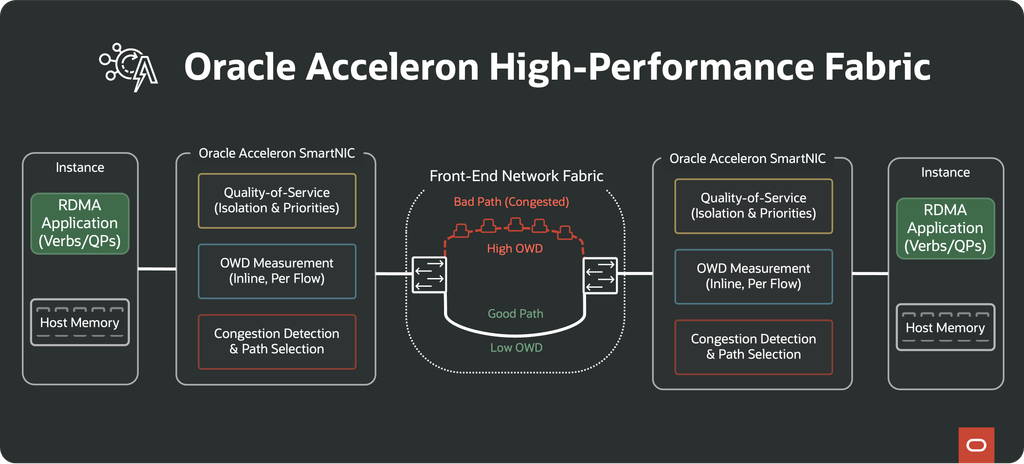
Image Credit: Oracle
Oracle’s October 27 networking announcement also describes improvements in storage connectivity, congestion management and network resilience. These capabilities are intended to keep distributed AI workloads operating efficiently while improving security and supporting multitenant cloud environments.
The company presents these capabilities as ways to reduce network friction and improve utilization. Their actual benefits will depend on workload characteristics, network configuration, software implementation and operational conditions; independent, comparable benchmarks would be needed to quantify the advantages over competing architectures.
What does this mean for AI cloud architecture?
The combined announcements point to a broader industry shift: AI infrastructure is increasingly designed as an integrated system rather than a collection of independent hardware products.
Three technical issues will be especially important:
1. Communication becomes a limiting factor. As accelerator counts increase, the ability to exchange data efficiently can constrain overall performance. Network topology, congestion control, latency and fault recovery can be as consequential as raw link bandwidth.
2. Heterogeneous computing creates opportunities and complexity. Offering NVIDIA GPUs and Google TPUs allows OCI customers to evaluate different architectures for training and inference. However, software portability, developer tools, model compatibility and operational complexity will influence whether that choice delivers practical benefits.
3. Utilization determines system efficiency. Expensive accelerators generate value only when they are doing useful work. Faster data movement, efficient collective communication, resilient networking and appropriate workload placement can help reduce idle time. The same principle applies to power consumption: infrastructure efficiency must be evaluated across the complete system, not just individual chips.
Oracle is also extending its infrastructure strategy to CPUs and specialized accelerators for inference and agentic applications. That reflects the growing importance of the work surrounding model execution, including tool calls, code execution, data retrieval and orchestration—not just the computation performed inside an AI model.
Oracle’s AI cloud infrastructure integrates accelerator hardware, high-density computing systems and high-performance networking to support distributed AI workloads:
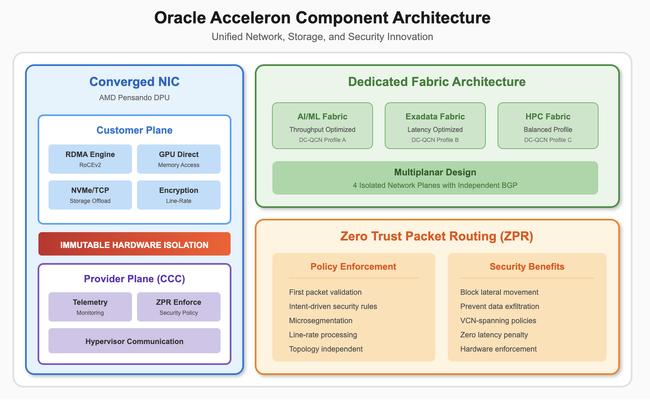
Image Credit: ChatGPT
……………………………………………………………………………………………………………………………………………………………………………………………………………………….
Conclusions:
Oracle’s October 27th announcements bring together three elements of its AI cloud strategy: NVIDIA’s latest accelerator systems, Google’s alternative TPU architecture, and Oracle’s high-performance cloud networking:
The NVIDIA systems combine NVLink scale-up interconnects with Ethernet-based scale-out fabrics, while Google’s TPU architecture integrates custom silicon, high-bandwidth memory and specialized interconnects. Oracle Acceleron adds RDMA connectivity, congestion control, multipath traffic distribution and automatic failover to help sustain performance across large, distributed AI clusters.
The important technical question is whether these components can deliver reliable, scalable and cost-effective performance for real AI workloads. Hardware specifications and announced deployment capacity are useful starting points, but customers ultimately need end-to-end benchmarks measuring training throughput, inference latency and cost per token, network utilization, storage performance, software compatibility, fault recovery, and power efficiency. For distributed training in particular, goodput—the proportion of time a cluster spends performing productive computation rather than waiting on communication or recovering from failures—is a more meaningful measure than peak compute performance alone.
The competitive battleground is no longer just the AI chip. It is the complete cloud computing and networking system: accelerators, memory, interconnects, Ethernet fabrics, storage and software working together to maximize useful computation per dollar and per watt.
Google says TPU chip-to-chip traffic uses ICI and OCS, while Oracle Acceleron connects TPU capacity to the rest of OCI. That differs from the NVIDIA NVLink scale-up and RoCE scale-out arrangement. Offering both accelerator families through OCI therefore should not be read as establishing a common GPU–TPU interconnect or transparent mixed-accelerator training.
Sidebar – Larry Ellison’s remarkable change of direction on cloud computing:
Oracle’s current AI infrastructure ambitions are particularly striking given Larry Ellison’s earlier skepticism about cloud computing. In 2008, Ellison publicly criticized cloud computing as a repackaging of established technologies under a fashionable label. Oracle’s business at the time centered on enterprise databases, business applications, software licensing and support. Its traditional model depended heavily on customers running Oracle software in their own data centers.
At an Oracle event I attended in spring 2011, that strategy remained intact: Oracle proposed licensing its software to cloud developers rather than becoming a cloud infrastructure provider. “We do not plan to become a cloud service provider,” the Oracle representative told the audience.
That began to change in a big way. In October 2011, Oracle introduced its public cloud, offering Oracle software and development services over the internet. In 2012, Ellison articulated a broader cloud strategy, although he continued to argue that cloud computing was an evolution of existing technology rather than a fundamentally new computing paradigm.
Oracle’s transformation subsequently accelerated. In 2016, the company launched its modern-generation cloud infrastructure platform, competing more directly with established infrastructure providers such as Amazon Web Services (AWS) and Microsoft Azure. The strategic change went well beyond delivering existing Oracle software as an online service. Oracle invested in compute, storage, networking, data centers and infrastructure designed for demanding enterprise workloads. Its later expansion into large-scale AI infrastructure has taken that evolution further.
Today, Oracle is deploying NVIDIA’s newest AI systems, preparing to offer Google’s TPUs, and developing networking capabilities intended to support distributed AI clusters at enormous scale. The historical irony is clear: a company long associated with proprietary enterprise software and database licensing has become a major contender in the infrastructure underpinning modern AI.
Whatever the merits of Ellison’s initial criticism of cloud terminology, Oracle’s subsequent decision to build and operate cloud infrastructure and provide cloud services reversed the position its representative had communicated to attendees in spring 2011. Ellison’s evolution also illustrates an important lesson in technology strategy. A company need not accept every new technology label or prevailing industry narrative to recognize that customer requirements and competitive economics are changing. But adapting successfully may ultimately require much more than adding new products to an existing business—it can require rebuilding the business around a different infrastructure model.
………………………………………………………………………………………………………………………………………………………………………………………………
References:
Oracle and NVIDIA — Vera Rubin systems and Vera CPUs on OCI
https://blogs.oracle.com/cloud-infrastructure/nvidia-vera-rubin-vera-cpus-oci
2. Oracle and Google — Bringing Google TPUs to Oracle Cloud Infrastructure
https://www.oracle.com/news/announcement/ai-world-oracle-brings-google-tpus-to-oracle-cloud-infrastructure-2026-10-27/
3. Oracle — Acceleron networking innovations for AI
https://www.oracle.com/europe/news/announcement/ai-world-oracle-unveils-new-cloud-networking-innovations-for-ai-2026-10-27/
https://blogs.oracle.com/cloud-infrastructure/first-principles-networking-for-ai-scale
https://blogs.oracle.com/cloud-infrastructure/wp-content/uploads/sites/83/2026/10/HP-Fabric-01-1024×464.png
4. WIRED — “Ellison Answers Benioff With Oracle Cloud” (October 2011)
https://www.wired.com/2011/10/ellison-answers-benioff-with-oracle-cloud/
Editorial note: The first three links cover the technical announcements. The WIRED article provides historical context for the sidebar on Larry Ellison’s changing position on cloud computing. Oracle’s official October 27th networking announcement is also available here: https://www.oracle.com/europe/news/announcement/ai-world-oracle-unveils-new-cloud-networking-innovations-for-ai-2026-10-27/
Custom AI Silicon: OpenAI, Anthropic, Hyperscalers and the Battle with Nvidia, AMD and Broadcom
Google’s TPU Business Outpaces Rivals as Hyperscalers Accelerate Custom AI Silicon Strategies
AWS to deploy AI inference chips from Cerebras in its data centers; Anapurna Labs/Amazon in-house AI silicon products
2026 OCP Summit: Full-Stack AI Networking Silicon from Nvidia/Cisco and Broadcom; Ethernet vs InfiniBand Interconnects
Huawei’s Ascend Silicon Roadmap Extends From AI Chips to Cluster-Scale Infrastructure
Cisco’s Silicon One G300 as the dominant AI networking fabric, competing with Broadcom’s Tomahawk 6 series
AWS, Google, Microsoft, Oracle win $9B DoD cloud computing contract (JWCC)
Oracle and Microsoft Enhance Interoperability of their Cloud Platforms (facilitating multi-cloud)
5 thoughts on “Oracle Integrates NVIDIA and Google AI Accelerators with its High-Performance Cloud Networking Infrastructure”
Leave a Reply

From Google Gemini:
The sidebar provides an important distinction between skepticism about cloud terminology and a reversal in corporate strategy. The author’s firsthand account—that an Oracle representative explicitly told the audience in spring 2011, “We do not plan to become a cloud service provider”—makes the subsequent move into providing cloud services a clear reversal of Oracle’s stated position, not merely a shift in emphasis. Criticism of the cloud buzzword does not explain away that contradiction.
The main article also raises the right question about Oracle’s AI infrastructure: how do the announced capabilities translate into useful application performance and customer economics? Offering NVIDIA GPUs and Google TPUs broadens customer choice, but does not by itself establish transparent interoperability or easy workload portability. Independent, end-to-end measurements—including software migration effort, communication overhead, utilization, and recovery from failures—will be more informative than peak accelerator specifications alone.
Oracle’s technical capabilities and the financial sustainability of deploying them are totally different topics. Its latest results show both substantial cloud growth and a buildout that is consuming more cash than operations generate.
The clearest evidence is in Oracle’s own fiscal Q1 2027 results, covering the three months ended August 31, 2026:
-Interest expense reached $1.43 billion for the quarter, up 55% year over year.
-Operating cash flow was approximately $23 billion, but free cash flow was approximately negative $5 billion after infrastructure investment.
-Oracle completed a $20 billion common-stock offering during the quarter—so this expansion is being financed through shareholder capital as well as borrowing.
On the other side of the ledger, cloud infrastructure revenue grew 121% to $7.4 billion, and remaining performance obligations reached $664 billion. That proves there is substantial contracted demand behind the AI infra investment, not simply speculative construction.
From Google Gemini:
The financing behind this infrastructure expansion deserves as much scrutiny as the accelerator and networking specifications. In Oracle’s fiscal Q1 2027 results, quarterly interest expense rose 55% to approximately $1.43 billion, while free cash flow was approximately negative $5 billion despite record operating cash flow of $23 billion. Oracle also completed a $20 billion common-stock offering during the quarter. This is a major capital commitment, not simply a technology upgrade.
Oracle’s rapidly growing cloud revenue and $664 billion in remaining performance obligations provide an important counterweight. Nevertheless, contracted future revenue is not the same as cash already collected or a demonstrated return on the infrastructure required to deliver it. The critical questions are how quickly these contracts produce cash, what margins remain after power, operations and hardware replacement, and how much additional financing will be required.
Strong technical performance would be necessary for this strategy to succeed, but not sufficient. A fuller assessment should examine whether Oracle can earn an adequate return after financing costs—and how resilient that return would be to deployment delays, lower utilization, pricing pressure or customers failing to meet their commitments.
From ChatGPT — a comment independent of the article’s research and authorship.
Oracle’s decision to offer both NVIDIA GPUs and Google TPUs through OCI is strategically significant, but access to both does not make them interchangeable. The two platforms have different interconnect architectures, software ecosystems and workload-optimization requirements.
The real test is whether Oracle can demonstrate measurable advantages in end-to-end performance, utilization, reliability and cost per useful AI task. Independent comparisons should include training throughput, inference latency, cost per token, power consumption and the engineering effort required to port workloads between platforms.
In the AI infrastructure race, accelerator choice matters—but the economics of the complete computing and networking system matter more.
This is an important development in the evolution of AI cloud infrastructure. Oracle’s strategy highlights how the competitive battleground is shifting from individual accelerators to complete systems that integrate compute, memory, networking, storage and software.
Offering both NVIDIA GPUs and Google TPUs gives OCI customers greater architectural choice, but it does not mean the two platforms are interchangeable or support transparent mixed-accelerator training. Ultimately, the winners will be determined by real-world system performance: useful AI throughput, cost per token, network efficiency, reliability and performance per watt—not simply peak chip specifications or announced cluster capacity. Oracle’s Acceleron networking strategy is therefore an important part of this competitive equation.