

Sept 2026 3GPP meeting updates for 5G Advanced and 6G planning (with timeline for submisson to ITU-R WP 5D via ATIS)
Introduction:
The 3GPP Plenary #113 meetings (comprising TSG RAN, TSG SA, and TSG CT) concluded with the RAN Plenary from September 15 to 17, 2026 in Madrid, Spain. There were major updates for both 5G Advanced (Release 20) and foundational 6G planning (Release 21). The first normative 6G document will be in Release 21, which will also have a lot of 5G-Advanced specification work, as it continues to full maturity. TSG SA approved TR 22.870 – “6G Use Cases and Service Requirements” in Release-20 and it is set to be the Stage 1 anchor for Release‑21 normative work.

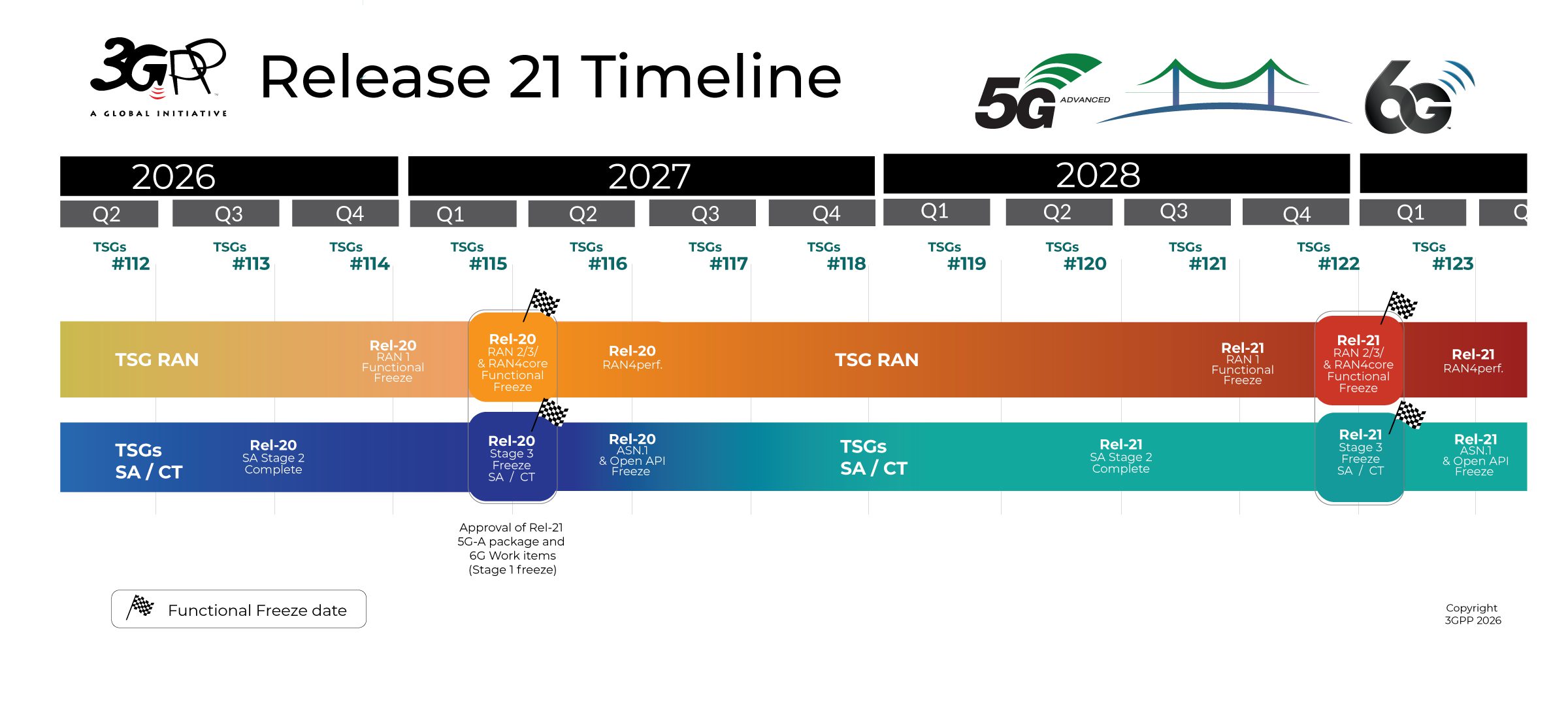
Here is a summary of the core outputs and milestones achieved during the September 2026 cycle:
1. Release 20 (5G Advanced) Milestone Reached
- 100% Stage 2 Freeze: The primary technical output for Release 20 was hitting the 100% completion target for Stage 2 (System Architecture). This officially locks down the architectural aspects for 5G Advanced next wave, transitioning the bulk of execution entirely to Stage 3 protocol and core implementation.
2. Crucial 6G Architectural & Spectrum Decisions
- 6G Dual Connectivity Way Forward: Delegates finalized critical deployment decisions regarding how 6G will integrate with existing infrastructure. Focus solidified around Option 1 (6G-anchored dual connectivity with 5G NR) and Option 3 (Dual stack, no RAN-level aggregation).
- Multi-RAT Spectrum Sharing (MRSS): RAN1 delivered its highly anticipated MRSS preliminary performance evaluation. This evaluates the overhead costs of operators running 5G and 6G simultaneously on the same frequencies, safeguarding migration investments.
3. Progressive 6G Requirements (Release 21)
Following the structural approval of the Release 21 timeline earlier in the year (targeting a functional freeze in December 2028), Working Group chairs presented progressive technical reports.
- Use Cases and Services: Deepened studies into Integrated Sensing and Communications (ISAC), native AI/ML network applications, and ubiquitous connectivity (“anywhere to everywhere”).
- Radio Advancements: Maturation of the 6G RAN study on Scenarios and Requirements (TR 38.914), steering the industry closer to initial physical layer specifications.
……………………………………………………………………………………………………………………………………………………………….
Main 6G Advancements at the Sept 2026 3GPP Meeting:
The primary 6G-specific outputs finalized during this meeting cycle include:
-
- Dual Connectivity Framework: Delegates officially locked down the deployment pathways for the first phase of 6G. They established a clear consensus favoring Option 1 (6G-anchored dual connectivity with 5G NR) and Option 3 (Dual stack/independent radio lines), settling intense architectural debates on how 6G will overlay on 5G infrastructure.
- MRSS Performance Baseline: RAN1 finalized its preliminary performance evaluations for Multi-RAT Spectrum Sharing (MRSS). This technical milestone establishes the exact overhead margins required to run 5G and 6G simultaneously on legacy bands, preventing spectral efficiency loss during the transition.
- TR 38.914 Technical Alignment: The radio groups finalized the foundational baseline for the Radio Scenarios and Requirements report (TR 38.914), updating propagation channel models to explicitly match the new spectrum ranges targeted for initial Release 21 designs.
- ISAC Requirements Progression: SA2 finalized early system-level flows for Integrated Sensing and Communications (ISAC), formalizing how a 6G network will dynamically allocate base station radio energy to double as radar mapping infrastructure.
Timeline for ATIS Submission to ITU-R WP 5D as IMT 2030 contributions:
Because these specific technical agreements form the baseline of 3GPP’s Release 21, ATIS will package and submit them to ITU-R WP 5D in the following time windows:
-
- Initial Framework Alignment (Mid-2027): ATIS will submit the early Release 21 architectural structures and capability definitions resulting from these choices to the 55th meeting of WP 5D. This acts as an initial informational contribution to show compliance with the IMT-2030 (6G) Framework.
- Formal Candidate Technology Submission (Late 2028 / Early 2029): Once these 2026 foundational agreements are fully written into frozen protocol code during the December 2028 Stage 3 Freeze, ATIS will package them into a formal “Candidate RIT (Radio Interface Technology)” proposal.
- The Absolute Cutoff: This complete compliance package and its accompanying technical self-evaluation will be submitted directly ahead of the 59th meeting of WP 5D in February 2029, which is the final deadline for IMT-2030 candidate evaluations.
……………………………………………………………………………………………………………………………………………………………………………………………………….
References:
https://www.3gpp.org/news-events/3gpp-news/ran113-reports
https://portal.3gpp.org/?tbid=373&SubTB=373#/
Roles of 3GPP and ITU-R WP 5D in the IMT 2030/6G standards process
Comparing AI Native mode in 6G (IMT 2030) vs AI Overlay/Add-On status in 5G (IMT 2020)
ITU-R WP5D IMT 2030 Submission & Evaluation Guidelines vs 6G specs in 3GPP Release 20 & 21
ITU-R M.[IMT-2030.EVAL] & ITU-R M.[IMT-2030.SUBMISSION] reports: Evaluation & Submission Guidelines for 6G RIT/SRITs (6G)
ITU-R WP5D invites IMT-2030 RIT/SRIT contributions
How NTIA “Call to Action for 6G Leadership and Security” might influence 6G/IMT-2030 standards and 3GPP specifications
NGMN issues ITU-R framework for IMT-2030 vs ITU-R WP5D Timeline for RIT/SRIT Standardization
IMT-2030 (“6G”) Minimum Technology Performance Requirements for Radio Interface Technologies
IMT-2030 Technical Performance Requirements (TPR) from ITU-R WP5D
One thought on “Sept 2026 3GPP meeting updates for 5G Advanced and 6G planning (with timeline for submisson to ITU-R WP 5D via ATIS)”
Leave a Reply

The 53rd ITU-R WP 5D meeting from Sept 28 -to- Oct 8th has no 3GPP contributions (via ATIS).
Key objectives of WG Technology Aspects at the 53rd WP 5D meeting:
i) Finalize Revision 1 of Document IMT-2030/2 “Process” – Submission, evaluation process and consensus building for IMT-2030;
ii) Finalize draft new Report M.[IMT-2030.SUBMISSION] – Candidate technology submission template for IMT-2030;
iii) Continue working of revision 4 of Recommendation ITU-R M.2150 (IMT 2020/5G RIT/SRIT) and revision 8 of Recommendation ITU R M.2012 (4G LTE-Advanced).
We think one of the most interesting 6G related contribution is about the IMT-2030 process “CONSIDERATIONS AND PROPOSALS FOR IMT-2030 PROCESS DOCUMENT,” which is coauthored by ZTE Corporation, Huawei Technologies Sweden AB, InterDigital Communications Inc., Nokia Corporation, Qualcomm Incorporated, Samsung Electronics Co. Ltd., and Telefon AB – LM Ericsson.