

6G market forecasts
Brooklyn AI-Native 6G Summit Highlights: Verizon’s 7 GHz Field Tests with Ericsson, AI-RAN Demonstrations and Wireless AI Interop
Disclaimer: ChatGPT was used extensively to research the Brooklyn AI-Native 6G Summit, review technical presentations and company announcements, analyze the technologies and demonstrations discussed, and assist with drafting this article. The author reviewed, fact-checked, and edited the material and is 100% responsible for its content.
Introduction:
Verizon’s 7 GHz 6G field testing:
- China’s DeepSig demonstrated an over-the-air AI-RAN system using the open-source OCUDU RAN ecosystem and NVIDIA DGX Spark. Its demonstrations included neural receiver processing, ray-traced channel emulation and AI-based spectrum sensing. This was a meaningful integration demonstration, but publicly available information did not provide independent quantitative results for throughput, latency, spectral efficiency, power consumption or performance against conventional receivers. It therefore should not be interpreted as evidence of commercial readiness.
- InterDigital and Arizona State University (ASU) demonstrated research on interoperable AI-based channel-state-information (CSI) feedback. Their approach uses independently trained encoder and decoder models designed to interoperate without exchanging model parameters or requiring identical architectures. The prototype used an OpenAirInterface-based testbed. The researchers reported performance approaching jointly trained models.
–>This is a potentially important research direction: future wireless systems may need AI models from different suppliers to work together. However, the work remains limited in scope and does not establish a standardized interface or universal multi-vendor interoperability.

…………………………………………………………………………………………………………………………………………………………………………………………………………………………………………….
Expanding on AI model interoperability (InterDigital / Arizona State University)
The InterDigital–ASU demonstration on interoperable AI-native Channel State Information (CSI) feedback deserves greater attention than it typically receives at such events. Their live prototype (“From Conventional CSI to Interoperable AI-Native Latent Feedback”) showed that an encoder and decoder trained completely independently—by different parties, without exchanging model parameters or requiring identical architectures—can still achieve performance approaching that of jointly trained models. The work was realized on an OpenAirInterface-based testbed, providing a concrete, over-the-air proof point rather than a purely simulation-based claim.
This matters because CSI feedback is inherently a two-sided AI/ML use case: the UE-side encoder and the gNB-side decoder will frequently come from different vendors in any realistic multi-vendor RAN. 3GPP’s ongoing AI/ML air-interface studies (beginning in Release 18) have already identified CSI compression/enhancement as one of the primary candidates for standardization precisely because of this cross-node dependency. Without well-characterized interfaces for the latent representation, model versioning, performance monitoring, and fallback behavior, operators risk recreating proprietary silos inside an otherwise open or disaggregated RAN architecture.
The technical problem is not merely “can AI compress CSI better?” A more important question if AI models from independent vendors interoperate reliably at scale? The InterDigital/ASU result is an early, encouraging data point that such interoperability is feasible. However, it remains limited in scope: it does not yet define a standardized latent-space interface, multi-vendor conformance testing methodology, or lifecycle management procedures. Those are the harder, longer-term questions that will determine whether AI-native features can actually be deployed across heterogeneous networks rather than remaining confined to single-vendor islands.
As AI-RAN concepts mature, progress on model interoperability—starting with CSI feedback and extending to other two-sided functions such as beam management or positioning—will likely prove as important as advances in model accuracy itself.
Physical AI and distributed infrastructure:
Another demonstration connected humanoid robots in Singapore with synchronized digital twins in Brooklyn. The project brought together Singapore’s Future Communications Program, NeuroRAN, Qualcomm Technologies, NVIDIA and MediaTek. Its workflow combined AI model selection, action generation, digital-twin validation and execution over a 5G/AI-RAN connection.
The demonstration illustrated how wireless connectivity, edge computing and AI orchestration could support remotely coordinated physical systems. However, the public description did not provide detailed measurements of end-to-end latency, synchronization accuracy, packet loss or operational reliability.
More broadly, the Brooklyn 6G Summit emphasized that AI-native networks will require coordination across mobile networks, cloud and edge computing, data-center switching, IP and optical transport. These infrastructure requirements are important, but the event did not establish a proven commercial business model for AI-RAN or AI-native 6G services.
Conclusions:
The Summit’s most useful contribution was to highlight both the opportunities and the engineering challenges facing AI-native 6G. Verizon’s 7 GHz trials exposed the propagation and coverage trade-offs associated with higher-frequency spectrum, emphasizing that future hardware architectures must evolve to overcome severe indoor building penetration limitations. DeepSig demonstrated an integrated AI-RAN research system, while InterDigital and Arizona State University explored a potentially important approach to interoperability between independently trained wireless AI models.
The Physical AI demonstration illustrated how wireless connectivity and distributed computing could support connected robotic systems. Ultimately, this 6G event underscored that scaling these technologies relies heavily on navigating broader, systemic bottlenecks. Chief among these is a shared sense of urgency regarding infrastructure power constraints, which threaten to restrict high-capacity AI-RAN and edge deployment at scale.
True commercial realization will not come from advancing computing, AI, or networking in isolation, but through their absolute, cross-layer convergence into a workload-aware, distributed infrastructure. These developments are worth watching, but they should not be confused with standardized, commercially deployable 6G technology. Significant work remains in radio performance, spectrum availability, AI model interoperability, network architecture, and deployment economics.
…………………………………………………………………………………………………………………………………………………………………….
Editor’s Note: This summary is based on publicly available Summit announcements, demonstration descriptions, the published agenda and post-event reporting. Presentation slides and full session recordings were not publicly available at the time of writing. Where detailed performance data were unavailable, claims are attributed to the participating organizations.
…………………………………………………………………………………………………………………………………………………………………….
References:
IEEE.tv — Brooklyn AI-Native 6G Summit
https://www.lightreading.com/6g/verizon-cto-assesses-7ghz-band-for-6g-after-first-call-in-the-field
Nokia: https://www.youtube.com/watch?v=og3f2v_WTSk
Highlights and Summary of the 2025 Brooklyn 6G Summit
ATIS Proposes Wireless Physical-Layer Foundation Models for AI-Native 6G Networks
6G Architecture and Economics: Core Network Evolution, AI Integration and Business Case
IMT-2030/6G Spectrum Sharing: The Roles of WRC-27, NTIA and ITU-R WP 5D
Perspective & Analysis of ITU-R Workshop on IMT-2030 (6G) terrestrial radio interfaces: February 10, 2027 in Geneva, Switzerland
AI-Native 6G RAN in Practice: Research and Validation Insights from 6G-MIRAI-HARMONY
Warning: 6G core network must not repeat the 5G SA 3GPP architecture specs vs lack of interoperable standards
Sept 2026 3GPP meeting updates for 5G Advanced and 6G planning (with timeline for submisson to ITU-R WP 5D via ATIS)
FCC plans 6G spectrum auctions before IMT 2030 frequencies have been identified and without a 6G frequency arrangement standard
How NTIA “Call to Action for 6G Leadership and Security” might influence 6G/IMT-2030 standards and 3GPP specifications
Autonomous customer experience required for AI-Native 6G and distributed intelligence at the network edge
Dell’Oro: 6G RAN Capex to reach $500 billion by 2034 + Counterpoint
Dell’Oro Report Summary:
According to a recent Dell’Oro Group report, global telecom operators will spend $500 billion on 6G infrastructure over the next decade. During that same period, the overall network equipment market is projected to grow at just a 1% CAGR. Telco revenues are expected to grow at 3% over the next decade. The report’s base-case scenario envisions 6G as an evolutionary technology that builds on Massive MIMO, the existing site grid, and wider channel bandwidths to deliver step-change improvements in RAN economics.
“While the G decoupling movement is gaining momentum for all the right reasons, the most likely scenario is still that 6G will be another G, with 6G RAN capex expected to accelerate toward the end of the decade,” said Stefan Pongratz, Vice President of RAN and Telecom Capex Research at Dell’Oro Group. “At the same time, operators are in a much stronger position today from a network capacity perspective than they were during the transition from 4G to 5G. As a result, cumulative 6G RAN revenue during the first six years of the cycle is projected to be 10 to 20 percent lower than during the comparable period of the 5G cycle.”
Additional highlights from the June 2026 6G Advanced Research Report include:
- 6G RAN is expected to scale rapidly, with cumulative RAN revenue and wireless capex during the first six years projected to exceed $100 B and $500 B, respectively.
- 6G is not expected to expand the overall RAN market. Instead, the baseline scenario projects the broader RAN market to grow at a 1 percent CAGR between 2030 and 2034.
- Both Sub-7 GHz and cmWave spectrum bands are expected to play important roles in 6G deployments, although momentum behind spectrum above 7 GHz continues to build.
- Cumulative 6G RAN investments between 2029 and 2034 are projected to account for approximately half of total RAN capex during the same forecast period.
Dell’Oro Group’s 6G Advanced Research Report offers an overview of the RAN market, including tables showing total RAN revenue by technology (2G-6G) from 2000 to 2034. 6G RAN is analyzed by spectrum (Sub-7 GHz, cmWave, mmWave), by Massive MIMO, by RF Power (Macro, Micro, Pico), and by region (North America, Europe, Middle East and Africa, China, Asia Pacific Excl. China, and CALA). To purchase this report, please contact us by email at [email protected].
Editor’s Counterpoint:
We don’t agree with Stefan’s statement that “6G RAN is expected to scale rapidly,” based on the delays and failures of ITU-R’s IMT 2020 (5G) standards and 3GPPs 5G SA core network specifications.
A phased ramp-up is more likely, as early commercial launches begin at the end of 2030 and early 2031. Then slower scaling through the early 2030s as spectrum, devices, infrastructure, and business cases mature.
At this point in time, we have no idea what the IMT 2030 RIT/SRITs will be or 3GPPs 6G SA Core network functionality. ITU WP5D’s IMT-2030 work is still setting requirements and evaluation criteria, and candidate RIT submissions are only expected in the 2027–2029 window. The ITU-R also says the technical performance requirements are minimum levels for consideration and do not guarantee real-world deployment performance. That’s similar to IMT 2020/5G RITs, where ITU-R M.2410 report: minimum performance requirements were NOT met for URLLC – ultra high reliability or ultra low latency (1ms in the data plane; 10ms in the control plane).
In other words, approval creates the foundation, not instant scale. That points to a 6G RAN standards process that finishes just as first deployments begin, not one that guarantees immediate mass rollout.
-
3GPP Release 20 (2025–2026): Early 6G studies focused on requirements/architecture
-
3GPP Release 21 (2027–2028): First concrete 6G specifications, core radio/network framework
-
3GPP 6G functional freeze: December 2028
-
ITU-R IMT-2030 formal approval: December 2026 for technical performance requirements; full RIT/SRIT approval late 2030–early 2031.
This timeline confirms the Counterpoint’s “standards finish just as first deployments begin” concern—there’s no guarantee of immediate mass rollout. Furthermore, 6G SA has not yet been defined while 5G SA is still rolling out in 2026 – six years after 5G NR specs and IMT 2020 RIT standards were completed. Therefore, the 2030-2031 6G commercial launch assumption is optimistic for many markets.
What’s needed by 2030: globally harmonized work, spectrum studies across low, mid, mmWave, and sub-THz bands, and network operator/vendor roadmaps. Once those crystalize they could support fast 6G uptake in premium pockets such as dense urban zones, enterprise campuses, and fixed wireless/edge-centric use cases where the economics are strongest. That means “rapid” is plausible in targeted launches, not across entire national footprints.
6G will likely face the same structural constraints that slowed 5G: spectrum availability, device ecosystems, deployment costs, and the need to integrate with 5G-Advanced during the transition time period. Higher-band operation, especially above 100 GHz, is technically feasible but still requires mature propagation, hardware, and deployment architectures before it can scale widely. The result is usually a long coexistence period where 5G remains the coverage layer while 6G expands selectively.
The likely pattern is “launch first, scale later,” with meaningful expansion depending more on spectrum policy, device availability, and operator ROI than on the standard approval itself.
Deployment timeline:
-
2026–2027: Standards and requirements work intensifies, with 3GPP/ITU alignment still being shaped and operators pushing for realistic deployment timelines.
-
2028–2029: Pre-commercial and early pilot networks appear, especially in dense urban, enterprise, and testbed environments.
-
2030: First commercial 6G launches are widely expected by the end of 2030, but these will be selective rather than universal.
-
2031–2033: Main capex ramp and larger-scale rollout window, as more of the macro grid, transport, and edge layers are upgraded.
-
2034 and beyond: Broader geographic expansion and more mature multi-band coverage, with 6G taking on a larger share of traffic and enterprise use cases.
6G Capex Outlook:
Dell’Oro’s view that the 6G capex ramp starts around the end of 2030 (we think it will be 2031), while cumulative 6G RAN investment in 2029–2034 could account for 55% to 60% of total RAN capex in that period. A separate data-driven forecast argues global 6G capex could land somewhere in the sub-$1 trillion to about $1.5 trillion range over a decade, depending on traffic growth and spec assumptions. That is a wide band, but it is consistent with a technology transition that reuses much of the existing macro grid rather than replacing everything at once.
………………………………………………………………………………………………………………………………………………………………………………………………
Sebastian Barros wrote:
6G will deliver necessary operational improvements. It will utilize new 7GHz spectrum, improve radio performance, and lower the cost per bit for operators still recovering from the 5G capex hangover. However, consumers and enterprises do not pay a premium for faster pipes. Connectivity is now a hyper-commoditized utility.
If Telcos want to capture value in this new economy, they must stop defining their core business as “connectivity.” Telecom is a distribution business.
Networks serve as the last-mile delivery system for the global economy. In the past, the industry distributed voice, SMS, and 8K video. Today, the asset being distributed is intelligence. Hyperscalers are building massive, centralized AI data centers, but that compute power requires a physical delivery mechanism to reach users.
…………………………………………………………………………………………………………………………………………………………………………………
References:
Current 6G Trajectory is Evolutionary, According to Dell’Oro Group
Dell’Oro: RAN Market Stabilized in 2025 with 1% CAG forecast over next 5 years; Opinion on AI RAN, 5G Advanced, 6G RAN/Core risks
Market research firms Omdia and Dell’Oro: impact of 6G and AI investments on telcos
ABI Research: 6G Radio Installed Base by Region from 2029 to 2034
GSMA Vision 2040 study identifies spectrum needs during the peak 6G era of 2035–2040
ABI Research: 6G Radio Installed Base by Region from 2029 to 2034
According to ABI Research, fewer than 0.35 million 6G-supported radios are expected to be deployed worldwide at the end of 2029. That’s understandable, because those “6G radios” will be pre-standard deployments. The IMT 2030 Radio Interface Technology (RIT) standards won’t be completed till the end of 2030!
By 2034, around 7.2 million 6G radios will have been deployed, as per the market research firm’s forecast. The Asia-Pacific region (4 million deployments by 2034) will likely see the first major global deployment of this new generation of radio equipment. North America (1.2 million deployments by 2034) and Europe (940K deployments by 2034) will also see significant deployments once telecom operators complete their own transition from 5G densification to 6G expansion.
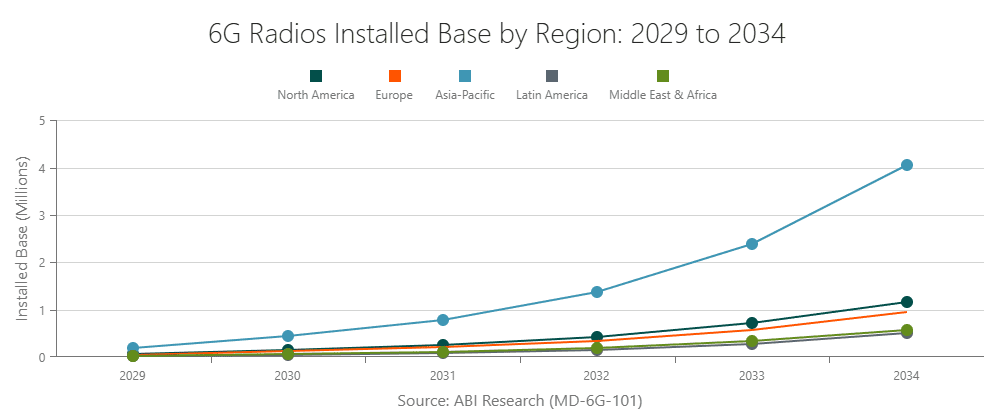
6G deployments are forecast to start low, due to continuing ITU-R standards/3GPP specifications work and early network operator caution, with rapid growth after 2031 to 2032 as mobile operators complete their overall first phase of 6G deployments and more operators gain confidence for scaled rollouts.
ABI is treating 6G as a multi-layer infrastructure market: not just spectrum and radios, but also core evolution, advanced antenna systems, and sensing/AI convergence. In practice, that means the report should help answer questions like where to target product planning, how regional adoption may diverge, and which infrastructure subsegments could capture early 6G spend.
ABI’s broader 5G/6G research service also emphasizes spectrum and infrastructure planning, advanced antenna systems, and Open RAN-adjacent market intelligence, which fits the framing of this 6G report as part of a wider network infrastructure portfolio.
References:
https://www.abiresearch.com/news-resources/chart-data/6g-radios-installed-base-forecast
Analysis: Nvidia’s rumored new 6G AI-RAN – likely features/functions and industry impact
Comparing AI Native mode in 6G (IMT 2030) vs AI Overlay/Add-On status in 5G (IMT 2020)
Roles of 3GPP and ITU-R WP 5D in the IMT 2030/6G standards process
NVIDIA and global telecom leaders to build 6G on open and secure AI-native platforms + Linux Foundation launches OCUDU
AI wireless and fiber optic network technologies; IMT 2030 “native AI” concept