

Ericsson’s June 2026 Mobility Report Highlights + AI impact on network traffic
Ericsson’s June 2026 Mobility report states that:
- 5G global subscriptions have now passed the 3 billion mark with the addition of 162 million in the first quarter of 2026.
- Half of the world’s mobile data traffic is now carried over 5G vs 48% at the end of 2025. It’s forecast to rise to 85% by the end of 2031.
- Mobile network data traffic growth exceeded expectations, at 22% between Q1 2025 and Q1 2026.
- Fixed Wireless Access (FWA) adoption is also growing, with around 70% of FWA service providers now offering the service over 5G.
- The number of commercial 5G SA network slicing offerings has increased from 65 to 84 in just 6 months.
- Cellular IoT connections are expected to approach 8 billion by the end of 2031
“With the upcoming transition to physical AI, traffic patterns will fundamentally shift as we move from centralized models in data centers to distributed, autonomous AI agents embedded across our device vehicles and cities, commonly connected by 5G,” said Ericsson CTO Erik Ekudden, in a statement accompanying the report.
“Mobile networks are no longer only about providing best-effort connectivity, they are becoming critical, intelligent infrastructure that meets diverse application needs, Reflecting part of this shift is the continued rise in new commercial service offerings based on 5G standalone network slicing and the number of communications service providers deploying 5G SA,” Ekudden said.
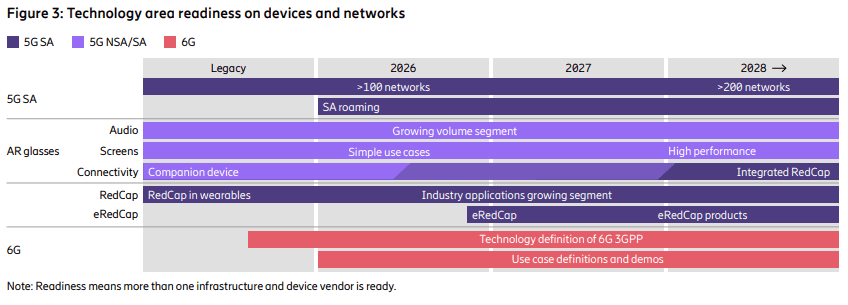
Image Credit: Ericsson
……………………………………………………………………………………………………………………………………………………………………….
Impact of Agentic AI workloads on network traffic:
The most critical engineering takeaway from the report is a profound asymmetry in data traffic growth, heavily driven by agentic AI workloads and user-generated content.
Key Insights:
- AI-driven applications – spanning smartphones, AI/AR smart glasses and autonomous vehicles – are inherently uplink heavy, generating continuous data streams that challenge traditional downlink-dominated traffic patterns.
- Uplink traffic growth is already outpacing downlink for many service providers, with field measurements indicating capacity constraints under peak load. Scenario modeling suggests that additional AI traffic will result in uplink traffic being three times higher in 2031 compared to 2025.
- Current networks are not dimensioned for sustained uplink demand, calling for a step change in design – from 5G software and hardware enhancements in the near term to 6G-native uplink innovations over the longer horizon.
- Traffic Inversion: Traditionally, cellular networks are architected and provisioned to handle heavily downlink-centric (DL) traffic patterns. However, the proliferation of multimodal generative AI and uplink-heavy applications is radically flipping this paradigm.
- Field Measurement Data: Out of 55 global operators analyzed, 43 experienced uplink (UL) growth rates outpaces DL growth. Crucially, 17 of those service providers reported UL expansion exceeding DL by a factor of 1.5x or higher.
- Projections: Ericsson’s scenario modeling suggests that cumulative AI-driven traffic could cause UL demands to spike threefold by 2031 compared to 2025 baselines.
- Near-Term: Immediate deployment of 5G RAN software optimizations and hardware refreshes. This includes pushing for 5G Standalone (SA) core migrations, leveraging AI-optimized Massive MIMO beamforming, and utilizing network slicing to guarantee bounded latency for critical UL channels.
- Long-Term: Transitioning to 6G-native uplink innovations. Early 6G standardization, targeted for finalization around 2028–2029, will focus deeply on AI-native architectures, Integrated Sensing and Communication (ISAC), and asymmetric air-interface designs natively optimized for continuous data streams.
Market Outlook:
Resolving these capacity constraints requires immediate, targeted infrastructure capital expenditure. While macro RAN spending has faced recent headwinds, the urgent necessity to re-dimension the air interface for an AI-centric world represents a powerful pipeline catalyst for Ericsson and its infrastructure rivals. Telco spending on RAN products has slumped from $45 billion in 2022 to $35 billion last year, according to analysts at Omdia, while Ericsson’s annual sales have dropped from SEK271.5 billion ($28.8 billion) to SEK236.7 billion ($25.1 billion) over this same period.
References:
https://www.ericsson.com/en/reports-and-papers/mobility-report/reports/june-2026
GSA: Global private mobile networks exceed 2,000 worldwide; Ericsson Private 5G from Verizon Business extends beyond U.S.
Ericsson reports 10% drop in 1st quarter sales; targets network growth
AT&T and Ericsson boost Cloud RAN performance with AI-native software running on Intel Xeon 6 SoC
Ericsson and Intel collaborate to accelerate AI-Native 6G; other AI-Native 6G advancements at MWC 2026
Ericsson goes with custom silicon (rather than Nvidia GPUs) for AI RAN
Nokia to showcase agentic AI network slicing; Ericsson partners with Ookla to measure 5G network slicing performance
China’s telecom industry rapid growth in 2025 eludes Nokia and Ericsson as sales collapse
Latest Ericsson Mobility Report talks up 5G SA networks and FWA
Ericsson Mobility Report touts “5G SA opportunities”
2 thoughts on “Ericsson’s June 2026 Mobility Report Highlights + AI impact on network traffic”
Leave a Reply

Ericsson launches AI in RAN as commercial software subscription, by Matt Walker of MTN Consulting:
Ericsson announced on 11 June 2026 the commercial availability of AI in RAN, a software subscription that embeds telco-grade AI models directly into basebands and radios. No additional hardware is required; the software runs on Ericsson Silicon in existing radios and the latest RAN Compute generation.
First features are available in 2Q26, with further enhancements through the year, including AI-native Scheduler for Link Adaptation, AI-powered Macro Positioning, AI-managed Beamforming, AI-powered Multi-layer Coordination, and Augmented Observability for AI in RAN.
Ericsson says the technology has completed more than 15 deployments and trials, and delivers up to 20% higher downlink throughput, up to 10% better spectral efficiency, up to 2x more supported high-traffic users, 90-95% coverage prediction accuracy, and up to 5x greater user-positioning precision.
The subscription also includes agentic AI support for advanced RAN automation. Operators confirming use include SoftBank, Bell Canada, SK Telecom, and Rogers.
Ericsson’s AI in RAN is the most direct counter-positioning to the Nokia-NVIDIA GPU-accelerated AI-RAN architecture. Ericsson’s argument is that telco-grade AI can be delivered as a software subscription running on existing silicon, without requiring GPU infrastructure. Ericsson’s performance claims (up to 20% higher downlink throughput, up to 10% better spectral efficiency) are meaningful: squeezing more capacity from existing 5G deployments addresses operator revenue pressure without new spectrum or hardware capex. The four named operators (SoftBank, Bell Canada, SK Telecom, Rogers) span multiple regions and include tier-1 telcos with heavy 5G investment. The agentic AI support signals Ericsson is positioning AI in RAN not only as a performance tool but as the foundation for autonomous network operations.
Source: https://www.ericsson.com/en/news/2026/6/the-ran-gets-smarter-ericsson-puts-ai-where-it-matters
………………………………………………………………………………………………………..
Three days earlier, Nokia and Indosat Ooredoo Hutchison announced a GPU-accelerated AI-RAN partnership in Indonesia, extending the Nokia-NVIDIA architecture already committed to by T-Mobile US, SoftBank, and Vodafone.
Two competing models are now in simultaneous commercial and field-trial deployment: one embeds AI in existing baseband silicon; the other adds NVIDIA GPU infrastructure to the RAN. Both claim throughput and efficiency gains; neither has published independent third-party benchmarks comparing them directly. The architecture choice operators make in 2026 will determine vendor dependencies for a decade.
The deeper pattern across this issue is operators moving from AI pilots to production AI operations across live networks. Verizon disclosed that its 60,000-site vRAN — the largest virtualized radio network in the world — is now applying agentic AI across planned changes, service assurance, and optimization, with early results described as “good” and a call for industry-wide interoperability standards for agentic operations. Nokia simultaneously launched an agentic AI framework for IP network operations within its NSP platform, its third agentic product announcement within four weeks.
Ericsson and KDDI published a TM Forum ANLET autonomy score of 3.86 on a live Japanese network. SK Telecom announced a gigawatt-scale AI Cloud built on NVIDIA DSX; Deutsche Telekom won the German federal government’s sovereign AI cloud contract; MTN Group outlined a plan to convert 18,000 African towers into a distributed AI inference grid.
In total, six network operators in six weeks (SKT, DT, MTN Group, Verizon, Softbank, and IOH) have converged on the same strategic premise: the operator’s infrastructure — connectivity, real estate, data center capacity, and government trust relationships — is the foundation for an AI compute business.
………………………………………………………………………………………………….
Governments continue to get more involved in AI compute directly, with implications for telecom. China’s $295 billion program establishes the upper bound of what state-backed AI compute investment looks like Beijing announced plans to invest 2 trillion yuan ($295 billion) over five years in AI datacenter infrastructure, with China Mobile and China Telecom designated as the primary operators of a national AI compute network, and Huawei supplying the majority of AI chips — explicitly bypassing NVIDIA. The plan accelerates China’s original 2030 national computing network target to 2028, funded through sovereign debt. China’s National Data Administration had already reported 140 trillion daily AI token flows by March 2026 — up 1,400-fold from the start of 2024 and China Mobile, Telecom, and Unicom had launched commercial AI token packages in May, with per-token costs centralized operations can reduce by approximately 30%. China Mobile separately unveiled AI-eSIM, which embeds an autonomous decision layer directly into the SIM. China’s operators are moving through the full AI lifecycle — token economy, infrastructure mandate, sovereign chip supply — at a pace and scale that no other single market currently matches.
AI Has Surpassed Human Traffic-Telcos Are Not Ready for What Comes Next as machines take over the internet, by Sebastian Barros
Aug 10, 2026
Machines are starting to generate more Internet requests than people. They will not use the network the way people do. Their payloads will often be smaller, but they will generate far more transactions, put greater pressure on uplinks, communicate constantly across clouds and data centers, and increasingly depend on the network for identity, latency, security, and reliability. Telcos need to prepare for a different Internet, not simply a bigger one.
Machines will dominate the Internet without dominating the bytes:
Cloudflare has reported an important shift in Internet traffic. Automated systems now generate more requests than humans across the web activity it measures, and Cloudflare CFO Thomas Seifert recently suggested that nonhuman traffic could eventually exceed human traffic by a factor of 1,000 within five years.
It is a spectacular headline, but it is also very easy to misunderstand. Cloudflare is not saying that global telecom networks will suddenly carry one thousand times more petabytes. Its bot-versus-human measure is based on HTTP requests to HTML content, not total Internet bytes. A crawler can request ten thousand web pages and create ten thousand separate interactions while still moving less data than one person watching a few hours of 4K video. For the past two decades, network evolution has been shaped mainly by humans consuming content. Smartphones arrived, video moved to mobile, social media exploded, and streaming pushed traffic relentlessly upward. The engineering response followed a familiar and expensive recipe: more spectrum, more radio capacity, more backhaul, more caching, and larger transport networks.
Machines and software agents introduce a different traffic pattern. A wearable, robot, camera, vehicle, industrial controller, or AI agent does not use connectivity like someone watching Netflix. Much of its traffic may consist of relatively small payloads, but the number of interactions can be enormous. Some of those interactions originate from physical devices. A growing share will also be generated inside smartphones, enterprise systems, cloud platforms, and data centers, where agents continuously call models, databases, APIs, and other agents.
The coming shift is therefore not simply from humans to machines. It is from a network dominated by content consumption to one increasingly dominated by automated actions.
Machine activity can therefore grow far faster than traffic volume. The number of autonomous actors, requests, API calls, authentication events, and machine transactions can increase by orders of magnitude while total network traffic continues growing at rates that look relatively familiar to a telecom planner.
Telcos may not face one thousand times more bytes. They may face one thousand times more transactions, decisions, and network events behind those bytes.
https://sebastianbarros.substack.com/p/ai-has-surpassed-human-traffic