

Ethernet Advances Towards 400 Gb/s-per-Lane Signaling for AI Networks: IEEE P802.3dv, Copper and Optical Interconnects
Introduction – Original Shared-Medium Ethernet LANs have evolved to High-Performance AI Networking Fabrics:
Ethernet originated at Xerox’s Palo Alto Research Center (PARC) in 1973 as a local area networking (LAN) technology that allowed computers and peripherals to communicate over a shared coaxial cable. The original experimental Ethernet, developed by Robert Metcalfe and David Boggs (RIP), used Carrier Sense Multiple Access with Collision Detection (CSMA/CD) to control access to the shared transmission medium. It’s primary purpose was to enable desktop workstations to share a printer.
Transforming that experimental technology into a working 10 Mb/s Ethernet implementation required substantial additional engineering. At Xerox, Ron Crane (RIP) and Robert Garner were key contributors to the 10 Mb/s Ethernet adapter developed for the Xerox Star workstation. Crane designed the analog front-end circuitry, including the receive clock-recovery phase-locked loop, and characterized the coaxial cable’s analog response and requirements, including transceiver tap placement. Garner designed the adapter’s digital logic and microcode. Their work was instrumental in the development of the DEC-Intel-Xerox (DIX) 10 Mb/s Ethernet specification, which subsequently provided the foundation for IEEE 802.3 10BASE5.
The original Ethernet LAN architecture has since undergone a major fundamental transformation. The introduction of switched, full-duplex Ethernet eliminated the shared-medium collision detection environment and made CSMA/CD unnecessary in mainstream deployments. Ethernet evolved from a 10 Mb/s LAN technology into a family of standardized physical-layer interfaces operating over copper and optical fiber, with switching architectures supporting increasingly sophisticated enterprise, carrier and data-center networks.
Today, Ethernet encompasses considerably more than its original LAN architecture. Although the IEEE 802.3 MAC frame format and associated link-layer functions remain foundational, modern Ethernet networks employ high-speed SerDes, advanced modulation and forward error correction (FEC), sophisticated switching fabrics, congestion management and optical interconnects. Ethernet framing transports IP packets and numerous other higher-layer protocols across these networks.
The latest transformation is being driven by the enormous bandwidth and low-latency requirements of artificial intelligence infrastructure. Distributed GPU systems require increasingly capable interconnections for scale-up, scale-out and scale-across networking. These requirements are pushing the industry toward 400 Gb/s-per-lane electrical signaling, higher-capacity optical interfaces and new approaches to copper and optical interconnects.
The IEEE 802.3 Working Group’s P802.3dv project addresses this next stage of Ethernet evolution, specifying physical-layer interfaces and management parameters for 400 Gb/s, 800 Gb/s and 1.6 Tb/s Ethernet based on 400 Gb/s-per-lane signaling. The project illustrates how far Ethernet has evolved from its original shared-medium LAN roots—and how its standardized framing and interoperability ecosystem continue to support entirely new classes of high-performance networking fabrics.
The Ethernet Alliance, formed in January 2006, was established to accelerate Ethernet technology adoption, promote interoperability, and provide an industry-wide voice supporting IEEE 802.3 Ethernet development.
Why AI Networking Requires Higher Ethernet Bandwidth:
AI infrastructure is creating three distinct networking requirements:
- Scale-up: High-bandwidth, low-latency interconnections among GPUs and other accelerators within a system or closely coupled cluster.
- Scale-out: Networking among GPU servers and racks within large data centers, connecting compute, storage and other infrastructure.
- Scale-across: Interconnecting geographically or operationally distributed AI computing resources and data-center clusters.
These architectures require high-radix switches, increasingly dense electrical and optical interconnections, low latency and efficient utilization of available bandwidth.
Traditional Ethernet speeds and interconnect architectures are being challenged by the growing number of accelerators and the volume of data exchanged during distributed AI training and inference.
The transition to 400 Gb/s-per-lane signaling is intended to increase bandwidth density while reducing the number of lanes, connections and associated infrastructure required to achieve higher aggregate data rates.
The challenge is not simply increasing signaling speed. Power consumption, signal integrity, latency, reach, thermal management and interoperability must all be addressed.
IEEE P802.3dv: Standardizing 400 Gb/s-per-Lane Ethernet:
The IEEE 802.3 Working Group approved the P802.3dv Project Authorization Request (PAR) on September 25, 2026. The project addresses physical-layer specifications and management parameters for:
- 400 Gb/s Ethernet
- 800 Gb/s Ethernet
- 1.6 Tb/s Ethernet
All three aggregate data rates are based on 400 Gb/s-per-lane signaling.
The project scope includes electrical interconnects and single-mode fiber (SMF) optical interfaces with reaches up to 500 meters. The IEEE 802.3 400 Gb/s/Lane Signaling Study Group completed its charter following PAR approval and transitioned into the P802.3dv Task Force. This is an important standards-development milestone. However, P802.3dv remains an active standards project; its approval as a PAR does not mean the resulting technical specifications have been completed or approved. The work is particularly important to AI networking because it establishes a standards framework for higher-bandwidth Ethernet interfaces across electrical and optical media.
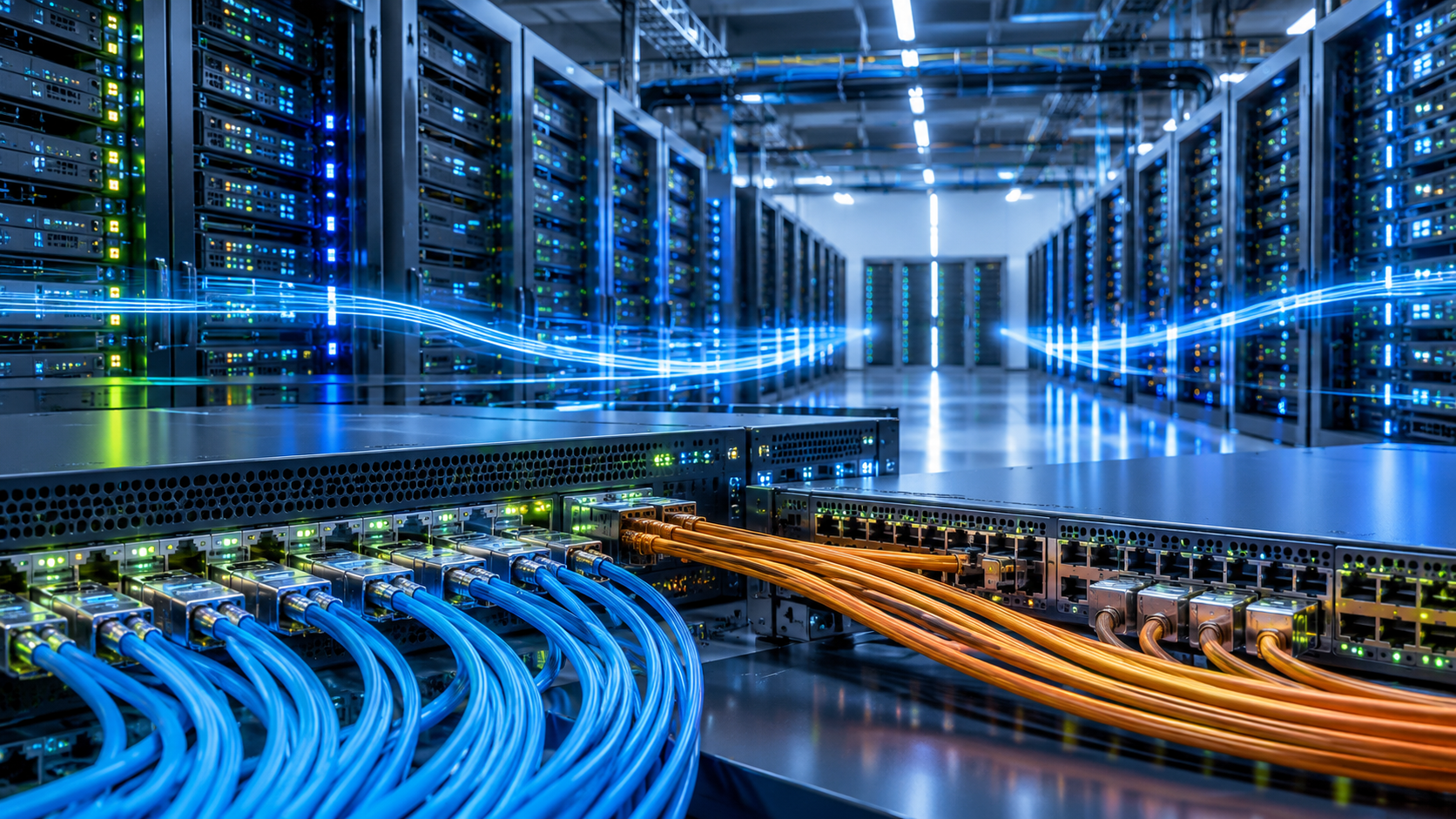
High-speed Ethernet switching and copper and optical interconnects are central to scaling AI data center networks.
Image generated by ChatGPT using AI image-generation technology.
………………………………………………………………………………………………………………………………………………………………………………………………………………………………………………………..
Electrical Signaling: PAM4/PAM6, Copper Channels, SerDes and FEC:
Moving to 400 Gb/s per lane creates substantial electrical engineering challenges. The TEF 2026 discussions included presentations from Broadcom, Synopsys, TE Connectivity, Amphenol and Huawei addressing 400G/lane signaling, copper interconnects, channel feasibility and system design.
- A central question is whether PAM4 modulation can continue to meet the requirements or whether higher-order modulation, including PAM6, offers advantages under particular channel conditions.
- PAM4 encodes two bits per symbol using four amplitude levels. PAM6 uses six amplitude levels, potentially increasing the number of bits transmitted per symbol but introducing additional challenges involving noise margins, receiver complexity and signal integrity.
At these signaling rates, performance depends on the entire electrical channel, including:
- SerDes transmitter and receiver design.
- Chip packages and host-board traces.
- Connectors and cable assemblies.
- Channel insertion loss and crosstalk.
- Equalization and clock recovery.
- Forward error correction.
Passive copper remains attractive because of its cost, power and manufacturing advantages, but reach becomes increasingly constrained as signaling rates increase. Active copper cables incorporating re-timers or drivers provide alternative approaches, although they introduce additional power, complexity and interoperability considerations.
The TEF presentations emphasized that 400G signaling requires a holistic system-design approach rather than simply increasing the operating speed of existing SerDes implementations.
Optical Infrastructure: IM-DD, Coherent Optics and Multi-Core Fiber:
Optical interconnects are essential as AI networks expand beyond the practical reach of electrical connections.
TEF 2026 addressed several competing and complementary approaches.
Intensity Modulation/Direct Detection (IM-DD):
IM-DD remains an important approach for short-reach optical interconnections. Its relatively straightforward transmitter and receiver architecture makes it attractive for high-volume data-center deployments. However, increasing bandwidth and reach requirements place additional demands on optical components, signal processing and power efficiency.
Coherent Optics:
Coherent transmission uses information encoded in the amplitude and phase of optical signals, enabling more sophisticated modulation and receiver processing. Although traditionally associated with longer-reach telecommunications applications, coherent technologies are increasingly being considered for high-capacity data-center and AI infrastructure interconnections. TEF discussions included coherent optics inside AI infrastructure and the future of coherent Ethernet.
Multi-Core Fiber:
Multi-core fiber offers another approach to increasing optical capacity and fiber density by transmitting independent optical signals through multiple cores within a single fiber. The TEF program addressed multi-core fiber technology, optical transceivers, connectivity, lane breakouts and polarity management. Commercial implementation will depend on compatible transceivers, connectors, testing methods and interoperability specifications. These approaches illustrate that AI networking will require multiple optical technologies rather than a single universal solution.
CPO, NPO and Pluggable Optics: Competing Architectures:
As electrical signaling rates increase, the location of optical conversion becomes increasingly important. TEF 2026 included discussions of several optical packaging architectures:
- Pluggable optics: Removable optical transceivers connected through standardized electrical interfaces. They offer serviceability and flexibility but require high-speed electrical connections between switching ASICs and optical modules.
- Near-Packaged Optics (NPO): Places optical engines closer to the switching ASIC to reduce electrical interconnect distances.
- Co-Packaged Optics (CPO): Integrates optical engines more closely with the switching ASIC package, potentially reducing electrical power consumption and improving bandwidth density.
These approaches involve different trade-offs in power consumption, thermal management, manufacturing complexity, optical alignment, serviceability and operational reliability. There is no reason to assume that one architecture will displace all others. The appropriate implementation will depend on network topology, port density, reach, cost and operational requirements. Interoperability between optical modules, switching systems and fiber infrastructure remains essential.
Interoperability, Testing, Power and Deployment Challenges:
Higher signaling rates and increasingly complex optical architectures make testing and interoperability more important. TEF 2026 included contributions from VIAVI, Keysight, Teledyne and other test-and-measurement companies. Important challenges include:
- Validating 400 Gb/s-per-lane electrical channels.
- Measuring signal integrity and FEC performance.
- Testing optical transmitters and receivers.
- Verifying interoperability among different vendors’ equipment.
- Characterizing CPO and NPO implementations.
- Addressing congestion management and lossless networking.
- Controlling power consumption and thermal dissipation.
The forum also addressed emerging low-latency networking mechanisms, including Link Layer Retry (LLR) and Credit-Based Flow Control (CBFC). Testing must extend beyond individual components to encompass the complete network system, including electrical channels, optical interfaces, switching equipment and operational behavior. This is particularly important for large AI clusters, where a failure or performance limitation in one part of the network can affect the utilization of many expensive accelerators.
Related development: The challenges of implementing lossless, high-bandwidth Ethernet for AI infrastructure are discussed in an earlier IEEE Techblog article, 1.6T Ethernet Packet Loss Problem Solved: PHY-Layer Buffer Exhaustion with MAC-Layer Credit-Based Flow Control. That article examines how OCP’s Ethernet for Scale-Up Networks (ESUN) specification uses MAC-layer Credit-Based Flow Control (CBFC) and Link-Level Retry (LLR) alongside IEEE 802.3 physical-layer technology.
Conclusions:
The Ethernet Alliance’s October 2026 Technology Exploration Forum demonstrated the breadth of engineering work required to advance Ethernet for AI infrastructure.
The transition toward 400 Gb/s-per-lane signaling involves much more than higher-speed Ethernet ports. It requires coordinated advances in SerDes, electrical signaling, copper channels, optical transmission, packaging, switching architectures, FEC and test methodologies.
IEEE P802.3dv provides an important standards-development framework for 400 Gb/s, 800 Gb/s and 1.6 Tb/s Ethernet interfaces using 400 Gb/s-per-lane signaling. However, achieving practical, interoperable implementations will require continued collaboration across the semiconductor, optical component, equipment, cabling and test-and-measurement industries.
Ethernet’s evolution from a shared-medium 10 Mb/s LAN into a high-performance networking ecosystem is a remarkable engineering achievement. Its next transformation will be measured not simply by signaling rates, but by the ability to deliver scalable, interoperable, power-efficient networking for increasingly demanding AI infrastructure.
……………………………………………………………………………………………………………………………………………………………………………………………………
Sidebar: Ethernet Alliance and Its Liaison with the Networking Standards Ecosystem:
The Ethernet Alliance (EA) serves as an industry coordination and adoption organization, connecting Ethernet technology developers, equipment manufacturers, component suppliers and end users with standards-development organizations. It does not develop Ethernet standards or compete with standards bodies. Instead, it promotes standards-based technologies, facilitates industry collaboration, and supports multi-vendor interoperability demonstrations and education.
Its relationships with IEEE 802.3, the Optical Internetworking Forum (OIF) and ITU-T Study Group 15 (SG15) address complementary aspects of Ethernet’s evolution.
IEEE 802.3 — Ethernet Standards Development:
IEEE 802.3 is the principal standards-development organization responsible for Ethernet MAC and PHY specifications. The Ethernet Alliance maintains a formal liaison relationship with the IEEE 802.3 Working Group, established in 2025. Peter Jones was appointed as the Ethernet Alliance liaison officer, with corresponding liaison coordination established by IEEE 802.3.
This relationship facilitates communication about emerging Ethernet applications, standards-development priorities, interoperability requirements and industry education. Recent cooperation includes the Ethernet Alliance’s TEF 2026 program, focused on Ethernet’s role in AI infrastructure, and IEEE 802.3’s Ethernet for AI (E4AI) assessment activities.
OIF — Optical and Electrical Interconnect Implementation Agreements:
The Optical Internetworking Forum develops Implementation Agreements (IAs) addressing interoperable optical and electrical interfaces, high-speed interconnects and networking technologies. Its work complements IEEE 802.3 by addressing implementation details and interoperability requirements across the broader networking ecosystem.
The Ethernet Alliance and OIF have collaborated on industry demonstrations, including joint demonstrations of Flexible Ethernet (FlexE) traffic. Their complementary activities help connect Ethernet standards and implementations with advanced optical and electrical interconnect technologies.
ITU-T Study Group 15 — Optical Transport Networks and Technologies:
ITU-T SG15 develops international Recommendations for optical transport networks and technologies (OTNT), including Optical Transport Network (OTN) architecture, interfaces, signal structures and transport-network management. Its work is particularly relevant to carrying high-capacity Ethernet client signals over optical transport infrastructure.
IEEE 802.3 and ITU-T SG15 maintain formal standards liaison activities covering Ethernet interfaces, optical transport mappings, fiber technologies and related specifications. Examples include coordination concerning 1.6 Tb/s Ethernet client mapping into OTN and emerging multi-core fiber technologies.
The Ethernet Alliance provides a complementary industry coordination and interoperability perspective. Its activities help communicate Ethernet requirements and implementation developments across the broader optical networking ecosystem.
Why These Relationships Matter:
The three organizations address different but complementary requirements:
- IEEE 802.3: Defines Ethernet MAC and PHY standards.
- OIF: Develops Implementation Agreements and promotes interoperability for optical and electrical interconnects.
- ITU-T SG15: Standardizes optical transport networks, technologies and associated international Recommendations.
The Ethernet Alliance helps connect these activities to industry adoption through education, technical collaboration and multi-vendor interoperability demonstrations. This coordination is increasingly important as Ethernet evolves to support 400 Gb/s-per-lane signaling, 1.6 Tb/s interfaces and large-scale AI networking fabrics.
End Note: The formal Ethernet Alliance (EA)–IEEE 802.3 liaison is documented, whereas the EA–OIF relationship is more informal – described through collaboration and interoperability activities.
Useful supporting references:
………………………………………………………………………………………………………………………………………………………………………………………………………………..
References:
https://ethernetalliance.org/tef-2026-the-ai-future-ethernet/
https://ethernetalliance.org/who-we-are/
https://standards.ieee.org/ieee/802.3dv/12772/
https://www.ieee802.org/3/400GPL/
https://ithistory.org/honoree/ron-c-crane [written by Alan J Weissberger]
https://ethernetalliance.org/voe-robert-garner/
https://www.oiforum.com/meetings-events/speaking-engagements-and-supported-events/
1.6T Ethernet Packet Loss Problem Solved: PHY-Layer Buffer Exhaustion with MAC-Layer Credit-Based Flow Control
2026 OCP Summit: Full-Stack AI Networking Silicon from Nvidia/Cisco and Broadcom; Ethernet vs InfiniBand Interconnects
Analysis: Ethernet gains on InfiniBand in data center connectivity market; White Box/ODM vendors top choice for AI hyperscalers
AI Compute Has a Switchboard Problem: Orchestration & Data Center Fabric Explained
The AI Infrastructure Build-Out: A $10 Trillion Bet on Compute, Power, and Networks
AI-Era Cloud Network Transformation: A Reference Architecture and Implementation Roadmap