

The AI Infrastructure Build-Out: A $10 Trillion Bet on Compute, Power, and Networks
Introduction:
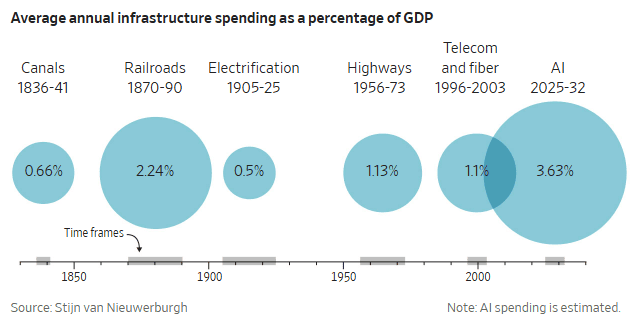
According to the Wall Street Journal, the AI build-out is rapidly becoming the largest concentrated infrastructure investment cycle in modern American economic history. Unlike earlier national build-outs—railroads, interstate highways, electrification, or the commercial internet—this cycle is being driven largely by a small group of cloud platforms deploying highly specialized compute, networking, power, cooling, and semiconductor infrastructure at unprecedented speed. Economist Stijn van Nieuwerburgh estimates that U.S. spending on data centers and related AI infrastructure could reach $10.3 trillion [1.] between 2025 and 2032, equivalent to an average of 3.6% of annual GDP. The estimate encompasses far more than conventional enterprise data centers: it reflects the industrial-scale infrastructure needed to train and serve frontier AI models, including GPU and accelerator clusters, high-bandwidth memory, advanced packaging, optical interconnects, high-capacity Ethernet and InfiniBand fabrics, grid interconnection, substations, backup generation, liquid cooling, and long-haul fiber connectivity.
Note 1. The $10.3 trillion number is a scenario-based estimate of U.S. AI infrastructure investment during 2025–2032—not a forecast of announced corporate spending. The Brookings analysis behind it assumes that about 183 GW of new data-center capacity will be completed through 2032, versus a 509-GW announced/planned pipeline. A representative 200-MW AI campus is estimated to cost about $8.2 billion: $5.6 billion for IT equipment, $2.2 billion for the facility, and $0.4 billion for power infrastructure. Thus, most of the investment is in compute and networking hardware rather than buildings.
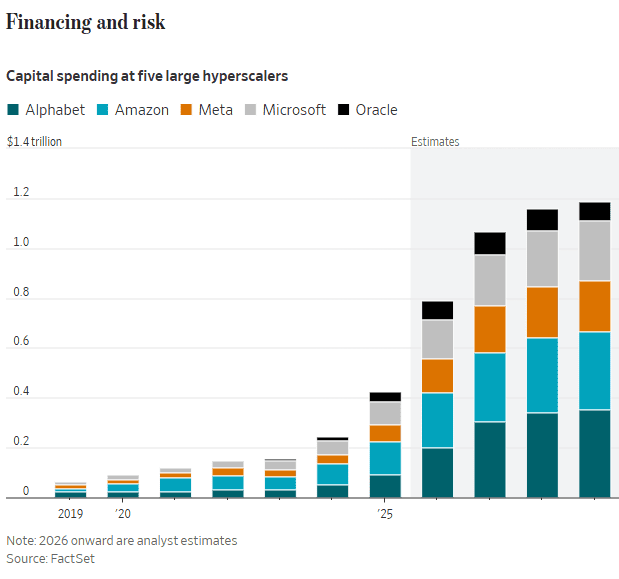
The scale creates a major financing challenge: the five largest hyperscalers are projected to spend about $800 billion on capex in 2026, exceeding their combined operating cash flow. Under the Brookings assumptions, the resulting infrastructure would need roughly $3.7 trillion of annual revenue by 2032 to produce a 10% unlevered return. The key economic issue, therefore, is whether future AI revenue and utilization can justify the enormous capital investment.
From Cloud Data Centers to AI Factories:
The defining characteristic of this AI buildout investment cycle is its concentration. The five U.S. hyperscalers (Alphabet, Amazon, Meta, Microsoft, and Oracle) are collectively expected to invest roughly $4.2 trillion in capital expenditures during the four years ending in 2029, according to FactSet estimates cited in the source material. Increasingly, this capital is directed toward AI-optimized facilities: campuses designed around megawatt-scale accelerator pods, dense GPU clusters, high-radix network fabrics, and power delivery systems capable of supporting workloads whose energy and cooling profiles differ sharply from those of traditional cloud computing.
Those five major hyperscalers increased combined capital expenditures from approximately $97 billion in 2020 to more than $400 billion in 2025, with the paper projecting approximately $800.5 billion in 2026. That 2026 figure is significant because it exceeds their combined operating cash flow of approximately $707.1 billion. In other words, projected capex is about 113% of operating cash flow. Pacific Software Ventures That creates a MAJOR financing problem: AI infrastructure investment is becoming too large to be financed entirely from hyperscaler internally generated cash.
AI infrastructure is not simply an expansion of conventional cloud capacity. Large-model training and inference create a distinct systems-engineering problem. Training AI frontier foundation models requires thousands to hundreds of thousands of tightly coupled accelerators. Those accelerators must exchange model parameters, activation data, and gradients at extremely high rates. Network performance therefore becomes a first-order determinant of usable compute capacity. A GPU cluster can deliver poor economics if its fabric introduces congestion, latency, packet loss, or inadequate bisection bandwidth during distributed training.
That requirement is accelerating deployment of:
-
GPU- and AI-accelerator servers with high-bandwidth memory and advanced semiconductor packaging.
-
High-speed scale-up interconnects within accelerator nodes and scale-out fabrics across clusters.
-
400 GbE, 800 GbE, and emerging 1.6 TbE Ethernet architectures, along with InfiniBand deployments for tightly coupled training environments.
-
Optical transceivers, co-packaged optics research, photonic switching, and expanded fiber density within and between data-center campuses.
-
AI-aware workload scheduling, distributed storage, data pipelines, checkpointing systems, and network telemetry.
-
Direct-to-chip liquid cooling, rear-door heat exchangers, chilled-water systems, and other thermal-management systems required by high-density AI racks.
-
New transmission lines, substations, transformers, gas generation, battery systems, and other power infrastructure needed to support multi-hundred-megawatt and gigawatt-scale campuses.
In effect, hyperscalers are building what are increasingly described as AI factories: integrated physical and digital production systems that convert electricity, capital equipment, data, and semiconductor capacity into trained models, inference tokens, and AI-enabled cloud services.
A Historically Large Capital Concentration:
AI investment is projected to reach 1.9% of U.S. GDP in 2026, according to Goldman Sachs estimates cited in the source material. The late-19th-century railroad boom was the last period in which a single new infrastructure category represented a larger share of the U.S. economy.
The comparison is useful, but incomplete. Railroads connected physical markets over decades. The AI build-out is being deployed on a far more compressed timetable and is dependent on global supply chains for leading-edge accelerators, high-bandwidth memory, advanced substrates, optical components, power equipment, and data-center construction capacity.
This creates a reinforcing investment loop:
-
Foundation-model developers require more compute to train larger or more capable models.
-
Cloud providers build additional accelerator capacity to support training and inference demand.
-
Semiconductor vendors, memory suppliers, networking companies, optical-component manufacturers, and power-equipment suppliers expand production.
-
Data-center developers secure land, power contracts, grid interconnections, fiber routes, water or cooling capacity, and financing.
-
Enterprises adopt AI services, increasing inference demand and reinforcing hyperscaler investment.
The strategic question is whether revenue from AI applications, enterprise subscriptions, API usage, advertising optimization, software agents, automation, and industry-specific deployments will scale fast enough to justify the capital intensity of the underlying infrastructure.
Financial and Infrastructure Risks:
The scale of investment introduces material financial-system risk. A growing portion of AI-related infrastructure is being financed through debt, including special-purpose entities and off-balance-sheet structures that may have limited public disclosure. These structures can allow technology companies and infrastructure developers to finance data-center construction, equipment purchases, and long-term capacity commitments without placing all obligations directly on corporate balance sheets.
That can be economically rational when capacity utilization is high and long-term AI demand is durable. However, it also creates exposure if expected AI revenues, cloud bookings, or accelerator utilization fail to materialize.
The central risk is not merely that an individual model underperforms. It is that a synchronized reduction in AI capital expenditure could affect multiple interconnected sectors at once:
-
Data-center developers and construction firms.
-
Semiconductor, memory, storage, and server suppliers.
-
Optical networking and switching vendors.
-
Utilities, independent power producers, and grid-equipment manufacturers.
-
Banks, private-credit funds, infrastructure lenders, and equipment-finance providers.
-
Commercial real-estate markets in data-center-heavy regions.
A sudden pause in hyperscaler spending would therefore have broader consequences than a typical technology downcycle. It could reduce orders across a deeply interdependent industrial supply chain while exposing leveraged infrastructure vehicles to weaker cash flows.
IT Product Inflation, Power, and Network Capacity:
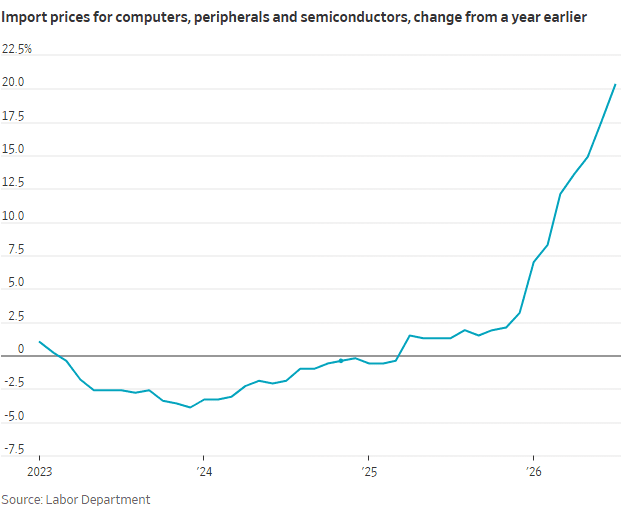
The AI build-out is also creating supply-side pressure in strategic technology markets. Demand for data-center equipment—especially memory, advanced semiconductors, servers, optics, and power-delivery equipment—has tightened supply and raised costs. The source material notes that prices paid by importers for computers, peripherals, and semiconductors were 20% higher in August than a year earlier.
That inflation can propagate beyond the data center. Higher component prices can increase the cost of consumer electronics, including smartphones, PCs, gaming systems, and storage products. Enterprises may also face higher prices for servers, networking equipment, cloud services, and AI-enabled software.
Power is an equally important constraint. AI data centers concentrate demand geographically, often creating large and relatively inflexible new loads on regional grids. A single large campus may require hundreds of megawatts, while the next generation of AI campuses could require gigawatt-scale capacity. This is driving demand for new generation, transmission capacity, substations, transformers, energy storage, and grid-management technologies.
The result is a collision between digital infrastructure planning and energy-system planning. Data-center capacity is no longer determined primarily by real estate, fiber connectivity, or server availability. In many markets, the gating factor is now the ability to obtain firm power, complete interconnection studies, procure transformers and switchgear, and finance new grid infrastructure.
Conclusions:
For IEEE Techblog readers, the central issue is not whether AI demand is real. It is whether the industry can build an economically sustainable, energy-efficient, resilient, and interoperable infrastructure stack at the required scale.
That challenge spans multiple engineering domains:
-
Semiconductor architecture, packaging, memory bandwidth, and energy efficiency.
-
Data-center electrical design, cooling, rack density, and operational resiliency.
-
High-performance networking, congestion control, optical interconnects, and distributed-system design.
-
AI software optimization, including model efficiency, quantization, sparsity, scheduling, and inference optimization.
-
Grid integration, power electronics, demand response, and energy-aware workload placement.
-
Security, supply-chain assurance, and operational management across increasingly autonomous infrastructure.
The AI boom may indeed become the defining infrastructure investment cycle of this era. Its long-term success, however, will depend less on headline capital-expenditure totals than on whether the industry can translate massive spending on accelerators and data centers into durable productivity gains, commercially viable AI services, and infrastructure that does not impose unsustainable costs on power systems, supply chains, consumers, or the financial sector.
………………………………………………………………………………………………………………………………………………
References:
Dell’Oro: Data Center capex grew 92% in 2Q-2026 (caveats galore)
Dell’Oro: 2H2026 Data Center Capex to Accelerate due to massive AI Deployments
PwC: Global AI data center spending to hit $31.6tn by 2050; Role of full stack orchestration layer explained
Nvidia CEO Huang: AI is the largest infrastructure buildout in human history; AI Data Center CAPEX will generate new revenue streams for operators
AI risks and backlash increase; Recap of the circular loop of fake AI profits and hyperscaler markups of private AI companies
China vs U.S.: Race to Generate Power for AI Data Centers as Electricity Demand Soars
How will fiber and equipment vendors meet the increased demand for fiber optics in 2026 due to AI data center buildouts?
Expose: AI is more than a bubble; it’s a data center debt bomb
Will billions of dollars big tech is spending on Gen AI data centers produce a decent ROI?
Huge Risks for the proposed $500B AI Investments from Giant Wall Street firms
Can the debt fueling the new wave of AI infrastructure buildouts ever be repaid?
3 thoughts on “The AI Infrastructure Build-Out: A $10 Trillion Bet on Compute, Power, and Networks”
Leave a Reply

Google Gemini:
Critical Assessment:
This post is an excellent piece of technical journalism because it treats AI infrastructure as an integrated production factory rather than an abstract cloud service. For engineering and telecom professionals, it delivers an objective reality check: the long-term viability of the AI cycle depends entirely on building economically sustainable, energy-efficient, and interoperable physical network stacks rather than simply chasing headline capital-expenditure metrics.
Systemic Risks Exposed:
The “Data Center Debt Bomb”: The article sheds light on high-risk financial structures. An increasing amount of this $10.3 trillion build-out is financed via off-balance-sheet special-purpose entities and private credit, creating exposure if enterprise AI revenues fail to materialize fast enough to justify the capital intensity.Interdependent Supply Chain Exposure: A sudden reduction in hyperscaler capital expenditures wouldn’t just impact chipmakers. The post highlights a synchronized risk across optical networking vendors, fiber developers, utilities, and regional infrastructure lenders.
AI is becoming a major bond-market issue because it is transforming a technology capex boom
into a large, correlated, long-duration debt cycle. With AI-linked borrowers accounting for 49% of
new investment-grade issuance in 2026 (source:WSJ), the bond market is being asked to absorb an exceptional
amount of additional corporate and infrastructure debt.
Hyperscaler Debt & Capex Projections (2026–2027)
-2026 Debt Issuance: Projected between $220 billion and $250+ billion for major US hyperscalers (Alphabet / Google, Amazon, Meta, Microsoft, and Oracle), with broader AI-related market debt reaching up to $570 billion.
-2027 Forecast: Goldman Sachs projects direct hyperscaler debt issuance to nearly double to around $400 billion (Jeff Pu estimates $419 billion) as companies finance over a third of their infrastructure needs.
-Aggregate Capex: Combined capital expenditures are expected to hit roughly $940 billion in 2026 and scale past $1.3 trillion in 2027. Market Share: Hyperscaler investment-grade bond sales have jumped from roughly 2% of total U.S. supply (2022–2024) to roughly 9% in 2026. Credit Impact: Credit spreads on a 10-year hyperscaler credit basket have widened from historical 40–75bp ranges toward 90bp+, driven by leverage concerns.
-Cash Flow Outlook: S&P Global Ratings expects all major hyperscalers to run negative free operating cash flow through 2026 and 2027, with a cash-flow inflection point not projected until 2028–2029