

5G
Performance analysis of big 3 U.S. mobile operators; 5G is disappointing customers
Speedtest Intelligence® from Ookla reveals T-Mobile was the fastest mobile operator in the United States during Q1 2021 with a Speed Score™ of 50.21 on modern chipsets. AT&T was second and Verizon Wireless third.
Note that this is the first quarter Ookla is reporting on the country as a whole, rather than using competitive geographies. Ookla says that expanding its focus to include rural areas will show drops in performance, decreasing speed and increasing latency when compared with prior reports.
In Q1 2021, T-Mobile had the fastest median 5G network download speed in the U.S. at 82.35 Mbps. AT&T was second at 76.60 Mbps and Verizon Wireless third at 67.24 Mbps. For a complete view of commercially available 5G deployments in the U.S. to-date, visit the Ookla 5G Map™.
Ookla discovered that during Q1 2021 that T-Mobile subscribers with 5G-capable devices were connected to a 5G service 65.4% of the time. 5G “time spent” on Verizon Wireless’ network was at 36.2% and at 31% on AT&T’s network.
In measuring each operator’s ability to provide consistent speeds, Ookla found that T-Mobile had the highest Consistency Score™ in the U.S. during Q1 2021, with 84.8% of results showing at least 5 Mbps download and 1 Mbps upload speeds. AT&T was second and Verizon Wireless third. All three U.S. mobile carriers were above 80% in terms of consistency.
Here’s the current status of Worldwide median 5G Speeds as of Q3-2022:

…………………………………………………………………………………………………………………………………..
Earlier this week a new report from becnhmarking company Rootmetrics found that T-Mobile US is leading in 5G availability across U.S. cities. Rootmetrics found that AT&T’s 5G provides the best performance, and AT&T and Verizon both won high marks for 5G reliability.
“While we’ve seen strong and improving 5G availability and speeds from the carriers in many cities, it’s important to keep in mind that with the major U.S. networks utilizing different types of spectrum for 5G, the 5G availability and speeds that consumers experience can vary a great deal for different carriers across or even within different markets,” Rootmetrics concluded.
Rootmetrics tested 5G networks in 45 cities across the U.S. between January and March of this year. It recorded at least some 5G availability from all three carriers in nearly all of them. T-Mobile US was the only carrier with a 5G network presence in all 45 of the cities, AT&T had 5G service in 44 out of the 45, and Rootmetrics saw 5G availability for Verizon in 43 out of the 45 cities.
The availability of T-Mobile’s 5G was one common theme across both testing reports. Rootmetrics’ testing, conducted in the first half of 2021, said that T-Mobile had 5G availability in all 45 of the markets it tested and showed the highest percentages of 5G availability in the most markets: More than 55% availability in 30 markets, with the lowest tested market being Sarasota, FL, where Rootmetrics’ testing showed T-Mo 5G available for a device to connect to only about 19% of the time.
…………………………………………………………………………………………………………………………………………
Separately, Light Reading’s Mike Dano writes that “AT&T, Verizon and T-Mobile offer unlimited 5G disappointment.” In a subhead titled, “T-Muddle” Dano writes:
In 2019, T-Mobile boasted that “5G speed will be up to 10x faster, compared to LTE.” But when it first launched its 5G network on its lowband 600MHz spectrum, speeds were only 20% faster than its LTE network. Then, after T-Mobile closed its acquisition of Sprint’s 2.5GHz midband spectrum, it quickly began offering 5G speeds up to 1Gbit/s. The operator even debuted a new 5G lexicon for its offerings: “5G Ultra Capacity” refers to its speedy 2.5GHz network, while “Extended Range 5G” refers to its slower 600MHz network.
So it would stand to reason that customers might want to see which flavor of T-Mobile 5G they can access, right? A quick check of T-Mobile’s coverage map reveals none of these details. The operator only offers a generic “5G” coverage layer that does not provide details about whether it’s 600MHz or 2.5GHz. One is slightly faster than LTE while the other provides average speeds of 300Mbit/s. Prospective T-Mobile customers are left in the dark.
T-Mobile isn’t the only operator seemingly content to hide behind 5G obfuscation. AT&T has debuted no fewer than three different 5G brands – 5G+, 5Ge and 5G – yet it does not offer any details to prospective customers about how it might charge for those offerings. The operator’s pricing plans mention only “5G” and do not specify whether that means 5G+, 5Ge or 5G, or all three.
Regarding Verizon’s 5G pricing plans, Dano stated:
The operator offers a truly dizzying array of 5G plans and pricing options – one observer described Verizon’s pricing plans as “a series of nesting dolls.”
In 5G, Verizon is reserving its faster “Ultra Wideband” technology only for its expensive unlimited plans. Customers on its cheapest Start Unlimited plan can either pay $10 extra for 5G specifically, or they can spend that same $10 to upgrade to a more expensive unlimited plan that offers 5G as well as other goodies, such as more mobile hotspot data. Why the two different upgrade options? “We always like to give customers choices,” explained a Verizon spokesperson.
But what that really means is that customers are simply left to fend for themselves. They’re left to pick from among a dizzying number of pricing options, all promising “unlimited” data, but all limiting that data in various ways. Customers are left to figure out why messages from iPhones to Android phones won’t show delivery receipts. They’re left to discover why they’re still receiving robocalls, and what they might need to do to block them. They’re left to uncover what kind of 5G they can get and whether it’s any different from 4G.
In conclusion, Dano says that “AT&T, Verizon and T-Mobile continue to be very interested in outdoing one another in their 5G pricing schemes and big, new network claims.” However, they’re not succeeding in pleasing their customers who remain frustrated and disappointed.
Cartoon courtesy of long time IEEE contributor Geoff Thompson:
…………………………………………………………………………………………………………………………………………
References:
https://www.speedtest.net/global-index/united-states#market-analysis
https://rootmetrics.com/en-US/content/5g-in-the-us-1H-2021
Lumen Technologies and T-Mobile collaborate on edge compute for enterprise customers
Following this week’s Verizon-AWS announcement on Multi-access Edge Computing (MEC), T-Mobile US has entered the mobile edge computing business using wireline carrier Lumen Technologies (formerly CenturyLink) as its initial preferred vendor.
T-Mobile US has taken a decidedly different MEC approach compared to its two domestic rivals (Verizon and AT&T). The U.S.’s #2 wireless network operator effectively views the edge as a latter opportunity that doesn’t merit a large initial investment. Its edge computing initiatives are exclusively focused on businesses and government agencies that fall under Lumen’s enterprise unit and T-Mobile for business.
“By pairing America’s largest and fastest 5G network with Lumen’s enterprise solutions, we can break down industry barriers and deliver unparalleled network reach to enterprise and government organizations looking to optimize their applications across networks,” Mike Katz, EVP for T-Mobile for Business, said in a prepared statement. “With our leading 5G network, Lumen and T-Mobile have the opportunity to accelerate business innovation in an era where the network is more critical than ever,” Katz added,

Enterprise applications will likely benefit from Lumen’s hundreds of thousands of fiber connected enterprise locations paired with T-Mobile’s “largest and fastest 5G network.”
“The Lumen platform, with 60 plus planned edge market nodes distributed on our high-capacity global fiber network enables application designs with latency of 5 milliseconds or less between the workload and the endpoint device,” wrote David Shacochis, VP of enterprise technology and field CTO at Lumen.
“Lumen’s fiber reach and edge computing resources can augment business solutions for T-Mobile customers, and private wireless solutions can augment business solutions for Lumen customers,” Shacochis added.
“The companies envision starting with metropolitan areas where they are already well connected, and expanding their joint go-to-market over time,” Shacochis wrote, adding that more details about commercial availability and services will be shared throughout 2021.
These efforts aim to address the pressing needs of enterprises to transform their networks to meet the data-intensive challenges across a variety of industries and use cases. Both companies will also continue to drive innovation in this space through T-Mobile’s labs and Tech Experience Center and the Lumen Edge Experience Center.
“Our relationship with T-Mobile aims to introduce a powerful trifecta – access to national 5G wireless and fiber connectivity, managed services across a range of technologies and edge computing resources,” said Shaun Andrews, executive vice president and chief marketing officer for Lumen Technologies. “T-Mobile’s expansive 5G footprint coupled with our extensive edge computing platform would provide enterprise developers with the best of both worlds to power the next wave of digital business.”
- For a current list of Lumen live and planned edge locations, visit: https://www.lumen.com/en-us/solutions/edge-computing.html#edge-computing-map
- The Lumen low latency network is comprised of approximately 450,000 global route miles of fiber and more than 180,000 on-net buildings, seamlessly connected to:
- 2,200 public and private third-party data centers in North America, Europe & Middle East, Latin America, and Asia Pacific
- Leading public cloud service providers including Amazon Web Services, Microsoft Azure ExpressRoute & Azure Government, Google Cloud, IBM Cloud and Oracle Cloud
T-Mobile’s partnership with Lumen is likely just the beginning. “As in all things with 5G, I think a lot of our efforts have to be done through partnerships,” said John Saw, EVP of advanced and emerging technologies at T-Mobile. Apparently, the network operator will form partnerships with many of the big vendors in the space, including hyperscalers (Google, Amazon, Microsoft), and other specialized mobile edge computing vendors.
Similarly, Shacochis said Lumen is also “open to and looking at” other partnerships in the wireless space. Lumen executives outlined a plan to offer edge compute services in August 2019. The company deployed its first block of edge nodes and obtained its first customer in Q3-2020, before formally launching its edge platform in December 2020.
Building on cloud partnerships with Microsoft Azure, Google Cloud and Amazon Web Services (AWS), Lumen bolstered its edge capabilities through additional deals with VMware and IBM.
…………………………………………………………………………………………………………………………….
References:
https://www.sdxcentral.com/articles/news/lumen-lands-t-mobiles-first-5g-edge-contract/2021/04/
https://www.fiercetelecom.com/telecom/lumen-strikes-edge-compute-deal-t-mobile
https://www.sdxcentral.com/edge/definitions/multi-access-edge-computing-vendors/
IBM and Verizon Business Collaborate on 5G, Edge Computing and AI Solutions for Enterprise Customers
Verizon Business wins Private 5G contract in the UK
Verizon Communications Inc. won a contract to erect and operate a private 5G network in Southampton, England (United Kingdom), for Associated British Ports Holdings, its first industrial 5G award in Europe. The #1 U.S. wireless telco beat out local telecommunications companies and is jump starts a push to sell the wireless systems to global businesses.
- Verizon teams up with Nokia to offer private 5G capabilities to enterprises in Europe and Asia-Pacific
- Private 5G will enable organizations to deliver mission critical and real-time capabilities
- Announcement marks Verizon’s continued investment in 5G and network-as-a-service strategy
A private 5G network is a self-contained network whose components all reside in a single facility, consisting of micro towers and small cells and connects to an organization’s Local Area Network (LAN) and enterprise applications. It will utilize Nokia’s Digital Automation Cloud, a private wireless network solution with automation enablers that will allow for application deployment through a web-based interface.
New York-based Verizon opened a showroom in London last year and spoke about its hopes to muscle in on 5G enterprise deals beyond the U.S. It’s a sign competition is heating up in the segment, seen as a key way to fuel growth in the otherwise stagnant telecommunications sector for local carriers like Newbury, England-based Vodafone Group Plc.
“We chose Verizon simply just due to the track record within setting up private 5G networks,” said Henrik Pedersen, chief executive officer of ABP, in a video call with Bloomberg. “Regional or local, I don’t see it like this. I see 5G as a global thing.”
Southampton is a crucial British terminal which usually handles about 900,000 cars and sees millions of cruise ship passengers per year. It’s upgrading its network as the port adapts to its new status as a freeport, one of several low-tariff business zones on the British coast that U.K. chancellor Rishi Sunak unveiled last month as part of his plans to stimulate post-Brexit trade.
Verizon’s 5G network will remove dead spots and increase bandwidth at the port, ultimately enabling new systems, such as using drones that can transmit high-definition video for maintenance checks, and sending live shipping data, Pedersen said.
“There’ll be a lot of need for data transfer in the future in the freeport zone, and especially when you start to move goods in and out of the customs zones,” said Pedersen. He said he wants the system up and running by July, and added that more of ABP’s 21 ports are likely to get 5G networks in the future.
“Today, we’ve announced the next phase of Verizon’s global 5G vision with the launch of private 5G for our international customers,” said Tami Erwin, CEO, Verizon Business. “If the past few months have taught us anything, it’s that there’s never been a more critical time for mobility, broadband and cloud products and services. Private 5G networks will be a transformative technology that will drive the new era of disruption and innovation for enterprises around the world.”
“Private wireless connectivity has become central to many industries in realizing their long-term digital transformation goals. By delivering private 5G together with Verizon, we’re paving the way to accelerate digitalization for the most demanding industries who crave reliable wireless connectivity,” said Brian R. Fitzgerald, SVP Global Solutions at Nokia.
“We’re seeing international markets moving rapidly to deploy 5G Private Networks, which appears as a major use case for the uptake of 5G, particularly in order to capitalize on 5G investments in the enterprise market. With the ingredients of an early mover go-to-market 5G-know-how, foundational enterprise networking and innovative 5G enabled services Verizon’s go-to-market recipe with Nokia will be an attractive solution to the broader market,” said Martina Kurth, associate vice president of IDC’s European Telco Research practice.
Today’s announcement follows recent MEC partnership announcements with Microsoft, Cisco, IBM and AWS. In August, Verizon recently announced its successful completion of lab trials with Corning and Samsung on its new 5G mmWave in-building solutions.
………………………………………………………………………………………………………………………………
References:
https://www.verizon.com/about/news/verizon-business-takes-private-5g-global
https://www.bnnbloomberg.ca/verizon-beats-out-european-carriers-to-run-5g-at-u-k-freeport-1.1585233
Samsung and Marvell develop SoC for Massive MIMO and Advanced Radios
Korean electronics giant Samsung Electronics said it has developed a new System-on-Chip (SoC) for its Massive MIMO and other advanced radios in partnership with U.S. chipmaker Marvell. It is expected to be available in Q2 2021 for use in equipment sold to Tier-One network operators.
The SoC is designed to help implement new technologies, which improve cellular radios by increasing their capacity and coverage, while decreasing power consumption and size. The new SoC is equipped to support both 4G and 5G networks simultaneously and aims to improve the capacity and coverage of cellular radios. It is claimed to save up to 70 percent in chipset power consumption compared to previous solutions.
“We are excited to extend our collaboration with Marvell to unveil a new SoC that will combine both companies’ strengths in innovation to advance 5G network solutions,” said Junehee Lee, Executive Vice President and Head of R&D, Networks Business at Samsung Electronics. “Samsung prioritizes the development of high-impact 5G solutions that offer a competitive edge to our operators. We look forward to introducing this latest solution to the market shortly.”
Samsung and Marvell have been working closely to deliver multiple generations of leading network solutions. Last year, the companies announced a collaboration to develop new 5G products, including innovative radio architectures to address the compute power required for Massive MIMO deployments.
“Our collaboration with Samsung spans multiple generations of radio network products and demonstrates Samsung’s strong technology leadership. The joint effort includes 4G and 5G basebands and radios,” said Raj Singh, Executive Vice President of Marvell’s Processors Business Group. “We are again honored to work with Samsung for the next generation Massive MIMO radios which significantly raise the bar in terms of capacity, performance and power efficiency.”
“Marvell and Samsung are leading the way in helping mobile operators deploy 5G with greater speed and efficiency,” said Daniel Newman, Founding Partner at Futurum Research. “This latest collaboration advances what’s possible through SoC technology, giving operators and enterprises a distinct 5G advantage through optimized performance and power savings in network deployments.”
Samsung has pioneered the successful delivery of 5G end-to-end solutions including chipsets, radios, and core. Through ongoing research and development, Samsung drives the industry to advance 5G networks with its market-leading product portfolio from fully virtualized RAN and Core to private network solutions and AI-powered automation tools. The company is currently providing connectivity to hundreds of millions of users around the world.
……………………………………………………………………………………………………………………………………………….
On the network equipment side, Samsung Electronics recently won a 5G contract with Japanese telco NTT DOCOMO, as it seeks to challenge incumbents like Huawei, Ericsson, and Nokia in the telecom equipment business, according to media reports.
In India, Samsung Electronics is likely to apply for a production-linked incentive (PLI) scheme for telecom equipment manufacturing, benefiting from India’s program to locally make 4G and 5G gear and other equipment – for sales both in India and overseas, ET recently reported.
Samsung would then join other global manufacturers such as Cisco, Jabil, Flex and Foxconn, besides European telecom equipment vendors Nokia and Ericsson in applying for the PLI scheme that seeks to boost local production of telecom equipment and reduce imports.
References:
https://telecom.economictimes.indiatimes.com/news/samsung-marvell-develop-soc-for-5g-radios/81720284
Samsung Boosts the Performance of Massive MIMO
Samsung Collaborates With NTT DOCOMO on 5G
MIIT: China has 260M 5G subs; Telecom business revenue significantly increased
China telecom regulator MIIT (Ministry of Industry and Information Technology) revealed this week that China has 260 million 5G subscribers at the end of February 2021. That is a huge number and more than the rest of the world combined [1.], but still a long way short of the 361 million claimed by the three operators. in February.
- China Mobile reported 173.2 million 5G package customers compared to 15.4 million 5G customers in February 2020. China Mobile’s overall mobile subscriber base was said to be 937.16 million at the end of February, down from 940.86 million in January.
- China Telecom added a total of 6.2 million 5G subscribers in February 2021 for a total of 103.4 million.
- China Unicom had 84.5 million 5G subscribers at the end of February 2021.
Note 1. GSA says that global 5G subscriptions grew by 57% in the fourth quarter of 2020 to reach nearly 401 million globally (representing 4.19% of the entire global mobile market). By the end of 2025, 5G will account for 31% of the global market (at 3.39 billion subscriptions), although LTE will still be dominant at 53.3% of all global mobile subscriptions.
……………………………………………………………………………………………………………………………………….
China’s vice-minister of industry and information technology Liu Liehong recently said that a total of 718,000 5G base stations have been built in China, accounting for nearly 70% of the world’s total 5G cell sites.
During Mobile World Congress Shanghai 2021, government officials said that Chinese carriers have invested more than CNY260 billion ($40.2 billion) to build the world’s largest 5G network.
MIIT further stated:
The growth rate of telecom business revenue has increased significantly. From January to February, the total revenue of telecommunications services reached 237.3 billion yuan, an increase of 5.8% year-on-year, and the growth rate increased by 4.3 percentage points year-on-year. The total telecommunications business calculated at the constant price of the previous year was 249.1 billion yuan, a year-on-year increase of 25.9%.
The scale of mobile phone users is basically stable, and 5G users are developing rapidly. As of the end of February, the total number of mobile phone users of the three basic telecommunications companies reached 1.592 billion, a year-on-year increase of 0.8%. As of the end of February, the number of 5G mobile terminal connections of the three basic telecommunications companies reached 260 million, a net increase of 61.3 million from the end of the previous year, accounting for 16.3% of mobile phone users.
Light Reading’s Robert Clark wrote: “The three (China) telcos’ annual filings over the past two weeks indicate that between them they spent a hefty 173 billion yuan ($26.5 billion) on 5G and they’re not slowing down; they’ve set aside another 185 billion yuan for 2021.”
“Their pricing, with plenty of encouragement from government officials, is also aggressive, with China Mobile’s 5G entry package costing just 128 yuan ($19.56). The heavy investment and the moderate pricing in pursuit of national objectives is why their results indicate little reward for the effort so far.”
MIIT also commented on other telecom services (besides 5G):
Data and Internet business revenue accounted for 60%, supporting the steady growth of overall telecom business revenue. From January to February, the three basic telecommunications companies completed fixed data and Internet business revenues of 41.5 billion yuan, a year-on-year increase of 10.2%, accounting for 17.5% of telecommunications business revenues, accounting for a year-on-year increase of 0.8 percentage points, driving a 1.7 percentage point increase in telecommunications business revenue . The revenue from mobile data and Internet services showed a decline for the first time. The completed business revenue was 106.2 billion yuan, a year-on-year decrease of 1.2%, and its share of telecom business revenue fell to 44.7%.
Fixed and mobile voice services declined steadily, and their share of telecom business revenue continued to decline. From January to February, the three basic telecommunications companies completed fixed voice and mobile voice business revenues of 3.82 billion yuan and 18.64 billion yuan, a year-on-year decrease of 1.1% and an increase of 5.0%, respectively, accounting for 9.5% of the total revenue of telecommunications services, and a decrease of 0.1%. Percentage points. The rapid growth of income from emerging businesses has strongly promoted the growth of telecom business income. The three basic telecommunications companies are actively transforming and upgrading, promoting IPTV, Internet data centers, big data, cloud computing, artificial intelligence and other emerging businesses. From January to February, they completed a total of 36.2 billion yuan in related business income, a year-on-year increase of 28.9%. The proportion increased sharply by 2.8 percentage points year-on-year to 15.3%, driving the growth of telecom business revenue by 3.6 percentage points.
The proportion of fixed broadband access users with speeds above 100M has exceeded 90%, and the number of gigabit users has continued to increase. The total number of fixed Internet broadband access users reached 492 million, a year-on-year increase of 8.9% and a net increase of 8.67 million from the end of the previous year. Among them, there are 463 million FTTH/O users, accounting for 94% of the total number of fixed Internet broadband users. The number of fixed Internet broadband access users with an access rate of 100Mbp and above reached 450 million, accounting for 90.4% of the total number of users, an increase of 0.5% from the end of the previous year; the promotion of gigabit broadband services was accelerated, and the access rate of 1000Mbps and above was fixed. The number of Internet broadband access users reached 8.03 million, a net increase of 1.63 million over the end of the previous year.
Mobile Internet traffic increased significantly, and DOU remained at a relatively high level in February. From January to February, the cumulative mobile Internet traffic reached 30.9 billion GB, a year-on-year increase of 31.8%. Among them, the Internet traffic through mobile phones reached 29.7 billion GB, a year-on-year increase of 31.2%, accounting for 96% of the total mobile Internet traffic. In February, the average mobile Internet access traffic (DOU) per household was 10.85GB/household, which was 1.97GB/household higher than the same period last year.
The penetration rate of fixed broadband access users of 100M and above tends to be even in all regions. As of the end of February, fixed broadband access users of 100Mbps and above in the eastern, central, western and northeastern regions reached 189.68 million, 11.17 million, 116.57 million and 26.74 million, respectively, accounting for 89.3. %, 91.7%, 90.8% and 91.8%. The difference between the highest proportion of fixed broadband access users above 100M and the lowest proportion in each province was 15.3 percentage points.
China Unicom and China Telecom say nearly a quarter of their mobile customers are on 5G plans. Chna Unicom boosted ARPU 4%, while China Telecom reported 5G ARPU nearly 50% above its blended ARPU.
China Mobile reported a 1% rise in profit but, despite the huge 5G subscriber base, recorded another decline in mobile ARPU.One winner for China Mobile was broadband access, which grew 17%, while China Telecom and China Unicom both experienced large increases in their smart home services.
………………………………………………………………………………………………………………………………………
Editorial Comment:
Many experts don’t trust economic numbers released by China’s government. Questions over the accuracy of China’s economic data, including industry groups like telecom, persist due to the lack of transparency used in the collection process. Critics say the government does not state how the data is collected or the different components that form the final numbers that are released to the public.
The methodology China uses to calculate its economic and industry data is opaque, and some knowledgeable people even accuse the government of abruptly changing methods without announcement to distort figures and hide declines.
The motivation seems to be to make China’s economy and industry groups look much stronger than they really are.
Most analysts treat any official Chinese data with caution and skepticism. Yet they have few, if any ways to establish an alternative, more accurate assessment of the world’s second-largest economy.
…………………………………………………………………………………………………………………………………………..
References:
https://www.miit.gov.cn/gxsj/tjfx/txy/art/2021/art_82f101e1d078447fac75443a50348b7c.html
https://www.lightreading.com/asia/china-5g-race-taking-its-toll-on-operators/d/d-id/768369?
https://gsacom.com/paper/lte-and-5g-subscribers-march-2021-q4/
Work from Home Reality Impacts Market for New Networking Technologies
SOURCE: Bigleaf Networks
Introduction:
Hype around next generation wireless standards (e.g. WiFi6/IEEE 802.11ax, 5G: ITU-R IMT 2020.SPECS/3GPP Release 16) has become a distraction, according to Bigleaf Networks founder and CEO, Joel Mulkey. Marketers are promoting these new technologies which sacrifice reliability to push faster speeds that are mostly useless in the new work from home era.
Mulkey and Bigleaf Vice President of Product, Jonathan Petkevich, looked into the reality behind the marketing hype around 5G and WiFi 6, as well as other networking trends such as satellite networks and artificial intelligence, in a wide-ranging panel discussion hosted for the company’s customers, partners, and agents.
As IT leaders look to regain their footing in 2021, many tech conversations that were trending at the beginning of 2020 picked up where they left off, while other trends emerged. Below are selected highlights from Mulkey and Petkevich’s conversation:
The Work From Home Reality:
“If you look at some of the Stay-At-Home mandates that have happened over the course of 2020, we estimate that about 85 million people are working from home, and that’s a big shift towards where we were at the start of 2020,” said Mulkey. “Starting at about the mid-March timeframe, 88% of organizations asked employees or required employees to work from home. About 57% of the US workforce started to work from home on a regular basis. So that was a big shift towards most people working in the office, with a few people working remotely in regional or local areas. And a lot of organizations have been talking about how they’re switching to a more long-term remote work-from-home strategy.”
Adapting to this new work from home reality meant frantically moving technology to the cloud. Part of that shift meant IT and network infrastructure teams needed to revamp their networks to support the connection reliability and application performance required in this kind of new normal.
“You need to have a healthy path between the device you’re using and the cloud server, otherwise you’re not going to have a usable experience,” said Mulkey. “One of the things we’re seeing companies running into is a sudden realization that quality of connectivity is really important.”
The Danger of WiFi 6:
According to Gartner, WiFi (IEEE 802.11) is the primary high performance network technology that companies will use through 2024. Today, roughly 96% of organizations use some form of wireless technology with many of those companies looking to move to faster versions of those networking capabilities in the next couple of years. Mulkey and Petkevich say the hype is hurting companies.
“Ensuring that you have technology that’s built on the latest standards makes sense,” said Petkevich. “I don’t know that 5G or WiFi 6 are drastically changing how a business operates day-to-day. There’s a little bit of over-hype around the speed and performance and some of the promise that’s with both of these.”
“WiFi 6 is a bit misplaced in our industry’s priorities and 5G is a marketing mess,” said Mulkey. “WiFi 6 is good for really dense, high bandwidth needs. So if you have an office with 1,000 people in a small area or you’re trying to provide WiFi offload in a stadium, WiFi 6 has technologies that will help you out. But if you’re a normal person and you’ve got a house with a couple of kids and you need to make sure your WiFi doesn’t drop-out when you’re on Zoom calls, I don’t see WiFi 6 moving the needle there. In fact, I think it’s harmful. The WiFi industry has become so focused on a story of faster, faster, faster, that the pace of innovation comes at the sacrifice of reliability. What you really need is stable WiFi connectivity that doesn’t drop out, that deals really well with roaming, that has some more intelligence to the quality of connectivity rather than prioritizing speed.”
5G Hype and Rural America:
“Now, 5G is interesting because there’s some really promising stuff there,” continued Mulkey. “Imagine if you didn’t even need WiFi, you just had always-on connectivity from all your devices at say, 100 megabits a second. That was the vision cast for it. The problem is, it’s almost all hype. What you need for the really high speeds is millimeter wave connectivity, which is really only going to be available in dense urban areas. So the folks that absolutely need good 5G today in rural areas or suburban areas without good landline connectivity, are probably not gonna get that millimeter wave behavior, surely not in rural areas.”
“We really have most of the benefits, if not all of them, with 4G today, so the evolution from a 4G to 5G in these longer distance connections is minimal to nothing,” added Mulkey. “It’s just a marketing term slapped on 4G. Now, 4G has gotten better since your phone first said 4G on it, but you’re not going to magically be able to stream 3D Star Wars style holograms because your phone has a 5G icon on it. That may come some day, but it won’t be 2021.”
Satellites:
Those who have the toughest time with WAN internet connectivity are those in rural areas or suburban areas that have been abandoned by the telecom and cable operators. An area Mulkey and Petkevich see low Earth orbit satellite networks moving beyond hype.
“The issue with traditional satellites is latency,” said Petkevich. “Starlink fixes that. So it’ll be interesting to see that play out in 2021.”
Artificial Intelligence in the Network:
44% of IT decision-makers believe that AI and machine learning can help companies optimize their network performance, and more than 50% identify AI as a priority investment needed to deliver their ideal network and make things work for them.
“There are two main ways that AI is in use today. You have a consumer-facing flavor — Siri on my iPhone, or the way that Google can find me images of apples; and then you have the hidden AI that nobody knows about — the instantaneous response of a Google search, where they’ve built smart technology that would fall under the definitions of AI to make sure that your request for Google gets to the right server from the right path and gets back to you as efficiently and effectively as possible,” said Mulkey. “Those technologies are available today. The challenge is they’re not available to the everyday person. This is an area where we, ourselves, have dedicated people and resources to figure out, ‘How can we make our network behave in an autonomous manner far better than it could if there were just people controlling it?'”
“There’s a kind of a misconception that when we talk about AI, the first thought is all the wonderful movies that have come out over the years,” quipped Petkevich. “Where we are today is there’s a lot of innovation going on to make this more tangible and more practical for businesses to use on the smaller scale, and not reserve it for the large enterprises of the world, and make it more generally available. This is definitely an area where a technology is moving beyond its hype.”
About Bigleaf Networks:
Bigleaf Networks is the intelligent networking service that optimizes Internet and Cloud performance by dynamically choosing the best connection based on real-time usage and diagnostics. Inspired by the natural architecture of leaves, the Bigleaf Cloud-first SD-WAN platform leverages redundant connections for optimal traffic re-routing, failover and load-balancing. The company is dedicated to providing a better Internet experience and ensuring peace of mind with simple implementation, friendly support and powerful technology. Founded in 2012, Bigleaf Networks is investor-backed, with service across North America.
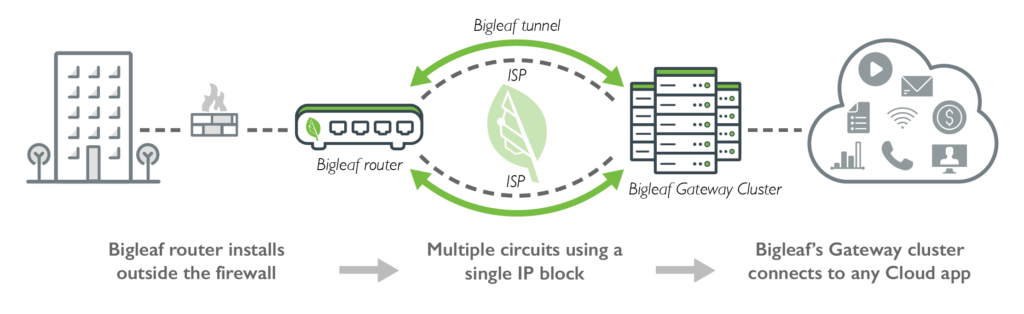
Bigleaf combines a simple on-site installation, intelligent hands-off operations, and redundancy at every level to turn commodity broadband connections into a worry-free, Enterprise-grade connection to your applications.
…………………………………………………………………………………………………………………………………………………………………………………………..
References:
SK Telecom and AWS launch 5G edge cloud service and collaborate on other projects
South Korea’s #1 wireless network operator SK Telecom (SKT) has launched a 5G edge cloud service in partnership with Amazon Web Services (AWS). ‘SKT 5GX Edge’ uses AWS Wavelength at the edge of SKT’s 5G network. SKT said that SKT 5GX Edge will enable customers to develop mobile applications that require ultra-low latency.
With SKT 5GX Edge, applications are connected to ‘AWS Wavelength Zones’, which are located at the edge of SK Telecom’s 5G network, making it unnecessary for application traffic to hop through regional aggregation sites and the public internet.
SKT 5GX Edge with AWS Wavelength is expected to enable SK Telecom’s enterprise customers and developers to build innovative services in areas including machine learning, IoT, video games and streaming using the AWS services, APIs, and tools they already use.
SK Telecom and AWS started operating the first AWS Wavelength Zone in South Korea in the central city of Daejeon (140 kilometers south of Seoul) earlier this month. They plan to expand the SKT 5GX Edge infrastructure to other parts of the country, including Seoul in 2021.
SK Telecom has been cooperating with AWS since February of this year to deploy AWS Wavelength Zones on SK Telecom’s 5G network and worked with 20 enterprise customers to test the service.
SKT and AWS are actively cooperating in the area of non-face-to-face services as demand grows due to the pandemic. The two companies have been working with video conferencing solution provider Gooroomee to build an environment where two-way video conferencing and remote education services are provided without delay, and have realized a service with a latency of less than 100 milliseconds for multiple simultaneous sessions.
“With AWS Wavelength on SKT’s 5G network, customers in South Korea can develop applications that take advantage of ultra-low latencies to address use cases like machine learning inference at the edge, smart cities and smart factories, and autonomous vehicles – all while using the same familiar AWS services, API, and tools to deploy them to 5G networks worldwide,” said Matt Garman, Vice President of Sales and Marketing, AWS.
“In collaboration with AWS, SK Telecom has successfully integrated private 5G and edge cloud. By leveraging this new technology, we will lead the efforts to create and expand innovative business models in game, media services, logistics, and manufacturing industries,” said Ryu Young-sang, President of MNO at SK Telecom.
………………………………………………………………………………………………………………………………
SK Telecom and AWS also report that they have been working to improve operational stability of autonomous robots and efficiency in remote monitoring and control. Together with Woowa Brothers, the operator of food delivery app ‘Baedal Minjok,’ the two companies have completed tests of applying the 5G MEC service to outdoor food delivery robot Dilly Drive. Meanwhile, work continues with local robotics company Robotis to test run autonomous robots in the 5G cloud environment.
SK Telecom and AWS have also signed an agreement with Shinsegae I&C and Maxst to build an AR navigation and guidance system in the Coex Starfield shopping mall in Seoul. They are also working on potential use of the 5G cloud service with Deep Fine, an AR glass solution developer, and Dabeeo, a spatial recognition service provider. With the National IT Industry Promotion Agency (NIPA), SK Telecom has launched an open lab to develop realistic contents optimized for the 5G network and to support the growth of the related ecosystem.
Collaboration is also ongoing with Looxid Labs, a provider of real-time analysis for eye-gaze tracking and brain wave data, to develop services on the 5G MEC for a senior citizen center in Busan.
SK Telecom and AWS are also cooperating in the area of non-face-to-face services as demand grows due to the COVID-19 pandemic. The two companies have been working with video conferencing services provider Gooroomee to develop an environment where 2-way video conferencing and remote education services are provided without delay, and claim they have achieved a service with a latency of less than 100 milliseconds for multiple simultaneous sessions.
………………………………………………………………………………………………………………………………………………
References:
https://www.sktelecom.com/en/press/press_detail.do?page.page=1&idx=1494&page.type=all&page.keyword=
https://www.telecompaper.com/news/sk-telecom-launches-5gx-edge-cloud-service-with-aws–1366915
Fastweb to launch 5G in 4 Italian cities and boost FTTH speeds to 2.5 Gbps
Italian network operator Fastweb plans to activate 5G in an initial four cities before the end of the year (it is the fifth mobile operator in Italy).
Separately, Fastweb will increase the top speed of its existing FTTH service to 2.5 Gbps in the coming months. The company already leads Italy’s fixed gigabit market with a 36.5 percent share of FTTH subscribers having download speeds of 1 Gbps speeds. It now intends to upgrade its proprietary network in 30 large cities so that it can hike top speeds from 1 Gbps to 2.5 Gbps at no additional cost in around 4 million homes, covering 15 percent of Italy’s population, starting in February 2021.
These two announcements follow the launch of Fastweb’s ‘UltraFWA’ service in partnership with Linkem to offer speeds of 1Mbps in 3 localities in the south of the country. Linkem said the 5G FWA service is now available in Modugno, Grottaglie and Avellino. Those are the first 3 of the 50 localities the network operator aims to connect by the end of this year, rising to 500 by the end of next year. part of a commitment to bridge the digital divide in “historically disadvantaged” areas of southern Italy.
Fastweb said it will continue to bridge the digital divide in small and medium-sized Italian towns with its new 5G FWA (Fixed Wireless Access) service. ‘UltraFWA’ will offer speeds of up to 1Gbps in a total of 50 localities by the end of this year, rising to 500 by the end of next year and around 2,000 by 2024 for a total coverage of 8 million homes in ‘grey’ areas and 4 million in ‘white’ areas.
The increased performance and coverage are part of Fastweb’s new multi-year commitment to citizens, institutions and companies called ‘NeXXt Generation 2025’. The plan to connect millions of families throughout the country is based on the three pillars of technological leadership, transparency and social responsibility, with the operator also confirming plans to activate its 5G service in an initial four cities on 27 December. Fastweb 5G will switch on in Milan, Bologna, Rome and Naples and then gradually extend to other cities to reach 90 percent of the population by 2025.
The company added that it will be the only operator to make 5G technology available to both new and existing customers at no additional cost and with no constraints whatsoever. Fastweb last year signed an ambitious decade-long network sharing deal with WindTre to jointly roll out 5G infrastructure on a national scale, having previously acquired a 200MHz frequency block in the 26 GHz band in Italy’s 5G spectrum auction in October 2018, swiftly followed by 40 MHz of spectrum in the 3.5 GHz band from Tiscali.
References:
Tutorial on Advanced Antenna Systems (AAS) for 5G Networks
Editor’s Note:
Rec. ITU‑R M.2101 uses the term AAS to mean Advanced Antenna System(s), while 3GPP uses the term AAS to mean Active Antenna System (s).
Definition:
Advanced antenna systems (AAS) is the general term used to describe antenna systems utilizing techniques aiming at improving performance and spectral efficiency of radiocommunication transceivers taking advantage of antenna array theory and practice.
These techniques include adaptive beamforming, multiple input multiple output (MIMO), and space division multiple access (SDMA) among other ones. These multi-antenna techniques are generally applicable to any frequency band or radio application and can be implemented using passive or active antennas.
In higher frequency bands, such as those around the millimetric wave bands, active advanced antenna systems are the prevalent technology choice.
- Smart antennas
- Adaptive beamforming
- Phased arrays
- Spatial multiplexing and MIMO
- Space Division Multiple Access (SDMA)
- Active and passive antennas
- Antenna Array Theory
Basic concepts:
Multiple antennas can be arranged in space in specific configurations to form a highly directive pattern. These arrangements are referred to as “arrays.” In an array antenna, the fields from the individual elements add constructively in some directions and destructively (cancel) in others thus creating an overall array radiation pattern different from that of the individual elements.
The major advantage of antenna arrays over a single antenna element is their electronic scanning capability; that is, the major lobe can be steered toward any direction by changing the phase of the excitation current at each array element (phased array antennas). Furthermore, by also controlling the magnitude of the excitation current, a large variety of radiation patterns and sidelobe level characteristics can be produced. Adaptive antennas (also called “smart antennas” in mobile communication applications) go a step further than phased arrays and can direct their main lobe (with increased gain) in a desired direction (e.g., a mobile user in a cellular communication system) and nulls in the directions of interference or jammers.
AAS enables state-of-the-art beamforming and MIMO techniques that are powerful tools for improving end-user experience, capacity and coverage. As a result, AAS significantly enhances network performance in both uplink and downlink. Finding the most suitable AAS variants to achieve performance gains and cost efficiency in a specific network deployment requires an understanding of the characteristics of both AAS and of multi-antenna features.
Multi-antenna techniques
Multi-antenna techniques, here referred to as AAS features, include beamforming and MIMO. Such features are already used with conventional systems in today’s LTE networks. Applying AAS features to an AAS radio results in significant performance gains because of the higher degrees of freedom provided by the larger number of radio chains, also referred to as Massive MIMO.
Beamforming
When transmitting, beamforming is the ability to direct radio energy through the radio channel toward a specific receiver, as shown in the top left quadrant of Figure 1. By adjusting the phase and amplitude of the transmitted signals, constructive addition of the corresponding signals at the UE receiver can be achieved, which increases the received signal strength and thus the end-user throughput. Similarly, when receiving, beamforming is the ability to collect the signal energy from a specific transmitter. The beams formed by an AAS are constantly adapted to the surroundings to give high performance in both UL and DL.
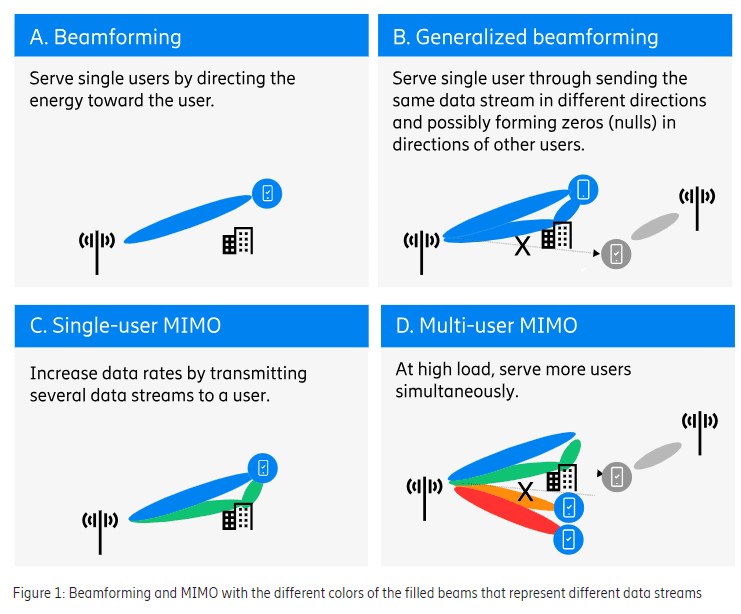
Although often very effective, transmitting energy in only one direction does not always provide an optimum solution. In multi-path scenarios, where the radio channel comprises multiple propagation paths from transmitter to receiver through diffraction around corners and reflections against buildings or other objects, it is beneficial to send the same data stream in several different paths (direction and/or polarization) with phases and amplitudes controlled in a way that they add constructively at the receiver. This is referred to as generalized beamforming, as shown in the upper right quadrant of Figure 1. As part of generalized beamforming, it is also possible to reduce interference to other UEs, which is known as null forming. This is achieved by controlling the transmitted signals in a way that they cancel each other out at the interfered UEs.
MIMO (Multiple Input, Multiple Output) techniques:
Spatial multiplexing, here referred to as MIMO, is the ability to transmit multiple data streams, using the same time and frequency resource, where each data stream can be beamformed. The purpose of MIMO is to increase throughput. MIMO builds on the basic principle that when the received signal quality is high, it is better to receive multiple streams of data with reduced power per stream, than one stream with full power. The potential is large when the received signal quality is high and the streams do not interfere with each other. The potential diminishes when the mutual interference between streams increases. MIMO works in both UL and DL, but for simplicity the description below will be based on the DL.
Single-user MIMO (SU-MIMO) is the ability to transmit one or multiple data streams, called layers, from one transmitting array to a single user. SU-MIMO can thereby increase the throughput for that user and increase the capacity of the network. The number of layers that can be supported, called the rank, depends on the radio channel. To distinguish between DL layers, a UE needs to have at least as many receiver antennas as there are layers.
SU-MIMO can be achieved by sending different layers on different polarizations in the same direction. SU-MIMO can also be achieved in a multi path environment, where there are many radio propagation paths of similar strength between the AAS and the UE, by sending different layers on different propagation paths, as shown in the bottom left quadrant of Figure 1.
In multi-user MIMO (MU-MIMO), which is shown in the bottom right quadrant of Figure 1. above, the AAS simultaneously sends different layers in separate beams to different users using the same time and frequency resource, thereby increasing the network capacity. In order to use MU-MIMO, the system needs to find two or more users that need to transmit or receive data at the very same time. Also, for efficient MU-MIMO, the interference between the users should be kept low. This can be achieved by using generalized beamforming with null forming such that when a layer is sent to one user, nulls are formed in the directions of the other simultaneous users.
The achievable capacity gains from MU-MIMO depend on receiving each layer with good signal-to-interference-and-noise-ratio (SINR). As with SU-MIMO, the total DL power is shared between the different layers, and therefore the power (and thus SINR) for each user is reduced as the number of simultaneous MU-MIMO users increases. As the number of users grows, the SINR will further deteriorate due to mutual interference between the users. The wireless network capacity (the number of devices that can use a wireless network at the same time and the bandwidth consumed) typically improves as the number of MIMO layers increases, to a point at which power sharing and interference between users result in diminishing gains, and eventually losses.
It should be noted that the practical benefits of many layers in MU-MIMO are limited by the fact that in today’s real networks, even with a high number of simultaneous connected users, there tends not to be many users who want to receive data simultaneously. This is due to the bursty (chatty) nature of data transmission to most users. Since the AAS and the transport network must be dimensioned for the maximum number of layers, the MNO needs to consider how many layers are required in their networks. In typical MBB deployments with the current 64T64R AAS variants, the vast majority of the DL and UL capacity gains can be achieved with up to 8 layers.
References:
https://www.ericsson.com/en/reports-and-papers/white-papers/advanced-antenna-systems-for-5g-networks
Executive Summary: IMT-2020.SPECS defined, submission status, and 3GPP’s RIT submissions
Introduction – IMT-2020.SPECS:
The forthcoming ITU-R recommendation “IMT-2020.SPECS” identifies the terrestrial radio interface technologies of International Mobile Telecommunications-2020 (IMT-2020) and provides the detailed radio interface specifications.
IMPORTANT: This new ITU-R standard will NOT include IMT 2020 non-radio aspects, such as 5G Core Network, Signaling, Network Slicing, Virtualization, Network Management/Maintenance, Security/Privacy, Fault Detection/Recovery, Codecs, Interworking, etc.
This new recommendation was developed by ITU-R WP5D (aka 5D) over the last five years. It consists of IMT 2020 (5G) Radio Interface Technologies (RIT) and Sets of Radio Interface Technologies (SRIT).
The final IMT-2020.SPECS is expected to be approved in late November 2020 at the ITU-R SG 5 (parent of WP 5D) meeting. Here’s the related ITU-R meeting schedule for the remainder of 2020:
|
WP 5D |
36 |
5 October 20 |
16 October 20 |
Geneva |
10 day meeting |
|
WP 5D |
36bis |
17 November 20 |
19 November 20 |
Geneva |
Focused WP 5D meeting on the technology aspects and related administrative activities for finalization of Step 8 of the IMT-2020 process for draft new Recommendation ITU-R M.[IMT-2020.SPECS] |
|
SG 5 |
23 November 20 |
24 November 20 |
Geneva |
Anticipated dates |
………………………………………………………………………………………………………………………………………………………………………….
IMT 2020 RIT/SRIT submission status:
IMT 2020 RIT submissions from 3GPP/China/Korea [1.], TSDSI [2], DECT/ETSI, and Nufront are all being considered by 5D. The latter two submissions have defined their own version of 5G New Radio (NR) as they do NOT use 3GPP’s 5G NR.
Note 1. ATIS found the China and Korea IMT 2020 RIT/SRIT submissions to be technically identical to 3GPPs. Please see IMT-2020 Consensus Building and Decision by 5D for more detail.
Note 2. The TSDSI submission uses 3GPP’s 5GNR but also ADDS functional capability to support Low Mobility Large Cell (LMLC).
->Hence, there are potentially three different 5G NRs (as the basis for the respective RIT submissions) that may be standardized in IMT-2020.SPECS if the DECT/ETSI and Nufront submissions achieve final approval from WP5D. 5D requested additional work for both DECT/ETSI and Nufront RIT submissions before they can be progressed to the next step at 5D’s October 2020 meeting. Those submissions will NOT be included in the first IMT-2020.SPECS recommendation 5D will send to ITU-R SG5 in late November 2020. If 5D subsequently approves them, they will be included in a revision of IMT-2020.SPECS in 2021.
At its July virtual meeting, 5D determined that the IMT-2020 candidate technology submission proposals from DECT/ETSI and Nufront will require additional evaluation to conclude their respective final assessment through Steps 6 and 7 of the current process. They will, therefore, on an exceptional basis continue in the process, rewinding to Step 4 in order to consider additional material.
– Candidate SRIT submission from ETSI (TC DECT) and DECT Forum (Acknowledgement of submission under Step 3 of the IMT-2020 process in IMT‑2020/17(Rev.1)).
– Candidate RIT submission from Nufront (Acknowledgement of submission under Step 3 of the IMT-2020 process in IMT-2020/18(Rev.1)).
The process extension for these two candidate technology submissions will not impact the schedule for the first release of Recommendation ITU-R M.[IMT-2020.SPECS] and the inclusion of the identified Proponent submissions identified below (IMT-2020 RIT/SRIT Submissions being progressed by 5D) that will proceed into Step 8. If these two proponent submission satisfy 5D requirements, they might then be included in a 2021 revision of IMT-2020.SPECS, but they won’t be in the initial recommendation expected to be approved at the end of 2020.
……………………………………………………………………………………………………………………………………………………………………………..
Sidebar: DECT-2020 NR
The “DECT-2020 NR” Radio Interface Technology (RIT) is designed to provide a slim but powerful technology foundation for wireless applications deployed in various use cases and markets. It utilizes the frequency bands below 6 GHz identified for International Mobile Telecommunication (IMT) in the ITU Radio Regulations.
The DECT-2020 radio technology includes, but is not limited to: Cordless Telephony, Audio Streaming Applications, Professional Audio Applications, consumer and industrial applications of Internet of Things (IoT) such as industry and building automation and monitoring, and in general solutions for local area deployments for Ultra-Reliable Low Latency (URLLC) and massive Machine Type Communication (mMTC) as envisioned by ITU-R for IMT-2020.
–>ETSI supports this DECT RIT mainly because of its URLLC capabilities, according to an email received from ETSI.
DECT-2020 NR is claimed by its sponsor to be a technology foundation is targeted for local area wireless applications, which can be deployed anywhere by anyone at any time. The technology supports autonomous and automatic operation with minimal maintenance effort. Where applicable, interworking functions to wide area networks (WAN). e.g. PLMN, satellite, fibre, and internet protocols foster the vision of a network of networks. DECT-2020 NR can be used as foundation for: Very reliable Point-to-Point and Point-to-Multipoint Wireless Links provisioning (e.g. cable replacement solutions); Local Area Wireless Access Networks following a star topology as in classical DECT deployment supporting URLLC use cases, and Self-Organizing Local Area Wireless Access Networks following a mesh network topology, which enables to support mMTC use cases.
……………………………………………………………………………………………………………………………………………………………………………
5D has approved the 3GPP and TSDSI RIT/SRIT submissions to be progressed to the next step at their recent e-Meeting which ended July 9, 2020. From the July 13, 2020 DRAFT NEW REPORT ITU-R M.[IMT-2020.OUTCOME]:
1.] Summary of the evaluations received for the candidate RIT submission (Document IMT-2020/14) from 3GPP Proponent:
There were ten relevant evaluation reports received for the candidate 3GPP RIT submission. The relevant received evaluation reports confirmed that the candidate 3GPP RIT proposal in IMT-2020/14 fulfils the minimum requirements for the five test environments comprising the three usage scenarios.
2.] The evaluated candidate RIT proposal (Document IMT-2020/19(Rev.1)) from TSDSI is assessed by ITU-R as satisfactorily fulfilling the minimum requirements for the five test environments comprising the three usage scenarios. Thus, this TSDSI RIT proposal is ‘a qualifying RIT’ and therefore will go forward for further consideration in Step 7.
……………………………………………………………………………………………………………………………………
IMT-2020 RIT/SRIT Submissions being progressed by 5D:
Each of the following IMT-2020 candidate technology submission proposals will be accepted for inclusion in the standardization phase described in Step 8.
– IMT-2020/13 – Acknowledgement of candidate SRIT submission from 3GPP proponent under step 3 of the IMT-2020 process.
– IMT-2020/14 – Acknowledgement of candidate RIT submission from 3GPP proponent under step 3 of the IMT-2020 process.
– IMT-2020/15 – Acknowledgement of candidate RIT submission from China (People’s Republic of) under step 3 of the IMT-2020 process.
– IMT-2020/16 – Acknowledgement of candidate RIT submission from Korea (Republic of) under Step 3 of the IMT-2020 process
– IMT-2020/19(Rev.1) – Acknowledgement of candidate RIT submission from TSDSI under step 3 of the IMT-2020 process.
………………………………………………………………………………………………………………………………………………………….
However, there is still confusion (at least for this author) as to whether the China and Korea submissions (which were stated to be technically identical to 3GPP submissions) will ultimately be included in IMT-2020.SPECs as independent/separate text or merged with the 3GPP RIT/SRIT submissions. That may be decided at the October or November 2020 5D meetings.
–>If they are all included as separate texts, it will pose a version change challenge with 3 technically identical sets of IMT 2020 RIT/SRITs with each proponent able to revise the spec at any time, independent of the others.
………………………………………………………………………………………………………………………
Overview of IMT-2020.SPECS:
The radio interface specifications in IMT-2020.SPECS detail the feature and parameters of IMT-2020. This Recommendation indicates that IMT-2020 enables worldwide compatibility, international roaming, and access to the services under all three usage scenarios, including enhanced mobile broadband (eMBB), massive machine type communications (mMTC) and ultra-reliable and low latency communications (URLLC).
The capabilities of IMT-2020 include:
– very high peak data rate;
– very high and guaranteed user experienced data rate;
– quite low air interface latency;
– quite high mobility while providing satisfactory quality of service;
– enabling massive connection in very high density scenario;
– very high energy efficiency for network and device side;
– greatly enhanced spectral efficiency;
– significantly larger area traffic capacity;
– high spectrum and bandwidth flexibility;
– ultra high reliability and good resilience capability;
– enhanced security and privacy.
These features enable IMT-2020 to address evolving user and industry needs. The capabilities of IMT-2020 systems are being continuously enhanced in line with user and industry trends, and consistent with technology developments.
IMT-2020 Frequencies and Arrangements:
It’s vitally important to recognize that the frequencies to be used by IMT-2020 RITs, including five sets of mmWave bands, will NOT be in IMT-2020.SPECS. Instead, they will be included in a revision of ITU-R M.1036 Recommendation (see below). At their July 2020 meeting, 5D could not reach consensus on the draft revision of M.1036, because the Russian Federation expressed concerns about the current version of the revision. Hence, this work item was carried over to 5D’s October 2020 meeting.
The highly touted and ultra hyped mmWave frequency arrangements (five such frequency arrangements were recommended by WRC 19) have yet to be added to the M.1036 revision. Frequency arrangements in the bands: 24.25-27.5 GHz, 37-43.5 GHz, 45.5-47 GHz, 47.2-48.2GHz, and 66-71 GHz will all use unpaired frequency arrangement with Time Division Duplexing (TDD) used to separate transmit and receive channels for full duplex communications.
Related ITU-R References:
– Recommendation ITU-R M.1036 Frequency arrangements for implementation of the terrestrial component of International Mobile Telecommunications (IMT) in the bands identified for IMT in the Radio Regulations
– Recommendation ITU-R M.2083 IMT vision -Framework and overall objectives of the future development of IMT-2020 and beyond
– Recommendation ITU-R M.1822 Framework for services supported by IMT
– Report ITU-R M.2320 Future technology trends of terrestrial IMT systems
– Report ITU-R M.2370 IMT traffic estimates for the years 2020-2030
– Report ITU-R M.2376 Technical feasibility of IMT in bands above 6 GHz
Report ITU-R M.2411 Requirements, evaluation criteria and submission templates for the development of IMT-2020
– Report ITU-R M.2410 Requirements related to technical performance for IMT-2020 radio interface(s)
– Report ITU-R M.2412 Guidelines for evaluation of radio interface technologies for IMT-2020
– Resolution ITU-R 56 Naming for International Mobile Telecommunications
– Resolution ITU-R 65 Principles for the process of development of IMT for 2020 and beyond
– Document IMT-2020/1 IMT-2020 Background 2020
– Document IMT-2020/2(Rev.2) Submission and evaluation process and consensus building for IMT-2020
– Document IMT-2020/20 Process and the use of Global Core Specification (GCS), references, and related certifications in conjunction with Recommendation ITU‑R M.IMT-[2020.SPECS]
……………………………………………………………………………………………………………………………………….
IMT-2020 Independent Evaluation Groups:
Under Step 4 of IMT-2020 process, candidate RITs or SRITs were evaluated by Independent Evaluation Groups (IEG) that registered with the ITU-R in conformance with the process. In this step, the candidate RITs or SRITs were assessed based on Reports ITU-R M.2411 and ITU-R M.2412.
The IEGs utilized the defined ITU-R evaluation methodology and criteria established in the relevant ITU-R Reports covering IMT-2020. ITU-R concluded that the IEGs had fulfilled their role in the process and that the inclusion of views from organizations external to the ITU‑R.
Considering the requirements, evaluation criteria and submission templates for the development of IMT-2020 included in Report ITU-R M.2411, the minimum requirements related to technical performance for IMT‑2020 radio interface(s) in Report ITU-R M.2410, and the guidelines for evaluation of radio interface technologies for IMT‑2020 are included in Report ITU‑R M.2412, the conclusions have been reached for each of the IMT-2020 RIT/SRITs submitted by 3GPP, China, Korea, TSDSI (India), DECT/ETSI, and Nufront. Those detailed conclusions are beyond the scope of this article.
………………………………………………………………………………………………………………………………………..
Overview of 3GPP’s radio interface technologies (E-UTRA/LTE and 5G NR):
The IMT-2020 RIT/SRIT specifications known as “5G” have been developed by 3GPP and consist of LTE and 5G NR Releases 15, 16, and beyond.
In 3GPP terminology, the term Evolved-UMTS Terrestrial Radio Access (E-UTRA) is also used to signify the LTE radio interface. 5G is a Set of Radio Interface Technologies (RITs) consisting of E-UTRA/LTE as one component RIT and (5G) NR as the other component RIT. Both components are designed for operation in IMT defined spectrum.
5G fulfills all technical performance requirements in all five selected IMT-2020 test environments : Indoor Hotspot – enhanced Mobile Broadband (eMBB), Dense Urban – eMBB, Rural – eMBB, Urban Macro – Ultra Reliable Low Latency Communication (URLLC) and Urban Macro – massive Machine Type Communication (mMTC).
5G also fulfills the service and the spectrum requirements. Both component RITs, NR and E-UTRA/LTE, utilize the frequency bands below 6 GHz identified for International Mobile Telecommunication (IMT) in the ITU Radio Regulations. In addition, the NR component RIT can also utilize the frequency bands above 6 GHz, i.e., above 24.25 GHz, identified for IMT in the ITU Radio Regulations. The complete set of standards for the terrestrial radio interface of IMT-2020 identified as 5G includes not only the key characteristics of IMT-2020 but also the additional capabilities of 5G both of which are continuing to be enhanced.
ITU-R WP5D’s conclusion on 3GPP’s 5G SRIT and 5G RIT is shown in the table below:
|
Radio Interface Technologies: |
NAME: (3GPP 5G:1 SRIT) |
|
Proponents (submission in): |
3GPP Proponent (IMT-2020/13)2 |
|
Determination whether the RIT or SRIT meets the requirements of Res. ITU‑R 65, resolves 6 e) and f), for the five test environments comprising the three usage scenarios |
YES |
|
Inclusion in the standardization phase described in Step 8 |
YES |
|
Radio Interface Technologies: |
NAME: (3GPP 5G:3 RIT) |
|
Proponents (submission in): |
3GPP Proponent (IMT-2020/14) China (People’s Republic of) (IMT-2020/15) Korea (Republic of) (IMT-2020/16) |
|
Determination whether the RIT or SRIT meets the requirements of Res. ITU‑R 65, resolves 6 e) and f), for the five test environments comprising the three usage scenarios |
YES |
|
Inclusion in the standardization phase described in Step 8 |
YES |
1 Developed by 3GPP as 5G, Release 15 and beyond (as indicated in Documents 5D/1215 and 5D/1216)
2 The NB-IoT part of IMT-2020/15 (China) candidate technology proposal is technically identical to the specifications for the NB-IoT part of IMT-2020/13 (3GPP SRIT).
3 Developed by 3GPP as 5G, Release 15 and beyond (as indicated in Documents 5D/1215 and 5D/1217)
…………………………………………………………………………………………………………………………………………………………………………..
The 3GPP 5G System (5GS) also includes specifications for its non-radio aspects, such as the core network elements (the Enhanced Packet Core (EPC) Network and 5G Core (5GC) Network), security, codecs, network management, etc.
–>These non-radio specifications are not included in the so-called “Global Core Specifications (GCS)” of IMT-2020.
Support of Industry Verticals:
The E-UTRA/LTE and 5G NR component RITs from 3GPP support a diverse set of mobile broadband (eMBB) services and other so-called industry “verticals,” including URLLC, Industrial IoT, Automotive/V2X, Private Networks (NPN), and others. NR RIT supports in-band coexistence with NB-IoT and eMTC. For optimal support of specific verticals, the 5G NR RIT has been designed, or enhanced, with certain key features, or set of features.
A short summary of relevant NR RIT capabilities for a few industry verticals is provided below.
Ultra-Reliable and Low Latency Communications (URLLC) and Industrial IoT (IIoT):
For support of Ultra-Reliable and Low Latency Communications services, some of the main features supported by the 5G NR RIT are:
• Logical Channel Priority (LCP) restrictions
• Packet duplication with DC or CA
• New QCI table for block error rate 10*-5
• Physical layer short transmission time interval (TTI)
From 3GPP Rel-16 onwards, URLLC and Industrial IoT use cases are further facilitated by:
• NR PDCP duplication enhancements,
• Prioritization/multiplexing enhancements,
• NR Time Sensitive Communications (TSC) related enhancements,e.g. Ethernet header compression, and
• Precise time information delivery
Factory Automation and “Industry 4.0”:
5G URLLC in Release 16 (RAN and 5G core) was said to improve link reliability by as much as 99.9999%. These types of applications are best served by a coordinated multi-point (CoMP) approach that leverages multiple transmission and reception (multi-TRP) architecture to provide redundant communication paths with some degree of spatial diversity.
Vehicle-to-everything (V2X) communications:
From 3GPP Rel-16, NR RIT includes support of Vehicle-to-everything (V2X), mainly by means of NR sidelink communication over the PC5 interface, partly leveraging what was defined for E-UTRA V2X sidelink communication.
Sidelink transmission and reception over the PC5 interface are supported when the UE is inside NG-RAN coverage, irrespective of which RRC state the UE is in, and when the UE is outside NG-RAN coverage.
………………………………………………………………………………………………………………………………………………………………..
IMT-2020 Consensus Building and Decision by 5D:
– IMT-2020/15 (China) candidate technology proposal is technically identical to the IMT‑2020/14 (3GPP RIT) candidate technology proposal and NB-IoT part of IMT‑2020/13 (3GPP SRIT) candidate technology proposal;
– IMT-2020/16 (Korea) candidate technology proposal is technically identical to the IMT‑2020/14 (3GPP RIT) candidate technology proposal;
Additionally, consensus building has been performed with the objective of achieving global harmonization and having the potential for wide industry support for the radio interfaces that are developed for IMT‑2020. (?????)
As a result of the consensus building in ITU-R among the seven technology proposals, the following groupings are agreed by ITU-R:
– The SRIT proposed in IMT-2020/13 including NB-IoT part to which China (People’s Republic of) (NB-IoT part of IMT-2020/15) is technically identical, is identified in ITU as “3GPP 5G SRIT”1, developed by the Third Generation Partnership Project (3GPP), for Step 7 and subsequent IMT-2020 development.
– The RITs proposed in IMT-2020/14, NR part of IMT-2020/15 and IMT-2020/16 are grouped into the technology identified in ITU as “3GPP 5G RIT”, developed by the Third Generation Partnership Project (3GPP), for Step 7 and subsequent IMT-2020 development.
……………………………………………………………………………………………………………………………….
Future plans for the IMT process:
IMT is an on-going process of development and updates within ITU-R WP 5D.
In 2021, ITU-R will define the schedule for future general revisions of the Recommendation ITU-R M.[IMT-2020.SPECS], to accommodate any future new, improved, or updated IMT-2020 candidate technology proposals beyond the first release, utilizing the same baseline IMT ‘revision and update process’ currently in place, as applied to IMT 2020.
………………………………………………………………………………………………………………………………………………………………….
Future IEEE Techblog posts on 3GPP Rel 16 and IMT 2020.SPECS:
This author has been in dialog with 3GPP leaders via the 3GPP Marketing Communications Manager to accurately assess 3GPP Rel 16 completed work items related to 5G (both radio and non-radio aspects).
In particular, we are very much interested in the 3GPP Rel 16 URLLC specification, performance simulation(s), and performance testing (not yet started). Only after independent performance testing will we know if the URLLC test implementation meets the required performance parameters specified by 3GPP and/or Minimum requirements related to technical performance for IMT-2020 radio interface(s) [ITU M.2410].
The IEEE Techblog Editorial Team is soliciting guest blog posts related to 3GPP Rel 16 and/or issues with IMT-2020.SPECS as well as other topics listed here.
…………………………………………………………………………………………………………………………………………………………….
References:
5G Specifications (3GPP), 5G Radio Standard (IMT 2020) and Standard Essential Patents
https://techblog.comsoc.org/?q=IMT%202020#gsc.tab=0&gsc.q=IMT%202020&gsc.page=1
https://www.itu.int/en/ITU-R/study-groups/rsg5/rwp5d/imt-2020/Pages/submission-eval.aspx
https://ieeexplore.ieee.org/stamp/stamp.jsp?arnumber=9114983