

5G
Gartner: Worldwide 5G Network Infrastructure Revenues to Grow 39% in 2021
Worldwide 5G network infrastructure revenue is on pace to grow 39% to total $19.1 billion in 2021, up from $13.7 billion in 2020, according to the latest forecast by Gartner, Inc.
Communications service providers (CSPs) in mature markets accelerated 5G development in 2020 and 2021 with 5G representing 39% of total wireless infrastructure revenue this year.
“The COVID-19 pandemic spiked demand for optimized and ultrafast broadband connectivity to support work-from-home and bandwidth-hungry applications, such as streaming video, online gaming and social media applications,” said Michael Porowski, senior principal research analyst at Gartner.
5G is the fastest growing segment in the wireless network infrastructure market (see Table 1). Of the segments that comprise wireless infrastructure in this forecast, the only significant opportunity for investment growth is in 5G. Investment in legacy wireless generations is rapidly deteriorating across all regions and spending on non-5G small cells is poised to decline as CSPs move to 5G small cells.
Table 1: Wireless Network Infrastructure Revenue Forecast, Worldwide (Millions of U.S. Dollars)
| Segment | 2020 Revenue | 2021 Revenue | 2022 Revenue |
| 5G | 13,768.0 | 19,128.9 | 23,254.6 |
| LTE and 4G | 17,127.8 | 14,569.1 | 12,114.0 |
| 3G and 2G | 3,159.6 | 1,948.2 | 1,095.2 |
| Small Cells Non-5G | 6,588.5 | 7,117.9 | 7,113.9 |
| Mobile Core | 5,714.6 | 6,056.2 | 6,273.3 |
| Total | 46,358.5 | 48,820.2 | 49,851.0 |
Source: Gartner (August 2021)
Regionally, CSPs in North America are set to grow 5G revenue from $2.9 billion in 2020 to $4.3 billion in 2021, due, in part, to increased adoption of dynamic spectrum sharing and millimeter wave base stations. In Western Europe, CSPs will prioritize on licensing spectrum, modernizing mobile core infrastructure and navigating regulatory processes with 5G revenue expected to increase from $794 million in 2020 to $1.6 billion in 2021.
Greater China is expected to maintain the No.1 global position in global 5G revenue reaching $9.1 billion in 2021, up from $7.4 billion in 2020. With China’s government funding 5G development for the three state owned carriers, that’s no surprise.
The big beneficiaries of China’s 5G infrastructure spending will be its domestic equipment makers, Huawei, ZTE, and (state owned) Datang Telecom. Despite clamoring for Sweden to permit Huawei 5G equipment to be deployed, Ericsson only received 3% of a joint 5G radio contracts from China Telecom, China Unicom and 2% from China Mobile, according to Reuters. Nokia, which was expected to take away Ericsson’s market share in China, did not receive any share, according to a tender document published by the Chinese companies.
In a way that’s a win for the Swedish vendor – and a brief share price hike backs up that statement – which won just 2% of an earlier deal from China Mobile. But if they want to secure their share of the multiple billions of dollars of global 5G infrastructure revenues forecast by Gartner, the likes of Ericsson and Nokia will need to keep winning contracts in their home markets.
5G Coverage in Tier-1 Cities Will Reach 60% in 2024:
While 10% of CSPs in 2020 provided commercialized 5G services, which could achieve multiregional availability, Gartner predicts that this number will increase to 60% by 2024, which is a similar rate of adoption for 4G- LTE in the past.
“Business and customer demand is an influencing factor in this growth. As consumers return to the office, they will continue to upgrade or switch to gigabit fiber to the home (FTTH) service as connectivity has become an essential remote work service,” said Porowski. “Users will also increasingly scrutinize CSPs for both office and remote work needs.”
This rapid shift in customer behavior is driving growth in the global passive optical network (PON) market as a preferred technology. The 10-Gigabit-capable symmetric-PON (XGS-PON) is not a new technology and with the price difference with other technologies narrowing, CSPs are willing to invest in XGS-PON to differentiate themselves in customer experience and network quality. Gartner estimates that by 2025, 60% of Tier-1 CSPs will adopt XGS-PON technology at large-scale to deliver ultrafast broadband services to residential and business users, up from less than 30% in 2020.
Gartner clients can learn more in the reports “Forecast Analysis: Communications Service Provider Operational Technology, Worldwide” and “Forecast: Communications Service Provider Operational Technology, Worldwide, 2019-2025, 2Q21 Update.”
…………………………………………………………………………………………
Small Cells?
While Gartner did not split out small cells’ contribution to the overall 5G infrastructure segment, evidence thus far suggests the market is progressing more slowly than many had once believed.
Last month, Crown Castle increased its guidance for the second time this year due to a strong cell towers market, but halved the number of small cells it expects to deploy in 2021 to 5,000. The company noted that wireless network operators have focused on tower-based 5G rollouts at the expense of small cells.
References:
5G network kit revenues to near $20 billion this year — report
Rootmetrics: U.S. 5G carriers in close race; South Korea 5G is worldwide #1
Executive Summary:
Rootmetrics (a division of IHS Markit) has just reported on how the U.S. carriers fared in delivering the key combination of widespread 5G availability plus higher speeds (than 4G LTE) and data reliability performances in 1H 2021.
“5G is quickly becoming more widespread, speeds are getting faster, and we expect the end-user … experience to become even better going forward as the networks continue to mature and bolster their spectrum holdings,” Rootmetrics said in its most recent report on carrier network performance testing results from the 125 most populous U.S. metropolitan areas.
Rootmetrics awards rankings across three categories: Availability, Reliability and Speed.
Here are how the top three U.S. wireless carriers fared:
- AT&T took the top honors in Rootmetrics’ “best Everyday 5G” category. AT&T had a much narrower win in fastest download speeds, winning in 20 markets while Verizon was fastest in 16 markets and T-Mo in 13. AT&T was second in reliability to Verizon.
- T-Mobile US was rated best in 5G availability and recognized as having “excellent” 5G availability. “T-Mobile also showed much faster speeds since [the second half of 2020]—in large part because of its increased usage of mid-band spectrum—as well as good data reliability in most cities,” Rootmetrics reported.
- Verizon was first in reliability and improving speeds and availability. Rootmetrics said that Verizon’s network is showing “rapid 5G expansion, providing users with 5G in far more cities than it did in [the second half of 2020]. What’s more, Verizon’s speeds were close to those of AT&T and stronger than those of T-Mobile.”
Rootmetrics said that AT&T most often provided what it judged to be the best combination of availability, speed and reliability, “until 5G becomes ubiquitous, consumers will, at times, need to weigh the benefits of high availability and lower performance or lower availability and high performance.”
“The mobile landscape—and the 5G race in particular—is highly dynamic and prone to rapid change, so it wouldn’t be a surprise to see the leaderboard shift as we move further into 2021 and beyond,” Rootmetrics stated.
Mid-band spectrum could change the 5G speed landscape going forward, according to the market research company. With the carriers investing billions at the C-Band auction earlier this year—and Verizon’s spend of $45B more than those of AT&T ($23B) and T-Mobile ($9B) combined—speeds for all three carriers could get much faster going forward. The move toward more mid-band 5G, however, has already begun. T-Mobile, which merged with Sprint primarily to acquire Sprint’s vast and coveted midband spectrum holdings, has an early lead on the competition in terms of implementing mid-band spectrum into its 5G. In fact, T-Mobile’s speeds have increased because of its additional usage of mid-band spectrum since 2H 2020.
………………………………………………………………………………………………..
Global 5G Assessment:
While this report only rated U.S. 5G carriers, Rootmetrics stated that South Korean network operators are providing the most widespread 5G in the world.
While 5G is growing fast in the U.S., South Korea still holds a commanding lead in the worldwide 5G race. With South Korean carriers the first in the world to deploy 5G on a wide scale, doing so in early April of 2019, it’s perhaps no surprise that the 5G results we’ve seen in South Korea have been outstanding and better than those in Switzerland, the UK, or the US. To see how 5G compares in major cities around the world, we looked at the highest 5G availability in South Korea’s biggest city (Seoul) compared to that in the most populated cities in Switzerland, the UK, and the U.S.
Note that with 5G availability approaching 100% for LG U+ in Seoul, Rootmetrics looked at 5G-only availability results for this comparison, which show how 5G would perform if it were ubiquitous today; all other metrics in this report reflect Everyday 5G performance.
5G availability recorded in Seoul was far higher than that in London, New York City, or Zurich. Speeds in South Korea are also much faster than those in other countries. While Everyday 5G median download speeds in the UK almost always exceed 100 Mbps in every city we test, speeds above 100 Mbps in the US are rare. In South Korea, on the other hand, we’ve seen Everyday 5G median download speeds in excess of 400 Mbps from all three major operators in multiple cities.
Conclusions:
The 5G race in the US is heating up fast. AT&T took home the top prize for providing the Best 5G experience, with the strongest combination of availability plus performance.
Even though some carriers are further ahead of others when it comes to delivering on the key combination of availability plus performance, all three major carriers showed improved Everyday 5G results compared to those in 2H 2020. As the carriers continue to make greater use of mid-band spectrum, whether from DSS, CBRS, the C-Band auction, or from T-Mobile’s already vast mid-band holdings, 5G in the US is clearly poised for better performance to come.
In fact, as 5G continues to expand across the country and more mid-band is deployed, we expect to see much stronger availability and performance over time. As we saw with T-Mobile (as well as
operators in the UK and South Korea), mid-band spectrum can certainly help contribute to faster Everyday 5G speeds.
Indeed, while it might take another year or more, the mid-band spectrum acquired at the C-Band auction could mark a watershed moment on the path toward a fully realized 5G experience in the US—perhaps one that rivals that in South Korea, where all three
major operators use mid-band spectrum for 5G.
In the meantime, stay tuned to RootMetrics for more on the Everyday 5G experience. Rootmetrics says they will continue testing the networks to keep an eye on the state of 5G in the US and around the world.
………………………………………………………………………………………..
References:
Ericsson and Telia said to provide lower 5G latency & power dissipation/longer battery life
Ericsson and Swedish telco Telia have joined forces with Qualcomm Technologies, Inc. to jointly test a claimed “industry-first feature” in Telia’s commercial 5G network.
This industry initiative adds to Telia and Ericsson’s 5G alliance with the purpose to enable better 5G for both smartphone users and advanced and emerging 5G use cases for consumers and enterprises.
The new 5G Standalone* (5G Core network) – the inactive state of Radio Resource Control (RRC Inactive) – reduces the amount of signaling required during state transitions, making it possible to significantly lower both latency and battery consumption, which are crucial requirements for many Internet of Things (IoT) and 5G use cases, including critical control of remote devices, enhanced mobile broadband, and smart transport.
* 5G Standalone (5G SA) is the eventual architecture of 5G networks, increasing efficiency and helping develop new use cases. Many 5G networks have been deployed in Non-standalone (NSA) mode where the underlying 4G network layer supported the necessary signaling. 5G SA removes this 4G dependency. With 5G SA faster network connection times, simpler mobility management and immediate access to wide 5G bands provide an even better user experience.
…………………………………………………………………………………………
RRC Inactive was implemented using Ericsson’s software and 5G Standalone network nodes and a test device powered by Qualcomm’s Snapdragon X60 Modem-RF System. The two companies were able to demonstrate the successful transition between a connected state and inactive state without the device falling back to idle.
The transition to this new inactive state reduces the amount of signaling required during state transitions, significantly lowering latency for the end user, as was seen in this test where the access latency was shortened by up to 3x. This shortened transit delay time could have a big impact in user experience in applications such as cloud gaming where fast multi-player interactions require 20-30ms end-to-end latency. For an immersive VR gaming experience, the latency and reliability requirements are even more demanding.
Since the shorter latency makes it possible to reduce the inactivity timer, the partner companies were also able to see battery savings of up to 30 percent for the modem compared to not activating the feature. While the screen and its associated electronics are the most power-consuming components in a mobile device, implementing the feature will result in a longer battery life for a 5G smart phone user, too.
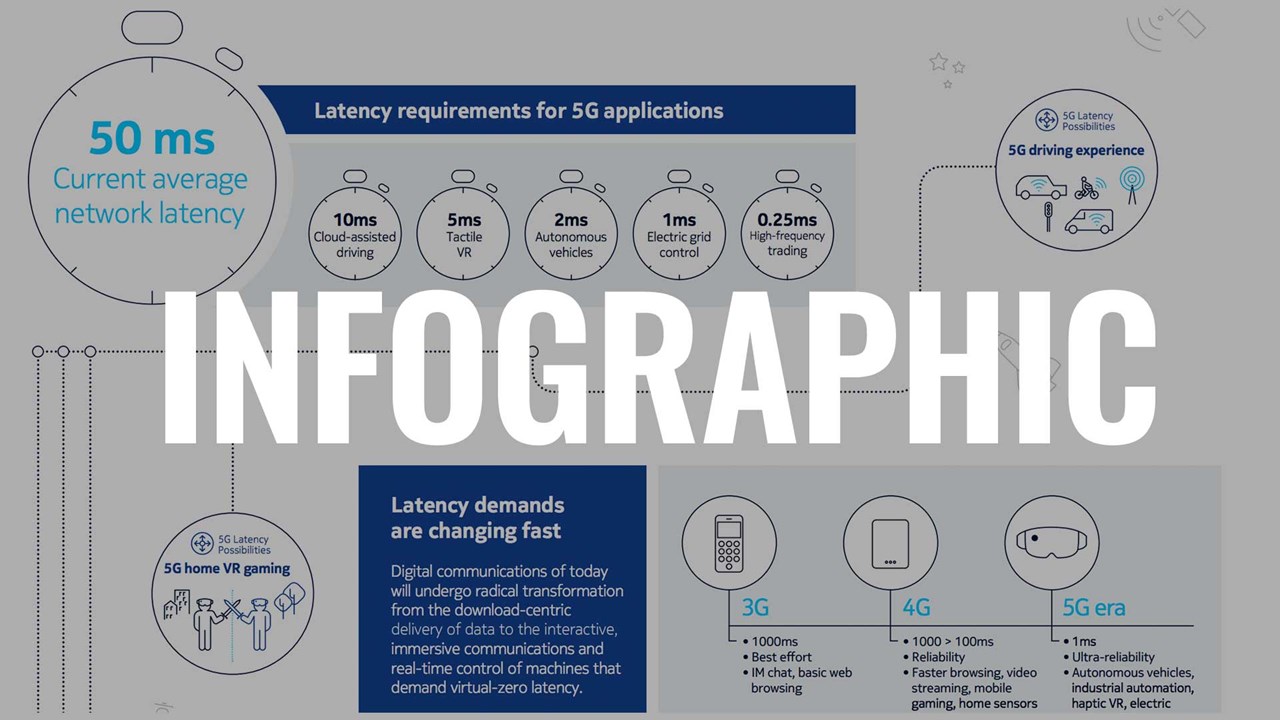
“Latency has now become a critical issue,” says Kester Mann, Director of Consumer and Connectivity at CCS Insights. “Speed and latency were always offered as the twin advantages of 5G, but now my perception is that latency has now become more important than speed.”
Latency management for applications will require a whole new set of control-points and techniques, such as segment routing to be applied right across the network (including the fixed parts) up to and including the end-user device – especially if there still any ambition to get to ‘sub-millisecond’ transmission for some applications (as in the above diagram).
It’s critically important to note that 1 way latency includes the 5G RAN, 5G Edge and Core networks. Also, that neither ITU-R 2150 recommendation or 3GPP Release 16 meet the URLLC latency performance requirements for the RAN, which is: <=1 msec for the data plane and <=10msec for the control plane as per ITU-R M.2410.
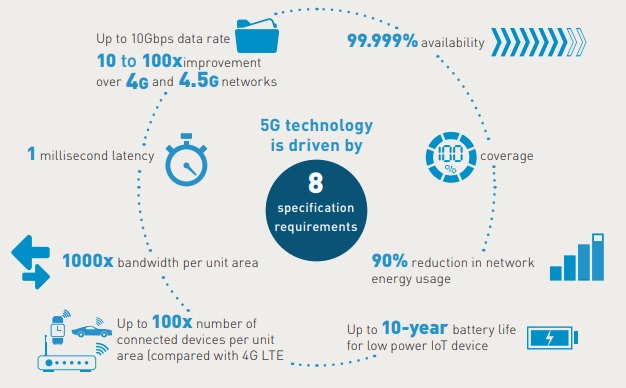
Image Credit: Thales Group
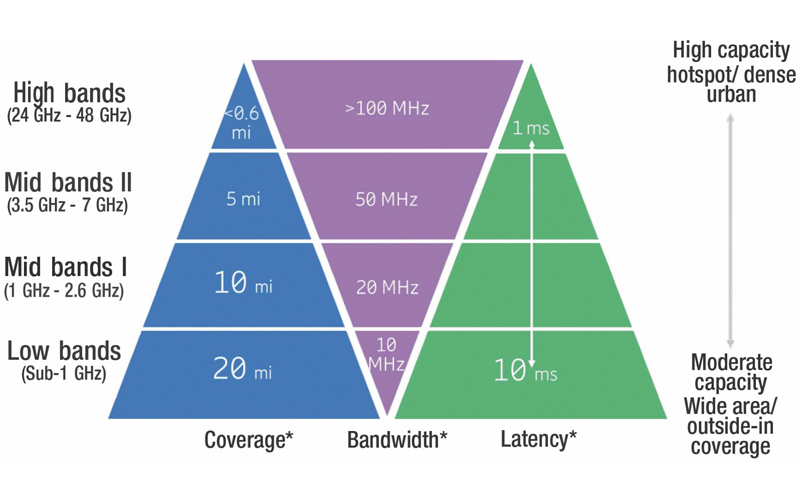
Image Credit: Broadband Library
…………………………………………………………………………………………..
Ericsson claims the development of the ‘inactive state’ has largely been driven by the growing field of Machine-type Communication (MTC), part of 3GPP’s specifications program, where Ericsson claims a leading role. In most MTC scenarios, the amount of data that wireless devices typically exchange with the network is small and usually not urgent enough to justify the high battery consumption required to handle all the signaling involved in the legacy idle-to-connected transition.
…………………………………………………………………………………….
Stefan Jäverbring, CTO, Telia Company, said: “We’re excited to be able to provide new and enhanced experiences for our customers through our close partnership with Ericsson. Our partnership has enabled this industry- and world-first feature, and this technology milestone is fundamental in making more efficient use of mobile network resources and meeting critical requirements with effective solutions.”
Jenny Lindqvist, Head of Ericsson Northern and Central Europe, said: “We’re proud to jointly with Telia and Qualcomm Technologies demonstrate a world-first innovative solution that will provide a significant boost in 5G benefits for a better mobile experience. This is already a huge milestone in taking 5G technology to the next level, and Radio Resource Control will continue to play a critical role for 5G networks for years to come.”
Enrico Salvatori, Senior Vice President and President, Qualcomm Europe/MEA, Qualcomm Europe, Inc., commented: “We are proud to have worked with Ericsson and Telia on bringing this key feature to commercialization. Reduced latency, shorter-time-to-content and increased battery life are high on the must-have lists for users and RRC Inactive helps to deliver them all.”
The development of the inactive state has largely been driven by the growing field of Machine-type Communication (MTC). This is part of 3GPP standardization where Ericsson has had a leading role in defining the functionalities. In most MTC scenarios, the amount of data that wireless devices typically exchange with the network is small and usually not urgent enough to justify the high battery consumption required to handle all the signaling involved in the legacy idle-to-connected transition. For current and future 5G use cases with a large and growing number of devices, improved connection, state, and mobility handling have been identified as key elements of efficient support.
5G skeptic William Webb said, “It’s a good practical development, but I think there is a dash of 5G-style confusion in there too. It’s not clear what or who this is aimed at. Is it aimed at (IoT/MTC) machines or mobile game users?”
……………………………………………………………………………………..
References:
https://www.ericsson.com/en/news/3/2021/5g-feature-enabling-lower-latency-and-increased-battery-life
https://www.thalesgroup.com/en/markets/digital-identity-and-security/mobile/inspired/5G
https://broadbandlibrary.com/5g-low-latency-requirements/
Are there any new services/apps leveraging 5G network capabilities?
At the Asia Tech X conference this week in Singapore, telco executives and analysts shared some lessons in building 5G networks. In a panel discussion session titled, “New Services Leveraging on the Capabilities of 5G Networks,” the consensus was that 5G doesn’t offer much value for traditional operators. At least not until 5G SA core network is widely deployed and available.
Note that 95% or more of deployed 5G networks use Non Stand Alone (NSA) mode, which requires a 4G LTE/EPC anchor for everything except the RAN (which uses 5G NR).
This panel session was supposed to address the following:
- How can telco operators further monetize 5G networks?
- Emerging technologies to differentiate from competitors
- Maximizing opportunities with new IoT consumer products to generate revenue
Once you register (free), you can watch a replay of the session here.
Olivier Rival, a Boston Consulting Group partner based in Singapore, said a breakdown of the 5G value chain did not make for happy reading for telcos. “Connectivity is about 12% to 18% of the total value of 5G – not much more than that,” Rival said.
Julian Gorman, head of GSMA Asia-Pacific, said APAC is the leading region for 5G. He said that 4G revenue would peak in 2023 at which time 5G would take over. With respect to consumer services, video streaming, high speed Internet access at large sports arenas are the most popular to date. However, 5G users are looking for lower cost service and find that early coverage is spotty. Gorman told the audience that the industry needs to do a lot of work in managing 5G expectations:
“For three years we’ve been saying [5G will deliver] 1ms latency, 10Gbit/s peak data rate, ‘enterprise is going to change overnight.’ Those peak technology speeds are not what we should be talking about. We should be talking about how you’re going to change lives and what people are going to use it for. We can play a big part in that value chain and step above connectivity. But we need to act with a better story as an industry.”
Manjot Singh Mann, CEO of Singapore’s M1, said his company is transitioning from 5G NSA (launched in September 2020) to SA, but didn’t say when that might happen. He said that 5G NSA is really 4G+ only providing eMBB service at a faster speed than 4G-LTE. On the other hand, 5G SA is a “game changer.” It provides a rich set of capabilities like lower latency, faster speeds, network slicing, B2B services, B2B2C, etc. There needs to be one driving factor that makes 5G technology relevant but that hasn’t been identified yet. Singapore government and regulator is looking at 5G in terms of its smart nation objective. That puts telcos in that country in a good position to realize the 5G vision.
“As long as telcos keep talk about 5G in terms of speeds as a differentiator, there’s no value in it. You have to find a value addition (for 5G) to succeed. Where will that value add come from? You’re always putting more and more into CAPEX on diminishing (revenue) from xG’s deployed. If we don’t create value from 5G we’ll always be asking this question. The value in Singapore will come from B2B and B2B2C applications which M1 is now monetizing to create value.”
M1 has undergone a digital transformation over the past 18 months. It has changed its IT stack and restructured itself to become a digital service platform. It was now “92% in the cloud” with a fully cloud-native BSS/OSS, he said.
“That allows you to have quick integration with partners that you bring onto your ecosystem so you can provide services to your consumers that are contextualized and real-time. I think that is where our future lies because we have been able to create this digital platform. We are now onboarding our partners so we are able to deliver those services to our customers.”
Changing people and processes has been another challenge. M1 has been trying to build a more innovative, risk-taking culture. “It takes a lot to get that culture going,” he added.
Indosat Ooredoo (Indonesian) COO Vikram Sinha said his company was trying new ways of working, setting up teams that break the functional silos and embrace risk and reward. No one function can solve all these problems, Sinha said. “As leadership team, we need to tell our teams it’s OK to fail, but fail fast and move on. I’m happy to say we have seen some change,” he added. Augmented reality, via a Snapchat partnership is being pursued for B2B applications. “5G is a journey. For telcos is about getting the ecosystem right, with partners and developers.”
Ian Watson CEO of Cellcard (a Cambodian network operator) said his company is working with GSMA to deploy 5G. Currently, Cellcard has more than 3100 4G-LTE cell sites deployed. Content creation, AR and VR for consumers are targeted 5G use cases for Cellcard. B2B market will be a longer investment for Cellcard, which is not a business hub like Singapore that has many businesses.
…………………………………………………………………………………………………………………………………………………………..
A fireside chat session titled, “Real Life 5G Applications in Asia,” was to address these points:
- Consumer 5G Applications taking place in Asia
- Delving into consumer pick up rates and expectations in Asia
- Enticing consumers through new devices and services at attractive price points
The participants were Aps Chikhalikar, Head of TMT, Asia Pacific Japan for Service Now; and Nicole McCormick Senior Principal Analyst Omdia.
Once you register (free), you can watch a replay of that session here.
Separately, Singapore plans to invest $50 million in a program to support research on AI and cybersecurity for future communications structures, Deputy Prime Minister Heng Swee Keat announced this week. As part of the Future Communications Research & Development Program, Singapore plans to set up new communications testbeds in 5G and beyond-5G, support technology development, and build up a local talent pool.
References:
https://virtual-event.asiatechxsg.com/event/asia-tech-x-singapore/planning/UGxhbm5pbmdfNTE1NTU5
https://virtual-event.asiatechxsg.com/event/asia-tech-x-singapore/planning/UGxhbm5pbmdfNTE1NTYw
https://www.lightreading.com/asia/5g-offers-little-value-for-traditional-telco/d/d-id/770886?
https://www.itnews.asia/news/the-asia-pacific-5g-revolution-is-real-and-happening-now-567044
Samsung partners with GBL to deploy 5G testbed for U.S. Army
Samsung has teamed up with GBL Systems Corporation [1.] to deploy new 5G testbeds at U.S. Army military bases for Augmented Reality/Virtual Reality. The testbeds are part of a broader initative announced by the Department of Defense in October, which awarded $600 million in contracts for 5G testing at several US military test sites. GBL and Samsung have been contracted to support one of the largest testbeds, demonstrating the use of AR and VR over 5G networks for training applications.
Note 1. GBL Systems Corporation (GBL) is a leading provider of systems engineering, software services, advanced technology solutions to the U.S. Department of Defense (DoD)
Under the deal, GBL will be responsible for prototype creation, technology integration, and aligning the system with DoD requirements. Samsung will deliver its 5G end-to-end system and technical expertise, including network products such as its Massive MIMO Radios, cloud-native 5G Standalone (SA) Core, and Galaxy 5G mobile devices. The goal is to deploy a scalable, resilient and secure 5G network for AR/VR-based mission planning and training.
The testbeds will support AR for live field military training exercises. Simulated scenarios include virtual obstacles found in the combat theater, and overlays of data and instruments relied on by military personnel. Testing will start in a lab environment using Samsung’s mmWave and mid-band 5G radios. Field testing will then follow at two U.S. Army training bases that will support a live and simulated Army brigade.

Samsung Networks and GBL Systems deploy 5G testbeds for the U.S. Department of Defense, enabling evaluation of AR/VR applications in mission planning and training. U.S. Army trainees will use AR/VR goggles to see enhanced digital content overlaid onto real-world environments.
……………………………………………………………………………………………………………………………………………………….
“GBL is excited to work with Samsung to rapidly field a 5G network that is scalable, resilient, and secure to create a prototype test bed in support of a new DoD 5G-enabled AR/VR training capability,” said Jim Buscemi, CEO. “This effort has the potential to revolutionize how the DoD performs distributed training exercises that are more combat-like to significantly advance warfighter readiness.”
“Samsung is pleased to collaborate with GBL to deliver a reliable, resilient and secure 5G network for the DoD to evaluate new capabilities for our U.S. troops,” said Imran Akbar, Vice President and Head of New Business Team, Networks Business, Samsung Electronics America. “We believe in the transformative power of 5G and look forward to assisting the U.S. Department of Defense as they use this technology to increase training safety and strengthen the Nation’s defense capabilities.”
Samsung’s 5G solution enables quality, real-time imagery to be shared by many participants simultaneously. The Army trainees will use AR/VR goggles to see enhanced digital content overlaid onto the real world, and can use this digital imagery to interact with and acquire information about their real environment. This expands what’s possible in military training today, and provides a competitive advantage against adversaries.
Samsung pioneered the successful delivery of the first 5G end-to-end solutions in 2018, including chipsets, devices, radios, and the core network. Through ongoing research and development, Samsung drives the industry to advance 5G networks with its market-leading product portfolio from fully virtualized RAN and Core to private network solutions and Artificial Intelligence (AI) powered automation tools. The company is currently providing network solutions to mobile operators that deliver connectivity to hundreds of millions of users worldwide, including customers of leading U.S. operators.
References:
https://www.telecompaper.com/news/samsung-gbl-to-deploy-5g-testbed-for-us-army–1390248
Qualcomm’s designing custom CPU’s for dominance in laptop markets; CEO: “We will go big in China”
Qualcomm’s new CEO believes that by next year his company will supply CPU chips for laptop makers competing with Apple. Last year, the Cupertino, CA based company introduced laptops using a custom-designed central processor chip that boasts longer battery life. Longtime processor suppliers Intel Corp and Advanced Micro Devices have no chips as energy efficient as Apple’s.
Qualcomm Chief Executive Cristiano Amon told Reuters on Thursday he believes his company can have the best chip on the market, with help from a team of chip architects who formerly worked on the Apple chip but now work at Qualcomm. In his first interview since taking the top job at Qualcomm, Amon also said the company is also counting on revenue growth from China to power its core smartphone chip business despite political tensions.
“We will go big in China,” he said, noting that U.S. sanctions on Huawei Technologies Co Ltd (HWT.UL) give Qualcomm an opportunity to generate a lot more revenue.
Amon said a cornerstone of his strategy comes from a lesson learned in the smartphone chip market: It was not enough just to provide modem chips for phones’ wireless data connectivity. Qualcomm also needed to provide the brains to turn the phone into a computer, which it now does for most premium Android devices.
Now, as Qualcomm looks to push 5G connectivity into laptops, it is pairing modems with a powerful central processor unit, or CPU, Amon said. Instead of using computing core blueprints from longtime partner ARM Ltd, as it now does for smartphones, Qualcomm concluded it needed custom-designed chips if its customers were to rival new laptops from Apple.
As head of Qualcomm’s chip division, Amon this year led the $1.4 billion acquisition of startup, whose ex-Apple founders help design some those Apple laptop chips before leaving to form the startup. Qualcom will start selling Nuvia-based laptop chips next year.
“We needed to have the leading performance for a battery-powered device,” Amon said. “If ARM, which we’ve had a relationship with for years, eventually develops a CPU that’s better than what we can build ourselves, then we always have the option to license from ARM.”
ARM is in the midst of being purchased by Nvidia Corp for $40 billion, a merger that Qualcomm has objected to with regulators.
Amon said Qualcomm has no plans to build its own products to enter the other big market for CPUs – data centers for cloud computing companies. But it will license Nuvia’s designs to cloud computing companies that want to build their own chips, which could put it in competition with parts of ARM.
“We are more than willing to leverage the Nuvia CPU assets to partner with companies that are interested as they build their data center solutions,” Amon said.
Smartphone chips accounted for $12.8 billion of its $16.5 billion in chip revenue in its most recent fiscal year. Some of Qualcomm’s best customers, such as phone maker Xiaomi Corp are in China.
Qualcomm is counting on revenue growth as its Android handset customers swoop in on former users of phones from Huawei, which was forced out of the handset market by Washington’s sanctions.
Kevin Krewell, principal analyst at TIRIAS Research, called it a “political minefield” due to rising U.S.-China tensions. But Amon said the company could do business as usual there.
“We license our technology – we don’t have to do forced joint ventures with technology transfers. Our customers in China are current with their agreements, so you see respect for American intellectual property,” he said.
Another major challenge for Amon will be hanging on to Apple as a customer. Qualcomm’s modem chips are now in all Apple iPhone 12 models after a bruising legal battle. Apple sued Qualcomm in 2017 but eventually dropped its claims and signed chip supply and patent license agreements with Qualcomm in 2019. Apple is now designing chips to displace Qualcomm’s communications chips in iPhones.
“The biggest overhang for Qualcomm’s long-term stock multiple is the worry that right now, it’s as good as it gets, because they’re shipping into all the iPhones, but someday, Apple will do those chips internally,” said Michael Walkley, a senior analyst at Canaccord Genuity Group.
Amon said that Qualcomm has decades of experience designing modem chips that will be hard for any rival to replicate and that the void in the Android market left by Huawei creates new revenue opportunities for Qualcomm.
Another challenge for Amon, a gregarious executive who is energetic onstage during keynote presentations, will be that Qualcomm is not well known to consumers in the way that Intel or Nvidia are, even in Qualcomm’s hometown.
“I flew into San Diego and got an Uber driver at the airport and told him I was going to Qualcomm. He said, ‘You mean the stadium?'” Krewell said, referring to the football arena formerly home to the San Diego Chargers.
Amon has started a new branding program for the company’s Snapdragon smartphone chips to try to change that. “We have a mature smartphone industry today. People care what’s behind the glass,” he said.
References:
https://www.reuters.com/technology/qualcomms-new-ceo-eyes-dominance-laptop-markets-2021-07-01/
Deutsche Telekom and partners complete 1st Voice over 5G New Radio call
Deutsche Telekom (DT) together with partners Ericsson, Nokia, Qualcomm, Samsung, Xiaomi announced the successful completion of the world’s first Voice over 5G New Radio (VoNR) call in an end to end multi-vendor environment.
The trial was in DT’s lab in Warsaw, Poland [1.]. The partners were able to verify the capability over a 5G Standalone (SA) network with voice and 5G data sessions in parallel. This network setup integrated a 5G Core from Ericsson and IP Multimedia Subsystem (IMS) from Nokia. The calls were completed on commercial terminals from Samsung Galaxy S21 5G, Xiaomi Mi 11 Lite 5G, and a 5G smartphone form factor test device powered by Qualcomm’s Snapdragon 780G and 888 5G Mobile Platforms with Snapdragon 5G Modem-RF Systems.
The partners said that “innovation milestone is an important step towards the commercial introduction of seamless native 5G voice services in Deutsche Telekom networks.”
Note 1. Deutsche Telekom, together with Nokia and Ericsson, established the 5G Standalone network infrastructure in test mode at Deutsche Telekom’s lab in Warsaw, Poland, where testing and engineering is conducted on behalf of the entire Group.
……………………………………………………………………………………………………………………………………………
In cloud-native 5G SA networks, operators will be able to deliver high quality voice services without having to rely on LTE as anchor. The addition of VoNR to the superior data transmission quality of 5G technology will allow customers to enjoy voice and data services in parallel. VoNR is therefore expected to play a role in many data services enabled by 5G, from enhancements to voice quality in existing services to completely new services around immersive video conferencing and augmented or virtual reality.
“High quality and seamless voice calling remains a must-have service for our customers in the 5G era. The addition of 5G VoNR can be a differentiator for next generation immersive applications that integrate high speed 5G data with high definition audio,” says Alex Choi, SVP Strategy & Technology Innovation, Deutsche Telekom. “Our collaboration with best-in-class partners to validate end-to-end 5G VoNR interoperability is an important step towards the future of 5G voice services for our customers.
Jan Karlsson, Senior Vice President and Head of Digital Services, Ericsson, says, “The end-to-end 5G voice over NR going live with the first call in Deutsche Telekom network further demonstrates the strength and recognition of our cloud native 5G Core network for standalone 5G networks.”
Marc Erhardt, Head of Cloud and Network Services in the Customer Team Deutsche Telekom, Nokia says, “Voice communication remains a key feature also in the 5G world. Subscribers demand high-quality voice services and voice also plays a role in many of the new data services enabled by 5G. Successful 5G strategies therefore must include a plan for embedding voice into 5G services, and the IMS core will be key for this. Our participation in this successful trial is the latest validation reflecting the strong capabilities of the Nokia IP Multimedia Subsystem and Telephony Application Server.”
“This achievement is a step forward in realizing the full potential of 5G for consumers and industries. The capabilities of mature 5G networks will bring significant benefits to end-users as well as produce a plethora of innovative new services and applications,” says Enrico Salvatori, senior vice president and president, Qualcomm Europe/MEA, Qualcomm Europe, Inc.
“Both the Xiaomi Mi 11 Lite 5G and the 5G smartphone form factor test device used in this activity are powered by Snapdragon 780G and 888 5G Mobile Platforms with Snapdragon 5G Modem-RF Systems respectively which support a wide range of 5G capabilities including both 5G VoNR and 5G SA.”
“Galaxy 5G devices are already changing the way we communicate and how we experience the world around us,” says KJ Kim, EVP and Head of Mobile R&D Office, Mobile Communications Business, Samsung Electronics. “Samsung’s longstanding partnership with Deutsche Telekom continues to lead the growth of 5G and as Galaxy S21 5G comes with next generation 5G VoNR, we look forward to giving more people access to innovative mobile experiences.”
“Close collaboration along 5G ecosystem is crucial to unlock the true potential of 5G.” Says James Munn, Head of Global Carrier Operations, Xiaomi. “Combining new 5G services, such as VoNR, with our world-class 5G smartphones will ensure we are able to offer the best possible experience to our customers.”
To achieve this 5G VoNR breakthrough Deutsche Telekom, together with Nokia and Ericsson, has established the 5G Standalone network infrastructure in test mode at Deutsche Telekom’s lab in Warsaw, Poland, where testing and engineering is conducted on behalf of the entire Group.
The setup includes the integration of a 5G Core (5GC) from Ericsson and an IMS (IP Multimedia Subsystem) from Nokia, whereby the IMS core provides voice as a 5G application service. The transmission was tested over 5G NR Standalone (SA) Radio Access Technology from both Ericsson and Nokia. The voice calls were completed using the Samsung Galaxy S21 5G, Xiaomi Mi 11 Lite 5G, and a 5G smartphone form factor test device powered by the Snapdragon 780G and 888 5G Mobile Platforms with Snapdragon 5G Modem-RF Systems.
References:
https://laboratories.telekom.com/
https://www.mobileeurope.co.uk/press-wire/13592-deutsche-telekom-launches-5g-testbed-in-warsaw
Strong Growth Forecast for 5G Security Market; Market Differentiator for Carriers
Some key findings from ResearchAndMarkets.com’s “5G Security Market by Technology, Solution, Category, Software, Services, and Industry Vertical Support 2021 – 2026” new report:
- The overall global 5G security market will reach $9.2 billion by 2026 [1.]
- The fastest-growing segment will be communications security at 49.2% CAGR
- North America [2.] will be the leading region projected to reach $4.1 billion by 2026
- Integrated 5G security and blockchain solutions will reach $183.1 million by 2026
- AI-based solutions for edge computing infrastructure will reach $253.2 million by 2026
- Distributed denial of service (DDoS) protection for 5G networks will reach $583 million by 2026
- Major drivers for carrier 5G security include 5G core network implementation and support of private wireless networks
- Leading carriers will transform 5G security from a cost of doing business into a major market differentiator for business customers
Note 1. In February 2021 report, Markets and Markets said that 5G security market size is projected to grow from $580 million in 2020 to $5.226 billion by 2026, at a compound annual growth rate (CAGR) of 44.3%. The market research firm believes the major drivers for the 5G security market include rising security concerns in the 5G networks, increasing ransomware attacks on IoT devices, rising attacks on critical infrastructure, and increasing IoT connections paved way for mMTC with enhanced security requirement.
The “cloud native mode” of 5G core/SA deployment is expected to exhibit a higher CAGR during the forecast period. By deploying 5G security solutions and services on the cloud, organizations can avoid spending on hardware, software, storage, and technical staff.
The cloud deployment type is often used for both private and public clouds and may vary from case to case, depending on the requirement of the client.
Additionally, organizations can scale up or down, depending on their use of cloud-based 5G security services. The cloud deployment segment has witnessed strong demand in the early phase of the 5G standalone network. It offers a wide range of benefits, such as scalability, accessibility, flexibility, and cost-effectiveness.
Note 2. Markets and Markets expects the APAC region to hold the largest market share during the forecast period. China, Australia, and Japan are the prime APAC countries that have started several 5G-related activities; which would provide growth opportunities for 5G security vendors in the region.
Asian telecom service providers, vendors, and government firms are determined to take the lead in 5G R&D. The infrastructural growth in APAC, especially in Japan, South Korea, Australia, Singapore, China, and India, and the increasing deployment of 4G and 5G networks present huge opportunities for the implementation of the 5G security solutions.
……………………………………………………………………………………………………………………………………………
The ResearchAndMarkets.com report evaluates the 5G threat landscape as well as technologies and solutions to secure networks, platforms, devices, data, and applications [3.]. The report also assesses the 5G security market outlook and potential for many solutions, services, and support. It also evaluates the impact of security functions across various technologies including Mobile Edge Computing (MEC), IoT networks, and mobility infrastructure. The report includes market forecasts for all major technologies, industry verticals, solutions, and service types from 2021 to 2026.
The 5G security market must be robust as solutions need to be deployed on multiple levels including devices, air interface equipment, cloud RAN infrastructure, mobile backhaul facilities, and more.
Note 3. There’s likely to be an increasing adoption of 5G security solutions by carriers. It will be used for identity management, differentiated security protection, privacy protection and growing demand for data protection worldwide. 5G security technology offers various benefits such as diversified system level protection of IT-aware infrastructure, security as service, and rapid detection and response.
The growing demand for a security monitoring and threat analysis to help the business to protect the integrity of systems and data is expected to create a huge opportunity for the global 5G Security market.
In addition, the need for E2E security for vertical industries from protection to detection and increasing importance of a unified security view across enterprise, are anticipated to drive the 5G Security market growth.
Reference: https://www.futuremarketinsights.com/reports/5g-security-market
……………………………………………………………………………………………………………………………………..
Among other areas, the 3GPP Security architecture and procedures for 5G System (Specification #: 33.501) specifies requirements for E1 and f1 interfaces as well as requirements for an overall secure environment. The organization specified many areas necessary for 5G security including subscription authentication, UE authorization, access and serving network authorization and more. Other areas include user and signaling data integrity to ensure seamlessness and interoperability between network elements.
Note that there are no ITU-T recommendations on 5G/IMT 2020 security.
One of the import areas emerging with 5G security that is a greater concern than ever before is data security and private. Much more so than LTE, 5G networks must be concerned with the confidentiality and integrity of user and signaling data. The 5G gNB must support encryption as per security policies for various potential vulnerability areas such as user data in transit as well as signaling for radio resource control. Access control is equally important as well as ensuring that serving networks are authorized by home networks.
5G mobile network operators need to expedite implementation of a more integrated 5G security approach, one of the primary areas of focus will be support of 5G-based private wireless networks for enterprise and industrial customers. While today’s private networks take a more old-school approach to security, more security-minded enterprise, industrial and government sector customers will realize greater cybersecurity through interconnection and managed services with leading carrier 5G security solutions.
Leading carriers will transform 5G security from a cost of doing business into a major market differentiator for business customers including direct to enterprise/industrial/government customers and via hybrid models involving neutral hosts and/or direct interconnect with private wireless networks. The challenging task for mobile network operators is to simultaneously convince business customers that they are more secure with them than without them, while not causing alarm about security holes that existed prior to implementation of 5G security solutions.
For more information about this report please visit: https://www.researchandmarkets.com/r/vqa21q
………………………………………………………………………………………………………………………………………….
In a recent IEEE Future Networks presentation titled, Security Considerations for Evolving RAN Architectures, Scott Poretsky and Jason Boswell of Ericsson wrote about “the trust stack in 5G Cloud RAN.” Here’s what they said (emphasis added):
Network security is built upon a trust stack of trusted hardware, trusted software, trusted deployment, trusted applications, and trusted operations. Cloud deployments have an expanded attack surface due to decoupling of the software from the hardware, multiple organizations sharing the same hardware, a third-party organization managing the cloud infrastructure, and use of open source software components.
The chain of trust between these disparate components is not standardized and is implementation dependent, making it challenging to determine the level of risk, such as defined by the NIST Risk Management Framework (RMF). In a cloud environment an external attacker could gain access to a compromised container and from there escalate privilege to gain access to services and infrastructure. Likewise, an attacker that gains access to a service can use it as platform to gain access to containers and infrastructure.
Reference:
https://www.ericsson.com/en/reports-and-papers/white-papers/security-in-5g-ran-and-core-deployments
………………………………………………………………………………………………………………………………
NTT DoCoMo: Higher Earnings; Big plans for 5G but lots of competition
NTT DoCoMo, now a fully owned unit of parent NTT Group, reported 6.3% higher full-year earnings of 629 billion yen (US$5.74 million). Revenue was 1.6% higher at 4.73 trillion yen ($43.14 billion) while operating costs were flat.
Quarterly mobile revenue, which had fallen in the first half of the year, grew slightly in the last two quarters, although over the full year it was flat at 2.7 trillion yen ($24.6 billion). The new Ahamo discount plans, launched in March, attracted more than 1 million new customers to the end of March, most of them aged under 30, DoCoMo CEO Motoyuki Ii told analysts on Thursday.
In its presentation to investors, the company described their 5G goals:
- Build 5G coverage that exceeds competitions’ in both speed and breadth while elevating our service offerings. Concentrate managerial resources on 5G to deliver on efficiency improvement at the same time.
- Concentrate network investments on 5G and improve efficiency of 4G spend, to achieve reduction in total expenditures.
- Accelerate replacement of base stations from 3G to 5G to suppress total network costs
DoCoMo had 3.09 million 5G customers as of March 31st, with a target of 10 million in the current fiscal year. In fiscal year 2020, there were 7,100 base stations deployed (in 574 major cities in Japan). In fiscal year 2021, the company expects to deploy 20,000 base stations and commence 5G core/SA service. The 5G SA network will be deployed only “where there is actual demand” for enterprise services such as network slicing.
Also, 55% of Japan’s population will be covered by “Lightning Speed 5G” (that uses sub-6GHz bands and millimeter wave spectrum).
DoCoMo’s most promising 5G solution was a joint venture with machinery company Komatsu to provide smart construction services, Ii said. The LANDLOG open platform connects land, equipment and materials for innovative and smart construction. These would be sold globally through NTT Group sales channels as well as locally.
Image Credit: Getty Images
……………………………………………………………………………………………………………………………….
Challenge toward a “New DoCoMo” include the following initiatives:
- Drive innovation and bring major changes to society.
- Pursue “customer-first” and deliver new value that exceeds customers’ expectations.
- Enhance customer experience (CX) and realize business structure reform by promoting and executing digitalization of business operations and data utilization.
- Promote business and ESG management in an integrated manner, thereby contributing to the creation of a sustainable society.
FY 2021 Principal Actions include:
Telecom Business:
- Expand customer base by offering rate plans and services catered to diverse customer needs.
- Achieving both Early expansion of 5G coverage and improvement of network cost efficiency.
- Accelerate digital shift of sales channel and digital transformation (DX) of call centers and DoCoMo Shops (converged online/offline CX).
Enterprise Business:
- Expand areas/industries where 5G solutions are applied and achieve nationwide deployment.
- Support DX of small- and medium-sized companies through early proliferation of “Business d Account.”
Smart Life Business:
- Expand finance/payment business and establish data-driven B2B2X ecosystem.
- Create new lifestyles centered on video offerings and expand new business domains.
With respect to earnings guidance, DoCoMo forecast a 1.4% increase in operating profit for the 2021-22 financial year, with Smart Life services expected to improve earnings by 9.3%. Telecom group operating profit is projected to fall 1.6%.
……………………………………………………………………………………………………………………………………
Sidebar: Japan Mobile Network Competition for DoCoMo
Mobile sites in Japan (courtesy of Light Reading)
| Mobile sites | 5G sites | 5G sites target | |
| KDDI | 110,000 | 10,000 | 50,000 by March 2022 |
| NTT DoCoMo | 80,000 | 7,100 | 20,000 by March 2022 |
| Rakuten | 44,000 (summer target) | 1,000 | N/A |
| SoftBank | 230,000 | N/A | 50,000 by March 2022 |
| Source: Companies | |||
KDDI says it had 10,000 5G base stations deployed at the end of March and is targeting 50,000 by March next year. KDDI estimates the latter number will provide population coverage of 90% of Japan’s population. Last year alone, it spent about JPY174 billion ($1.6 billion) on 4G and 5G rollout, as well as JPY200 billion ($1.8 billion) on “common equipment.”
SoftBank, the third operator, has precisely the same target of 50,000 base stations and 90% population coverage by March 2022.
………………………………………………………………………………………………………………………………………………
References:
https://www.nttdocomo.co.jp/english/corporate/ir/library/presentation/index.html
https://www.lightreading.com/5g/rakuten-and-curious-case-of-missing-5g-plan/d/d-id/769477?
Ericsson claims to be 5G market leader with strong revenues coming in 2022
On Ericsson’s 1st quarter 2021 earnings call this past week, CEO Börje Ekholm said that while Ericsson is focused on growing its core business of networks and digital and managed services, it’s also putting energy into building an enterprise business. The Swedish based company is “seeing a very strong development, strong demand for 5G and enterprise applications.”
The CEO believes that the 5G market cycle will be both longer and bigger due to entering a complete new application area with enterprise applications. What’s encouraging is the progress Ericsson is making on their product portfolio. In Q1-2021, the company announced the ultra-lightweight, high-performance Massive MIMO radio portfolio.
“We have continued to consolidate our position as market leader in 5G with 136 commercial contracts and 85 live networks in 42 countries. What’s also encouraging is that organically, FX-adjusted, we saw sales grew 10% during the first quarter. And if we actually add — or adjust for the IPR revenues, organic growth was 14% in our business. So that is really driven by a strong growth in networks that, again, if you would adjust for IPR, actually grew 19% in the quarter, which is fairly significant growth.
If we look at the market areas, we saw good growth in four out of five market areas. Northeast Asia, we grew by 80%, which is really driven by the non-Chinese markets, primarily. If we look at — the next one is Southeast Asia, Oceania, and India, where we saw good growth, driven by 5G in Australia, as well as 4G rollout in India, of a little touch more than 20%. Moving on to Europe, where we had good growth, 15% in Europe.But that was partly offset by more flattish development in Latin America. And, of course, Latin America suffers from the pandemic and the macroeconomic effects following the tough situation with the COVID-19. If we then look – MANA had a strong development based on continued rollout of 5G. And there, we see, actually, good progress also on our cloud-native portfolio in digital services.So we had a growth of 10% — more than 10% organically. And we’ve been able to also strengthen our market position, which is, long term, going to be very attractive for us. We also saw the completion of the C-band auction, so we expect that to result in deployments during the second half of the year. And if we look then at our last market area, Middle East and Africa, we saw sales falling by 16%.That is really an effect of the pandemic in Africa impacting the macroeconomic and the spend environment, but we’re also seeing a slowdown in Middle East following the large investments last year. So one of the cornerstones of our strategy has been to grow gross margin, and it’s a fundamental indicator of success or progress on the focus strategy. So it is encouraging that we continue to see our gross margin strengthen in the business, and we are able to see that strengthening despite lower IPR revenue. As a matter of fact, we fully compensate for the lower IPR revenue in the gross margin development.”
In the enterprise market, Ericsson is starting to see good progress on its 5G IoT offering, but we’re also seeing that Cradlepoint becomes integrated into our business and seeing the growth opportunities now materializing in the numbers from Cradlepoint.
Ekholm said that the expects to see the U.S. C Band auction result in deployments during the second half of this year. Verizon, in particular, has indicated that it wants to have 7,000 to 8,000 C Band sites ready to go when the spectrum is cleared in late 2021.
Ekholm also briefly addressed Ericsson’s supply chain. AT&T CEO John Stankey raised the potential for C Band equipment supply chain issues this week during AT&T’s quarterly call with investors. Asked about the carrier’s plans for C Band deployment, Stankey said that global supply chains are “stretched” and as a result, he is “a little skittish,” adding that the company is “seeing dynamics that are occurring in the global supply chain where unexpected things are popping up, and it is possible that we could see certain element shortages that start to crop up as everybody’s racing to put stuff up on towers.”
The CEO categorized 2021 as an investment year for Ericsson, particularly in its Digital Services segment, and that the company is incurring costs ahead of revenues — some of which might come as soon as the fourth quarter, but “we’re really going to see revenues coming in 2022,” he said.
References:
Ericsson: Enterprise focus will mean a ‘bigger and longer’ 5G cycle