

Huge Risks for the proposed $500B AI Investments from Giant Wall Street firms
Disclaimer: Perplexity.ai was used for research and analysis in this article.
……………………………………………………………………………………………………………………..
Executive Summary:
This past Monday, six giant Wall Street asset managers, private-equity firms and banks announced an effort to raise $500 billion to keep fueling the A.I. boom by financing more data centers, power plants and chips. The proposed platform would direct capital to Nvidia customers—including AI startups and data-center operators—at precisely the point when many have struggled to obtain funding through ordinary credit channels.
We take that as a huge warning sign for the proposed AI investments. Here’s why: If the underlying projects offered clearly proven cash flows, predictable utilization and collateral with durable value, lenders would not need a specially assembled consortium, headline-scale commitments and Nvidia’s direct involvement to make the loans happen. The initiative appears designed to overcome a financing bottleneck created by the extraordinary gap between AI infrastructure spending and demonstrated AI revenue.
This proposed $500 billion AI-financing initiative is less a validation of durable AI economics than an admission that the sector’s spending plans have outgrown its customers’ ability—or willingness—to finance them conventionally. Rather than demonstrating independently sustainable demand, the arrangement risks extending an investment cycle increasingly dependent on vendor-enabled credit, opaque commitments and financial engineering.
The firms—Apollo, BlackRock, Blackstone, Brookfield, Goldman Sachs and KKR—said they were working together to come up with that huge sum to lend to Nvidia’s customers, including the start-ups that use the company’s chips in data centers to develop and operate A.I. software. These customers, Nvidia said, have been struggling to secure financing for chips and data centers.
Nvidia will connect its customers with one of the six lenders, which will provide financing that could range from loans to credit. The financing will be “at attractive rates,” Nvidia said in a blog post.
In practical terms, this is a vendor-financing mechanism, even if the capital technically comes from third parties. Nvidia is helping its customers obtain the money required to buy Nvidia-dependent infrastructure. The more readily startups and data-center operators can borrow, the more equipment they can order; the more equipment they order, the more Nvidia can sell. That does not mean the demand is fictitious, but it does make it harder to distinguish independent end-user demand from demand supported by an ecosystem that is financing itself.
Circularity is the principal concern. When suppliers, investors, cloud providers, AI labs and lenders all have financial incentives to keep capital circulating within the same small group of counterparties, reported growth can look more robust than the ultimate economics justify. The risk is not simply that projects fail individually. It is that a shortfall in AI-service revenues, utilization or pricing could spread simultaneously through hardware vendors, AI developers, cloud operators, private-credit vehicles and the securities backed by their cash flows. Circular financing can blur the line between real external demand and investment-funded purchases.
Executives from the lenders joined Jensen Huang, Nvidia’s CEO & founder, for an unusual, extended interview on CNBC, where they talked up their new, seemingly insatiable desire to finance infrastructure for A.I. Huang said on the air. He added that “A.I. labs” and “A.I. start-ups” would have access to the financing. He did not name those companies or whether Nvidia would receive any money as part of the effort. David M. Solomon, Goldman’s chief executive, said the consortium was Mr. Huang’s idea.
“We need to raise this money as fast as possible,” said Larry Fink, BlackRock’s chief executive. He also stated: “There’s quite a bit of negativity around A.I. and data centers right now, but let’s be clear: This is going to be creating a huge amount of jobs.”
Skeptical Analysis:
The urgency in those statements deserves more scrutiny. Speed is not a substitute for underwriting, and job-creation claims do not establish that investments will meet their cost of capital. The industry is attempting to finance assets whose useful economic life may be much shorter and more uncertain than that of traditional infrastructure. A GPU fleet can lose competitiveness rapidly when a new architecture, memory standard or systems design emerges. Its resale value can fall sharply if capacity demand weakens. Treating such hardware as collateral comparable to a toll road, utility asset or long-lived building is a major assumption—not an established fact.
The announcement punctuates a head rush on Wall Street and in Silicon Valley into anything that even vaguely resembles A.I. The stocks of tech giants and chipmakers have soared for most of this year, and a pair of the biggest names in the space, Anthropic and OpenAI, are expected to file for initial public offerings that could value them at $1 trillion apiece.
But soaring equity valuations and enormous projected IPO valuations do not answer the basic return-on-investment question: who will pay enough, for long enough, to justify the total cost of the data centers, power plants, networking, GPUs and debt now being assembled? AI vendors may generate impressive revenue growth while still failing to earn enough to cover the depreciation, energy, financing and replacement costs of the infrastructure required to produce it.
Nvidia’s financing narrative appears to conflate broad interest in AI-enabled services with broad, independent demand for capital-intensive AI infrastructure. Governments, enterprises and startups may all seek access to AI capabilities, but the current demand for hyperscale GPU clusters, dedicated power capacity and purpose-built “AI factories” remains concentrated among a relatively small group of frontier-model developers and cloud platforms.
That distinction matters because broad adoption of AI applications does not automatically translate into economically sustainable demand for vast new data-center capacity. Enterprises can consume AI through APIs, hosted platforms, smaller models and open-source software without owning—or financing—dedicated high-density compute infrastructure. Nvidia itself describes demand as spanning enterprises, startups, governments, nations and AI labs, but the critical question for investors is how much of that demand converts into durable, contracted infrastructure revenue rather than experimentation, pilots or subsidized consumption.
As Bloomberg reported last week, OpenAI accounted for somewhere between 50% and 70% of Microsoft’s AI revenue in the 12 months to 30 June.
That degree of concentration is significant. Microsoft disclosed $24.1 billion in sales from OpenAI during the year ended in June; outside estimates place that at more than half, and perhaps about 70%, of Microsoft’s AI-related revenue. Much of the revenue reflects OpenAI’s spending on Microsoft cloud and model-development services, meaning a substantial portion of the apparent AI revenue base may be generated within a tightly linked commercial relationship rather than by a diversified population of external enterprise customers.
That could be problematic if the picture is similar at other hyperscalers and at other frontier AI companies like Anthropic, for example. A market in which a handful of loss-making model developers drive an outsized share of cloud and infrastructure revenue is inherently more fragile than one supported by a broad base of profitable end users. It exposes infrastructure providers and lenders to customer concentration, correlated capital spending and the possibility that a reduction in financing at one frontier lab quickly reduces demand across the supply chain.
Indeed, as has been reported by multiple correspondents – most notably staunch AI critic Ed Zitron – LLM makers like OpenAI are losing money hand over fist and can only charge so much for tokens before customers either curb their usage or switch to open source models. Zitron wrote:
“It’s estimated that 70% or more of the AI revenues of Microsoft, Google, and Amazon were from either OpenAI or Anthropic. UBS estimated that next year, Anthropic and OpenAI’s compute spend would be 48% of all Google Cloud revenues — which means that they likely account for even more than 70% of its AI revenues.”
The commercial challenge is not whether frontier models have value- they do. It is whether they can deliver that value at prices that exceed the combined costs of training, inference, electricity, networking, cloud capacity, depreciation and ongoing model development. If token pricing rises too far, customers may reduce usage, shift workloads to lower-cost models, or use open-source alternatives. If pricing remains low, frontier-model providers may struggle to cover their infrastructure bills. Open-source fine-tuning can materially reduce costs for specialized enterprise workloads, reinforcing the competitive pressure on premium proprietary-model pricing.
The most plausible downside is that the technology becomes broadly useful but insufficiently profitable to support today’s extreme capital intensity. That outcome would leave the sector with too much high-cost capacity, thin margins, declining GPU collateral values and lenders dependent on assumptions about utilization and cash flows that have not yet been tested through a downturn. The foundational financial risk is straightforward: AI-service revenues may prove insufficient to service the fixed obligations incurred to construct the infrastructure. Notably, Nvidia stock dipped modestly on Monday after The Financial Times reported that the company was nearing the mammoth financing deal.
While the contours of the arrangements were announced Monday afternoon, details remained scarce. A joint news release referred only to “memorandums of understanding” to “create dedicated pools of capital at significant scale.”
That language is important. Memorandums of Understanding (MoU’s) are not equivalent to binding, fully funded commitments. Until investors know the actual terms—capital committed, leverage permitted, collateral requirements, Nvidia’s role in losses, loan maturities, customer concentration limits and underwriting standards—the $500 billion figure is better understood as an ambitious financing target than as validated capital deployment. Reporting has described the initiative as a multiyear target rather than cash already committed, while questions remain about the scale of any Nvidia backstop.
During their television interview, the lenders’ executives alluded vaguely to “yield-based products” and even securitization, or the creation of bonds that would divvy up the revenue from A.I. labs into risky and less risky categories. There were several references to A.I. as a new asset class and to allowing smaller investors an opportunity to invest in debt backed by the data centers.
This is where the proposal moves from aggressive investment to potential systemic-risk creation. Securitization can distribute risk, but it does not eliminate it; it can instead diffuse difficult-to-value exposure across a wider investor base. Packaging AI-data-center debt into yield products may make financing more available, but it also risks obscuring the quality of the underlying cash flows, the degree of correlated exposure among borrowers and the vulnerability of rapidly depreciating hardware collateral. The more complex the capital stack becomes, the greater the danger that investors mistake engineered liquidity for genuine economic value.
Executive Quotes:
“NVIDIA has reached an important milestone. We began by building chips; today, we are helping create a new class of productive, investable infrastructure: AI factories,” said Jensen Huang, founder and CEO of NVIDIA. “In AI, compute is revenue. NVIDIA compute is uniquely suited for this role. It is broadly adopted, flexible across models and workloads, fungible and transferable across customers and operators, and continuously improved through CUDA software — extending its useful life and improving its economics over time. It is supported by a deep global ecosystem of developers, customers and offtakers. That is why we are bringing the world’s leading long-term capital providers together to independently underwrite AI infrastructure. These financing platforms will help customers access scarce compute at scale and build the DSX AI factories that will power every industry and country in the age of AI.”
“Modern compute has emerged as a scarce, mission-critical asset class with compelling investment characteristics that is positioned to drive significant long-term economic growth and productivity gains,” said Apollo President Jim Zelter. “The combination of NVIDIA’s proprietary technology ecosystem and Apollo’s flexible, long-term capital base provides a strong foundation to support the next stage of the AI buildout as part of the broader Global Industrial Renaissance.”
“The AI buildout will require unprecedented investment and a skilled workforce to turn that investment into the infrastructure that will help power future growth,” said Larry Fink, Chairman and CEO of BlackRock. “This partnership deepens our relationship with NVIDIA, including through the AI Infrastructure Partnership, and brings together NVIDIA’s leadership in accelerated computing with BlackRock’s ability to connect long-term capital to essential infrastructure. Together, we can help deliver the compute capacity that companies need to grow and create more jobs, supporting the continued growth of the U.S. and global economies, while creating attractive, long-term investment opportunities for our clients.”
“NVIDIA has created extraordinary demand for its compute through an intense focus on customer value and versatile technology,” said Jon Gray, President and COO of Blackstone. “We continue to be enormous investors globally across the NVIDIA ecosystem, and this announcement further underscores our confidence in their platform and the future of AI infrastructure.”
“As our strategic partner, NVIDIA is enabling us to scale AI factories. We are excited about further collaboration to build and fund the backbone of AI globally,” said Bruce Flatt, CEO of Brookfield. “With demand for large-scale AI compute growing significantly as adoption scales across industries, compute is fast becoming the essential layer of infrastructure and a core pillar of the Brookfield AI infrastructure strategy.”
“We’re in a pivotal moment of a historic AI investment cycle. NVIDIA’s full-stack platform is in high demand and uniquely positioned at the center of that global buildout,” said David Solomon, Chairman and CEO of Goldman Sachs. “Our investment and distribution roles reflect our confidence in NVIDIA’s leadership, and we’re excited for the new opportunity to create a market for credit backed by NVIDIA compute.”
“Compute has become a critical infrastructure asset. As we’ve scaled our approach to digital infrastructure, we’ve learned that delivery, not ambition, is the hard part. That’s why we’re excited to build on our strategic partnership with NVIDIA, a founding investor in Helix Digital Infrastructure, to bring together NVIDIA’s accelerated computing platform with KKR’s long-duration capital, infrastructure expertise and capital markets capabilities to turn growing demand into real capacity at extraordinary scale,” said Joe Bae and Scott Nuttall, Co-Chief Executive Officers of KKR.
“This is the very beginning — like what it was when I started in the mortgage-backed securities market in the 1970s,” Mr. Fink said. “I look upon this as a next future for financial engineering.”
That analogy should be treated as cautionary, not reassuring. Financial engineering can expand access to capital and spread risk efficiently when assets have transparent valuations, stable cash flows and conservative underwriting. It becomes dangerous when it is used to finance unproven revenue models, rapidly obsolescing assets and demand forecasts that must remain exceptionally optimistic simply to justify the initial investment.
Huge Risks Explained:
If AI demand stalls, Nvidia faces a sharp reversal in hardware demand and a potentially damaging credit overhang, while lenders could be left financing underutilized data centers secured by equipment whose value can decline far faster than conventional infrastructure. The common vulnerability is that the same uncertain AI revenue streams would be expected to support chip purchases, data-center leases, project debt and securitized investment products. Nvidia is especially exposed to risks:
-
Order cancellations and lower pricing power. Cloud providers, AI labs and startups would likely slow GPU orders, defer deployments or renegotiate capacity commitments. Nvidia could face weaker revenue growth, inventory risk and pressure on the high margins that have supported its valuation.
-
Vendor-financing and counterparty risk. If Nvidia is arranging or backstopping financing for customers buying its systems, a demand slowdown could turn what appeared to be hardware sales into indirect credit exposure. Customers unable to earn adequate returns from AI services may struggle to repay loans used to buy Nvidia equipment. The risk is magnified where the company’s commercial success depends on borrowers gaining access to financing in the first place.247wallst+1
-
Collateral impairment. GPUs are not durable, slow-depreciating infrastructure assets. A new chip generation, a shift toward more efficient models, or weak utilization can materially reduce the resale value of installed systems. If lenders rely on those systems as collateral, a default could leave them holding equipment worth substantially less than the loan balance—and Nvidia could face lower demand for both new and prior-generation products. Moody’s identifies rapid capacity expansion and fast-changing chips, cooling and computing architectures as sources of overbuilding and technology-obsolescence risk.moodys
-
Feedback-loop risk. A slowdown could create a negative cycle: AI customers reduce spending; Nvidia’s sales weaken; lenders become more cautious; financing availability tightens; customers cut orders further. Where vendors, customers and capital providers are financially intertwined, the decline can be more abrupt than a normal inventory correction.
-
Equity-valuation risk. Nvidia’s market value reflects unusually strong assumptions about the longevity of AI spending, margins and growth. A reassessment of those assumptions could compress the valuation sharply even if Nvidia remains profitable. BIS warns that disappointment in AI returns could trigger a sudden financing pullback and turn the capex boom into a prolonged investment bust.bis
Lenders’ exposure:
The most immediate lender risk is a mismatch between long-lived debt obligations and unstable, technology-dependent revenue. A data center might be financed over many years, but its GPU fleet may need continual upgrades to remain competitive—requiring additional capital expenditure before the original debt is repaid. Moody’s notes that this combination of increasing capital intensity, uncertain compute requirements and structured finance can pressure developers, landlords and investors through execution, renewal and refinancing risk.moodys
Construction and power risks:
A demand slowdown could arrive before projects enter service. That creates a particularly difficult situation for lenders because construction interest, cost overruns and power-reservation charges may accumulate before revenue begins.
Permitting delays, local opposition, water constraints and electricity-grid limitations further compound this exposure. Reuters reported that lenders increasingly treat project readiness—including approvals, permits and local community support—as a credit factor because delays can increase costs, jeopardize covenants and prevent projects from reaching revenue-generating operation.
System-wide scenario:
The more serious scenario is a correlated unwind:
-
AI applications fail to deliver enough monetizable demand.
-
AI labs and cloud providers reduce compute commitments.
-
Data-center utilization and expected rental income fall.
-
Borrowers cannot service or refinance project debt.
-
GPUs and related infrastructure lose collateral value.
-
Losses reach private-credit funds, banks, securitized vehicles, insurers and institutional investors.
-
New financing becomes unavailable, causing further cuts in infrastructure orders and Nvidia sales.
This would not necessarily resemble the 2008 banking crisis: some first-loss exposure sits outside regulated banks. But Chicago Booth research estimates that a severe re-rating of AI-related debt could still produce roughly $60 billion to $140 billion in realized credit losses, alongside large equity-market effects.
What matters most:
The decisive question is not whether AI is useful or whether data centers remain necessary. It is whether cash-paying end users will generate sufficient, durable revenue to justify the full cost of the hardware, power, real estate, construction and financing now being committed. If that answer is no, the sector may discover that it financed capacity—not returns.
……………………………………………………………………………………………………………………………………………………………………………………
From Google’s Gemini:
-
- The Revenue Void: If OpenAI or Anthropic defers or cancels capacity commitments, hyperscalers are left with energized Megawatts (MW) that have no immediate, high-paying tenant.
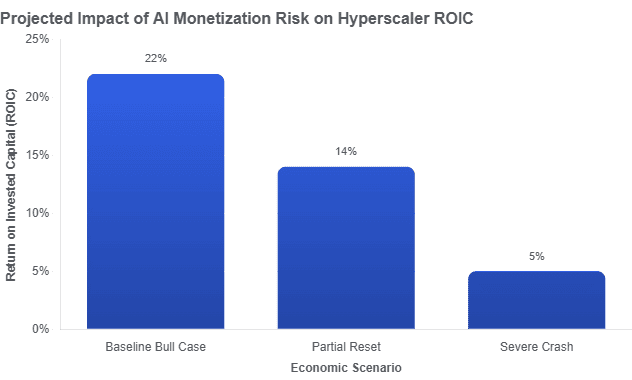
- Stranded Capital: The specialized power, liquid cooling systems, and electrical equipment tailored for dense AI clusters cannot easily be repurposed for traditional cloud workloads without lowering returns on invested capital (ROIC).
| Financial Metric | Baseline Forecast (Bull Case) | Partial Monetization Reset | Severe Crash / Structural Downside |
|---|---|---|---|
| Cloud Revenue Growth | Accelerated (driven by AI APIs & enterprise seats) | Flattens out as enterprise customers consolidate suppliers | Decelerates sharply; circular cloud revenue loops collapse |
| CapEx Infrastructure | Full execution of Dell’Oro’s ~200 GW build out by 2030 | 20–30% of capacity commitments deferred or resized | Mass cancellations of orders; multi-year build freezes |
| Operating Margins | Expands as inference costs decline relative to software prices | Compresses due to underutilized GPU clusters and high DCPI fixed costs | Severe contraction; massive asset write-downs and depreciation drag |
| ROIC | Historic highs driven by high-density compute demand | Diluted; longer payback periods for specialized data centers | Tanks; billions in stranded physical capital and obsolete hardware |
References:
https://www.nytimes.com/2026/08/10/business/ai-nvidia-lenders-500-billion.html
https://www.wheresyoured.at/dont-look-up/
Curmudgeon: Caveat Emptor: Huge Debt and Circular Financing Deals Dominate AI Build-Outs (07/23/26)
Merry-go-round of dog chasing its tail: Relationship between U.S. hyperscalers and private Gen AI companies
AI infrastructure spending boom: a path towards AGI or speculative bubble?
Expose: AI is more than a bubble; it’s a data center debt bomb
Will Google Cloud’s AI and data analytics revenue +TPU IP licensing income offset huge AI CAPEX to produce a decent ROI?
Amazon’s Jeff Bezos at Italian Tech Week: “AI is a kind of industrial bubble”
Big Tech AI spending binge results in massive job cuts!
AI spending boom accelerates: Big tech to invest an aggregate of $400 billion in 2025; much more in 2026!
FT: Scale of AI private company valuations dwarfs dot-com boom
Big tech spending on AI data centers and infrastructure vs the fiber optic buildout during the dot-com boom (& bust)
AI Data Center Boom Carries Huge Default and Demand Risks
Can the debt fueling the new wave of AI infrastructure buildouts ever be repaid?
Gartner: AI spending >$2 trillion in 2026 driven by hyperscalers data center investments
Will billions of dollars big tech is spending on Gen AI data centers produce a decent ROI?
11 thoughts on “Huge Risks for the proposed $500B AI Investments from Giant Wall Street firms”
Leave a Reply

AI revenues today are over concentrated in OpenAI and Anthropic, whose valuations are also very overstretched. Ed Zitron’s told Bloomberg, that OpenAI recorded a $20.9 billion loss in 2025. “Things are only getting worse,” he said on the podcast. But the collapse of these “unsustainable” companies, as he calls them, would reverberate throughout the economy simply because they continue to account for most of the AI business.
Glaring example of circular AI revenues: Microsoft buys and licenses core technology from OpenAI. Microsoft pays to use OpenAI’s advanced artificial intelligence models and intellectual property, integrating them directly into products like Microsoft Copilot and its Azure cloud ecosystem. Then OpenAI buys so much of Microsoft cloud services that it accounted for 69% of the growth at Microsoft’s intelligent cloud business last year.
YET WALL STREET ANALYSTS DON’T RECOGNIZE THIS? OR THE HUGE HYPERSCALER “OTHER INCOME” FROM MARKING UP ASSESSED VALUES OF OPEN AI & ANTHROPIC?
Current stock market valuations of the world’s biggest tech companies are now worryingly based on the ludicrous hopes surrounding Open AI and Anthropic (each valued at over $1T). The “Magnificent Seven” tech stocks are heavily invested in AI & now account for about a third of the S&P 500 Index’s total market capitalization.
–>Prepare for a MAJOR AI CRASH!
The circularity at the heart of AI investments is no longer a suspicion; it is the structure. Go to: https://www.fiendbear.com/Curmudgeon679.htm
Summary:
The hyperscalers are funding their AI buildouts with staggering leverage — more than $300 billion in debt raised year-to-date in 2026 alone, according to Bank of America Global Research, more than double last year’s $136 billion tally. Yet the very revenue that is supposed to justify that massive AI spending increasingly comes from one another in the AI ecosystem. For example:
· Nvidia sells chips to the cloud giants; the cloud giants, in turn, rent that compute back to the AI model developers; and the model developers, in turn, buy their capacity from the same hyperscalers. It is a closed loop, and a closed loop is not a business model.
· Microsoft has poured tens of billions into OpenAI and, in return, hosts the bulk of its compute on Microsoft’s Azure cloud. Approximately 65-70% of Azure’s AI cloud business revenue comes from OpenAI!
· Amazon and Google have done the same with Anthropic — Amazon alone committed up to $8 billion, with its chips and cloud the natural landing spot for Anthropic’s workloads which is the major part of those hyperscalers AI cloud revenue.
The pattern is uniform: the hyperscaler funds the AI model developer, the model developer buys back capacity from the hyperscaler, and both sides book the revenue. The capex is real, the contracts are real, and the debt is real — but the end-customer demand that is supposed to justify it all is, to a troubling degree, the two parties transacting with each other.
The article identifies a real and important underwriting problem: capital for AI infrastructure is becoming increasingly concentrated, interdependent, and potentially reliant on financing structures whose economics are not yet transparent. But it overstates several conclusions, blurs fact with scenario analysis, and uses overly certain, polemical language for a technically oriented publication.
The factual core of the piece is sound: Nvidia announced nonbinding memoranda of understanding with Apollo, BlackRock, Blackstone, Brookfield, Goldman Sachs and KKR to seek to mobilize “over $500 billion” of third-party capital over time for AI-compute infrastructure. Final agreements, individual commitments, underwriting terms, loss-sharing, leverage, tenor, collateral, and deployment timetable have not been disclosed. Calling this a financing target rather than $500 billion of already committed capital is exactly right.
The article also correctly focuses on the most consequential questions:
Whether AI service revenue, rather than investor-funded compute consumption, can support the combined cost of GPUs, facilities, power, networking, depreciation, and financing.
Customer and ecosystem concentration—particularly the disproportionate role of a few frontier labs in cloud demand.
The mismatch between long-dated project debt and shorter, technologically contingent economics of accelerators.
The possibility that securitization distributes AI-infrastructure risk without improving the quality or diversity of the underlying cash flows.
That framework is an effective extension of the May “merry-go-round” IEEE Techblog article: hyperscalers invest in AI labs; the labs commit to buy cloud capacity; the resulting cloud revenue and backlog support further capital expenditure and valuations; new funding helps the labs sustain their compute purchases. The new piece adds lenders and structured-credit investors as another transmission channel. That is a valid reflexivity/circularity risk, even if “circular revenue” should be used carefully.
The May article’s strongest contribution is exposing the combined valuation–cloud-revenue–capex feedback loop. There is substantiated evidence that investment gains in Anthropic materially affected reported earnings: Amazon’s Q1 filing states that net income included $16.8 billion of pre-tax gains from Anthropic investments, while its quarterly filing describes a $15.6 billion net gain mainly attributable to an observable-price adjustment on Anthropic preferred shares.
Similarly, reporting based on Microsoft disclosures states that Microsoft recorded $24.1 billion in fiscal-2026 revenue from commercial arrangements with OpenAI; estimates that this represented roughly 70% of Microsoft’s AI revenue are an inference based on estimated total AI revenue, not a Microsoft-reported percentage. The new article mostly handles this nuance better than the earlier piece, but should label it explicitly.
Bottom line: This is a timely, provocative, and directionally valuable article. Its best insight is that the marginal AI funding mechanism is becoming as important as the technology itself: vendor-adjacent financing, concentrated frontier-lab demand, rapidly changing compute assets, and potential securitization can make a capex correction more nonlinear.
The huge circular AI financial loop is very real! Cloud hyperscalers fund AI labs, which in turn are contractually obligated to use that capital to purchase services back from the same cloud providers. This cycle inflates market growth through artificial revenue booking and equity revaluation, threatening a “correlated unwind” if end-user AI demand fails to justify the investment.
Here is what the AI cheerleaders and pundits miss:
1. Hyperscaler’s concentration on OpenAI and Anthropic. From AI critic Ed Zitron: “70% or more of the AI revenues of Microsoft, Google, and Amazon were from either OpenAI or Anthropic. UBS estimated that next year, Anthropic and OpenAI’s compute spend would be 48% of all Google Cloud revenues — which means that they likely account for even more than 70% of its AI revenues.”
2. Recirculating/vendor financing deals, e.g. Microsoft pays to use OpenAI’s advanced artificial intelligence models and intellectual property, integrating them directly into products like Microsoft Copilot and its Azure cloud ecosystem. Then OpenAI buys so much of Microsoft cloud services that it accounted for 69% of the growth at Microsoft’s intelligent cloud business in 2025. Many of these deals are consummated with borrowed money, e.g. Oracle
3. Hyperscaler “other income” is actually private equity markups from their investments in OpenAI and Anthropic + smaller AI companies:
Nearly half of Alphabet’s (Google) record $62.6 billion profit—about $28.7 billion—did not come from search ads, cloud services or any of its products at all. It came from Alphabet updating the value of the equity it owns in private AI companies, primarily Anthropic. Alphabet holds a 14% stake before the announcement of an additional $40 billion commitment last week.
Amazon’s earnings release stated that first-quarter net income “includes pre-tax gains of $16.8 billion included in non-operating income from our investments in Anthropic”—more than half of Amazon’s pre-tax income (or profit) for the quarter.
-Alphabet and Amazon generated “other income” totaling $53 billion in Q1 2026, which accounted for nearly 60% of those two companies’ total net income in Q1 and 34% of the total $155 billion in income this quarter. Of this $53 billion in “other income,” $49 billion was explicitly due to equity stakes in private AI companies.
-Microsoft reported “only” $942mn of other income in the first three months of the year, but this line item has now made $7.2bn over the past nine months.
https://techblog.comsoc.org/2026/05/13/merry-go-round-of-dog-chasing-his-tail-relationship-between-u-s-hyperscalers-and-private-gen-ai-companies/
From Light Reading’s Iain Morris:
Between them, OpenAI and Anthropic are widely believed to have racked up losses worth tens of billions of dollars, lacking the revenues to cover their exorbitant spending on AI infrastructure. Google Cloud is reckoned by UBS to generate 27% of its revenues from the two companies. For the most recent four quarters, that would equate to about $21 billion. Next year, the figure is projected to hit 48%.
Google, however, is effectively paying Anthropic to buy its cloud services. In April, the hyperscaler confirmed plans to pump an additional $40 billion into the loss-making startup after earlier investments. This incestuous arrangement is an extreme version of the money-go-round in which the cash exchange between Google and Anthropic ignores any broader economic realities. To Ed Zitron, the CEO of market research company EZ Primary Research, it makes both OpenAI and Anthropic appear unsustainable. “They have to grow so very large to make AI pay off because otherwise there just isn’t demand for compute at scale,” he told a recent Bloomberg podcast.
The hyperscalers cite growing AI demand to justify their own outrageous levels of capital expenditure, forecast by Google to hit $200 billion this year. Spending naturally goes on Nvidia’s graphics processing units (GPUs), the powerful chips that train the LLMs.
The risk, by then, is that the dominoes will have already started to fall, triggered by the toppling of OpenAI, Anthropic or both. As the AI demand generated by the two companies evaporates, the hyperscalers will no longer be able to maintain such high levels of capital expenditure. Spending cuts will be felt by Nvidia, Cisco and others. They will also ripple through the broader AI economy and lead other organizations to scale back investment.
Ripple effect
AI’s evangelists naturally dismiss talk of a bubble, just as former Cisco CEO John Chambers continued to preach about a “new era of computing” in the run-up to the dotcom bust. Yet the increasingly wild antics and unhinged views of AI’s architects seem to betray some desperation.
AI software has been unleashed to hack into companies, without being given that explicit order by a human, as if this proves it is God-like. Sam Altman, OpenAI’s CEO, reportedly thinks the “singularity” has arrived. Elon Musk, SpaceX’s founder, predicts AI will render money obsolete in a few years. Before then, SpaceX managed to find nearly $24 billion to invest in AI-related capital expenditure for the first half of this year, almost twice what Musk’s company earned in total sales.
Robbins could not resist slipping the “super cycle” expression into his remarks or linking that other revenue growth to AI. Telcos, he said, are buying Cisco’s products because “network traffic related to AI-based scale-across versus traditional data center interconnect is roughly 14 times what it might have been before.”
https://www.lightreading.com/ai-machine-learning/cisco-must-steel-itself-for-the-coming-ai-bust
WSJ on private equity markups by S&P 500 companies-“a big chunk of the earnings consisted of paper gains from marking up equity investments in other companies.”
Last quarter, “other income” at Amazon.com AMZN -0.48%decrease; red down pointing triangle and Alphabet GOOGL -0.38%decrease; red down pointing triangle, Google’s parent company, totaled roughly $121 billion combined after taxes, almost all of it from investment gains. Alphabet’s portion is on track to represent about 10% of second-quarter earnings for the S&P 500, and Amazon’s share another 5%, according to a Wall Street Journal analysis.
Other income was 71% of Alphabet’s quarterly profits and 66% of Amazon’s. Alphabet’s mark-to-market gains came from revaluing equity holdings, which include SpaceX and Anthropic, the artificial-intelligence developer behind Claude. Amazon’s markups primarily arose from its stake in Anthropic.
Those investment gains are part of net income under GAAP, or generally accepted accounting principles. But nobody trying to assess the valuations at Alphabet or Amazon should be placing a market multiple on them. These are unrealized paper profits, and they are inherently nonrecurring. Even including these gains, the S&P 500 looks expensive at about 27 times trailing earnings. The historical average is about 16 times.
The problem isn’t just financial cosmetics. It’s utter inconsistency. Wall Street lacks a unified approach for investment markups. Last quarter, Nvidia NVDA 0.03%increase; green up pointing triangle steered analysts to exclude them, so they did. Alphabet and Amazon didn’t, so analysts fell right in line.
That strength makes accounting numerology all the more absurd. When markets trade near historical highs, investors need clear signals about operating strength, not bespoke metrics designed to help management beat consensus estimates.
Counting gains in volatile equities when they go up while subtracting everyday operating costs isn’t analysis. It’s marketing, which of course is what Wall Street is all about. Investors beware.
https://www.wsj.com/finance/stocks/the-121-billion-in-one-time-gains-boosting-big-techs-profits-5d2201da
THE AI BUBBLE IS ACTUALLY SMOTHERING AMERICAN GROWTH
The ubiquitous belief is that AI is boosting growth. From our vantage point, that’s a total inversion of the truth. It hinges on first-order, nominal spending only, without following that spending through the economy or financial pipes. It doesn’t take account of where it goes (i.e. imported goods and commodities), whether it’s real or nominal, or its inflationary and capital-consumptive effects. It doesn’t factor the consequent crowding out of everything else, especially everything else debt-funded and interest-rate sensitive (such as the entire rest of the American economy). AI is currently a net negative to growth, and a bonfire of cash (at least up front) at a time when liquidity and real incomes are already contracting. That mix is – at least right now – sucking the rest of the economy dry. For the top branch of the K-shaped economy to exist, the bottom branch must also exist. They aren’t separate phenomena.
It’s not mechanically possible for AI to scale returns as priced in, over the priced-in timeline. We’re not asserting this as mere opinion – it’s inescapable because at the end of the cycle, available (physical) resources are depleted, no matter how many dollars are printed or borrowed. Further spending simply creates inflation, keeps rates up, and squeezes real income. This explains the memory and broader commodity price moves. Every dollar of AI spending in this zero-sum situation crowds out a dollar of potential demand one-for-one. So AI will accelerate the recession before it can generate revenue, because AI-related activity is smothering its own potential customers. Normally, capex aims to increase the supply of things already in strong demand, thereby alleviating economic tightness down the road. But emerged out of a weak economy…and isn’t responding to any demand signal at all (which is why none of it is financed out of revenue). It isn’t building any physical supply of goods or commodities to increase economic runway – just compute. And most of the spending flows abroad, via imports. So it crowds out domestic income and ships it to other economies. In other words, it’s currently a net drain and a productivity drag, which is why it’s also inflationary, not deflationary. So it’s a no from us on the “deflationary productivity boom” narrative. There’s no capex on the horizon that will bring down the cost of real tangible things, so it’s hard to see how non-inflationary demand returns.
► Just to be clear – technological change has been enormously, incredibly beneficial over the long run. None of this is to say whatever gets built won’t be used, or helpful, or productive in the future. But that’s always going to be true no matter what – whether it gets used doesn’t speak to whether it is positive RoI, or whether that capital was put to its best possible use relative to others. This seems more uncertain than most in that respect, because most technology comes in response to a given identifiable problem, there’s at least some indication of a clear use case upfront, and some demand and cashflow funding it. It was clear to everyone how railroads would benefit them. AI is, if anything, scaring people, rightly or wrongly. And they’re also aware that it’s already costing them income.
https://x.com/TotemMacro/status/2085335558004392317?mc_cid=aca16efffc&mc_eid=5917efd771
Hyperscalers are using off balance sheet loans to partially finance their AI buildouts. From the FT:
Goldman Sachs analysts had scoured through the footnotes of the hyperscalers’ regulatory filings and counted $1.5tn of AI lease commitments, of which $1tn hadn’t started yet and therefore didn’t appear in their financial accounts as conventional liabilities. As those analysts obliquely noted:
From a credit perspective, this treatment can understate leverage and future liquidity needs as these obligations are eventually recognised and contractual payments come due.
We also threw in an interesting titbit from an earlier Morgan Stanley report from July, which also toted up the purchase commitments of Alphabet, Microsoft, Amazon, Nvidia and Oracle. These are typically contractual obligations to buy chips, compute, electricity to power data centres, and other equipment, and came to another $982bn at the end of the first quarter.
Alphabet itself says that $200bn of its purchase commitments are “short-term”. Looking at the details of its 10-Q filing it appears that the vast majority of the overall payment liability consists of commitments to secure chips and power for the data centres that the company is building:
“We have contractual obligations from contracts with remaining terms greater than one year primarily consisting of certain long-term supply agreements to secure future production capacity for technical infrastructure and inventory components. In addition, we have commitments for certain energy service agreements to secure energy for data center usage, and certain content licensing agreements.”
“As of June 30, 2026, expected future fixed or guaranteed commitments under these agreements were $707.0 billion, the significant majority of which related to long-term supply agreements. We expect contractual commitments under the long-term supply agreements and content licenses to generally be fulfilled through 2030. The energy service agreements include terms ranging from two to 26 years, with obligations through 2054, and generally include take-or-pay provisions for minimum quantities of energy supply and substantive termination fees.”
The balance between the $707bn and the top-line $811bn figure appears to consist of various financial guarantees and other credit backstops (which might not materialise) and a $20bn investment promise to “a private company contingent upon the achievement of specified operational and financial milestones through 2030”, which presumably is Anthropic.
Beyond Alphabet’s eye-catching increase, Meta’s purchase commitment increase was biggest, jumping from $238bn at the end of March to $349.3bn at the end of June.
https://www.ft.com/content/1fbe47a6-bbf1-4de1-973b-8ce5baea591d
The “Growth Engine” Factor: This massive AI spending is heavily propping up national economic growth numbers. In recent quarters, AI-related investments alone accounted for over 25% of total U.S. GDP growth. When the broader economy was softening, massive tech capital expenditures artificially kept the headline GDP expansion floating at a stable annualized rate.
Unlike the 1990s telecom boom, which was distributed across hundreds of highly indebted startups, today’s massive AI spending footprint is overwhelmingly driven by an oligopoly of massive, cash-rich tech giants—principally Microsoft, Amazon, Alphabet, and Meta. ALSO the 2 heavyweight AI startups-Open AI and Anthropic!
Hyperscaler Debt & Capex Projections (2026–2027)
-2026 Debt Issuance: Projected between $220 billion and $250+ billion for major US hyperscalers (Alphabet / Google, Amazon, Meta, Microsoft, and Oracle), with broader AI-related market debt reaching up to $570 billion.
-2027 Forecast: Goldman Sachs projects direct hyperscaler debt issuance to nearly double to around $400 billion (Jeff Pu estimates $419 billion) as companies finance over a third of their infrastructure needs.
-Aggregate Capex: Combined capital expenditures are expected to hit roughly $940 billion in 2026 and scale past $1.3 trillion in 2027. Market Share: Hyperscaler investment-grade bond sales have jumped from roughly 2% of total U.S. supply (2022–2024) to roughly 9% in 2026. Credit Impact: Credit spreads on a 10-year hyperscaler credit basket have widened from historical 40–75bp ranges toward 90bp+, driven by leverage concerns.
-Cash Flow Outlook: S&P Global Ratings expects all major hyperscalers to run negative free operating cash flow through 2026 and 2027, with a cash-flow inflection point not projected until 2028–2029