

AI Investments
AI Debt Wave Implications: Higher interest rates with enormous AI sales required for ROI
Executive Summary:
Artificial Intelligence (AI) debt fueled infrastructure buildouts have become a broad fixed-income-market supply shock. The Wall Street Journal reports that 49% of new investment-grade bond issuance year to date in 2026 has been AI-linked—a figure that underscores how the financing of data centers, compute infrastructure and supporting power systems is reshaping bond market fundamentals and technical factors.
As the supply of long-dated bonds rises, prices fall and yields rise until investors are compensated enough to absorb them. The AI buildout is adding enormous corporate debt from hyperscalers, data-center developers, semiconductor and networking suppliers, and utilities—while also driving public borrowing for grid, power, water and transportation infrastructure. This is putting upward pressure on yields across Treasuries, corporate bonds and municipal debt. This heavy concentration of long-dated supply creates a crowding-out effect that forces non-AI issuers to compete against elevated benchmark yields and potentially stifles broader economic growth, especially for companies not involved in circular AI funding deals (see References).
AI is capital intensive (see Table 1. below). Building data-center capacity requires cash not only for GPUs and servers, but also for land, buildings, fiber, networking, cooling, power procurement, backup generation, substations, transmission and water systems. The major hyperscalers can fund part of that investment from cash flow, but they are also issuing lots of new bonds and notes to preserve liquidity and accelerate buildouts. Their suppliers, data-center partners and power providers are doing the same. Much of this borrowing is long dated—exactly where the Treasury is issuing heavily to finance federal deficits.
The result is an expanding pool of long-duration debt competing for the same institutional buyers: insurers, pension funds, mutual funds, banks, foreign investors and asset managers. When those buyers do not increase their allocations at the same pace as supply, issuers must offer higher yields. Here’s the flow chart that loops around indefinitely until there is an AI crash!:
More AI related bond supply→lower prices→higher yields→higher term premium for U.S. Treasuries→higher budget deficits to finance the increased debt→more bond supply→etc.
……………………………………………………………………………………………………………………………………………………………………………………………………………………………………………………………………………….
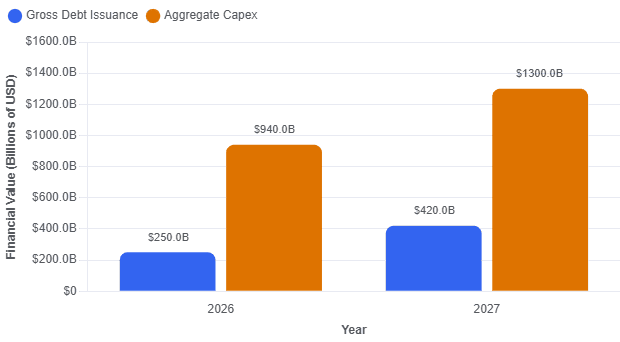
- 2026 Debt Issuance: Projected between $220 billion and $250+ billion for major US hyperscalers (Alphabet / Google, Amazon, Meta, Microsoft, and Oracle), with broader AI-related market debt reaching up to $570 billion.
- 2027 Forecast: Goldman Sachs projects direct hyperscaler debt issuance to nearly double to around $400 billion (Jeff Pu estimates $419 billion) as companies finance over a third of their infrastructure needs.
- Aggregate Capex: Combined capital expenditures are expected to hit roughly $940 billion in 2026 and scale past $1.3 trillion in 2027.
- Market Share: Hyperscaler investment-grade bond sales have jumped from roughly 2% of total US supply (2022–2024) to roughly 9% in 2026.
- Credit Impact: Credit spreads on a 10-year hyperscaler credit basket have widened from historical 40–75bp ranges toward 90bp+, driven by leverage concerns.
- Cash Flow Outlook: S&P Global Ratings expects all major hyperscalers to run negative free operating cash flow through 2026 and 2027, with a cash-flow inflection point not projected until 2028–2029.
Hyperscaler Funding Boom: Debt vs. Capex Projections (2026–2027):
Source: Google Gemini
……………………………………………………………………………………………………………………………………………………………………………………………………………………………………
Corporate Borrowing Negatively Impacted by AI Debt Financing:
Corporate bonds face the most direct effect. When hyperscalers, data-center operators, chip suppliers and utilities all enter the fixed income market at once, they compete for investor capital and dealer balance sheets.
The bond market adjusts through the following mechanisms:
- Larger new-issue concessions, meaning issuers must offer higher yields than comparable bonds already trading.
- Lower prices for outstanding corporate bonds as investors sell them to make room for new issues.
- Wider credit spreads, particularly for lower-rated investment-grade borrowers.
- Higher borrowing costs for non-AI companies that must compete with AI-linked supply for investor allocations.
The pressure is not limited to companies directly building AI agents or systems. A telecom operator, industrial firm, REIT or consumer company will likely pay more to borrow because investors can buy a new, liquid, highly rated hyperscaler bond at a potentially higher and attractive yield. That discourages non-AI corporate borrowing and leads to slower economic growth.
………………………………………………………………………………………………………………………………………………………………………………………………
AI Pain Points Personified:
1. Ares reports, “We documented well more than 100 digital-infrastructure financings from just the past twelve months… Despite different issuers, different structures, different rating agencies and different credit markets, all of the risk converges on just eight (AI tech) names: Meta, Oracle, Microsoft, Amazon, Google, Nvidia, and, on a look-through basis, OpenAI and Anthropic.”
2. Analysts at Goldman Sachs Group and elsewhere have calculated that more than $1 trillion has already been spent on the data center build-out since the launch of ChatGPT in late 2022. Presumably, other large American businesses would need to pay for AI tools to justify all of this investment. That money needs to come from somewhere. but who’s going to pay for those AI tools?
3. From Greg Ip of the WSJ: “Will America Spend 9% of Its GDP on AI? The Industry Is Counting on It“:
“Is it plausible that Americans will spend as much of their income on this one technology as they do on food? Roughly twice what the nation pays for all forms of energy or all computers and software? Seven times what consumers spend on phone, streaming, and internet services combined?”
“You should be skeptical. Even the most transformative inventions eventually run into the law of diminishing returns: each additional dollar a user spends yields less additional productivity (or enjoyment) than the last. That imposes a natural ceiling. The question, of course, is where that ceiling is. Whether or not you think 9% of GDP is right, you have to care, because this figure isn’t some fever dream: it is implicit in the dollars that investors and companies are committing right now.”
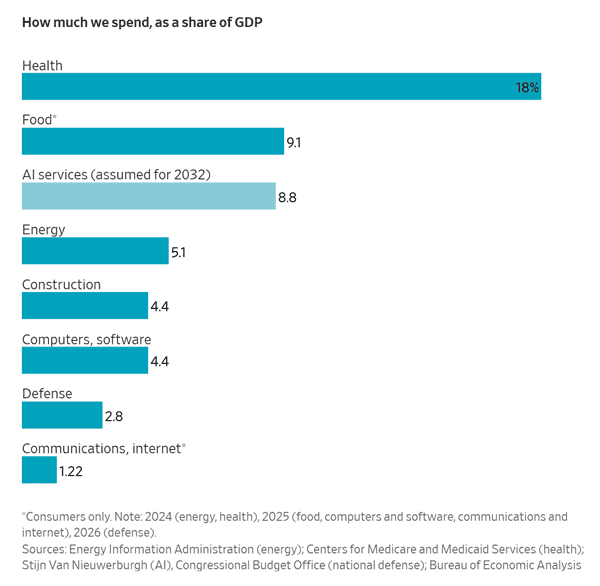
Chart Credit: Greg Ip, Wall Street Journal
………………………………………………………………………………………………………………..
Dire Warnings:
Nobel laureate Daron Acemoglu writes about “Distorted Intelligence at the AI Frontier” (emphasis added):
“The real problem for the frontier AI labs is not that their models are too powerful and already “misaligned” with the goals their creators set for them. Rather, it is that the models are being trained in ways that may be leading to a type of intelligence that will become less predictable. AI frontier labs are training their models in ways that may be leading to a type of distorted intelligence.
“This is what I mean by distorted intelligence. If my suspicion is correct, what we are dealing with is not a model racing toward superintelligence, but a brittle house of cards that becomes more and more likely to malfunction and collapse as we demand more from it.”
Conclusions:
The above analysis outlines critical structural risks and concerns directly related to the AI infrastructure (capex) spending boom. It references several articles which highlight the risks of circular financing loops where hardware suppliers (like Nvidia and Broadcom) fund their buyers (like Anthropic and Open AI). Additionally, hyperscalers face structural cash deficits with negative free operating cash flows projected through 2027, alongside rising sovereign risk and potential conflicts of interest from intertwined debt and leasing arrangements. This table balances the author’s views with a counter-perspective:
| IEEE Techblog Warning | The Nuanced Counter-Perspective |
|---|---|
| Circular Funding Risk: Massive vendor lending deals (like Broadcom lending Anthropic $42 billion) are artificially inflating revenue and building a brittle house of cards. | Balance Sheet Cushion: Unlike the 2000 Dot-Com crash where telecom infrastructure was built on speculative, junk-rated leverage, 2026 hyperscalers possess massive cash-generative core businesses (search, cloud, e-commerce) to subsidize their debt service even if AI returns are delayed. |
| Diminishing Returns: Society cannot plausibly spend 9% of GDP on AI, meaning demand will hit a hard ceiling and spark a debt bust. | Productivity Deflation: AI infrastructure spending may not need to justify itself through direct “software sales.” If the technology lowers the baseline operating costs of the global services economy, the ROI manifests as structural corporate margin expansion rather than retail sales. |
………………………………………………………………………………………………………………………………………………………………………………………………
References:
Curmudgeon: Caveat Emptor: Huge Debt and Circular Financing Deals Dominate AI Build-Outs (07/23)
Broadcom lending Anthropic up to $42 billion in yet another AI circular financing deal
Bain & Co: AI Infrastructure Buildout Will Require $6 Trillion Revenue by 2031 to Support Massive CAPEX
The AI Infrastructure Build-Out: A $10 Trillion Bet on Compute, Power, and Networks
Nvidia CEO Huang: AI is the largest infrastructure buildout in human history; AI Data Center CAPEX will generate new revenue streams for operators
AI risks and backlash increase; Recap of the circular loop of fake AI profits and hyperscaler markups of private AI companies
China vs U.S.: Race to Generate Power for AI Data Centers as Electricity Demand Soars
How will fiber and equipment vendors meet the increased demand for fiber optics in 2026 due to AI data center buildouts?
Expose: AI is more than a bubble; it’s a data center debt bomb
Will billions of dollars big tech is spending on Gen AI data centers produce a decent ROI?
Huge Risks for the proposed $500B AI Investments from Giant Wall Street firms
Can the debt fueling the new wave of AI infrastructure buildouts ever be repaid?
The AI Infrastructure Build-Out: A $10 Trillion Bet on Compute, Power, and Networks
Introduction:
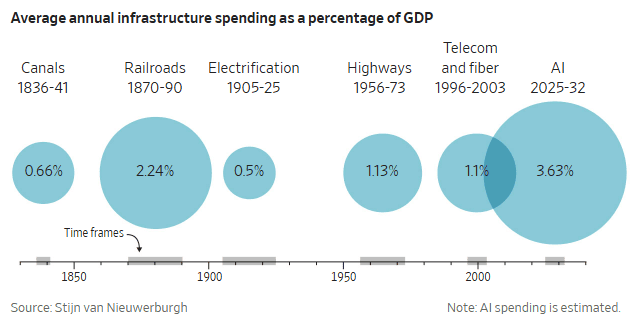
According to the Wall Street Journal, the AI build-out is rapidly becoming the largest concentrated infrastructure investment cycle in modern American economic history. Unlike earlier national build-outs—railroads, interstate highways, electrification, or the commercial internet—this cycle is being driven largely by a small group of cloud platforms deploying highly specialized compute, networking, power, cooling, and semiconductor infrastructure at unprecedented speed. Economist Stijn van Nieuwerburgh estimates that U.S. spending on data centers and related AI infrastructure could reach $10.3 trillion [1.] between 2025 and 2032, equivalent to an average of 3.6% of annual GDP. The estimate encompasses far more than conventional enterprise data centers: it reflects the industrial-scale infrastructure needed to train and serve frontier AI models, including GPU and accelerator clusters, high-bandwidth memory, advanced packaging, optical interconnects, high-capacity Ethernet and InfiniBand fabrics, grid interconnection, substations, backup generation, liquid cooling, and long-haul fiber connectivity.
Note 1. The $10.3 trillion number is a scenario-based estimate of U.S. AI infrastructure investment during 2025–2032—not a forecast of announced corporate spending. The Brookings analysis behind it assumes that about 183 GW of new data-center capacity will be completed through 2032, versus a 509-GW announced/planned pipeline. A representative 200-MW AI campus is estimated to cost about $8.2 billion: $5.6 billion for IT equipment, $2.2 billion for the facility, and $0.4 billion for power infrastructure. Thus, most of the investment is in compute and networking hardware rather than buildings.
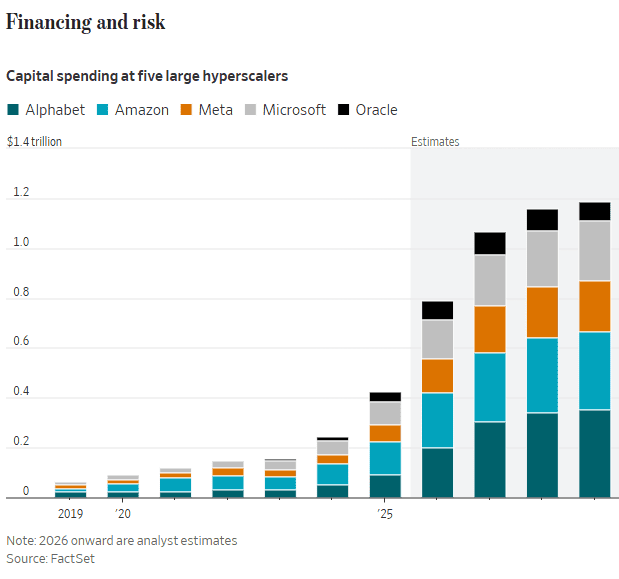
The scale creates a major financing challenge: the five largest hyperscalers are projected to spend about $800 billion on capex in 2026, exceeding their combined operating cash flow. Under the Brookings assumptions, the resulting infrastructure would need roughly $3.7 trillion of annual revenue by 2032 to produce a 10% unlevered return. The key economic issue, therefore, is whether future AI revenue and utilization can justify the enormous capital investment.
From Cloud Data Centers to AI Factories:
The defining characteristic of this AI buildout investment cycle is its concentration. The five U.S. hyperscalers (Alphabet, Amazon, Meta, Microsoft, and Oracle) are collectively expected to invest roughly $4.2 trillion in capital expenditures during the four years ending in 2029, according to FactSet estimates cited in the source material. Increasingly, this capital is directed toward AI-optimized facilities: campuses designed around megawatt-scale accelerator pods, dense GPU clusters, high-radix network fabrics, and power delivery systems capable of supporting workloads whose energy and cooling profiles differ sharply from those of traditional cloud computing.
Those five major hyperscalers increased combined capital expenditures from approximately $97 billion in 2020 to more than $400 billion in 2025, with the paper projecting approximately $800.5 billion in 2026. That 2026 figure is significant because it exceeds their combined operating cash flow of approximately $707.1 billion. In other words, projected capex is about 113% of operating cash flow. Pacific Software Ventures That creates a MAJOR financing problem: AI infrastructure investment is becoming too large to be financed entirely from hyperscaler internally generated cash.
AI infrastructure is not simply an expansion of conventional cloud capacity. Large-model training and inference create a distinct systems-engineering problem. Training AI frontier foundation models requires thousands to hundreds of thousands of tightly coupled accelerators. Those accelerators must exchange model parameters, activation data, and gradients at extremely high rates. Network performance therefore becomes a first-order determinant of usable compute capacity. A GPU cluster can deliver poor economics if its fabric introduces congestion, latency, packet loss, or inadequate bisection bandwidth during distributed training.
That requirement is accelerating deployment of:
-
GPU- and AI-accelerator servers with high-bandwidth memory and advanced semiconductor packaging.
-
High-speed scale-up interconnects within accelerator nodes and scale-out fabrics across clusters.
-
400 GbE, 800 GbE, and emerging 1.6 TbE Ethernet architectures, along with InfiniBand deployments for tightly coupled training environments.
-
Optical transceivers, co-packaged optics research, photonic switching, and expanded fiber density within and between data-center campuses.
-
AI-aware workload scheduling, distributed storage, data pipelines, checkpointing systems, and network telemetry.
-
Direct-to-chip liquid cooling, rear-door heat exchangers, chilled-water systems, and other thermal-management systems required by high-density AI racks.
-
New transmission lines, substations, transformers, gas generation, battery systems, and other power infrastructure needed to support multi-hundred-megawatt and gigawatt-scale campuses.
In effect, hyperscalers are building what are increasingly described as AI factories: integrated physical and digital production systems that convert electricity, capital equipment, data, and semiconductor capacity into trained models, inference tokens, and AI-enabled cloud services.
A Historically Large Capital Concentration:
AI investment is projected to reach 1.9% of U.S. GDP in 2026, according to Goldman Sachs estimates cited in the source material. The late-19th-century railroad boom was the last period in which a single new infrastructure category represented a larger share of the U.S. economy.
The comparison is useful, but incomplete. Railroads connected physical markets over decades. The AI build-out is being deployed on a far more compressed timetable and is dependent on global supply chains for leading-edge accelerators, high-bandwidth memory, advanced substrates, optical components, power equipment, and data-center construction capacity.
This creates a reinforcing investment loop:
-
Foundation-model developers require more compute to train larger or more capable models.
-
Cloud providers build additional accelerator capacity to support training and inference demand.
-
Semiconductor vendors, memory suppliers, networking companies, optical-component manufacturers, and power-equipment suppliers expand production.
-
Data-center developers secure land, power contracts, grid interconnections, fiber routes, water or cooling capacity, and financing.
-
Enterprises adopt AI services, increasing inference demand and reinforcing hyperscaler investment.
The strategic question is whether revenue from AI applications, enterprise subscriptions, API usage, advertising optimization, software agents, automation, and industry-specific deployments will scale fast enough to justify the capital intensity of the underlying infrastructure.
Financial and Infrastructure Risks:
The scale of investment introduces material financial-system risk. A growing portion of AI-related infrastructure is being financed through debt, including special-purpose entities and off-balance-sheet structures that may have limited public disclosure. These structures can allow technology companies and infrastructure developers to finance data-center construction, equipment purchases, and long-term capacity commitments without placing all obligations directly on corporate balance sheets.
That can be economically rational when capacity utilization is high and long-term AI demand is durable. However, it also creates exposure if expected AI revenues, cloud bookings, or accelerator utilization fail to materialize.
The central risk is not merely that an individual model underperforms. It is that a synchronized reduction in AI capital expenditure could affect multiple interconnected sectors at once:
-
Data-center developers and construction firms.
-
Semiconductor, memory, storage, and server suppliers.
-
Optical networking and switching vendors.
-
Utilities, independent power producers, and grid-equipment manufacturers.
-
Banks, private-credit funds, infrastructure lenders, and equipment-finance providers.
-
Commercial real-estate markets in data-center-heavy regions.
A sudden pause in hyperscaler spending would therefore have broader consequences than a typical technology downcycle. It could reduce orders across a deeply interdependent industrial supply chain while exposing leveraged infrastructure vehicles to weaker cash flows.
IT Product Inflation, Power, and Network Capacity:
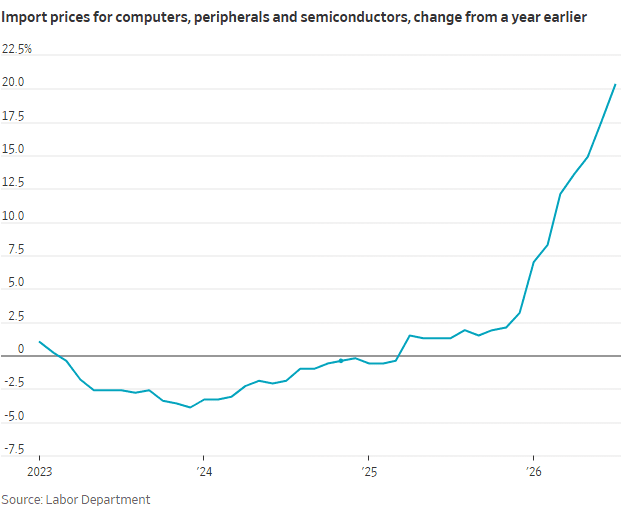
The AI build-out is also creating supply-side pressure in strategic technology markets. Demand for data-center equipment—especially memory, advanced semiconductors, servers, optics, and power-delivery equipment—has tightened supply and raised costs. The source material notes that prices paid by importers for computers, peripherals, and semiconductors were 20% higher in August than a year earlier.
That inflation can propagate beyond the data center. Higher component prices can increase the cost of consumer electronics, including smartphones, PCs, gaming systems, and storage products. Enterprises may also face higher prices for servers, networking equipment, cloud services, and AI-enabled software.
Power is an equally important constraint. AI data centers concentrate demand geographically, often creating large and relatively inflexible new loads on regional grids. A single large campus may require hundreds of megawatts, while the next generation of AI campuses could require gigawatt-scale capacity. This is driving demand for new generation, transmission capacity, substations, transformers, energy storage, and grid-management technologies.
The result is a collision between digital infrastructure planning and energy-system planning. Data-center capacity is no longer determined primarily by real estate, fiber connectivity, or server availability. In many markets, the gating factor is now the ability to obtain firm power, complete interconnection studies, procure transformers and switchgear, and finance new grid infrastructure.
Conclusions:
For IEEE Techblog readers, the central issue is not whether AI demand is real. It is whether the industry can build an economically sustainable, energy-efficient, resilient, and interoperable infrastructure stack at the required scale.
That challenge spans multiple engineering domains:
-
Semiconductor architecture, packaging, memory bandwidth, and energy efficiency.
-
Data-center electrical design, cooling, rack density, and operational resiliency.
-
High-performance networking, congestion control, optical interconnects, and distributed-system design.
-
AI software optimization, including model efficiency, quantization, sparsity, scheduling, and inference optimization.
-
Grid integration, power electronics, demand response, and energy-aware workload placement.
-
Security, supply-chain assurance, and operational management across increasingly autonomous infrastructure.
The AI boom may indeed become the defining infrastructure investment cycle of this era. Its long-term success, however, will depend less on headline capital-expenditure totals than on whether the industry can translate massive spending on accelerators and data centers into durable productivity gains, commercially viable AI services, and infrastructure that does not impose unsustainable costs on power systems, supply chains, consumers, or the financial sector.
………………………………………………………………………………………………………………………………………………
References:
Dell’Oro: Data Center capex grew 92% in 2Q-2026 (caveats galore)
Dell’Oro: 2H2026 Data Center Capex to Accelerate due to massive AI Deployments
PwC: Global AI data center spending to hit $31.6tn by 2050; Role of full stack orchestration layer explained
Nvidia CEO Huang: AI is the largest infrastructure buildout in human history; AI Data Center CAPEX will generate new revenue streams for operators
AI risks and backlash increase; Recap of the circular loop of fake AI profits and hyperscaler markups of private AI companies
China vs U.S.: Race to Generate Power for AI Data Centers as Electricity Demand Soars
How will fiber and equipment vendors meet the increased demand for fiber optics in 2026 due to AI data center buildouts?
Expose: AI is more than a bubble; it’s a data center debt bomb
Will billions of dollars big tech is spending on Gen AI data centers produce a decent ROI?
Huge Risks for the proposed $500B AI Investments from Giant Wall Street firms
Can the debt fueling the new wave of AI infrastructure buildouts ever be repaid?
Bain: AI to greatly increase network operator expenses; network re-engineering needed!
Introduction by Bain:
“Over the next three to five years, the operating cost structure used by telecom operators is likely to undergo one of the most significant shifts in decades. As AI agents become embedded across customer care, network operations, software engineering, and enterprise functions, tokens will account for a growing share of operating expenditures.”
Key Points:
- Unless telcos proactively manage their costs, scaling up AI will simply add expenses to an already-heavy legacy base.
- An agentic operating model is emerging: a 70-to-30 ratio of legacy to AI costs, with AI automating or augmenting work across processes.
- Cost traps lurk: cheaper AI models, bigger bills; bolting AI onto legacy processes; and demos mistaken for transformation.
- Telco leaders can take five key actions today to avoid the traps.
Executive Summary:
Telecom operators are extending AI agents across network operations as they pursue higher levels of autonomy, but the shift could introduce a significant new operating-cost burden unless legacy processes, tooling and organizational structures are retired alongside the automation, according to Bain & Company.
Bain’s warning comes as operators accelerate plans for autonomous networks. TM Forum reported in June that 81% of 80 surveyed operators are targeting Level 4 autonomous networks or higher by 2030, and 20% expect to reach that threshold by 2027.
Under TM Forum’s Autonomous Networks framework, Level 4 moves beyond rule-based or preconfigured automation toward closed-loop, intent-driven decision-making within defined network domains. Current Level 4 work includes deployment of closed-loop operations in production networks, agent-based operating architectures, and metrics intended to quantify the operational and business value of autonomous-network use cases.
-
- Lagging Returns: According to Bain’s Automation and AI Pathfinder Survey, nearly 40% of companies saw AI cost savings land below 10%.
- Growing Budgets: Despite missing initial savings targets, 90% of these companies are still increasing their AI budgets.
- Autonomous Agents: Only 7% of companies currently run fully autonomous AI agents in production. Data access remains the top barrier to progress.
- AI Summaries: Bain’s research on Zero-Click Search shows that 80% of consumers rely on AI-written results for at least 40% of their searches.
- Fewer Clicks: About 60% of searches now end without the user clicking through to another website. This shift reduces organic web traffic by 15% to 25%.
Bain estimates that AI agents and associated token consumption could represent 20% to 30% of a telecom operator’s operating-cost base within the next three to five years, leaving conventional operating costs at 70% to 80%.
As AI spending rises, telcos risk increasing total costs without generating proportional gains in productivity or growth.
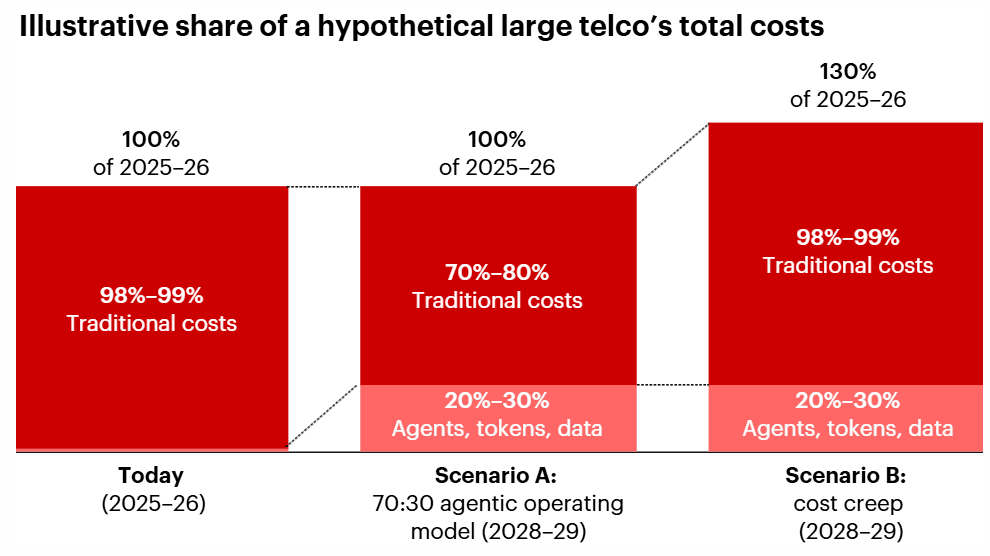
Notes: Illustration doesn’t incorporate absolute value changes; traditional costs are fully loaded, including costs from traditional software-as-a-service and cloud infrastructure, agency/outsourcing, depreciation, and more. Source: Bain estimates
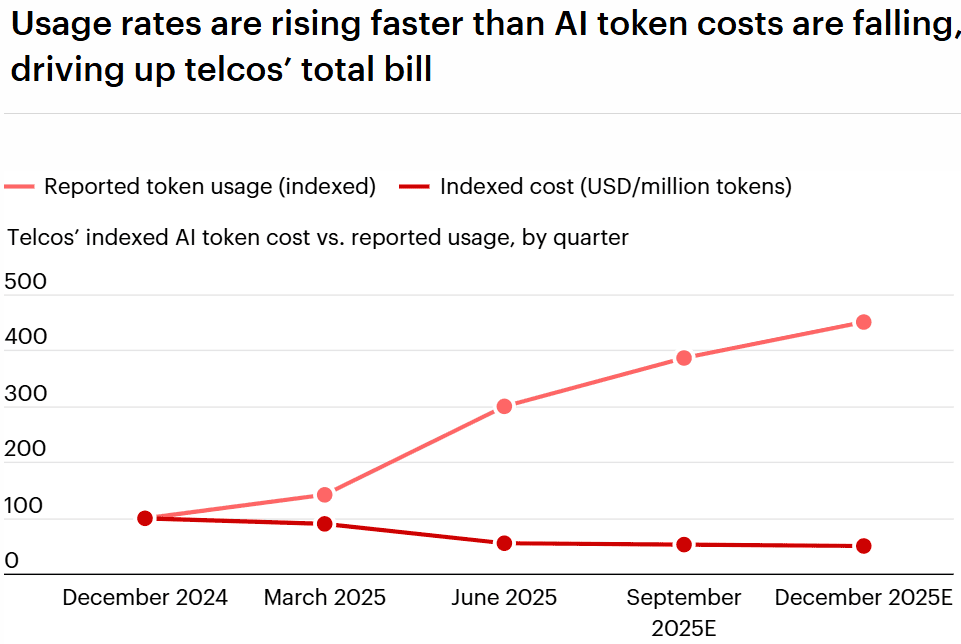
Sources: Wells Fargo (October 2025); Barclays (November 2025); company websites; news and industry reports; Bain analysis.
…………………………………………………………………………………………………………………………………………………………………………………..
However, cost is not the main issue. The principal risk is that network operators can create a parallel operating model when they layer agentic AI onto established network-operations processes without eliminating the people, software, outsourced functions and infrastructure those processes were designed to support.
In that scenario, AI compute, model inference and agent orchestration become incremental expenses, while legacy network operations centers, monitoring platforms, user-facing software licenses, managed-service arrangements and manual operational handoffs remain largely intact.
Network Re-engineering Required:
Avoiding this outcome requires process re-engineering rather than task-level automation. Bain recommends that operators redesign end-to-end workflows around the work agents assume, including:
-
Reducing manual monitoring, ticket triage and operational handoffs.
-
Reassessing workforce requirements as agents absorb repeatable diagnostic and remediation tasks.
-
Reviewing software, tooling and managed-service contracts when agents begin performing functions previously executed through conventional applications or outsourced processes.
-
Removing redundant operational steps rather than simply automating them.
-
Measuring the cost of an operational outcome, rather than the unit cost of model inference or token consumption.
This distinction is especially important in network operations, where an agent may continuously ingest alarms, correlate events, retrieve telemetry, diagnose faults, select a remediation action, trigger network tools, validate results and escalate exceptions to human operators. Each stage can add cost.
Inference is therefore only one component of the AI operating model. A production-grade agentic workflow may also require orchestration, tool and API calls, runtime evaluation, observability, data storage, policy enforcement, security controls, human-in-the-loop escalation and supporting compute infrastructure.
Bain argues that operators should evaluate the complete cost of the resolved operational event. For a service-affecting incident, that includes the total cost of detection, triage, diagnosis, remediation, validation and any remaining human intervention—not simply the marginal cost of the model invocation.
Closed-Loop Operations and Opex Reduction:
Bain cited Vivo in Brazil as an example of an operator redesigning a complete network workflow around AI-enabled automation rather than applying automation to discrete tasks. As part of Telefónica’s Autonomous Network Journey program, Vivo implemented a self-healing mechanism for its virtualized standalone 5G core.
The implementation monitors network-function performance, detects anomalies, identifies root causes and applies corrective actions automatically. It then validates whether the action restored normal operation and can progress to an additional remediation level when required.
Telefónica said the system correlates events across logical and physical infrastructure and completes the detect-to-resolve sequence without human intervention. For the targeted incidents, the company reported a 30-minute reduction in mean time to resolution.
The deployment also reduces repetitive work and manual intervention, while improving the use of computational resources. Telefónica has not disclosed a monetary estimate of the operating-cost savings associated with the implementation, however.
The significance of the Vivo deployment is architectural as much as operational. It integrates detection, correlation, diagnosis, remediation and verification into a closed-loop workflow. That is materially different from deploying an AI assistant within an otherwise unchanged operating model.
Other operator deployments illustrate the potential conventional opex benefits associated with higher autonomy. In a TM Forum case study, China Mobile reported that intelligent agents helped its network operations center achieve Level 4 autonomy under its self-assessment using TM Forum’s Autonomous Networks Levels framework.
China Mobile reported:
-
More than 30% reduction in backend operations-and-maintenance manpower.
-
More than 5% savings in frontline installation-and-maintenance manpower.
-
An average 30% reduction in mean time to repair for network faults and customer complaints.
An earlier TM Forum autonomous-network case study involving China Mobile reported O&M efficiency improvements of 10% to 20%, service-provisioning time reductions of 30% to 50%, and energy-consumption reductions of 3% to 5% across participating internet data centers and base stations.
The reported figures are operator-reported results published through TM Forum case studies. They demonstrate the possible efficiency gains from closed-loop automation, but they do not eliminate the need to account for AI-specific costs such as inference, orchestration, tool execution, supporting infrastructure and operational governance.
Measure Autonomous Networks by Outcomes:
TM Forum is also developing mechanisms to measure the value generated by autonomous-network deployments. In July, it approved version 2.0 of its Autonomous Networks High-Value Scenarios Effectiveness Indicators guide, intended to help operators quantify the impact of Level 4 autonomous-network scenarios.
This outcome-based approach aligns with Bain’s recommendation. For network operations, operators should move beyond narrow AI measures such as token counts, model cost per query or inference latency. Those measures remain operationally useful, but they do not establish whether an AI deployment improves the economics of network operation.
The most relevant measures include:
An operator may accept higher AI spending per workflow if it meaningfully reduces outage duration, truck rolls, customer-impacting incidents, workforce requirements or service-activation delays. Conversely, a deployment that lowers model-inference costs but leaves manual handoffs, duplicate monitoring tools and legacy support structures unchanged may offer limited net operating benefit.
AI Consumption at Telecom Scale:
AT&T has illustrated the potential scale of enterprise AI consumption, although its reported figures span AI workloads across the business and are not limited to autonomous network operations. The operator said in July that it processes an average of 45 billion tokens per day.
AT&T uses an AI gateway to route tasks among models based on cost, latency and expected output quality. The company said the platform can switch models during multi-turn interactions and has reduced costs for certain AI workloads by as much as 90%, producing multimillion-dollar savings.
The operating principle is relevant to telecom network automation: only a minority of tasks require the most capable—and most expensive—models. Routine classification, alarm enrichment, knowledge retrieval, configuration validation and other bounded operational tasks may be suitable for smaller models, purpose-built models or conventional deterministic automation. More capable reasoning models can be reserved for ambiguous, multi-domain or exception-heavy cases.
Bain similarly recommends matching model capability to task complexity rather than applying a single model class across every AI workload. Operators should establish dedicated compute budgets, instrument workflow-level economics and treat inference capacity as an operational resource that requires active governance.
Governing Agentic Network Operations:
Agent behavior itself can become a material source of cost and operational risk. Poorly designed agents may repeatedly transmit large context windows, loop without completing a task, invoke overlapping diagnostic tools or conduct duplicative checks that add token and infrastructure consumption without improving the result.
Bain recommends guardrails that limit both expenditure and runtime. In a telecom network-operations environment, those controls could include:
-
Maximum token, compute and tool-call budgets per incident or workflow.
-
Time limits before an agent must escalate an unresolved task to a human operator.
-
Context-management rules that prevent unnecessary repetition of telemetry, alarms and historical ticket data.
-
Controls to consolidate overlapping diagnostic checks and duplicate agent activity.
-
Policy constraints governing which network changes an agent may propose, execute or validate autonomously.
-
Continuous monitoring for model drift, abnormal agent behavior, spending anomalies and degraded operational outcomes.
-
Explicit business and financial ownership for each production agent and workflow.
The central issue is that autonomous networks will not necessarily lower opex simply because they reduce manual work. Operators must also remove the legacy cost structures that agentic systems replace. Otherwise, AI agents risk becoming an additional layer of expense on top of existing network operations rather than the foundation for a more efficient operating model.
……………………………………………………………………………………………………………………………………….
References:
Bain & Co, McKinsey & Co, AWS suggest how telcos can use and adapt Generative AI
McKinsey: AI infrastructure opportunity for telcos? AI developments in the telecom sector
AI risks and backlash increase; Recap of the circular loop of fake AI profits and hyperscaler markups of private AI companies
5G infrastructure moves from coverage and speeds to cloud-native, orchestration, automation and AI-assisted networks
Huge Risks for the proposed $500B AI Investments from Giant Wall Street firms
Disclaimer: Perplexity.ai was used for research and analysis in this article.
……………………………………………………………………………………………………………………..
Executive Summary:
This past Monday, six giant Wall Street asset managers, private-equity firms and banks announced an effort to raise $500 billion to keep fueling the A.I. boom by financing more data centers, power plants and chips. The proposed platform would direct capital to Nvidia customers—including AI startups and data-center operators—at precisely the point when many have struggled to obtain funding through ordinary credit channels.
We take that as a huge warning sign for the proposed AI investments. Here’s why: If the underlying projects offered clearly proven cash flows, predictable utilization and collateral with durable value, lenders would not need a specially assembled consortium, headline-scale commitments and Nvidia’s direct involvement to make the loans happen. The initiative appears designed to overcome a financing bottleneck created by the extraordinary gap between AI infrastructure spending and demonstrated AI revenue.
This proposed $500 billion AI-financing initiative is less a validation of durable AI economics than an admission that the sector’s spending plans have outgrown its customers’ ability—or willingness—to finance them conventionally. Rather than demonstrating independently sustainable demand, the arrangement risks extending an investment cycle increasingly dependent on vendor-enabled credit, opaque commitments and financial engineering.
The firms—Apollo, BlackRock, Blackstone, Brookfield, Goldman Sachs and KKR—said they were working together to come up with that huge sum to lend to Nvidia’s customers, including the start-ups that use the company’s chips in data centers to develop and operate A.I. software. These customers, Nvidia said, have been struggling to secure financing for chips and data centers.
Nvidia will connect its customers with one of the six lenders, which will provide financing that could range from loans to credit. The financing will be “at attractive rates,” Nvidia said in a blog post.
In practical terms, this is a vendor-financing mechanism, even if the capital technically comes from third parties. Nvidia is helping its customers obtain the money required to buy Nvidia-dependent infrastructure. The more readily startups and data-center operators can borrow, the more equipment they can order; the more equipment they order, the more Nvidia can sell. That does not mean the demand is fictitious, but it does make it harder to distinguish independent end-user demand from demand supported by an ecosystem that is financing itself.
Circularity is the principal concern. When suppliers, investors, cloud providers, AI labs and lenders all have financial incentives to keep capital circulating within the same small group of counterparties, reported growth can look more robust than the ultimate economics justify. The risk is not simply that projects fail individually. It is that a shortfall in AI-service revenues, utilization or pricing could spread simultaneously through hardware vendors, AI developers, cloud operators, private-credit vehicles and the securities backed by their cash flows. Circular financing can blur the line between real external demand and investment-funded purchases.
Executives from the lenders joined Jensen Huang, Nvidia’s CEO & founder, for an unusual, extended interview on CNBC, where they talked up their new, seemingly insatiable desire to finance infrastructure for A.I. Huang said on the air. He added that “A.I. labs” and “A.I. start-ups” would have access to the financing. He did not name those companies or whether Nvidia would receive any money as part of the effort. David M. Solomon, Goldman’s chief executive, said the consortium was Mr. Huang’s idea.
“We need to raise this money as fast as possible,” said Larry Fink, BlackRock’s chief executive. He also stated: “There’s quite a bit of negativity around A.I. and data centers right now, but let’s be clear: This is going to be creating a huge amount of jobs.”
Skeptical Analysis:
The urgency in those statements deserves more scrutiny. Speed is not a substitute for underwriting, and job-creation claims do not establish that investments will meet their cost of capital. The industry is attempting to finance assets whose useful economic life may be much shorter and more uncertain than that of traditional infrastructure. A GPU fleet can lose competitiveness rapidly when a new architecture, memory standard or systems design emerges. Its resale value can fall sharply if capacity demand weakens. Treating such hardware as collateral comparable to a toll road, utility asset or long-lived building is a major assumption—not an established fact.
The announcement punctuates a head rush on Wall Street and in Silicon Valley into anything that even vaguely resembles A.I. The stocks of tech giants and chipmakers have soared for most of this year, and a pair of the biggest names in the space, Anthropic and OpenAI, are expected to file for initial public offerings that could value them at $1 trillion apiece.
But soaring equity valuations and enormous projected IPO valuations do not answer the basic return-on-investment question: who will pay enough, for long enough, to justify the total cost of the data centers, power plants, networking, GPUs and debt now being assembled? AI vendors may generate impressive revenue growth while still failing to earn enough to cover the depreciation, energy, financing and replacement costs of the infrastructure required to produce it.
Nvidia’s financing narrative appears to conflate broad interest in AI-enabled services with broad, independent demand for capital-intensive AI infrastructure. Governments, enterprises and startups may all seek access to AI capabilities, but the current demand for hyperscale GPU clusters, dedicated power capacity and purpose-built “AI factories” remains concentrated among a relatively small group of frontier-model developers and cloud platforms.
That distinction matters because broad adoption of AI applications does not automatically translate into economically sustainable demand for vast new data-center capacity. Enterprises can consume AI through APIs, hosted platforms, smaller models and open-source software without owning—or financing—dedicated high-density compute infrastructure. Nvidia itself describes demand as spanning enterprises, startups, governments, nations and AI labs, but the critical question for investors is how much of that demand converts into durable, contracted infrastructure revenue rather than experimentation, pilots or subsidized consumption.
As Bloomberg reported last week, OpenAI accounted for somewhere between 50% and 70% of Microsoft’s AI revenue in the 12 months to 30 June.
That degree of concentration is significant. Microsoft disclosed $24.1 billion in sales from OpenAI during the year ended in June; outside estimates place that at more than half, and perhaps about 70%, of Microsoft’s AI-related revenue. Much of the revenue reflects OpenAI’s spending on Microsoft cloud and model-development services, meaning a substantial portion of the apparent AI revenue base may be generated within a tightly linked commercial relationship rather than by a diversified population of external enterprise customers.
That could be problematic if the picture is similar at other hyperscalers and at other frontier AI companies like Anthropic, for example. A market in which a handful of loss-making model developers drive an outsized share of cloud and infrastructure revenue is inherently more fragile than one supported by a broad base of profitable end users. It exposes infrastructure providers and lenders to customer concentration, correlated capital spending and the possibility that a reduction in financing at one frontier lab quickly reduces demand across the supply chain.
Indeed, as has been reported by multiple correspondents – most notably staunch AI critic Ed Zitron – LLM makers like OpenAI are losing money hand over fist and can only charge so much for tokens before customers either curb their usage or switch to open source models. Zitron wrote:
“It’s estimated that 70% or more of the AI revenues of Microsoft, Google, and Amazon were from either OpenAI or Anthropic. UBS estimated that next year, Anthropic and OpenAI’s compute spend would be 48% of all Google Cloud revenues — which means that they likely account for even more than 70% of its AI revenues.”
The commercial challenge is not whether frontier models have value- they do. It is whether they can deliver that value at prices that exceed the combined costs of training, inference, electricity, networking, cloud capacity, depreciation and ongoing model development. If token pricing rises too far, customers may reduce usage, shift workloads to lower-cost models, or use open-source alternatives. If pricing remains low, frontier-model providers may struggle to cover their infrastructure bills. Open-source fine-tuning can materially reduce costs for specialized enterprise workloads, reinforcing the competitive pressure on premium proprietary-model pricing.
The most plausible downside is that the technology becomes broadly useful but insufficiently profitable to support today’s extreme capital intensity. That outcome would leave the sector with too much high-cost capacity, thin margins, declining GPU collateral values and lenders dependent on assumptions about utilization and cash flows that have not yet been tested through a downturn. The foundational financial risk is straightforward: AI-service revenues may prove insufficient to service the fixed obligations incurred to construct the infrastructure. Notably, Nvidia stock dipped modestly on Monday after The Financial Times reported that the company was nearing the mammoth financing deal.
While the contours of the arrangements were announced Monday afternoon, details remained scarce. A joint news release referred only to “memorandums of understanding” to “create dedicated pools of capital at significant scale.”
That language is important. Memorandums of Understanding (MoU’s) are not equivalent to binding, fully funded commitments. Until investors know the actual terms—capital committed, leverage permitted, collateral requirements, Nvidia’s role in losses, loan maturities, customer concentration limits and underwriting standards—the $500 billion figure is better understood as an ambitious financing target than as validated capital deployment. Reporting has described the initiative as a multiyear target rather than cash already committed, while questions remain about the scale of any Nvidia backstop.
During their television interview, the lenders’ executives alluded vaguely to “yield-based products” and even securitization, or the creation of bonds that would divvy up the revenue from A.I. labs into risky and less risky categories. There were several references to A.I. as a new asset class and to allowing smaller investors an opportunity to invest in debt backed by the data centers.
This is where the proposal moves from aggressive investment to potential systemic-risk creation. Securitization can distribute risk, but it does not eliminate it; it can instead diffuse difficult-to-value exposure across a wider investor base. Packaging AI-data-center debt into yield products may make financing more available, but it also risks obscuring the quality of the underlying cash flows, the degree of correlated exposure among borrowers and the vulnerability of rapidly depreciating hardware collateral. The more complex the capital stack becomes, the greater the danger that investors mistake engineered liquidity for genuine economic value.
Executive Quotes:
“NVIDIA has reached an important milestone. We began by building chips; today, we are helping create a new class of productive, investable infrastructure: AI factories,” said Jensen Huang, founder and CEO of NVIDIA. “In AI, compute is revenue. NVIDIA compute is uniquely suited for this role. It is broadly adopted, flexible across models and workloads, fungible and transferable across customers and operators, and continuously improved through CUDA software — extending its useful life and improving its economics over time. It is supported by a deep global ecosystem of developers, customers and offtakers. That is why we are bringing the world’s leading long-term capital providers together to independently underwrite AI infrastructure. These financing platforms will help customers access scarce compute at scale and build the DSX AI factories that will power every industry and country in the age of AI.”
“Modern compute has emerged as a scarce, mission-critical asset class with compelling investment characteristics that is positioned to drive significant long-term economic growth and productivity gains,” said Apollo President Jim Zelter. “The combination of NVIDIA’s proprietary technology ecosystem and Apollo’s flexible, long-term capital base provides a strong foundation to support the next stage of the AI buildout as part of the broader Global Industrial Renaissance.”
“The AI buildout will require unprecedented investment and a skilled workforce to turn that investment into the infrastructure that will help power future growth,” said Larry Fink, Chairman and CEO of BlackRock. “This partnership deepens our relationship with NVIDIA, including through the AI Infrastructure Partnership, and brings together NVIDIA’s leadership in accelerated computing with BlackRock’s ability to connect long-term capital to essential infrastructure. Together, we can help deliver the compute capacity that companies need to grow and create more jobs, supporting the continued growth of the U.S. and global economies, while creating attractive, long-term investment opportunities for our clients.”
“NVIDIA has created extraordinary demand for its compute through an intense focus on customer value and versatile technology,” said Jon Gray, President and COO of Blackstone. “We continue to be enormous investors globally across the NVIDIA ecosystem, and this announcement further underscores our confidence in their platform and the future of AI infrastructure.”
“As our strategic partner, NVIDIA is enabling us to scale AI factories. We are excited about further collaboration to build and fund the backbone of AI globally,” said Bruce Flatt, CEO of Brookfield. “With demand for large-scale AI compute growing significantly as adoption scales across industries, compute is fast becoming the essential layer of infrastructure and a core pillar of the Brookfield AI infrastructure strategy.”
“We’re in a pivotal moment of a historic AI investment cycle. NVIDIA’s full-stack platform is in high demand and uniquely positioned at the center of that global buildout,” said David Solomon, Chairman and CEO of Goldman Sachs. “Our investment and distribution roles reflect our confidence in NVIDIA’s leadership, and we’re excited for the new opportunity to create a market for credit backed by NVIDIA compute.”
“Compute has become a critical infrastructure asset. As we’ve scaled our approach to digital infrastructure, we’ve learned that delivery, not ambition, is the hard part. That’s why we’re excited to build on our strategic partnership with NVIDIA, a founding investor in Helix Digital Infrastructure, to bring together NVIDIA’s accelerated computing platform with KKR’s long-duration capital, infrastructure expertise and capital markets capabilities to turn growing demand into real capacity at extraordinary scale,” said Joe Bae and Scott Nuttall, Co-Chief Executive Officers of KKR.
“This is the very beginning — like what it was when I started in the mortgage-backed securities market in the 1970s,” Mr. Fink said. “I look upon this as a next future for financial engineering.”
That analogy should be treated as cautionary, not reassuring. Financial engineering can expand access to capital and spread risk efficiently when assets have transparent valuations, stable cash flows and conservative underwriting. It becomes dangerous when it is used to finance unproven revenue models, rapidly obsolescing assets and demand forecasts that must remain exceptionally optimistic simply to justify the initial investment.
Huge Risks Explained:
If AI demand stalls, Nvidia faces a sharp reversal in hardware demand and a potentially damaging credit overhang, while lenders could be left financing underutilized data centers secured by equipment whose value can decline far faster than conventional infrastructure. The common vulnerability is that the same uncertain AI revenue streams would be expected to support chip purchases, data-center leases, project debt and securitized investment products. Nvidia is especially exposed to risks:
-
Order cancellations and lower pricing power. Cloud providers, AI labs and startups would likely slow GPU orders, defer deployments or renegotiate capacity commitments. Nvidia could face weaker revenue growth, inventory risk and pressure on the high margins that have supported its valuation.
-
Vendor-financing and counterparty risk. If Nvidia is arranging or backstopping financing for customers buying its systems, a demand slowdown could turn what appeared to be hardware sales into indirect credit exposure. Customers unable to earn adequate returns from AI services may struggle to repay loans used to buy Nvidia equipment. The risk is magnified where the company’s commercial success depends on borrowers gaining access to financing in the first place.247wallst+1
-
Collateral impairment. GPUs are not durable, slow-depreciating infrastructure assets. A new chip generation, a shift toward more efficient models, or weak utilization can materially reduce the resale value of installed systems. If lenders rely on those systems as collateral, a default could leave them holding equipment worth substantially less than the loan balance—and Nvidia could face lower demand for both new and prior-generation products. Moody’s identifies rapid capacity expansion and fast-changing chips, cooling and computing architectures as sources of overbuilding and technology-obsolescence risk.moodys
-
Feedback-loop risk. A slowdown could create a negative cycle: AI customers reduce spending; Nvidia’s sales weaken; lenders become more cautious; financing availability tightens; customers cut orders further. Where vendors, customers and capital providers are financially intertwined, the decline can be more abrupt than a normal inventory correction.
-
Equity-valuation risk. Nvidia’s market value reflects unusually strong assumptions about the longevity of AI spending, margins and growth. A reassessment of those assumptions could compress the valuation sharply even if Nvidia remains profitable. BIS warns that disappointment in AI returns could trigger a sudden financing pullback and turn the capex boom into a prolonged investment bust.bis
Lenders’ exposure:
The most immediate lender risk is a mismatch between long-lived debt obligations and unstable, technology-dependent revenue. A data center might be financed over many years, but its GPU fleet may need continual upgrades to remain competitive—requiring additional capital expenditure before the original debt is repaid. Moody’s notes that this combination of increasing capital intensity, uncertain compute requirements and structured finance can pressure developers, landlords and investors through execution, renewal and refinancing risk.moodys
Construction and power risks:
A demand slowdown could arrive before projects enter service. That creates a particularly difficult situation for lenders because construction interest, cost overruns and power-reservation charges may accumulate before revenue begins.
Permitting delays, local opposition, water constraints and electricity-grid limitations further compound this exposure. Reuters reported that lenders increasingly treat project readiness—including approvals, permits and local community support—as a credit factor because delays can increase costs, jeopardize covenants and prevent projects from reaching revenue-generating operation.
System-wide scenario:
The more serious scenario is a correlated unwind:
-
AI applications fail to deliver enough monetizable demand.
-
AI labs and cloud providers reduce compute commitments.
-
Data-center utilization and expected rental income fall.
-
Borrowers cannot service or refinance project debt.
-
GPUs and related infrastructure lose collateral value.
-
Losses reach private-credit funds, banks, securitized vehicles, insurers and institutional investors.
-
New financing becomes unavailable, causing further cuts in infrastructure orders and Nvidia sales.
This would not necessarily resemble the 2008 banking crisis: some first-loss exposure sits outside regulated banks. But Chicago Booth research estimates that a severe re-rating of AI-related debt could still produce roughly $60 billion to $140 billion in realized credit losses, alongside large equity-market effects.
What matters most:
The decisive question is not whether AI is useful or whether data centers remain necessary. It is whether cash-paying end users will generate sufficient, durable revenue to justify the full cost of the hardware, power, real estate, construction and financing now being committed. If that answer is no, the sector may discover that it financed capacity—not returns.
……………………………………………………………………………………………………………………………………………………………………………………
From Google’s Gemini:
-
- The Revenue Void: If OpenAI or Anthropic defers or cancels capacity commitments, hyperscalers are left with energized Megawatts (MW) that have no immediate, high-paying tenant.
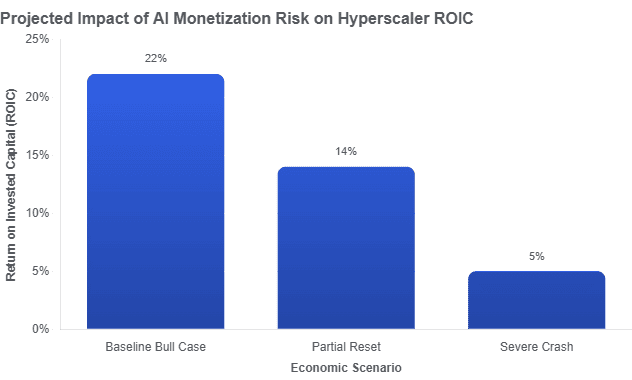
- Stranded Capital: The specialized power, liquid cooling systems, and electrical equipment tailored for dense AI clusters cannot easily be repurposed for traditional cloud workloads without lowering returns on invested capital (ROIC).
| Financial Metric | Baseline Forecast (Bull Case) | Partial Monetization Reset | Severe Crash / Structural Downside |
|---|---|---|---|
| Cloud Revenue Growth | Accelerated (driven by AI APIs & enterprise seats) | Flattens out as enterprise customers consolidate suppliers | Decelerates sharply; circular cloud revenue loops collapse |
| CapEx Infrastructure | Full execution of Dell’Oro’s ~200 GW build out by 2030 | 20–30% of capacity commitments deferred or resized | Mass cancellations of orders; multi-year build freezes |
| Operating Margins | Expands as inference costs decline relative to software prices | Compresses due to underutilized GPU clusters and high DCPI fixed costs | Severe contraction; massive asset write-downs and depreciation drag |
| ROIC | Historic highs driven by high-density compute demand | Diluted; longer payback periods for specialized data centers | Tanks; billions in stranded physical capital and obsolete hardware |
References:
https://www.nytimes.com/2026/08/10/business/ai-nvidia-lenders-500-billion.html
https://www.wheresyoured.at/dont-look-up/
Curmudgeon: Caveat Emptor: Huge Debt and Circular Financing Deals Dominate AI Build-Outs (07/23/26)
Merry-go-round of dog chasing its tail: Relationship between U.S. hyperscalers and private Gen AI companies
AI infrastructure spending boom: a path towards AGI or speculative bubble?
Expose: AI is more than a bubble; it’s a data center debt bomb
Will Google Cloud’s AI and data analytics revenue +TPU IP licensing income offset huge AI CAPEX to produce a decent ROI?
Amazon’s Jeff Bezos at Italian Tech Week: “AI is a kind of industrial bubble”
Big Tech AI spending binge results in massive job cuts!
AI spending boom accelerates: Big tech to invest an aggregate of $400 billion in 2025; much more in 2026!
FT: Scale of AI private company valuations dwarfs dot-com boom
Big tech spending on AI data centers and infrastructure vs the fiber optic buildout during the dot-com boom (& bust)
AI Data Center Boom Carries Huge Default and Demand Risks
Can the debt fueling the new wave of AI infrastructure buildouts ever be repaid?
Gartner: AI spending >$2 trillion in 2026 driven by hyperscalers data center investments
Will billions of dollars big tech is spending on Gen AI data centers produce a decent ROI?