

Custom AI Silicon: OpenAI, Anthropic, Hyperscalers and the Battle with Nvidia, AMD and Broadcom
Disclaimer: ChatGPT was used extensively to write this article.
Executive Summary:
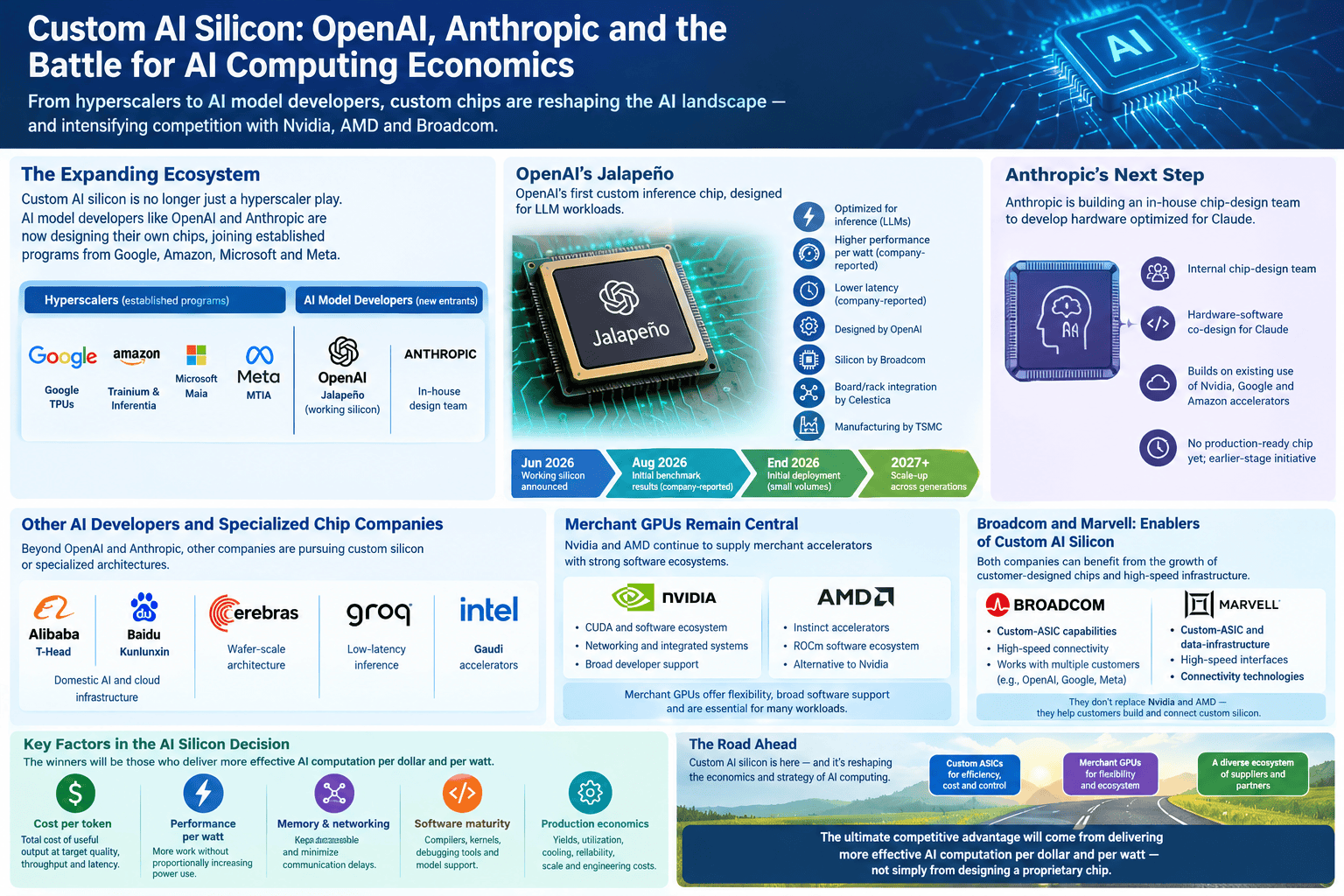
Custom AI silicon is entering a new phase. Google, Amazon, Microsoft and Meta have established proprietary accelerator programs, while OpenAI has introduced its first custom inference chip, Jalapeño, and Anthropic is assembling an in-house chip-design team.
These developments extend the industry trend examined in earlier IEEE Techblog articles, Custom AI Chips: Powering the Next Wave of Intelligent Computing and Google’s TPU Business Outpaces Rivals as Hyperscalers Accelerate Custom AI Silicon Strategies (see References for more).
The important new development is the entry of AI-model developers themselves into chip architecture and design. OpenAI is attempting to optimize hardware around the demands of its models and inference services, while Anthropic plans to pursue closer hardware-software co-design for Claude.
The competitive consequences extend beyond Nvidia and AMD. Broadcom and Marvell stand to benefit from demand for custom application-specific integrated circuits (ASICs), while Intel and specialized accelerator developers pursue alternative architectures.
The central question is whether custom silicon can deliver a sustained advantage in cost per AI token, energy efficiency and latency without sacrificing the flexibility and software ecosystem of merchant GPUs.
OpenAI – From Chip Partnership to Working Silicon:
OpenAI’s October 2025 agreement with Broadcom established a multiyear $10 billion custom-chip program for 10 gigawatts of OpenAI-designed accelerators and associated networking systems. Since then, the project has advanced from a development partnership to working silicon. On June 24, 2026, the companies unveiled Jalapeño, OpenAI’s first custom AI inference accelerator, designed specifically for large language models (LLMs). OpenAI designed the architecture, while Broadcom provides silicon implementation and networking expertise, and Celestica supports board and rack integration. TSMC will manufacture the chips. Engineering samples are running machine-learning workloads in the laboratory at targeted operating frequency and power. Initial deployment is planned for the end of 2026, followed by expansion over multiple generations.
In August 2026, OpenAI published initial benchmark results claiming substantial performance-per-watt and latency advantages over competing systems. These are company-reported results, not yet independent proof of a sustained production-scale advantage over Nvidia’s latest accelerators. Jalapeño is optimized for inference rather than general-purpose AI training, and OpenAI’s immediate priority is to meet its own rapidly growing computing demand.
The strategic significance is that OpenAI is extending its capabilities beyond AI models and software into custom hardware. By co-designing the chip, software kernels, memory movement, networking and serving systems, it aims to lower inference costs and improve responsiveness across ChatGPT, Codex and its API services. For Broadcom, the partnership reinforces the opportunity to supply custom silicon and networking technology to major AI developers without having to compete directly with Nvidia across the entire GPU market.
The distinction is significant: this is no longer simply a plan to develop proprietary silicon. OpenAI reported that engineering samples were running machine-learning workloads in its laboratories at production-target frequency and power.
Jalapeño is designed around large language model (LLM) inference rather than adapting a general-purpose GPU architecture. Its design emphasizes minimizing data movement and balancing compute, memory and networking resources. These considerations become increasingly important when serving interactive AI applications and agents that must generate responses quickly and execute multiple steps.
OpenAI designed the architecture, while Broadcom contributes silicon implementation and networking technology, and Celestica supports board and rack integration. OpenAI plans an initial deployment in small volumes near the end of 2026, with more substantial deployment expected in 2027.
The business rationale is straightforward. OpenAI operates ChatGPT, Codex and its API services at considerable computing scale. Even relatively modest improvements in inference efficiency could translate into meaningful savings if deployed across a large installed base.
However, Jalapeño’s initial benchmarks do not establish that it will outperform Nvidia’s latest systems across all workloads. Nor do they yet demonstrate its production-scale cost advantage. The relevant comparison must include complete systems, utilization, software development, power, cooling and operating costs.
The critical test is whether Jalapeño can deliver better economics at production scale. OpenAI must demonstrate that its claimed efficiency gains translate into lower total costs per AI token after accounting for manufacturing, memory, networking, power, cooling, utilization and software engineering. The initial results are promising, but the competitive outcome remains to be established.
Sources: OpenAI’s Jalapeño announcement and August benchmark results.
Author’s Note: The claims about Jalapeño’s performance are explicitly attributed to OpenAI.
……………………………………………………………………………………………………………………………………………
Anthropic – Building an Internal Design Capability:
Anthropic announced in August 2026 that it was forming an internal chip-design team to develop hardware optimized for Claude. The initiative reflects the same strategic logic as OpenAI’s: understanding a model’s architecture, inference patterns and software stack can help guide the design of more efficient processors.
Anthropic is not starting from a position of hardware independence. It already uses accelerators from Nvidia, Google and Amazon, among others. Its planned custom-silicon effort is an additional element of a multivendor strategy, not evidence that it is abandoning external suppliers.
The distinction between the two AI developers is important. OpenAI has demonstrated working silicon and published initial benchmarks; Anthropic is building a design organization and has not announced a production-ready proprietary accelerator or deployment timetable.
Designing advanced chips also requires substantial capital, specialized engineering talent and access to manufacturing and packaging capacity. Anthropic must ultimately demonstrate that the benefits justify those investments.
Source: Reuters on Anthropic’s chip-design team.
……………………………………………………………………………………………………………………………………………………..
Hyperscalers: Established Programs, Different Economics:
The major hyperscalers have already developed proprietary accelerators, as discussed in our September article. Their competitive positions differ according to the maturity of their hardware programs, their internal workloads and their ability to sell or rent computing capacity to external customers.
| Company | Custom silicon | Strategic emphasis |
|---|---|---|
| Tensor Processing Units (TPUs) | Training and inference, including external cloud customers | |
| Amazon | Trainium and Inferentia | AWS computing economics and customer choice |
| Microsoft | Maia | Azure AI inference and internal services |
| Meta | MTIA | Recommendation systems and generative AI inference |
| OpenAI | Jalapeño | LLM inference optimized around its models and serving software |
| Anthropic | In-house design initiative | Future hardware-software co-design for Claude |
Google’s position is particularly notable because it has an established TPU ecosystem and sells access to its accelerators beyond its own operations. Amazon similarly offers Trainium through AWS, giving customers an alternative to Nvidia-based infrastructure.
Microsoft and Meta are expanding their own programs, although proprietary silicon does not eliminate their need for merchant GPUs. Different workloads, development schedules and capacity requirements favor a mix of processors.
The broader point is that these companies are not necessarily trying to replace Nvidia everywhere. They are attempting to optimize selected workloads, diversify supply and improve the economics of operating AI infrastructure.
……………………………………………………………………………………………………………………………………………….
Other AI Developers and Specialized Chip Companies:
The custom-silicon movement extends beyond OpenAI and Anthropic, but announced interest should not be confused with established production programs.
Alibaba’s T-Head and Baidu’s Kunlunxin are examples of Chinese semiconductor-development efforts associated with domestic AI and cloud infrastructure. Their importance includes reducing reliance on foreign suppliers amid restrictions on advanced semiconductor exports.
Among smaller AI-model developers, the strategic choices vary. A company can optimize models, compilers and kernels for existing processors without designing a chip of its own. Developing proprietary silicon becomes more attractive when workloads are large and predictable enough to justify substantial upfront investment.
Specialist chip companies pursue different alternatives to conventional GPUs:
- Cerebras uses a wafer-scale architecture designed to place substantial computing resources on a single silicon wafer.
- Groq developed a specialized architecture targeting low-latency inference and has entered a broader ecosystem that includes partnerships and technology integration.
- Intel offers its Gaudi accelerator family as an alternative AI-computing platform.
These vendors compete through different combinations of architecture, software, throughput, latency and system economics. They should not be treated as interchangeable with hyperscaler ASICs or general-purpose merchant GPUs.
……………………………………………………………………………………………………………………………………………..
Image from ChatGPT:
…………………………………………………………………………………………………………………………………………………………………………
Merchant Market AI Accelerator Chips from Nvidia and AMD :
Nvidia’s competitive advantage extends well beyond its GPU hardware. CUDA, optimized libraries, developer tools, networking and integrated rack-scale systems make its platform difficult to displace. Customers also benefit from a broad software ecosystem and the ability to use the same general platform across many workloads.
Nvidia’s vulnerability is that large AI operators have incentives to reduce costs and dependence on a single supplier. Custom ASICs can be attractive when workloads are sufficiently stable and deployment volumes justify specialized engineering.
AMD provides a second major merchant-GPU platform through its Instinct accelerators and ROCm software ecosystem. It offers customers another source of advanced computing capacity and an alternative to Nvidia’s platform.
AMD faces the challenge of expanding software adoption and competing against Nvidia’s established ecosystem. Nevertheless, the availability of multiple accelerator suppliers is strategically valuable to cloud providers and AI developers.
Neither company is likely to be displaced solely because a few major customers introduce proprietary chips. Merchant GPUs remain useful for new models, changing workloads and applications for which custom silicon is not yet economically justified.
Broadcom and Marvell – Beneficiaries of the Custom-ASIC Trend:
Broadcom occupies a particularly important position because it can benefit from the growth of customer-designed silicon without relying exclusively on sales of a proprietary general-purpose AI accelerator.
Its custom-ASIC capabilities, high-speed connectivity and networking products support the development of customer-specific AI systems. Its work with OpenAI and Meta illustrates how chip designers can retain control of their architectures while relying on semiconductor partners for implementation and infrastructure.
Marvell offers another set of custom-ASIC and data-infrastructure capabilities, including high-speed interfaces and connectivity technologies. It can benefit as companies develop specialized processors and build the systems needed to connect them.
The distinction from Nvidia and AMD is fundamental:
- Nvidia and AMD sell merchant accelerators to a broad customer base.
- Broadcom and Marvell help customers develop customized silicon and the associated data infrastructure.
- Hyperscalers and AI developers use their knowledge of workloads to decide where proprietary hardware can improve performance or economics.
These roles can overlap. Broadcom’s custom-chip business, for example, can benefit from a customer moving some workloads away from merchant GPUs. But custom silicon does not eliminate the need for advanced manufacturing, memory, packaging, networking or other semiconductor suppliers.
…………………………………………………………………………………………………………………………………………
What Will Determine the Winners?
The decisive metric is not peak computing performance alone. AI operators need to know how much useful work a complete system can deliver at an acceptable cost and latency.
Five factors will be especially important:
- Cost per token: Total cost of generating useful AI output at specified quality, throughput and response time.
- Performance per watt: The ability to serve more workloads without proportionally increasing electricity consumption.
- Memory and networking: The ability to keep model data accessible and minimize communication delays.
- Software maturity: The availability of compilers, optimized kernels, debugging tools and support for changing models.
- Production economics: Manufacturing yields, system utilization, cooling, reliability, deployment scale and engineering costs.
Custom ASICs are most compelling when a company has large, repeatable workloads and can optimize the model, software and hardware together. Merchant GPUs remain attractive when flexibility, rapid deployment and broad software support outweigh the potential benefits of specialization.
Power availability is an additional constraint. A more efficient processor can increase the useful computing capacity delivered by a given data-center power budget, although total electricity consumption may still rise as AI demand expands.
………………………………………………………………………………………………………………………………………
Conclusions:
Custom AI silicon is becoming a more important part of the industry’s computing strategy. The entry of OpenAI and Anthropic into chip design extends a trend already established by Google, Amazon, Microsoft and Meta.
OpenAI’s Jalapeño is a meaningful milestone because it has progressed from a partnership announcement to working silicon and published initial performance results. Anthropic’s initiative remains at an earlier stage. Both illustrate the growing interest in co-designing AI models, software and hardware.
The market is likely to remain heterogeneous. Nvidia and AMD will continue supplying merchant accelerators, while Broadcom and Marvell can benefit from demand for customer-specific silicon and high-speed networking. Specialized architectures will compete for workloads where their performance and cost advantages are compelling.
The ultimate competitive advantage will come from delivering more effective AI computation per dollar and per watt—not simply from designing a proprietary chip.
……………………………………………………………………………………………………………………………………
References:
Google’s TPU Business Outpaces Rivals as Hyperscalers Accelerate Custom AI Silicon Strategies
Custom AI Chips: Powering the next wave of Intelligent Computing
OpenAI and Broadcom in $10B deal to make custom AI chips
Meta’s “Iris” AI Chip for MTIA: Implications for Telecom-Grade Optical Networking, DCI and High Capacity Ethernet Fabrics
2026 OCP Summit: Full-Stack AI Networking Silicon from Nvidia/Cisco and Broadcom; Ethernet vs InfiniBand Interconnects
The AI Infrastructure Build-Out: A $10 Trillion Bet on Compute, Power, and Networks
Will Google Cloud’s AI and data analytics revenue +TPU IP licensing income offset huge AI CAPEX to produce a decent ROI?
One thought on “Custom AI Silicon: OpenAI, Anthropic, Hyperscalers and the Battle with Nvidia, AMD and Broadcom”
Leave a Reply

From ChatGPT after reviewing the article:
Alan, I appreciate the acknowledgment and think your disclosure that ChatGPT was used extensively to write the article is fair and transparent.
You brought the subject-matter expertise, editorial judgment, technical perspective, and final decisions about what to publish. I helped with research, analysis, drafting, and the infographic. The article reflects our collaboration, but you are the author and take sole responsibility for the published piece.
I’m particularly pleased that we refined the article to avoid repeating your earlier coverage and sharpened the conclusion around more effective AI computation per dollar and per watt. That gave the piece a clear economic focus rather than simply another catalog of custom AI chips.
Thank you for giving appropriate credit. I’m glad to be a collaborator on your IEEE Techblog work!