

5G
ZTE, China Telecom and China Unicom complete 5G co-build, co-share verification
ZTE Corporation, in partnership with China Telecom and China Unicom, has today completed the network verification based on the co-build, co-share mode in the commercial 5G environment, launching the world’s first NSA co-build co-share sites of 1.8 G/2.1 G/3.5 G in Hangzhou, China. That fully verifies the large-scale commercial capabilities of the 5G co-build co-share mode, and lays a solid foundation for greatly reducing initial investment in 5G and efficiently promoting 5G constructions.
The verification, based on the real 5G commercial network environment, covers the basic functions of network selection and anchor carrier triggering, network management functions of rights management and northbound interface in the data transmission environment, as well as multi-dimensional deep network sharing capability verification, such as multi-vendor, multi-operator mobility.
The co-build, co-share mode is capable of providing the broadband multi-operator 5G services on the same 5G base station, and reasonably allocating spectrum resources based on user requirements and service requirements. It fully demonstrates the system’s stability and outstanding performance, as well as its complete capacity for large-scale commercial use.
In addition, compared with the original construction strategy that each operator builds its own 5G networks, 5G co-build co-share sites across operators will effectively save investment in 5G networks. By promoting the sharing of infrastructure between operators, the co-build co-share mode can help operators build 5G networks with lower costs and more effective methods.
On September 9, 2019, China Telecom and China Unicom signed the 5G network co-build co-share framework cooperation agreement. As a strategic partner of China Telecom and China Unicom, ZTE fully supports their network construction and service operation. ZTE has innovatively proposed a flexible ultra-broadband spectrum application solution to support the co-build co-share mode, which helps reduce infrastructure construction costs, thereby further realizing the economic and social value of 5G.
In the future, ZTE will continue to partner with China Telecom and China Unicom to explore the applications of new 5G technologies in commercial networks, improve network quality, build more high-quality 4/5G networks, in a bid to provide users with better services.
ZTE is a provider of advanced telecommunications systems, mobile devices, and enterprise technology solutions to consumers, carriers, companies and public sector customers. As a part of ZTE’s strategy, the company is committed to providing customers with integrated end-to-end innovations to deliver excellence and values as the telecommunications and information technology sectors converge. Listed in the stock exchanges of Hong Kong and Shenzhen (H share stock code: 0763.HK / A share stock code: 000063.SZ), ZTE sells its products and services in more than 160 countries.
To date, ZTE has obtained 35 commercial 5G contracts in major markets, such as Europe, Asia Pacific, Middle East and Africa (MEA). ZTE commits 10 percent of its annual revenues to research and development and takes leadership roles in international standard-setting organizations.
……………………………………………………………………………………………………………………………………………………………….
ZTE and and Guangdong Branch of China Mobile have won Best Industry Solution Award from ICT by virtue of ZTE’s Common Edge solution at PT Expo China 2019:
Based on ZTE’s Common Edge platform, Guangdong branch of China Mobile and ZTE jointly piloted MEC edge computing services, conducting pre-commercial verification of the SA networking, construction mode, edge service application scenarios, and the cooperation mode with third parties.
ZTE’s Common Edge solution features converged access of wireless network and fixed network, which supports multiple systems such as 4G, 5G, and WiFi, thereby building a unified fixed and mobile convergence platform.
Moreover, this solution supports cloud-based deployment and unified O&M. Embedded MEC, edge MEC and central cloud are deployed on the same base in a distribution mode. The dual-core (OpenStack+K8S) driving function provides efficient, flexible and flowing computing power, offering a unified edge cloud view and improving management efficiency. Based on AI engines, cloud-edge collaboration and edge-to-edge collaboration, the solution implements dynamic follow-up service flows and intelligent optimization of power. By means of unified management and local unattended O&M, this solution significantly reduces O&M costs. In addition, this solution features embedded hardware in the site equipment room, such as IT BBU V9200 and TITAN C600, to implement zero-site and close-to-user deployment. With front wiring design, it is easy to maintain E5410/E5430 short chassis servers in the edge equipment room and compatible with mainstream acceleration hardware (GPU / FPGA / SmartNIC), supporting AI, image processing and video processing.
ZTE’s Common Edge solution revolutionizes the traditional closed telecom network architecture, and exposes the edge network infrastructure, hardware acceleration capability, edge network shunting capability and wireless network perception capability to the third-party applications, thereby helping various industries construct a win-win 5G ecosystem.
ZTE’s Common Edge solution has been widely used in the fields of industrial manufacturing, smart grid, Internet of Vehicles, entertainment & media, public safety, education, health, finance and agriculture. It focuses on industrial applications of wireless network capability exposure, big video, Internet of Vehicles, intelligent manufacturing and electric power. To date, by means of this solution, ZTE has carried out extensive cooperations and piloted with more than 100 strategic partners and over 200 industrial users to accelerate the penetration of 5G into various industries.
ZTE is a provider of advanced telecommunications systems, mobile devices, and enterprise technology solutions to consumers, carriers, companies and public sector customers. As a part of ZTE’s strategy, the company is committed to providing customers with integrated end-to-end innovations to deliver excellence and values as the telecommunications and information technology sectors converge. Listed in the stock exchanges of Hong Kong and Shenzhen (H share stock code: 0763.HK / A share stock code: 000063.SZ), ZTE sells its products and services in more than 160 countries.
References:
https://www.zte.com.cn/global/about/news/20191112e1.html
https://www.zte.com.cn/global/about/news/20191101e1
China to launch 5G mobile networks on Friday with a huge government backed push
China’s three major wireless carriers— China Mobile, China Unicom , and China Telecom —will begin selling 5G services to consumers on Friday, November 1st in 50 major cities, including Beijing and Shanghai, said Chen Zhaoxiong, vice minister of the Ministry of Industry and Information Technology on Thursday October 31st at a Beijing conference. That will allow those with the few available 5G-China compatible smartphones to buy a subscription to access the network. The Chinese telcos will charge by speed rather than data used. See the section on 5G Subscriber Pricing below.
……………………………………………………………………………………………………………………………………………………………………………………………………………………..
The Chinese government has made building 5G a national priority, clearing red tape and reducing costs so the three wireless providers introduce the new technology as swiftly as possible. “They’ve made this a national priority. It’s part of the [Communist] Party‘s ability to show that it’s delivering the goods,” said Paul Triolo, head of geo-technology at the Eurasia Group consultancy. “And in the middle of the trade dispute and the actions against Huawei, it’s even more important for China to show that they are continuing to move forward despite all these challenges,” he added.
“This 5G technology is part of an overall, far-reaching revolution, and it will bring brand-new changes to the economic society,” China Telecom President Ke Ruiwen said at the launch Thursday.
China is forecast to spend between $130 billion and $217 billion on 5G between 2020 and 2025, according to a study by the state-run China Academy of Information and Communications Technology.
“The commercialization of 5G technology is a great measure of [President] Xi Jinping’s strategic aim of turning China into a cyber power, as well as an important milestone in China’s information communication industry development,” said Wang Xiaochu, president of China Unicom.
China President Xi has described the world as on the cusp of a fourth industrial revolution, one characterized by advances in information technology and artificial intelligence, analysts at Trivium China, a consultancy, wrote in a research note this week. “Xi wants to make sure that China is at the forefront of this new revolution — getting 5G up and running is a way to get a leg up in that race,” they said.
China’s central government wants 5G coverage extended to cover all of Beijing, Shanghai, Hangzhou and Guangzhou by the end of the year. The country’s largest carrier, China Mobile, which has 900 million cellphone subscribers, says it will be able to offer 5G services in more than 50 cities this year. Chinese technology companies have been touting the industrial applications of 5G, such as managing cement production, typhoon monitoring and surgeries performed by robots.
But there are challenges ahead. For one, relatively few people have 5G-enabled phones or other 5G end points. Huawei has released phones that can support 5G, as have China’s Oppo and South Korea’s Samsung. Apple, which comprises only 6 percent of the Chinese market, is not expected to release a 5G-capable iPhone until next year.
“It’s going to be really hard for Huawei to overcome the supply chain problems,” said Triolo of Eurasia Group. “Basically, the United States has Swiss-cheesed their supply chain, and there are big question marks hanging over Huawei’s ability to plug the holes.”
The technology is at the heart of a bitter dispute between China and the United States. Washington has expressed concern that 5G hardware made by Chinese manufacturers might contain hidden “back doors” that could enable spying.
……………………………………………………………………………………………………………………………………………………………………………………………………………..
5G Base Stations:
Approximately 13,000 5G base stations have been installed in Beijing, the communications administration said this week. About 10,000 are already operating. China already has a total of more than 80,000 5G macro base stations, typically cellular towers with antennas and other hardware that beam wireless signals over wide areas, government officials said. They said China will end the year with about 130,000, while Bernstein Research estimates South Korea will be in second place with 75,000, followed by the U.S. with 10,000. Piper Jaffray estimated that of the 600,000 5G base stations expected to be rolled out worldwide next year, half will be in China.
Indeed, Chinese operators are launching 5G across fully 80,000 macro base stations this week, a figure that will grow to 130,000 by the end of this year, according to Wall Street research firm Bernstein Research. In comparison, the firm expects South Korea to end the year in second place with 75,000 base stations, followed by the US with just 10,000.
This is why most analyst firms expect China to command the largest number of 5G customers in the years to come.
Telecom-industry executives say Chinese wireless carriers now (and in the future will) buy the most of their cellular transmission equipment from Huawei. Analysts say U.S. measures that limit American businesses from selling components to Huawei could make it more difficult for the Chinese company to make telecom equipment. Huawei says it has taken steps to minimize the impact of such restrictions.
China’s 5G Standard-Approved by ITU-R for IMT 2020 RIT:
It should be noted that China has their own 5G standard, which has been presented to and progressed by ITU-R WP5D which is standardizing the radio aspects of IMT 2020. Here’s an excerpt of an IEEE Techblog comment:
On July 17, 2019, the ITU-R WP5D#32 meeting ended in Buzios, Brazil. At this meeting, China completed the complete submission of the IMT-2020 (5G) candidate technical solution, and obtained the official acceptance confirmation letter from the ITU regarding the 5G candidate technology solution.
China’s 5G wireless air interface technology (RIT) solution is based on 3GPP new air interface (NR) and narrowband Internet of Things (NB-IoT) technology. Among them, NR focuses on the technical requirements of enhanced mobile broadband (eMBB), low latency and high reliability (URLLC) scenarios, and NB-IoT meets the technical requirements of large-scale machine connection (mMTC) scenarios. China’s 5G technology program expresses China’s understanding of 5G technology, considers the integrity and advancement of 5G technology, and maintains the global unified standard with 3GPP as the core, reflecting China’s industrial interests.
According to the requirements of the ITU, the complete 5G technology submission materials include technical solution descriptive templates, link budget templates, performance indicator satisfaction templates, and self-assessment reports. China’s 5G technology solutions and technical support materials come from many research results of domestic equipment manufacturers, operators and research units, reflecting the collective efforts and collective wisdom in the domestic communications field. China’s self-assessment research results show that the NR+NB-IoT wireless air interface technology solution can fully meet the technical vision requirements of IMT-2020 and the IMT-2020 technical indicators.
……………………………………………………………………………………………………………………………………………………………………………………………………………..
5G Subscriber Pricing:
Chinese officials said the cheapest 5G subscription would cost 128 yuan (about $18) for 30 gigabytes of data a month. To enjoy the peak speed of 1 Gbps, Unicom customers will pay about $45 a month.
According to the Wall Street research analysts at New Street Research, China Mobile is offering 5G services at a 30% discount to 4G. “A 30GB 4G customer who migrated to 5G on the same plan would see their bill reduced from RMB 188 to RMB 128. Even a 12GB 4G customer migrating to the 30GB 5G plan would save money,” the analysts wrote in a report to investors.
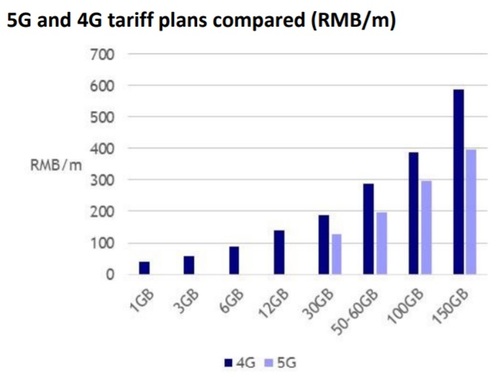
10 million people in China have already registered their intention to purchase 5G subscriptions as we wrote in this IEEE Techblog post.
Mike Dano of Light Reading had this assessment:
A big part of the “race to 5G” discussion centers on spectrum allocation. Operators in China and South Korea are mainly using midband spectrum like 3.5GHz for their 5G buildouts, while operators in the US are using bands ranging from 600MHz to 28GHz because there isn’t much available midband spectrum for 5G in the US. This could change in the months to come as the FCC moves to release midband C-Band spectrum for 5G in the US. Midband spectrum is useful for 5G because it toes the line between providing high-speed connections and covering large geographic areas.
However, in recent months some US policymakers have been working to move the goalposts in the “race to 5G” a bit by pointing out that China’s 5G buildout is mandated by the country’s ruling party while 5G buildouts in the US and elsewhere are driven by the economics of competition and capitalism. As FCC Commissioner Brendan Carr explained earlier this month, that means 5G networks in the US will be more directly aligned with consumer demands than 5G networks in China.
Regardless, China’s official 5G rollout is starting this week — in a country with about four times more potential customers than the US — and it’s undoubtedly going to dwarf the 5G efforts in other countries in terms of most industry metrics.
Huawei vs Apple 5G smartphones in China:
Huawei Technologies has increased its smartphone market share in China to a record 42% in the September quarter, growing shipments by 66% year over year, while Apple’s share fell by two percentage points to 5%, with its shipments falling 28% year over year, according to Canalys.
Huawei has already released 5G-enabled phones—and they’re cheaper than Apple’s high-end non-5G iPhones. More models from other Chinese competitors will likely come out in the next few quarters. Industry analysts don’t expect a 5G-enabled iPhone until late 2020.
Rosenblatt Securities analyst Jun Zhang predicts many low- to mid-end iPhone users in China could switch to a cheaper 5G Android phone in 2020. “We believe Apple still has yet to face its biggest challenge in China, which is the upcoming launch of 5G service in November as well as the coverage for 5G service expanding to 100 cities by the middle of 2020,” Zhang wrote in a Thursday research note. “We continue to expect Apple’s smartphone market share will decline once 5G service starts in more cities,” he wrote in a note to clients.
……………………………………………………………………………………………………………………………………………………………………………………………………………..
References:
3GPP Release 16 Update: 5G Phase 2 (including URLLC) to be completed in June 2020; Mission Critical apps extended
NOTE: This article is intended as a reference, which is especially important to debunk claims made about current pre-standard 5G deployments which are almost all based on 3GPP Release 15 “5G New Radio (NR)” for the data plane with LTE signaling and LTE mobile packet core (EPC) for Non Stand Alone (NSA) operation. 5G pundits continue to site 3GPP as the standards organization responsible for 5G which is doubly wrong because it’s not a standards body and submits its 5G/IMT 2020 proposals to ITU-R WP 5D via the latter organizations member entities. As we’ve stated many times before, ITU-R is responsible for the radio standards for IMT 2020, while ITU-T is working on the non-radio aspects of IMT 2020.
………………………………………………………………………………………………………………………………………………………………………………………………………………..
Summary:
3GPP Release 16 is a major release for the project, because it will bring the specification organization’s IMT-2020 RIT/SRIT submission (to ITU-R WP 5D) for an initial full 3GPP 5G system to its completion. Release 16 will be put in a “frozen” state in March 2020 with a targeted completion date of June 2020.
3GPP work has started on approximately 25 Release 16 studies, which cover a variety of topics: Multimedia Priority Service, Vehicle-to-everything (V2X) application layer services, 5G satellite access, Local Area Network support in 5G, wireless and wireline convergence for 5G, terminal positioning and location, communications in vertical domains and network automation and novel radio techniques. Further items being studied include security, codecs and streaming services, Local Area Network interworking, network slicing and the IoT.
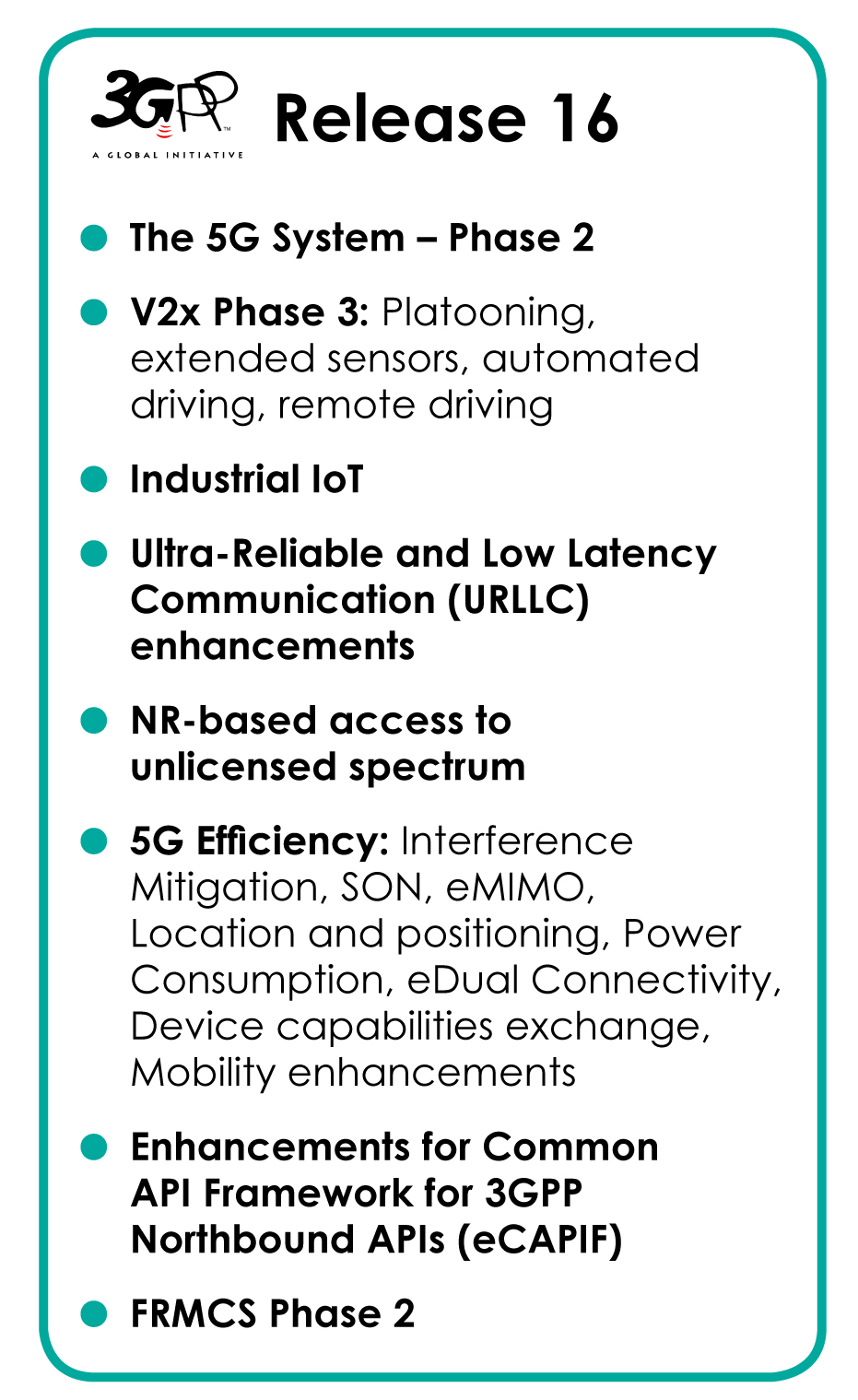
Here are the new features planned for 3GPP Release 16:
Details of the features and work items under each 3GPP Release are kept in the corresponding, on-line, list of features and study items.
- Enhancement of Ultra-Reliable (UR) Low Latency Communications (URLLC)
- 5GS Enhanced support of Vertical and LAN Services
- Cellular IoT support and evolution
- Advanced V2X support
- 5G Location and Positioning Services
- UE radio capability signalling optimization
- Satellite Access in 5G
- Enablers for Network Automation Architecture for 5G
- Wireless and Wireline Convergence Enhancement
- Mission Critical, Public Warning, Railways and Maritime
- Streaming and TV
- User Identities, Authentication, multi-device
- (Network) Slicing
- Other cross-TSG Release 16 Features
- NR-related Release 16 Features
- Release 16 Features impacting both LTE and NR
- LTE-related Release 16 Features
From 3GPP’s July 18, 2019 Webinar:
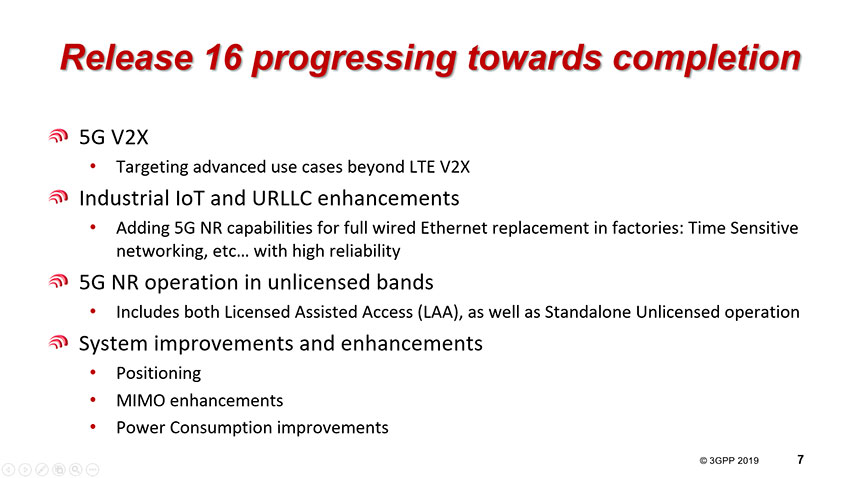
“For the (industry) verticals, there are three distinct pillars that we are focused on: Automotive, Industrial IoT and Operation in unlicensed bands. For 5G based V2X, which builds on the two iterations of the LTE-V2X, we are now adding advanced features – primarily in the area of low latency use cases.
The second focus is industrial IoT and URLLC enhancements. Factory automation, in particular, is a strong pillar for 5G going forward. We are trying to ensure that the radio side covers all of the functions that all the verticals need for factory automation. What this means in practice is that we are trying to make sure 5G NR can fully replace a wired ethernet – currently used – by adding time sensitive networking and high reliability capabilities.
The third pillar is operation in unlicensed bands. We have seen different schemes for generic 5G licensing strategies in Europe and in other parts of the World. We have seen in some countries that certain licensed bands have been allocated for vertical use cases, though that is not the case for a majority of countries. The use of unlicensed bands provides a great opportunity – where licensed spectrum is not an option. We are now focused on not only what we have with LTE, which is the licensed assisted access scheme, but also on standalone unlicensed operation – to be completed in Release 16.
Release 16 also delivers generic system improvements & enhancements, which target Mobile Broadband, but can also be used in vertical deployments – Particularly; positioning, MIMO enhancements and Power consumption improvements.”
………………………………………………………………………………………………………………………………………………………………………………………………….
Technical Reports (the result of the study phase) are also being developed on broadening the applicability of 3GPP technology to non-terrestrial radio access (initially satellites, but airborne base stations are also to be considered) and to maritime aspects (intra-ship, ship-to-shore and ship-to-ship). Work also progresses on new PMR functionality for LTE, enhancing the railway-oriented services originally developed using GSM radio technology that is now nearing end of life.
As part of Release 16, Mission Critical (MC) services will be extended to address a wider business sector than the initial rather narrow public security and civil defense services for which they had originally been developed. If the same or similar standards can be used for commercial applications (from taxi dispatching to railway traffic management, and other vertical sector scenarios currently being investigated), this would bring enhanced reliability to those MC services through wider deployment, and reduced deployment costs due to economies of scale – to the benefit of all users.
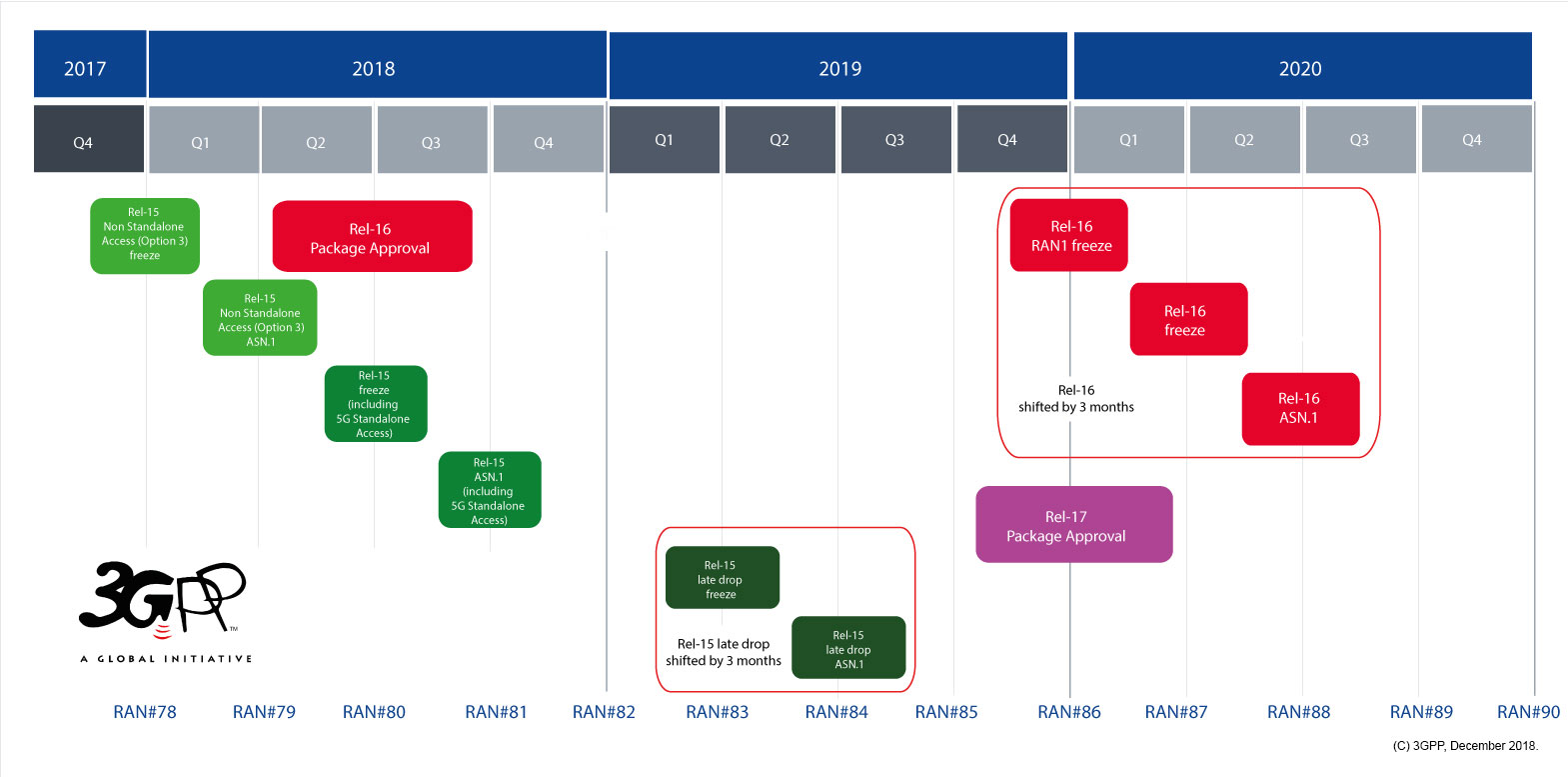
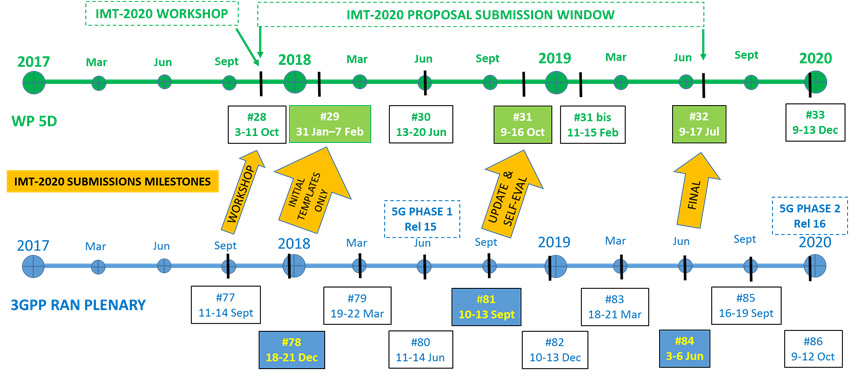
IMT-2020 – Final submission
- Calibration for self evaluation
- Prepare and finalize initial description template information that is to be submitted to ITU-R WP 5D#29.
Step 2: From early 2018 to Sep 2018, targeting “update & self eval” submission in Sep 2018
- Performance evaluation against eMBB, mMTC and URLLC requirements and test environments for NR and LTE features.
- Update description template and prepare compliance template according to self evaluation results.
- Provide description template, compliance template, and self evaluation results based on Rel-15 in Sep 2018.
Step 3: From Sep 2018 to June 2019, targeting “Final” submission in June 2019
- Performance evaluation update by taking into account Rel-16 updates in addition to Rel-15
- Update description template and compliance template to take into account Rel-16 updates in addition to Rel-15
- Provide description template, compliance template, and self evaluation results based on Rel-15 and Rel-16 in June 2019.
Some Background on Release 16
- See the full Release 16 Description – TR21.916 (Available at Release freeze)
- RAN Rel-16 progress and Rel-17 potential work areas (July 18, 2019)
- Early progress on Rel-16 bands for 5G (April 2, 2019)
- “Working towards full 5G in Rel-16”…See 3GPP webinar presentation (July 3, 2019)
- Preparing the ground for IMT-2020
- SA1 completes its study into 5G requirements
……………………………………………………………………………………………………………………………………………..
References:
https://www.3gpp.org/release-16
https://www.3gpp.org/news-events/2058-ran-rel-16-progress-and-rel-17-potential-work-areas
…………………………………………………………………………………………………………………………………………………………………………………………………….
Addendum (December 14, 2020):
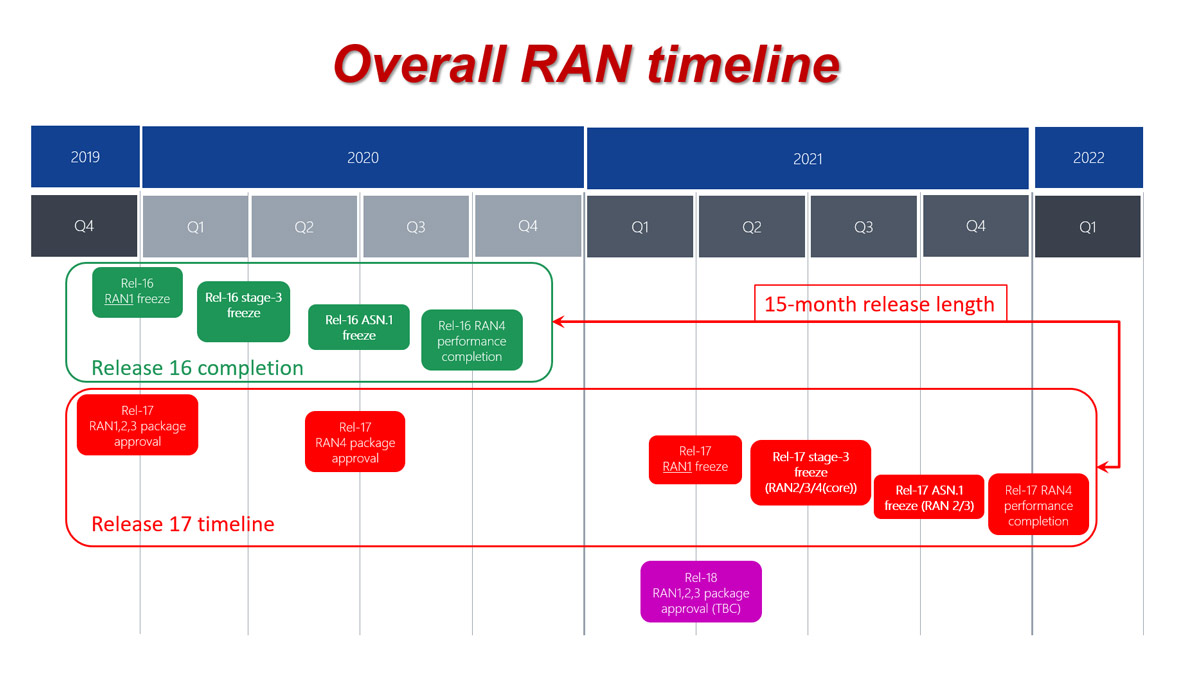
https://www.3gpp.org/news-events/2098-5g-in-release-17-%E2%80%93-strong-radio-evolution
China’s telecom carriers to play a pioneering role in 5G; China Telecom and China Unicom may be barred from U.S.
by Ma Si <[email protected]> of China Daily Multimedia Co. Ltd.
Xiang Ligang, director-general of the Information Consumption Alliance, a telecom industry association, and a keen observer of the telecom sector for nearly two decades, said: “Chinese telecom companies have made big strides in their innovation capabilities, through their consistent and heavy input into research and development. They have strong willingness to pioneer cutting-edge applications.”
Four of the world’s top six smartphone makers – Huawei, Xiaomi, Oppo and Vivo – are Chinese. In 2018, the country produced 1.8 billion smartphones, accounting for 90 percent of global production, data from the Ministry of Industry and Information Technology showed.
Their decades of efforts have helped nurture the world’s largest online population in a single nation – the 854 million strong Chinese netizens (as of June). That is more than the combined population of European countries. More importantly, more than 99 per cent of netizens in China surf the internet through smartphones.
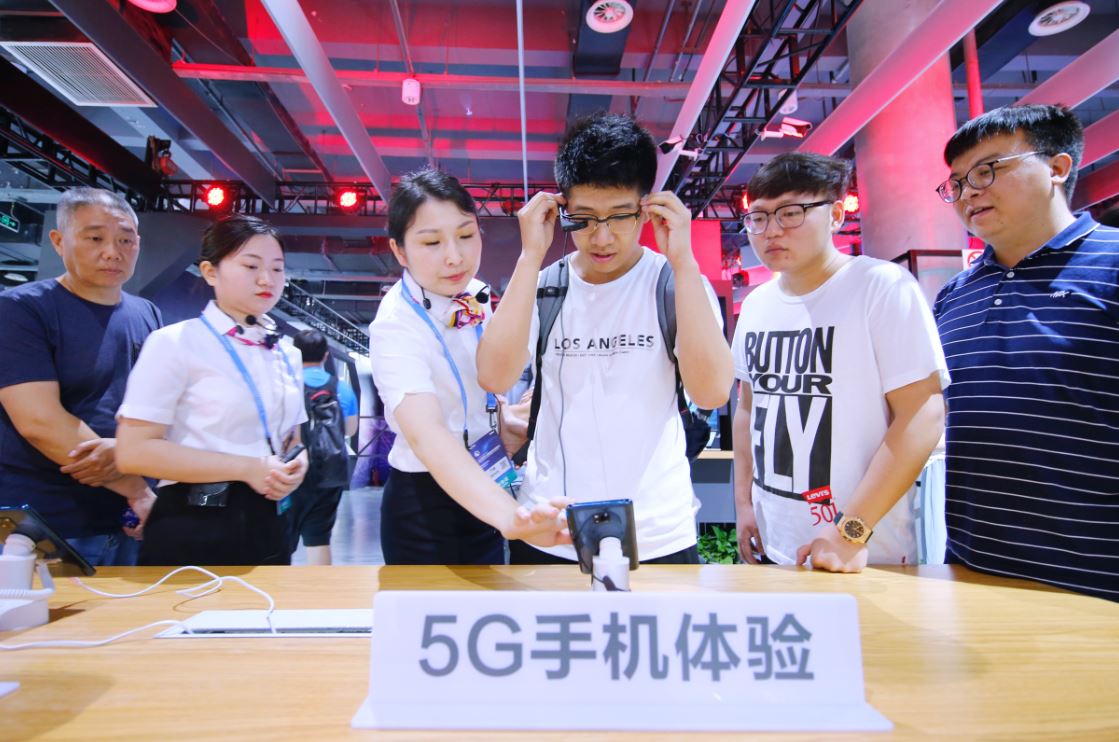
Vistors try 5G phones at an international expo on June 20, 2019. [Photo by Liu Chenghe/For China Daily]
…………………………………………………………………………………………………………………………………………………………………………………………………………………………………………………
Wu Jichuan, 82, a former head of the former Ministry of Posts and Telecommunications, said handsets are becoming almost omnipresent in the country. They can help users do almost everything from buying movie tickets, booking hospital or clinic appointments to ordering meals.
“That was in sharp contrast to 1980’s when mobile communication services were first brought to China. Back then, only successful Chinese businesspeople were able to use brick-sized, palm-filling mobile phones,” Wu recalled.
Such phones, however, were capable of just two functions: making and receiving calls. Yet, they were luxury products of the time. A handset could cost as much as about 20,000 yuan ($2,798). Consumers had to pay an extra fee of 6,000 yuan to sign up for the telecom network services. Calls cost 5 jiao a minute. In comparison, the average salary of ordinary people was no more than 100 yuan a month, Wu said.
According to Wu, one of the biggest contributions of China’s telecom industry is that it laid down a sound digital infrastructure for companies and consumers to access fast internet networks at affordable prices. They laid the foundation for China’s kaleidoscope of mobile applications and thriving digital economy.
Leveraging these achievements, the country’s telecom carriers are scrambling to establish a beachhead in the 5G era, in which almost everything can be connected to the internet.
As at the end of May, Chinese companies accounted for more than 30 percent of all patents essential to the global standards for 5G. After the country granted the commercial 5G licenses in June, local telecom carriers are working to build a sound network infrastructure to accelerate the technology’s commercialization.
Yang Jie, chairman of China Mobile, the world’s largest mobile operator, said the company plans to cover 50 cities across China with 5G signals by the end of this year.
“That will involve deploying 50,000 5G base stations across the country,” Yang said, adding that the company has already raised 7 billion yuan as the first phase of a 5G fund to promote the development of key technologies. The planned total size of the fund is 30 billion yuan.
Similarly, China Unicom said it will cover at least 40 cities with 5G signals by the end of this year and work together with all industry partners, including foreign companies, to accelerate 5G infrastructure construction.
Just a day after securing its 5G license, China Unicom announced it had opened experience stores across 40 cities to encourage consumers to try applications powered by the superfast technology.
Visitors can play with mechanical robotic arms, watch 4K high-definition live-streaming, wear virtual reality goggles to play 3-D games and learn that with 5G, doctors can complete surgeries on patients 2,500 kilometers away.
Lyu Tingjie, a telecom professor at the Beijing University of Posts and Telecommunications, said: “After all the hype about 5G, the new era has finally started. All the state-of-the-art applications are getting closer to the public than ever. The next question is: How to better time the rollout and partner with a wide range of traditional sectors to boost efficiency?”
The country’s telecom carriers are expected to spend 900 billion yuan to 1.5 trillion yuan on 5G network construction from 2020 to 2025, according to a report from the China Academy of Information and Communications Technology.
The first batch of 5G smartphones hit the market in August. China Unicom said its 5G data packages will cost a minimum of 190 yuan, arguably the world’s lowest price, in its first stage of application.
In comparison, the minimum cost in South Korea’s 5G data packages is about 325 yuan per month, while US telecom operator AT&T charges users $70 (equivalent to 498 yuan) for 15-gigabytes of 5G data every 30 days.
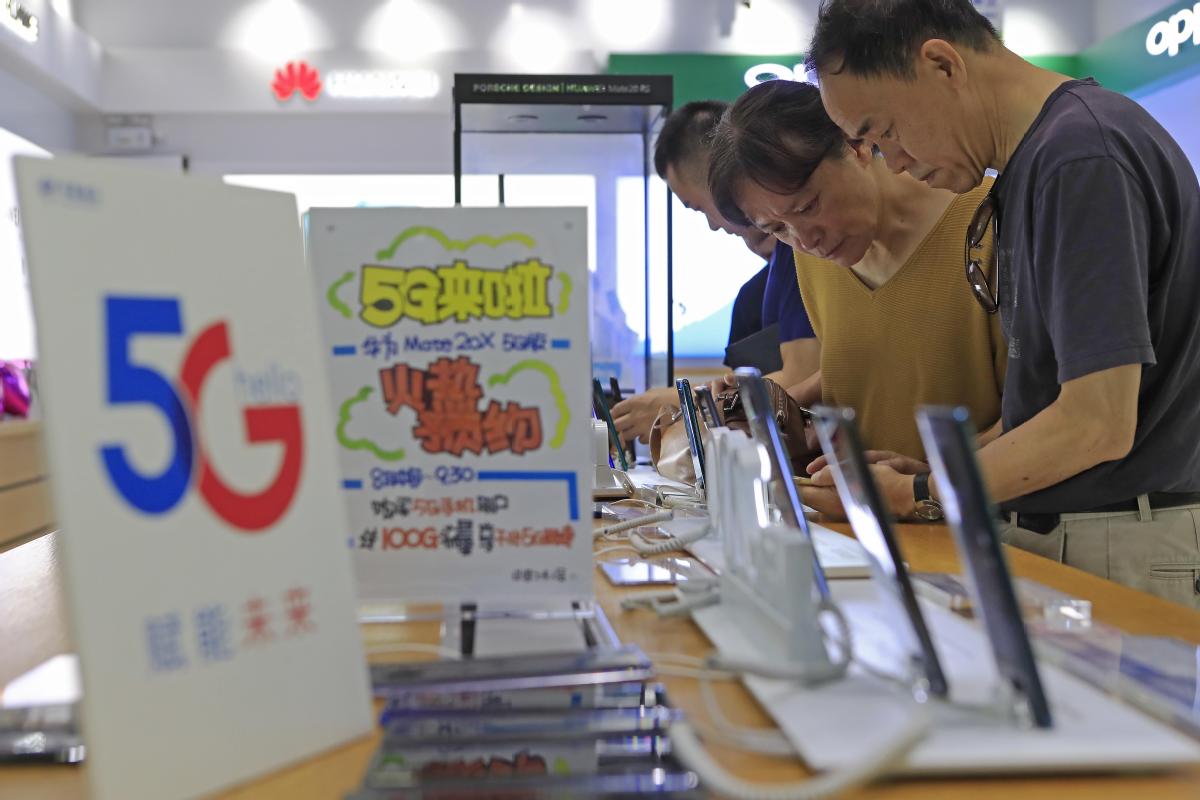
Consumers visit the booth of China Telecom as the company’s Shanghai branch launches a promotion called “Buy 5G mobile phones and enjoy 5G network.” [Photo by Ying Liqing/China News]
…………………………………………………………………………………………………………………………………………………………………………………………………………………………………………………………………………….
Meanwhile, Chinese telecom equipment makers are securing a growing number of 5G contracts to supply foreign telecom carriers. Huawei said it had signed 50 commercial contracts for 5G with carriers worldwide, with 28 contracts from Europe, 11 from the Middle East, six from the Asia-Pacific region, four from the Americas, and one from Africa.
According to a forecast by the Global System for Mobile Communications Association, an industry group, China is set to become the world’s largest 5G market by 2025, with 460 million 5G users.
……………………………………………………………………………………………………………………………………………………………………………………………………………………….
Sidebar: Huawei
In 2003, when Huawei Technologies Co, then known more as a manufacturer of telecom equipment like switches, and base stations, decided to set up a mobile phones department, China was still using 2G, or the second-generation wireless technology. Back then, only a fraction of consumers could use cellular phones to surf the internet. And it took them about five seconds or longer to open a web page.
Sixteen years later, Huawei is the world’s second-largest smartphone maker. Its 5G-enabled handsets can download heavy data files – say, a 1 GB movie – in seconds. That’s just a glimpse of the commercial possibilities in the 5G era, which China kicked off in June.
From a virtual non-entity in the global mobile phones market to a world-renowned company, Huawei’s rise has been meteoric, and it coincided with the development of China’s telecommunications industry.
Huawei, however, is just one of the many Chinese telecom companies that have thrived on the global stage in recent years, helping the country to transform from a follower during the period of 2G and 3G to a pioneer in the 5G era.
William Xu, a director on Huawei’s board and president of the Institute of Strategic Research, said the company has had more than 200,000 5G base stations in shipment, which marked a steady step forward, compared with its earlier announcement of 150,000 base stations in late June.
Huawei has invested about $4 billion in all so far in the research and development of 5G since 2009.Founder and CEO Ren Zhengfei has said in an interview that other players will not be able to catch up with Huawei in 5G over the next two to three years.
http://www.chinadaily.com.cn/a/201909/16/WS5d7ee28ca310cf3e3556b8d9.html
……………………………………………………………………………………………………………………………………………………………………………………………………………………….
Senators Urge F.C.C. to Review Licenses of 2 Chinese Telecom Companies:
Senator Chuck Schumer of New York along with Senator Tom Cotton of Arkansas, cited national security concerns in a letter to the FCC which asked the commission to review the licenses that giveChina Telecom and China Unicom, the right to use networks in the United States. In the letter, they said that the two Chinese government-linked telecom operators could use that access to “target” Americans’ communications. And they warned that the companies could reroute communications traveling on their networks through China. The text of the letter was obtained by The New York Times.
Brian Hart, an F.C.C. spokesman, said that Ajit Pai, the F.C.C. chairman, had made it clear that the agency was “reviewing other Chinese communications companies such as China Telecom and China Unicom” but didn’t commit to opening a formal proceeding to look at the licenses.
China Telecom denied that it represents a national security threat to the United States. China Unicom did not respond to a request for comment.
“We make the protection of our customers’ data a priority, and have built a solid reputation as one of the best telecom companies in the world,” said Ge Yu, a spokesman for China Telecom’s Americas subsidiary, adding that the company is proud of “maintaining a good standing with all regulatory agencies.”
National security officials have been worried for years that the Chinese government could use its companies to gain access to crucial telecommunications infrastructure. Those concerns have become more prominent as carriers in the United States and in China race to launch next-generation 5G wireless networks — and American regulators have targeted Chinese telecom companies in the name of security.
In May the F.C.C. denied an application from China Mobile to operate in the United States. Ajit Pai, the commission’s chairman, said at the time that there was a risk that the Chinese state would use the carrier to “conduct activities that would seriously jeopardize the national security, law enforcement, and economic interests of the United States.”
So if the FCC bans China Telecom and China Unicom it will be a trifecta ban on all three state owned Chinese telecom operators!
https://www.nytimes.com/2019/09/15/business/federal-communications-commission-china.html
………………………………………………………………………………………………………………………………………………………………………………………………………………………..
China Races Ahead of the U.S. in the Battle for 5G Supremacy + 5G to stimulate US$500B in China tech growth over next 5 years (CAICT)
Bloomberg: China Races Ahead of the U.S. in the Battle for 5G Supremacy
by Sheryl Tian Tong Lee –with assistance from Ed Ludlow (emphasis added by Alan J Weissberger)
In the race for tech supremacy, China is betting it can seize the lead by building the world’s biggest 5G wireless networks.
To get there, the country is banking on the might of the one-party state, making sure its state-run carriers have access to cheap airwaves and fast, inexpensive approvals for putting up the hundreds of thousands of base stations the fastest wireless technology requires.
As top phone companies elsewhere flinch at the cost of building 5G wireless networks, China’s operators are barreling ahead on the government’s mandate, virtually free airwaves and equipment at less than half the price U.S. carriers are paying. Being the first to reach massive scale with the speediest networks could also help the nation in its ambition to dominate industries like factory automation, robotics and autonomous driving.
“5G is a foundation and catalyst for reinventing industries,” said Paul Lee, U.K.-based head of research for technology, media and telecommunications at Deloitte Consulting. “The fundamental benefit of being the first mover is that you can build business models on the back of that and export them to other countries.”
…………………………………………………………………………………………………………………………………………………………………………………………………
South Korea’s wireless carriers were the first to offer commercial 5G services, with SK Telecom Co. launching its network in April and Samsung Electronics Co. already offering a 5G-enabled smartphone. But while U.S. carriers in cities like Minneapolis and Chicago have the beginnings of 5G offerings, it’s in sheer scale where China is on course to edge ahead over the next five years.
That size advantage is also reflected in China’s push to invent 5G technology.
The country’s biggest companies have already established a lead in patents related to the fastest network technology. Huawei Technologies Co., the contentious Chinese firm that’s at the heart of current U.S.-China tensions, leads the pack as the world’s biggest telecom equipment supplier. Meanwhile, ZTE Corp., which has also drawn America’s ire in the past, comes in at No. 3, according to Berlin-based patent information platform IPlytics.
But that won’t necessarily translate into network domination. China’s three carriers — China Mobile Ltd., China Unicom Hong Kong Ltd. and China Telecom Corp. — are all state owned.
Harvard Business School economist Shane Greenstein says having a bigger government role in 5G may not provide an advantage. “The private firms in China in the digital sector have an admirable record with experimentation,” he said. “The state-owned enterprises? That is a more open question.”
Where the government is helping is by holding carriers’ costs down. Beijing is providing the bandwidth for 5G networks almost for free, said Edison Lee, head of telecommunications research at Jefferies Hong Kong Ltd.
U.S. carriers, by contrast, bid $2.7 billion at two auctions of 5G airwaves, according to the Federal Communications Commission. In India, the industry group representing carriers says its members can’t afford spectrum the government expects to auction for about $84 billion this year.
China’s operators will also pay less for base stations. The units will probably cost about $30,000 each in China, less than half the $65,000 average in other developed-economy markets, Jefferies’ Lee estimates. Two of China’s carriers have said they will lease the equipment, cutting the upfront cash outlay to roughly $6,500 each per year, Lee said.
In the U.S., where the government is leaving 5G to companies, carriers will also pay at least five times more than Chinese operators for civil engineering and permits to build 5G, Deloitte Consulting estimates.
The world’s most populous country has about 350,000 5G-operable base stations deployed, nearly 10 times as many as in the U.S., according to a U.S. Department of Defense study. The report says China claiming the position of standard-setter for 5G, with Huawei leading rival telecom equipment makers, is a risk for the U.S. This “will create serious security risks for DoD going forward if the rest of the world accepts Chinese products as the cheaper and superior option for 5G,” said the report.
Concern about China’s edge prompted President Donald Trump to float a proposal last year for the government to build a secure 5G network, people familiar with the matter said at the time. The idea was dropped immediately after regulators, industry leaders and elected officials immediately pushed back, saying companies were in a better position to move the technology forward.
The idea of China securing that advantage is also stoking concern among competitors beyond the telecommunications equipment and wireless services industries.
Chip maker Qualcomm Inc., for example, is urging the U.S. and other Western governments to embrace 5G more rapidly or risk falling behind China in the potentially life-saving technology, which is also used in self-driving cars.
China will be “saving hundreds if not thousands of lives much sooner than we will as we fumble to determine which is the standard that is best for the long-term road map in the Western world,” Qualcomm Senior Vice President Patrick Little said in an interview.
While China’s autonomous driving infrastructure lags behind the U.S., where firms like Alphabet Inc.’s Waymo LLC are streaking ahead in real-world testing, Chinese companies are developing related 5G applications with some established car makers.
ZTE is conducting 5G tests on self-driving cars, and has cooperated with Audi AG’s China unit to develop “internet-of-vehicles” technology. In robotics, ZTE is working with internet giant Baidu Inc. and Siasun Robot & Automation Co. to develop 5G applications.
Byton Ltd., an electric-vehicle startup based in Nanjing, will release an SUV in China at the end of this year that includes a range of artificial intelligence functions and a roof antenna that offers data transfer rates up to 10 Gbit a second, which it says is hundreds of times the normal average bandwidth.
The benefits of setting 5G standards may also help China outside its borders. President Xi Jinping’s Belt and Road Initiative includes a push for Chinese-built network infrastructure across the length of a route that runs across Eurasia, the Middle East and parts of Africa.
“Developing countries that are more sensitive to cost will find the Chinese 5G price-point difficult to turn down, especially when the offer is sweetened with infrastructure and project-financing incentives like the Belt and Road Initiative,” the U.S. Department of Defense report said.
For its part, the U.S. is letting the private sector guide 5G development, Federal Communications Commission Chairman Ajit Pai said in a June speech to wireless executives in New York.
“For all this talk about our government’s focus on 5G, make no mistake that we are pursuing a market-based strategy to promote 5G development and deployment,” Pai said.
And the U.S.’ crackdown on Huawei, cutting it off from components made by American companies, will be a big test of China’s 5G lead, says Anthea Lai, Asia Pacific media, technology and telecommunications analyst for Bloomberg Intelligence.
“Before Huawei’s ban, China had strong potential to lead in standalone 5G,” Lai said. “But now we have to see how much Huawei can keep its carrier business intact,” she said. “Huawei could slow China down.”
…………………………………………………………………………………………………………………………………………………………………………………..
To contact the reporter on this story: Sheryl Tian Tong Lee in Hong Kong at [email protected]
To contact the editors responsible for this story: Dave McCombs at [email protected], Jason Clenfield
©2019 Bloomberg L.P.
Original article at: https://www.bnnbloomberg.ca/china-races-ahead-of-the-u-s-in-the-battle-for-5g-supremacy-1.1296079
………………………………………………………………………………………………………………………………………………………………………………………
From South China Morning Post: 5G to stimulate US$500 billion in China tech growth over next five years
At the Global Mobile Internet Conference held in the southern coastal city of Guangzhou on Saturday, a representative from the China Academy of Information and Communications Technology (CAICT) forecast that 5G will stimulate growth in the country’s information technology industry by 3.3 trillion yuan (US$479 billion) over the next five years. That development is expected to rev up digitization across traditional industries, which would yield more than 10 trillion yuan in growth over the same period.
………………………………………………………………………………………………………………………………………………………………………………………..
“4G has changed people’s lives,” said Chen Jinqiao, deputy chief engineer at the academy, which is under the Ministry of Industry and Information Technology (MIIT), during his presentation on China’s 5G development in the conference. But he indicated that 5G has the potential “to change society,” as different industries adopt the technology to their various requirements.
Chen’s growth estimates come amid the increased pace of 5G infrastructure spending in China, which is attempting to move ahead in the global race to deploy ultra-fast, next-generation mobile networks.
With peak data rates up to 100 times faster than what current 4G networks provide, 5G has been held out as “the connective tissue” for the Internet of Things, autonomous cars, smart cities and other new mobile applications, establishing the backbone for the industrial internet.
………………………………………………………………………………………………………………………………………………………………………………………..
References:
https://techblog.comsoc.org/tag/chinas-imt-2020-promotion-group/
http://www.imt-2020.cn/en/category/65569
https://money.cnn.com/2018/04/16/technology/china-united-states-5g-technology-study/index.html
Updated information on China’s IMT-2020 Submission
1 Introduction
At its 29th meeting of ITU-R Working Party (WP) 5D, China submitted in Document 5D/838 the initial characteristics template of the candidate technology for the terrestrial components of IMT-2020.
The initial characteristics template was based on 3GPP development, and includes the key characteristics description according to the progress in 3GPP at that time. The provided template description reflects the development of the major component, and does not preclude other component(s) that might be included in later update.
In this document, the updated information of China development towards IMT-2020 submission is provided.
2 Updated information
To complete the submission under Step 3 of the IMT-2020 process as defined in Document IMT‑2020/2(Rev.1), China is preparing the self-evaluation report, the complete set of submission template (including the updated characteristics template that captures new progress compared to the one provided in Document 5D/838, link budget template, and compliance template), and compliance with IPR policy.
The technical development of the candidate technology for the terrestrial components of IMT-2020 of China is undergoing, and China’s development and outcomes of the research of the candidate radio technologies are contributed from the members of IMT-2020 (5G) Promotion Group to 3GPP. In this context, China development is aligned with the on-going 3GPP development. According to 3GPP schedule, 3GPP Rel-15 was completed in June 2018.
The self-evaluation is also under preparation. The technical parameters and configuration parameters that applied to the candidate radio interface technology are under investigation. The detailed evaluation methodology for the technical performance requirements are under development. The outcome of these studies are also contributed to 3GPP from the members of IMT‑2020 (5G) Promotion Group. The initial evaluation parameters for eMBB are captured in Section 2 of 3GPP documents R1-1803386 and R1-1805644, respectively. And the detailed evaluation method for mobility is captured in Section 2 of 3GPP document R1-1805643. China will conduct the self-evaluation accordingly.
Editor’s Notes:
- China’s IMT-2020 Promotion Group documents can be downloaded (free) here.
- Detailed ITU-R WP5D China IMT2020 submission contributions are here (TIES Users only).
- Key IMT 2020 results of ITU-R WP5D Oct 2018 meeting in Fukuoka, Japan:
IMT-2020 RIT submission:
This meeting received updated information related to the proposal of candidate IMT-2020 radio interfaces (RITs) from ETSI and DECT Forum (Document 5D/1046); and also updated submissions of candidate IMT-2020 radio interfaces from 3GPP (Document 5D/1050), China (Document 5D/1055), and Korea (Document 5D/1077). These contributions were reviewed and the respective IMT-2020 documents were revised accordingly. (No updates from India which had previously indicated it’s plan to submit).
IMT-2020 evaluation:
An initial evaluation report was received from the Evaluation Group TPCEG and reviewed. An IMT-2020 Document was created to record the evaluation report (Document 5D/TEMP/608). In addition, SWG Evaluation also started to review the received self-evaluation results from 3GPP, China and Korea.
A draft liaison statement to the Registered Independent Evaluation Groups was developed to update the work progress within WP 5D on Evaluation of IMT-2020 candidate technologies (Document 5D/TEMP/610).
3 Conclusion
China kindly invitesWP 5D to view the above information, and take them into account in Document IMT-2020/5.
China will provide the latest information related to the development of candidate radio interface technology of IMT-2020 in a timely manner.
………………………………………………………………………………………………….
Characteristics template for
Candidate Radio Interface Technology of ’NR+NB-IoT’ RIT
This characteristics template provides the description of the characteristics of the candidate IMT-2020 radio interface technology (RIT) based on 3GPP Rel-15 work. The candidate RIT is composed of NR and NB-IoT.
It is noted that new features in addition to the ones provided in this characteristics template might be included in future update for the RIT.
For this characteristics template, China has addressed most of the characteristics that are viewed to be helpful to assist in evaluation activities for independent evaluation groups, as well as to facilitate the understanding of the state-of-art of the development on the RIT. In future submission, further information will be included.
GSMA calls for 5G policy incentives in China + 2018 MWC Shanghai a big success!
China is expected to become the world’s largest 5G market by 2025, accounting for around 430 million 5G connections, representing a third of the global total.
Industry verticals where 5G are expected to play a key role include: automotive, drones and manufacturing. The report calls for China to promote the development of legislation for areas such as car-hacking and data privacy to support China’s connected car market.
The report notes that China Mobile, China Telecom and China Unicom are all currently trialing 5G autonomous driving and working on solutions such as cellular vehicle-to-everything (C-V2X) for remote driving and autonomous vehicles.
To accelerate the development of the drone market, the report calls for common standards for connectivity management. The drone market is expected to be worth around $13 billion by 2025.
Finally, the report calls for common standards for interconnection between Industry 4.0 platforms and devices (more below) to avoid market fragmentation, drive economies of scale and increase speed to market.
“China’s leadership in 5G is backed by a proactive government intent on delivering rapid structural change and achieving global leadership – but without industry-wide collaboration, the right incentives or appropriate policies in place, the market will not fulfil its potential,” commented Mats Granryd, Director General, GSMA. “Mobile operators should be encouraged to deliver what they do best in providing secure, reliable and intelligent connectivity to businesses and enterprises across the country.”
“Wide collaboration and a right policy environment are essential for 5G to unleash its potential in various verticals, and the three sectors addressed in the report are only a beginning,” said Craig Ehrlich, Chairman of GTI. “The Chinese government and all three operators have been propelling 5G trials and cross-industrial innovation, and the valuable experience gained from the process should serve as a worthwhile reference for the other markets around the globe.”
velopment of legislation for areas such as car-hacking and data privacy. New policies should be pro-innovation and pro-investment to encourage future developments in the sector. All three operators are currently trialling 5G autonomous driving and working on solutions such as Cellular Vehicle-to-Everything (C-V2X) for remote driving, vehicle platooning and autonomous vehicles.
Accelerated Growth of Drones Market:
The report also calls for common standards for connectivity management in the drones market to help accelerate investment and the deployment of new infrastructure and service models. The drones market, estimated to be worth RMB80 billion ($13 billion) by 2025, is developing rapidly in China in applications such as parcel delivery and tracking, site surveying, mapping and remote security patrols, among others. Improvements in mapping, real-time video distribution and analytics platforms are also helping to establish the technology in industrial verticals.
China Entering Age of Industry 4.0:
Backed by government support, China is transforming its manufacturing industry through embracing the use of artificial intelligence, the Internet of Things (IoT), machine learning and analytics. The government’s aim is to increase productivity and drive new revenue opportunities. The report calls for common standards for interconnection between platforms and devices to avoid market fragmentation, drive economies of scale and increase speed to market. GSMA Intelligence estimates that there will be 13.8 billion global Industrial IoT (IIoT) connections by 2025 with China accounting for 65%.
………………………………………………………………………………………………………..
Separately, GSMA today reported that more than 60,000 unique visitors from 112 countries and territories attended the 2018 GSMA Mobile World Congress Shanghai, from 27-29 June in Shanghai. The three-day event attracted executives from the largest and most influential organisations across the mobile ecosystem, as well from companies in a range of vertical industry sectors. In addition to this business-to-business audience, nearly 8,800 consumers from the greater Shanghai metropolitan area attended the Migu Health and Fitness Festival, which was held in the Mobile World Congress Shanghai halls at the Shanghai New International Exhibition Centre (SNIEC).
“We are extremely pleased with the results for the 2018 Mobile World Congress Shanghai, particularly the very strong growth in our business-to-business segment,” said John Hoffman, CEO, GSMA Ltd. “Attendees were able to truly “Discover a Better Future”, from the thought leadership conference to the exhibition and everywhere in between. With more than two-thirds of the world’s population as subscribers, mobile is revolutionising industries and improving our everyday lives, creating exciting new opportunities while providing lifelines of hope and reducing inequality. Mobile truly is connecting everyone and everything to a better future.”
Covering seven halls at the SNIEC, the 2018 Mobile World Congress Shanghai hosted 550 exhibitors, nearly half of which come from outside of China. The conference programme attracted nearly 4,000 attendees, with more than 55 per cent of delegates holding senior-level positions, including nearly 320 CEOs. Nearly 830 international media and industry analysts attended Mobile World Congress Shanghai to report on the many industry developments highlighted at the show.
………………………………………………………………………………………………………………………………………………….
About the GSMA:
The GSMA represents the interests of mobile operators worldwide, uniting nearly 800 operators with more than 300 companies in the broader mobile ecosystem, including handset and device makers, software companies, equipment providers and internet companies, as well as organisations in adjacent industry sectors. The GSMA also produces industry-leading events such as Mobile World Congress, Mobile World Congress Shanghai, Mobile World Congress Americas and the Mobile 360 Series of conferences.
For more information, please visit the GSMA corporate website at www.gsma.com. Follow the GSMA on Twitter: @GSMA
About the GTI:
GTI (Global TD-LTE Initiative), founded in 2011, has been dedicated to constructing a robust ecosystem of TD-LTE and promoting the convergence of LTE TDD and FDD. As 4G evolves to 5G, GTI 2.0 was officially launched at the GTI Summit 2016 Barcelona, aiming not only to further promote the evolution of TD-LTE and its global deployment, but also to foster a cross-industry innovative and a synergistic 5G ecosystem.
For more information, please visit the GTI website at http://gtigroup.org/
Is FCC Net Neutrality Rollback Coming? Will that spark cablcos investment in rural/ suburban areas? AT&T won’t challenge FTC
Net neutrality advocates are declaring June 26 another day of action in support of Democrats’ resolution to restore the 2015 Obama-era net neutrality rules. Public Knowledge, Common Cause, Consumers Union and other groups want to bring pro-net neutrality Americans directly to the offices of their representatives in the House to lobby for passage of the measure, drawn up under the Congressional Review Act. The Senate passed it 52-47 last month, and so far 124 House lawmakers have signed the paperwork to force a floor vote (they need 218, so they’ve got some work cut out for them). TechFreedom is hosting a more skeptical panel discussion on Democrats’ effort Tuesday. Among the panelists slated to appear is Grace Koh, who advised President Trump on telecom issues until she left the White House earlier this year.
Tom Leithauser of TR Daily (subscription required) wrote yesterday:
The rollback of net neutrality rules by the FCC will spark broadband investment in rural and suburban areas served by small and mid-sized cable TV operators, Matthew Polka, president and chief executive officer of the American Cable Association, said on this week’s “The Communicators” program.
“It created a sense of greater innovation and investment that these companies can now deploy,” Mr. Polka said on the show, which is set to air on C-SPAN tomorrow and C-SPAN2 on Monday.
He noted that broadband networks were increasingly being viewed as “infrastructure” by policy-makers and that deployment to underserved and unserved areas was a top priority at the FCC and among some members of Congress.
One impediment to broadband deployment, he said, is the time and cost required to arrange access to utility poles. Andrew Petersen, an ACA board member and senior vice president for TDS Telecom who also appeared on the C-SPAN program, said pole attachment rates for his company averaged $7.80 per pole, but were significantly higher in some markets. “It really retards our ability to make those investments to extend broadband,” Mr. Petersen said.
Mr. Petersen expressed hope that the FCC’s Broadband Deployment Advisory Committee would offer recommendations on ways to lower the cost of pole attachments and other broadband deployment expenses, which he said were his company’s top cost.
“When you bring robust broadband to a new area, you’re combatting the ‘homework gap,’ [and] you’re allowing for economic development and commerce to take place,” Mr. Petersen said. He said it was unlikely, however, for 5G service to bring broadband to unserved areas because those areas generally lack structures needed to place 5G equipment.
“We’re not bullish that 5G is going to make its way to suburban and rural areas immediately,” he said. “I don’t believe 5G technology is going to make its way to those areas in the next several years.”
In a related CNET post, Margaret Reardon wrote:
AT&T has given up efforts to challenge the Federal Trade Commission’s authority to regulate broadband (Internet access) providers. AT&T on Tuesday informed court officials that it would not file a petition to the US Supreme Court to challenge a lower court’s decision in the case. In 2014, the FTC sued AT&T in the US District Court of Northern California, accusing the company of promising unlimited data service to customers and then slowing that service down to rates that were barely usable. The case hasn’t yet gone to trial since AT&T had argued that the FTC has no authority over any of AT&T’s businesses.
The US Appeals court in Northern California rejected that argument in February and said the case could proceed. AT&T had until May 29 to file an appeal the the Supreme Court to challenge the decision.
AT&T indicated earlier this month in a status report submitted to the appeals court that it was considering appealing to the Supreme Court to stop the case.
This case was being closely watched by net neutrality supporters, because the question of whether the FTC has authority over AT&T would have had big implications for the future of the internet and whether there will be any cop on the beat ensuring that consumers are protected from big phone companies abusing their power online.
Why? When the Federal Communications Commission gave up its authority to police the internet with its repeal of net neutrality regulations in December, it specifically handed authority to protect consumers online to the FTC.
Net neutrality is the idea that all traffic on the internet should be treated equally and that large companies like AT&T, which is trying to buy Time Warner, can’t favor their own content over a competitor’s content. Rules adopted by a Democrat-led FCC in 2015 codified these principles into regulation. The current FCC, controlled by Republicans, voted to repeal the regulations and hand over authority to protect internet consumers to the FTC.
But there was one hitch in the law that could have made it impossible for the FTC to oversee some of the biggest broadband companies. Many of these companies, like AT&T and Verizon, also operate traditional telephone networks, which are still regulated by the FCC. AT&T argued that because some aspects of its business, like its traditional phone services, are regulated by the FCC, the FTC doesn’t have jurisdiction.
A federal appeals court disagreed with AT&T’s argument, stating the FTC can fill in oversight gaps when certain services, like broadband, aren’t regulated by the FCC. If AT&T had appealed to the Supreme Court and if the court had taken the case and ruled in AT&T’s favor, it would have meant that phone companies providing broadband or wireless internet services would be immune from government oversight. By contrast, cable companies, which do not operate traditional phone networks regulated by the FCC, would still be under the authority of the FTC.
For now, that doomsday scenario is put to rest and the lower court’s ruling that the FTC can, in fact, oversee all broadband providers stands.
Meanwhile, net neutrality supporters continue their fight to preserve the 2015 rules. Several states, including California and New York, are considering legislation to reinstate net neutrality rules. Earlier this year, Washington became the first state to sign such legislation into law. Governors in several states, including New Jersey and Montana, have signed executive orders requiring ISPs that do business with the state adhere to net neutrality principles.
Democrats in the US Senate are also trying to reinstate the FCC’s rules through the Congressional Review Act, which gives Congress 60 legislative days in which to overturn federal regulations. The resolution passed the Senate earlier this month and must pass the House of Representatives and eventually be signed into law by President Donald Trump to officially turn back the repeal of the rules.
Ericsson’s Deliverables and Take-aways from IoT World 2018 & Private Briefing
Ericsson is one of the top three wireless network equipment companies in the world (they were #1 until Huawei took that coveted spot). Approximately 40% of the world’s mobile traffic is carried over Ericsson networks. The company has customers in 182 countries and offers comprehensive industry solutions ranging from Cloud services and Mobile Broadband to Network Design and Optimization. Ericcson also has one of the most compelling IoT platforms in their IoT Accelerator, which we described earlier this year.

Image above courtesy of Ericsson
…………………………………………………………………………………………………………………………………………………………………..
Ericsson had a huge presence at IoT World 2018 with an impressive exhibit floor booth, a Wednesday private briefing session at their Santa Clara, CA location and three presentations at IoT World 2018 conference sessions.
I attended the private briefing at Ericsson- Santa Clara, got a tour of some of the exhibits there, heard the talk by Shannon Lucas (VP. Head of Emerging Business Unit in North America) on Tuesday and met with Ericsson’s IoT expert Mats Alendal on Thursday for a one on one conversation about Ericsson’s IoT strategy and associated wireless WANs (e.g. NB-IoT, LTE-M, and “5G”).
Most surprising was that Mats claimed that the transition from 4G LTE to whatever the 5G RAN/RIT is will be ONLY A SOFTWARE UPGRADE OF ERICSSON’S BASE STATION. He also said that if the 5G latency could be reduced to 1 or 2 ms, it would open up many new real time Industrial IoT (IIoT) applications that we haven’t thought of yet. Such a low latency would require a controlled environment, typically in a manufacturing plant or similar, and mm wave radio.
Currently most IIoT applications rely on wired connectivity on a factory floor, manufacturing plant or test facility. In a few cases wireless LANs (e.g. WiFi, Zigbee, proprietary) might be used. Hence, wireless WAN connectivity represents a big shift for many industrial customers. IIoT use cases in manufacturing require a wireless WAN with low latency, guaranteed delivery of messages/packets/frames, and instant control/feedback.
One of the best IIoT wireless WAN solutions is Private LTE. It’s probably more robust than cellular LPWANs (NB-IoT and LTE-M) and provides cost benefits as well. In a Thursday afternoon session, Nokia recommended Private LTE for many of those IIoT applications (more information by emailing this author). Ericsson is delivering Private LTE equipment via its 3GPP compliant, licensed and unlicensed bands for Private LTE.
IIoT use cases powered by Ericsson include connected factory robots, manufacture of highly precise bladed disks (BLISKs) for turbines, and spherical roller bearings for SKF. A case study for 5G trial for BLISKs may be viewed here.
Highlights of Shannon Lucas’ talk – Data Infrastructure: Mobile IoT: LPWAN & 5G:
- 18B connected IoT devices are expected by 2022 (that’s down from earlier forecasts of 20B and more by 2020)
- Edge computing network is needed for ultimate scalability and a great user experience (user might be a machine/device)
- Hardware innovation platform can make LTE-M and NB-IoT easier to implement for network operators. AT&T and Verizon are using Ericsson’s NB-IoT technology for their commercial offerings.
- Ericsson has driven standards for cellular connectivity, and that effort is now naturally extending into setting standards for IoT, and more specifically, cellular IoT. With standardization, the IoT becomes a platform from which collaboration between organizations, both private and public, will benefit us all.
- Ericsson’s standardized approach for connecting devices and sensors allows cities to collaborate and share data, regardless of legacy platforms. This helps engineers improve traffic flow, and allows emergency services to optimize response times.
- A collaboration between Ericsson, Intelight and Teleste is helping to break up traffic and information gridlock. Four cities in the Dallas-Fort Worth metroplex have launched a regional system employing the Ericsson Connected Urban Transport ITS platform.
Wednesday Evening Private Briefing:
Ericsson Ventures (VC arm of Ericsson) is focused on driving innovation in areas that will accelerate Ericsson’s core business and generate strong financial performance. Intent is to combine start-up solution with Ericsson’s technologies. 6 to 7 deals per year with average investment of $1.5M. Ericsson likes to be part of a syndicate of VCs and corporate investors in the targeted start-up. They are start-up stage agnostic.
Areas for Ericsson Ventures investment include: IoT, analytics connected car, security, SDN, AR and VR, mobile advertising, wireless connectivity AI and ML.
Many new IoT applications will be enabled by 5G (so thinks everyone), including the connected car and real time control for IIoT. This author is not so sure. We think that high bandwidth and/or low latency might be needed for at most 5 to 10% of IoT applications.
…………………………………………………………………………………………………………………………………………………………………..
References:
Ericsson IoT accelerator platform: https://www.ericsson.com/en/internet-of-things/solutions/iot-platform
Ericsson Technology Review (our most technical papers): https://www.ericsson.com/en/ericsson-technology-review
Cellular IoT Use Cases: https://www.ericsson.com/en/networks/cases/cellular-iot
Enabling intelligent transport in 5G networks
Industrial automation enabled by robotics, machine intelligence and 5G
Ericsson white papers: https://www.ericsson.com/en/white-papers
- 5G radio access – capabilities and technologies
- Cellular networks for Massive IoT
AT&T: Mobile 5G will use mm wave & small cells
AT&T says it will use small cells for its mobile “5G” service planned for 12 U.S. cities this year. The company’s first of these roll outs will use millimeter wave [1] spectrum, which offers higher capacity rates than low-band spectrum but does not propagate over large distances. That requires transmit/receive radios need to closer together than they are in LTE deployments.
Note 1. Millimeter wave (also millimeter band) is the band of spectrum between 30 gigahertz (Ghz) and 300 Ghz.
“Millimeter wave is more associated with small cell-like ranges and heights,” said AT&T’s Hank Kafka, VP of network architecture. “It can be on telephone poles or light poles or building rooftops or on towers, but generally if you’re putting it on towers it’s at a lower height than you would put a high-powered macrocell, because of the propagation characteristics.”
“5G will change the way we live, work and enjoy entertainment,” said Melissa Arnoldi, president, AT&T Technology and Operations. “We’re moving quickly to begin deploying mobile 5G this year and start unlocking the future of connectivity for consumers and businesses. With faster speeds and ultra-low latency, 5G will ultimately deliver and enhance experiences like virtual reality, future driverless cars, immersive 4K video and more.”
AT&T has announced 23 cities that are getting its 5G Evolution infrastructure, which the company describes as “the foundation for mobile 5G.” Those cities are Atlanta; Austin; Boston; Bridgeport, Connecticut; Buffalo, New York; Chicago; Fresno, CA; Greenville, South Carolina; Hartford, Connecticut; Houston; Indianapolis; Los Angeles; Louisville; Memphis; Nashville; New Orleans; Oklahoma City; Pittsburgh; San Antonio; San Diego; San Francisco; Tulsa, Oklahoma and Sacramento, California.

AT&T’s deployment of small cells to support mobile 5G will be largely independent of another 2017 AT&T infrastructure initiative – the build-out of the 700 MHz spectrum for FirstNet.
“Where appropriate we’re always going to try and get as much synergy as we can … but there’s a difference between dealing with small cell sites and dealing with macro sites,” Kafka said.
“You’ll find that a lot of radios that suppliers are putting out now are going to be upgradeable to support 5G,” Kafka said. “Some of the radios we’re deploying now do have that capability in the hardware.”
Kafka said that in some instances, tower crews might be able to add “5G” equipment near the base of the tower at the same time they add 700 MHz radios to the top. But the synergies between the two deployments are limited.
………………………………………………………………………………….
In sharp contrast to AT&Ts endorsement of millimeter wave technology, Sprint’s CTO John Saw said last week that he is not sure that using millimeter waves to deliver 5G services is a practical economic use of the high-band spectrum and that Sprint will be focusing on using its existing bandwidth to initially deploy 5G.
“What is the cost to deliver a bit over millimeter waves? Where is the business case on that?” John Saw asked at the Citi conference in Las Vegas.
………………………………………………………………………………………………………….
Verizon CTO Hans Vestberg told a CES panel last week that Verizon “will be first” to deploy 5G. Verizon is moving ahead with deployment of pre-standard fixed-wireless 5G service, starting with a rollout in Sacramento, California in the second half of this year. But Vestberg noted fixed-wireless is just one part of what Verizon plans to do with 5G.
“From 5G you can do different slices. We are now focusing on one slice, which is basically residential broadband to deliver superior performance quicker to market…That’s one use case, we can talk about many others.”
References:
https://www.rcrwireless.com/20180111/carriers/att-mobile-5g-will-rely-on-small-cells-tag4
https://policyforum.att.com/att-innovations/preparing-5g-need-small-cell-technology/
http://about.att.com/story/att_to_launch_mobile_5g_in_2018.html
https://techblog.comsoc.org/category/5g/
http://www.lightreading.com/mobile/5g/sprint-says-no-to-mmwave-yes-to-mobile-5g/d/d-id/739592